GAME · 1996
Civilization II
24 archived facts 3 topics 1 source Last reviewed Sep 2026
21 Interesting Facts About Civilization II
- #001
The William Shakespeare passages read by the stage actor are the opening and closing lines of the Chorus's first speech in Henry V.
- #002
The Attitude Advisor resembles Elvis Presley, and nearly every line he speaks contains a line from an Elvis song, either verbatim or paraphrased.
- #003
The Pyramids are counted as a "granary in every city," reflecting the ancient tourists' misconception that they were grain storage buildings. Apart from the very small chambers where treasures were kept, they are actually solid rock; these were looted shortly after being placed there, which makes them one of history's most failure-resistant monuments.
- #005
When the Medieval Military Advisor is happy, he sings John Dyer's 18th-century song "Down Among the Dead Men."
- #006
The Statue of Liberty's theme music is John Philip Sousa's El Capitan march.
- #007
Isaac Newton's College music is the "Allegro" from Johann Sebastian Bach's Concerto for Four Harpsichords.
- #009
Adam Smith's Trading Company's music is George Frideric Handel's "Arrival of the Queen of Sheba."
- #010
When Sun Tzu's War Academy is built, the video shows the Terracotta Army, built around 210 BC for the tomb of China's First Emperor.
- #011
Four of the accepted Ancient Wonders of the World are among the game's Wonders: the Pyramids, the Hanging Gardens, the Great Lighthouse and the Colossus. The three not in the game are the Statue of Zeus, the Temple of Artemis and the Mausoleum.
- #012
Civilization II was a commercial success, selling nearly three million copies by 2001. It received many awards and has frequently appeared on "best games of all time" lists. The game was succeeded by Civilization III (2001).
- #013
Cities in Civilization II occupy a single tile and collect food, trade and production from surrounding tiles. Units produce city improvements or World Wonders. Civilizations generally expand by founding new cities until the map is fully settled. Units, which resemble chess pieces, have varying roles and reflect historical soldiers and professions. Each unit occupies one tile and can move each turn. Most units take part in combat, while some serve non-military purposes.
- #014
Civilization II is a turn-based strategy game that simulates the historical development of human civilization. Players can choose from among 21 historical civilizations or create a custom one, while the computer can control multiple rival civilizations. Initially the game offered only a single-player mode, until the debut of the Multiplayer Addon.
- #016
The game features 21 playable civilizations: the Americans, Aztecs, Babylonians, Carthaginians, Celts, Chinese, Egyptians, English, French, Germans, Greeks, Indians, Japanese, Mongols, Persians, Romans, Russians, Sioux, Spanish, Vikings and Zulus. Barbarians appear as non-playable NPCs.
- #017
Brian Reynolds and his team were initially hesitant to significantly change the original game's design and worried about being seen as "the guys who screwed up Civilization (1991)."
- #018
The PC version of Sid Meier's Civilization II appears in the book 1001 Video Games You Must Play Before You Die, edited by Ged Mulherin.
- #019
When civilizations make contact, they enter into diplomatic relations. During war, one civilization can capture another's cities, and if all of a player's cities are captured, that player is permanently eliminated from the game. Peace between civilizations can be restored when both sides agree to peaceful relations.
- #020
Civilization II supports mods that change the game's graphics or mechanics. "Scenarios" are preconfigured game files designed to recreate historical, fictional or unique situations for players to experience.
- #021
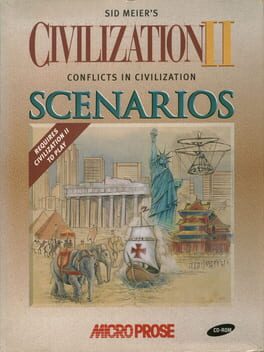
Civilization II had two expansion packs that gradually introduced new features. The first, Conflicts in Civilization, added 20 new scenarios: 12 created by the developers and eight fan-made "Best of the Net" scenarios. It also introduced an advanced macro language with enhanced programming capabilities for scenario writing, although most people found these features unnecessary; a bug in this expansion disabled the Encarta-style Civilopedia. The second expansion pack, Civ II: Fantastic Worlds, offered new scenarios with unique themes, including a Mars colonization scenario and a fantasy-themed Midgard scenario featuring civilizations such as Elves, Goblins and Mermaids. It also included scenarios inspired by other MicroProse games such as X-COM, Master of Orion (1993) and Master of Magic (1994) Jr. Fantastic Worlds also had a new scenario editor that let players customize unit stats, city improvements, terrain and technologies, and create event triggers and other game developments.
- #022
Scientific research is central to Civilization II. Players begin with primitive technology and limited options. As they advance from the ancient era to the modern era, progress in science and society unlocks new abilities and strategic advantages.
- #023
Civilization II: Test of Time (1999), released in 1999 after Alpha Centauri (1999), is a remake with a refreshed color palette and user interface. It introduced new elements such as animated units, a playable Alpha Centauri faction and additional campaign modes.
- #024
Civilization II was re-released on December 9, 1998 as Civilization II: Multiplayer Gold Edition. This version combined the previous two expansion packs and introduced multiplayer options, among other improvements. However, unlike the original Civilization II, which supported Windows 3.1, it required Windows 95 or later. Multiplayer Gold Edition was later included in the Civilization Chronicles box set released in 2006.
Sources & editorial notes
Sources for the entries on this page
- IMDb IMDb
Information from external sources is independently selected, consolidated and edited by Arka Evren. Sources are listed for verification and further reading. Encyclopedia text is used under its licence (CC BY-SA). How we work