GAME · 2016
Doom
- Developer
- Bethesda Game Studios
- Publisher
- Bethesda Softworks
- Platforms
- Microsoft Windows
22 archived facts 4 topics 1 source Last reviewed Sep 2026
15 Facts From the Development of Doom
- #001
After Doom 3 shipped in 2004, id Software started work on a new property called Rage and tried without success to hand the Doom franchise to another studio, as it had done with Wolfenstein.
- #002
id Software started developing Doom 4 in 2007, though the studio had only 19 employees when Doom 3 launched and found it hard to work on Rage and Doom 4 at the same time.
- #003
The existence of Doom 4 became public on May 7, 2008, when job postings for a project with that title appeared on id Software's website.
- #004
ZeniMax Media, the parent company of Bethesda Softworks, bought id Software on June 23, 2009, and said Bethesda would publish id's future titles; id creative director Tim Willits said the deal let the company run two teams with projects in parallel, while id CEO Todd Hollenshead stated in April 2009 that Doom 4 was neither a sequel to Doom 3 nor a reboot.
- #005
Doom 4, the earlier version of the 2016 game Doom, was to have its story written by British science fiction author Graham Joyce.
- #006
The planned Doom 4 was to take place on Earth and was described as a new interpretation of Doom II, subtitled Hell on Earth.
- #008
Doom 4 drew on the Call of Duty first-person shooter series, with passive health regeneration, cover-based protection for the player character and scripted cinematics; developers and fans mocked the project as "Call of Doom". After Rage arrived in 2011 to mixed reception, id and Bethesda judged Doom 4 out of step with the original games and restarted its development.
- #009
Bethesda unveiled a teaser trailer for Doom at E3 2014 on June 10, 2014.
- #010
Stratton, Martin, and id used the original Doom games as a template for Doom's artwork and gameplay, abandoning the slower pace and survival horror themes of Doom 3; Stratton emphasized id's desire to remain faithful to the legacy and tone of the original Doom, and Willits said Doom was built on the emotional core of the original game.
- #011
Development of Doom centered on refining its combat, which was described as "push forward combat".
- #012
The Glory Kill mechanic originated as a "sync melee" system intended for Doom 4 and was developed early, becoming central to Doom's combat design.
- #013
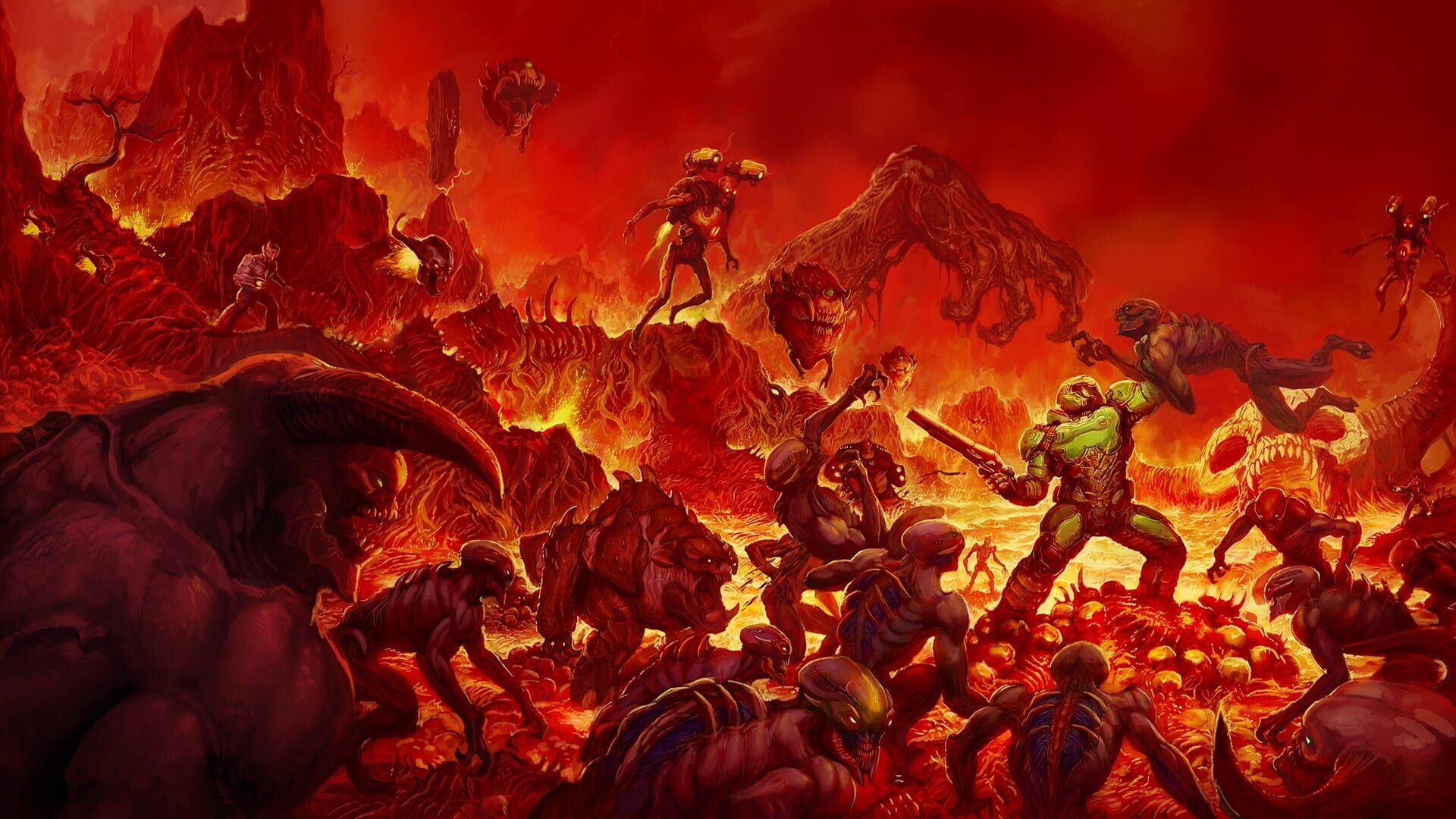
Enemies in Doom were designed to visually resemble those of the original Doom games and to encourage the player to stay mobile.
- #014
Doom's story was written by Adam Gascoine, and director Martin told Noclip that the narrative was among the last parts of the game to be added.
- #017
Doom's SnapMap mode was developed together with Escalation Studios.
- #018
Post-release patches for Doom added a photo mode, an option to hold weapons in the center of the screen as in the original games, and support for the Vulkan API; the Vulkan patch was expected to make playable frame rates possible on older hardware, and benchmarks showed frame-rate improvements of up to 66% on AMD graphics cards with only minor changes for Nvidia cards.
Sources & editorial notes
Sources for the entries on this page
- Wikipedia Doom (2016 video game) — Wikipedia
Information from external sources is independently selected, consolidated and edited by Arka Evren. Sources are listed for verification and further reading. Encyclopedia text is used under its licence (CC BY-SA). How we work