GAME · 2020
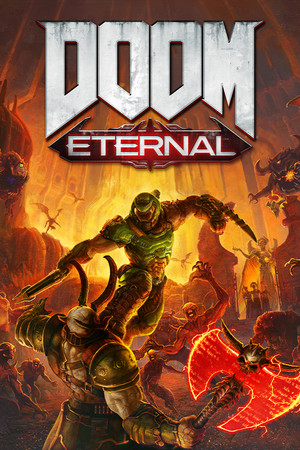
Doom Eternal
- Publisher
- Bethesda Softworks
- Platforms
- Microsoft Windows, Xbox Series X and Series S
36 archived facts 7 topics 1 source Last reviewed Sep 2026
24 Facts From the Development of Doom Eternal
- #001
Doom Eternal was developed by id Software, with pre-production beginning in 2016 and early production starting in 2017.
- #002
After the positive reception of Doom (2016), id Software aimed to build on that momentum with a sequel while addressing the earlier game's shortcomings.
- #003
During the marketing cycle for Doom Eternal, id Software frequently compared the game to Evil Dead II, describing it as a significant expansion on the foundation of its predecessor.
- #004
Hugo Martin returned as game director and Marty Stratton as executive producer for Doom Eternal, whose team was about 35% to 45% larger than that of its predecessor.
- #005
During development of Doom Eternal, the team found that the newly added movement made the experience too easy and unengaging, so they made enemy encounters more challenging and pushed players to play more aggressively.
- #008
Unlike the 2016 game, Doom Eternal keeps the experience consistent across difficulties by having enemies attack more often and deal greater damage rather than changing demon behavior.
- #009
Doom Eternal's developers addressed complaints that the 2016 game grew repetitive in its third act by adding more tools, doubling the enemy types and setting levels in more diverse locations.
- #010
Because players tended to rely on the shotgun alone, the Doom Eternal team adjusted the arsenal to encourage use of other weapons, giving each weapon less ammo than in Doom 2016 and reducing arena pickups so the chainsaw is needed more often.
- #013
According to Martin, Doom Eternal's levels are significantly larger than before and each follows a three-act structure, with something cool at the start, something new in the middle and something fantastic at the end.
- #014
The team behind Doom Eternal cited Doom 64's levels as their inspiration, and to keep the stretches between combat arenas engaging they added more enemy encounters and exploration puzzles, which were kept straightforward to preserve a brisk pace.
- #015
Doom Eternal introduced platforming elements, with traversal mechanics rolled out gradually across the campaign so players would not feel overwhelmed; Martin called these "skill-based" puzzles and compared them to the mechanics of the Tony Hawk's skateboarding series.
- #016
During development of Doom Eternal, the meat hook initially pulled enemies toward the player, but this was reversed so it pulled the player toward enemies to maximize mobility; a proposal to let players hook onto any surface was rejected because the team felt it would trivialize other traversal mechanics such as double-jumping and dashing.
- #017
Doom Eternal's developers set out to build a "Doom universe," broadening the lore and setting that its predecessor had introduced.
- #021
Doom Eternal's multiplayer was developed internally by id Software, unlike the multiplayer of Doom 2016, which had been outsourced to Certain Affinity.
- #022
id Software developed Doom Eternal's multiplayer itself because it wanted to bring the campaign's core gameplay loop into a more social setting.
- #023
The team created Battlemode for Doom Eternal, a mode in which players fight against player-controlled demons.
- #024
An Invasion mode for Doom Eternal, in which a player controlling a demon could enter another player's single-player campaign and hunt them down, was initially planned but scrapped.
- #025
Mick Gordon returned to compose the soundtrack for Doom Eternal.
- #028
Doom Eternal's soundtrack was made available for download on April 19, 2020, to those who purchased the collector's edition.
- #032
Gordon agreed to the collaboration and sent Mossholder roughly 12 finished tracks; Mossholder then mixed and edited the remaining songs from in-game assets, which were more heavily compressed to offset other in-game audio.
- #033
Stratton later wrote that although id had planned to keep working with Gordon, the studio would use a different composer going forward; Andrew Hulshult and David Levy composed the music for The Ancient Gods expansion campaign.
- #034
In response to Stratton's post, Gordon gave his own account of the history of the in-game score and the original soundtrack for Doom Eternal, and of how he repeatedly tried to engage id to resolve problems before and after the OST's release.
- #035
Gordon alleged that no contract for a Doom Eternal soundtrack album existed until two days before the game's release.
- #036
Bethesda released a statement backing Stratton, Mossholder and the id Software team, saying it had evidence to rebut Gordon's claims and implying that his statement incited harassment and violence.
Sources & editorial notes
Sources for the entries on this page
- Wikipedia Doom Eternal — Wikipedia
Information from external sources is independently selected, consolidated and edited by Arka Evren. Sources are listed for verification and further reading. Encyclopedia text is used under its licence (CC BY-SA). How we work