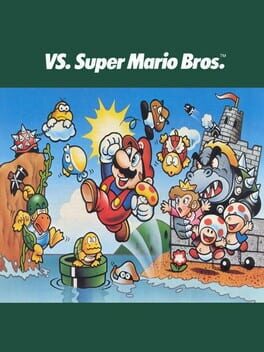
GAME · 1985
Super Mario Bros.
- Developer
- Nintendo Entertainment Analysis & Development
- Publisher
- Nintendo
- Platforms
- Nintendo Entertainment System, arcade video game, Famicom Disk System, Game Boy Color, Nintendo GameCube
30 archived facts 5 topics 1 source Last reviewed Sep 2026
All facts (30)
- #001
Toshihiko Nakago of SRD largely programmed Super Mario Bros.; SRD became a longtime Nintendo partner and later a wholly owned subsidiary.
- #002
For Super Mario Bros., Shigeru Miyamoto wanted a more colorful "athletic game" with a scrolling screen and larger characters.
- #003
Shigeru Miyamoto used the term "athletic games" for what later became known as platform games; the 1983 Mario Bros. is an arcade platformer set on a single screen with a black background.
- #004
Super Mario Bros. was the culmination of its team's technical knowledge gained from the 1984 games Devil World, Excitebike, and Kung Fu, and of their wish to push further the platforming "athletic game" genre they had already created.
- #005
While working on Excitebike and Kung Fu, Miyamoto conceived a platformer in which the player would "strategize while scrolling sideways" across long distances, with aboveground and underground levels and colorful rather than black backgrounds.
- #006
Super Mario Bros. ran on the fast scrolling engine Miyamoto's team had first built for Excitebike, which let Mario accelerate smoothly from a walk to a run instead of moving at a constant speed as in earlier platformers.
- #007
Pac-Man creator Toru Iwatani has said that Miyamoto told him personally that Pac-Land, an earlier scrolling platformer using Iwatani's character, influenced Super Mario Bros.
- #008
Super Mario Bros. and The Legend of Zelda shared some similar elements; the fire bars seen in the Mario castle levels originated as objects in Zelda.
- #009
Nintendo aimed for simplicity so that a new game would be ready for the end-of-year shopping season, and in December 1984 the team built a prototype in which the player moved a 16x32-pixel rectangle around a single screen.
- #010
After seeing the sales figures of Mario Bros., Tezuka proposed using Mario, and in February 1985 the team settled on the name Super Mario Bros. once the Super Mushroom power-up had been implemented.
- #011
Super Mario Bros. was first conceived with Mario or Luigi flying a rocket ship and firing at enemies, an idea that went unused; the sky-based bonus stages in the finished game survive as a remnant of it.
- #012
Developers of previous hit games joined the Super Mario Bros. team in February 1985, bringing many special programming techniques, features, and design refinements.
- #013
Super Mario Bros. incorporated design elements from earlier games, including Donkey Kong's slopes, lifts, conveyor belts, and ladders; Donkey Kong Jr.'s ropes, logs and springs; and Mario Bros.'s enemy attacks, enemy movement, frozen platforms and POW Blocks.
- #014
The development team for Super Mario Bros. initially designed the levels around a small Mario and planned to scale up his sprite for the final release, but ultimately decided it would be more engaging to let players change the character's size dynamically through a power-up.
- #015
The use of mushrooms to change Mario's size in Super Mario Bros. was influenced by Japanese folktales about people who wander into forests and eat magical mushrooms, which also led to the game world being named the "Mushroom Kingdom".
- #016
Miyamoto explained that the team had Mario begin levels as small Mario so that obtaining a mushroom would be more gratifying, saying that after making a prototype of the big Mario they did not feel he was big enough and came up with the idea of showing the smaller Mario first so players could see and feel that he was bigger.
- #017
Miyamoto denied rumors that a small Mario was implemented in Super Mario Bros. after a bug caused only his upper half to appear, and said the shell-kicking 1-up trick was carefully tested but that people turned out to be much better at pulling it off for long stretches than the team had thought.
- #018
Super Mario Bros. was developed for a cartridge holding 256 kilobits (32KiB) of program code and data plus 64 kilobits (8KiB) of sprite and background graphics.
- #019
Because of the tight storage limits on Super Mario Bros., the designers treated their hunt for space-saving tricks as a fun television game show contest. Clouds and bushes in the backgrounds, for example, reuse the same sprite recolored, and background tiles come from an automatic algorithm.
- #020
Around July 1985, Super Mario Bros. had its development time extended to 3–4 weeks to adjust and fix memory bugs. Sound effects were recycled as well: the damage sound matches the pipe-entry sound, and jumping on an enemy uses the same sound as each swimming stroke.
- #021
After finishing Super Mario Bros., the team wanted a simple, easy-to-defeat opening enemy instead of Koopa Troopas, so with memory nearly exhausted they built the Goombas from a single static image flipped back and forth. Once the music was added, about 20 bytes of cartridge space remained, and Miyamoto used it for a crown sprite shown in the life counter as a reward for reaching at least 10 lives; the game went to manufacturing in August 1985.
- #022
The opening section of Super Mario Bros. was designed so that players would be forced to explore the game's mechanics in order to advance.
- #023
The first level of Super Mario Bros. introduces the game's hazards through repetition, iteration and escalation rather than by confronting the newly oriented player with obstacles.
- #024
The first level of Super Mario Bros. was finished around July 1985, and development time was extended by 3–4 weeks to complete the rest of the game.
- #025
In an interview with Eurogamer, Miyamoto said he created World 1-1 so a player could gradually and naturally understand what they were doing and quickly grasp how the game works.
- #026
Nintendo sound designer Koji Kondo created the six-track score and all sound effects for Super Mario Bros.
- #027
When Koji Kondo composed the music for Super Mario Bros., video game music was largely intended to attract attention rather than to enhance or conform to the game.
- #028
Koji Kondo's work on Super Mario Bros. was one of the major forces in music becoming an integral and participatory part of video games.
- #029
Koji Kondo set two goals for his Super Mario Bros. music: to convey an unambiguous sonic image of the game world and to enhance the emotional and physical experience of the gamer.
- #030
The music of Super Mario Bros. was further revised in response to feedback and expectations from Nintendo's playtesters.
Sources & editorial notes
Sources for the entries on this page
- Wikipedia Super Mario Bros. — Wikipedia
Information from external sources is independently selected, consolidated and edited by Arka Evren. Sources are listed for verification and further reading. Encyclopedia text is used under its licence (CC BY-SA). How we work