GAME · 2007
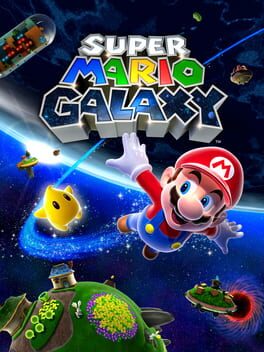
Super Mario Galaxy
- Developer
- Nintendo Entertainment Analysis & Development
- Publisher
- Nintendo
- Platforms
- Wii, Wii U
28 archived facts 2 topics 1 source Last reviewed Sep 2026
All facts (28)
- #001
The gameplay principles of Super Mario Galaxy grew out of ideas first explored in Super Mario 128, a technology demonstration shown at Nintendo Space World in 2000 to display the GameCube's processing power.
- #002
Yoshiaki Koizumi, who directed the Super Mario 128 demonstration and would later direct Super Mario Galaxy, wanted its spherical-based platforms used in a future game but believed technical limits made this impossible at the time.
- #003
In mid-2003, before the newly formed Nintendo EAD Tokyo began Donkey Kong Jungle Beat, a staff member proposed pooling the team's skills on the next Super Mario game, and Koizumi agreed after their shared experience on Jungle Beat; Miyamoto then pushed for the spherical platform concept to be realised on a large-scale Mario game once Jungle Beat was finished in late 2004.
- #004
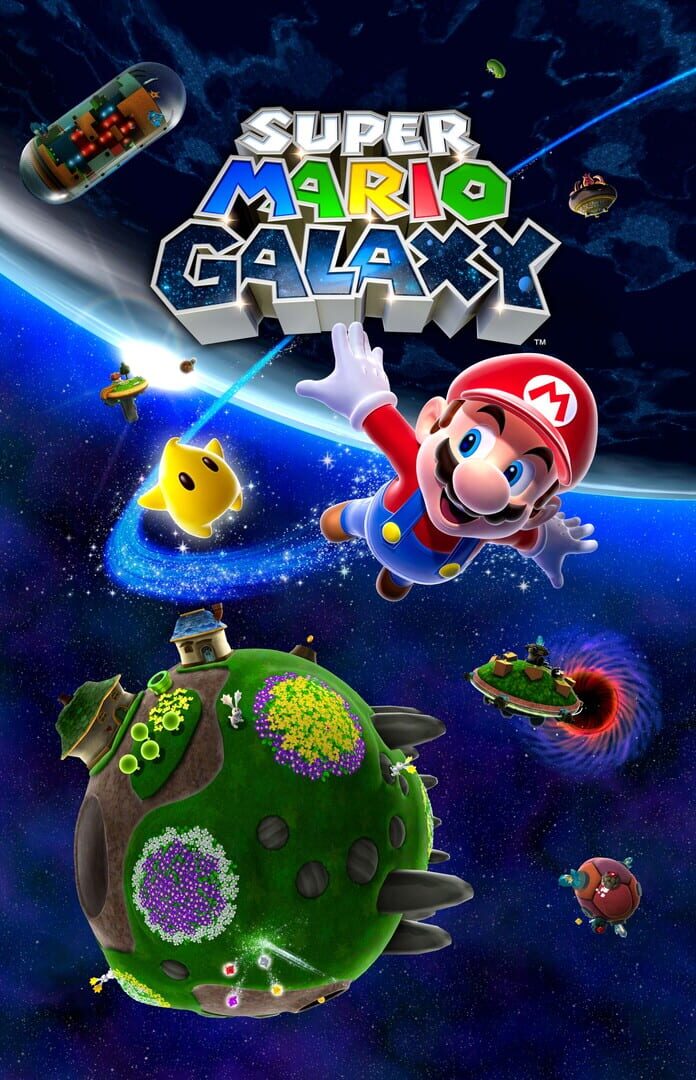
Super Mario Galaxy was conceived as a 3D action platformer in which Mario runs around spherical worlds that each have their own center of gravity, preventing him from falling off the edge and allowing him to return to his starting position by continuing in one direction.
- #005
Super Mario Galaxy producer and programmer Takeo Shimizu noted that running is the most basic action in a 3D action game and concluded that spinning, rather than jumping, was the easiest way to attack.
- #006
The spin attack in Super Mario Galaxy was first planned for the GameCube controller's analogue stick, then activated by rotating the Nunchuk's control stick, and finally changed to a shake of the Wii Remote once motion sensing was confirmed for that controller.
- #007
During early development of Super Mario Galaxy, the team aimed for the game to be enjoyed by players aged 5 to 95 and took steps so that players could adjust to it without difficulty.
- #008
Koichi Hayashida, a co-designer of Super Mario Galaxy, was initially sceptical about putting a spherical playing field into a jump-based platform game, calling it "a bad match".
- #009
Shimizu also reacted negatively to the spherical platform concept, mainly because he believed it could not be achieved for technical reasons, and he "felt a sense of danger" once the plan was approved.
- #010
After starting to debug Super Mario Galaxy, Shimizu found the experience "totally fresh" and felt he was "playing a game like nothing that's come before it".
- #011
Level designer Futoshi Shirai had a positive impression of the new gameplay elements, liked the idea of running on different planetoids and designed planets shaped like ice cream and apples.
- #012
According to Hayashida, the idea to include transformations in Super Mario Galaxy came from Koizumi. A female staff member working on the game responded to Koizumi's question about what Mario should transform into by writing a note saying "I want a Bee Mario".
- #013
Iwata noted that Mario's Bee Suit was popular with women, and said the character's other suits were designed to add variation to the gameplay. Staff members enjoyed the freedom the game offered, particularly Mario's transforming abilities.
- #014
Shirai stated that the Super Mario Galaxy development team always discussed their ideas together, working out how to incorporate an idea into the game and make it more entertaining. Iwata concluded that setting the game in space was advantageous because it was flexible enough to accommodate a wide range of ideas.
- #015
During development, Miyamoto regarded Super Mario Galaxy as a "true" successor to Super Mario 64, and it surpassed the indefinitely-halted Super Mario 128 project.
- #016
According to Shimizu, Super Mario Galaxy's ulterior motive was to have everybody gather around the TV, since he felt a Mario game was not necessarily something to enjoy alone; the game supports six save files so one player can view another's progress and compare it with their own.
- #017
During development of Super Mario Galaxy, Mahito Yokota, who led the game's musical direction, initially wanted a Latin American style and composed 28 tracks in that style.
- #018
For Super Mario Galaxy's theme, Mahito Yokota combined Latin American instruments with a synthesiser to imitate sounds heard in old science fiction films.
- #019
Super Mario Galaxy director and designer Yoshiaki Koizumi approved Mahito Yokota's composition, but sound supervisor Koji Kondo rejected it as "no good".
- #020
When Mahito Yokota asked why his music was rejected, Koji Kondo told him to discard any image of Mario as cute, implied the character was "cool" and told him to try again; Yokota was so angered that he nearly resigned.
- #021
According to Yokota, he believed Mario was suited for children and therefore created "cute" music aimed at that audience. After Yokota's music was rejected, Koizumi later told him, "It wasn't so bad."
- #022
Three months after his music was rejected, Yokota presented Miyamoto with three musical styles: an orchestral piece, a pop piece, and a mix of orchestral and pop. Miyamoto selected the orchestral one because it sounded the most "space-like".
- #023
Yokota stated that Miyamoto chose the orchestral piece without knowing that Kondo had actually written it. In a retrospective interview, Satoru Iwata said Miyamoto sought a "space-like" sound to express the game, in contrast to the tropical sounds of Super Mario Bros.
- #024
Super Mario Galaxy originally made heavy use of the Wii Remote speaker for sound effects, but sound director Masafumi Kawamura judged them redundant alongside the television's audio. Kawamura limited Wii Remote effects to those triggered by Mario's actions, such as hitting an enemy, feeling this better immersed the player.
- #025
Super Mario Galaxy's soundtrack includes 28 orchestral songs performed by a 50-person symphony orchestra.
- #026
Yokota was initially unsure whether orchestral music would suit the rhythm of a Mario game, but felt it would make the game's scale seem more epic.
- #027
Kondo believed that using orchestral music would obligate the player to play the game in time to the music.
- #028
To synchronise the soundtrack with gameplay, Kawamura applied techniques he had used for sound effects in The Legend of Zelda: The Wind Waker and Donkey Kong Jungle Beat, synchronising MIDI data with streaming data so sound effects played alongside background music; the audio team asked the orchestra to perform at different tempos set with a metronome.
Sources & editorial notes
Sources for the entries on this page
- Wikipedia Super Mario Galaxy — Wikipedia
Information from external sources is independently selected, consolidated and edited by Arka Evren. Sources are listed for verification and further reading. Encyclopedia text is used under its licence (CC BY-SA). How we work