FILM · 1998
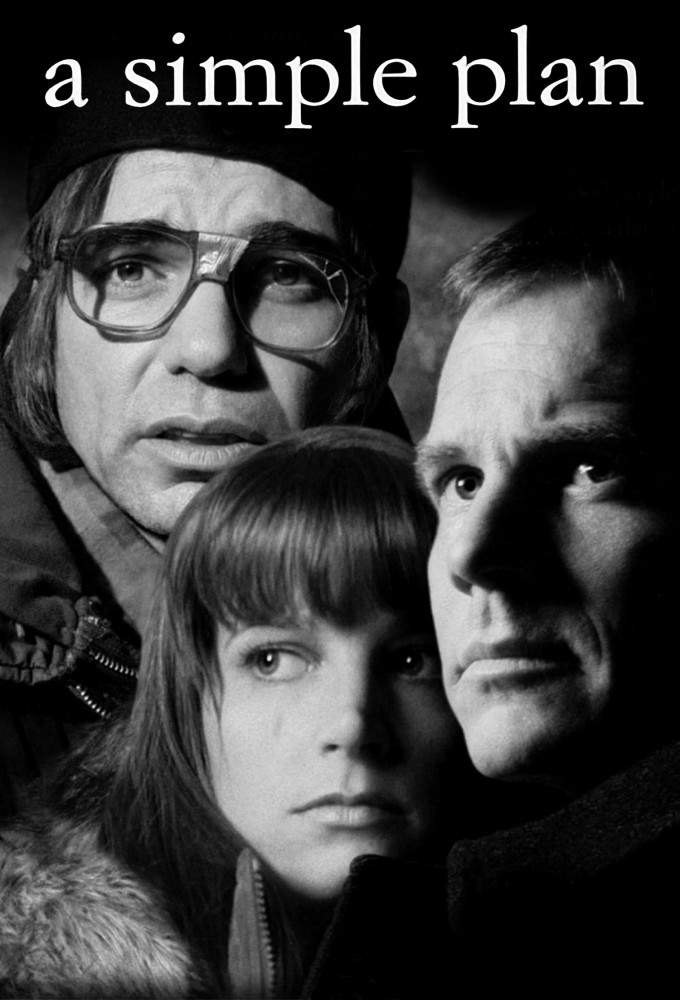
A Simple Plan
20 archived facts 7 topics 1 source Last reviewed Oct 2026

All facts (20)
- #001
Appearing on National Public Radio's "Fresh Air" in 2002, Bill Paxton told interviewer Terry Gross that he remained unaware his father was in the cast until he arrived at a production office at the start of shooting and saw John Paxton's headshot on the wall among those of the other actors. John Paxton had written a letter to director Sam Raimi expressing his admiration for his films and asking about small roles that might suit him. Raimi gave him a choice and cast him as Mr. Schmitt. The elder Paxton's film career included the 1992 independent feature One False Move, which also starred his son and was the project that first raised the younger Paxton's profile as a dramatic actor.
- #002
A scene featuring Billy Bob Thornton and Bill Paxton disappeared in transit in January 1998 while the production was flying Northwest Airlines from Minnesota to Los Angeles. The lost footage had been shot in Minnesota. The production's insurance coverage allowed the filmmakers to reshoot the missing scene. Principal photography took place largely in Delano, Minnesota, where harsh winter conditions were central to the story's snow-covered setting, until a sudden warm spell forced part of the production to move to Ashland, Wisconsin, to find sufficient snow cover.
- #003
Location scouts chose Delano, Minnesota, for the bar sequences. The crew converted an empty building into a fictional establishment called Tippy's Town Tavern because the only operating bar in the community could not meet their spatial requirements. The chosen structure had previously operated as a tavern before its former owners converted the space into a private residence with an upstairs apartment. During the winter shoot in early 1998, the building had no running water, forcing the art department to wash glassware at the neighboring business.
- #004
Scott B. Smith initially developed his story as a screenplay but decided to turn it into a novel before adapting it back into a script. The novel was published in 1993 and was later adapted for the screen. After Smith published a short story in a national magazine, the publication's fiction editor learned of his then-unpublished novel, read it and passed the manuscript to an agent. Mike Nichols spent a weekend reading the book before closing a rights deal the following Monday morning, buying the property for Icarus Productions for $250,000 against $750,000. The original screenplay Smith wrote for Nichols ran 256 pages, equivalent to a four-and-a-half-hour film, and Smith kept Nichols's suggestion to move the story from Ohio to Minnesota.
- #005
Billy Bob Thornton joined the production during the period when John Boorman was attached to direct. Boorman cast the actor after seeing his performance in Sling Blade (1996).
- #006
A black-and-white photograph of Bill Bixby and Lou Ferrigno from The Incredible Hulk (1977) is visible on the refrigerator in the house shared by Hank and Sarah. The set-dressing choice reflects the care the production took with detail in establishing the Mitchell family's modest home life.
- #007
ZZ Top drummer Frank Beard came in for a small role in the funeral scene. In the finished film he is barely visible, positioned behind the funeral director next to a white carnation. Beard was born on June 11, 1949, in Frankston, Texas, and is, ironically, the only member of ZZ Top without the band's signature long beard. After the shoot, originally planned for Delano, Minnesota, had to be relocated temporarily to find enough snow, the production filmed many exterior scenes in Ashland and Saxon, Wisconsin.
- #008
Wentworth Aircraft supplied the wreckage of the crashed plane from a salvage yard in Minneapolis. The production team bought a Piper PA-23 Apache fuselage for the shoot and moved it to a wooded area near Ashland, Wisconsin. Crew members positioned the aircraft to simulate a crash site that had lain hidden for months. Production designer Patrizia von Brandenstein oversaw the weather conditions and placement to make the fuselage appear naturally integrated into the snowy landscape. Over a shooting schedule lasting several weeks, the site required constant maintenance to preserve the visual appearance of the snow around the wreckage.
- #009
Between 1994 and 1996, Ben Stiller was attached to direct the project, with Nicolas Cage in the lead role. Cage's rising salary demands began to strain the production budget and led Stiller to leave the project. John Dahl then took over directing duties and, before departing, passed the job to John Boorman, who wanted to cast Natalie Portman as Sarah. Emma Thompson also held the role of Sarah during development before it ultimately fell through. Sam Raimi eventually replaced Boorman as director, and production was to begin three years after producer Mike Nichols bought the rights for $250,000 against $750,000. During his involvement with the project, Nichols had planned to cast John Cusack as Hank. Scott Smith's novel served as the source material, and Smith adapted his own book into a screenplay during the long development cycle.
- #010
The adaptation was first set up at Savoy Pictures, where it remained in pre-production as the company withdrew from filmmaking and began selling off unfinished projects. Paramount then took on the film for production and distribution, while Savoy retained a co-production credit on the completed film. [UNVERIFIED] The finished film appears to be Savoy's last feature.
- #011
Laura Dern and Embeth Davidtz contended for the role that Bridget Fonda accepted. The character serves as the story's ethical center and the main voice of warning after her husband and his brother discover a downed plane full of stolen money. Over the four years of development before principal photography in the winter of 1998, numerous changes occurred in the cast and in directing attachments.
- #012
Brad Pitt and Juliette Lewis left the project due to scheduling conflicts. The draft presented states that these two actors departed the lead roles during the long development process. However, existing production records show that the project moved to Paramount after Savoy Pictures closed in November 1997, where John Boorman took over directing, but scheduling conflicts led to Raimi replacing him. Producer Scott Rudin hired Boorman, and Boorman subsequently cast Bill Paxton and Billy Bob Thornton in the lead roles of Hank and Jacob Mitchell. Development began before the novel's publication in 1993, when Mike Nichols bought the film rights and the project reached Savoy Pictures, entering development hell as Ben Stiller and John Dahl turned down directing opportunities.
- #013
In a late scene at the city library where she works, Sarah Mitchell reshelves a first edition of Stephen King's novel Christine. The deliberate placement serves as a subtle nod to director Sam Raimi's debt to the horror author's influence on American genre storytelling. Bridget Fonda's character returns to her routine job in the final act while the consequences of the discovered plane money continue to upend the lives of the men around her. The visual detail appears only briefly but rewards viewers familiar with King's 1983 tale of a malevolently possessed car. Raimi's background in horror filmmaking makes the Easter egg a natural extension of his directorial sensibility, even in this grim neo-noir crime narrative.
- #014
Nicole Kidman and Anne Heche were considered for the role of Sarah Mitchell during the long casting process [UNVERIFIED]. The character serves as the wife of protagonist Hank Mitchell and acts as a key moral turning point in the narrative when she learns of the discovered money. Bridget Fonda ultimately accepted the role and joined Bill Paxton and Billy Bob Thornton in the main cast. The part of Sarah passed through multiple potential actresses over the four-year development period, with each successive director attached to the project developing different casting preferences before scheduling conflicts and creative differences forced them to leave.
- #015
Gary Cole, playing the FBI agent impersonator Vernon Bukovsky, carries a SIG-Sauer P226. The weapon choice broadly fits the period, since federal inventory records from the following few years show FBI inventories including SIG Sauer P226 pistols and Glock 22 pistols, which makes the stronger claim that the P226 alone was the Bureau's standard sidearm at the time of the film's production overly absolute.
- #016
The first announcement of the film adaptation coincided with the publication of Scott B. Smith's source novel in 1993. Mike Nichols acquired the rights for Icarus Productions, paying $250,000 against $750,000 to secure the property. The project was one of a number Nichols announced at the time, none of which he ultimately directed himself. Smith delivered to Nichols a 256-page first screenplay draft that would have produced a four-and-a-half-hour film, before the project passed through multiple directors and studios over the following four years.
- #017
The clock visible on the wall of Carl's office as he and Hank wait for Neil, roughly an hour and forty-five minutes into the film, bears the name of Amie McCarthy Winn, the production's art department property master. The set-dressing details reflect the production's practice of including locally sourced elements tied to the crew in the Minnesota and Wisconsin locations.
- #018
Billy Bob Thornton and Bill Paxton had previously appeared together in One False Move (1991) and Tombstone (1993). Their earlier collaboration in One False Move (1991) paired Thornton as a violent criminal and Paxton as a small-town police chief, while Tombstone (1993) placed both actors within a large Western community. The roles of Jacob and Hank Mitchell continued a screen relationship built around morally tense crime and frontier settings before this film turned that dynamic into a brotherly one.
- #019
In his 1993 source novel, Scott B. Smith originally described the character Jacob Mitchell as overweight. After the production cast the slim Billy Bob Thornton in the role, the author omitted that physical description when adapting his own book into a screenplay. Producer Scott Rudin, while expanding Jacob's presence in the narrative, requested script revisions that streamlined the overall story to focus the film on the shifting relationship between the two brothers, altering the character's original arc in the novel. Thornton was nominated for the Academy Award for Best Supporting Actor for his performance.
- #020
Italy's national censorship board issued visa number 93545 for the film on May 21, 1999. Distributors in the region released it in Italian cinemas the following month, on June 18, under the alternative title Soldi sporchi, meaning "Dirty Money." The late-spring opening formed part of a staggered international rollout that followed the film's domestic theatrical release in the United States in the winter of 1998.
Sources & editorial notes
Reference databases
Sources for the entries on this page
- IMDb IMDb kaydı
Information from external sources is independently selected, consolidated and edited by Arka Evren. Sources are listed for verification and further reading. Encyclopedia text is used under its licence (CC BY-SA). How we work