FILM · 1977 · USA
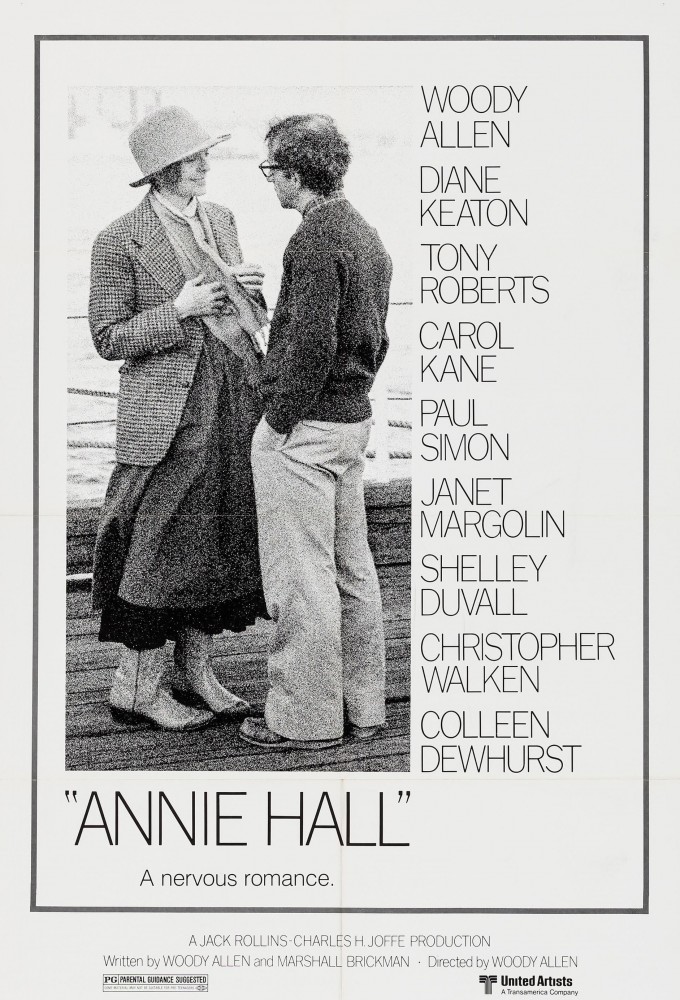
Annie Hall
- Directed by
- Woody Allen
- Runtime
- 93 min
- Studio
- Jack Rollins & Charles H. Joffe Productions, United Artists
24 archived facts 6 topics 1 source Last reviewed Oct 2026
New York comedian Alvy Singer falls in love with the ditsy Annie Hall.
Summary: TMDB

All facts (24)
- #001
The split-screen scene showing Alvy and Annie in their respective psychiatrists' offices was actually filmed on the same set at the same time, with a wall between the two sides.
- #002
Near the end of the film, Sigourney Weaver made her screen debut in a non-speaking part as Alvy's date.
- #003
Annie's clothes, which sparked a brief fashion craze, were Diane Keaton's own.
- #004
Alvy's (Woody Allen's) sneeze into a pile of cocaine was an unscripted accident. During a preview, the audience laughed so loudly that director Allen decided to keep it, and he later had to add footage to compensate for viewers who missed the next few jokes because they were still laughing.
- #005
With this film, Woody Allen became the first person to be nominated for an acting Oscar for a film for which he also won Best Director.
- #006
The house beneath the rollercoaster where Alvy grows up is actually the Kensington Hotel, located under the Thunderbolt rollercoaster at Coney Island in Brooklyn. Allen discovered it while scouting locations during filming. The hotel and the rollercoaster were demolished in 2000.
- #007
Woody Allen and Diane Keaton had trouble keeping a straight face while working together. One example of the uncontrollable laughter between them was the lobster dinner scene. It was the first scene shot for the film, and because their laughter was entirely spontaneous, neither Woody nor Diane had to act much for the scene.
- #008
Woody Allen initially conceived the film as a murder mystery with a romantic subplot. During script revisions, Allen decided to drop the murder plot, which he and Marshall Brickman later revived in Manhattan Murder Mystery (1993).
- #009
The first rough cut ran 2 hours and 20 minutes. Scenes later cut included: segments showing Alvy's former classmates in the present day; Alvy as a youth; a scene in a junk food restaurant (featuring Danny Aiello); extensive additional scenes with Carol Kane, Janet Margolin, Colleen Dewhurst and Shelley Duvall; and a fantasy segment in which the New York Knicks played against a team of five great philosophers at Madison Square Garden. Christopher Walken's driving scene was also cut, but it was restored a week before the film was completed. New material for the ending was shot three times, but most of it was discarded. The final montage was a late addition.
- #010
The exchange in which Alvy (Woody Allen) and Rob (Tony Roberts) constantly call each other "Max" comes from Allen and Roberts's real-life friendship, in which they habitually addressed each other as "Max." Early on, Allen asked Roberts not to call him "Woody" in public for fear that people would recognize him. Roberts then suggested calling him "Max," and Allen agreed. Roberts kept doing it in private as well, and Allen soon began doing the same.
- #011
At 93 minutes, it became the second-shortest film ever to win the Best Picture Oscar. The shortest Best Picture Oscar winner is Marty (1955) at 91 minutes.
- #012
The jokes Woody Allen told in front of audiences at the University of Wisconsin and on The Dick Cavett Show (1968) came from his stand-up comedy days.
- #013
Marshall McLuhan was not Allen's first choice. Federico Fellini and Luis Buñuel were asked first.
- #014
A scene cut from the film was a fantasy sequence in which Annie and Alvy visit hell. This scene was rewritten 20 years later for Allen's Deconstructing Harry (1997).
- #015
Woody Allen and Marshall Brickman developed most of the script while walking up and down the streets of New York City, particularly between Lexington and Madison Avenues.
- #016
Danny Elfman can be briefly seen passing by Alvy during the house party scene in Los Angeles.
- #017
For a scene set in Coney Island, Woody Allen once had a group of 200 extras walk around all morning, and that day he never found the inspiration to shoot.
- #018
Brooke Shields appeared in a deleted scene as the schoolgirl who has a crush on young Alvy.
- #019
During the classroom flashbacks, one of the teachers writes "Tuesday, December 1" on the blackboard. December 1 was Woody Allen's birthday, and Tuesday, December 1, 1942, was his seventh birthday, tying into the school setting.
- #020
Some younger viewers believe the appearances of Sigourney Weaver and Jeff Goldblum are small roles like Paul Simon's. Although Goldblum had appeared in about 7 feature films and 3 series, none of those roles were significant and he was relatively unknown at the time. For Weaver, this was her first appearance in a film, which is why she is listed at the end of the credits. However, two years after this film, she would win the lead role of Ellen Ripley in the hit film Alien (1979) and become a name everyone knew.
- #021
When Alvy and Robin are in bed together and a siren interrupts their lovemaking, she complains of a severe headache. Alvy worriedly asks her whether it is "bad," and Robin replies, "Like Oswald, in 'Ghosts'." 'Ghosts' was an 1881 Henrik Ibsen play whose main character, Oswald, has endured the effects of syphilis his whole life. Toward the end of the play, after a devastating revelation, Oswald suffers such a severe headache that he considers committing suicide with morphine.
- #022
Alvy jokes about the political magazines Dissent and Commentary merging to form "Dysentery." Dissent was a famous liberal magazine, while Commentary was a famous conservative one.
- #023
When Annie is late, the film that Alvy and Annie had initially planned to see is Ingmar Bergman's Face to Face (1976). Woody Allen always cited Bergman as one of his main sources of inspiration.
- #024
During the lobster-cooking scene, Annie runs and gets a camera to photograph Alvy as he struggles with the crustaceans. Later, when Alvy rushes to Annie's apartment to kill a spider, a series of photographs Annie took are on the wall in the background.
Continue through the archive

Sources & editorial notes
Reference databases
Sources for the entries on this page
- IMDb IMDb kaydı
Information from external sources is independently selected, consolidated and edited by Arka Evren. Sources are listed for verification and further reading. Encyclopedia text is used under its licence (CC BY-SA). How we work