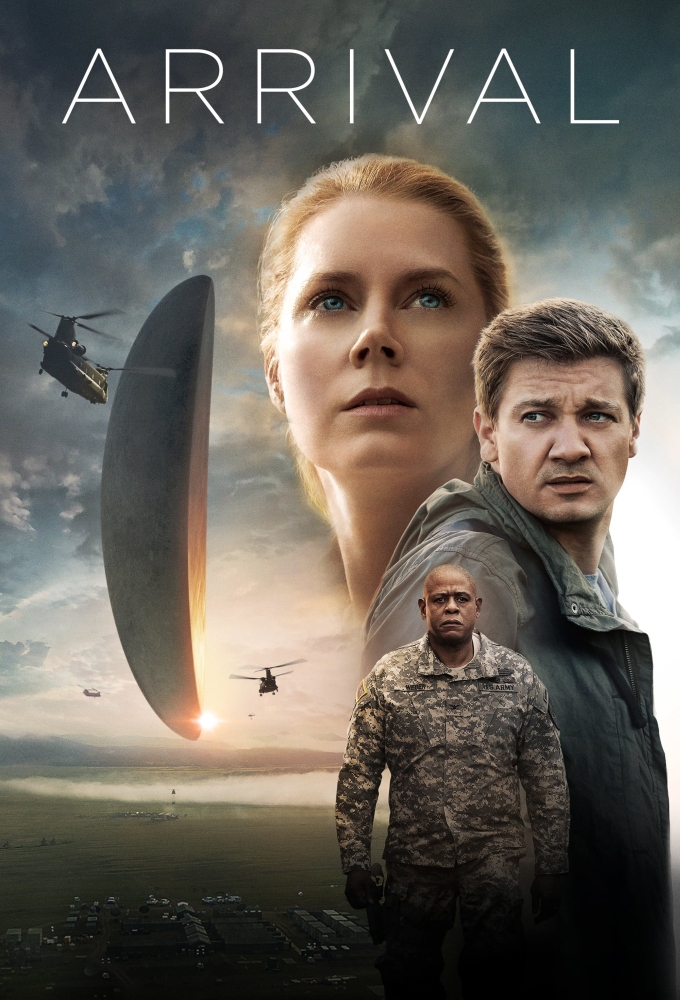
FILM · 2016 · USA
Arrival
- Directed by
- Denis Villeneuve
- Runtime
- 116 min
- Studio
- FilmNation Entertainment, Lava Bear Films, 21 Laps Entertainment
75 archived facts 7 topics 1 source Last reviewed Sep 2026
Taking place after alien crafts land around the world, an expert linguist is recruited by the military to determine whether they come in peace or are a threat.
Summary: TMDB

49 Interesting Facts About Arrival
- #001
Contains a major spoiler — show
Director Denis Villeneuve and screenwriter Eric Heisserer created a fully working, visual and alien language. Heisserer, Villeneuve and their teams managed to build a "logogram bible" containing more than a hundred different, fully functional logograms, seventy of which were actually used in the film.
- #002
Contains a major spoiler — show
The ink-colored circular alien language was created by Montreal artist Martine Bertrand. The artist's son is the one who drew Hannah's drawings.
- #003
Contains a major spoiler — show
Production designer Patrice Vermette explains why the ships never touch the ground: "Twelve identical ships will travel through the universe and end their journey hovering in a delicate balance twenty-eight feet above the ground, leaving the final help in making contact to the people of Earth."
- #004
Contains a major spoiler — show
Although the shape of the ship had been decided in advance, Denis Villeneuve had great difficulty imagining an interior that would allow people to move around easily in such a steep, vertical design. The later decision to turn gravity sideways offered a clear and practical solution.
- #010
Contains a major spoiler — show
While writing the story, Ted Chiang had in mind the great physicist Albert Einstein's words: "The distinction between the past, present and future is only a stubbornly persistent illusion."
- #013
Contains a major spoiler — show
The violin melody in the final sequence is palindromic.
- #014
Contains a major spoiler — show
The Heptapod craft owes its design to an asteroid named 15 Eunomia. During research, director Denis Villeneuve was struck by Eunomia's "insane shape like a strange egg" and thought this kind of pebble or oval shape would bring a perfect sense of threat and mystery to the spacecraft.
- #016
Director Denis Villeneuve and the writing team made an intense effort to ensure the film's scientific ideology was accurate. The renowned scientist and technology inventor Stephen Wolfram and his son Christopher Wolfram were consulted to make sure all the terminology, graphics and depictions were sound.
- #019
Contains a major spoiler — show
The dream scene in which Louise encounters a heptapod in her caravan was actually written and shot as an ordinary conversation involving Louise Banks, Ian Donnelly and Colonel Weber. It was cut for time until Denis Villeneuve and editor Joe Walker realized that this scene contained the only mention of the Sapir-Whorf hypothesis, which is crucial to the plot. While trying to cut the conversation to its shortest possible version, they created a strange, disjointed rhythm in the scene and decided it worked as a dream scene.
- #020
Contains a major spoiler — show
In a shot where the alien language is transformed, lines of programming language code are shown along with the animation. Stephen Wolfram notes in his blog that this code was written in the Wolfram Language and actually performs the transformation being described.
- #022
The classical piece featured in the film is Max Richter's "On the Nature of Daylight." Because it is prominently used throughout the film and was a pre-existing composition, Jóhann Jóhannsson's score, despite being widely admired, was ruled ineligible for the Oscar.
- #023
Contains a major spoiler — show
In the shot where Louise writes the big question on the whiteboard, the standard formula for entropy — the arrow of time — appears directly above the question.
- #025
The film's composer, Jóhann Jóhannsson, stated that he began recording the music before shooting on the film started, and that he and the director both liked to work on the music while the director's films were being made.
- #027
Contains a major spoiler — show
Thinking about the possibilities of building a story around a character who knows what will happen in the future and how that character acquired this knowledge, the story's author, Ted Chiang, initially considered creating a character who used drugs or practiced some form of meditation. However, none of these options struck him as particularly interesting. He then considered including language, and made the character a linguist.
- #028
Contains a major spoiler — show
In Ted Chiang's novella "Story of Your Life," nine "looking glasses" come to America, out of a worldwide total of 112. The film reduces this number and alters their dimensions to create a deeper impact.
- #029
Contains a major spoiler — show
In linear time, the film's final scene is Louise leaving the hospital room where Hannah died, and it is immediately followed by the first scene, in which Louise arrives at the university and finds only a few students in the lecture room.
- #030
Contains a major spoiler — show
The vision of the Heptapod in Louise's nightmare is the same as when she later approaches Costello while drifting on the alien side of the barrier.
- #031
Contains a major spoiler — show
The bird in the cage is used to test whether the alien's atmosphere is safe. Miners have done this for centuries; the phrase "canary in a cage" (also rendered as "canary in a coal mine" or "miner's canary") comes from this practice.
- #032
Contains a major spoiler — show
The hanging lamp in Louise's home is the same shape and color as the Heptapods' ships.
- #033
As stated in the film, the story Louise Banks tells — that Captain Cook named Australia's native animal "kangaroo" because of a misunderstanding — is not true. In fact, three scientific members of Cook's crew encountered the local Aboriginal people. The name "kangaroo" for the native people encountered there came from "gangaroo," the local Guugu-Yimidhirr name for a Grey Kangaroo, and entered the English language. Cook himself was not there and was in no way involved in the event, and no misunderstanding occurred. Louise was nevertheless comfortable telling this story because, as a teacher, she was familiar with the pedagogical technique jokingly known as "lying to children." Lying to children is an example of deliberately inventing a false story to convey a principle that is normally true and, though not true, is easier to communicate with a simple example. The aim is not to deceive but to meet the student at their own limited level of understanding about a complex subject.
- #035
Max Richter's "On the Nature of Daylight" is also used in the films Stranger Than Fiction (2006), Shutter Island (2010) and Disconnect (2012).
- #038
Contains a major spoiler — show
A tribute to Contact (1997) is made by using Hokkaido as a location, the place where the secret second machine was built in that film.
- #039
Contains a major spoiler — show
Of the twelve landings shown on television news, one takes place in the Indian Ocean, two in North America and one in Europe. The communications tent holds twelve large screen displays, one of them from Australia (to coordinate ships on its west coast), but only one screen for the United States and two from Europe. The reason is that one landing has occurred in Greenland, which politically remains part of Denmark.
- #040
Jóhann Jóhannsson also composed the scores for director Denis Villeneuve's films Prisoners (2013) and Sicario (2015), and was attached to Blade Runner 2049 (2017) before being replaced over creative differences.
- #041
Contains a major spoiler — show
When Colonel Weber (Forest Whitaker) enters Louise Banks's (Amy Adams) office, an inconspicuous picture of the famous linguist Noam Chomsky can be seen on the shelf directly above her laptop.
- #043
For "Story of Your Life," the story on which Arrival (2016) is based, Ted Chiang drew themes and inspiration from Fermat's Principle of Least Time and the variational principles of physics.
- #044
The campus scenes (in the classroom and walking through the cafeteria) were shot in the Decelles building of HEC Montréal.
- #045
Contains a major spoiler — show
The Sapir-Whorf Hypothesis, the film's central premise, is not portrayed accurately. Although language does influence how a person perceives events, this applies only to a person's first (native) language, not to other languages learned later, such as Heptapod.
- #046
Montana is also the place where first contact between humans and aliens occurs in the Star Trek storyline, as first shown in Star Trek: First Contact (1996).
- #048
Director Denis Villeneuve began working on Blade Runner 2049 (2017) as soon as he finished this film.
- #049
Contains a major spoiler — show
Amy Adams burst into tears after her first scene with Denis Villeneuve.
- #050
Contains a major spoiler — show
The Heptapods in this film bear an uncanny resemblance to an octopus-like creature seen in Martin Villeneuve's film Jouisseland (2002). That Denis Villeneuve's younger brother put forward this image about 14 years before Arrival (2016) led some viewers to speculate about the "precognition" at the heart of this film.
- #052
It is included in "1001 Movies You Must See Before You Die," edited by Steven Schneider.
- #053
Contains a major spoiler — show
The helmets worn are modified respiratory protection units manufactured by the Sundstrom company and widely used across industries.
- #054
Contains a major spoiler — show
In an interview with The New York Times, Amy Adams stated that she did not know Mandarin before making the film.
- #055
Filming began in mid-June 2015, immediately after Jeremy Renner finished shooting Captain America: Civil War (2016).
- #057
Early in the film, Dr. Ian Donnelly, who meets Louise, mentions the Sapir-Whorf hypothesis. Louise explains to him that the hypothesis (a real and debated one in linguistics) proposes that the language a person speaks shapes their experience of reality. This foreshadows one of the film's main threads: the aliens (and later Louise) are able to experience time non-linearly because they can fluently speak a language that conceptualizes time non-linearly.
- #060
Principal photography on the film began on 7 June 2015 in Montréal, Québec, Canada.
- #061
Contains a major spoiler — show
This is Michael Stuhlbarg's second alien film dealing with non-linear time. In Men in Black 3 (2012), he played Griffin, an alien able to see all the consequences of future events and how a present action could affect that outcome.
- #062
This is director Denis Villeneuve's first PG-13 feature film.
- #065
Contains a major spoiler — show
Three of the places where the alien spacecraft land on Earth are the US state of Montana, the United Kingdom and Russia. These are some of the places where the alien Tripods land in When the Tripods Came (1988), the prequel novel to John Christopher's "Tripods" trilogy.
- #067
Contains a major spoiler — show
(At about 1 hour 3 minutes) Something seen ONLY in the video conference involving Japan: the Japanese soldiers wear clothing with camouflage patterns (nearly) identical to JGSDF (Japan Ground Self-Defense Force) camouflage. The coordinates 42°58'23.1204"N 144°23'13.3764"E (alternative formats: 42.973089, 144.387049), shown as Hokkaido, Japan, accurately point to the center of the city of Kushiro, Hokkaido (address: 2-3 Miyamoto, Kushiro, Hokkaido). In fact, this location has been the site of Kushiro Prison since 1885, and it currently houses an apartment complex for government employees and their families.
- #069
Contains a major spoiler — show
Abbott and Costello are known as Gianni e Pinotto in the Italian-dubbed versions of their films.
- #070
It is one of Elle Fanning's favorite films.
- #071
This was the first of Forest Whitaker's two science fiction films released in 2016. The second was Rogue One: A Star Wars Story (2016).
- #072
Forest Whitaker and Amy Adams have both appeared in Star Wars spin-offs. Whitaker appeared in Rogue One: A Star Wars Story (2016); Adams will appear in Star Wars: Starfighter (2027).
- #073
Amy Adams and Jeremy Renner have both appeared in comic book films about alien invasions. Adams appeared in DC's Man of Steel (2013); Renner appeared in Marvel's The Avengers (2012).
- #074
This is the first film Forest Whitaker and Jeremy Renner have appeared in together since A Little Trip to Heaven (2005).
- #075
Contains a major spoiler — show
Hannah's name is a palindrome (it reads the same forwards and backwards). This is also true of the surname of one of the film's stars, Jeremy Renner.
Sources & editorial notes
Reference databases
Sources for the entries on this page
- IMDb IMDb
Information from external sources is independently selected, consolidated and edited by Arka Evren. Sources are listed for verification and further reading. Encyclopedia text is used under its licence (CC BY-SA). How we work