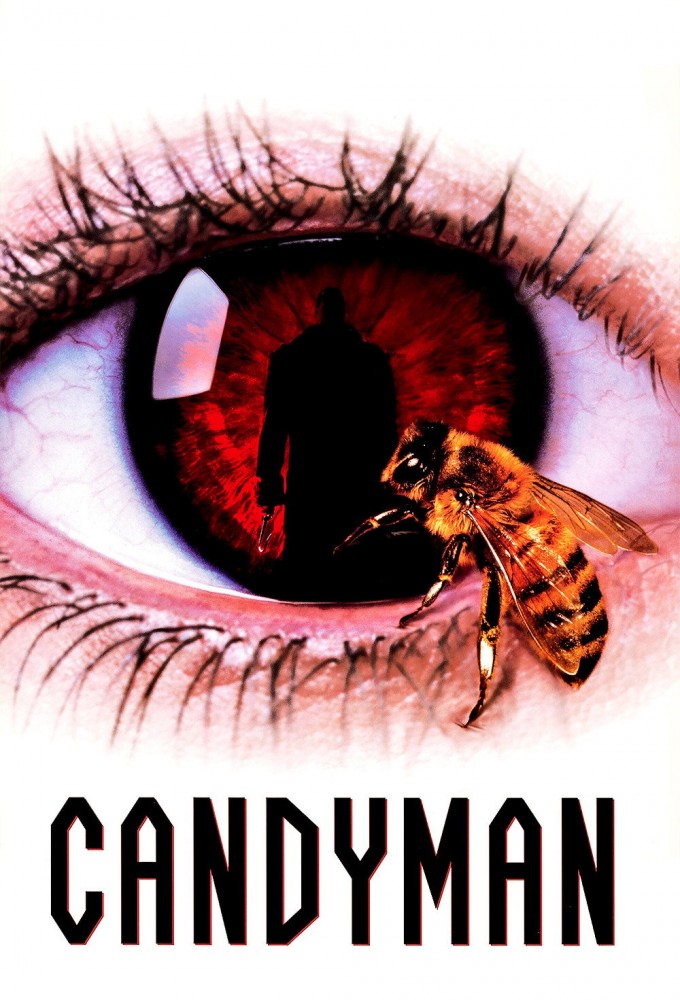
FILM · 1992
Candyman
30 archived facts 4 topics 1 source Last reviewed Oct 2026

All facts (30)
- #001
The bees used in the film were specially bred for the production. The team had to ensure the bees were only 12 hours old, so that they looked like mature bees but their stingers were not yet strong enough to cause real harm.
- #002
The exterior, corridor and stairwell scenes were actually shot over several days in the famous Cabrini-Green housing projects, but to keep the cast and crew safe during filming the producers had to strike a deal with gang leaders to have them appear in the film as extras. Despite this arrangement, on the last day of shooting a sniper fired a bullet into the production van, though no one was injured.
- #003
While investigating one of Candyman's crime scenes, Helen and Bernadette discover that the design of the apartment's medicine cabinet makes it a possible entry point for an intruder. This was not an invented horror-movie device: while researching the film, Bernard Rose learned that a number of murders had been committed in Chicago in exactly this way.
- #004
In the documentary In Search of Darkness 1990-1994: A Journey Into Iconic '90s Horror (2024), director Bernard Rose said that the story of Tony Todd negotiating a $1,000 bonus for every bee sting he suffered during filming is an urban legend with no truth to it.
- #005
The scene in which Candyman's hook pierces through Helen's bathroom cabinet was edited without Virginia Madsen's knowledge, so her terror and shock are genuine. She ran off the set screaming.
- #006
In Slashers Part 1 (2018), Tony Todd said he was stung by bees 26 times over the course of the Candyman trilogy.
- #007
The change of setting required changes to some elements of the film. According to journalist Steve Bogira, one of the inspirations may have been a pair of articles he wrote in the Chicago Reader in 1987 and 1990 about the killing of Ruthie Mae McCoy, a resident of Chicago's Abbot Homes housing project. In 1987, McCoy was murdered by an intruder who entered her apartment through an opening behind the bathroom medicine cabinet.
- #008
It was Tony Todd's favorite role and the film he considered his own.
- #009
Candyman's lair was designed to resemble a Gothic church built by the people who believed he lived in Cabrini-Green.
- #010
While his actors were developing their characters, director Bernard Rose had Virginia Madsen and Tony Todd take ballroom dance lessons so they could build a more romantic connection.
- #011
According to Tony Todd, "I met Bernard Rose, who is a brilliant brain and a great director, and I wanted to say this was a hire. But I just… people were telling me, 'Oh, you'll never live this down,' and I said, 'You know what, I'm going to do the best I can and I'm going to walk away from it.' When I read it and saw the bees and everything else, I knew things like this hadn't been done before, so it was interesting. And I've always wanted to find my own personal Phantom of the Opera."
- #012
The fact that Candyman's footsteps are never heard whenever he walks shows that he is rumor and mythology, sustained by superstition, brought to life.
- #013
There was some debate over the film's depiction of racism and racial stereotypes. According to Bernard Rose, "I had to have a series of meetings with the NAACP because the producers were very worried, and when they read the script they said to me: 'Why are we having this meeting? You know, this is a lot of fun.' Their argument was: 'Why shouldn't a Black actor be a ghost? Why shouldn't a Black actor play Freddy Krueger or Hannibal Lecter? If you say they can't, that's really perverse. It's a horror film…'" According to Virginia Madsen, "I was worried about how people would react, and I still am. I don't think Spike Lee is going to like this film."
- #014
Helen discovers a toilet bowl filled to the brim with bees, all of them feeding on something unseen. To achieve the effect, a professional beekeeper applied queen bee scent to the inside of the toilet bowl. This assistant released the bees from the hive into the toilet, which had no water in the bowl and was not functional. Vaseline was applied to the upper inside of the bowl to keep the bees from approaching the lid. After the scene was shot, the bees were collected with a special soft, safe, gentle vacuum and returned to the hive.
- #015
The effects team had a blacksmith make Candyman's hook, but when they went to collect it the blacksmith refused to sell it to them. The devout Christian blacksmith, upon learning it was a Clive Barker horror film, became concerned about the project and forced them to have another hook made.
- #016
For the scene in which Helen undresses in front of a police officer, Virginia Madsen suggested her lifelong best friend Rusty Schwimmer for the role, because she felt more comfortable doing it in front of a familiar face.
- #017
It took half an hour for all the bees to enter Tony Todd's mouth. The trick was spreading the scent of queen bees on him, and he recalled being "tranced out" when he let all the bees out of his mouth.
- #018
Virginia Madsen claims she was hypnotized during some of the film's scenes.
- #019
In Clive Barker's original story, Candyman was described as a rebellious red-bearded, imposing, possibly white man (described, of course, as having a rather unnatural yellow tint that contributed to the candy theme).
- #020
DeJuan Guy was too frightened to watch the entire film for the first time at a screening attended by the cast and crew. According to an interview for Shout Factory, a few minutes after hearing Philip Glass's music during the opening title sequence, Guy asked to be excused once his name appeared and requested to be let back in only to watch his own scenes.
- #021
For the scene in which bees fill Candyman's chest cavity, the bees were placed in a special body rig filled off-set and strapped to Tony Todd's chest. The utmost care was taken to place the bees appropriately on the set and to collect them afterwards.
- #022
Initially, Candyman's name was to be mentioned 13 times in the script, but writer and director Bernard Rose reduced this to 5 because he felt 13 was a bit excessive.
- #023
Bernard Rose expressed interest in Clive Barker's story "The Forbidden," and Barker agreed to license the rights. While Barker's story revolves around themes of the English class system in contemporary Liverpool, Rose chose to adapt the story to the Cabrini-Green housing development in Chicago and instead focus on themes of race and social class in inner-city United States.
- #024
In the DVD commentary, Alan Poul said that had Virginia Madsen been unavailable, the role of Helen would most likely have gone to the then-unknown Sandra Bullock.
- #025
Tony Todd compares his character's capacity for fear, suggestion and seduction to DC Comics' villain Scarecrow. He also compares his character to the Phantom of the Opera and the Hunchback of Notre Dame, since they are all "monsters" who make a failed attempt to win the love of their heroines using both tenderness and terror.
- #026
In an August 2011 interview with Cindy Pearlman of the Chicago Sun Times, Tony Todd said, "I'll never forget that I shot that film in a building on the South Side of Chicago. The building was 116. Unit C. That's Candyman territory!"
- #027
In 2011, the last high-rise building remaining in the Cabrini-Green housing project was demolished. Opened in 1942, the property gained a worldwide reputation over the years as a haven for violence, drugs, gangs and other criminal activity. The project's real-life story is part of Candyman's narrative, and it makes sense that Bernard Rose wanted to shoot there. And so he did. However, in order to get permission to shoot there, he had to agree that some residents would appear as extras. "I went to Chicago on a research trip to see where it could be done, and some people from the Illinois Film Commission showed me around and took me to Cabrini-Green," Rose said. "And I spent some time there and realized it was an incredible arena for a horror film because it was a place where there was a very tangible fear. And the number one rule when you're making a horror film is to set it in a frightening place. And the fear of the urban housing project seemed to me to be actually entirely for a horror film. Irrational, because you couldn't really be that much in danger. Yes, there was crime there, but people were genuinely afraid to walk through it. And there was such an atmosphere of fear around it that I thought this was an interesting thing that really needed to be examined, because it's a kind of fear located in the heart of modern cities. And obviously it's racially motivated, but it's more than that, it's poverty-driven."
- #028
DeJuan Guy was nicknamed "One Take Jake" because he completed his scenes flawlessly.
- #029
Virginia Madsen was originally going to play the role of Bernadette, but when the film was moved from Liverpool to Chicago, it was decided that the character would be played by an African-American actress.
- #030
The honey bees in Candyman were controlled by Norman Gary, who had previously handled bees in films such as The Deadly Bees (1966), My Girl (1991) and Fried Green Tomatoes (1991). More than 200,000 real honey bees were used throughout the film, and most of the crew wore coveralls to protect themselves from stings, but all of them faced at least one sting.
Sources & editorial notes
Reference databases
Sources for the entries on this page
- IMDb IMDb kaydı
Information from external sources is independently selected, consolidated and edited by Arka Evren. Sources are listed for verification and further reading. Encyclopedia text is used under its licence (CC BY-SA). How we work