FILM · 2000 · USA
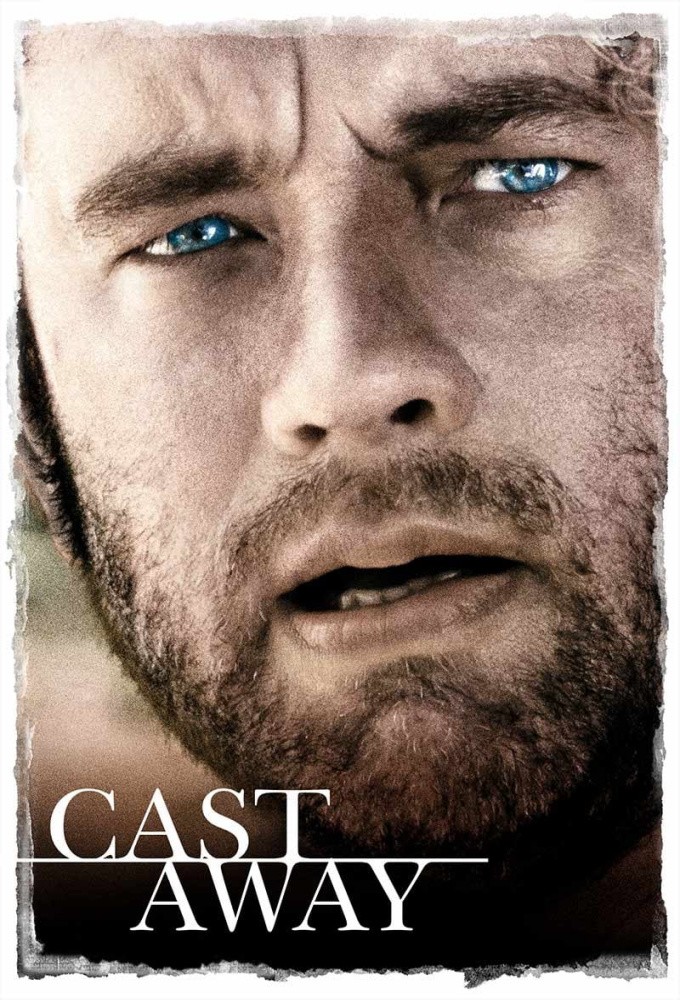
Cast Away
- Directed by
- Robert Zemeckis
- Runtime
- 143 min
- Studio
- 20th Century Fox, DreamWorks Pictures, Playtone
49 archived facts 5 topics 1 source Last reviewed Sep 2026
Chuck Noland, a top international manager for FedEx, and Kelly, a Ph.D. student, are in love and heading towards marriage. Then Chuck's plane to Malaysia crashes at sea during a terrible storm. He's the only survivor, and finds himself marooned on a desolate island. With no way to escape, Chuck must find ways to survive in his new home.
Summary: TMDB

All facts (49)
- #001
Contains a major spoiler — show
A FedEx commercial that aired during the 2003 Super Bowl broadcast featured the film's final scene, in which Chuck returns the package to its sender. In this version the woman opens the door, and when Chuck asks what is in the box, she replies: "Just a satellite phone, GPS locator, fishing rod, water purifier, and some seeds. Just silly stuff."
- #002
To make himself look like an average, out-of-shape, middle-aged man, Tom Hanks did not exercise and allowed himself to gain weight. Production was then shut down for a year so he could lose fifty kilos and grow his hair long for the time spent on the deserted island. During this break, Robert Zemeckis used the same crew to shoot What Lies Beneath (2000).
- #003
Real dialogue lines were written for the volleyball Wilson to help Tom Hanks interact more naturally with an inanimate object. The volleyball's lines were cut from the final film, likely because they wanted the film to seem more realistic rather than creative or perhaps fantastical.
- #004
After the film's premiere, job applications to FedEx increased by 30%.
- #005
Contrary to popular belief, FedEx did not pay the filmmakers anything in exchange for its presence in the film. Robert Zemeckis made this clear in several interviews. FedEx was very worried when it heard about the project, but it had no objections to the completed script and offered support during shooting. The company later said the film was very good for FedEx, especially in overseas markets.
- #006
Tom Hanks said the idea for the film first came about after he read an article about FedEx. "I realized that Boeing 747s full of packages fly across the Pacific three times a day. What happens if one of them goes down?" he said. He embraced the idea and combined it with his interest in how one could survive without the five elements needed to live it (food, water, shelter, fire and companionship).
- #007
Some crew members stayed on the island for a few days to survive and learn certain skills. They used some of these survival techniques for the character Chuck in the film. These were: struggling to light a fire, opening a coconut, talking to a volleyball, collecting packages that washed ashore, and catching fish.
- #008
Most of the night scenes on the island (except for the creation of the fire scene) were shot during the day. Darkness and night-sky effects were added in post-production.
- #009
Tom Hanks's blond hair and facial hair were actually real.
- #010
Contains a major spoiler — show
On Inside the Actors Studio (Tom Hanks: 2 (2006)), James Lipton asked Tom Hanks what he thought happened to Chuck after the film ended. Hanks replied, "He turned around. He went back and made babies with that lady."
- #011
Almost all of the sound, including the dialogue in the island scenes (about an hour and a half of screen time), had to be replaced in post-production. Sound expert William B. Kaplan made a bold attempt to capture usable sound on the island, but because most of the scenes had to be very quiet, the nearby surf made this impossible.
- #012
Contains a major spoiler — show
During a Q&A session at USC, Robert Zemeckis was asked what was inside the unopened package. He said it was a waterproof, solar-powered satellite phone.
- #013
Contains a major spoiler — show
To make Wilson appear to have been 'born' from Chuck, Robert Zemeckis came up with the idea that Chuck's blood formed the volleyball Wilson's face.
- #014
One of the three volleyballs used in the film sold at auction for $18,400.
- #015
Tom Hanks said the hardest part of losing so much weight was not eating French fries for a long time, and that what helped him most during the process was drinking plenty of coffee every morning.
- #016
Tom Hanks has always regarded this film as one of his personal favorites.
- #017
Contains a major spoiler — show
Alan Silvestri wrote 24 minutes of music for a 143-minute film (including more than seven minutes over the end credits). Apart from the studio logo fanfares, the Russian choir and the two Elvis Presley songs before the crash, there is not a single written note in the film until Noland leaves the island (1 hour 43 minutes into the film). Only then does the music come in: the only instruments Silvestri used are oboe, piano and strings. Every musical cue is a variation on the same melody finally heard in full.
- #018
The scene in which Noland talks with Stan by the fireplace in Stan's house was shot in a single continuous take in which the camera slowly circles Noland. The shot lasts 3 minutes 46 seconds.
- #019
The production employed several local Fiji islanders from the surrounding archipelago, including the neighboring Mana Island about a mile away. As a sign of the local people's help, they were allowed to keep some materials and tools.
- #020
None of the animals caught were real; the fish that Chuck Noland (Tom Hanks) 'eats' in the film was made of rubber, and the crab, though quite expensive, was a robotic prop.
- #021
The flight number of the plane that crashes, FedEx 88, was a real flight number at the time of filming. It was operated from Memphis to Penang, Malaysia, with stops in between.
- #022
Tom Hanks said one reason he wanted to make the film was to reinvent the "stuck on a desert island" concept. Up to that point, he felt most people's associations with the idea were limited to "Robinson Crusoe" or Gilligan's Island (1964), and that there was room for a new take rooted in modern times. He also said the film had room for some of the sad things Hanks had to say about what Gilligan never told us about surviving on an island.
- #023
Some of the 'desert island' filming was done on the mainland, and a highway in the background had to be digitally removed in post-production.
- #024
The handwriting on the birthday card Chuck reads on the island belongs to director Robert Zemeckis.
- #025
Nearly fifteen years after the film's release, Tom Hanks jokingly "reunited" with Wilson while playing volleyball at a New York Rangers hockey game.
- #026
Chuck Noland's name can be shortened to 'C'. Noland, or "see no land", fits plainly given the film's circumstances or plot.
- #027
Dear Doctor TV interviewed dental technician Gary Archer, who created this particular effect, and many others. "They wanted to have an abscess above the tooth with all sorts of gunk and pus and stuff coming out of it," Archer explained. "I met with Tom and took measurements of his mouth and we came up with this great little piece. It slid over his own natural teeth." The actor could pop it out during the scene using his lower tooth when the time came. In the end it looked so realistic that, as Archer put it, "it was not for the easily squeamish!"
- #028
In the first draft of the screenplay, Chuck had two separate personalities that talked to each other: Good Chuck and Bad Chuck.
- #029
The paper Chuck writes his note to Bettina Peterson on is stationery from "Arrington Ranch" (a cattle ranch facility), the actual house where Chuck leaves the letter.
- #030
Rita Wilson (Tom Hanks's wife), appearing on the "Joy" podcast with Craig Ferguson, admits at around 20:30 that the reason Wilson the volleyball was used in the film is that her surname is Wilson.
- #031
Contains a major spoiler — show
Just before Chuck pulls his tooth out in the cave, he tells Wilson that his dentist in Memphis is named "Dr. James Spalding". In the German dub the name was changed to "Dr. James Volley" because few Germans know the American brand "Spalding". In the Hungarian version the dentist is named "Dr. James Speedo". His best friend on the island was Wilson the volleyball player. Spalding and Wilson make athletic equipment.
- #032
At the beginning of the film, as the camera tilts toward Chuck's fireplace, you see Joshua Slocum's book "Sailing Alone Around the World".
- #033
Contains a major spoiler — show
When Chuck returns the FedEx package sent by the man who "saved his life", the name of Bettina's cheating husband is removed from the farm gate.
- #034
It grossed 11 million dollars domestically on Christmas Day, the biggest Christmas Day gross in history. The previous record was held by Titanic (1997), which grossed 9.2 million dollars.
- #035
The song Chuck sings after successfully creating fire is The Doors' "Light My Fire".
- #036
As Tom Hanks's character goes to return the last package with angel wings, Elvis's "Return to Sender" plays on the radio, indicating his intention.
- #037
Contains a major spoiler — show
Near the end of the film, as Chuck Noland, after being rescued, boards a plane to return to America, two FedEx cups are visible in the background. The two cups were rearranged to spell the word Ex Fed, signaling his departure from the company.
- #038
Kelly said that Chuck's island was 600 miles south of the Cook Islands, meaning the island's location was about 1,600 miles away from where most of the island scenes were filmed.
- #039
Contains a major spoiler — show
Tom Hanks claimed that during development the original idea was for Chuck to be rescued on the island; the idea of him finding a way to escape only emerged much later.
- #040
Contains a major spoiler — show
Tom Hanks later admitted that although Chuck was meant to show dramatic weight loss after four years of progress, he actually only got his weight down to 170 pounds. Hanks attributed this to a shoulder injury that kept him from his diet and exercise program.
- #041
Crew member Nick Phillips was the only person to work on both Castaway (1986) and Cast Away (2000), serving as engineering consultant and Libra assembly technician respectively.
- #042
While filming the fire-making scene, Tom Hanks had to be hospitalized with a staphylococcal infection after kneeling on the ground for hours and developing an infection in his knee.
- #043
On the flight he is offered a Dr Pepper. In Forrest Gump, Forrest is offered a Dr. Pepper at the White House.
- #044
The band Phish showed a video clip from the film at their 2002 New Year's show at Madison Square Garden. Special guest Steve McConnell, the brother of Phish keyboardist Page McConnell, pretended to be Tom Hanks. The next song the band played was the aptly named "Wilson." Many major news sites reported that this song was believed to be Tom Hanks.
- #045
The film was released domestically by 20th Century Fox and internationally by DreamWorks Pictures; select DreamWorks Animation films were released by Fox at that time.
- #046
Just before setting off, Bettina (Lari White) says "Good luck Cowboy" to Chuck (Tom Hanks), a small nod to the Woody character in Toy Story.
- #047
One of the Wilson volleyballs used on screen was included in the 2021 Walt Disney Archives exhibition brought to Graceland in Memphis, TN, the home of the fictional Chuck Noland.
- #048
Contains a major spoiler — show
Coincidentally, Kelly in this film, played by Helen Hunt, and Jenny in Forrest Gump (1994), played by Robin Wright, both wear similar haircuts when they reunite with Tom Hanks's characters Chuck and Forrest after long periods apart.
- #049
Tom Hanks and Helen Hunt each played a parent of Haley Joel Osment in separate films: Hanks in Forrest Gump (1994) and Hunt in Pay It Forward (2000).
Sources & editorial notes
Reference databases
Sources for the entries on this page
- IMDb IMDb
Information from external sources is independently selected, consolidated and edited by Arka Evren. Sources are listed for verification and further reading. Encyclopedia text is used under its licence (CC BY-SA). How we work