
FILM · 1990 · USA
Darkman
30 archived facts 6 topics 1 source Last reviewed Oct 2026
All facts (30)
- #001
The story was taken from Sam Raimi's short story conceived as a tribute to the 1930s Universal horror films.
- #002
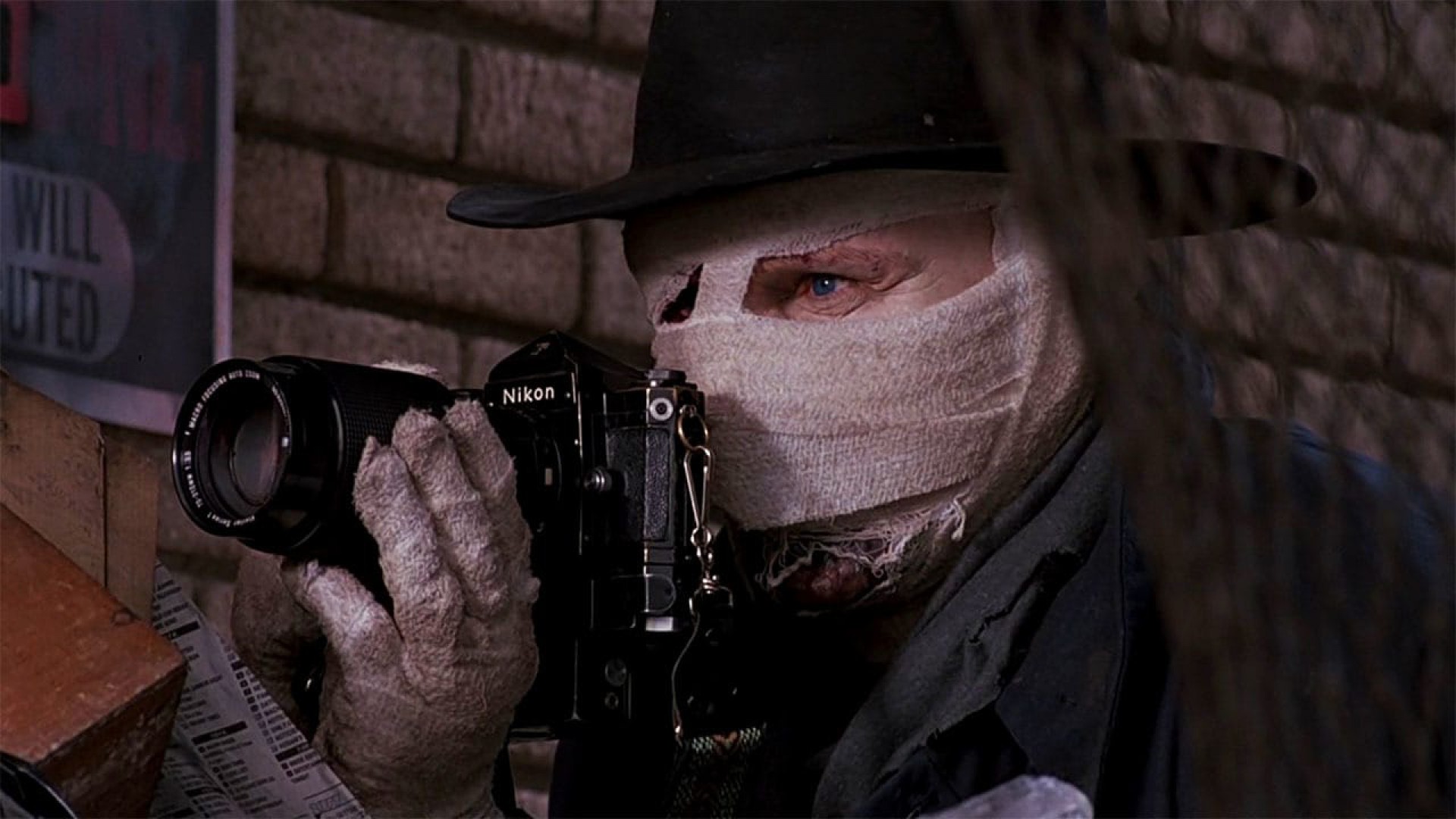
For the role of Darkman, Sam Raimi wanted someone who could portray a monster with a human soul and do it all under heavy makeup. He also liked Liam Neeson's Gary Cooper-like charisma. Neeson was drawn to the story's operatic nature and the character's inner turmoil. To research the role, Neeson contacted the Phoenix Society, an organization that helps accident victims with severe disfigurements reintegrate into society.
- #003
Bill Paxton nearly took the role of Peyton Westlake. According to Paxton, he told his friend Liam Neeson about the audition. When Neeson got the part, Paxton was so angry that he did not speak to Neeson for months.
- #004
Sam Raimi's close friends Joel Coen and Ethan Coen made changes to the finished script, some of which went uncredited.
- #005
Liam Neeson worked eighteen hours a day in ten-piece makeup, but he enjoyed the challenge, the idea of working behind a mask on camera and exploring the possibilities it required. Neeson also spoke about the costume he wore as Darkman, especially the cape. The hardest part was speaking with the false teeth, because he did not want them to move at all.
- #006
Director Sam Raimi wanted Bruce Campbell to play the lead, but the producers were not sure Campbell could handle the role. Campbell instead makes a small cameo in the final scene.
- #007
Sam Raimi initially wanted to base the film on "The Shadow," but when he could not obtain the rights he had to create the character of Darkman. In 2006, Raimi tried again to make a Shadow film with Batman producer Michael E. Uslan, but the project never came to fruition.
- #008
Unable to secure the rights to either The Shadow or Batman, Sam Raimi wrote his own character who could change his own face, drawing inspiration from The Hunchback of Notre Dame (1939), The Phantom of the Opera (1943) and The Elephant Man (1980).
- #009
Although his status as a star of the genre would be cemented later in his career, this was Liam Neeson's first leading role in an action film.
- #010
The production had behind-the-scenes problems. The scriptwriting process was exhausting and there were long post-production battles with the studio. Sam Raimi and Frances McDormand also clashed over creative differences. She was reportedly very difficult to direct. Raimi said, "Apparently I didn't know Fran as well as I thought I did. The reason it was difficult was that we had different ideas of the best possible film and argued to make it possible. We encountered disagreements, but they were very healthy." McDormand looks back on the film fondly, and she and her husband Joel Coen are still friends with Raimi.
- #011
Director Sam Raimi wanted to cast his friend Bruce Campbell as Peyton/Darkman, but the studio would not approve it. Raimi still got his way in a sense: Campbell briefly plays Darkman in his final guise at the end. He also provided some of the screams of characters who die falling.
- #012
The editing process was extremely difficult. The film's editor reportedly had a nervous breakdown and left the production. Universal executives were also very nervous about some of the crazy things in the film and insisted they be removed. Sam Raimi admitted that studio filmmaking did not satisfy him the same way independent filmmaking did, but he still credited Universal's marketing campaign for Darkman's success at the box office.
- #013
Bruce Campbell appears in the final shot as Darkman's last reincarnation. He is listed in the credits as Final Shemp, a reference to Shemp Howard, who was often doubled by lookalikes in The Three Stooges projects after his death.
- #014
Durant's finger fetish stems from Sam Raimi wanting the character to have a specific trademark, one that hints at a military background, which explains why Durant is so adept with a grenade launcher while firing from a helicopter.
- #015
The script went through roughly twelve drafts overall. This was because Sam Raimi wanted to explore Peyton/Darkman's arc throughout the film. He said: "I decided to explore the soul of a man. At the beginning he is a sympathetic, sincere man. In the middle, a vengeful man committing hideous acts against his enemies, and at the end, a man who hates himself for what he has become, forced to retreat into the darkness of night, into a world apart from everyone he knew and everything he loved."
- #016
Sam Raimi was apparently interested in paying tribute to the 1930s Universal horror films. Production designer Randy Ser noted: "If you look at Darkman's laboratory, the old warehouse he moves into, I had Dr. Frankenstein in mind. There were visual references to what we thought about those films."
- #017
Larry Drake was cast as Durant because of the understated way he played him: quiet, careful but intense. Sam Raimi had not even seen a single episode of L. A. Law (1986), in which Drake played the developmentally disabled Benny, but Drake's face reminded him of a modern-day Edward G. Robinson. He looked very rough and authoritative, yet still had a polite intelligence. Raimi believed these qualities made him the perfect adversary for Darkman.
- #018
The director brothers, longtime friends of director Sam Raimi, appear as the Oldsmobile passenger and driver, respectively.
- #019
The film had a difficult and long editing process. Sam Raimi's rough cut scored around 65 in test screenings, so the studio demanded a re-edit. When the score dropped even lower (26), the studio hired its own editor, Bud S. Smith, who recut the film from about two hours to 85 minutes without Raimi's involvement while Raimi was on vacation. This cut scored even lower, and after seeing it Danny Elfman threatened to remove his name from the film in support of Raimi. In the end Universal decided there was nothing that could be done to save the film and locked the cut. On Bob Murawski's advice, Raimi, Rob Tapert and Murawski re-edited the entire film over a 48-hour period without the studio's permission. They restored 9 minutes of footage, including poorly tested material they liked, and cut the negatives. Universal executives were furious when they learned of this after the sound mix was completed, but there was little they could do because the film's press screening was two days away. The film then opened at No. 1 at the box office, proving Raimi and his colleagues right.
- #020
Colin Friels broke his femur falling from a three-story steel beam in the middle of a fight scene.
- #021
Kathy Bates was originally cast as the burned doctor, but the role was dropped before filming. Jenny Agutter took over the part at John Landis's request.
- #022
Julia Roberts was nearly set to play Julie Hastings before she took a role in Pretty Woman (1990), and had to be replaced.
- #023
Sir Gary Oldman was considered to play Peyton/Darkman.
- #024
In the cemetery scene, the name of the set designer, George Denes Suhayda, appears on the nearest gravestone.
- #025
As Darkman pushes the cart of laboratory equipment into the warehouse where he sets up his new lab, a torn shirt reading "Tamakwa" hangs on the fence. Director Sam Raimi went to Camp Tamakwa as a child.
- #026
Around the time of the film's release, Universal Studios donated $5,000 to Strack Middle School in Klein, Texas, as part of its unique promotional strategies (the school shares its name with Darkman's main villain).
- #027
Frances McDormand's husband, Joel Coen, edited Sam Raimi's first film, The Evil Dead (1981).
- #028
According to Bruce Campbell, the characters played by Ethan Coen and Joel Coen drive Sam Raimi's '73 Oldsmobile, the car Darkman shouts "Watch out!" about while hanging from Durant's helicopter, but when you freeze the frame the two people inside look nothing like the Coen Brothers, so this may be a long story.
- #029
Liam Neeson and Frances McDormand worked closely together in rehearsals. They even rewrote the three love scenes they share after he becomes Darkman. According to McDormand, they got through the scenes by relying on each other and on each other's theater knowledge.
- #030
John Landis has a small role as a bespectacled, bearded, masked doctor who watches the burned doctor's presentation after Westlake's gruesome sacrificial ceremony. Landis would later reprise his role in Sam Raimi's Spider-Man 2 (2004), appearing in the notorious hospital massacre scene as the doctor whose glasses reflect Doc Ock's tentacles before he is killed.
Sources & editorial notes
Reference databases
Sources for the entries on this page
- IMDb IMDb kaydı
Information from external sources is independently selected, consolidated and edited by Arka Evren. Sources are listed for verification and further reading. Encyclopedia text is used under its licence (CC BY-SA). How we work