
FILM · 1989 · USA
Do the Right Thing
- Directed by
- Spike Lee
- Runtime
- 120 min
- Studio
- Universal Pictures, 40 Acres and a Mule Filmworks
34 archived facts 6 topics 1 source Last reviewed Oct 2026
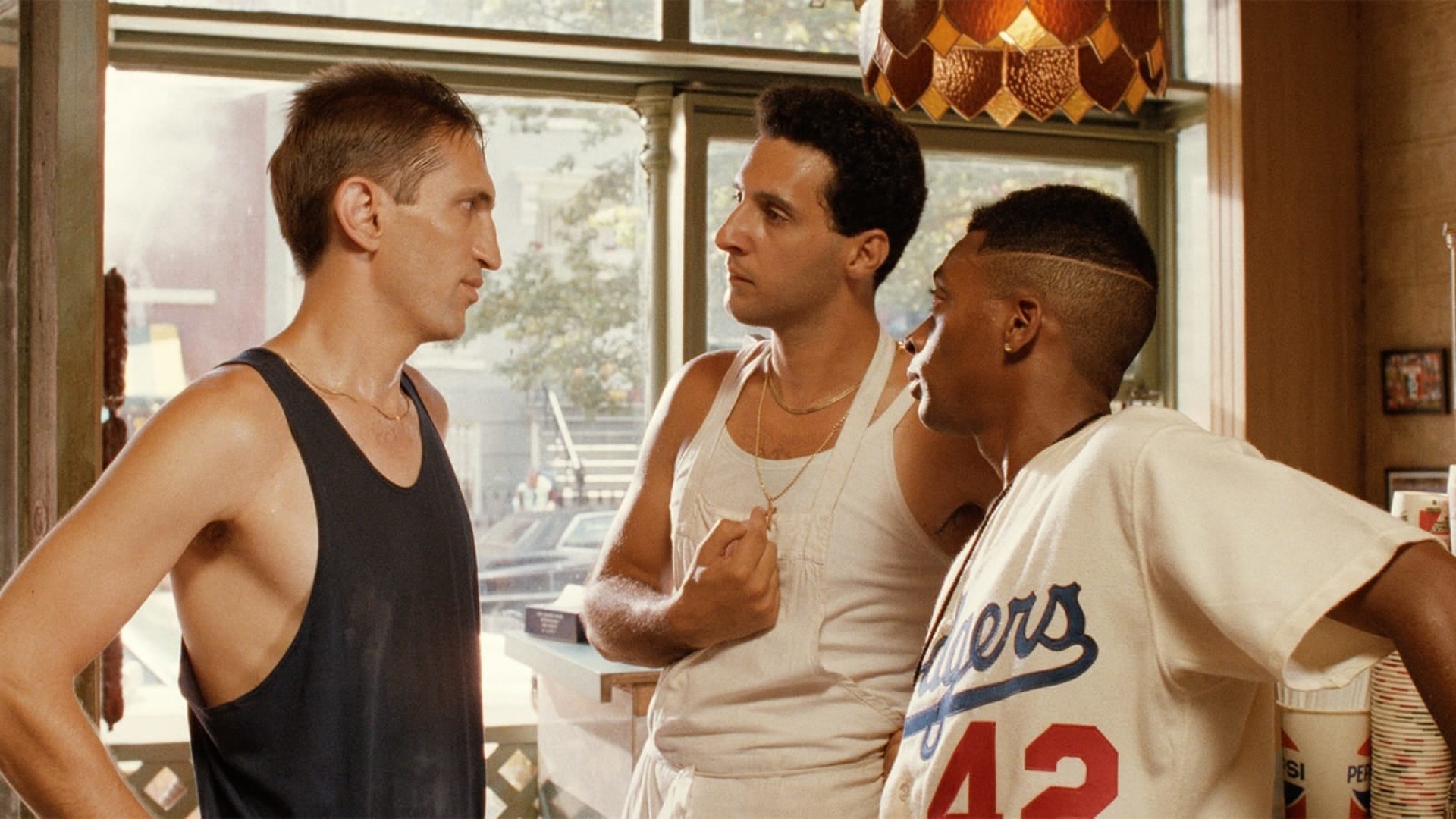
Sal is the Italian owner of a pizzeria in Brooklyn. A neighborhood local, Buggin' Out, becomes upset when he sees that the pizzeria's Wall of Fame exhibits only Italian actors. Buggin' Out believes a pizzeria in a black neighborhood should showcase black actors, but Sal disagrees. The wall becomes a symbol of racism and hate to Buggin' Out and to other people in the neighborhood, and tensions rise.
Summary: TMDB
All facts (34)
- #001
During the 1990 Oscar ceremony, Kim Basinger ignored the script while introducing Dead Poets Society as a Best Picture nominee, causing some controversy when she said: "We have five great films here and they are great for one reason, because they tell the truth. But there is one film missing from this list that deserves to be on it because, ironically, it might tell the biggest truth of all; that's Do the Right Thing (1989)." Spike Lee would later thank her for it in a 2019 episode of his "Unspooled" podcast.
- #002
Although Da Mayor (Ossie Davis) and Mother Sister (Ruby Dee) do not get along in the film, the actors were in real life husband and wife and often performed together until Davis's death in 2005. The pair also played a married couple in another film directed by Lee, Jungle Fever (1991).
- #003
All the scenes of the corner men (Robin Harris, Paul Benjamin and Frankie Faison) were improvised.
- #004
Spike Lee has repeatedly stated that, in his view, the reason Mookie throws the trash can through the window is that he has seen his best friend Raheem killed in front of him. Lee accepted the alternative theory that Mookie did it to save Sal, Pino and Vito, and he liked the fact that the scene has led to such different interpretations, even though that was never his intention.
- #005
The main scene in which Danny Aiello and John Turturro talk alone around the middle of the film was partly improvised. The scripted scene ended with the character Smiley approaching the window. Everything after that, until the end of the scene, was entirely improvised.
- #006
According to Spike Lee, Rosie Perez's casting came about during a birthday party he threw at a club in Los Angeles. When Experience Unlimited's R&B song "Da Butt" from Lee's previous film School Daze (1988) started playing, a spontaneous "butt contest" broke out. Lee saw Perez dancing on top of a speaker and, afraid she would fall and hurt herself and that he would be sued, told her to get down. Security had to step in to push Perez down, after which Perez cursed Lee out profusely. Lee was struck by her voice and quickly learned that the two of them were from the same part of Brooklyn. He offered her the role of Mookie's girlfriend right there and decided she would be Puerto Rican. Perez, however, tells it differently in interviews. She said Lee himself started the butt contest to see which black woman had the biggest butt. She also said she thought Lee was initially hitting on her and ignored him. She did not learn until later that it was for a role in his film.
- #007
This was Martin Lawrence's (Cee) first feature film.
- #008
Spike Lee criticized several white critics over perceived racist reviews claiming the film would provoke anger among the black population and cause riots, and that if that happened the blood would be on Lee's hands. Lee defended his film by saying that if white people can keep themselves from causing trouble after seeing violence in Arnold Schwarzenegger's films, black people can do the same. He would later praise Roger Ebert as one of the few white critics who understood the film's message of mutual understanding.
- #009
In the original scripted ending, Sal and Mookie reconcile. Although Sal is sad, he tells Mookie that he understands Mookie had to do the right thing. Spike Lee claimed that the original studio, Paramount, even demanded at the last minute that Sal and Mookie hug. Lee rejected this, calling it a "Hollywood bullshit ending," because he wanted the epilogue to stay true to the characters, and took the project to Universal Pictures.
- #010
Spike Lee wrote the script in two weeks.
- #011
Spike Lee initially wanted Robert De Niro for the role of Sal Frangione. De Niro, however, turned the role down, saying it was too similar to many of the roles he had played in the past. The part eventually went to Danny Aiello. A photo of De Niro is one of the pictures that appear on Sal's Wall of Fame. De Niro and Aiello appeared side by side in The Godfather Part II (1974) and Once Upon a Time in America (1984).
- #012
The film was inspired by a real event in New York City in which some black youths were chased from a pizzeria by some white youths in a part of New York City known as Howard Beach.
- #013
The character Smiley was not originally in the script. Roger Guenveur Smith approached Spike Lee to ask for a role, and his scenes were added during shooting.
- #014
Rick Aiello, who plays Officer Long in the film, is the real-life son of Danny Aiello, who plays Sal.
- #015
Laurence Fishburne was offered the role of Radio Raheem but turned it down.
- #016
Danny Aiello admitted that he almost turned down the role of Sal when he saw that he would be playing the owner of a pizzeria, believing it was a lazy stereotype of Italian-Americans despite the large number of pizzerias owned by Italian-Americans.
- #017
According to former President Barack Obama at a fundraising event in New York City, he and First Lady Michelle Obama watched the film on their first date in 1989, but they had also planned to watch Driving Miss Daisy (1989). Spike Lee later joked that if Barack had chosen the latter, their relationship probably would never have happened.
- #018
According to Rosie Perez, she showed her first nude scene in this film. However, her face is not shown because she felt exploited during the shoot and cried. For years she stated in interviews that she was angry at Spike Lee for making her do a nude performance. She later forgave him and even appeared nude in other films.
- #019
It was one of nine films selected by the Library of Congress for inclusion in the National Film Registry in its first year of eligibility. The others were Raging Bull (1980), GoodFellas (1990), Toy Story (1995), Fargo (1996), 13 Lakes (2004), Freedom Riders (2010), 12 Years a Slave (2013) and 20 Feet from Stardom (2013).
- #020
Spike Lee thanks Thomas Philip Pollock, then president of Universal Pictures, for standing by the film even after it caused serious controversy at its premiere at the Cannes Film Festival. The film was scheduled to be released in the US in the summer of 1989, but Pollock was under heavy pressure to release it in the fall for fear of inciting riots. This became even more urgent because Pollock was still under protective security after he and his family received death threats following the release of The Last Temptation of Christ (1988). Even Lee told Pollock that he would understand if the film were released later, but Pollock stood behind his decision and released the film on the planned date.
- #021
The building that houses Sal's Pizzeria did not exist before filming. It was constructed by the production company on an empty lot and then demolished after the film was shot.
- #022
All filming took place on a seized block in Brooklyn, and extra care was taken to make the experience pleasant for local residents. The production even hired several residents from the block.
- #023
The word "fuck" is used roughly two hundred and forty times in the film, an average of about twice per minute.
- #024
In 2019, Spike Lee became the first Black person nominated for Academy Awards in both Best Original Screenplay and Best Adapted Screenplay. He was nominated for writing Do the Right Thing (1989) and BlacKkKlansman (2018), respectively, and won for the latter.
- #025
Giancarlo Esposito plays a revolutionary character who is largely ostracized by the community he tries to engage in social activism. In Spike Lee's previous film School Daze (1988), he played a character who avoided a revolutionary figure seeking to raise social awareness about injustice.
- #026
Love Daddy's roll call names 74 musical artists. The first is Boogie Down Productions and the last is Mary Lou Williams.
- #027
In a conversation with Mother Sister, Da Mayor recalls a similarly hot day in Snow Hill, Alabama, in 1939. Snow Hill is the hometown of Spike Lee's father, the composer Bill Lee.
- #028
Spike Lee spent his free time on set writing the screenplay for Mo' Better Blues (1990).
- #029
When the Italian-American Pino calls the African-American Mookie a "tutsoon," he uses a Southern Italian slang word referring to charred wood in a fire pit or the burnt end of a charred stick.
- #030
The first spoken words, "Wake Up," are the last words spoken in Spike Lee's previous film School Daze (1988).
- #031
Cinematographer Ernest Dickerson decided the production had to shoot on a Manhattan east-west street so that the light would be consistent on both sides of the street.
- #032
Rick Aiello and Miguel Sandoval, who play Officers Long and Ponte, reprised their roles in Jungle Fever (1991), also directed by Spike Lee.
- #033
Spike Lee's first choice for the role of Pino was Matt Dillon.
- #034
According to the newspaper, the date on the first day is August 5, 1989.
Continue through the archive


Sources & editorial notes
Reference databases
Sources for the entries on this page
- IMDb IMDb kaydı
Information from external sources is independently selected, consolidated and edited by Arka Evren. Sources are listed for verification and further reading. Encyclopedia text is used under its licence (CC BY-SA). How we work