
FILM · 2021 · JAPAN
Doraibu mai kâ
26 archived facts 5 topics 1 source Last reviewed Oct 2026
All facts (26)
- #001
The film was originally set in Busan, South Korea, but the setting was changed to Hiroshima because of the COVID-19 pandemic.
- #002
The film adapts the title story from Haruki Murakami's 2014 short story collection "Men Without Women," and the director acknowledged that he also drew inspiration from two other stories in the collection: "Scheherazade" and "Kino."
- #003
Ryûsuke Hamaguchi and Takamasa Oe became the first Japanese winners of the Best Screenplay Award at Cannes.
- #004
The film's final scene takes place not in Japan but in Korea. Misaki speaks Korean in a store in Korea and drives Kafuku's car on the right side of the road rather than the left, as in Japan throughout the film. The car now bears Korean plates.
- #005
Tôko Miura, who plays the driver, did not drive in real life and did not even have a license when she was cast.
- #006
Murakami's story begins with the actor hiring the driver, and memories of Oto emerge from their conversations. In the film this order is reversed, so that we learn the history first and then live with Oto's ghostly memory for the rest of the film.
- #007
For Ryûsuke Hamaguchi, the main point of the whole story is the moment Takatsuki strikes Kafuku from his blind spot. In Hamaguchi's own words, "Kafuku is looking at Takatsuki. He doesn't have much respect for the young man. But then Kafuku is shaken by Takatsuki's explanation that you cannot know someone deeply; if you really want to do that, you have to start with yourself." Likewise Haruki Murakami describes this moment as such: "Takatsuki's speech seemed to come from deep within him."
- #008
In one scene, a brief transition following the car's movement merges the wheels with cassette reels, as if the recorded voice of Kafuku's wife were fueling the car. According to Ryûsuke Hamaguchi, this relates to the rotation that in some way represents what the film is about. According to Hamaguchi, the scene shows Kafuku's dream world and his emotional state. It expresses forward movement, but the tape only turns and turns, meaning he too returns. This rotation is a representation of what this film is about.
- #009
The film stays faithful to Oto's death in Haruki Murakami's story, but Ryûsuke Hamaguchi later creates a central narrative thread by referencing "Uncle Vanya" from the original. Staging a Chekhov production may seem like a significant departure from Murakami's self-contained story, but according to the author, who expressed his feelings to The New York Times, it is a completely fair play.
- #010
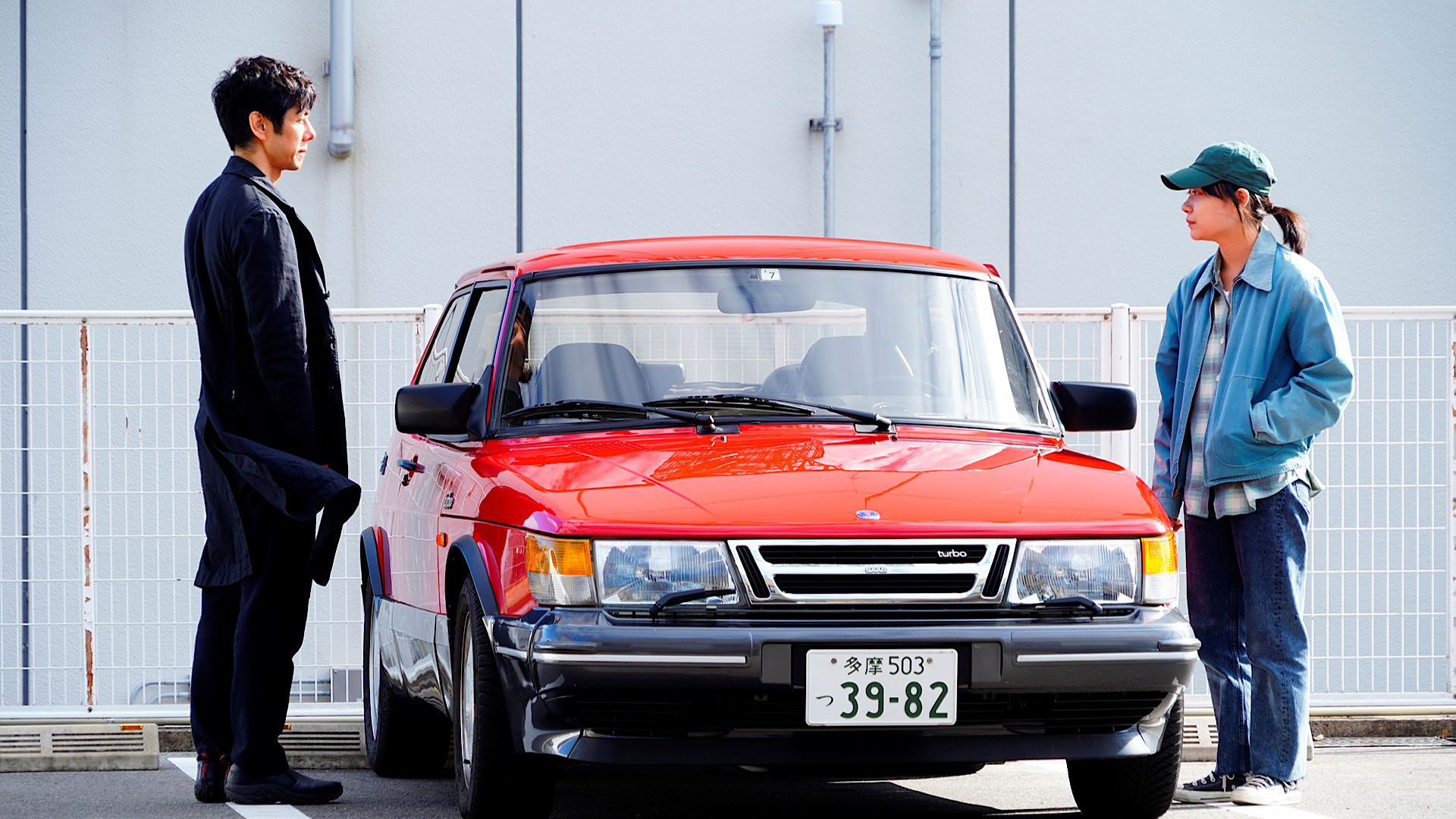
The car Yûsuke uses throughout the film is a red '87 Saab 900 Turbo. While the Swedish company SAAB's aviation division still exists, the car company went bankrupt more than a decade ago and no longer exists.
- #011
To stay faithful to the original story, the director was looking for a yellow, vintage Saab through a prop coordinator. On the day the planned vehicle inspections were to take place, the coordinator arrived in his own red Saab, which the director loved for its sportiness and vivid color that contrasted with the lead actors' emotions, and he put that car at the center of the film and looked at no others! The coordinator still owns the car!
- #012
The cast and crew credits do not appear until 40 minutes in.
- #013
Ryûsuke Hamaguchi chose to adapt Murakami's text for two reasons: because the characters are in a car, and also because of the acting questions the story explores.
- #014
The classic SAAB is indeed a rare import in Japan, with only around 100 models remaining.
- #015
It was selected to compete for the Palme d'Or at the 2021 Cannes Film Festival. There it won the Best Screenplay Award, the FIPRESCI Prize and the Ecumenical Jury Prize.
- #016
In 2022 it was Japan's official submission in the 'Best International Feature Film' category at the 94th Academy Awards.
- #017
In a brief shot showing the location returning to Hiroshima, the famous Atomic Bomb Dome appears covered in scaffolding due to conservation work underway at the time of filming.
- #018
Chronological settings are generally kept concrete but conveyed only indirectly. In the prologue, at a Buddhist ceremony, the daughter's date of death is given as February 25, 2001; this is the only event in which a specific year is explicitly presented. At that point viewers can guess that February is the anniversary of the death but cannot determine what the current year is. Much later, when the daughter's age is stated, Japanese tradition (if we do the arithmetic) will reveal that the ceremony is the traditional 16th anniversary, thus establishing the story's chronology.
- #019
The title "Drive My Car" appears as the film's title only at the closing. However, in the minimal opening title sequence, the name of the production committee and the title of Haruki Murakami's source story are already stated beforehand.
- #020
Except for the striking exception of the final scene in Korea, the red Saab bears plates reading "Tama 503 / (tsu) 39-82" throughout the film. Tama is the name of a western suburban area of Tokyo, suggesting that Kafuku's residence in Tokyo is located outside the 23-ward metropolitan area, while Murakami's original novel states that Kafuku's apartment is in Ebisu in Tokyo's Shibuya district.
- #021
The "Uncle Vanya" auditions are set to take place on 22 October, supposedly in 2019. Although the story never mentions it, that day was a one-off national holiday in the real Japan, marking the enthronement ceremony of the new emperor Naruhito.
- #022
As Kafuku ponders the eel-like fish ("lampreys") on his PC screen, a scratched vinyl record playing Beethoven gets stuck in an endless repetition of one sentence until his wife notices and lifts the needle.
- #023
The driver's seat of the car in which much of "Drive My Car" takes place is on the left. In Japan cars drive on the left side of the road and are right-hand drive (RHD), so the old LHD Saab would be a rare imported car there. However, both LHD and RHD cars can be registered and driven in Japan without restriction.
- #024
It placed 3rd in Sight & Sound's countdown of the 50 best films of 2021.
- #025
It placed 4th in Cahiers du Cinéma's annual Top 10 Film Award.
- #026
It was one of former President Barack Obama's 14 favourite films of 2021.
Sources & editorial notes
Reference databases
Sources for the entries on this page
- IMDb IMDb kaydı
Information from external sources is independently selected, consolidated and edited by Arka Evren. Sources are listed for verification and further reading. Encyclopedia text is used under its licence (CC BY-SA). How we work