FILM · 2013 · USA
Frozen
- Directed by
- Chris Buck, Jennifer Lee
- Runtime
- 102 min
- Studio
- Walt Disney Animation Studios
217 archived facts 7 topics 1 source Last reviewed Sep 2026
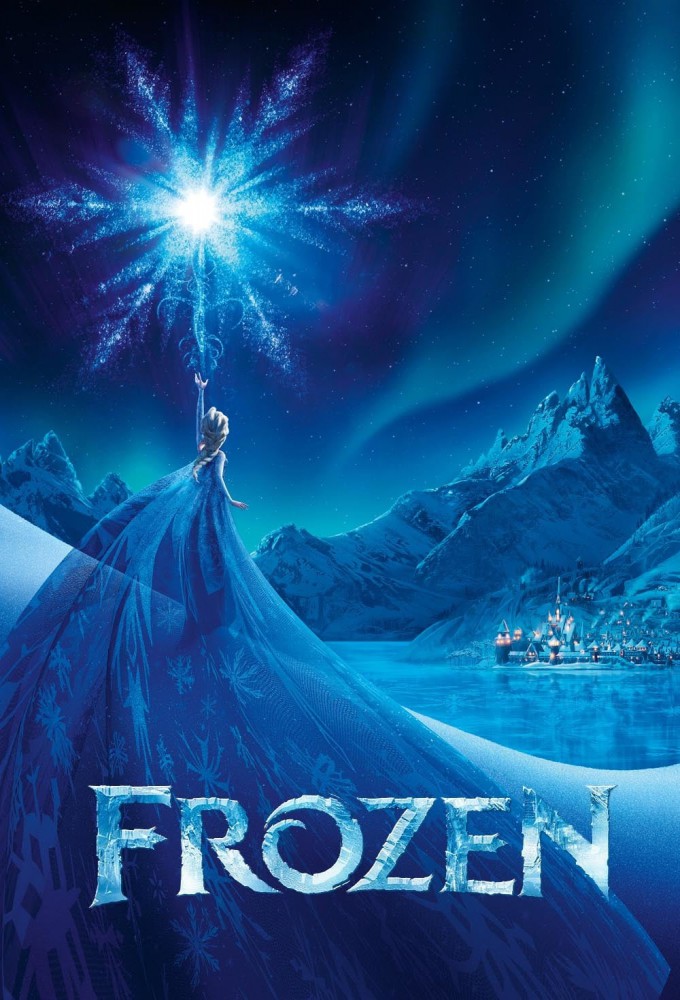
Young princess Anna of Arendelle dreams about finding true love at her sister Elsa’s coronation. Fate takes her on a dangerous journey in an attempt to end the eternal winter that has fallen over the kingdom. She's accompanied by ice delivery man Kristoff, his reindeer Sven, and snowman Olaf. On an adventure where she will find out what friendship, courage, family, and true love really means.
Summary: TMDB

14 Facts on the Deeper Meaning of Frozen
- #036
Contains a major spoiler — show
At the start of the film, Elsa and Anna wear brightly colored clothing that symbolizes their happiness. As they grow apart over the course of the film, however, their clothing becomes progressively darker. (This is especially noticeable in the "Do You Wanna Build a Snowman" montage.) At the end of the film — when the sisters are finally reunited — their clothing is once again bright.
- #049
Contains a major spoiler — show
In the fight scene, Hans looks up just before running to the Duke's henchman to deflect the arrow away from Elsa. This makes the "perfect shot" that causes the chandelier to fall and knock Elsa unconscious more realistic, and provides a more concrete yet still subtle look that hints at his villainy.
- #062
The two snowmen, Olaf and Marshmallow, represent Elsa's personality at the time she made them. Olaf, whom Elsa built while playing with Anna when she was a little girl, is friendly and affectionate. Marshmallow (the Golem-like creature), whom Elsa created when she wanted Anna, Kristoff and Olaf to leave her castle and never return, is rude and violent.
- #085
One line of the song "Let It Go," sung as Elsa creates her ice palace, is "My soul is spiraling in frozen fractals all around." "Fractal" is the term applied to certain mathematical geometries with the property of looking the same at every level of magnification. Snowflakes and other ice formations exhibit fractal geometry, and some artificial fractal objects are called "snowflakes" because of their resemblance to them. But the word "fractal" has another meaning connected to this film as well. The application of fractal mathematics to computer-generated images was one of the first major breakthroughs in creating realistic three-dimensional landscapes in computer graphics, and it made films like Frozen (2013) possible.
- #089
Elsa's mountain peak took its distinctive silhouette from one of the iconic landmarks of Whistler, British Columbia, which hosted the alpine events during the 2010 Olympic Games. The peak is known to Whistler Blackcomb skiers as "Black Tusk."
- #098
Contains a major spoiler — show
Hans appears to be based on the cursed mirror from the original fairy tale "The Snow Queen." In the tale, when a shard of the mirror strikes someone, that person sees only the bad in the world and becomes hard-hearted. Because Hans was constantly overshadowed by his older brothers, he grew up a cold, manipulative scoffer. Moreover, for the first two-thirds of the film Hans acts like a mirror, skillfully imitating whoever is beside him so that no one suspects his true intentions. When he sees his own reflection in his study window, he finally reveals his true, evil nature.
- #110
When Elsa is finally captured, her cell is equipped with shackles that encase her hands and limit her powers. Since the cell and shackles were clearly built in advance, it is implied that the king and queen expected Elsa to lose control and had prepared to restrain her.
- #126
Contains a major spoiler — show
During "Love Is an Open Door," Hans fails to match Anna's movements in several scenes, hinting that he is only trying to keep up with her. For example, when they dance like robots in the clock tower, Anna moves slightly faster than Hans, and when they dance on the sail in the lighthouse light, their movements are not actually centered. He is also sometimes shown trying to catch up with Anna, as in the scene where they balance on the bridge railing. When they climb onto the roof to look at the stars, Anna climbs first and Hans follows. Even in the heart shape they make with their hands at the end, Anna forms the symbol first and Hans completes it.
- #131
Olaf's name is a hint at the character's purpose of providing comic relief; it can be interpreted as "oh laugh."
- #149
Contains a major spoiler — show
Elsa's lines in "For the First Time in Forever (Reprise)" are built on a deceptive cadence, representing her worries and concerns about Anna and her fear that she could hurt her as she did in the past, which is exactly what happens when she freezes Anna's heart at the end of the song.
- #156
Contains a major spoiler — show
Before Hans says "Hey, that's what I was gonna say!" he briefly looks surprised after following the "We finish each others…" "… sandwiches!" line in "Love is an Open Door," implying that he can persuade Anna in a way that suits her interests in order to advance his own goals. He also says this right after Anna leaves the scene.
- #163
In the song "Love is an Open Door," Anna's line "I see your face" implies that she sees only the face Hans shows to the outside world, not the real Hans.
- #179
Both open and closed doors are used to represent relationships. After the accident the sisters suffered as children, the castle gates were ordered closed and Elsa had to keep away from Anna, with a closed door constantly dividing Anna and Elsa. When Elsa opens the gates on the day of her coronation, Anna uses the moment to finally see the outside world and interact with her sister once more, while Elsa considers closing the gates again, risking Anna's exclusion once more. When Anna meets Elsa in the ice palace, she stands guard to keep her from ever shutting her out again, and in the end Elsa decides never to close the gates again, meaning the sisters are reunited. Elsa also breaks the fourth wall by slamming a door after "Let It Go", and during "Love Is an Open Door" Anna closes the balcony door to separate herself and Hans from the rest of the party, including Elsa.
- #215
Contains a major spoiler — show
Open and closed doors represent relationships. After the accident the sisters experienced as children, the castle gates were ordered closed, and a closed door constantly separated Anna and Elsa. When Elsa opens the gates to the public at her coronation, Anna feels the excitement of being released into the outside world for that day. Anna also scolds Elsa for shutting her out of her life, closes the balcony doors to separate herself and Hans from the party, and Elsa's "Let it Go" number and the doors break the fourth wall. Elsa's line at the end that she will never close the doors again means the sisters' relationship is finally repaired.
Sources & editorial notes
Reference databases
Sources for the entries on this page
- IMDb IMDb
Information from external sources is independently selected, consolidated and edited by Arka Evren. Sources are listed for verification and further reading. Encyclopedia text is used under its licence (CC BY-SA). How we work