

FILM · 1987 · UK
Full Metal Jacket
- Directed by
- Stanley Kubrick
- Runtime
- 117 min
- Studio
- Natant, Stanley Kubrick Productions, Warner Bros. Pictures
576 archived facts 8 topics 1 source Last reviewed Nov 2026
A pragmatic U.S. Marine observes the dehumanizing effects the U.S.-Vietnam War has on his fellow recruits from their brutal boot camp training to the bloody street fighting in Hue.

576 Interesting Facts About Full Metal Jacket
Interesting Facts (20)
- #001
- #002
- #003
- #004
The film ran into censorship trouble in South Africa as it was given a "no persons 2 - 19" age restriction, i.e. no one aged between those ages was permitted to enter the cinema. This is extremely ironic when one considers that at that time in South Africa, school leavers were conscripted into the army from the age of 16 so they were legally permitted to serve in the armed forces but not permitted to see a fact based war film.
- #005
The 7.62mm full metal jacket round that Pvt. Pyle refers to was the standard infantry round leading up to the Vietnam War. It was used in the M-14 infantry rifle that was designed in 1949, soon after WWII, and manufactured up until the Vietnam war era. Although the M-14 was used in the Vietnam War the M-16 had replaced it as the standard rifle. The M-16 uses a 5.56mm round, also fully jacketed.
- #006
- #007
- #008
- #009
- #010
- #011
Many people have noticed that in the opening scene, where Gunnery Hartman belittles Joker and Cowboy, the Senior Drill Instructor walks past one recruit before reaching Pyle. This led to speculation that the actor was placed there by accident and that Pyle was supposed to stand next to Cowboy, since it would make no sense for Hartman to jump over someone as he does in the film. R. Lee Ermey was asked about this during a 2008 appearance and stated that it was in fact not a mistake: during his time as a drill instructor, Ermey would often skip some recruits and catch the next one off guard, because they would not expect to be yelled at the next time.
- #012
- #013
R. Lee Ermey was in a jeep accident during the making of the film. One night at 1:00 a.m. he went off the road and broke all the ribs on his left side. He refused to pass out and kept his car lights on until a driver stopped. You will notice that in some scenes he never moves his left arm. In an interview, Stanley Kubrick claimed that it took Ermey four and a half months to return to work and that production had to be suspended because he appeared in all the remaining scenes.
- #014
All of the film's Vietnam scenes were shot first, and the Parris Island basic training scenes were shot second. The opening shot of the Da Nang street with the local prostitute was the first scene to be filmed. The square where the marines march during their graduation was the last scene to be filmed.
- #015
Production designer Anton Furst studied 6,000 photographs of the Vietnam War as research. He wanted to create an image of a nightmarish hell: "We didn't want blue sky; when the sun came out, Kubrick wasn't shooting. When the crew entered the burned city of Quai, we had set all the buildings on fire. Parris Island was supposed to train them for their tour of Vietnam, so we contrasted the incredible cleanliness of the basic training camp with the incredible filth of the real war; the important thing was that they came up against something they could never be trained for."
- #016
- #017
The entire film was shot in England, at Pinewood Studios and Bassingbourn Barracks. Footage of a real graduation ceremony on Parris Island was used in the film, with an additional segment added from England. For the final battle scenes set in Hue, Stanley Kubrick was able to use Beckton, an abandoned gasworks town on the Thames. Researchers meticulously studied dozens of images of the real Hue to make sure Beckton looked authentic, and palm trees were brought to the area to create a tropical effect.
- #018
- #019
In the book, Gunnery Sergeant Gerheim (as he is known) is not as crude; he summons people to his office or the showers to beat them privately. He encourages other, worse punishments or orders other recruits to carry them out. R. Lee Ermey once recalled this story and noted that any drill instructor who tried such a thing would never again earn the respect of his recruits.
- #020
Production Story (278)
- #021
Director Stanley Kubrick asked Michael Herr for help in making a Vietnam war movie, since Herr had written the narration for Apocalypse Now (1979). Kubrick and Herr became close friends over time when Kubrick shared his intention to adapt the novel "The Short Timers" by Gustav Hasford. Herr helped write much of the screenplay, particularly the part set in Vietnam. His contributions to the script were based largely on his own non-fiction novel "Dispatches", which details his own experiences as a reporter covering the war. Like Joker and Rafterman, Herr was essentially freelance and allowed to travel anywhere in the country, and the scene where Joker and Rafterman watch the crazed gunner in the chopper machine-gun civilians is taken directly from his novel.
- #022
- #023
- #024
Production designer Anton Furst went through 6000 photos of the Vietnam War as research. He wanted to create an image of a nightmarish inferno: "We didn't want blue skies; if the sun came out, Kubrick didn't shoot. When the squad went into the burned out city of Quai, we had every building on fire. Parris Island was supposed to train them for their tour of Vietnam, so we contrasted the unbelievable cleanness of the boot camp with the incredible filth of the actual war; the point was that they came up against something they could never have trained for."
- #025
While developing the script, Stanley Kubrick consulted with Gustav Hasford over the telephone three to four times a week, often for several hours at a time. The indirect collaboration ultimately led to a dispute over the final credits, as Kubrick and Michael Herr reportedly objected to Hasford sharing screenwriting credit.
- #026
- #027
- #028
- #029
- #030
The source novel "The Short-Timers" (1979) has its own sequel, "The Phantom Blooper" (1990). It depicts the further military career of James T. "Joker" Davis, his time in captivity by the Viet Cong, and his return to the United States. Feeling alienated from his family and disillusioned with the United States, Joker soon plans to migrate back to Vietnam. An intended third novel featuring Joker was never completed due to the novelist's death.
- #031
- #032
- #033
Vincent D'Onofrio heard of the auditions for the film from Matthew Modine. Using a rented video camera and dressed in army fatigues, he recorded his audition for the part of Private Pyle. At the time, D'Onofrio was working as a bouncer in a club, and had only acted in a few projects, so he didn't expect much from the audition. In fact, when director Stanley Kubrick and his assistant called him about the role, D'Onofrio hung up, thinking someone was pulling a prank on him. On their second call, they were able to convince him that they were the real thing, and that they were genuinely interested in him. D'Onofrio later said that he owes his career to Kubrick casting him in the film.
- #034
Tim Colceri was originally cast as Sgt. Hartman, but ended up being replaced with military consultant R. Lee Ermey, who successfully lobbied with director Stanley Kubrick to play the part himself; Colceri accepted the role of a helicopter door-gunner in the Vietnam segment of the film instead. Actor Michael Biehn, who was in England to shoot Aliens (1986) at the time and shared a house with Colceri, placed a story on his Facebook page in 2019 that chronicled his memories of Colceri working with the notoriously perfectionist and unpredictable Kubrick. Apparently, Colceri, who didn't have an agent at the time, received written instructions from Kubrick on the day he arrived in England, asking him to learn the first 28 pages of his dialogue by heart before they even met. Afterwards, Colceri had to rehearse his role with Kubrick's assistant Leon Vitali, while separated from the other actors, in anticipation of his scheduled shooting days. He spent many weeks rehearsing several revised scripts for six days-a-week, twelve hours-a-day, where no deviation from the written lines was allowed. When it was time to shoot his scenes, he showed up on set fully prepared, only to learn time after time that his scenes had been postponed. Colceri would often visit the Aliens (1986) set after hearing that he wasn't required, spending more time with their cast and crew than on the set of his own movie. Finally, after ten weeks of rehearsing and waiting, Vitali came to Colceri's house and handed him a letter from Kubrick, notifying him of how he was replaced by Ermey (Biehn actually threw Vitali out of the house upon learning what the letter said). After preparing for his new role less than a week, Colceri learned from Vitali that he had been rehired, as Ermey had been involved in a near-fatal accident. However, several days later, Vitali told him that Kubrick had changed his mind, and was shutting down production to give Ermey time to recover. Colceri had been back in the USA for 6 months when he learned that shooting would resume, but after rehearsing the new part, he learned via his newly acquired agency that the role was dropped from the film entirely; it was only through intervention of the agency that the part was reinstated. He went back to England and discussed the role with Kubrick, who wrote new dialogue for him. The next day, Colceri did ten filmed rehearsals before Kubrick arrived, who made him do 16 more takes, telling him to "lose the laugh, just give me that everyday killer Marine look". After the movie's release, Colceri noted that Kubrick had used a shot of him laughing anyway. Despite the torment, Colceri still remains proud of his participation in the movie.
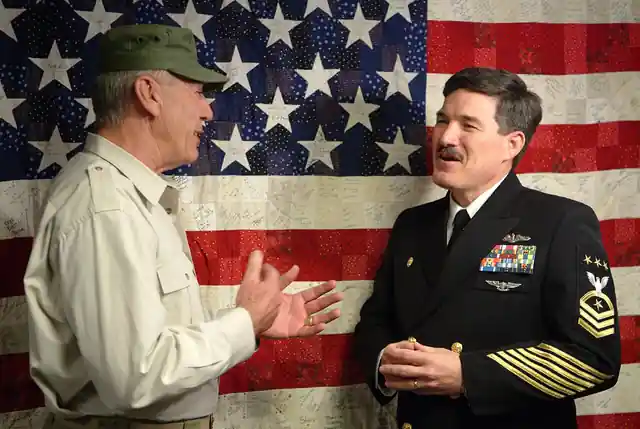
Full Metal Jacket (1987): Gny. Sgt. Hartman speaking in front of the American flagImage: Wikimedia Commons · U.S. Navy photo by Journalist 2nd Class Brandan W. Schulze, Public domain - #035
- #036
- #037
William Hope and Ricco Ross were both offered roles, but turned them down in favor of doing Aliens (1986). Ross initially tried to do both movies since both were shot around the same time in London (with members of each movie team often gathering together for parties), and his shooting schedules only overlapped by one week. However, he bowed out of this film because Stanley Kubrick could not guarantee that he would be finished at the scheduled time. When Aliens finally premiered, Kubrick was still shooting.
- #038
Stanley Kubrick really wanted to adapt the novel "The Short Timers" by Gustav Hasford into a movie, but was unsure about the title, fearing that people might think it was about people who only did half a day of work. He reportedly chose the title 'Full Metal Jacket' after reading about it in a gun magazine (as the term appears nowhere in the source novel). A "full metal jacket" refers to the type of small arms ammunition used in warfare, as heard in Private Pyle's famous line spoken on the toilet ("7.62 millimeter, full... metal... jacket"). FMJ ammunition has a copper coating covering the lead core of its projectile. Under the Geneva Convention, only FMJ bullets can be used by military personnel, because while still very deadly, they are more likely to pass through a person without greatly expanding or breaking up than other types of bullets (hollow point or unjacketed soft lead bullets), and thus causing less damage. Thus the title is a subtle commentary on the absurdity of trying to make civilized rules for warfare.
- #039
According to director John Boorman, Stanley Kubrick wanted to cast Bill McKinney in the role of Gunnery Sgt. Hartman. However, Kubrick was so unsettled after viewing McKinney's performance in Deliverance (1972) that he declined to meet with him, saying he was simply too frightened at the idea of being in McKinney's presence. Kubrick then hired Tim Colceri to play Hartman. Colceri never got to play the role, as former US Marine Corps Drill Instructor R. Lee Ermey, consultant for the Marine Corps boot camp portion of the film, performed a demonstration on videotape in which he yelled obscene insults and abuse for 15 minutes without stopping, repeating himself or even flinching - despite being continuously pelted with tennis balls and oranges. Kubrick was so impressed that he cast Ermey as Hartman. Colceri was bitter but accepted Kubrick's consolation prize of a small role as a helicopter door-gunner.
- #040
- #041
According to actor Matthew Modine, the "Mickey Mouse" scene would have originally continued to show Joker marching along with his platoon, inter-cut with flashback footage to Joker as a five year old boy playing with a toy rifle. His voice would have then narrated "Your feet tells your head to pick your body up and to run from these things that pursue you." It then would have been shown child Joker pretending to die in combat, while adult Joker is suddenly shot and killed for real in an ambush. This idea was later abandoned.
- #042
A sex scene with Pvt. Joker and the Vietnamese prostitute was cut. According to the actress, director Stanley Kubrick cut the scene because it detracted from the cold mood of the film.
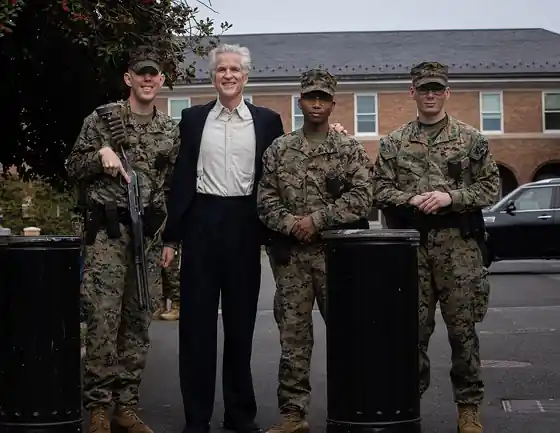
Full Metal Jacket (1987): Pvt. Joker with soldiers in front of a brick buildingImage: Wikimedia Commons · Lance Cpl. Pranav Ramakrishna, Public domain - #043
Tony Spiridakis (Captain January) was deleted from the final print. In the screenplay, Captain January has the longest dialog scene - which was the first scene of the movie to be shot. Rehearsal was done in one week and filming of the scene was shot in four weeks. However, during post-production, Stanley Kubrick realized that the off-screen actor performing the scene with Spiradikis was completely out of timing and decided to scrap the scene. All of his scenes were subsequently cut out.
- #044
- #045
- #046
- #047
- #048
- #049
Anthony Michael Hall was originally set to play Pvt. Joker as Stanley Kubrick had seen Sixteen Candles (1984) three times and felt he was perfect for the part. Hall spent eight months preparing for the role but could not reach an agreement with Kubrick regarding the salary and the schedule. He was replaced by Matthew Modine. Hall has since responded to claims that he was fired for objecting to Kubrick's perfectionist style of directing as "not true".
- #050
Stanley Kubrick decided to hire Anton Furst to do the production design for this movie after being impressed by his work in the horror movie The Company of Wolves (1984). This was an especially challenging job, since Kubrick's phobias prevented him from flying, which meant filming a movie set in South Vietnam on a constructed set outside of London. Because the Vietnam part was set in the coastal city of Hue, there was no need to construct large areas of jungle. Several hundred palm trees were brought in from Spain to give the location a tropical feel. This also explains why some outdoor scenes (like the exposed mass grave scene) have clouds of smoke in the background to prevent the viewer from seeing the outskirts of London.
- #051
- #052
- #053
Stanley Kubrick's frequent cinematographer John Alcott was approached to shoot the movie but turned it down, instead focusing on US-based projects, and Alcott's focus puller Douglas Milsome took over his duties. Filming took about six months and was shut down for 20 weeks from June 1985 to September 1986. Alcott died of a heart attack at end of July 1986.
- #054
- #055
In the book Gunnery Sergeant Gerheim (as he was known) isn't near as vulgar, but calls people into his office or the showers to beat them in private. He encourages other punishments -some worse- or orders the other recruits to perform. R. Lee Ermey once recalled that story and pointed out that any DI who ever tried something like that would never have been able to command respect among his recruits again.
- #056
The film is loosely based on the military service of the combat correspondent Gustav Hasford, who wrote stories for "Leatherneck Magazine", ""Pacific Stars and Stripes", and "Sea Tiger". There is an emphasis on the Battle of Hue (January-March, 1968), because Hasford took part in the battle and was awarded the Navy & Marine Corps Achievement Medal with Valor Device for his role in it.
- #057
Val Kilmer auditioned for the part of Pvt. Joker, but was rejected. According to Matthew Modine, he later met Kilmer in a restaurant, who confronted him about several of Modine's roles that he had also auditioned but been rejected for. Kilmer mistakenly thought that Modine had been cast in Full Metal Jacket, and nearly challenged him to a fight because he believed that Modine had stolen that part from him. Ironically, Modine was not even aware of the film at the time, but immediately had his agent confirm that Kubrick was indeed looking for actors in his new movie. Modine then auditioned by sending Kubrick footage from Vision Quest (1985) and won the part.
- #058
Most actors auditioned for their roles by submitting videotapes of themselves performing a scene in Vietnam. Director Stanley Kubrick and the studio placed ads throughout the United States for young aspiring actors to send in audition tapes for the film. They received around 3,000, of which Kubrick personally watched about 800.
- #059
Stanley Kubrick chose to shoot this film in the full-frame standard academy (1.33:1) format. In the United States, a high percentage of multiplexes are not equipped to show this format. Most audiences saw the film with the top and bottom of the frame masked off as if it were shot in spherical widescreen.
- #060
During filming, Gustav Hasford contemplated legal action over the writing credit. Originally the filmmakers intended Hasford to receive an "additional dialogue" credit, but he wanted full credit. The writer took two friends and snuck onto the set dressed as extras only to be mistaken by a crew member for Michael Herr.
- #061
- #062
- #063
- #064
The score to this film was composed by Vivian Kubrick (under the pseudonym Abigail Mead) using the Fairight CMI III (which was released in 1985) and the Fairlight CMI Series 1 (released in 1979). The Fairlight, a synthesizer and sampler, was used according to Kubrick, "to avoid any prior musical associations that conventional orchestra instruments might bring."
- #065
- #066
Part of a mini-cycle of Hollywood movies made during the early 1980s centering around military cadet training. The pictures include Taps (1981), Stripes (1981), Private Benjamin (1980), Up the Academy (1980), The Lords of Discipline (1983) and An Officer and a Gentleman (1982). Then the mid-late 1980s saw a few more: Cadence (1990), Biloxi Blues (1988), Heartbreak Ridge (1986) and this film.
- #067
- #068
Stanley Kubrick had extensive phone conversations with writer Gustav Hasford over the screenplay, to discuss the adaptation of his novel into a movie. He eventually wanted to meet with Hasford in person, even though co-screenwriter Michael Herr tried to talk Kubrick out of this, as he thought Hasford was a 'scary man'. The meeting took place at Kubrick's house, but it went so badly that Hasford was kept out of the writing process for the remainder of production. Hasford later considered legal action to obtain a full writing credit on the screenplay.
- #069
Contains a major spoiler — show
R. Lee Ermey claimed that a scene was cut in which Hartman breaks character, and warmly expresses pride toward the recruits for having completed their training. The closest that the book "The Short Timers" (that was the basis for the film) comes to such a moment is when when the sergeant confronts the crazed marine (Leonard Pratt in the book, Leonard Lawrence in the movie) in the bathroom; when he notices that his usual yelling is ineffective, he proceeds by saying "I'm proud..." but is cut off when Pratt shoots him. In the movie, Hartmann gets shot in the middle of another tirade.
- #070
- #071
Contains a major spoiler — show
According to Matthew Modine (Pvt. Joker) in an interview with Philadelphia radio station WMMR's Preston & Steve Show on May 19, 2017, originally and throughout the shoot, Joker was supposed to die in Vietnam. Director Stanley Kubrick had already scrapped an opening flashback to Joker's funeral, and kept asking Modine what he thought of Joker's death. During one creative argument, Modine blurted out that Joker should live. Kubrick pressed him as to why he should live and Modine explained that Joker saw his D.I. killed in basic training, the recruit he tried to help (Pyle) blow his brains out in a Parris Island head, the only man he knew from basic (Cowboy) die in his arms during battle, and a teen aged female sniper killed by his own hand. Joker had to live because living with those experiences were worse than dying and "that's the real horror of war." Kubrick replied, "that's the end of the movie." Modine never knew if he convinced Kubrick to change the end or if Kubrick already planned the ending and just confirmed it when Modine said it.
- #072
Contains a major spoiler — show
There was supposed to be an extra scene after Joker kills the sniper (it was in the script). After Joker kills the sniper, Animal Mother would bring out his machete and chop off the sniper's head and throw it out the window. Journalist Jon Ronson describes finding the prop of the decapitated head in his work "Stanley Kubrick's Boxes."
- #073
Matthew Modine revealed on a radio program in 2017 that Joker was originally planned to die in Vietnam. Kubrick had already shot the funeral scene and kept asking Modine what he thought about death. Modine argued that Joker should live: his instructor had been killed, Pyle had committed suicide, Cowboy had died in his arms, and he had killed a young sniper with his own hands. Living with those experiences was worse than dying, and 'that was the real horror of war.' Kubrick said, 'That's the end of the film.' Modine never knew whether he had convinced Kubrick or whether Kubrick had planned it that way all along.
- #074
- #075
- #076
It is a common misconception that most of R. Lee Ermey's dialogue was improvised. Ermey stated that he worked closely with Kubrick to make the script more convincing, but that Kubrick kept some of the dialogue. In the opening scene, when he used the phrase 'reach-around' while berating Cowboy, Kubrick immediately said 'Cut!' and asked what it meant. When Ermey explained, Kubrick laughed and told him to reshoot the scene using the phrase.
- #077
- #078
Modine wanted to leave the set on the day his pregnant wife was to have a cesarean section. Kubrick refused to allow it, saying he would faint at the sight of blood. When Modine threatened to cut his hand in order to go to the hospital, Kubrick gave him permission, saying, 'Come back the moment it's over.'
- #079
- #080
- #081
- #082
- #083
- #084
Kubrick wanted to adapt 'The Short Timers' but was unsure about the title; he feared it would be mistaken for 'people who work half a day.' He chose it after reading 'Full Metal Jacket' in a gun magazine. The term refers to the type of ammunition used in war. FMJ bullets fragment less, a subtle commentary on the absurdity of setting civilized rules for war.
- #085
- #086
- #087
- #088
Kubrick had extensive phone conversations with Hasford and wanted to meet him in person. Herr tried to dissuade Kubrick because he saw Hasford as 'a horrible man.' The meeting went so badly that Hasford was removed from the writing process and later considered legal action for full writing credit.
- #089
- #090
- #091
- #092
- #093
- #094
- #095
Co-screenwriter Michael Herr recounts that during a visit to a shooting range, Kubrick was surprised to learn that someone who had spent so much time in a war zone could be such a bad shot. The director teased him gently: 'Michael, I'm beginning to wonder whether you were capable of carrying a rifle in my beloved corps!'
- #096
- #097
- #098
- #099
During filming, Gustav Hasford considered legal action over writing credit. The producers initially planned an 'additional dialogue' credit, but he wanted full credit. Hasford took two friends and sneaked onto the set disguised as extras, though a crew member mistook him for Michael Herr.
- #100
- #101
- #102
- #103
- #104
- #105
- #106
- #107
- #108
The source novel The Short-Timers (1979) has a sequel, The Phantom Blooper (1990). The book recounts Joker's military career, his time in Viet Cong captivity and his return to the US; alienated from his family, Joker plans to return to Vietnam. A third novel was left unfinished by the author's death.
- #109
- #110
- #111
When the film was released in 1987, screenwriter Gustav Hasford was known for his literary career. In March 1988 he gained notoriety for his hobby of stealing books; campus police found about 10,000 stolen library books in a rented storage locker. He was reported to have stolen books from more than a dozen libraries in the US, the United Kingdom and Australia. In January 1989 he was sentenced to six months in prison.
- #112
- #113
Gustav Hasford, whose work formed the basis of the film, had served as a correspondent in Vietnam, writing for Leatherneck Magazine, Pacific Stars and Stripes and Sea Tiger. The particular focus on the Battle of Hue between January and March 1968 stems from the fact that Hasford took part in that fighting himself and was awarded the Navy & Marine Corps Achievement Medal with Valor Device for his outstanding performance.
- #114
Full Metal Jacket is part of a wave of early 1980s Hollywood films about military cadet training. During this period, productions such as Taps (1981), Stripes (1981), Private Benjamin (1980), Up the Academy (1980), The Lords of Discipline (1983) and An Officer and a Gentleman (1982) were released; from the mid to late 1980s, Cadence (1990), Biloxi Blues (1988) and Heartbreak Ridge (1986) continued the trend.
- #115
- #116
- #117
- #118
- #119
- #120
- #121
According to a 2017 interview with Matthew Modine, Joker was planned to die in Vietnam over the course of filming. Kubrick had already cancelled Joker's funeral scene and kept asking Modine what he thought about death. Modine said Joker had to live, because confronting the losses he suffered and the female sniper he killed was heavier than dying. Kubrick confirmed with, "That's the end of the film." Modine is not sure whether he convinced Kubrick or whether Kubrick had planned it that way all along.
- #122
- #123
Kubrick initially planned to write Gunnery Sergeant Hartman's dialogue, but was so impressed by Ermey's improvisations that he let him improvise entirely. This was almost unheard of for a Kubrick film. Ermey's performances were so flawless that his scenes were usually completed in two or three takes. The only exception was the "Jelly Donut Scene," which took 37 takes.
- #124
- #125
- #126
- #127
- #128
- #129
- #130
It is a common misconception that most of Ermey's dialogue was improvised. In fact, he worked closely with Kubrick to make the script more believable, but preserved certain lines that were important to Kubrick's vision. When he used the term "reach-around" in the opening scene, Kubrick asked what it meant, laughed when he heard the explanation, and reshot the scene to keep the phrase.
- #131
During filming, Ermey crashed a jeep and broke his left ribs. He fought not to pass out and flashed the car's headlights on and off until a driver stopped. In some scenes it is noticeable that he never moves his left arm. Kubrick said it took Ermey four and a half months to return to work and that production was shut down.
- #132
Vincent D'Onofrio gained 70 pounds (31 kilos) for the role of Private Pyle, breaking Robert De Niro's weight-gain record for Raging Bull. It took him seven months to gain the weight and nine months to lose it. He stated that his new appearance frightened women and that people, assuming he was mentally disabled, repeated what they said to him.
- #133
- #134
- #135
D'Onofrio heard about the audition from Matthew Modine. He made his audition tape with a rented video camera and military fatigues. At the time he was working as a bouncer at a club and expected little. When Kubrick and his assistant called, he thought it was a joke and hung up. He was convinced on the second call and later said he owed his career to Kubrick.
- #136
- #137
- #138
- #139
In his memoir, Matthew Modine recounts that he asked Kubrick for permission on the day his pregnant wife was to have a caesarean section. Kubrick refused, saying he would see blood and faint. Kubrick did not back down until Modine threatened to cut his own hand, and then allowed him to go on the condition that he "come back right after it's done."
- #140
- #141
- #142
- #143
Production designer Anton Furst examined 6,000 photographs from the Vietnam War. He wanted to create an image of a hellish nightmare: 'We didn't want blue skies; if the sun came out, Kubrick wouldn't shoot. When the platoon enters the burned city of Hue, we set every building on fire. Parris Island was meant to prepare them for their Vietnam tours; we contrasted the cleanliness of boot camp with the filth of war.'
- #144
R. Lee Ermey said of the physical discipline Gunnery Sergeant Hartman applies to recruits that he had never known a drill instructor who did not slap or punch a recruit. However, he noted that no drill instructor would choke a recruit unnecessarily or single one out for especially harsh treatment. The gunnery sergeant in the book frequently resorts to physical violence late in the training period; in the film this is considerably softened.
- #145
- #146
The film was shot entirely in England: Pinewood Studios and Bassingbourn Barracks. Footage of a real graduation ceremony at Parris Island was used. For the battle scenes in Hue, the abandoned gasworks town of Beckton on the Thames was used; researchers meticulously studied photographs of the real Hue, and palm trees were brought in for a tropical effect.
- #147
- #148
- #149
In the book, Gunnery Sergeant Gerheim is not that crude; he summons people to his office or the showers to beat them in private. He encourages other punishments or has recruits carry them out. R. Lee Ermey stated that a drill instructor who tried such a thing would not earn the respect of recruits.
- #150
- #151
- #152
- #153
- #154
According to Matthew Modine, the 'Mickey Mouse' scene was originally to include Joker marching with the platoon and flashbacks of five-year-old Joker playing with a toy rifle. The voice-over was to say, 'It tells you to get your feet off your head and to run from the things that pick you up and chase you.' Then it was to show the child Joker playing dead in battle, while the adult Joker is actually shot and killed in an ambush. This idea was abandoned.
- #155
- #156
Val Kilmer auditioned for the role of Private Joker but was rejected. According to Matthew Modine, when they met in a restaurant, Kilmer threw in his face several roles that Modine had auditioned for and been rejected for. Kilmer mistakenly thought Modine had been cast in Full Metal Jacket and nearly started a fight. Modine was unaware of the film at the time, but had his agent confirm that Kubrick was looking for actors for his new film. Modine later auditioned by sending Kubrick footage from Vision Quest and won the role.
- #157
- #158
According to John Boorman, Kubrick was considering Bill McKinney for the role of Gunnery Sergeant Hartman. However, he was so unsettled by McKinney's performance in Deliverance that he refused to meet with him. Kubrick then hired Tim Colceri for the role of Hartman. Colceri never got to play the role, because former Marine Corps Drill Instructor R. Lee Ermey gave a demonstration as a consultant in which he hurled obscene insults nonstop for 15 minutes on video - despite being continually pelted with tennis balls and oranges. Kubrick was so impressed that he cast Ermey as Hartman. Colceri was hurt but accepted the small role of helicopter door gunner as a consolation prize.
- #159
- #160
- #161
- #162
Stanley Kubrick was very eager to adapt Gustav Hasford's novel "The Short Timers" into a film, but he was unsure about the title; he feared people would think it was about people working half a day. He is reported to have chosen the title 'Full Metal Jacket' after reading it in a weapons magazine (the term never appears in the source novel). "Full metal jacket" refers to the type of small-arms ammunition used in war, as heard in Private Pyle's famous line in the bathroom ("7.62 millimeter, full... metal... jacket"). FMJ ammunition has a copper jacket covering the lead core of the bullet. Under the Geneva Convention, military personnel may use only FMJ bullets because, while still highly lethal, they are more likely to pass through a person than other bullet types (hollow-point or unjacketed soft-lead bullets) and therefore cause less damage. The title is thus a subtle commentary on the absurdity of trying to impose civilized rules on war.
- #163
R. Lee Ermey claimed that a scene was cut in which Hartman breaks character and expresses warm pride in the recruits for completing their training. In "The Short Timers," the book on which the film is based, the closest moment to such a scene is when the sergeant encounters the crazed marine (Leonard Pratt in the book, Leonard Lawrence in the film) in the bathroom; when he realizes his usual shouting is not working, he begins to say "I'm proud..." but Pratt shoots him. In the film, Hartmann is shot in the middle of another tirade.
- #164
To get into character as the military journalist, Matthew Modine would bring a notebook and camera to set to record and photograph his experiences. Director Stanley Kubrick encouraged him in this and often asked him to read his diary aloud on set. Modine later used his notes as the basis for his memoir "Full Metal Jacket Diary."
- #165
- #166
The weapons-drill scene in which Hartman slaps Pyle on the left and right sides of his face for a mistake appears to show Pyle disobeying an order (picking up the hat Hartman dropped). This is because Pyle's dropping of his hat was not in the script, and because Hartman mostly improvised his lines, he told Pyle out of habit to pick up his hat, but Pyle was not supposed to move for the rest of the scene.
- #167
Director Stanley Kubrick asked Michael Herr for help making a Vietnam War film, because Herr had written the narration for Apocalypse Now (1979). Kubrick and Herr became close friends over time as Kubrick shared his intention to adapt Gustav Hasford's novel "The Short Timers." Herr helped write a large portion of the screenplay, especially the section set in Vietnam. His contributions to the screenplay were largely based on his nonfiction book "Dispatches," which recounted his own experiences as a reporter covering the war. Like Joker and Rafterman, Herr was essentially a freelancer and was allowed to travel all over the country; the scene in which Joker and Rafterman watch the crazed gunner machine-gun civilians from a helicopter is taken directly from his book.
- #168
- #169
For Hue's final battle, two hundred palm trees were imported from Spain and several thousand tropical plastic plants from Hong Kong. Plastic trees had previously been brought in from California, but when director Stanley Kubrick saw them, he is reported to have said, "I don't like them. Take them away."
- #170
In many interviews about the film, R. Lee Ermey said that Hartman was meant to be an example of HOW a drill instructor should not do his job. As a real-life drill instructor, he stated that no drill instructor should physically mistreat his recruits and that any instructor who knew his job would recognize that Private Pyle was having a mental breakdown. He said he was surprised that many people seemed to admire Hartman, because he always saw him as an incompetent instructor whose ego and excessively cruel methods caused his own death.
- #171
- #172
Stanley Kubrick held extensive phone conversations with writer Gustav Hasford about the screenplay, discussing the film adaptation of his novel. Eventually he wanted to meet Hasford in person, but co-screenwriter Michael Herr tried to dissuade him because he thought Hasford was 'a horrible man.' The meeting took place at Kubrick's home, but it went so badly that Hasford was kept out of the writing process for the rest of the production. Hasford later considered taking legal action to receive full writing credit on the screenplay.
- #173
- #174
- #175
Adam Baldwin was initially supposed to shoot for three months. In the end, he shot for nine months. He later said that he was young and eager and that he sometimes argued with director Stanley Kubrick about the number of takes and the dangers to which Kubrick exposed his actors. Now he regrets that he did not fully appreciate the extraordinary experience of Kubrick's process and the fact that there were no time constraints back then.
- #176
Stanley Kubrick's daughter makes a cameo in the scene in Vietnam where Joker and Rafterman see a mass open grave. She can be seen for a few seconds operating a film camera filming the open grave. Vivian Kubrick was also the film's composer and was credited as Abigal Mead. According to her, the name was based on the Abbott's Mead estate where the Kubricks lived from 1965 to 1979. It was located near MGM's Borehamwood studio.
- #177
Stanley Kubrick decided to hire Anton Furst for this film's production design after being impressed by his work on the horror film The Company of Wolves (1984). This was a particularly difficult job, because Kubrick's phobias prevented him from flying, which meant that a film set in South Vietnam had to be shot on a set built outside London. Since the Vietnam section takes place in the coastal city of Hue, there was no need to build extensive forest areas. Several hundred palm trees were brought from Spain to give the location a tropical feel. This also explains why some exterior scenes (such as the open grave scene) have clouds of smoke in the background to hide the outskirts of London.
- #178
Anthony Michael Hall was cast after Stanley Kubrick watched 'Sixteen Candles' three times and saw him as tailor-made for the role of Pvt. Joker. Hall prepared for eight months but could not take the role because of a pay and scheduling dispute; Matthew Modine replaced him. Hall denied claims that he was fired for objecting to Kubrick's perfectionist directing style.
- #179
- #180
- #181
- #182
- #183
- #184
- #185
- #186
- #187
According to the medal ribbons on Sergeant Hartman's chest, he previously served in Vietnam and received the 'Vietnam Campaign Medal' and the 'Vietnam Service Medal' with two bronze service stars. This indicates that he took part in at least two operations during the conflict and then returned to the US as a drill instructor.
- #188
It has been suggested that R. Lee Ermey, apart from Peter Sellers, was the only actor allowed to improvise in a Stanley Kubrick film. However, there are counterexamples: Malcolm McDowell came up with the idea of Alex singing 'Singin' In The Rain' in 'A Clockwork Orange' (1971); Jack Nicholson improvised the famous 'Here's Johnny' line in 'The Shining' (1980) (Kubrick almost cut the line because he had never watched Johnny Carson's show). In the same film, Danny Lloyd came up with the idea of 'Tony' speaking through Danny Torrance's finger.
- #189
- #190
- #191
Tony Spiridakis (Captain January) was cut from the film. In the script, Captain January had the longest dialogue scene, and this scene was the first scene shot for the film. Rehearsals lasted a week and filming lasted four weeks. However, in post-production, Kubrick realized that the timing of the voice-over actor in the scene with Spiridakis was completely off and cancelled the scene. All of his scenes were cut.
- #192
- #193
- #194
Private Joker's rifle jamming at the worst possible moment is historically accurate. The M-16 was the new standard rifle used in the Vietnam War, but it became famous for its firing mechanism locking up. The reason was the US Army's switch from IMR 4475 powder to spherical ball powder. Ball powder burns faster and leaves more fouling. It also greatly accelerated the firing mechanism. Because the rifles were issued without cleaning kits, the firing mechanism jammed so badly that the rifle had to be completely disassembled to fire. This was a major problem in firefights where US forces could not return fire against Viet Cong forces using the far more reliable AK-47. The problem was solved in the late 1960s with the distribution of cleaning kits.
- #195
Stanley Kubrick shot a scene in the Norfolk Broads in which a Westland 'Wessex' helicopter (flown by a stunt pilot) flew low along a canal and a heavy machine gun was fired from the door. The scene was shot at dawn and local police had to warn fishermen, but there was a communication problem. Many fishermen woke up to an American helicopter strafing their positions with a machine gun. The helicopter was later damaged while parked when its tail rotor struck an obstacle.
- #196
- #197
- #198
- #199
- #200
- #201
Among the medals on Gunnery Sergeant Hartman's uniform are the Silver Star, the Purple Heart showing he was awarded it five times, the Navy Presidential Unit Citation, the Republic of Vietnam Gallantry Cross, the Marine Corps Good Conduct Medal, the Marine Corps Expeditionary Medal, the National Defense Service Medal, the Korean Service Medal, the Vietnam Service Medal, the Republic of Korea Presidential Unit Citation, the United Nations Korea Service Medal, the Republic of Vietnam Campaign Medal, and the Rifle and Pistol Expert badges.
- #202
- #203
A subtle joke was hidden in the scene between Colonel Poge, played by Bruce Boa, and Joker. When Joker explains the contradiction between his helmet and his peace badge with 'the duality of man' and 'the Jungian thing,' the Colonel looks bewildered. Yet Boa understood this reference perfectly, thanks to his sister Marion Woodman, a Jungian analyst, and his brother.
- #204
- #205
- #206
- #207
- #208
- #209
- #210
Some scenes of the ruined city of Hue were shot at a shipyard slated for demolition in the Isle of Dogs in London. The Hue ruins in the sniper and final night scenes were shot at the Beckton Gas Works. In some shots, a rock resembling the monolith from 2001: A Space Odyssey is visible in the background; Kubrick said this was not intentional. The Beckton Gas Works had also been used a year earlier in Biggles: Adventures in Time.
- #211
- #212
- #213
- #214
- #215
- #216
- #217
- #218
- #219
Tim Colceri was originally cast as Sergeant Hartman, but was replaced by military advisor R. Lee Ermey. Ermey won the role by convincing Kubrick. Colceri accepted the role of helicopter door gunner in the Vietnam section. Actor Michael Biehn recounted Colceri's experiences with Kubrick on Facebook in 2019: Colceri had no manager; as soon as he arrived in England, he was asked to memorize the first 28 pages of dialogue. He then rehearsed separately from the other actors with Kubrick's assistant Leon Vitali. Six days a week, twelve hours a day, he memorized several revised scripts. The shooting day was postponed repeatedly. Colceri often went to the set of Aliens (1986) to pass the time. After ten weeks of rehearsal and waiting, Vitali brought a letter from Kubrick informing him that he had been replaced by Ermey. When Biehn learned of the letter, he threw Vitali out of the house. After Colceri prepared for his new role in less than a week, Vitali said that Ermey had suffered a fatal accident and had been rehired. However, a few days later Kubrick changed his mind and decided to halt production and wait for Ermey to recover. Colceri learned six months later that filming would resume, but after rehearsing the new role, he learned that the role had been cut from the film entirely; it was restored through his new manager's intervention. He returned to England and discussed the role with Kubrick, and Kubrick wrote new dialogue. The next day Colceri did ten rehearsals; when Kubrick arrived, he asked for 16 more takes and said, "Drop the smile, give me that marine look that kills me every day." After the film was released, Colceri noticed that Kubrick had used a take in which he smiled anyway. Despite all this torment, Colceri stated that he was proud to be in the film.
- #220
Editor Martin Hunter admired Kubrick's energy after a long editing session. After editing for hours, Hunter grew tired and looked at Kubrick; Kubrick was also tired and suggested a break. Kubrick agreed and said that the festival print of "Doctor Strange" had arrived and that they could "relax" by winding and checking the reels.
- #221
- #222
During filming, Gustav Hasford considered taking legal action for writing credit. The producers initially planned to give Hasford an "additional dialogue" credit, but he wanted full credit. The writer took two friends, entered the set disguised as extras, and was mistaken for Michael Herr by a crew member.
- #223
- #224
- #225
Vincent D'Onofrio recounted that during a long and boring shoot at the old Beckton Gasworks outside London, about 300 hungry and thirsty British extras voiced their complaints in thick British accents to Kubrick, who was preparing a crane. Kubrick first lowered the crane and sent an assistant, but when the complaints continued, he came down himself and asked, "Who said that?" A few seconds later, one of the extras stood up and shouted, "I'm Spartacus!" Then another said, "No, I'm Spartacus!" and dozens of extras shouted "I'm Spartacus!" at the director of Spartacus. Filming was halted that day and they ate.
- #226
- #227
All the exterior scenes during basic training were shot at Bassingbourne barracks in Cambridgeshire. During World War II, this was a bomber base belonging to the 8th Air Force and was home to the 91st Bombardment Group. This was the group to which the Memphis Belle belonged, and all 25 of its missions were flown from here. (Matthew Modine had played the pilot on the plane's last mission in the film Memphis Belle (1990).)
- #228
Mickey Mouse is mentioned at the end of both sections. At the end of the basic training section, Sergeant Hartman shouts, "What is this Mickey Mouse shit?" At the end of the Vietnam section, the marines sing the Mickey Mouse Club theme song as they move away from the burning city of Hue. Additionally, Mickey and Minnie Mouse figurines can be seen in the background of Lieutenant Lockhart's office.
- #229
- #230
- #231
- #232
For the audition tape, R. Lee Ermey decided to film himself improvising insults at soldiers who were being considered as extras in the film, but this was not enough to convince Kubrick. Instead, Kubrick asked for a test to prove that the candidate could achieve the same success under more intense scrutiny. Kubrick had his assistant Leon Vitali throw tennis balls and oranges at Ermey while he worked on his lines; the challenge was to catch and throw back as many as possible while delivering the dialogue as fast as he could. He succeeded on the 20th attempt and ironically told Vitali, "you're my drill instructor."
- #233
John Alcott, the cinematographer Kubrick worked with often, was offered the job of shooting the film but declined, preferring to focus on US-based projects; Alcott's focus puller Douglas Milsome took over the task. Shooting lasted about six months and was halted for 20 weeks from June 1985 to September 1986. Alcott died of a heart attack at the end of July 1986.
- #234
- #235
- #236
- #237
The "What do we get for ten dollars?" dialogue between Joker and the prostitute was used as a sample in 2 Live Crew's song "Me So Horny." The song also features the lyrics "Me love you long time" and "Me sucky sucky." Attentive listeners can also notice Nancy Sinatra's "These Boots Are Made for Walkin'" in the background of the samples.
- #238
- #239
- #240
- #241
- #242
- #243
- #244
- #245
- #246
- #247
- #248
- #249
- #250
- #251
- #252
- #253
- #254
- #255
- #256
- #257
- #258
- #259
- #260
The film is based on the military service of journalist Gustav Hasford. Hasford wrote for 'Leatherneck Magazine', 'Pacific Stars and Stripes' and 'Sea Tiger', took part in the Battle of Hue (January-March 1968) and received the Navy and Marine Corps Achievement Medal (with Combat Distinguishing Device) for his role there.
- #261
- #262
- #263
Writer and former soldier George MacDonald Fraser questions the accuracy of the film's military details in his book 'The Hollywood History of the World' (1988). For example, in the wounded female sniper scene, he notes that properly trained Marines would automatically scan the area for other snipers, and that Joker and his comrades standing around arguing would quickly get them killed in a real battle. Fraser describes the experiences in the camp as 'a caricature of military discipline'; however, given that the characters in Kubrick's 'Dr. Strangelove' (1964), 'A Clockwork Orange' (1971) and 'Barry Lyndon' (1975) are also considered caricatures, this may be a deliberate choice.
- #264
- #265
The film is part of a mini-cycle of early 1980s Hollywood films revolving around military cadet training. This cycle includes productions such as 'Taps' (1981), 'Stripes' (1981), 'Private Benjamin' (1980), 'Up the Academy' (1980), 'The Lords of Discipline' (1983) and 'An Officer and a Gentleman' (1982). Then come 'Cadence' (1990), 'Biloxi Blues' (1988), 'Heartbreak Ridge' (1986) and this film.
- #266
Joker references John Wayne twice over the course of the film. The first is in the basic training section, after Gunny Hartman's opening speech, when he says in John Wayne's voice, 'Is that you, John Wayne? Is this me?' He repeats the same line in the Vietnam section, while filming to retake the city of Hue.
- #267
- #268
- #269
- #270
- #271
'Being in a world of shit.' Gunny Hartman tells the recruits during marksmanship training what will happen to them if they hesitate. The phrase appears at the end of both sections. In the basic training section, when Joker finds crazy Leonard with his rifle in the bathroom, Hartman says that if he catches them, 'we'll both be in a world of shit'; Leonard replies, 'I... am in a world of shit.' At the end of the Vietnam section, Joker says in the closing narration, 'I am in a world of shit.'
- #272
- #273
- #274
In a 2020 interview with Salon, Matthew Modine said: 'I find it strange to meet people who say they watched 'Full Metal Jacket' and joined the military. Yes, the military can offer life-changing opportunities, but 'Full Metal Jacket' is not an advertisement for joining the military... With 'Full Metal Jacket', we tried to show what happens when you have someone in basic training who doesn't fit in, when we all beat him together until his head is straight. In the film we see the terrible result.'
- #275
- #276
- #277
- #278
- #279
- #280
- #281
- #282
- #283
- #284
- #285
- #286
- #287
- #288
- #289
Kevyn Major Howard (Rafterman), Kirk Taylor (Payback) and Tony Spiridakis (whose role as Captain January was cut from the film) all played violent thugs in the Death Wish series. Howard played Stomper in Death Wish II (1982), while Taylor and Spiridakis played Giggler and Angel respectively in Death Wish 3 (1985).
- #290
- #291
- #292
- #293
- #294
- #295
- #296
- #297
- #298
Behind the Scenes (101)
- #299
- #300
- #301
- #302
- #303
Vincent D'Onofrio said during a long, tedious shoot at the old Beckton Gasworks outside London, a few of the 300 or so hungry and thirsty British extras in the scene surreptitiously voiced complaints from below in a thick British accent aimed at director Stanley Kubrick as he painstakingly fiddled with his different camera lenses from above them in preparation for a crane shot. After first lowering the crane and sending over an assistant to identify the complainant from the crowd only to hear more whining after going back up, Kubrick himself finally lowered the basket, stepped over to the assembled and asked them all "Who said it?" After several seconds of no response, finally one of the extras in the back stood up and yelled at Kubrick "I am Spartacus!" Then another stood and yelled "No, I am Spartacus!" And another and another and then dozens of them yelled "I am Spartacus!" at the director of Spartacus. They wrapped for the day and ate.
- #304
- #305
According to an interview with Vincent D'Onofrio, the production schedule for the film was so drawn-out that lead actor Matthew Modine got married, conceived a child with his wife, the child was born, and then turned one year old... all during the course of filming.
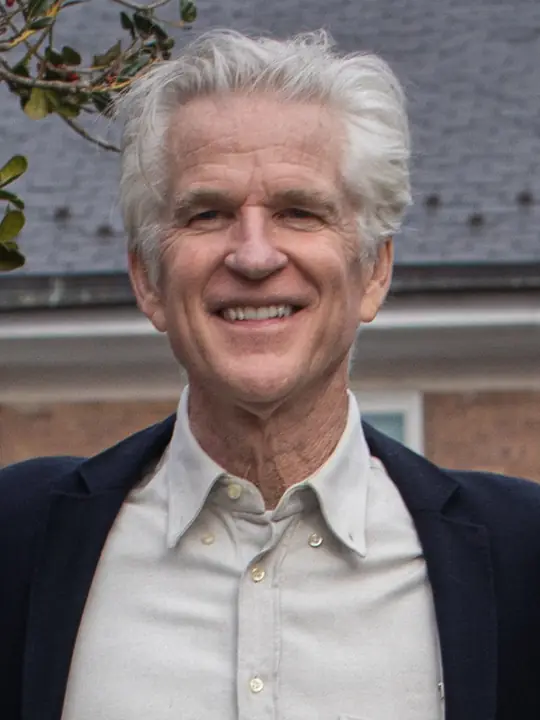
Full Metal Jacket (1987): Pvt. Joker smiling in the barracksImage: Wikimedia Commons · Lance Cpl. Pranav Ramakrishna, Public domain - #306
Adam Baldwin was originally supposed to do principal photography for three months. He ended up doing it for nine months. He later stated that he was young and eager, and would sometimes clash with director Stanley Kubrick over the number of takes and the hazards that Kubrick would put his actors through. He now regrets not fully appreciating the extraordinary experience of being part of Kubrick's process and free from time constraints at the time.
- #307
- #308
Stanley Kubrick shot a scene in the Norfolk Broads where a Westland "Wessex" helicopter (flown by a stunt pilot) was required to fly low down along a canal (the area doubling for paddy fields) while someone fired a heavy machine gun out of the doors. The scene was shot at dawn and the local police were supposed to have warned fishermen but there was a communications problem. The many fishermen were awoken by a US helicopter apparently machine gunning their "positions". The Wessex itself was subsequently damaged during filming when the tail rotor got pushed into an obstacle while the copter was parked.
- #309
Some scenes of the ruined city of Hue were shot at a dockyard on the Isle of Dogs, London, that was scheduled for demolition. The ruins of Hue in the sniper and final nighttime scenes were shot at the Beckton Gasworks in London's East End, which was also slated for demolition. In some shots there is a rock in the background that looks very much like the monolith from Stanley Kubrick's 2001: A Space Odyssey (1968). Kubrick said it wasn't intentional, but only noticed while watching the rushes. Beckton Gas Works was used a year before for the movie Biggles: Adventures in Time (1986).
- #310
All of the Vietnam sequences of the film were shot first, and the Parris Island basic training scenes were filmed second. The opening shot of the street of Da Nang with the local prostitute was the the very first scene to be filmed. The shot of the Marine recruits marching during their graduation was the very last scene to be filmed.
- #311
Editor Martin Hunter admired Stanley Kubrick's energy after one lengthy editing session. Editing for hours, Hunter, tired and weary, looked over at Kubrick, who was also tired and suggested they have a break. Kubrick agreed, and said that a festival print of "Doctor Strange" had just come in and that they could "relax" by winding the reels through and checking it over.
- #312
R. Lee Ermey was involved in a jeep accident during the making of the movie. At 1:00 a.m. one night he skidded off the road, breaking all the ribs on his left side. He refused to pass out, and kept flashing his car lights until a motorist stopped. In some scenes you'll notice that he does not move his left arm at all. Stanley Kubrick claimed in an interview that it took four and a half months before Ermey could return to work in which production simply had to be suspended since he was involved in all the remaining scenes.
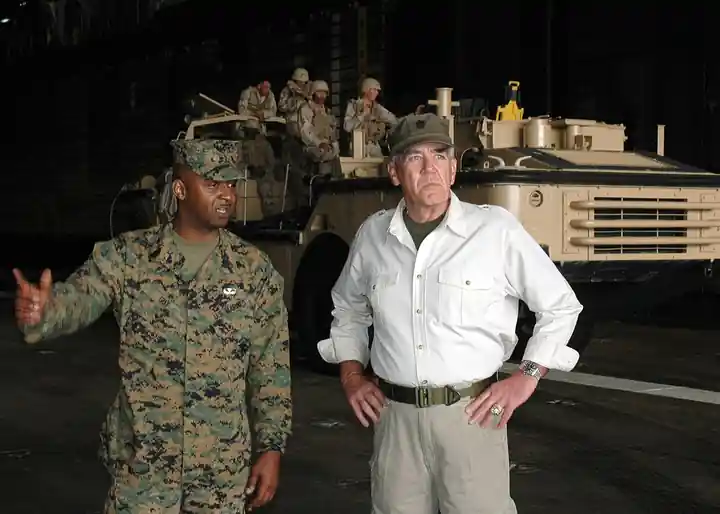
Full Metal Jacket (1987): Gny. Sgt. Hartman speaking in front of a military vehicle at nightImage: Wikimedia Commons · U.S. Navy photo by Photographer’s Mate Airman Nelson A. Graca, Public domain - #313
Director Stanley Kubrick had nothing but praise for R. Lee Ermey's skills as a performer. Kubrick originally was going to write dialogue for Ermey's character himself, but he became so impressed with what Ermey improvised, he decided it was not necessary. He simply let him ad-lib, an act practically unheard of for a Kubrick film. Ermey's performances were so faultless that Kubrick only needed two to three takes to get his scenes filmed, which was also extremely rare for a Kubrick film. The only instance Ermey had to film more than two to three takes was in the "Jelly Doughnut Scene," which he claimed was filmed in 37 takes, to the point his voice kept disappearing from time to time.
- #314
It is a common misconception that much, if not all, of R. Lee Ermey's dialogue during the Parris Island sequence was improvised. In several interviews Ermey himself has stated that he worked closely with Stanley Kubrick to help mold the script so that it was more believable, all while retaining certain dialogue crucial to Kubrick's vision. While filming the opening scene, where he disciplines Pvt. Cowboy, he yells at Cowboy by crudely describing him as "the type of guy who would fuck a person in the ass and not even have the god damned common courtesy to give him a reach-around". Kubrick immediately yelled cut and went over to Ermey and asked, "What the hell is a reach-around?" Ermey politely explained what it meant. Kubrick laughed and re-shot the scene, telling Ermey to keep the line.
- #315
- #316
All the out door scenes during basic training were filmed at Bassingbourne barracks in Cambridgeshire. In WWII this was an 8th Airforce bomber base, home to the 91st Bomber Group. This was the Bomb Group that the Memphis Belle belonged to and the base is where all 25 of her missions were flown from. (Matthew Modine starred in the movie Memphis Belle (1990) as the pilot of the plane on its final mission.)
- #317
- #318
- #319
- #320
According to Vincent D'Onofrio, to prepare himself for Private Pyle's final scene, he had the nursery rhyme "Three Blind Mice" playing in his head before and during the scene was filmed. He discovered that the nursery rhyme not only relaxed him, but also put him in the state of mind that he found fitting for the scene.
- #321
Vincent D'Onofrio gained 70 pounds (31 kilos) for his role as Pvt. Pyle, breaking Robert De Niro's movie weight-gain record (60 pounds; 27 kilos) for Raging Bull (1980) (a record that still stands as of 2025). It took him seven months to put the weight on, and nine months to take it off with physical training. He noted that his new look scared off women, and people would often repeat things to him, thinking that he was mentally challenged.
- #322
- #323
To get into character as a military journalist, Matthew Modine would bring a notepad and camera, and write down and photograph the things he experienced on set. Director Stanley Kubrick encouraged him in this, and frequently asked him to read his diary aloud on set. Modine would later use the notes as the basis of his memoirs, "Full Metal Jacket Diary".
- #324
- #325
- #326
To make Gunnery Sgt. Hartman's performance and the recruits' reactions as convincing as possible, Matthew Modine, Vincent D'Onofrio, and the other actors playing recruits never met R. Lee Ermey prior to filming. Stanley Kubrick also saw to it that Ermey didn't fraternize with the actors between takes.
- #327
The manual of arms scene where Hartman slaps Pyle on the left and right side of his face for his mistake appears to show Pyle disobeying an order (to pick up his cover, or hat, after Hartman knocked it off). This is because it wasn't in the script for Pyle's hat to be knocked off, and since Hartman was mostly ad-libbing his lines, he told Pyle to pick it up by force of habit, but Pyle wasn't supposed to move for the rest of the scene.
- #328
Co-screenwriter Michael Herr relates that they visited a firing range and Stanley Kubrick was surprised to find out that someone who had spent so much time in a war zone could be such a lousy shot, so the director gently teased him: "Gee, Michael, I'm starting to wonder if you have what it takes to carry a rifle in my beloved corps!"
- #329
- #330
While location scouting for the film Stanley Kubrick was driving his wife's new SUV around the countryside with cinematographer Douglas Milsome and R. Lee Ermey as passengers. At one point Kubrick noticed a potential location out his window, and became so distracted describing to Milsome how he wanted the location used in the film that he crashed the car into a six foot deep ditch, rolling the SUV onto its side. Undeterred, Kubrick continued talking about the location uninterrupted as they climbed out of the car and walked back home.
- #331
- #332
- #333
- #334
- #335
- #336
- #337
- #338
Many have noticed that, during the opening scene where Gunnery Hartman belittles Joker and Cowboy, the Senior Drill Instructor walks past one recruit before getting to Pyle. This has led to speculation that the actor was misplaced there by accident, and that Pyle was supposed to be standing next to Cowboy, as it would make no sense for Hartman to skip over somebody as he does in the movie. R. Lee Ermey was asked about this in a 2008 appearance, in which he stated this was actually not a mistake: during his time as a drill instructor, Ermey would usually skip over some privates to catch the next one off guard, as they would not be expecting to be yelled at next.
- #339
In his memoir, Matthew Modine recalled a day where he asked Stanley Kubrick's permission to leave the set because his pregnant wife was scheduled to have a C-section, and he didn't have scenes planned for that day. Kubrick didn't want him to leave the set, claiming that he would just pass out from the blood and get in the way of the doctors. It wasn't until Modine threatened to cut his own hand in order to get to the hospital that Kubrick relented and allowed him to leave (by making him promise to "come back immediately after it's done").
- #340
It has been suggested that R. Lee Ermey was the only actor allowed to improvise, barring Peter Sellers, in a Stanley Kubrick film. However, there are some counterexamples: Malcolm McDowell came up with the idea of Alex singing "Singin' In The Rain" in A Clockwork Orange (1971), and Jack Nicholson improvised the infamous "Here's Johnny" line in The Shining (1980) (the line was almost cut as Kubrick had never watched The Tonight Show Starring Johnny Carson (1962)). In that same movie, Danny Lloyd came up with the idea of "Tony" speaking through Danny Torrance's finger.
- #341
The entire film was shot in England (Pinewood Studios and Bassingbourn Barracks). Footage of an actual graduation ceremony at Parris Island was used in the film, with an insert from England added to it. For the final battle scenes set in Hue, Stanley Kubrick was able to use the abandoned gasworks town of Beckton on the River Thames. Researchers painstakingly went through dozens of shots of the real Hue in order to make sure Beckton looked authentic, and palm trees were brought into the area to create a tropical effect.
- #342
For the final battle of Hue, two hundred palm trees were imported from Spain and a few thousand tropical plastic plants were imported from Hong Kong. Plastic trees had previously been flown in from California, but upon seeing them, director Stanley Kubrick reportedly said, "I don't like it. Get rid of it."
- #343
- #344
- #345
For his audition tape, R. Lee Ermey decided to be filmed curling ad-libbed insults in the direction of soldiers being considered for background roles in the film, which still wasn't enough to convince Stanley Kubrick. Instead, he demanded a test of his own, one designed to ensure the prospective cast that he'd be able to replicate the feat under heightened scrutiny. To that end, Kubrick drafted his assistant Leon Vitali to launch tennis balls and oranges in Ermey's direction while he rehearsed his lines, with the difficulty being increased by the fact he had to catch as many as possible and throw them back while reciting his dialogue as fast as possible. If he missed a beat, slipped up, or slowed down, he finally mastered it on the 20th attempt, which proved to be such a exacting process that he ironically referred to Vitali as "my drill instructor."
- #346
- #347
- #348
- #349
Contains a major spoiler — show
After Private Pyle's continual failures, Joker leads others to do what is called a "blanket party" on him. This is reserved for substandard recruits in both the Navy and the Marines, and is designed to motivate one to improve or get kicked out. The initial scene shows a recruit putting a bar of soap inside of a towel as a striking weapon, which is factual for a blanket party. For the movie, the bars of soap were replaced with rolled-up socks to add to the dramatic effect of the pain inflicted on Private Pyle, but he wasn't really hurt. If it was a real blanket party, Private Pyle would have been covered in bruises in the afflicted area the next day.
- #350
- #351
Director Stanley Kubrick did nothing but praise R. Lee Ermey's skills as an artist. Kubrick had initially planned to write the dialogue for Ermey's character himself, but he was so impressed by Ermey's improvisations that he decided it was unnecessary. He allowed him to improvise, an almost unheard-of move for a Kubrick film. Ermey's performances were so flawless that Kubrick needed only two or three takes to shoot his scenes, which was also extremely rare for a Kubrick film. The only instance in which Ermey had to do more than two or three takes was the "Jelly Doughnut Scene," which he claimed was shot in 37 takes, to the point that his voice occasionally gave out.
- #352
It is a common misconception that R. Lee Ermey's dialogue during the Parris Island scenes was entirely, or mostly, improvised. In several interviews, Ermey stated that he worked closely with Stanley Kubrick to make the script more convincing and that Kubrick kept certain lines that were vital to his vision. While shooting the opening scene in which he disciplines Pvt. Cowboy, he yells at Cowboy and crudely calls him "the kind of guy who could fuck a man in the ass and not even have the courtesy to lie around." Kubrick immediately yelled cut and went over to Ermey and asked, "What does lying around mean?" Ermey politely explained what it meant. Kubrick laughed and reshot the scene, telling Ermey to keep the line.
- #353
- #354
- #355
While Kubrick was scouting locations in his wife's SUV, cinematographer Douglas Milsome and R. Lee Ermey were with him. In a momentary lapse of attention, they drove the vehicle into a six-meter ditch and rolled it onto its side. Even as he got out of the car and walked home, Kubrick kept talking about the location.
- #356
R. Lee Ermey broke all of his left ribs in a jeep accident at 1 a.m. He fought not to pass out and flashed his headlights on and off until a driver stopped. In some scenes you can notice that he never moves his left arm. Kubrick said Ermey's recovery took four and a half months and that production was halted for the remaining scenes.
- #357
- #358
- #359
- #360
Production designer Anton Furst studied 6,000 Vietnam War photographs. "We didn't want blue sky; if the sun came out, Kubrick wouldn't shoot. We contrasted the cleanliness of Parris Island with the filth of the war; the aim was for them to encounter something they couldn't be trained for."
- #361
- #362
The film was shot entirely in England: Pinewood Studios and Bassingbourn Barracks. Footage of a real graduation ceremony at Parris Island was used. For the Hue battle scenes, Beckton, an abandoned gasworks town on the Thames, was used; to make it look authentic, dozens of shots of the real Hue were studied and palm trees were brought in.
- #363
- #364
- #365
- #366
- #367
- #368
- #369
Kubrick hired Anton Furst after being impressed by his work on The Company of Wolves (1984). Because of Kubrick's fear of flying, the Vietnam scenes were shot on a set built outside London. Smoke clouds were used in the exterior scenes so that London would not be visible in the background.
- #370
- #371
- #372
- #373
- #374
It is said that R. Lee Ermey, apart from Peter Sellers, is the only actor allowed to improvise in a Stanley Kubrick film. But there are exceptions: Malcolm McDowell came up with the idea of Alex singing "Singin' In The Rain" in A Clockwork Orange (1971); Jack Nicholson improvised the famous "Here's Johnny" line in The Shining (1980) (the line was nearly cut because Kubrick had never seen The Tonight Show with Johnny Carson); and Danny Lloyd came up with the idea of Tony speaking through his finger.
- #375
- #376
Stanley Kubrick shot a scene on the Norfolk Broads that required a Westland "Wessex" helicopter (flown by a stunt pilot) to fly low along a canal while someone fired a heavy machine gun from the door. The scene was shot at dawn and the local police were supposed to warn the fishermen, but there was a communication problem. Many fishermen woke up to claims that a US helicopter was machine-gunning their positions. The Wessex was later damaged while parked when its tail rotor struck an obstacle.
- #377
- #378
- #379
The film's music was composed by Vivian Kubrick (under the pseudonym Abigail Mead) using a Fairlight CMI III (1985) and a Fairlight CMI Series 1 (1979). According to Kubrick, the Fairlight, a synthesizer and sampler, was used "to avoid the previous musical associations that traditional orchestral instruments might bring."
- #380
Some of the scenes of the ruined city of Hue were shot at a shipyard in the Isle of Dogs in London that was scheduled for demolition. The Hue ruins in the sniper and final night scenes were shot at the Beckton Gas Works in London's East End, also scheduled for demolition. In some shots, a rock in the background looks very much like the monolith from Stanley Kubrick's 2001: A Space Odyssey (1968). Kubrick said this was not intentional and that he only noticed it while watching the raw footage. Beckton Gas Works had been used a year earlier for Biggles: Adventures in Time (1986).
- #381
- #382
Editor Martin Hunter admired Stanley Kubrick's energy after a long editing session. After editing for hours, Hunter, tired and exhausted, looked at Kubrick, who was also tired and suggested taking a break. Kubrick agreed and said that a festival print of "Doctor Strange" had just arrived and that they could "relax" by winding and checking the reels.
- #383
- #384
Vincent D'Onofrio recounted that during a long and tedious shoot at the old Beckton Gas Works outside London, some 300 hungry and thirsty British extras secretly complained in thick British accents to director Stanley Kubrick, who was up above dealing with lenses for a crane shot. Kubrick first lowered the crane and sent an assistant to identify the complainer, but when he went back up and heard more grumbling, he finally lowered the basket himself and asked the gathered crowd, "Who said it?" After a few seconds of silence, one of the extras at the back stood up and shouted at Kubrick, "I'm Spartacus!" Then another stood up and said, "No, I'm Spartacus!" and soon dozens of extras were shouting "I'm Spartacus!" at the director of the film Spartacus. They finished the day's shooting and ate.
- #385
All the exterior scenes during basic training were shot at Bassingbourne barracks in Cambridgeshire. During World War II this was a bomber base belonging to the 8th Air Force and was home to the 91st Bombardment Group. This was the Bombardment Group to which the Memphis Belle belonged, and the base was where all 25 of the aircraft's missions were launched. (Matthew Modine had played the pilot on the aircraft's final mission in the film Memphis Belle (1990).)
- #386
Stanley Kubrick's frequent collaborator, cinematographer John Alcott, was called to shoot the film but declined the offer, preferring to focus on US-based projects, and Alcott's focus puller Douglas Milsome took over his role. Shooting lasted about six months, with a 20-week break from June 1985 to September 1986. Alcott died of a heart attack at the end of July 1986.
- #387
- #388
- #389
- #390
- #391
- #392
- #393
- #394
- #395
- #396
- #397
- #398
- #399
Characters & Cast (68)
- #400
- #401
Regarding his character Gunny Hartman's brutal discipline of the recruits, R. Lee Ermey once said in an interview that he never knew a single DI who didn't put hands on a recruit, whether it be a slap on the head or a punch in the solar plexus, as Hartman does with Joker. However, Ermey was quick to point out that no DI would pointlessly choke a recruit or single out a recruit for especially harsh treatment. Nevertheless, the gunnery sergeant in the book that the film was based on ("The Short Timers" by Gustav Hasford) often resorts to physical violence during the latter part of his drilling period, something that was significantly toned down in the movie.
- #402
The casting of Joker and Animal Mother can be seen as a case of art imitating life: Matthew Modine is an outspoken liberal Democrat, not too dissimilar to Joker; who is clearly more of a dove, and may not have any religious preference (He tells Sergeant Hartman he does not believe in the Virgin Mary). Meanwhile, Animal Mother's hawkish instinct can be somewhat of a parallel to Adam Baldwin's conservatism.
- #403
- #404
Gunnery Sergeant Hartman wears the following decorations: Silver Star, Purple Heart (with silver star, indicating five awards), Navy Presidential Unit Citation, Republic of Vietnam Gallantry Cross (with palm), Marine Corps Good Conduct Medal (with silver star, indicating five awards), Marine Corps Expeditionary Medal, National Defense Service Medal (with bronze star, indicating two awards), Korean Service Medal, Vietnam Service Medal (with bronze star, indicating two awards), Republic of Korea Presidential Unit Citation, United Nations Service Medal for Korea, Republic of Vietnam Campaign Medal, Rifle Expert marksmanship badge, Pistol Expert marksmanship badge.
- #405
- #406
- #407
- #408
- #409
- #410
- #411
- #412
- #413
In every dialogue scene with Animal Mother, he delivers his lines employing what Paypack describes and what's commonly referred to as the "thousand-yard stare." Also known as the two thousand yard stare or shell-shock, one would describe it as a far off emotionless gaze typically washed over battle-weary soldiers who have seen traumatic battle and death.
- #414
R. Lee Ermey has said in many interviews about the film that Hartman was supposed to be an example of how a drill instructor should NOT do their job. As a real-life drill instructor, he said that no D.I. should or would ever physically abuse his recruits, and any instructor worth their salt would have noticed that Pvt. Pyle was suffering a mental breakdown. He has said that he's shocked that so many people seemed to admire Hartman, since he always saw him as an inept instructor whose ego and overly cruel methods caused his own death.
- #415
Vincent D'Onofrio claimed that he based his performance as Pvt. Pyle on the silent film performances of Lon Chaney, and he was overjoyed when he heard Stanley Kubrick tell him, "I want you to be big. Lon Chaney big," without knowing that D'Onofrio had been studying Chaney's films all along.
- #416
- #417
- #418
Vincent D'Onofrio heard about the film's auditions from Matthew Modine. Using a rented video camera and wearing army clothes, he recorded his audition for the role of Pvt. Pyle. At the time D'Onofrio was working as a bouncer at a club and had appeared in only a few projects, so he did not expect much from the audition. In fact, when director Stanley Kubrick and his assistant called him about the role, D'Onofrio thought someone was playing a joke on him and hung up. In their second conversation, they managed to convince him that they were real and genuinely interested in him. D'Onofrio later said he owed his career to Kubrick casting him in the film.
- #419
Most of the actors auditioned for their roles by sending in videotapes shot while performing a scene set in Vietnam. Director Stanley Kubrick and the studio placed advertisements all over the United States for young actor candidates to send in audition tapes for the film. They received about 3,000, and Kubrick personally watched about 800 of them.
- #420
- #421
Val Kilmer auditioned for the role of Pvt. Joker but was rejected. According to Matthew Modine, he later met Kilmer at a restaurant, and Kilmer confronted him about some of the roles Modine had won that Kilmer had also auditioned for and been rejected from. Kilmer mistakenly thought Modine had been in Full Metal Jacket and nearly invited him to a fight, believing Modine had stolen that part from him. Ironically, Modine was not even aware of the film at the time, but his agent immediately confirmed that Kubrick really was looking for an actor for his new film. Modine then auditioned by sending Kubrick footage from Vision Quest (1985) and won the role.
- #422
- #423
Stanley Kubrick was so impressed by R. Lee Ermey's acting that he gave up writing the dialogue himself. Ermey's improvisations were so flawless that Kubrick usually completed scenes in two or three takes, which was extremely rare for him. The only exception was the "Jelly Donut Scene," which took 37 takes and in which his voice occasionally gave out.
- #424
- #425
Vincent D'Onofrio gained 70 pounds (31 kg) for the role of Private Pyle, breaking Robert De Niro's record in Raging Bull (a record that still stands as of 2025). It took him seven months to gain the weight and nine months to lose it through physical training. He said his new appearance frightened women and that people assumed he was mentally disabled and repeated what he said back to him.
- #426
Vincent D'Onofrio heard about the role from Matthew Modine. He made an audition tape with a rented video camera and military fatigues. At the time he was working as a bouncer at a club and had appeared in only a few projects, so he did not expect much from the audition. When Stanley Kubrick and his assistant called him, D'Onofrio hung up on them because he thought it was a joke. They convinced him on the second call. D'Onofrio later said he owed his career to Kubrick.
- #427
- #428
- #429
In an interview, R. Lee Ermey said he did not know a single drill instructor who did not use the physical contact Hartman applies to the recruits (a slap to the head, a punch to the solar plexus). However, he stated that no drill instructor would choke a recruit unnecessarily or subject him to especially harsh treatment. The first sergeant in the book the film is based on frequently resorts to physical violence late in the training period; this was significantly softened in the film.
- #430
- #431
- #432
Val Kilmer auditioned for the role of Private Joker but was rejected. According to Matthew Modine, he later ran into Kilmer at a restaurant, and Kilmer confronted him about several roles Modine had auditioned for and been rejected for. Kilmer mistakenly thought Modine had been cast in Full Metal Jacket and nearly challenged him to a fight because he believed Modine had stolen the role from him. Ironically, Modine was not even aware of the film at the time, but he immediately had his agent confirm that Kubrick was looking for actors for his new film. Modine then auditioned by sending Kubrick footage from Vision Quest (1985) and won the role.
- #433
Stanley Kubrick wanted Bill McKinney for the role of Sergeant Hartman but was so disturbed by his performance in Deliverance (1972) that he refused to meet with him. Kubrick then hired Tim Colceri. Colceri never got to play the role because the consultant R. Lee Ermey recorded a video in which he spewed obscene insults for 15 minutes without stopping, repeating himself or flinching, all while being pelted with tennis balls and oranges. Kubrick was so impressed that he cast Ermey as Hartman. Colceri was hurt but accepted a small role as a helicopter door gunner as a consolation prize from Kubrick.
- #434
- #435
To get into character as the military journalist, Matthew Modine brought a notebook and camera with him, writing about and photographing what he experienced on set. Stanley Kubrick encouraged him in this and often asked him to read his diary aloud on set. Modine later used the notes as the basis for his memoir "Full Metal Jacket Diary."
- #436
- #437
- #438
Adam Baldwin was initially scheduled to shoot for three months, but ended up filming for nine. He later said he was young and eager and sometimes clashed with Stanley Kubrick over the number of takes and the dangers the actors were exposed to. He now regrets not fully appreciating at the time the extraordinary experience of Kubrick's process and of being free from time constraints.
- #439
Anthony Michael Hall was originally cast as Private Joker because Stanley Kubrick had watched Sixteen Candles (1984) three times and thought he was perfect for the role. Hall prepared for the role for eight months but could not agree with Kubrick on salary and scheduling. Matthew Modine replaced him. Hall later said claims that he was fired for objecting to Kubrick's perfectionist directing style were "not true."
- #440
- #441
- #442
- #443
- #444
- #445
- #446
- #447
- #448
Tim Colceri was originally cast as Sergeant Hartman, but military advisor R. Lee Ermey successfully lobbied Kubrick to play the role himself. Colceri accepted the role of helicopter door gunner. According to memories Michael Biehn shared in 2019, as soon as Colceri arrived in England he received written instructions from Kubrick asking him to memorize 28 pages of dialogue. For weeks he rehearsed twelve hours a day, six days a week, but his scenes were postponed repeatedly. Ten weeks later, Kubrick's assistant Leon Vitali informed Colceri that his role had been given to Ermey. While Colceri was preparing for his new role, Ermey had a near-fatal accident and was rehired, but Kubrick changed his mind and halted production. Returning to the US six months later, Colceri learned that his new role had been cut from the film; it was restored after his agent intervened. Kubrick wrote new dialogue for him and told Colceri during filming, 'Drop the smile, give me your everyday killer marine look.' When the film was released, Colceri noticed that Kubrick had used a take in which he was laughing. Despite all this ordeal, Colceri is proud of his involvement in the film.
- #449
- #450
For his audition tape, R. Lee Ermey was filmed improvising insults at soldiers being considered for background roles, but this was not enough to convince Kubrick. Kubrick tasked his assistant Leon Vitali with throwing tennis balls and oranges at Ermey; Ermey had to deliver his dialogue quickly while catching them and throwing them back. If he paused for a moment or made a mistake, he started over. Ermey succeeded on the 20th attempt and ironically told Vitali, 'my drill sergeant.'
- #451
- #452
- #453
William Hope and Ricco Ross were offered roles but turned them down, preferring to appear in 'Aliens' (1986). Ross initially tried to appear in both films because both were shooting in London at the same time and their schedules overlapped by only a week. However, he withdrew from this film after Kubrick could not guarantee he would finish on time. When 'Aliens' was released, Kubrick was still shooting.
- #454
- #455
- #456
- #457
- #458
- #459
- #460
Matthew Modine said in a 2020 interview with Salon: "I find it strange to meet people who say they watched 'Full Metal Jacket' and then joined the military. Yes, the military can offer life-changing opportunities, but Full Metal Jacket is not an advertisement for joining up... What we were trying to show with Full Metal Jacket was what happens when someone doesn't fit in during boot camp, when we all beat him together until he straightens out. In Full Metal Jacket we see the terrible result."
- #461
- #462
- #463
- #464
- #465
The casting of Joker and Animal Mother is a fine example of art imitating life: Matthew Modine, like Joker, is an outspoken liberal Democrat; Joker is a dove at heart, with an unclear religious preference (he tells Hartman he does not believe in the Virgin Mary). Animal Mother's hawkish instincts, meanwhile, parallel Adam Baldwin's conservatism.
- #466
- #467
Easter Eggs & References (41)
- #468
- #469
- #470
- #471
Mickey Mouse is referred to at the end of both segments. At the end of the boot camp segment, Gunny Hartman yells "What is this Mickey Mouse shit." At the end of the Vietnam segment, the Marines are singing the theme song to The Mickey Mouse Club as they march away from the burning city of Hue. Also a Freeze-Frame Bonus: look toward the background of Lt. Lockhart's office, figurines of Mickey and Minnie Mouse can be seen.
- #472
- #473
The Charles Whitman shootings (which Gunny Hartman describes to the recruits as an example of "what one motivated Marine and his rifle can do") took place August 1, 1966, presumably a few months before the recruits arrive on Parris Island. Though only one person (Cowboy) raises his hand when the recruits are asked who Charles Whitman was, the Associated Press and United Press International called the shootings the second most important news story of 1966--trailing only the Vietnam War.
- #474
The first sentence of dialogue that Lt. Lockhart gives to his press team, the morning after the Tet offensive, "the enemy has very deceitfully, chosen to take advantage of the Tet ceasefire," is identical to language from a speech that Gen. Westmoreland gave to the press the day after the actual Tet offensive.
- #475
Joker and Cowboy are the only two members in the platoon who wear eyeglasses and they are each wearing different styles of designer eyeglasses. In 1960s Marine Corps, and even today, recruits who need vision correction are issued standard government-issue (GI) plastic-cellulose spectacles colloquially known as "birth control glasses" (BCGs). The 1960s-era BCG glasses featured heavy, chunky, horn-rimmed brown cellulose acetate (plastic) frames with a distinct, utilitarian shape. They were notoriously unstylish, heavy, and hard-edged. Upon arrival at Marine Corps Recruit Depot (MCRD) San Diego or Parris Island, personal civilian glasses are immediately confiscated alongside other civilian belongings, safely stored, and returned only upon graduation/completion of training. Recruits are required to wear their issued BCGs at all times.
- #476
- #477
- #478
- #479
- #480
- #481
- #482
- #483
- #484
- #485
In the German dub, Pvt. Pyle is named Pvt. Paula. This is because the character Gomer Pyle is unknown in Germany, as Gomer Pyle: USMC (1964) and The Andy Griffith Show (1960), which the former show was spun off from and in which the Gomer Pyle character of a dumb country bumpkin originated, never aired there.
- #486
In the Sea Tiger editorial scene, an American flag was seen at the back of the Quonset hut. This was Gustav Hasford's nod to his fellow combat correspondent Bob Bayer who donated photographs and various items for set decoration of the movie. The flag seen was also his and it contains signatures of all First Marine combat correspondents of 1967-68.
- #487
Joker references actor John Wayne during both segments. First in the boot camp segment, in his very first line in the film, when he says out loud and in Wayne's voice, after Gunny Hartman's opening speech, "Is that you, John Wayne? Is this me?". He repeats the line later during the Vietnam segment, while the Marines are being filmed while going into Hue to take the city back from the NVA.
- #488
- #489
- #490
Stanley Kubrick's daughter makes a cameo appearance during a scene in Vietnam where Joker and Rafterman encounter a mass open grave. She can be seen wielding a motion picture camera, shooting into the open grave for a few moments. Vivian Kubrick was also the film's composer, credited as Abigal Mead. According to her, the name was based on Abbott's Mead, the mansion where the Kubricks lived from 1965 to 1979. It was located near to MGM's Borehamwood studio.
- #491
- #492
- #493
Bruce Boa's Poge Colonel scene with Private Joker likely contained a subtle inside joke. When pressed for an answer on the contradictory meanings of his helmet and peace button Joker replies talking about the "duality of man" and the "Jungian thing". While the Colonel looks perplexed at Joker's explanation, the actor Boa knew exactly what he meant. Both Boa's older sister, Marion Woodman, and younger brother were published Jungian analysts.
- #494
- #495
"A world of shit". Gunny Hartman first tells the recruits during marksmanship training that this is what they will be in if they hesitate in combat. It's referred to at the end of both of segments. At the end of the boot camp segment, Joker, after, finding the crazy Leonard in the head with his rifle, tell him that if Hartman catches them, they'll "both be in a world of shit" to which Leonard replies, "I AM...in a world...of shit." At the end of the Vietnam segment, Joker says, during his closing narration, "I am in a world of shit."
- #496
When Lt Lockhart was briefing the combat correspondents in their office, one can see two Mickey Mouse figurines on the windowsill over Joker's left shoulder. At the end of the film during the final voice over narration the Marines are heard signing the Mickey Mouse theme song while marching.
- #497
- #498
- #499
- #500
According to Sgt. Hartman's medal ribbons on his chest, he previously served in Vietnam where he received the "Vietnam Campaign Medal" and the "Vietnam Service Medal" with two bronze service stars. The latter indicates he took part in at least two operations during the conflict before he was stationed back in the United States as a drill instructor.
- #501
Gunny Hartman said to the recruits when they got their rifles: "You will give your rifle a girl's name! Because this is the only pussy you people are going to get! Your days of finger-banging old Mary Jane Rottencrotch through her pretty pink panties are over!" In the closing narration, Joker says: "My thoughts drift back to erect nipple wet dreams about Mary Jane Rottencrotch and the Great Homecoming Fuck Fantasy."
- #502
Lines from the scene in which Private Joker (Matthew Modine) and Private Rafterman (Kevyn Major Howard) are approached by the Da Nang Hooker (Papillon Soo) were sampled in 2 Live Crew's 1989 hit "Me So Horny" on the album 'As Nasty As They Wanna Be'. The exchange between Joker and the hooker - "What do we get for ten dollars? / Every t'ing you want. / Everything? / Every t'ing." - is used at the very beginning of the song. While the "Me so horny. Me love you long time" sample is used in the chorus of the song, as well as throughout. You can also hear the hooker's "Me sucky sucky" during the hook. If you listen carefully to the samples at the very beginning and end of the song, you can hear Nancy Sinatra's "These Boots Are Made for Walkin'", which plays under the original scene in the movie. The song also contains a sample from Which Way Is Up? (1977).
- #503
- #504
Contains a major spoiler — show
When Private Pyle commits suicide by shooting himself in the mouth, the bullet impact on his body is so powerful that his yellow sandal on his right foot is knocked off and lands upside down in front of his right foot, as can be seen in the last shot of him in the film.
- #505
- #506
- #507
Contains a major spoiler — show
After the sniper is shot, Joker says that she is praying. However, she is actually saying "So much pain" in Vietnamese which is why she pleaded to be shot. Her pleading is in French ('A boire' - Let me drink' -, then 'Tuez moi'' - Kill me - repeated several times); most likely not understood by the Marines around her.
- #508
Deeper Meaning (51)
- #509
In a 2020 interview with Salon, Matthew Modine said, "It is weird to me when I meet people who say they saw 'Full Metal Jacket' and then went and joined the military. Yes, the military can provide life-changing opportunities but 'Full Metal Jacket' is not an advertisement for joining up... What we tried to do with 'Full Metal Jacket' is to present what happens in boot camp when there's somebody who doesn't fit in and then we have to collectively beat his ass until he gets his head screwed on straight. In 'Full Metal Jacket,' we see the horrible outcome."
- #510
Private Joker's rifle jamming at the worst possible time is historically accurate. The M-16 was the new standard issue rifle used in the Vietnam War, but it quickly became infamous because the rifle action would jam, meaning the firing mechanism would lock up. This was due to the U.S. Army's change from IMR 4475 ("improved military rifle") to a spherical ball powder. Ball powder burns faster than IMR powder and leaves more fouling. Also, ball powder made the firing mechanism too fast. This, combined with the fact that the rifles were not issued with cleaning kits (IMR powder was a much cleaner powder), caused the rifle's firing mechanism to jam to the point a full field strip would be needed to get the rifle to fire. This was a major problem during firefights, when US forces were unable to return fire at Vietcong forces who were using the much more reliable AK-47. This problem was solved in the late 1960s when cleaning kits were issued.
- #511
- #512
- #513
- #514
Author and former serviceman George MacDonald Fraser is skeptical about the accuracy of the film's military details in his book "The Hollywood History of the World" (1988); for example, he notes that, in the climactic scene with the wounded female sniper, properly trained marines would automatically comb the area for other snipers, and that, by standing around discussing at length whether or not to shoot her, Joker and his colleagues would ensure themselves limited life expectancy in an actual combat scenario. Fraser calls their experiences in camp "a caricature of military discipline"; however, bearing in mind that characters in Dr. Strangelove or: How I Learned to Stop Worrying and Love the Bomb (1964) are caricatures of American soldiers, that characters in A Clockwork Orange (1971) are caricatures of probation, police and prison officers, and that characters in Barry Lyndon (1975) are caricatures of British soldiers and aristocracy, this may well have been Kubrick's intention.
- #515
Contains a major spoiler — show
When Joker's M-16 fails to fire when he's about to shoot the sniper that's looking out the window and a sniper hears his weapon fail and turns around and starts shooting at him with her own AK-47, as he's hiding behind the concrete pillar as cover, he has the presence of mind to not only drop his M-16, but unholster his M1911A1.45-caliber semi-automatic pistol in a last-ditch effort to defend himself. He actually begins to chamber a round when he is finally saved by Rafter Man, who shoots the sniper.
- #516
In the opening scene, when Senior Drill Instructor Hartman scolds Joker and Cowboy and then skips one recruit to land on Pyle, it gave some viewers the impression that the actor was in the wrong place. R. Lee Ermey said in a 2008 interview that this was deliberate: when he himself was a sergeant, he would sometimes skip one recruit and yell at another to throw them off.
- #517
- #518
- #519
- #520
- #521
- #522
- #523
- #524
R. Lee Ermey says that Hartman is an example of how a drill instructor should not be. As a real drill instructor, he states that no drill instructor should use physical violence against recruits and that a good sergeant would notice that Private Pyle was suffering a mental breakdown. He expresses surprise at the number of people who admire Hartman, because he saw him as an incompetent instructor whose arrogance and excessively cruel methods led to his death.
- #525
According to the medal ribbons on Senior Drill Instructor Hartman's chest, he previously served in Vietnam and received the 'Vietnam Campaign Medal' and the 'Vietnam Service Medal' with two bronze service stars. This indicates that he took part in at least two combat operations before returning to the U.S. as a drill instructor.
- #526
- #527
Joker's rifle jamming at the worst possible moment is historically accurate. The M-16 was the new standard rifle used in the Vietnam War, but it became notorious for its bolt mechanism locking up. The reason was that the U.S. Army switched from IMR 4475 powder to spherical ball powder. Ball powder burns faster and leaves more residue. In addition, the rifles were issued without cleaning kits (IMR powder was cleaner). This led to a major problem in firefights, in which U.S. forces were unable to return fire against the Viet Cong, who used the more reliable AK-47. The problem was solved in the late 1960s with the distribution of cleaning kits.
- #528
- #529
The 7.62 mm full metal jacket round that Private Pyle mentions was the standard infantry round before the Vietnam War. It was used in the M-14 infantry rifle, designed in 1949. Although the M-14 was used in Vietnam, the M-16 had replaced it as the standard rifle. The M-16 also uses a full metal jacket 5.56 mm round.
- #530
Senior Drill Instructor Hartman wears the following decorations: Silver Star, Purple Heart (with a silver star indicating five awards), Navy Presidential Unit Citation, Republic of Vietnam Gallantry Cross (with palm), Marine Corps Good Conduct Medal (with a silver star indicating five awards), Marine Corps Expeditionary Medal, National Defense Service Medal (with a bronze star indicating two awards), Korean Service Medal, Vietnam Service Medal (with a bronze star indicating two awards), Republic of Korea Presidential Unit Citation, United Nations Korean Service Medal, Republic of Vietnam Campaign Medal, Rifle Expert badge, Pistol Expert badge.
- #531
- #532
The scene between the Colonel, played by Bruce Boa, and Private Joker probably contained a subtle joke. Joker answers about the contradictory meanings on his helmet and badge by saying 'the duality of man' and 'the Jungian thing.' Although the Colonel looks confused, Boa knew exactly what he meant, because his sister Marion Woodman and his brother were published Jungian analysts.
- #533
The Charles Whitman attacks that Hartman describes to the recruits as an example of 'what a motivated marine and his rifle can do' took place on August 1, 1966, a few months before the recruits arrived at Parris Island. Although only Cowboy among the recruits says he knew Whitman, the Associated Press and United Press International described the attack as the second most important news event of 1966; the Vietnam War was first.
- #534
- #535
- #536
- #537
Mickey Mouse appears at the end of both parts of the film. At the close of the basic training section, Hartman shouts, 'What is this Mickey Mouse shit?'; at the end of the Vietnam section, the marines sing the Mickey Mouse Club theme song as they move away from the burning Hue. Mickey and Minnie figurines are also visible in Lieutenant Lockhart's office.
- #538
- #539
- #540
The dialogue in the scene where Joker and Rafterman encounter the Da Nang prostitute was sampled in 2 Live Crew's 1989 hit 'Me So Horny.' The exchange 'What we get for ten dollars? / Everything you want. / Everything? / Everything.' is heard at the start of the song, 'Me so horny. Me love you long time' in the chorus, and 'Me sucky sucky' in the hook. In the samples at the beginning and end of the song, Nancy Sinatra's 'These Boots Are Made for Walkin',' which plays in the film's scene, is also audible. The song additionally contains a sample from Which Way Is Up? (1977).
- #541
- #542
- #543
- #544
- #545
- #546
- #547
- #548
In his book The Hollywood History of the World (1988), author and former soldier George MacDonald Fraser questions the accuracy of the film's military details. For example, in the wounded female sniper scene, he notes that properly trained marines would scan the area for other snipers, and that the long discussion between Joker and his comrades would limit their life expectancy in a real battle. Fraser calls the camp experiences 'a caricature of military discipline'; however, given that Kubrick is also thought to have caricatured the characters in Dr. Strangelove (1964), A Clockwork Orange (1971) and Barry Lyndon (1975), this may be a deliberate choice.
- #549
- #550
The phrase 'being in a world of shit' appears at the end of both parts. During marksmanship training, Hartman describes this situation to the hesitant recruits. At the end of the basic training section, after Joker finds the insane Leonard in the bathroom, he says, 'we're both in a world of shit'; Leonard replies, 'I… am in a world of shit.' At the end of the Vietnam section, Joker says in the closing narration, 'I am in a world of shit.'
- #551
- #552
- #553
- #554
- #555
- #556
- #557
- #558
- #559
Career & Awards (15)
- #560
- #561
Matthew Modine thinks Lou Gossett Jr. cost R. Lee Ermey his oscar for this movie. Modine stated: "Had Lou Gossett Jr. not won the Oscar for 'An Officer and a Gentleman,' Lee would have won for that performance. But the way the Academy works is, 'Oh, we already gave it to a guy who played a drill instructor. Let's give it to somebody else.'"
- #562
- #563
- #564
- #565
- #566
Actors Kevyn Major Howard (Rafterman), Kirk Taylor (Payback) and Tony Spiridakis (whose part of Captain January was cut from the film) all portrayed violent thugs in the Death Wish franchise. Howard played a criminal named Stomper in Death Wish II (1982), and Taylor and Spiridakis played gang members Giggler and Angel respectively in Death Wish 3 (1985).
- #567
- #568
- #569
- #570
- #571
- #572
- #573
- #574
Life & Family (2)
- #575
At the time of the film's release in 1987, the screenwriter Gustav Hasford was primarily famous for his literary career. In March 1988, he became notorious for his hobby as a book thief. The campus police of the California Polytechnic State University investigated Hasford's rented storage locker and found nearly 10,000 stolen library books. He reportedly had stolen books from over a dozen different libraries across the United States, the United Kingdom, and Australia. In January 1989, he was sentenced to six months of prison.
- #576
Continue through the archive


Sources & editorial notes
Reference databases
- Wikipedia
- IMDb
Information from external sources is independently selected, consolidated and edited by Arka Evren. Sources are listed for verification and further reading. Encyclopedia text is used under its licence (CC BY-SA). How we work