

FILM · 2008 · USA
Iron Man
- Directed by
- Jon Favreau
- Runtime
- 126 min
- Studio
- Marvel Studios, Marvel Entertainment, Fairview Entertainment
266 archived facts 8 topics 2 sources Last reviewed Nov 2026
After being held captive in an Afghan cave, billionaire engineer Tony Stark creates a unique weaponized suit of armor to fight evil.

266 Interesting Facts About Iron Man
Interesting Facts (71)
- #001
Agent Phil Coulson (Clark Gregg) was originally a much smaller part. In fact, the character at first was only called "Agent," but as filming went on, and Gregg's chemistry with all the other cast members became apparent, they added more and more scenes. Agent Coulson would go on to appear in Iron Man 2 (2010), Thor (2011), The Avengers (2012), Captain Marvel (2019), and would star in the spinoff series, Agents of S.H.I.E.L.D. (2013).
- #002
Paul Bettany has never seen the film, and is unfamiliar with the plot. He said J.A.R.V.I.S. was the easiest job ever, and it was almost like a robbery, since he only worked for two hours, got paid a lot of money, then went on vacation with his wife (Jennifer Connelly, who would later voice the A.I. in Spider-Man: Homecoming (2017)). His role would, however, be expanded considerably in the later Marvel films, and even require his physical presence from Avengers: Age of Ultron (2015) on.
- #003
- #004
- #005
- #006
- #007
- #008
(at around 1h 25 mins) When Pepper discovers Tony removing the damaged Iron Man armor, Captain America's shield can be seen sitting on a workbench. This same scene was shown in many trailers, but the image of the shield was edited out. Iron Man 2 (2010) and Captain America: The First Avenger (2011) would later reveal that Howard Stark, Tony's father, was responsible for the creation of Captain America's shield, and the one in Tony's home is an early prototype.
- #009
(at around 49 mins) When Pepper helps Tony replace his arc reactor, it was filmed using a prosthetic chest, joined to Robert Downey Jr.'s own chest, and projecting out at an angle, while Robert was "in" the back of the seat, on which he was sitting. A bright light was positioned, shining on the area to hide any potential "edges" of the fake chest piece. A similar method was used in Star Trek: First Contact (1996) when the Borg Queen was introduced.
- #010
- #011
The cave in which Tony Stark is imprisoned was a one hundred fifty to two hundred yard-long set, which had built-in movable forks, to allow greater freedom for the film's crew. It also had an air conditioning system installed, as production designer J. Michael Riva had learned that remote caves are actually very cold.
- #012
Sir Christopher Nolan said of Robert Downey Jr.'s casting as Iron Man, "I thought when Favreau had the insight to cast him as Iron Man... It's one of the greatest casting decisions in the history of movies. And you look at what that did and where that went with everything. And I think that was Jon just knowing what an incredible actor, what incredible potential it was from Downey. And then the movie star charisma, that wonderful charisma comes into play."
- #013
- #014
- #015
Marvel Studios's Kevin Feige describes a transformation in Robert Downey Jr. at that moment, "Seeing Robert in the suit for the first time was like watching a kid in a candy store. He looked amazing and had all of the enthusiasm of a little boy. Then, he suddenly stood up and you could see the hero forming within him."
- #016
Christine Everhart mentioned to Tony that he is called the "da Vinci of our time." The real Leonardo da Vinci was a military engineer in addition to being an artist and inventor. Among da Vinci's weapon designs were a gigantic crossbow, multi-barreled cannons, and an armored vehicle powered by hand-cranks.
- #017
- #018
- #019
- #020
According to Jon Favreau, it was difficult to find a proper opponent for Iron Man to face, since he wanted the film to remain grounded in reality as much as possible. It was decided to have a foe in the film who would serve as a parallel of Stark (for example, an armored opponent). Well-known enemies like the Titanium Man and the Crimson Dynamo were considered, but finally the lesser-known Iron Monger, Obadiah Stane, was chosen as Iron Man's adversary (Stane, as well as possessing his own armor, is also a business contemporary of Stark).
- #021
- #022
Jon Favreau was inspired to cast Robert Downey Jr. as Tony Stark/Iron Man after seeing his performance in Kiss Kiss Bang Bang (2005). That film was written and directed by Shane Black, and he consulted on the scripts of both this film and Iron Man 2 (2010). Black ended up succeeding Favreau as director with Iron Man 3 (2013).
- #023
- #024
According to Terrence Howard, he and Robert Downey Jr. competed physically on the set: "I'm forty to fifty pounds heavier than him, so I'm lifting and I push up about two hundred twenty-five, and knocked it out ten times. Robert wanted to go about two hundred thirty-five, and he did it, so I pushed it up to about two hundred forty-five. Robert and his competitive ass almost tore my shoulder trying to keep up with him!"
- #025
- #026
Originally, Iron Man's archnemesis, the Mandarin, was going to be the film's villain, but Jon Favreau felt him to be too fantastic and dated, so he was re-written into a "working-behind-the-scenes" presence. Favreau cited "Star Wars" as a case: "I looked at the Mandarin more like how in 'Star Wars' you had the Emperor, but Darth Vader is the guy you want to see fight. Then you work your way to the time when lightning bolts are shooting out of the fingers, and all that stuff could happen. But you can't have what happened in Star Wars: Episode VI - Return of the Jedi (1983) happen in Star Wars: Episode IV - A New Hope (1977)."
- #027
When designing Tony Stark's house, the guideline the designers were given was to make it more "grease monkey" (inventor and mechanic) than futuristic, in order to keep the film realistic. Production designer J. Michael Riva took inspiration from the photographs of Julius Schulman, who was noted for photographs of 1950s and 1960s Los Angeles houses.
- #028
In October 1999, Quentin Tarantino was approached to write and direct the film. Later, Joss Whedon, a big fan of the comic book, was in negotiations to direct the film in June 2001. In December 2004, Nick Cassavetes was hired as a director, with the film to release in 2006, but everything fell through. Finally, Jon Favreau was hired as director in April 2006. Whedon would later get his chance to direct the Iron Man character twice, in The Avengers (2012) and Avengers: Age of Ultron (2015).
- #029
- #030
- #031
- #032
Jon Favreau was originally going to direct Captain America: The First Avenger (2011) in the manner of a superhero comedy adventure, but he instead chose to direct this film and give it a more serious tone. Ironically, Nick Cassavetes, who was chosen to direct that film, had been filled in to direct this film in December 2004.
- #033
- #034
- #035
- #036
(at around 26 mins) While playing backgammon with Yinsen, Stark says "Sheesh o Besh." This is a Persian slang phrase which means a roll of six and five ("Sheesh" is Persian slang for six, "o" means "and" and "Besh" is Turkish for five). Shaun Toub, who plays Yinsen, is of Persian ancestry.
- #037
- #038
- #039
- #040
When Tony flies too high, and his suit is rendered inoperable by ice, contains many similarities to the tale of Icarus. His hubris drives him to climb too high, even as J.A.R.V.I.S. warns him of the danger, in much the same way Icarus flew too close to the sun against the advice of his father, Daedalus, causing the wax holding his wings to his body to be melted by the heat.
- #041
- #042
- #043
- #044
The English translation of the Hungarian dialogue when Tony and Yinsen are about to break out of the cave, is this: Man from outside: Yinsen, Yinsen! Stop! Show your hands! Yinsen: One minute, one minute! Man from outside: Come over here right now! What is going on in there? What is going on in there? Hands up.
- #045
- #046
- #047
- #048
(at around 4 mins) The headlines on the magazine covers shown right before Tony Stark is presented with his award at the beginning of the film are Wired: "The Mind Of Tony Stark," Newsweek: "WHAT'S NEXT A New Superpower Steps Up" and "The Interim President Obadiah Stane To Lead Stark Industries," Popular Mechanics: "METAL VS. WOOD, Sharpen Your Skills," "Chip Off The Old Block, Six year old Tony Stark builds first V8," "Will the Arc Reactor save all our energy needs?" and "BACKYARD ROCKETS," Forbes: "THE NEW KID, Tony Stark takes reigns at 21," "Technology, The Information Superhighway" and "Industry, The Defeat Of Braniff," and the Rolling Stone Special Double Issue: "TONY STARK Wants To Save THE WORLD."
- #049
"From my point-of-view Robert was essential to the suit performance because he instructed me or any other member of the suit crew as to what he needed to make his performance better," said Mahan. "We were happy to take a bicep or the lower legs off so that he had more freedom of movement, because in the end it's all about performance and if we needed to do something to make the actor more comfortable, that's what we did."
- #050
According to Phil Saunders, Tony Stark would develop a Mark IV armor, which would have been used in the final battle. This Mark IV armor would become the War Machine armor, and had swap-out armaments that would be worn over the Mark III armor. However, halfway through pre-production, the concept was removed from the script.
- #051
Although it was considered a complete success at the time, Shane Mahan points to the major improvements he and the Iron Man practical suit team made during the process: "Mike Justice had to get into great shape and had to maintain it the whole time because the Mark I suit had so many pieces. Very heavy. We were limited by the materials we had; epoxy armor, aluminum frame, backpack and plenty of leather. I think it came in around 90 pounds. That's not very pleasant. It's a lot until you're in it all day. If we did it today, with everything we've done on Iron Man 1-3, The Avengers and now Robocop, the Mark I would be about 40 pounds now. But any time you do something for the first time, it's kind of an experiment." The roughly 90-pound suit required costume artist Mike Justice to stay in top shape during the making of Iron Man. Safety is always the number one priority, and the SWS team always took great care to make sure everything was safely attached to Mike Justice, even lining the interior with aluminum during the flamethrower scene. According to Shane Mahan, perhaps the best thing about the Mark I was this: "It was the first costume in the shooting schedule and it set the tone for what could be achieved by blending physical and digital Iron Man suits. And for a lot of fans it's still their favorite suit. It's a great throwback to the 60s comic with that iconic tin can design. I'm proud to have brought the Mark I to life with the rest of the team."
- #052
- #053
- #054
- #055
For the exterior shots when Tony Stark bursts out of the cave in the Mark I suit, flamethrowers blazing, the production relocated to an actual cave location in Lone Pine, California. Dave Merritt remembers adding the element of fire to the Mark I's arsenal during the exterior scene, "Special Effects Coordinator Dan Sudick's team stepped in to oversee all the fire work. They had to rig all the hoses down Mike's arms, and then in a big loop around his body so when he'd do all those turns he would sort of unwind all the hoses as he was blowing everything up." "Safety is always our first priority," added Shane Mahan, "so the interior pieces of the Mark I suit were lined with aluminum and the gloves were heat resistant. The flamethrower itself was built by Dan's team to be pretty user friendly so Mike Justice would be in total control at all times. There was a hand trigger that activated it so he could be very precise about when to shoot or not shoot the flames."
- #056
According to The Cannon Group, Inc. co-owner, producer Yoram Globus, in the 1980s, along with Captain America, Superman IV: The Quest for Peace (1987), Spider-Man and Masters of the Universe (1987), The Cannon Group, Inc. also had an Iron Man movie in production. The Cannon Group, Inc. wanted Tom Selleck to play Tony Stark. They also wanted the costume house that made the RoboCop (1987) suit to build the Iron Man costume.
- #057
When Tony first tests his hand repulsors in his lab, he ends up in front of a bookcase that has several airplane models on top of it, including a C-130 Hercules. The model at the far left is an XB-70 Valkyrie, a jet developed by the military in the late 1950s and intended as a bomber, capable of Mach 3+ (more than three times the speed of sound). It never became operational, but the design inspired the Air France Concorde SST, a Mach 3 passenger jet in the 1970s, 1980s, 1990s, and the early 2000s.
- #058
While Ryan Meinerding's designs were excellent references for the shape of the Mark I, they were all in black and white. Broad color schemes and tones were then worked out in conversation with Jon Favreau. "The idea was that Tony's constructing the Mark I out of old shell casings and equipment, and everything had to look like found objects. Dirty, rough metal of different shades. Some of it had paint on it, some of it had decals to make it look like cut-apart missiles. It had to have weld marks. It had to have a very handmade, hand-pounded kind of forged look to it," said Mahan Trevor Hensley and the other painters at SWS compiled copious reference to execute Favreau's vision. "We referenced mostly old pictures from World War II," said Hensley. "We looked at those polished aluminum planes that had been shot down, P-51s, P-38 Lightnings, so we had damage reference from that that we incorporated. The Mark I gets really shot up right when he leaves the cave, before he takes off and escapes. And for that they wanted us to do a whole bunch of fifty caliber hits and a bunch of medium size bullet hits, tiny small arms shrapnel, and all kinds of stuff, so we did a whole Photoshop series with different battle damage." But the coolest part of the paint job for Hensley is something you might not even see in the finished film. "You know when a chromed motorcycle exhaust goes through the whole spectrum of colors as it's being heated up? It goes purple, brown, blue, pink. We used a lot of that because we were thinking Tony would be torch cutting all this stuff in a cave and arc welding it so it would have that colored distortion along the edges where the parts were cut and heated. Unfortunately, a lot of that subtlety was covered by dirt with the Mark I being sandblasted in the desert for days on end."
- #059
The F-22, in the close-up ground shots, is serial number 6, deployed to Edwards Air Force Base. This is one of the last "pre-production" F-22s, and is one of the first fully operational aircraft. (The first five airframes were later retrofitted to also be fully operational). Interestingly, the pole model outside of Stark Industries is labelled as "YF-22", meaning the first flying prototype for the competition between the YF-22 and the Northrop YF-23. The size of this pole model, indicates that it may be one of the original wind-tunnel models.
- #060
- #061
- #062
- #063
- #064
- #065
- #066
Stane's computer appears to be a desktop, but it's actually a laptop - the Dell XPS M2010, released in 2006. It had a 20-inch screen, weighed 18 pounds, and was generally used on a desk with its keyboard detached. However, it contained a battery could in principle be folded up or used on the move as a notebook computer. Like Stane's armor design, its scale rather limited its practicality.
- #067
In Iron Man, director Jon Favreau aimed to use as little CGI as possible. As a result, the Iron Man suit was largely practical rather than fully CGI. Robert Downey Jr. later explained that when he wore the helmet, his vision was extremely limited and two internal lights would shine directly into his eyes, making it difficult to see. Because of these issues, later films relied more heavily on CGI for the helmet.
- #068
- #069
Contains a major spoiler — show
(at around 1h 40 mins) In the film, Rhodey (Terrence Howard) looks at the Mark II armor and says "Next time, baby!" hinting at War Machine, Rhodey's alter-ego. An animation of a War Machine suit, with a Gatling gun attached to a shoulder, can be seen in the closing credits. War Machine appeared in Iron Man 2 (2010), Avengers: Age of Ultron (2015), Captain America: Civil War (2016), and Avengers: Infinity War (2018). However, in those films the role of James Rhodes was played by Don Cheadle.
- #070
- #071
Contains a major spoiler — show
(at around 1hr 6m) Jarvis sarcastically says "perhaps if you intend to visit other planets we should improve the ecosystems." Sarcastic as it was intended, Tony does indeed visit another planet years late in Avengers: Infinity War (2018), so this turned out to be somewhat prophetic.
Production Story (46)
- #072
- #073
According to Jon Favreau, when making this film, there was a lot of pressure for it to succeed. This was particularly due to Marvel using their characters as collateral when they received a five hundred twenty-five million dollar, seven year deal, called a non-recourse debt facility, allowing them to make original films based on their properties. Marvel wanted to have complete creative control over their characters, build a film library, and greater profit potential than the deals they've inked with other studios owning the film rights to their characters. Marvel also changed its name to Marvel Entertainment, Incorporated, to establish a Hollywood presence. If the film didn't succeed, Marvel would've lost the intellectual property rights to their library. However, the wager paid off, as Iron Man's box office success enabled Marvel to kick off an entire Marvel Cinematic Universe (MCU) consisting of interconnecting films and series.
- #074
In the comics, Tony Stark participated (and became Iron Man) in the Vietnam War. Later, this was changed to the Gulf War. In this film, the character's origin was changed to Afghanistan, as director Jon Favreau did not wish to make the film a period piece, but instead give it a realistic contemporary look.
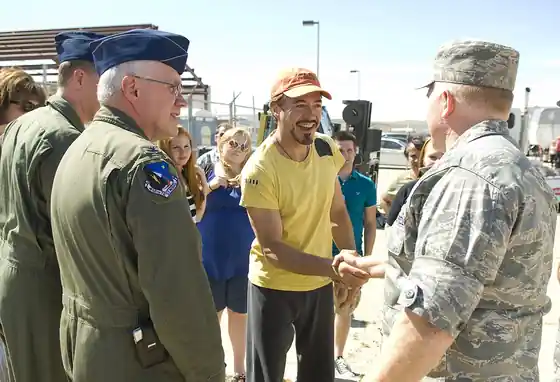
Iron Man (2008): Tony Stark and Air Force Officer, in the streetImage: Wikimedia Commons · Air Force photo by Mike Cassidy, Public domain - #075
- #076
- #077
- #078
- #079
Kevin Feige said, "There was a moment in post-production when everything seemed very tenuous and bleak. We hadn't settled into a satisfying cut, and the effects weren't yet landing right. It is an awful period in the process when, after years of hard work, you are struck with the lingering fear that, in spite of unflagging dedication and meticulous planning, the whole thing might go pear-shaped." His hope was restored after reading a book about the making of Star Wars: Episode IV - A New Hope (1977), "It documented interviews and photos done behind the scenes long before the film was ever a hit. When all seemed to be going very wrong. But it didn't. It went quite well, most would say, when all was said and done. Reading this book gave me the one thing most required for the making of a successful movie (and life, for that matter). Faith."
- #080
- #081
- #082
- #083
Jon Favreau was originally going to direct Captain America: The First Avenger (2011) in the manner of a superhero comedy adventure, but he instead chose to direct this film and give it a more serious tone. Ironically, Nick Cassavetes, who was chosen to direct that film, had been filled in to direct this film in December 2004.
- #084
When designing Tony Stark's house, the guideline the designers were given was to make it more "grease monkey" (inventor and mechanic) than futuristic, in order to keep the film realistic. Production designer J. Michael Riva took inspiration from the photographs of Julius Schulman, who was noted for photographs of 1950s and 1960s Los Angeles houses.
- #085
The production met with about thirty different writers, and they all passed, as most of them felt that Iron Man was a relatively obscure character in the Marvel universe. They were also a bit nervous about working for an untried studio better known for producing comic books. Even the re-writes led to many refusals.
- #086
According to Phil Saunders, Tony Stark would develop a Mark IV armor, which would have been used in the final battle. This Mark IV armor would become the War Machine armor, and had swap-out armaments that would be worn over the Mark III armor. However, halfway through pre-production, the concept was removed from the script.
- #087
While Ryan Meinerding's designs were excellent references for the shape of the Mark I, they were all in black and white. Broad color schemes and tones were then worked out in conversation with Jon Favreau. "The idea was that Tony's constructing the Mark I out of old shell casings and equipment, and everything had to look like found objects. Dirty, rough metal of different shades. Some of it had paint on it, some of it had decals to make it look like cut-apart missiles. It had to have weld marks. It had to have a very handmade, hand-pounded kind of forged look to it," said Mahan Trevor Hensley and the other painters at SWS compiled copious reference to execute Favreau's vision. "We referenced mostly old pictures from World War II," said Hensley. "We looked at those polished aluminum planes that had been shot down, P-51s, P-38 Lightnings, so we had damage reference from that that we incorporated. The Mark I gets really shot up right when he leaves the cave, before he takes off and escapes. And for that they wanted us to do a whole bunch of fifty caliber hits and a bunch of medium size bullet hits, tiny small arms shrapnel, and all kinds of stuff, so we did a whole Photoshop series with different battle damage." But the coolest part of the paint job for Hensley is something you might not even see in the finished film. "You know when a chromed motorcycle exhaust goes through the whole spectrum of colors as it's being heated up? It goes purple, brown, blue, pink. We used a lot of that because we were thinking Tony would be torch cutting all this stuff in a cave and arc welding it so it would have that colored distortion along the edges where the parts were cut and heated. Unfortunately, a lot of that subtlety was covered by dirt with the Mark I being sandblasted in the desert for days on end."
- #088
Sir Christopher Nolan said of Robert Downey Jr.'s casting as Iron Man, "I thought when Favreau had the insight to cast him as Iron Man... It's one of the greatest casting decisions in the history of movies. And you look at what that did and where that went with everything. And I think that was Jon just knowing what an incredible actor, what incredible potential it was from Downey. And then the movie star charisma, that wonderful charisma comes into play."
- #089
An early draft of the script revealed Tony Stark to be the creator of Dr. Otto Octavius's tentacles from Spider-Man 2 (2004). Octavius is a villain from the Spider-Man comic, but at the time, this wouldn't have been allowed, as Sony was the film rights holder to Spider-Man. However, Sony and Marvel Studios agreed to share the film rights to the character in 2015, with Spider-Man/Peter Parker (Tom Holland) first appearing in Captain America: Civil War (2016), where he's introduced to Tony Stark (Robert Downey Jr.). While Downey reprised his role alongside Holland in Spider-Man: Homecoming (2017) and several other Marvel films, Dr. Otto Octavius appeared in Spider-Man: No Way Home (2021) with Alfred Molina reprising his role (who previously portrayed the character in Spider-Man 2 (2004) of the Sam Raimi Spider-Man trilogy).
- #090
- #091
Jon Favreau was inspired to cast Robert Downey Jr. as Tony Stark/Iron Man after seeing his performance in Kiss Kiss Bang Bang (2005). That film was written and directed by Shane Black, and he consulted on the scripts of both this film and Iron Man 2 (2010). Black ended up succeeding Favreau as director with Iron Man 3 (2013).
- #092
For the first three Iron Man movies, director Jon Favreau thought of making the Iron Monger the main villain of the second film. Stane was going to be Stark's friend and confidant in the first film, but then would become his enemy in the second installment. However, Favreau was worried how to handle The Mandarin, who was to be the villain of the first film, so he decided to re-work the character into a behind-the-scenes presence, and make Iron Monger the first villain.
- #093
According to The Cannon Group, Inc. co-owner, producer Yoram Globus, in the 1980s, along with Captain America, Superman IV: The Quest for Peace (1987), Spider-Man and Masters of the Universe (1987), The Cannon Group, Inc. also had an Iron Man movie in production. The Cannon Group, Inc. wanted Tom Selleck to play Tony Stark. They also wanted the costume house that made the RoboCop (1987) suit to build the Iron Man costume.
- #094
According to Jon Favreau, it was difficult to find a proper opponent for Iron Man to face, since he wanted the film to remain grounded in reality as much as possible. It was decided to have a foe in the film who would serve as a parallel of Stark (for example, an armored opponent). Well-known enemies like the Titanium Man and the Crimson Dynamo were considered, but finally the lesser-known Iron Monger, Obadiah Stane, was chosen as Iron Man's adversary (Stane, as well as possessing his own armor, is also a business contemporary of Stark).
- #095
Originally, Iron Man's archnemesis, the Mandarin, was going to be the film's villain, but Jon Favreau felt him to be too fantastic and dated, so he was re-written into a "working-behind-the-scenes" presence. Favreau cited "Star Wars" as a case: "I looked at the Mandarin more like how in 'Star Wars' you had the Emperor, but Darth Vader is the guy you want to see fight. Then you work your way to the time when lightning bolts are shooting out of the fingers, and all that stuff could happen. But you can't have what happened in Star Wars: Episode VI - Return of the Jedi (1983) happen in Star Wars: Episode IV - A New Hope (1977)."
- #096
- #097
- #098
In 2023, Kevin Feige revealed that Robert Downey Jr.'s history of addiction made Marvel Studios apprehensive about casting him as Iron Man, "My board thought I was crazy to put the future of the company in the hands of an addict. I helped them understand how great he was for the role. We all had confidence that he was clean and would stay clean."
- #099
Director Jon Favreau wanted Robert Downey Jr. because he felt the actor's past was right for the part. He commented: "The best and worst moments of Robert's life have been in the public eye. He had to find an inner balance to overcome obstacles that went far beyond his career. That's Tony Stark. Robert brings a depth that goes beyond a comic book character having trouble in high school, or can't get the girl." Favreau also felt Downey could make Stark "a likable asshole," but also depict an authentic emotional journey once he won over the audience.
- #100
Stan Lee intentionally created Iron Man to be unpopular with readers, explaining, "I gave myself a dare. It was the height of the Cold War. The readers, the young readers, if there was one thing they hated, it was war, it was the military... So I got a hero who represented that to the hundredth degree. He was a weapons manufacturer, he was providing weapons for the Army, he was rich, he was an industrialist... I thought it would be fun to take the kind of character that nobody would like, none of our readers would like, and shove him down their throats and make them like him... And he became very popular." In his debut in Tales of Suspense #39 (Mar. 1963), Iron Man was an anti-communist hero who battled the Viet Cong, an angle Lee regretted, saying, "this yarn was written in 1963, at a time when most of us genuinely felt that the conflict in that tortured land really was a simple matter of good versus evil and that the American military action against the Viet Cong was tantamount to St. George's battle against the dragon. Since that time, of course, we've all grown up a bit, we've realized that life isn't quite so simple."
- #101
- #102
In an interview with Britain's Empire Magazine, Robert Downey Jr. thanked Burger King for helping him get straight edged in 2003, with a car full of drugs. He had a burger that was so disgusting, it made him rethink his life, and dump the drugs in the ocean. He repeats this, with his impromptu sit-down session with the press, upon his return from captivity. Burger King also promoted the film with toys based on this movie, as well as the sequel.
- #103
According to Jon Favreau, when making this film, there was a lot of pressure for it to succeed. This was particularly due to Marvel using their characters as collateral when they received a five hundred twenty-five million dollar, seven year deal, called a non-recourse debt facility, allowing them to make original films based on their properties. Marvel wanted to have complete creative control over their characters, build a film library, and greater profit potential than the deals they've inked with other studios owning the film rights to their characters. Marvel also changed its name to Marvel Entertainment, Incorporated, to establish a Hollywood presence. If the film didn't succeed, Marvel would've lost the intellectual property rights to their library. However, the wager paid off, as Iron Man's box office success enabled Marvel to kick off an entire Marvel Cinematic Universe (MCU) consisting of interconnecting films and series.
- #104
The production met with about thirty different writers, and they all passed, as most of them felt that Iron Man was a relatively obscure character in the Marvel universe. They were also a bit nervous about working for an untried studio better known for producing comic books. Even the re-writes led to many refusals.
- #105
In the comics, Tony Stark participated (and became Iron Man) in the Vietnam War. Later, this was changed to the Gulf War. In this film, the character's origin was changed to Afghanistan, as director Jon Favreau did not wish to make the film a period piece, but instead give it a realistic contemporary look.
- #106
- #107
- #108
The leader of the Ten Rings is named Raza, after a Marvel Comics character. However, the comic version of Raza is not an enemy of Iron Man, but an alien cyborg, who is a member of the space pirate gang known as the Starjammers. The only similarity they share, is their facial disfigurement. In the comics, Raza has implants on the left side of his face, while in the film, Raza is scarred on the right side of his face.
- #109
- #110
(at around 1h 24 mins) When Obadiah Stane (Jeff Bridges) watches Rhodey (Terrence Howard) on television, an expensive chess set is visible on the table in front of him. In the comics, Obadiah Stane was fond of playing chess, and also created a group called "The Chessmen" to attack Stark Industries.
- #111
Iron Man was famously created by Stan Lee, along with Larry Lieber, Don Heck and Jack Kirby in 1963's Tales of Suspense #39 published by Marvel Comics. When the Iron Man movie got off the ground with 20th Century Fox in 1996, Stan Lee was the co-writer on the first draft of the script, along with Jeff Vintar. According to sources, the story would have had the super intelligent MODOK as the villain. The script was apparently pretty good, because of Tom Rothman (President of Production at Fox) later saying Lee's screenplay made him finally "get" the character of Iron Man. The problem is that they never ended up using Lee's script. In fact, the movie went through a lot of scripts, and Lee never even ended up in the credits. It's like the script never existed, and that's probably been a disappointment for Lee.
- #112
- #113
- #114
Contains a major spoiler — show
The film had a torturous development process. Stuart Gordon was originally going to direct in 1990 when the rights were held by Universal Pictures, though nothing came of that. In 1996, 20th Century Fox acquired the rights with Nicolas Cage expressing an interest in the project. Two years later, it hadn't moved on so Tom Cruise tried to kickstart a production, to the extent of commissioning a script by Stan Lee and Jeff Vintar. Jeffrey Caine then did a polish on the screenplay. Still nothing. In 1999, Quentin Tarantino was approached to see if he could move things along but that too came to nothing. The rights moved to New Line Cinema in 2000 with Ted Elliott, Terry Rossio, and Tim McCanlies writing a screenplay (this version even featured a cameo by Nick Fury). New Line Cinema started talking to Joss Whedon about directing, but this didn't pan out. By 2004, Nick Cassavetes was attached as director, but when this too failed, the rights reverted to Marvel Studios.
- #115
Contains a major spoiler — show
The climactic showdown in the film, with Tony Stark, a.k.a. Iron Man, facing Obadiah Stane, a.k.a. Iron Monger, is based on Iron Man #200 (November 1986). A face-off occurs between Stane's larger, more powerful Iron Monger and Stark's greater experience, and an exploding reactor appears. However, the comic concludes with Stane committing suicide with a repulsor ray blast to the head.
- #116
Contains a major spoiler — show
According to Jeff Bridges, Obadiah Stane was originally supposed to survive the final battle against Tony, with Stark opening up Stane's destroyed suit to find that there was no corpse inside. Presumably this would have poised Stane to return for future movies.
- #117
Contains a major spoiler — show
Brian Michael Bendis had written three pages of dialogue for the Nick Fury scene, out of which the filmmakers chose the best lines. To keep it a secret, the scene was filmed with a skeleton crew, and was omitted from all previews of the film, which thus maintained the mystery and surprise, and kept fans speculative and interested. It conclusively appeared in the final cut as a post-credits scene, and started the tradition of every film in the Marvel Cinematic Universe having at least one post- or mid-credits scene.
Behind the Scenes (55)
- #118
- #119
- #120
When the day of the film test came, the SWS crew was ready to make their case for shooting with a real Mark I. "So we showed up for the first Mark I film test at the cave interior set. They didn't know we were bringing a suit, they thought we were bringing a prop on a stand that they could roll in and roll out as a reference element," said Hensley. "So we uncover the Mark I and Mike Justice is inside it, but it was dark and they couldn't tell there was a guy in the suit. We lit him all up and there was a very brief moment where they were all looking at it, Favreau, the producers, and then suddenly Mike took a step forward and they were shocked. And then it was lots of hushed conversation and they started asking 'How much can he move?' Mike starts turning sideways, putting his arms out, moving all around, and they realized this was a suit that they could actually shoot with. We were so proud that we did it." To support the nearly 90-pound Mark I suit, the Stan Winston Studio crew created a sturdy corset harness and aluminum support rig. The 90-pound suit was primarily comprised of epoxy "armor" shells, flexible urethane, leather and aluminum.
- #121
- #122
Marvel Studios's Kevin Feige describes a transformation in Robert Downey Jr. at that moment, "Seeing Robert in the suit for the first time was like watching a kid in a candy store. He looked amazing and had all of the enthusiasm of a little boy. Then, he suddenly stood up and you could see the hero forming within him."
- #123
For the exterior shots when Tony Stark bursts out of the cave in the Mark I suit, flamethrowers blazing, the production relocated to an actual cave location in Lone Pine, California. Dave Merritt remembers adding the element of fire to the Mark I's arsenal during the exterior scene, "Special Effects Coordinator Dan Sudick's team stepped in to oversee all the fire work. They had to rig all the hoses down Mike's arms, and then in a big loop around his body so when he'd do all those turns he would sort of unwind all the hoses as he was blowing everything up." "Safety is always our first priority," added Shane Mahan, "so the interior pieces of the Mark I suit were lined with aluminum and the gloves were heat resistant. The flamethrower itself was built by Dan's team to be pretty user friendly so Mike Justice would be in total control at all times. There was a hand trigger that activated it so he could be very precise about when to shoot or not shoot the flames."
- #124
According to Merritt, the Mark I was one of the most complicated maquettes he's ever worked on, "It was really like building three maquettes in one because you had a body substructure underneath and then you had all these armor shells that hang onto a frame. The digital team modeled the shells first and I said, 'Well you've gotta attach these shells to something if we're going to grow them.' And so they attached these frames, and then I said, 'Well you know you've really gotta have these things attached to a body so it won't fall apart.' So then they had to model a body inside as well." Key artist at Stan Winston Studio & Legacy Effects, Trevor Hensley, said, "The Mark I was the first time we used that killer chrome paint, that metallic surface finish. You start with a shiny black surface and then you mist on the chrome paint. And it was kind of a test run, we weren't really sure how to use that stuff. Of course it's always a team effort, but it was cool that my Mark I maquette paint job set the standard for many of the metallic characters we've done here (SWS & Legacy Effects) for the last 5 years. Before that we'd been chrome plating and using other automotive finishes but they never had that incredible reflective quality. We used the same paint technique on the full-size suit because Jon Favreau loved it." After Jon Favreau and the producers approved the maquette, Dave Merritt and the model making team at SWS moved onto the full-size Mark I armor. "We didn't grow any of those full-size shells. We just felt that the type of detail that was on them didn't warrant the expense of going through the growing process. So they were all milled out of foam," said Merritt. "Then we went in and hand-carved and sanded the foam, put resins on them and smoothed them out. Then we could go in and add bullet holes or damaged, dented marks into the surfaces. We just kinda fashioned it like it was hammered out in a cave." The final steps are where everything started to come together, added Merritt. "The shells were then molded and cast in epoxy. We added some flexible urethane areas for comfort. And then all those parts were hung onto the frame. We had to go through several fittings to make sure that suit performer Mike Justice would be able to fit it in and move in it because it's a very clunky suit. But the clunkiness is sort of what made the Mark I what it was, you know? You kinda didn't want him to move well in it because then it wouldn't have made as much sense. It was supposed to be primitive."
- #125
Ahmed Ahmed had played terrorists for many years, and eventually asked his agent to stop offering those roles, since he was uncomfortable with perpetuating harmful stereotypes. Nonetheless, his agent approached him for a terrorist role in this film, and he intentionally played it "over the top" for the audition to avoid being cast. The following day, his agent told him that Marvel wanted to cast him, but he still initially refused it. He finally agreed after being told he would be paid $50,000 for two weeks of filming. He recalled his experience during a stand-up routine, and joked, "sometimes terrorism pays off."
- #126
Gwyneth Paltrow said of Robert Downey Jr.'s improvisation, "There would be this process of Jon Favreau and Robert and I going into Jon's trailer in the morning and Robert being like, 'I'm not fucking saying these lines' and throwing them out. And then live improv-ing either in the trailer or on the set. I think in order for something to feel alive for Robert, it has to feel fresh, and he makes it fresh by making it feel like it was just invented. So many of those famous lines were written 10 minutes before we said them."
Iron Man (2008): Pepper PottsImage: Wikimedia Commons · 28277470@N05, CC BY-SA 2.0 - #127
To add to the complexity of the job, Mahan added, "We were forced to reverse-engineer the suit because we didn't have Robert's body cast to build the suit over joint-for-joint, measurement-for-measurement. The digital build and design of the suit was 95 percent complete before Robert was even cast in the film." "We actually built the structures in the computer so that they're mathematically perfect and grew those parts in a process of rapid prototyping. Then we made the pieces and fit them around him and made them work and actually move. I was very happy with the results because the suits are quite athletic." said Mahan.
- #128
There are about five sets of armor in the film, all inspired from the "Iron Man" comics: Mark I armor, Stark's first suit, is a simple suit constructed of iron. Mark II armor is a silver suit, the prototype Stark develops (this can also be counted as the War Machine armor, as Rhodes looks speculatively at it). Mark III armor is the final red and gold armor. J.A.R.V.I.S. first presents the Mark III armor in full gold, the look pays tribute to the all-gold "Golden Avenger" armor Iron Man wore early in his career. J.A.R.V.I.S. later presents the armor in silver and red, making it look almost identical to Iron Man's "Silver Centurion" armor that he wore in the 1980s.
- #129
- #130
- #131
The script was not completely finished when filming began, since the filmmakers were more focused on the story and the action, so the dialogue was mostly ad-libbed throughout filming. Director Jon Favreau acknowledged this made the film feel more natural. For example, Tony's monologue while he demonstrates the 'Jericho' in the desert to the troops in the beginning of the movie was conceived on the spot; Robert Downey Jr. isn't just wearing sunglasses for protection from the bright sun, but also to hide the fact that he is reading his lines off of cue cards. Some scenes were shot with two cameras, to capture lines improvised on the spot. Downey would ask for many takes of one scene, since he wanted to try something new. Gwyneth Paltrow, on the other hand, had a difficult time trying to match Downey with a suitable line, as she never knew what he would say.
- #132
- #133
- #134
- #135
"From my point-of-view Robert was essential to the suit performance because he instructed me or any other member of the suit crew as to what he needed to make his performance better," said Mahan. "We were happy to take a bicep or the lower legs off so that he had more freedom of movement, because in the end it's all about performance and if we needed to do something to make the actor more comfortable, that's what we did."
- #136
- #137
This film and Iron Man 2 (2010) made frequent use of practical Iron Man suits in lieu of CGI, which caused issues for Robert Downey Jr. He said, "The first half hour of being in the Iron Man suit is like the coolest Halloween you ever had, except you're alone in the trailer before they call you on a set... It's designed for guys to wear, but I'm not a stuntman, and most of the stuntmen aren't doing... 65 scenes in the next 3 weeks. It was tough, and as we went further and further along, I realized... I could wear the suit all the time, but I can't wear the suit all the time and be an effective actor." Starting with The Avengers (2012), Downey wore motion capture suits instead.
- #138
- #139
The English translation of the Hungarian dialogue when Tony and Yinsen are about to break out of the cave, is this: Man from outside: Yinsen, Yinsen! Stop! Show your hands! Yinsen: One minute, one minute! Man from outside: Come over here right now! What is going on in there? What is going on in there? Hands up.
- #140
- #141
Although considered a total success at the time, Shane Mahan points out the huge improvements he and the IRON MAN practical suit team have made to the process, "Mike Justice had to get into great shape and he had to keep that up the whole time because there's a lot of parts on the Mark I suit. It's very heavy. We were limited to the materials we had, the epoxy armor, the aluminum frame, the backpack, lots of leather. I think it came in at around 90 pounds. Which doesn't sound like a lot until you're in it all day. If we were to do it today, with all that we've done for Iron Man 1-3, The Avengers and currently on Robocop, the Mark I would be about 40 pounds now. But whenever you do something for the first time it's kind of an experiment." The nearly 90-pound suit required suit performer Mike Justice to stay in top shape during the making of IRON MAN. Safety is always a number one priority and the SWS crew took great care to make sure everything was securely fitted to Mike Justice at all times, even lining the interior with aluminum during the flamethrower sequence. Perhaps the greatest thing about the Mark I, according to Shane Mahan, was that "it was the first suit up in the shooting schedule and it set the tone for what could be accomplished by blending physical & digital Iron Man suits. And for a lot of fans, that's still their favorite suit. It's a great throwback to the 60s comic with that iconic tin can design. I'm proud to have brought the Mark I to life along with the rest of the team."
- #142
According to Terrence Howard, he and Robert Downey Jr. competed physically on the set: "I'm forty to fifty pounds heavier than him, so I'm lifting and I push up about two hundred twenty-five, and knocked it out ten times. Robert wanted to go about two hundred thirty-five, and he did it, so I pushed it up to about two hundred forty-five. Robert and his competitive ass almost tore my shoulder trying to keep up with him!"
- #143
- #144
- #145
- #146
At approximately (at around 36 mins), the very first punch thrown by Iron Man in the MCU (during the Mark I cave escape) was physically performed by director Jon Favreau (Jon Favreau) in a motion-capture suit, rather than Robert Downey Jr. Favreau confirmed this "Sunday Secret" in 2013, provided the specific reference for the animators to capture the character's initial weight and power.
- #147
The cave in which Tony Stark is imprisoned was a one hundred fifty to two hundred yard-long set, which had built-in movable forks, to allow greater freedom for the film's crew. It also had an air conditioning system installed, as production designer J. Michael Riva had learned that remote caves are actually very cold.
- #148
(at around 49 mins) When Pepper helps Tony replace his arc reactor, it was filmed using a prosthetic chest, joined to Robert Downey Jr.'s own chest, and projecting out at an angle, while Robert was "in" the back of the seat, on which he was sitting. A bright light was positioned, shining on the area to hide any potential "edges" of the fake chest piece. A similar method was used in Star Trek: First Contact (1996) when the Borg Queen was introduced.
- #149
- #150
- #151
In Iron Man, director Jon Favreau aimed to use as little CGI as possible. As a result, the Iron Man suit was largely practical rather than fully CGI. Robert Downey Jr. later explained that when he wore the helmet, his vision was extremely limited and two internal lights would shine directly into his eyes, making it difficult to see. Because of these issues, later films relied more heavily on CGI for the helmet.
- #152
- #153
As a tribute to Howard Hughes, who inspired Iron Man, production was mainly based in the former Hughes Company soundstages in Playa Vista. The scene where the Iron Man Mark III armor was created was filmed in the area where Hughes assembled the H-4 Hercules airplane (better known as "The Spruce Goose").
- #154
Although originally planned as a completely digital suit, the Stan Winston Studio IRON MAN team built a "real" Mark I suit that wound up performing over 80% of the Mark I shots in the final film. From first film test to flamethrowers blazing real fire, the Mark I suit was a pivotal creation that would set the tone for the IRON MAN franchise's fantastic blend of both digital and practical techniques to bring Tony Stark's armor to life. Academy Award nominated, 25 year-SWS supervisor and co-founder of Legacy Effects, Shane Mahan recalls the first images for the Mark I sent over by Marvel during pre-production, "The Mark I, the cave escape suit, was originally designed by Ryan Meinerding at Marvel. The Mark I one was intended to be an homage to the first suit Tony Stark builds in the comic book, it's sort of like a big metal can. Ryan's overall Photoshop design was pretty clear. Then our modelers at Stan Winston Digital started working on how to make it work practically, creating 3D models on the computer. We spent long nights at the studio crunching it down, and the Marvel brass would get to the shop at 7am and we'd been there all night, making digital turntables, tweaking it." "Once the 3D model was approved we went through the standard process of breaking it apart so that we could grow a maquette. SWS & Legacy Effects model shop supervisor, Dave Merritt, led the model makers in sanding and doing the body shop work once the pieces were grown." continued Mahan.
- #155
Shane Mahan recalls the Mark I's digital beginnings: "The Mark I was going to be done entirely digitally, but we kept saying that this suit is perfect for having a performer inside and making it work. We were all a bit cocky about it. Our feeling was like, this is what we do. It's a guy in a suit, trying to escape. So let us make a guy in a suit, trying to escape. We would shoot our own internal tests with stuntman Mike Justice and he'd move around while we'd operate all the radio controlled engines and belt drives on the back of the suit." Proving the producers wrong became a point of pride among the crew at Stan Winston Studio. "They were telling us it was never gonna work. That the suit wouldn't walk. And Shane took that as a challenge and we all busted our ass to get that thing working. There's not a person who worked on that suit who wasn't up all night, taking that challenge by the horns," Trevor Hensley remembers.
- #156
During the final battle, there was originally going to be a sequence where Tony, in the Iron Man suit, drives an Audi R8 that would crash into Iron Monger's legs then flip over, after which Iron Man would split the car in half and jump out. However, the Audi R8 was so well-built, that it refused to flip, despite repeated crashes and the roof wouldn't split the way director Jon Favreau wanted it to, because the car's frame was so tough. As a result, the whole final fight sequence was re-written. The filmmakers were so impressed by the toughness of the car, that it was decided that the convertible version was to be featured in Iron Man 2 (2010).
- #157
- #158
The script was not completely finished when filming began, since the filmmakers were more focused on the story and the action, so the dialogue was mostly ad-libbed throughout filming. Director Jon Favreau acknowledged this made the film feel more natural. For example, Tony's monologue while he demonstrates the 'Jericho' in the desert to the troops in the beginning of the movie was conceived on the spot; Robert Downey Jr. isn't just wearing sunglasses for protection from the bright sun, but also to hide the fact that he is reading his lines off of cue cards. Some scenes were shot with two cameras, to capture lines improvised on the spot. Downey would ask for many takes of one scene, since he wanted to try something new. Gwyneth Paltrow, on the other hand, had a difficult time trying to match Downey with a suitable line, as she never knew what he would say.
- #159
- #160
As a tribute to Howard Hughes, who inspired Iron Man, production was mainly based in the former Hughes Company soundstages in Playa Vista. The scene where the Iron Man Mark III armor was created was filmed in the area where Hughes assembled the H-4 Hercules airplane (better known as "The Spruce Goose").
- #161
- #162
- #163
Shane Mahan recalls the Mark I's digital beginnings: "The Mark I was going to be done entirely digitally, but we kept saying that this suit is perfect for having a performer inside and making it work. We were all a bit cocky about it. Our feeling was like, this is what we do. It's a guy in a suit, trying to escape. So let us make a guy in a suit, trying to escape. We would shoot our own internal tests with stuntman Mike Justice and he'd move around while we'd operate all the radio controlled engines and belt drives on the back of the suit." Proving the producers wrong became a point of pride among the crew at Stan Winston Studio. "They were telling us it was never gonna work. That the suit wouldn't walk. And Shane took that as a challenge and we all busted our ass to get that thing working. There's not a person who worked on that suit who wasn't up all night, taking that challenge by the horns," Trevor Hensley remembers.
- #164
- #165
Gwyneth Paltrow said of Robert Downey Jr.'s improvisation, "There would be this process of Jon Favreau and Robert and I going into Jon's trailer in the morning and Robert being like, 'I'm not fucking saying these lines' and throwing them out. And then live improv-ing either in the trailer or on the set. I think in order for something to feel alive for Robert, it has to feel fresh, and he makes it fresh by making it feel like it was just invented. So many of those famous lines were written 10 minutes before we said them."
- #166
According to Merritt, the Mark I was one of the most complicated maquettes he's ever worked on, "It was really like building three maquettes in one because you had a body substructure underneath and then you had all these armor shells that hang onto a frame. The digital team modeled the shells first and I said, 'Well you've gotta attach these shells to something if we're going to grow them.' And so they attached these frames, and then I said, 'Well you know you've really gotta have these things attached to a body so it won't fall apart.' So then they had to model a body inside as well." Key artist at Stan Winston Studio & Legacy Effects, Trevor Hensley, said, "The Mark I was the first time we used that killer chrome paint, that metallic surface finish. You start with a shiny black surface and then you mist on the chrome paint. And it was kind of a test run, we weren't really sure how to use that stuff. Of course it's always a team effort, but it was cool that my Mark I maquette paint job set the standard for many of the metallic characters we've done here (SWS & Legacy Effects) for the last 5 years. Before that we'd been chrome plating and using other automotive finishes but they never had that incredible reflective quality. We used the same paint technique on the full-size suit because Jon Favreau loved it." After Jon Favreau and the producers approved the maquette, Dave Merritt and the model making team at SWS moved onto the full-size Mark I armor. "We didn't grow any of those full-size shells. We just felt that the type of detail that was on them didn't warrant the expense of going through the growing process. So they were all milled out of foam," said Merritt. "Then we went in and hand-carved and sanded the foam, put resins on them and smoothed them out. Then we could go in and add bullet holes or damaged, dented marks into the surfaces. We just kinda fashioned it like it was hammered out in a cave." The final steps are where everything started to come together, added Merritt. "The shells were then molded and cast in epoxy. We added some flexible urethane areas for comfort. And then all those parts were hung onto the frame. We had to go through several fittings to make sure that suit performer Mike Justice would be able to fit it in and move in it because it's a very clunky suit. But the clunkiness is sort of what made the Mark I what it was, you know? You kinda didn't want him to move well in it because then it wouldn't have made as much sense. It was supposed to be primitive."
- #167
- #168
Kevin Feige said, "There was a moment in post-production when everything seemed very tenuous and bleak. We hadn't settled into a satisfying cut, and the effects weren't yet landing right. It is an awful period in the process when, after years of hard work, you are struck with the lingering fear that, in spite of unflagging dedication and meticulous planning, the whole thing might go pear-shaped." His hope was restored after reading a book about the making of Star Wars: Episode IV - A New Hope (1977), "It documented interviews and photos done behind the scenes long before the film was ever a hit. When all seemed to be going very wrong. But it didn't. It went quite well, most would say, when all was said and done. Reading this book gave me the one thing most required for the making of a successful movie (and life, for that matter). Faith."
- #169
This film and Iron Man 2 (2010) made frequent use of practical Iron Man suits in lieu of CGI, which caused issues for Robert Downey Jr. He said, "The first half hour of being in the Iron Man suit is like the coolest Halloween you ever had, except you're alone in the trailer before they call you on a set... It's designed for guys to wear, but I'm not a stuntman, and most of the stuntmen aren't doing... 65 scenes in the next 3 weeks. It was tough, and as we went further and further along, I realized... I could wear the suit all the time, but I can't wear the suit all the time and be an effective actor." Starting with The Avengers (2012), Downey wore motion capture suits instead.
- #170
- #171
Contains a major spoiler — show
"I am Iron Man" was ad-libbed by Robert Downey Jr. Producer Kevin Feige approved using it in the final cut of the film, and credits this with his decision to largely do away with secret identities in the Marvel Cinematic Universe. Only Spider-Man conceals his identity, while Thor's alter ego, Donald Blake, is similarly not used.
- #172
Characters & Cast (17)
- #173
The initial reaction to Robert Downey Jr.'s casting as Iron Man was negative. Many fans felt he was too old, and had concerns with his history of substance abuse. Others joked that his addiction issues made him perfect for the part, since Tony Stark struggles with alcoholism in the comics.
- #174
- #175
- #176
- #177
Agent Phil Coulson (Clark Gregg) was originally a much smaller part. In fact, the character at first was only called "Agent," but as filming went on, and Gregg's chemistry with all the other cast members became apparent, they added more and more scenes. Agent Coulson would go on to appear in Iron Man 2 (2010), Thor (2011), The Avengers (2012), Captain Marvel (2019), and would star in the spinoff series, Agents of S.H.I.E.L.D. (2013).
- #178
- #179
Paul Bettany has never seen the film, and is unfamiliar with the plot. He said J.A.R.V.I.S. was the easiest job ever, and it was almost like a robbery, since he only worked for two hours, got paid a lot of money, then went on vacation with his wife (Jennifer Connelly, who would later voice the A.I. in Spider-Man: Homecoming (2017)). His role would, however, be expanded considerably in the later Marvel films, and even require his physical presence from Avengers: Age of Ultron (2015) on.
- #180
Jeff Bridges, hearing that Obadiah was a Biblical name, researched the Book of Obadiah in the Bible, and was surprised to learn that a major theme in that particular book is retribution, which Obadiah Stane represents. However, the name "Obadiah" means "servant and worshiper of the Lord," which Stane obviously isn't.
- #181
- #182
- #183
Director Jon Favreau wanted Robert Downey Jr. because he felt the actor's past was right for the part. He commented: "The best and worst moments of Robert's life have been in the public eye. He had to find an inner balance to overcome obstacles that went far beyond his career. That's Tony Stark. Robert brings a depth that goes beyond a comic book character having trouble in high school, or can't get the girl." Favreau also felt Downey could make Stark "a likable asshole," but also depict an authentic emotional journey once he won over the audience.
- #184
- #185
- #186
During Pepper Potts's investigation of Obidiah Stane's secret arms deals with the terrorists, one of the documents, an invoice/arrival notice, shows missiles from Stark Industries being shipped from Long Beach to Karachi. The vessel used to ship the missiles, according to the document, was the "MSC LEBOWSKI." Actor Jeff Bridges, who played Obidiah, is well known as the main protagonist in the cult classic film "The Big Lebowski (1998)" in which he played "Jefferey Lebowski," AKA: "The Dude."
- #187
In 2023, Kevin Feige revealed that Robert Downey Jr.'s history of addiction made Marvel Studios apprehensive about casting him as Iron Man, "My board thought I was crazy to put the future of the company in the hands of an addict. I helped them understand how great he was for the role. We all had confidence that he was clean and would stay clean."
- #188
Ahmed Ahmed had played terrorists for many years, and eventually asked his agent to stop offering those roles, since he was uncomfortable with perpetuating harmful stereotypes. Nonetheless, his agent approached him for a terrorist role in this film, and he intentionally played it "over the top" for the audition to avoid being cast. The following day, his agent told him that Marvel wanted to cast him, but he still initially refused it. He finally agreed after being told he would be paid $50,000 for two weeks of filming. He recalled his experience during a stand-up routine, and joked, "sometimes terrorism pays off."
- #189
Contains a major spoiler — show
In the Ultimate Marvel Comics series, the character of Nick Fury is portrayed as African-American, with his look and personality tailored after Samuel L. Jackson, all carried out with Jackson's explicit permission. During one of the Ultimate Avengers issues, while discussing the possibility of a movie being made about them, and which actors would play which heroes, Nick Fury comments that nobody else but Samuel L. Jackson could play him. (Ironically, on the very same page in this issue, Fury says that his nose has been "smashed more times than Robert Downey Jr.") Jackson, himself a comic book fan, played Fury in this movie. Later on, the popularity of this character led Marvel to introduce this character into the mainstream comics as "Nick Fury, Jr.," the son of the original Nick Fury, in a move to work towards retiring the original from the mainstream universe.
Easter Eggs & References (60)
- #190
(at around 1h 25 mins) When Pepper discovers Tony removing the damaged Iron Man armor, Captain America's shield can be seen sitting on a workbench. This same scene was shown in many trailers, but the image of the shield was edited out. Iron Man 2 (2010) and Captain America: The First Avenger (2011) would later reveal that Howard Stark, Tony's father, was responsible for the creation of Captain America's shield, and the one in Tony's home is an early prototype.
- #191
- #192
(at around 1h 24 mins) When Obadiah Stane (Jeff Bridges) watches Rhodey (Terrence Howard) on television, an expensive chess set is visible on the table in front of him. In the comics, Obadiah Stane was fond of playing chess, and also created a group called "The Chessmen" to attack Stark Industries.
- #193
- #194
- #195
- #196
(at around 58 mins) Obadiah brings Tony a pizza from New York City in a box marked "Ray's." Ray's is a famous chain of pizza places in New York City. It also marks the second Favreau-directed film to refer to Ray's Pizza. In Elf (2003), it is the pizza recommended by Santa Claus to Buddy the Elf.
- #197
- #198
- #199
- #200
(at around 26 mins) While playing backgammon with Yinsen, Stark says "Sheesh o Besh." This is a Persian slang phrase which means a roll of six and five ("Sheesh" is Persian slang for six, "o" means "and" and "Besh" is Turkish for five). Shaun Toub, who plays Yinsen, is of Persian ancestry.
- #201
Stane's computer appears to be a desktop, but it's actually a laptop - the Dell XPS M2010, released in 2006. It had a 20-inch screen, weighed 18 pounds, and was generally used on a desk with its keyboard detached. However, it contained a battery could in principle be folded up or used on the move as a notebook computer. Like Stane's armor design, its scale rather limited its practicality.
- #202
At several points in the movie, Obadiah Stane (Jeff Bridges) is seen wearing a 'ball and chain' style 'necklace', with a round black gem that signifies the Ten Rings terrorist organization. At the same time, Jeff Bridges - along with his father and brother, Lloyd and Beau - is a former member of the U.S. Coast Guard, and the ball and chain style is normal for holding dog tags, the military ID.
- #203
(at around 4 mins) The headlines on the magazine covers shown right before Tony Stark is presented with his award at the beginning of the film are Wired: "The Mind Of Tony Stark," Newsweek: "WHAT'S NEXT A New Superpower Steps Up" and "The Interim President Obadiah Stane To Lead Stark Industries," Popular Mechanics: "METAL VS. WOOD, Sharpen Your Skills," "Chip Off The Old Block, Six year old Tony Stark builds first V8," "Will the Arc Reactor save all our energy needs?" and "BACKYARD ROCKETS," Forbes: "THE NEW KID, Tony Stark takes reigns at 21," "Technology, The Information Superhighway" and "Industry, The Defeat Of Braniff," and the Rolling Stone Special Double Issue: "TONY STARK Wants To Save THE WORLD."
- #204
- #205
- #206
- #207
- #208
- #209
- #210
Christine Everhart mentioned to Tony that he is called the "da Vinci of our time." The real Leonardo da Vinci was a military engineer in addition to being an artist and inventor. Among da Vinci's weapon designs were a gigantic crossbow, multi-barreled cannons, and an armored vehicle powered by hand-cranks.
- #211
- #212
- #213
EASTER EGG: In the Region 1 DVD disc 1, Special Features section, there is a hidden circle icon (not Iron Man's arc generator, oddly enough) between the "Previews" and "Main Menu" items (on a DVD remote, highlight "Main Menu", then go left). Press Enter to see a video of Stan Lee and Robert Downey Jr. discussing Lee's cameo in the film.
- #214
- #215
The F-22, in the close-up ground shots, is serial number 6, deployed to Edwards Air Force Base. This is one of the last "pre-production" F-22s, and is one of the first fully operational aircraft. (The first five airframes were later retrofitted to also be fully operational). Interestingly, the pole model outside of Stark Industries is labelled as "YF-22", meaning the first flying prototype for the competition between the YF-22 and the Northrop YF-23. The size of this pole model, indicates that it may be one of the original wind-tunnel models.
- #216
(at around 14 mins) Ghostface Killah, a long-time fan of the Iron Man comics (he uses the aliases "Ironman" and "Tony Starks," titled his 1996 album "Ironman," and sampled clips of Iron Man (1966)), got a cameo as a Dubai tycoon. However, his scene was cut from the final film. Jon Favreau apologized to Ghostface and used his "We Celebrate" video in the film.
- #217
The leader of the Ten Rings is named Raza, after a Marvel Comics character. However, the comic version of Raza is not an enemy of Iron Man, but an alien cyborg, who is a member of the space pirate gang known as the Starjammers. The only similarity they share, is their facial disfigurement. In the comics, Raza has implants on the left side of his face, while in the film, Raza is scarred on the right side of his face.
- #218
- #219
- #220
- #221
- #222
When Tony first tests his hand repulsors in his lab, he ends up in front of a bookcase that has several airplane models on top of it, including a C-130 Hercules. The model at the far left is an XB-70 Valkyrie, a jet developed by the military in the late 1950s and intended as a bomber, capable of Mach 3+ (more than three times the speed of sound). It never became operational, but the design inspired the Air France Concorde SST, a Mach 3 passenger jet in the 1970s, 1980s, 1990s, and the early 2000s.
- #223
- #224
During Pepper Potts's investigation of Obidiah Stane's secret arms deals with the terrorists, one of the documents, an invoice/arrival notice, shows missiles from Stark Industries being shipped from Long Beach to Karachi. The vessel used to ship the missiles, according to the document, was the "MSC LEBOWSKI." Actor Jeff Bridges, who played Obidiah, is well known as the main protagonist in the cult classic film "The Big Lebowski (1998)" in which he played "Jefferey Lebowski," AKA: "The Dude."
- #225
- #226
- #227
Tony Stark's computer system is called J.A.R.V.I.S. (Just A Rather Very Intelligent System). This is a tribute to Edwin Jarvis, Howard Stark's butler. He was changed to an artificial intelligence to avoid comparisons to Bruce Wayne's butler Alfred Pennyworth. In the comic book Iron Man 2: Public Identity, which serves as a prequel to Iron Man 2 (2010), it is revealed that Tony named the computer system after Edwin Jarvis following his death, as Edwin was responsible for raising Tony after the death of his parents. James D'Arcy would portray a young Edwin Jarvis in Agent Carter (2015) and Avengers: Endgame (2019).
- #228
When Tony asks Pepper to help him with open-heart surgery, he compares it to the game "Operation." This was a popular Milton Bradley game that was invented by John Spinello. It involved players using metal tweezers to try and remove internal organs from a metal game board representing a patient. If the tweezers touch the edge of the body cavity, a loud buzzer would be activated and the patient's red nose would light up.
- #229
- #230
There are various references in the film to the Mandarin, Iron Man's archnemesis: -The organization that kidnaps Stark is called "the Ten Rings", after the ten rings that comprise the Mandarin's arsenal (Jon Favreau has stated that The Ten Rings, in fact, works for The Mandarin). -Commandant Raza speaks of Genghis Khan and Asia. -Commandant Raza is seen occasionally fiddling with an ornate gold ring. -The rings are worn by Stark, Stane, Rhodes, and Raza (that is to say those in positions of power).
- #231
(at around 58 mins) Obadiah Stane plays on the piano a musical piece written by eighteenth century composer Antonio Salieri. Salieri is best known as a jealous rival of Wolfgang Amadeus Mozart, despite that both had collaborated on, and promoted each other's work on several occasions). This serves as an appropriate parallel of Stark and Stane's relationship in the film.
- #232
- #233
There are about five sets of armor in the film, all inspired from the "Iron Man" comics: Mark I armor, Stark's first suit, is a simple suit constructed of iron. Mark II armor is a silver suit, the prototype Stark develops (this can also be counted as the War Machine armor, as Rhodes looks speculatively at it). Mark III armor is the final red and gold armor. J.A.R.V.I.S. first presents the Mark III armor in full gold, the look pays tribute to the all-gold "Golden Avenger" armor Iron Man wore early in his career. J.A.R.V.I.S. later presents the armor in silver and red, making it look almost identical to Iron Man's "Silver Centurion" armor that he wore in the 1980s.
- #234
- #235
EASTER EGG: In the Region 1 DVD disc 1, Special Features section, there is a hidden circle icon (not Iron Man's arc generator, oddly enough) between the "Previews" and "Main Menu" items (on a DVD remote, highlight "Main Menu", then go left). Press Enter to see a video of Stan Lee and Robert Downey Jr. discussing Lee's cameo in the film.
- #236
(at around 58 mins) Obadiah brings Tony a pizza from New York City in a box marked "Ray's." Ray's is a famous chain of pizza places in New York City. It also marks the second Favreau-directed film to refer to Ray's Pizza. In Elf (2003), it is the pizza recommended by Santa Claus to Buddy the Elf.
- #237
- #238
There are various references in the film to the Mandarin, Iron Man's archnemesis: -The organization that kidnaps Stark is called "the Ten Rings", after the ten rings that comprise the Mandarin's arsenal (Jon Favreau has stated that The Ten Rings, in fact, works for The Mandarin). -Commandant Raza speaks of Genghis Khan and Asia. -Commandant Raza is seen occasionally fiddling with an ornate gold ring. -The rings are worn by Stark, Stane, Rhodes, and Raza (that is to say those in positions of power).
- #239
When the day of the film test came, the SWS crew was ready to make their case for shooting with a real Mark I. "So we showed up for the first Mark I film test at the cave interior set. They didn't know we were bringing a suit, they thought we were bringing a prop on a stand that they could roll in and roll out as a reference element," said Hensley. "So we uncover the Mark I and Mike Justice is inside it, but it was dark and they couldn't tell there was a guy in the suit. We lit him all up and there was a very brief moment where they were all looking at it, Favreau, the producers, and then suddenly Mike took a step forward and they were shocked. And then it was lots of hushed conversation and they started asking 'How much can he move?' Mike starts turning sideways, putting his arms out, moving all around, and they realized this was a suit that they could actually shoot with. We were so proud that we did it." To support the nearly 90-pound Mark I suit, the Stan Winston Studio crew created a sturdy corset harness and aluminum support rig. The 90-pound suit was primarily comprised of epoxy "armor" shells, flexible urethane, leather and aluminum.
- #240
(at around 14 mins) Ghostface Killah, a long-time fan of the Iron Man comics (he uses the aliases "Ironman" and "Tony Starks," titled his 1996 album "Ironman," and sampled clips of Iron Man (1966)), got a cameo as a Dubai tycoon. However, his scene was cut from the final film. Jon Favreau apologized to Ghostface and used his "We Celebrate" video in the film.
- #241
- #242
- #243
- #244
At approximately (at around 36 mins), the very first punch thrown by Iron Man in the MCU (during the Mark I cave escape) was physically performed by director Jon Favreau (Jon Favreau) in a motion-capture suit, rather than Robert Downey Jr. Favreau confirmed this "Sunday Secret" in 2013, provided the specific reference for the animators to capture the character's initial weight and power.
- #245
- #246
- #247
- #248
Contains a major spoiler — show
(at around 1h 50 mins) Just before the final press conference, Tony Stark is reading the newspaper with a grainy, amateur photograph of Iron Man on the cover. The picture is part of a video, shot by onlookers hiding in a bush during initial filming, that appeared on the Internet in 2007.
- #249
Contains a major spoiler — show
When presented at the movie's end with the cover story by S.H.I.E.L.D. Agent Coulson that Iron Man is employed by Tony Stark to act as his bodyguard, Stark dismisses it as "pretty flimsy." In the Iron Man comics, this was precisely the cover that Tony Stark used to protect his identity until 2002, when Stark went public with his identity as Iron Man.
Deeper Meaning (9)
- #250
When Tony flies too high, and his suit is rendered inoperable by ice, contains many similarities to the tale of Icarus. His hubris drives him to climb too high, even as J.A.R.V.I.S. warns him of the danger, in much the same way Icarus flew too close to the sun against the advice of his father, Daedalus, causing the wax holding his wings to his body to be melted by the heat.
- #251
Jeff Bridges, hearing that Obadiah was a Biblical name, researched the Book of Obadiah in the Bible, and was surprised to learn that a major theme in that particular book is retribution, which Obadiah Stane represents. However, the name "Obadiah" means "servant and worshiper of the Lord," which Stane obviously isn't.
- #252
- #253
Stan Lee intentionally created Iron Man to be unpopular with readers, explaining, "I gave myself a dare. It was the height of the Cold War. The readers, the young readers, if there was one thing they hated, it was war, it was the military... So I got a hero who represented that to the hundredth degree. He was a weapons manufacturer, he was providing weapons for the Army, he was rich, he was an industrialist... I thought it would be fun to take the kind of character that nobody would like, none of our readers would like, and shove him down their throats and make them like him... And he became very popular." In his debut in Tales of Suspense #39 (Mar. 1963), Iron Man was an anti-communist hero who battled the Viet Cong, an angle Lee regretted, saying, "this yarn was written in 1963, at a time when most of us genuinely felt that the conflict in that tortured land really was a simple matter of good versus evil and that the American military action against the Viet Cong was tantamount to St. George's battle against the dragon. Since that time, of course, we've all grown up a bit, we've realized that life isn't quite so simple."
- #254
- #255
To add to the complexity of the job, Mahan added, "We were forced to reverse-engineer the suit because we didn't have Robert's body cast to build the suit over joint-for-joint, measurement-for-measurement. The digital build and design of the suit was 95 percent complete before Robert was even cast in the film." "We actually built the structures in the computer so that they're mathematically perfect and grew those parts in a process of rapid prototyping. Then we made the pieces and fit them around him and made them work and actually move. I was very happy with the results because the suits are quite athletic." said Mahan.
- #256
When Tony asks Pepper to help him with open-heart surgery, he compares it to the game "Operation." This was a popular Milton Bradley game that was invented by John Spinello. It involved players using metal tweezers to try and remove internal organs from a metal game board representing a patient. If the tweezers touch the edge of the body cavity, a loud buzzer would be activated and the patient's red nose would light up.
- #257
Contains a major spoiler — show
Tony Stark eventually discovers that Obadiah Stane has been secretly selling Stark Corp. weapons to the very same Afghan rebels who kidnapped him and held him hostage. This is a reference to the real-life "Reagan Doctrine," the Reagan Administration's policy of arming and giving financial aid to various groups of "insurgents" around the globe who were fighting Communists during the 1980s Cold War. The best known application of the Reagan Doctrine was the millions of dollars worth of arms and finances provided by the US Government to the Afghan rebels then known as the Mujahideen and now known as the Taliban.
- #258
Contains a major spoiler — show
Obadiah tells Tony that the arc reactor is his 'ninth symphony.' In the classical music world, there is a belief that after a composer writes their ninth symphony they would die. He was implying that the arc reactor would be the last thing Tony created before Obadiah kills him.
Career & Awards (5)
- #259
Gwyneth Paltrow only needed to travel fifteen minutes to get to the studio. She claimed that this is a part of the reason she took the role, as she could be home with her two children during the entire shoot.
Iron Man (2008): Pepper PottsImage: Wikimedia Commons · Georges Biard, CC BY-SA 3.0 - #260
- #261
In 2022, it was selected for preservation in the National Film Registry by the Library of Congress, deeming it "culturally, historically or aesthetically significant." It was the fourth comic book film be selected, after Flash Gordon (1936) in 1996, Superman (1978) in 2017, and The Dark Knight (2008) in 2020.
- #262
- #263
Although originally planned as a completely digital suit, the Stan Winston Studio IRON MAN team built a "real" Mark I suit that wound up performing over 80% of the Mark I shots in the final film. From first film test to flamethrowers blazing real fire, the Mark I suit was a pivotal creation that would set the tone for the IRON MAN franchise's fantastic blend of both digital and practical techniques to bring Tony Stark's armor to life. Academy Award nominated, 25 year-SWS supervisor and co-founder of Legacy Effects, Shane Mahan recalls the first images for the Mark I sent over by Marvel during pre-production, "The Mark I, the cave escape suit, was originally designed by Ryan Meinerding at Marvel. The Mark I one was intended to be an homage to the first suit Tony Stark builds in the comic book, it's sort of like a big metal can. Ryan's overall Photoshop design was pretty clear. Then our modelers at Stan Winston Digital started working on how to make it work practically, creating 3D models on the computer. We spent long nights at the studio crunching it down, and the Marvel brass would get to the shop at 7am and we'd been there all night, making digital turntables, tweaking it." "Once the 3D model was approved we went through the standard process of breaking it apart so that we could grow a maquette. SWS & Legacy Effects model shop supervisor, Dave Merritt, led the model makers in sanding and doing the body shop work once the pieces were grown." continued Mahan.
Life & Family (3)
- #264
- #265
In an interview with Britain's Empire Magazine, Robert Downey Jr. thanked Burger King for helping him get straight edged in 2003, with a car full of drugs. He had a burger that was so disgusting, it made him rethink his life, and dump the drugs in the ocean. He repeats this, with his impromptu sit-down session with the press, upon his return from captivity. Burger King also promoted the film with toys based on this movie, as well as the sequel.
- #266
At several points in the movie, Obadiah Stane (Jeff Bridges) is seen wearing a 'ball and chain' style 'necklace', with a round black gem that signifies the Ten Rings terrorist organization. At the same time, Jeff Bridges - along with his father and brother, Lloyd and Beau - is a former member of the U.S. Coast Guard, and the ball and chain style is normal for holding dog tags, the military ID.
Continue through the archive


Sources & editorial notes
Reference databases
- Wikipedia
- IMDb
Information from external sources is independently selected, consolidated and edited by Arka Evren. Sources are listed for verification and further reading. Encyclopedia text is used under its licence (CC BY-SA). How we work