

FILM · 1946 · FRANCE
La Belle et la Bête
- Directed by
- Jean Cocteau
- Runtime
- 96 min
- Studio
- Andre Paulve Film
45 archived facts 6 topics 1 source Last reviewed Nov 2026
The story of a gentle-hearted beast in love with a simple and beautiful girl. She is drawn to the repellent but strangely fascinating Beast, who tests her fidelity by giving her a key, telling her that if she doesn't return it to him by a specific time, he will die of grief. She is unable to return the key on time, but it is revealed that the Beast is the genuinely handsome one. A simple tale of tragic love that…

45 Interesting Facts About La Belle et la Bête
Interesting Facts (5)
- #001
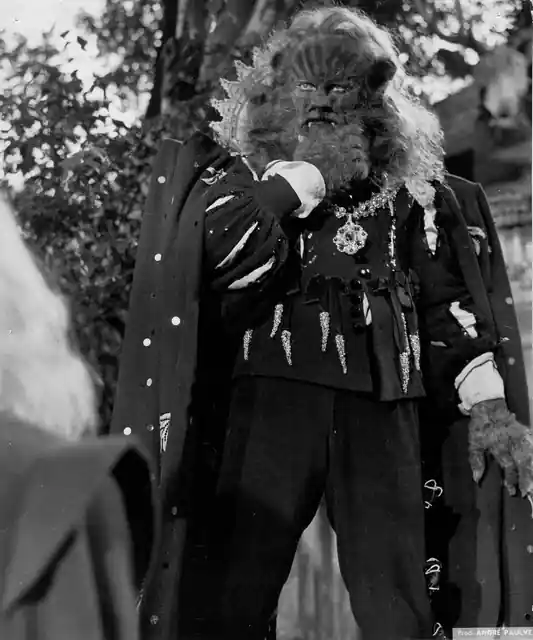
It took five hours for Jean Marais to put on his make-up as the Beast.
Beauty and the Beast (1946): Jean Marais in Beast costume outdoorsImage: Wikimedia Commons · G.R. Aldo, Public domain - #002
- #003
- #004
- #005
Production Story (14)
- #006
Philip Glass composed an opera perfectly synchronized to the film. The original soundtrack was eliminated, and he composed the opera to be performed along with the film projected behind the orchestra and voice talent. The compact disc recording of Glass' "La Belle et la Bête" can be played alongside the film with a very similar effect. Note: the opera is recorded on two compact discs; hence it will be necessary to pause the film once while changing discs. In the US, the second DVD release of this film by the Criterion Collection gives the viewer the option of hearing the original soundtrack or the Glass opera version, which, in a sense, gives you two movies for the price of one. Glass has composed similar works for two other Jean Cocteau films: Orpheus (1950) and The Terrible Children (1950).
Beauty and the Beast (1946): Two people sitting at a table full of candles and fruitImage: Wikimedia Commons · G.R. Aldo, Public domain - #007
- #008
Walt Disney was interested in adapting the fairy tale "Beauty and the Beast" into an animated feature, but when this film released he felt discouraged and believed it wouldn't be as good as what Jean Cocteau did. Eventually, Walt Disney Pictures would adapt the fairy tale as Beauty and the Beast (1991), to great acclaim; however that feature is greatly influenced by this film.
- #009
- #010
- #011
- #012
- #013
Jean Marais originally suggested to Jean Cocteau for the beast to have a stag's horned head, remembering it from a detail in the fairy tale. This would have evoked the mythical echo of Cernunnos, the Celtic stag-headed god of the woods. Cocteau however refused the idea, fearing that to the modern audience a stag's head would turn the beast into a laughing-stock.
- #014
- #015
Walt Disney was considering adapting the fairy tale "Beauty and the Beast" as an animated film, but he was discouraged when this film was released; he believed he could not surpass Cocteau's work. Years later, Disney made its widely acclaimed 1991 adaptation; but that version bears deep traces of Cocteau's film.
- #016
- #017
Jean Marais's performance as the Beast was so beloved that when he transforms into a human at the end of the film, Greta Garbo exclaimed, 'Give me back my Beast!' Marlene Dietrich wept, asking, 'Where is my beautiful Beast?' Cocteau and Marais were even flooded with letters describing the disappointment their transformation had caused.
- #018
Philip Glass composed an opera that syncs perfectly with the film. The original score was removed, and the opera was written to be performed with the film projected in front of the orchestra and vocalists. Glass's 'La Belle et la Bête' recording creates a similar effect when played alongside the film; however, since the opera spans two CDs, the film must be paused once. The Criterion Collection's second DVD edition effectively offers two films in one, giving viewers the choice between the original score or Glass's opera version.
- #019
Behind the Scenes (16)
- #020
Initially, Jean Cocteau and Henri Alekan clashed over the filming style. Alekan wanted to use soft focus to create his version of what a fairy tale would look like. Cocteau, however, insisted a more hard-edged style would make even the most fantastic scenes seem grounded in reality. After the first few days of shooting, Alekan declared the rushes laughably bad. As Cocteau persisted in pursuing his personal vision of the film, the cinematographer gradually came around.
- #021
- #022
- #023
- #024
- #025
- #026
The farmhouse scenes were shot on a farm outside Tours near an airfield. Although the commanding officer was happy to give the company permission to film there, he did not always keep track of the shooting schedule. As a result, takes were often ruined by the sound of training flights overhead.
- #027
- #028
- #029
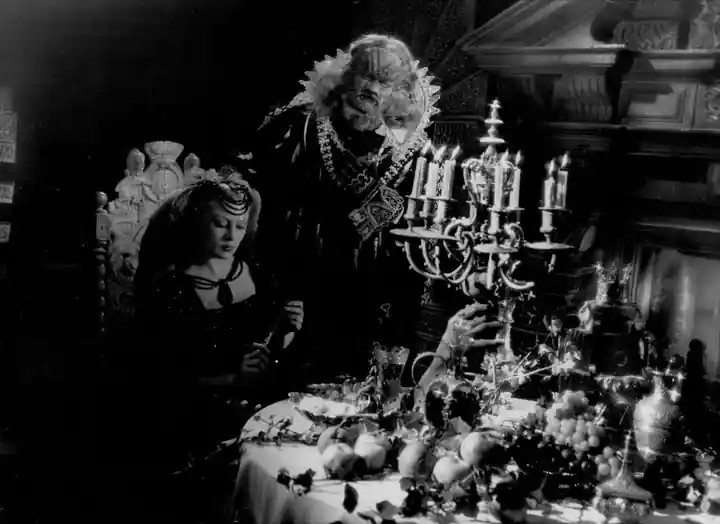
The effect of the candles lighting themselves as the merchant passes them was achieved by blowing them out and then running the film in reverse as he walked backward past them. The entire sequence was done in one long take and reversed - a quick glimpse of the fireplace shows the flames appearing to move downward.
- #030
- #031
- #032
- #033
The effect of the candles lighting themselves as the merchant passes was achieved by lighting the candles, then having the actor walk backwards past them while the film was run in reverse. The entire sequence was shot in one long take and then reversed; a quick glance at the fireplace shows the flames appearing to move downward.
- #034
- #035
At the outset, Jean Cocteau and Henri Alekan clashed over the shooting style. Alekan wanted to use soft focus to create his own version of how a fairy tale should look, but Cocteau insisted that a harsher style would make even the most fantastical scenes appear grounded in reality. After the first few days of shooting, Alekan declared the fuss to be ridiculously bad. While Cocteau insisted on maintaining his personal vision for the film, the cinematographer gradually came around.
Characters & Cast (2)
- #036
For the role of the Beast, Jean Marais's outer body was covered with animal hair. "On my face there's a plenty of cracks, wounds and itches and my hands are bleeding" Jean Cocteau wrote when he was hospitalized during filming, "but the face and the hands of Jean Marais are covered with a so painful crust that removing it is similar to suffer my treatments".
- #037
Easter Eggs & References (3)
Deeper Meaning (5)
- #041
PROLOGUE: "Children believe what we tell them. They have complete faith in us. They believe that a rose plucked from a garden can plunge a family into conflict. They believe that the hands of a human beast will smoke when he slays a victim, and that this will cause the beast shame when a young maiden takes up residence in his home. They believe a thousand other simple things. I ask of you a little of this childlike simplicity, and, to bring us luck, let me speak four truly magic words, childhood's 'Open Sesame': 'Once upon a time...'" ---- Jean Cocteau
- #042
Contains a major spoiler — show
Jean Cocteau intentionally made The Beast a sympathetic character, and his alter ego, the Prince, a over-sentimental and saccharine character. "My aim was to make the Beast so human, so superior to men, that his transformation into Prince Charming would come as a terrible blow to Beauty, condemning her to a humdrum marriage and future; it would expose the naivete of the old fairy tale that conventional good looks are ideal." The contrasting approach worked; so popular was Jean Marais as the Beast, that when he was transformed at the end back to human form, Greta Garbo famously said, "Give me back my Beast!", Marlene Dietrich cried, "Where is my beautiful Beast?", and letters poured in from matrons, teenage girls, and children complaining to Cocteau and Marais about the transformation.
- #043
Jean Marais's performance as the Beast was so beloved that when he transforms into a human at the end of the film, Greta Garbo cried out, 'Give me back my Beast!' Marlene Dietrich wept, asking, 'Where is my beautiful Beast?' Cocteau and Marais were even flooded with letters describing the writers' disappointment at the transformation.
- #044
Philip Glass composed an opera that synchronizes perfectly with the film. The original score was removed, and the opera was written to be performed with the film projected in front of the orchestra and vocalists. Glass's 'La Belle et la Bête' recording creates a similar effect when played alongside the film; however, since the opera spans two CDs, the film must be paused once. The Criterion Collection's second DVD edition offers viewers the choice between the original score or Glass's opera version, effectively providing two films in one.
- #045
Sources & editorial notes
Reference databases
- Wikipedia
- IMDb
Information from external sources is independently selected, consolidated and edited by Arka Evren. Sources are listed for verification and further reading. Encyclopedia text is used under its licence (CC BY-SA). How we work