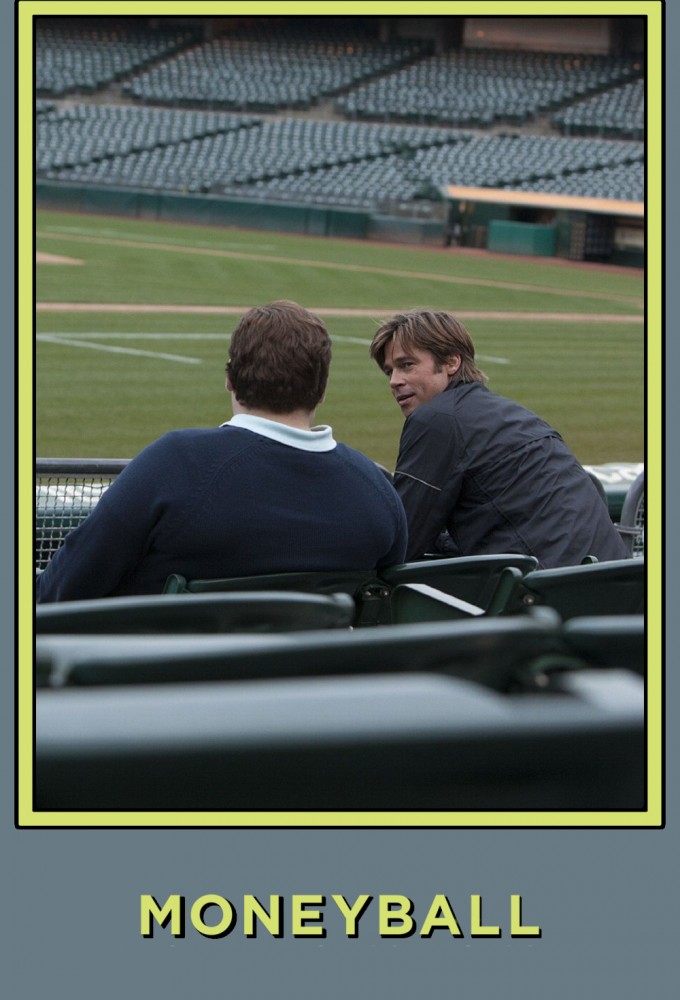
FILM · 2011 · USA
Moneyball
- Directed by
- Bennett Miller
- Runtime
- 134 min
- Studio
- Scott Rudin Productions, Michael De Luca Productions, Rachael Horovitz Productions
48 archived facts 7 topics 1 source Last reviewed Sep 2026
The story of Oakland Athletics general manager Billy Beane's successful attempt to put together a baseball team on a budget, by employing computer-generated analysis to draft his players.
Summary: TMDB

32 Interesting Facts About Moneyball
- #001
Because the Oakland Athletics did not have the budget to shoot at every stadium they visited, Dodger Stadium was dressed to stand in for eight different ballparks.
- #002
During a meeting in which scouts discuss players, one scout dismisses a player for having "an ugly girlfriend," which he translates as the player having "no confidence." The story that an Athletics scout rejected a player because he did not have an attractive girlfriend is apparently true, but the scout stated that in real life it meant "bad eyesight."
- #003
Contains a major spoiler — show
According to the book, the bat Hatteberg used during his walk was made by a company he had no agreement with. He was not supposed to bat in that game, and had earlier borrowed the bat from a teammate and grabbed it on his way out to pinch-hit. He was later fined for using a different brand of bat.
- #004
David Justice is played by Stephen Bishop, a former professional baseball player. Bishop was a Minor League player in his career and, as a Braves prospect, was nicknamed "Young Justice" because of his physical resemblance to and similar style of play to David Justice.
- #005
Contains a major spoiler — show
With the lowest payroll in Major League Baseball and a record fifty-four wins from rookie pitchers, the A's won the AL West again in 2012. The season was unofficially called "Moneyball 2" by fans and the press.
- #006
Billy Beane is portrayed as lonely and divorced. In real life he had remarried. Scenes were shot with Kathryn Morris as his second wife, Tara. Although they were included as Blu-ray extras, they did not make the final cut. Brad Pitt's character still wears a wedding ring throughout the film.
- #007
All but about four of the scouts in the film were played by real Major League Baseball scouts. Tom Gamboa is perhaps best known as the Kansas City Royals' first base coach who was attacked on the field by two fans during a game against the Chicago White Sox on September 19, 2002. The heavily intoxicated father and son ran onto the field unprovoked, attacked Gamboa and threw several punches before players and security restrained them. Gamboa ultimately suffered permanent hearing loss.
- #010
Despite suggestions in the film that Scott Hatteberg was a poor-fielding first baseman, he finished that year with a fielding percentage (0.994) higher than the league average for his position (0.993).
- #011
While advising his players, Beane says, "When your enemy is making mistakes, don't interrupt 'em." This is a rewording of advice Napoléon Bonaparte is said to have given his generals during a battle in 1805.
- #013
Contains a major spoiler — show
The Oakland A's set an American League record with 20 consecutive wins. The all-time Major League record is 26 wins and a tie, set by the New York Giants in 1916. Excluding ties, the record belongs to the 2017 Cleveland Indians with 22 consecutive wins.
- #014
The film's original director, Steven Soderbergh, intended for all the baseball players to play themselves. When Columbia Pictures dropped the film, the screenplay was later rewritten and the new director, Bennett Miller, hired actors.
- #015
Scouting director Grady Fuson, whose departure is depicted at the end of the film, returned to the A's in 2010. By his account he enjoyed the film, but "the only thing that was uncomfortable for me was dropping the F-bomb on my boss. I don't think I can take my grandson to see it yet."
- #017
Bill James, noted in the analysis of the main characters as a statistical influence, is widely regarded as the father of sabermetrics. This work on advanced baseball statistics takes its name from the Society for American Baseball Research (SABR), an organization to which James and other sabermetrics pioneers belonged. The film places great emphasis on on-base percentage (OBP) but does not mention concepts such as wOBA, FIP and BABIP.
- #018
The film does not mention that the A's had three pitchers with more than fifteen wins (Mark Mulder 19, Tim Hudson 15 and Barry Zito 23) and two sluggers with more than thirty home runs and 100 runs (Eric Chavez 34/109 and Miguel Tejada 34/131). In fact, Miguel Tejada was the American League's Most Valuable Player in 2002, Barry Zito won the coveted Cy Young Award, and many observers and students of the game generally rank the early-2000s A's pitching rotation among the best in baseball history.
- #019
In a 2014 interview on the National Public Radio program "Fresh Air," director Bennett Miller said that nearly all of the scouts depicted in the film were played by real scouts: "Most of these guys are just scouts and there are a few actors in there. You know, we were just researching and trying to get a sense of what these meetings were like, and we invited a bunch of scouts to come talk to us about how they approach things and, you know, what these kinds of meetings are. And I don't know, in preparing the film we probably gathered 20 people and just to have a roundtable discussion and to reenact something, we just kind of mixed it up and watched the flow of it and, you know, sat with Brad Pitt and just looked at each other and wondered, why don't we invite these guys again and say, tell them you worked that season and you're working for A's. How are you going to do this? And you know, a kind of hybrid with the script written by Steven Zaillian and Aaron Sorkin kind of brought it to life."
- #020
At one point we hear that Miguel Tejada made a move to end the game. In the original book, Tejada's free-swinging ways and relatively high strikeout rate were a point of contention, because the Dominican shortstop told Billy Beane and other members of the Athletics that "You can't walk your way off the island."
- #021
In interviews, Art Howe objected to his portrayal in this film.
- #023
Bobby Kotick, President, CEO and director of Activision Blizzard, plays Oakland Athletics owner Stephen Schott in the film.
- #026
Contains a major spoiler — show
A's closer Billy Koch, who won the team's 20th consecutive game during the streak, blew the save in the top of the ninth by giving up the tying run. Oakland then won when Scott Hatteberg hit a walk-off home run in the bottom of the ninth. Koch saved nine of the 20 games in the winning streak and also earned the win in three of them.
- #027
When Billy Beane meets with his scouts, he says: "It's an unfair game." The film is adapted from the book "Moneyball: The Art of Winning an Unfair Game."
- #028
The film is known for its dramatic license with real events. Art Howe actually agreed with the Moneyball concept from the start, especially after Scott Hatteberg became the regular first baseman. Carlos Pena was not a Rookie of the Year candidate and did not receive that consideration until he was traded to the Detroit Tigers, where his performance improved greatly. The film also did not focus on the fact that the Athletics arguably had the best defensive infield in the league, which helped given that their top three pitchers relied heavily on balls in play. While the scouts in the film are archaic and behind the times, Oakland had one of the best farm systems in the league. Although Boston used the Moneyball concept to win the 2004 and 2007 World Series, it had the second-highest payroll in the league after the New York Yankees, proving that Moneyball is good for filling out a roster but that highly paid stars still matter.
- #029
Many of the players who play basketball have baseball experience. Casey Bond spent time in the Giants' organization. Stephen Bishop played for three years, including one season in the 1990s playing with David Justice. Royce Clayton played 17 years in the MLB. Derrin Ebert had played five games for the Braves in 1999.
- #030
During the film's theatrical run, Oakland Athletics coach Ron Washington, played in the film by Brent Jennings, was managing the Texas Rangers in the World Series.
- #031
Sharon's new husband Alán is not listed in the credits.
- #036
Production was to begin on June 22, 2009, but Columbia Pictures co-chairman Amy Pascal canceled the film after objecting to the changes Steven Soderbergh made to Steven Zaillian's script.
- #039
In the second staff meeting, a nameplate reading "Pratt, C" is visible on the board behind them. Chris Pratt is one of the players.
- #040
Billy Beane refers to John Poloni as "Rocco." This is a nod to Jack McGee's father, who played minor league baseball and whose nickname was "Rocco."
- #044
The player closest to the 2002 A's was Billy Koch. Koch can be seen in several scenes but is never heard speaking. Koch played college baseball at Clemson University and was selected fourth overall in the 1996 MLB draft. In college and the minor leagues, he was known for wearing cut-off jeans under his uniform pants.
- #045
Brad Pitt and Jonah Hill had both appeared in Megamind (2010).
- #046
Contains a major spoiler — show
Joe Satriani plays the national anthem at the opening game.
- #047
In the scene where Billy Beane (Brad Pitt) and Peter Brand (Jonah Hill) tell General Manager Art Howe (Philip Seymour Hoffman) that they have traded two of his key players, a framed cartoon hangs on the wall. It depicts Thurman Munson catching for the Yankees above two boys while rain falls from the clouds; the boys below walk away from home with gloves and heads hung low, and one says to the other, "Naw, Yuchie, I just don't feel like playing ball today." The cartoon first ran in the New York Daily News after Munson died in a tragic plane crash in Ohio on August 2, 1979. It is one of the most beloved and best-known editorial cartoons in all of sports, memorializing one of the saddest events in baseball history. Munson was the catcher and team captain who led the Yankees to the American League pennant in 1976 and to back-to-back World Series championships in 1977 and 1978. He was a much-loved figure in baseball, particularly for his reluctance to be bullied by team management. It is a clear sign to Beane of his manager's unwillingness to let the General Manager dictate how he plays his team.
- #048
Billy Beane meets with Indians general manager Mark Shapiro to trade for Ricardo Rincon. Shapiro instead offers Dave Hollins, Karim Garcia or Chris Coste, while Beane offers Mark Guthrie, and no trade is made.
Sources & editorial notes
Reference databases
Sources for the entries on this page
- IMDb IMDb
Information from external sources is independently selected, consolidated and edited by Arka Evren. Sources are listed for verification and further reading. Encyclopedia text is used under its licence (CC BY-SA). How we work