FILM · 2010 · USA
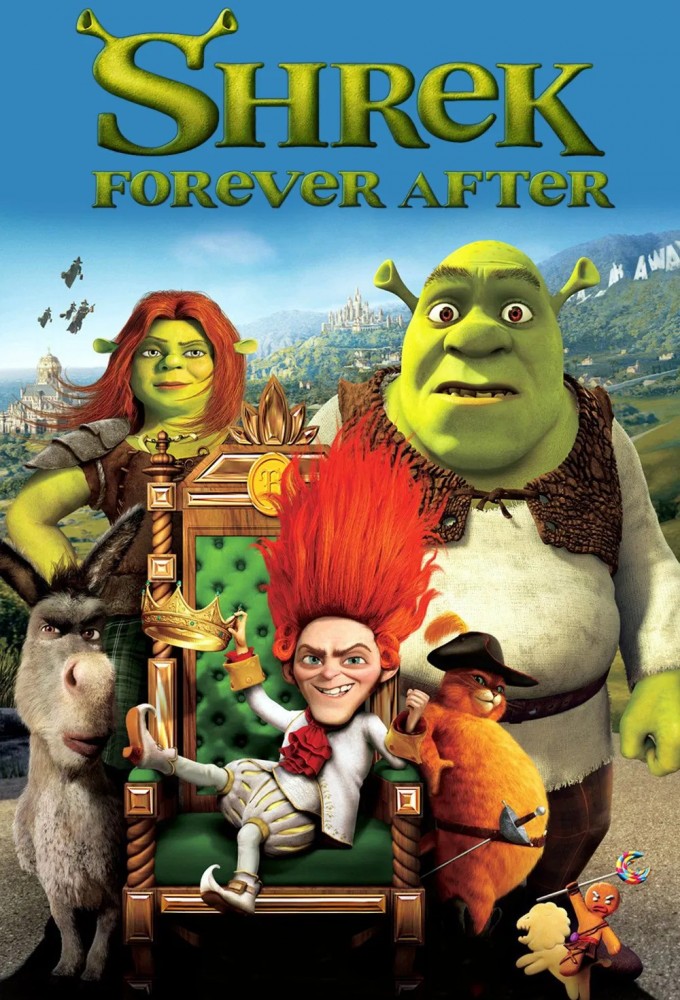
Shrek Forever After
32 archived facts 5 topics 1 source Last reviewed Oct 2026

28 Interesting Facts About Shrek Forever After
- #001
The flute solos played by the Pied Piper were performed by the well-known jazz flutist Jeremy Steig. He is also the son of the late William Steig, author of the original Shrek books.
- #002
Walt Dohrn, who is credited at the start of the story, voiced all the characters during storyboard meetings. No other actor could come close to the voice he found for Rumpelstiltskin, so he was cast in the role.
- #003
Hair is known to be quite difficult to recreate in CGI animation. There is a big difference between Fiona's rather stiff braids in Shrek (2001) and her flowing curls in this film, thanks to advances in computer animation over the nine years in between. Fiona's hair in this film was largely modeled on Janis Joplin's hair.
- #004
One of Rumpelstiltskin's witch friends is named "Baba," inspired by the witch Baba Yaga of Slavic/Russian folklore.
- #005
In the audio commentary on the DVD release, director Mike Mitchell states that Brogan is actually Prince Charming, the villain of Shrek the Third (2007), that he suffers from the same curse as Fiona, and that he is named "Gnimrahc," which is "Charming" spelled backwards.
- #006
(At about 9 minutes) Early in the film, the birthday of Shrek's children takes place at the Poison Apple, the old bar used in previous installments.
- #007
Rumpelstiltskin appeared briefly in Shrek the Third (2007), but he looked different there (wide-brimmed hat, trimmed beard, mustache and sideburns, different facial features) and his voice was provided by a different person.
- #008
Since this film mainly deals with a crisis in Shrek and Fiona's marriage, the production team actually consulted various marriage counselors on how the characters should best behave.
- #009
Initially, the idea of Puss in Boots getting fat and lazy met with some resistance until the writers convinced everyone that the idea had rich comedic potential.
- #010
This is not the Pied Piper's first appearance. He also had a brief role in Shrek (2001). He can be seen when Shrek first finds all the fairy-tale creatures who sent dozens of mice flying through his swamp. He looked different and wore red clothes instead of black.
- #012
The discussion arose after paparazzi photos revealed that Justin Timberlake went to the studio to record lines as Artie, the Shrek the Third (2007) character who proved popular among fans of the series. It soon emerged that after he did not appear at the gala at the Tribeca Film Festival, his scenes were deleted but he does not appear in the DVD releases either. Moreover, his character never appears and is never mentioned, possibly indicating that director Mike Mitchell scrapped Artie entirely or forgot about him.
- #013
(At about 35 minutes) This is the only Shrek film in which Shrek is shown crying.
- #014
The original title was "Shrek Goes Fourth," and it was to be directed by Andrew Adamson, director of the first two Shrek films, until mid-2009. Until it was decided in mid-2009 to make this film the last in the series and not to put the fifth film, which Mike Mitchell took over from Andrew Adamson, into production, Adamson had difficulty making it a normal film in the series. However, a fifth film was put back into production and was eventually announced as a reboot with the potential return of the majority of the series' cast.
- #015
The role of Rumpelstiltskin was intended for Sir Paul McCartney, but he ultimately left the project due to creative differences.
- #017
Rumpelstiltskin takes some elements from the main villains of previous Shrek films: he is short and, similar to Lord Farquaad in Shrek (2001), rules an empire with an iron fist. Similar to Fairy Godmother in Shrek 2 (2004), he has magical powers that help others change their fates. Similar to Prince Charming in Shrek the Third (2007), Shrek's life was ruined after he rescued Fiona from the castle.
- #018
At its peak, this was the seventh highest-grossing animated film of all time. Although this is high for a DreamWorks Animation film, it is the lowest peak of any Shrek film. Shrek (2001) rose to fourth place, Shrek 2 (2004) to first place, and Shrek the Third (2007) (coincidentally) to third place.
- #019
Following the release of numerous YouTube videos about the Shrek series by Mr Sunday Movies, one person took on the task of connecting every scene in the entire series to a scene from Gilligan's Island (1964), something that has been proven to affect the entire Shrek series.
- #020
Antonio Banderas (Puss in Boots), John Cleese (King Harold), Dame Julie Andrews (Queen Lillian) and Larry King (Doris) have appeared in every Shrek film since Shrek 2 (2004).
- #021
Shrek Forever After was the number one film at the US box office for three weeks.
- #022
It was the second highest-grossing animated film of 2010, after Toy Story 3 (2010).
- #023
In a teaser trailer, the martini Shrek was holding had a bullet on a toothpick, but in the final film this was changed to an animal's eye.
- #025
All four Shrek films were released in May.
- #026
It is the only Shrek film in which Prince Charming does not appear and is not mentioned.
- #028
It is the first Shrek film to be in 3D.
- #029
Lord Farquaad (John Lithgow), Fairy Godmother (Jennifer Saunders), Prince Charming (Rupert Everett) and Arthur Pendragon (Justin Timberlake) were to appear in the alternate reality in which Shrek was never born. Lord Farquaad was to be Fiona's husband and the only human member of the resistance, the Fairy Godmother was to be the Queen of Far Far Away and Rumple's wife, Prince Charming was to be Rumple's stepson who had forgotten his love for Fiona, and Arthur Pendragon was to be Rumplestiltskin's loyal advisor and would be seen attending the trio's birthday party in the real world. However, they were not in the final film.
- #030
The witches have a weakness to water, like the witch in The Wizard of Oz (1939).
- #031
All four Shrek films were released in the gap between the second and third films of Disney/Pixar's Toy Story series.
- #032
It is the first Shrek film made in the 2.39:1 widescreen aspect ratio, unlike the first three films, which were made in the longer 1.85:1 aspect ratio, although Shrek: The Ghost of Lord Farquaad (2003) was shot at Universal Studios in the 2.20:1 70 mm widescreen aspect ratio.
Sources & editorial notes
Reference databases
Sources for the entries on this page
- IMDb IMDb kaydı
Information from external sources is independently selected, consolidated and edited by Arka Evren. Sources are listed for verification and further reading. Encyclopedia text is used under its licence (CC BY-SA). How we work