

FILM · 2025 · USA
Sinners
- Directed by
- Ryan Coogler
- Runtime
- 138 min
- Studio
- Warner Bros. Pictures, Proximity Media, Domain Entertainment
315 archived facts 8 topics 1 source Last reviewed Nov 2026
Trying to leave their troubled lives behind, twin brothers return to their hometown to start again, only to discover that an even greater evil is waiting to welcome them back.

315 Interesting Facts About Sinners
Interesting Facts (90)
- #001
The film takes place entirely between the morning of October 15, 1932 and the morning of the following day; the closing credits and post-credit footage are from October 16, 1992, so the film covers a time span of 21,916 days, despite about 95% of it taking place within the space of just one solar day (24 hours).
- #002
Director Ryan Coogler was impressed by Miles Caton's audition tape from the very beginning. "He was just in the dark--like he didn't turn his lights on," Coogler said. "Something about that was, like, so intriguing. This kid looked like he was in his basement, like in between homework assignments. But he had this voice--a once-in-a-lifetime voice."
- #003
- #004
- #005
- #006
Sammie's guitar is said to have belonged to blues legend Charley Patton. Patton was often said to be of Irish, Choctaw and African-American descent... the three ethnic groups mentioned at the beginning of the film. (While parts of Patton's ancestry aren't known for certain, it is generally agreed upon that he had Black, White, and Native heritage, including of the Choctaw people.)
- #007
According to producer Sev Ohanian, many of the extras' costumes were repurposed from Marvel Studios' Blade, which had just been delayed indefinitely. He said, "At one point, that movie was going to deal with... the past around the same era as 'Sinners.' [They] happened to have a warehouse full of period-appropriate clothes, and it was like, 'Yo, we got to shoot this movie like tomorrow.'Costume designer Ruth E. Carterwas allowed by them to purchase the period costumes she designed for that movie and use them for the film and Marvel was generous enough and kind enough to let us basically purchase it at a price." Marvel Studios sold all the costumes to the film's production team.
- #008
- #009
For his first film to achieve major box office returns, director Ryan Coogler decided to thank the fans who came and the filmmakers who inspired him to make the film. He did so by writing a letter to all of us. "Infinite gratitude. My heart is full with it. I want to thank each and every one of you who bought a ticket to see Sinners," the letter reads. "Who decided to drive to see the film in different formats, who bought popcorn and a drink, who booked a sitter and carpooled and then stood in the lobby talking and made friends, who changed your work schedules, who watched the film in groups." "I got the chance to make a film inspired by my family and my ancestors, but this was always a film we wanted to make for audiences in theaters," Coogler wrote. "We always had you, the audience, in mind, and we felt a deep responsibility to entertain you and to move you in a way only cinema can." The director continues, "I believe in cinema. I believe in the theatrical experience. I believe it is a necessary pillar of society. That's why I and many of my friends have dedicated our lives to the craft. If you don't come, we can't do what we do. The global theatrical audience allowed me to dream, to find a career and to build a more sustainable life for myself and my family. And the only way I know how to thank you for that is to keep exploring more stories that will present my personal human experience and relationships to you in the language of cinema."
- #010
- #011
- #012
Hailee Steinfeld wrote and recorded an original song, "Dangerous", for the film.
- #013
- #014
- #015
Michael B. Jordan says there were "a lot of nerves" playing identical twins and explained how he differentiated them: "I wore shoes that were too small for Stack because I liked him antsy, and not really being able to sit still. Smoke, a size too big. He didn't move as much. It all started to take shape, with Ryan (director Ryan Coogler) being the perfect North Star for where the story's going."
- #016
Composer Ludwig Göransson and director Ryan Coogler insisted that Göransson's wife Serena McKinney produce the songs. Serena Göransson, a classically trained violinist, said that Southern Black music had to be handled carefully and with expert consultation, and that she felt "like a steward with this project […] especially with the music. I just feel that it has a life of its own…".
- #017
Hailee Steinfeld opened up about making discoveries about her roots in preparing to play Mary, who is a multi-racial woman. "It had such an impact on me personally," she told PEOPLE. "Therefore, I feel like the least it can do is make an impact on those that watch it. I think it affected all of us so personally and so deeply, and I do believe that you feel that and you see that when you watch this movie." I'm so grateful for the deeply personal connection that each of us have [to the material]," she added, "mine being with my family history, with my grandfather, who I wish was still here to answer all the questions that I have that this movie raised for me and making this movie raised." She added that "part of my research included understanding my own family history a bit better, which I am grateful for."
- #018
When Smoke and Stack return, one of the first places they go to was downtown Clarksdale, Miss. It's where they spread their message about the juke joint, and where they get their supplies. This was shot in Donaldsonville, La. Production designer Hannah Beachler had three to four weeks to create a whole block. Every road needed to be dirt instead of paved, so the dirt was brought in by the truckload. More importantly, each side of the street was a reflection of their segregated town. "When you go into downtown in our film, you'll see that King Tamales is one of the stores right next to the grocery store. I started really learning and talking to the people about the history of tamales, because it's a big deal in the Delta, and that's not two things you'd put together, the Mississippi Delta and tamales. Different cultures played a big part in the film. I wanted to include Red Hots and King Tamales, things that are part of their history," Beachler said. "Ryan (director Ryan Coogler) wanted to divide the street with one side being black and one side being white. We were really influenced by Min Sang of Clarksdale from that era, and that was a Chinese American grocer in Clarksdale around that time. So there's a lot of what Clarksdale is in the train station and in downtown, and not just coming up with what we think it is, but what it actually was. If you look at the window, it tells you about where you are. If you notice in the two grocery stores, one is the black grocery store owned by Bo and Grace Chow. In that, you'll notice that it's all produce. It's all working things to buy like hoses, brooms, buckets and mops. If somebody wanted you to be their maid, you had to be their maid. That was just the way that it was. So it's all about the work. The candy on the Black side is hard but when you get to the white side, there are cakes, fruit, and there's more advertising. Those are small, subtle differences between those two sides. Even when you walk up to the stores and see the exteriors, you'll see that there is a similarity in the signs because it was done by Grace. If she were living today, she would be an artist. So that comes out in the signs and you'll see that they're very specific in the way that the language of those signs is to her. A lot of that was inspired by Chinese graphics from the 1920s in Shanghai. We really wanted to make those subtle differences between the two places, of what you see on each side and understand the differences in that Jim Crow era. On the White side, you'll see that they have a car dealership and a movie theater, whereas on the Black side You've got The tamale store and a little tiny cafe, where you've got a really nice cafe on the other side."
- #019
- #020
- #021
- #022
- #023
Composer Ludwig Göransson and his wife Serena McKinney worked with blues producer Lawrence 'Boo' Mitchel, owner of Royal Studios, and visited the B. B. King Museum and local music venues in Clarksdale and Indianola with him for inspiration. Göransson and Mitchel recorded songs at Royal Studios over five days with musicians such as Alvin Youngblood Hart and Cedric Burnside. Mitchel also brought in other blues musicians including Brittany Howard, Raphael Saadiq, Buddy Guy and Bobby Rush.
- #024
- #025
According to production designer Hannah Beachler, the church set is one of her absolute favorite sets and, along with the juke joint and Annie's shop, was among the first three things she designed. She explained, "I jumped in and I don't know if I was possessed or something, but I started doing all my research and really looking at a lot of writer Eudora Welty, who is a fabulous photographer from the Delta during that same time period. I grabbed my sketchbook, and the first things I sketched were what ended up in the film. But the church became very much about several different things that Ryan (director Ryan Coogler) talked to me about, but mostly about the representation of that holiness and that purity that you find in juxtaposition to the outright hedonism and capitalism of the juke joint."
- #026
Delta Slim has a memorable introduction early in the film, playing music at the train station when Stack asks him to perform on the juke joint's opening night. But when Delroy Lindo first received the script from Ryan Coogler, he noticed that the character began to fade after that scene. "My introduction was so dynamic and so rich, and I told Ryan that I seemed to disappear in the second act of the film," Lindo says. Coogler promised to fix the problem, a testament to the collaborative spirit for which nearly everyone involved in the film's production praises him. Lindo adds, "I'm much more present than I was originally in that first draft." The train station where Delta Slim is first shown is one of production designer Hannah Beachler's many intricate creations; Lindo says he associates the space with a single word: "Home." He shares another story that proves not only Coogler's collaborative spirit but also how the director's vision for the film extends to the characters' smallest movements and how they adapt to the world around them. "Discovering me in that train station was discovering me in my element, in a place that is foundational to who I am," he says. "I remember one instruction Ryan gave me. He wanted me to sit on that trunk, and at one point I got the instinct to get up and move. 'No, no, no. This is your world,' he said. And I felt very strongly that I should sit. He proved to be right about that. If I had gotten up, something would have fallen apart. The fact that I could be in my own world, planted in that box in my own world, that is true storytelling."
- #027
Director Ryan Coogler cited the Disney Channel movie The Luck of the Irish (2001) as one of the influences on the film. Coogler states, "That was our first introduction to some of the similarities in Irish folk music to, basically, our music. There was a small Irish community in The Bay, and we would talk about it. That movie was kind of a touchpoint for us to jump off of, crazy enough. We've been fascinated with that culture in my family." The film talk about a basketball player who learns he is descended from leprechauns.
- #028
Director Ryan Coogler hired intimacy coordinator Amanda Peek and emotional wellness coordinator Kim Whyte to help assess the film's sex scenes and other intimate scenes, and make the actors feel comfortable and safe. Coogler was applauded for doing this, especially during a time when intimacy coordination is still in its infancy and looked at with apprehension by some actors and actresses.
- #029
Ryan Coogler recalls filming one scene where he nearly lost his mind, where the twins had to drive the car and get into the bushes. Pulling off that shot was "fucking crazy," because Michael B. Jordans driving, and they had to do a repeated pass of the car driving up and landing, them getting out of the car with the correct timing, and then interacting with the bush with the correct timing.
- #030
Director Spike Lee explained that his first experience with this film began with a cold call from the film's director and his friend Ryan Coogler. Lee said: "My brother Ryan, he did that damn thing. Let me tell a short story. He called me and said, 'Spike, are you in Los Angeles?' I said, 'Yeah, why?' 'Well, we're doing the final stage in IMAX and if you can get here within an hour you can see it.' I rarely go to Los Angeles. So it wasn't a mistake that I was there, and he took the opportunity to call me." He concurred that he had quite the outward reaction to the film, as he said, "So I'm there. I'm on the right, Ryan's in the center and his wonderful wife Zinzi is there too. I know they won't want to sit next to me at a movie again because I was like I was in my courtside seats at the Garden and the Knicks were killing the Celtics. I was jumping up and down. Especially that music sequence blew my mind. That film took me somewhere else. I love movies and when I see something great it lifts me up. To me 'Sinners' was the film of the year."
- #031
Delroy Lindo reflected on his final day on the set, as he was about to leave the set, director Ryan Coogler and some of the actors spoke to him about what his work had meant to them and what the process of working together had meant to them. Lindo said a few words through blubbering tears because he was so moved. "That was special, and it felt special in the moment - a deep, deep-seated feeling of appreciation," he said.
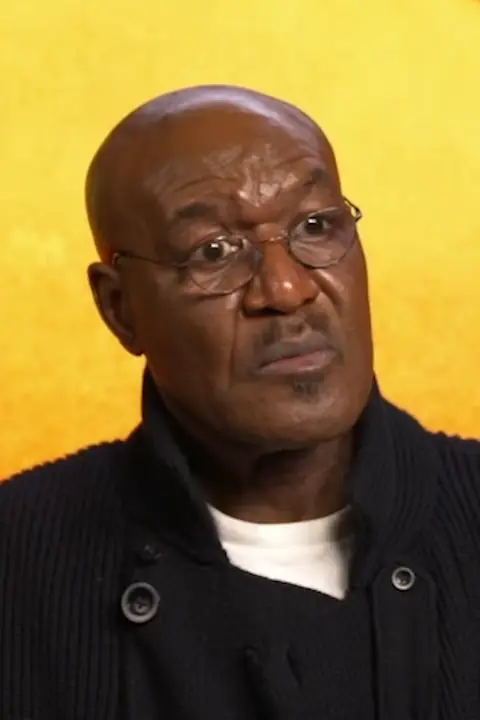
Sinners (2025): Delta SlimImage: Wikimedia Commons · The Movie Blog, CC BY 4.0 - #032
- #033
- #034
- #035
- #036
Ryan Coogler said the film was directly inspired by the structure and intensity of the song Metallica: One (1989). He explained that he wanted the film to feel like a musical piece, combining the "simplicity and profound nature of a Delta blues song" with the "contrast, variation, and inevitability" of the Metallica track.
- #037
- #038
- #039
The film takes place entirely between the morning of October 15, 1932 and the morning of the following day; the closing credits and post-credit footage are from October 16, 1992, so the film covers a time span of 21,916 days, despite about 95% of it taking place within the space of just one solar day (24 hours).
- #040
- #041
- #042
Contains a major spoiler — show
The scene in which Sammie's musical talents "pierce the veil between life and death," metaphorically setting the house on fire and briefly exposing the revellers in the music venue to the demons outside. "Everybody would have reactions when they read that [scene], and that, to me, was like 'OK, maybe I've got something,'" director Ryan Coogler said. Translating it from script to screen, however, was difficult. "From a production standpoint, we had a lot of work to do. Every department was involved; it took a lot of coordination," he notes. "There are a few scenes like this in every film; as you get closer to production, you realize, 'We're going to need way more planning than we thought.'" Rather than using previsualization technology to map out the sequence, Coogler opted for Sidney Lumet-style rehearsals, in which key players in the production came together in the physical space to map it out. "You gotta know how big the camera is. You gotta have the person who's gonna hold the camera here," he explains. "You have to go through that process and find where your trouble spots are and try to get ahead of them. We had to know what people were wearing, and we had to find Jesus Christ… we had to find the right musicians; we had to find dancers who could do these cultural dances. These are highly specialized people," he says, noting that choreographer Aakomon Jones, who had previously worked with Coogler on Black Panther (2018), was simultaneously working on Usher's Super Bowl performance. Not to mention that Ludwig Göransson and his wife Serena McKinney recorded the scene live on set.
- #043
Contains a major spoiler — show
When Buddy Guy was brought in for facial scanning, visual effects artist James Alexander shared, "He's a born entertainer and he told me a bunch of stories. He's just mesmerizing, because he's got one of those faces [where] you can tell he's just got a million stories behind those eyes. And he started telling me stories about Aretha Franklin [and] stories from New York in the sixties and the seventies."
- #044
Contains a major spoiler — show
According to Peter Dreimanis, there's a cut scene that explains Bert and Joan talking about their desire to have a child and their inability to do so. Then an injured man shows up and changes it all, which explains why there's a crib in their house in the scene where Joan discovers that Remmick has killed Bert.
- #045
Contains a major spoiler — show
The other two newspaper pages that can be found on Spotify reveal just how Smoke and Stack made their money: bank robberies. The first page is from their hometown paper, and outlines the outcome of a bank robbery, along with a description of the brothers' personalities as recounted by eyewitnesses, including Stack's smooth-talking commanding nature, and Smoke's more abrasive, violent streak. That robbery occurred in 1924 judging by the paper's date. The second page details the clash between the Italian mafia and the Irish mob in Chicago, following the arrest of Al Capone. As the paper states, the two factions are at each other's throats as they vie for control of the city in the vacuum left by Capone's arrest. It specifically states that both sides accuse the other of stealing an illegal alcohol horde. Meanwhile, the Smokestack Twins fill Club Juke with cases of Irish beer and Italian wine from their truck, clearly implicating them in the brewing gang war in the North.
- #046
Contains a major spoiler — show
When Remmick arrives at Bert and Joan's house, black vultures can be seen circling over their house, but do not land until after the Choctaw vampire hunters leave, indicating that their fate is sealed. In a blink-and-you'll-miss-it moment of foreshadowing, a black vulture can also be seen in one of the earlier scenes as Smoke and Stack are driving around.
- #047
Contains a major spoiler — show
A trip to the birthplace of the Delta Blues popularized by Charley Patton inspired director Ryan Coogler to make the film as big and boldly cinematic as possible. The director struck out to show "how brilliant these people were, how they persevered, and how their culture went to these metropolises and dominated, and to dispel all the lies told about them." Omar Benson Miller said he can appreciate this history personally, too. "My family is from Mississippi, and I'm from a family of sharecroppers," he said. "I was happy to bring that to the screen in this way, because these are hardworking people, and people who set the foundation for me to be able to have a cush job making my living telling their stories." Coogler uses the public's fascination with vampires and horror to make a larger point. For him, the vampirism is a warning to look beyond the moment and temporary gain. Because, if you don't, you might just find that the quick fix to a problem "comes at an incomprehensible price" to the culture and future generations.
- #048
Contains a major spoiler — show
While explaining the concept of individuals whose music is so true it can conjure spirits from the past and the future, the opening narration brings up as specific examples the terms used to describe such people in Ancient Ireland, among the Choctaw people and in West Africa. The main antagonist is an Ancient Irish vampire, who enters the story pursued by a group of Choctaw vampire hunters, and the story revolves around one such gifted musician, likely descended from West African people, like most African Americans.
- #049
- #050
Contains a major spoiler — show
In the first third of the story, the Moore Brothers, Smoke and Stack, are characterized by their willingness to bargain, even down to Smoke actively teaching a young girl how to haggle with him over the price he pays her to watch over his car. Remmick, by contrast, does not accept rejection, and does not alter his terms. He only knows how to bully others into doing his will. This is how we know that Stack is still himself, even after decades as being the undead when he approaches the elderly Sammie, not with threats but with an offer, and accepts Sammie's refusal instead of pushing it.
- #051
Contains a major spoiler — show
Smoke didn't just stop Remmick's performance of "Pick Poor Robin Clean" because he didn't want him in the joint. The lyrics contain several racial slurs. This shows that Smoke was hyper-aware of details in things and sensed that Remmick was not to be trusted.
- #052
- #053
Contains a major spoiler — show
Sammie asks Stack if he can drive his car. Stack tells him that he will allow him to on the way back. This foreshadows the scene, both from the beginning and end of the film, of when Sammie drives the car back to his father's church after the vampire massacre.
- #054
Contains a major spoiler — show
The survivors eating garlic cloves to see which of them may be a vampire may be a riff on the hot-wire blood test from The Thing (1982). There's also a similarity to the Husky Thing arriving at the American base in the former film and Remmick arriving at Bert and Joan's house in this film. In "The thing", the Husky Thing arrives at the American base while being chased by the surviving Norwegians who witnessed the carnage the Thing caused. Before they are killed, the Norwegians try in vain to warn the main characters that "It's not a dog!" In this film, the Choctaw hunters chase Remmick to Bert and Joan's house and try to warn the couple that he's a monster (like the Americans in The Thing, Joan ignores the warning).
- #055
Contains a major spoiler — show
Director Ryan Coogler said that at one point during production the team called a meeting to discuss Michael B. Jordan's dislike of the fake blood. "I liked the fangs. Fangs were dope. The blood was a bit messy and uncomfortable at times. The blood was a lot," Jordan said first, and Coogler added: "Within a few weeks I was called into a meeting by my producer and wife, Zinzi Coogler, and she said to me: 'Hey, we need to talk about Mike.' I said, 'What? What's going on?' And she said, 'He doesn't like the blood.' I said, 'Wait, what?'" Jordan added, "First of all, there's a difference between complaining and venting. I was more just riffing, you know what I mean? But they care about me, so they had a meeting. I'm grateful for the meeting." Coogler recalled, "I remember times when I said 'Okay, action' and you said 'That's disgusting…'" Jordan agreed, "Disgusting."
- #056
Contains a major spoiler — show
For most of the movie, the twins Elijah (Smoke) and Elias (Stack) Moore, both played by Michael B. Jordan, are differentiated sartorially by color: Stack wears red accessories (including a tie, pocket square, and wide-brimmed hat), and Smoke wears blue (including a blue shirtfront and blue newsboy-style cap). However, by Smoke's last appearance in the movie, all these blue accessories have been stripped away, and his formerly white shirt is covered in blood, meaning that he is also clothed in red.
- #057
Contains a major spoiler — show
When Smoke and Stack pick up Sammy, Stack assures him that they'll get Sammy back to him "in one piece." Turns out, they did end up keeping that promise. As a vampire, Stack agrees to not target Sammy and lets him live to old age, and Smoke protects Sammy to the very end, allowing him to be the sole survivor and the only person able to return home after the massacre.
- #058
Contains a major spoiler — show
Ryan Coogler and his Creative Partners use background elements to enhance the different characters. Annie and her house have a drift of air-borne, glowing, wisps akin to milkweed or cottonwood. Vultures appear in proximity to characters destined to die (the Grand Dragon, Burt and Lois, and the inhabitants of the juke joint).
- #059
Contains a major spoiler — show
When Remmick leads his thralls in a performance of Rocky Road to Dublin he's actually choosing a very relevant song. A young man leaves home and is robbed, then finds police are useless and just mock him for his accent, he crosses the ocean in the hold of a ship and is forced to stay in the hold with pigs, where he battles low spirits and seasickness by singing and dancing. When he reaches his destination he's met with anti-Irish sentiment and has had enough and despite being outnumbered attacks those mocking him. Now, at last, his fortunes turn as other Irishmen join him.
- #060
- #061
- #062
Contains a major spoiler — show
Production designer Hannah Beachler had eight weeks to build two juke joints: one for interior shoots and one for exterior shoots. It was all about the detailing process she went through. They had to use boric acid to rust the sheets of metal outside the juke joint, Beachler said. While the process took longer, Beachler wanted everything to feel as real and authentic as possible, so everything needed to be real, including the rust. She explained, "One of the things and I'm not going to say which things - I'll eventually say what it is exactly, but I want people to see it again and see if they can find - there is a representation in the juke joint for every environment that we visited on the way to it. So there's a representation of Annie's oak trees that sort of protect and cover her home in the juke joint that protects and covers them. In the third act the white wall where Mary bites Stack - that is the representation of a white church, and there are horizontal lines above people's heads - specifically Stack and the vampires, I should say - within that. When you first see the place with Hogwood, the mill owner, it feels very much like old wood, but as it turns into the juke joint, we changed the bottoms of everything to rough sawn wood. What happens is that wood is wet and it shrinks and that's what they built with. As we filmed, it started shrinking up, and we would put dust on it. We didn't put anything underneath it, so it would bounce. When they were doing the scene with Jayme Lawson, and she's singing and you see everybody smacking the floor, therefore was bouncing and the dust was coming up and it was making it a little bit more atmospheric. It really lent itself to the sound, to the atmosphere that it created when the extras came in and we're doing that sultry juke joint dancing. There are a ton of Easter eggs in the juke joint, on the back wall where the entrance is, and you'll see the rusted tin inside of that juke joint. And if you were to play "Smokestack Lightning" by Howlin' Wolf and you were playing it on a tape recorder and you stopped it in the chorus and you looked at the equalizer where all the bars stop, we painted that in on the back rust wall. So that chorus sort of lived in the juke joint and over everyone. I think they say it at the end, "For that one day we were free,' and that's really what it was. It was the story of the sun, and with that, that was our inspiration for Sergio Leone. I love a Western, and that's something Ryan Coogler and I have greatly in common. I would watch Westerns nonstop when I was young. So you have some Stagecoach (1939) and The Searchers (1956), Chisum (1970) and Leone's trilogy, all of that is in there."
- #063
- #064
Contains a major spoiler — show
In an extended version of Remmick leading the vampires to sing and dance "The Rocky Road to Dublin", Stack and Mary are seen beginning to dance with each other instead of just toward Remmick. Had this been in the film, it would have been foreshadowing of Stack and Mary's power of autonomy, ultimately choosing to save themselves instead of dying with Remmick at the end and continuing to thrive as a vampire couple.
- #065
- #066
Contains a major spoiler — show
Sammie's introduction in the flash forward that begins the movie also has some foreshadowing as to how the final confrontation plays out, in the form of Jedediah's religious sermons and body language triggering Sammie into vivid flashbacks of Remmick, shown as brief, out-of-context clips, including Remmick advancing on him, struggles in waist-high water, and a horde of people on the shoreline preaching out, before the movie skips back to the following day and we eventually see those scenes play out in context.
- #067
Contains a major spoiler — show
Smoke and Remmick wear the same model of blue-and-white pencil-striped Winchester shirt throughout the movie. Smoke's is new, clean, and has the collar attached, while Remmick's is stained and missing the collar. Characterized by its non-matching (usually white) collar, Winchester shirts were a popular alternative for upwardly-mobile men in the 1920s-30s, as white collars were usually reserved for high-income professions, while patterned and dark-colored shirts were meant to help hide the stains acquired by low-income, manual laborers. Matching a white collar with a non-white shirt demonstrated the wearer had sufficient funds to blend elements of the two wardrobes, making it a popular choice for men like Smoke who had recently come into money either through bootlegging or the Stock Market. Remmick's wearing of an identical but worn out shirt demonstrates both the similarities he possesses to Smoke, and also his aspirations to literally become Smoke by adding his consciousness to the vampire hive mind.
- #068
Contains a major spoiler — show
In IMAX at least, most of the movie is presented in a 2.76:1 aspect ratio. But for major visual set pieces, such as Sammie's song at the juke joint, the vampires' Irish dance outside, and the climactic battle, the aspect ratio widens vertically to a 1.43:1 aspect ratio. In short, whenever the aspect ratio opens up, it means something big is about to happen.
- #069
Contains a major spoiler — show
Delta Slim is reluctant to play at the Smokestack brothers' juke joint at first despite the offer of generous pay. As he points out, he already has a steady gig playing in a different bar during the evening, and while it doesn't pay as much, it does pay, and has reliably for many years, with the likelihood that the bar will still be around long after the elderly Slim has passed on, whereas the new business joint the brothers are creating may only pay well for one night and be gone the next. Indeed, not only do the brothers discover that the major currency the black community utilizes being company scrip means the actual monetary profits they're drawing in will probably doom the business within two months at best, the Juke Joint itself is only open for one night thanks to Remmick's attack, not to mention the planned Klan assault in the morning.
- #070
- #071
Contains a major spoiler — show
Remmick primarily speaks with a southern accent due to his time in America. On occasions, he slips into his native Irish accent, such as when he's singing "Rocky Road to Dublin" and when he recites the Lord's Prayer to Sammie to mock him (Sammie). There are also a few times that his thralls adopt his Irish accent.
- #072
Contains a major spoiler — show
When Smoke reluctantly mercifully kills Annie to prevent her from becoming a vampire after she was bitten during the massacre, Stack and Mary's reactions are of surprise and devastation. It is theorized that even though they were under Remmick's compulsion as his thralls and were going along with the plan to turn the rest of the survivors into vampires, this moment woke up their humanity and made them realize how their behaviors and actions as vampires had aided in causing destruction and pain. They ended up feeling very remorseful. Afterwards, Smoke ended up besting Stack, despite being a vampire, in a brief fight towards the end of the massacre, which led to Smoke making him promise not to harm Sammie. After these moments, as shown during the credits scene when they visited Sammie at his club, Stack and Mary's behaviors became generally less aggressive, boisterous, and bold, and a bit softer, serious, and humble.
- #073
Contains a major spoiler — show
During Sammie's song in the Juke Joint, where he summons the spirits of ancestors and descendants, it's pretty obvious that he and the others can't actually see them. The imagery of the spirits as well as the Joint burning down is only visible to the audience and to Remmick. As a spiritual creature, albeit an evil vampire, that is simply how Remmick sees the world. His vision pierces the veil between life and death, past and future, but he's unable to interact with it like Sammie can. This fuels his desire to turn Preacher Boy into a vampire, part of his hive mind.
- #074
- #075
Contains a major spoiler — show
Halfway through the film, Sammie plays his magical music, that pierces the veil, being half way between past and the future, life and death. It's the halfway point between the movie was passed and the movie that is still to be, and it's also the point where the plot turns. The peak point of freedom, before the vampires show up and the movie turns to horror.
- #076
- #077
Contains a major spoiler — show
The opening narration not only hints at the later supernatural elements that will show up (a bald-headed figure with glowing red eyes peering from outside in to the merry-making of a West African griot at a party) but also hints at the inciting incident that kicks off Remmick's interest in the party and specifically Sammie and the main defence barring the vampires attacking the Juke Joint.
- #078
- #079
Contains a major spoiler — show
Composer Ludwig Göransson and his wife Serena McKinney worked with blues producer Lawrence 'Boo' Mitchel on the recording of the film's songs. They worked at Mitchel's studio, Royal Studios. At one point, one of the musicians Mitchel brought in to help record the film's songs was Buddy Guy. Guy would go on to portray Sammie at the end of the film as an older, successful musician.
- #080
Contains a major spoiler — show
Whenever Remmick attacks his victims, he bites and kills them to turn them into vampires. However, when Remmick attacks Sammie when he (Sammie) tries to escape the massacre towards the end of the film, he (Remmick) doesn't bite him immediately. Instead, he brutalizes him (Sammie) by slashing him on the side of the face and roughing him up while they're in the lake. He further terrorizes and taunts Sammie, even when Sammie says the Lord's Prayer to comfort himself in the face of his possible demise. This shows Remmick's hostility towards Sammie despite loving his (Sammie's) music. It further shows that evil does not like anything good unless it can benefit from the goodness.
- #081
Contains a major spoiler — show
When Stack and Mary visit Sammie 60 years after the events, Stack looked and sounded generally sad during his conversation with Sammie. Mary also looked and sounded sad, especially when she bid Sammie farewell when she and Stack were getting ready to leave Sammie's club after their visit. This indicates that even though Stack and Mary have each other as a couple and are content in their lives as immortals, being a vampire is a lonely and miserable existence. Especially after they (Stack and Mary) lost their loved ones before and after they were turned, and briefly being part of Remmick's covenant and taking part in the massacre. They appear to carry a lot of regret and longing. It is suggested that Stack and Mary visiting and talking with Sammie was probably their way of reclaiming their humanity and being nostalgic, as Sammie was the sole survivor who was the link to the past that they missed when they were humans. Other vampire films such as Nosferatu the Vampyre (1979), Innocent Blood (1992), and Interview with the Vampire: The Vampire Chronicles (1994) explore more of the horrible downsides of vampirism and the emotional toil it has on some vampires who are trying to hang on to their humanity despite having immortality and incredible abilities.
- #082
- #083
Contains a major spoiler — show
Remmick's death occurs through the three methods of harming and killing a vampire. They are: * First, silver. Although the use of silver against vampires is less known than other methods, it is an indispensable object for warding off and harming such creatures. When Remmick held Sammie hostage and prepared to kill him and turn him into a vampire, he (Remmick) was struck on the head by Sammie with his (Sammie's) guitar in self-defense. The guitar had a decorative silver plate that became lodged in Remmick's head. This partially incapacitated him and caused him severe pain. * Second, a stake driven into the heart. This is a common method of killing a vampire. It involves pushing a piece of wood turned into a very sharp stick into the creature's chest and heart. While Remmick was somehow incapacitated and struggling with the pain of the head trauma despite still holding Sammie hostage, Smoke sneaked up behind him and drove a stake into his back, heart and chest. * Third, sunlight. Sunlight is the primary way to make a vampire die. Depending on the iteration type of the creature, the Sun usually turns a vampire to ash or tears it apart until it is destroyed. At the end of the massacre, as morning broke, Remmick was mortally wounded twice and finally weakened when the Sun rose. In the end, he dies by burning and turning into a column of fire before disappearing along with most of his slaves.
- #084
- #085
- #086
Contains a major spoiler — show
When Smoke kills Hogwood and his Klan members towards the end of the film, he uses various weapons in his arsenal to shoot most of them and blow up others who tried to flee. He killed them in ways that reflect both his civilian criminal activities and military combat as a World War I veteran. Michael B. Jordan, who portrays Smoke, underwent intense gun training with 1930s weapons, including M1911 pistols, the Thompson submachine gun (Tommy gun), and the BAR (Browning Automatic Rifle).
- #087
- #088
Contains a major spoiler — show
In a uniquely tragic manner, both Smoke and Stack lost each other to death. As follows: * When Mary, now a vampire, and Stack get intimate, she ends up fatally biting him. After Smoke fends her off and she runs out of the juke joint, Stack ends up dying in Smoke's arms. Smoke is devastated and mourns. Several moments later, Stack awakens as a vampire and becomes very aggressive. After Smoke is forced to fend him off after Stack attacks him, he (Stack) also runs out of the juke joint. A little later, after finding out that his brother had become an undead creature, Smoke was angered and saddened, knowing that he had lost his brother to vampirism. * When Smoke kills Hogwood and his Klan members after the massacre, he's fatally injured during the shootout and gradually dies from his gunshot wound. Beforehand, Smoke had sealed Stack and Mary in the juke joint to keep them from attacking and turning anyone else, and protecting them from sunlight. Though this isn't shown, when Smoke died, Stack felt anguish, knowing that his brother sacrificed himself. As indicated in the later conversation between Sammie and Stack at Sammie's club, Stack still mourns his brother.
- #089
- #090
Contains a major spoiler — show
Remmick says Sammie's name a total of three times. As follows: * When Remmick and his two thralls, Bert and Joan, approach the juke joint, Smoke, Stack, Cornbread, Annie, and Mary are in the doorway. A few seconds later, Sammie joins the group at the door. As soon as Remmick sees Sammie in person, he smiles and simply says, "Sammie." Notably, Sammie has never met Remmick before. Hence, he'd never introduced himself to him. * The second time is during the massacre when the last few survivors are fighting back against Remmick and his now-huge coven of thralls. At one point, while Sammie was trying to defend himself, Remmick sped towards him in an attempt to attack him while screaming, "Sammie!" * The third time is when he was holding Sammie hostage and taunting him.
Production Story (36)
- #091
Director Spike Lee revealed that his first experience with this film began with a cold call from the film's director and friend Ryan Coogler. Lee states, "My brother, Ryan, he did the damn thing. Let me tell a quick story. He called me up, and he said, 'Spike, do you happen to be in LA?' I said, 'Yeah, why?' 'Well, we're going through the final thing on IMAX and, if you can get here in an hour, you could see it.' I'm rarely in LA. So, it wasn't a mistake I was there, and he took a chance calling me." He concurred that he had quite the outward reaction to the film, as he said, "So I'm there. I'm on the right, Ryan's in the center, and his wonderful wife, Zinzi, is there. I know they're not gonna want to sit next to me in a movie again, because I was acting like I was [in] my courtside seats at the Garden, and [the Knicks] were killing the Celtics. I was jumping up and down. My mind was blown, especially that musical sequence. That film took me to another place. I love movies and, when I see something that's great, it lifts my spirit. And 'Sinners', to me, was that film this year."
- #092
Composer Ludwig Göransson and director Ryan Coogler insisted that Göransson's wife, Serena McKinney, should produce the songs. Serena Göransson, a classically trained violinist, said the southern Black music had to be handled with care and expert consultation, and that she felt "like a steward with this project [...] especially with the music. I just feel that it has a life of its own...."
- #093
As soon as director Ryan Coogler told her he was writing the script, production designer Hannah Beachler began researching. The director had just done the Blue Trail through the Mississippi Delta, talking to blues artists and learning the history behind the music, so Beachler decided to do the same. "I wanted to be there talking to older generations and younger generations. We met a couple of owners of some juke joints, and learned what the vernacular and the architecture were," Beachler said, explaining that much of the trip was about observation. "What are the things that I'm noticing?" Beachler noticed she could drive for 30 minutes and not see another car. On the drive, she noticed the field and drove through it, traveling for at least a mile before coming across a small church. "There was nothing around but the big blue sky and cotton fields," Beachler recalled. That detail later shows up in the film as she designed the farmhouse style chapel. Amid all that, she placed easter eggs that honored her past work, namely Black Panther: Wakanda Forever (2022), and the history and legacy of African folklore, and of course the blues.
- #094
Composer Ludwig Göransson and his wife, Serena McKinney, worked with Lawrence 'Boo' Mitchel, a blues producer who owns Royal Studios, and visited the B.B. King Museum and local juke joints in Clarksdale and Indianola with him for inspiration. The Göranssons and Mitchel recorded the songs at Royal Studios over five days with musicians such as Alvin Youngblood Hart and Cedric Burnside. Mitchel also brought in other blues musicians such as Brittany Howard, Raphael Saadiq, Buddy Guy and Bobby Rush.
- #095
Director Ryan Coogler was impressed by Miles Caton's audition tape from the very beginning. "He was just in the dark--like he didn't turn his lights on," Coogler said. "Something about that was, like, so intriguing. This kid looked like he was in his basement, like in between homework assignments. But he had this voice--a once-in-a-lifetime voice."
- #096
- #097
For Miles Caton's audition, he was brought in for a chemistry read with Michael B. Jordan and director Ryan Coogler. Caton worked with composer Ludwig Göransson, who played him "Death Letter Blues" by Son House. That was one of the songs that he started learning to get a feel for what the process would be like for learning the blues.
- #098
Ryan Coogler said the film was directly inspired by the structure and intensity of the song Metallica: One (1989). He explained that he wanted the film to feel like a musical piece, combining the "simplicity and profound nature of a Delta blues song" with the "contrast, variation, and inevitability" of the Metallica track.
- #099
- #100
- #101
- #102
- #103
Director Ryan Coogler hired intimacy coordinator Amanda Peek and emotional wellness coordinator Kim Whyte to help assess the film's sex scenes and other intimate scenes, and make the actors feel comfortable and safe. Coogler was applauded for doing this, especially during a time when intimacy coordination is still in its infancy and looked at with apprehension by some actors and actresses.
- #104
In exchange for the distribution rights to the film, director Ryan Coogler was also reportedly asking studios for first-dollar gross, final cut privilege, and ownership of the film 25 years after its release. Last one is a very rare thing in today's franchise-driven film-making world. It's largely a symbol of Coogler's clout. The following month, Warner Bros. won the distribution rights to the film and director had seen his clout further reinforced by the film's huge success and 16 Oscar nominations.
- #105
- #106
- #107
Delta Slim has an indelible introduction early in the film, playing music at the train station when Stack asks him to perform for the juke joint's opening night. But when Delroy Lindo first received the script from Ryan Coogler, he noticed that the character was fading away after that scene. "My introduction was so dynamic and so rich, and I told Ryan that I seemed to disappear in the second act of the film," Lindo says. Coogler, in a testament to the collaborative spirit that nearly everyone involved in making the film has praised him for, promised he'd fix it. Adds Lindo, "I'm much more present than I was originally in that first draft." The train station where Delta Slim is first shown is one of the many intricate creations of production designer Hannah Beachler, a space Lindo says he associates with a single word: "Home." He shares another story that's evidence not only of Coogler's collaborative spirit, but also of how the director's vision for the film extended to the most minute movements of the characters and how they fit into the world around them. "Discovering me in that train station was discovering me in my element, in a place that is foundational to who I am," he says. "I remember a piece of direction that Ryan gave me. He wanted me to sit on that crate, and at one point, I had this instinct to get up and move. He said, 'No, no, no. This is your world.' And he felt very strongly that I should sit. He proved to be right about that. Had I gotten up, it would have dissipated something. The fact that I could be in my world, be planted in my world on that box it's accurate storytelling."
- #108
Dolly Li, an Asian-American journalist and documentary filmmaker, is listed in this movie's end credits as a consultant on Mississippi Delta Chinese history. Though she was born and raised in Brooklyn and now lives in Los Angeles, she produced a 2017 documentary segment for the TV series "Untold America" on the generations of Chinese-Americans who have lived in the Mississippi Delta for over a century. Li's narration in the segment explains: "The Chinese originally came here to work in the cotton fields. With the end of slavery, plantation owners could no longer depend on the free labor of slaves, so they looked to the Chinese, who were cheap, disposable, and politically voiceless. But with harsh conditions and little pay, working in the fields didn't last long. They soon started opening grocery stores in small towns up and down the Delta... These stores played a uniquely important role in the segregated South, serving the black community when the white community wouldn't. And this is significant because it meant more than 70% of the population got their groceries and everyday goods from a tiny Chinese community. Freida [Quon]'s family store Min Sang started out in the 1930s as two different buildings across the street from each other: one serving black people, the other serving white people. Neither black nor white, the Chinese community found themselves in the middle." This situation of two segregated store locations (one for Black customers and one for White) across the street from each other on the main street of a Mississippi Delta town is faithfully reproduced and depicted in Sinners in the form of the Chow family's business.
- #109
Warner Bros. executive Jesse Ehrman asked director Ryan Coogler if he had considered shooting large format. "He was asking from a business sense, seeing how complicated it's become to convince folks to come out of their house and watch something that's original. So, he was thinking about it from that side," Coogler explained. "But as soon as he said that, it unlocked something in me. It was the missing link to what the movie needed." The team decided to shoot on a combination of IMAX film and the even less commonly used Ultra Panavision 70 format, meaning that certain scenes have different aspect ratios. "We're using these two formats for the very first time," Coogler said, per AP. "It really complements the story, it really complements the setting, and it really complements the filmmaking." It also landed the film--and cinematographer Autumn Durald Arkapaw --another historic first. AP reports that Sinners marks the first time a female director of photography has ever shot a movie on large format IMAX film. "I think for us females in business, the more women are able to shoot on large format, it will inspire the younger girls who maybe don't think that they can get there," Arkapaw said. Coogler has always had a particular penchant for film. "That's the format that I fell in love with when I was in film school," he said in the Kodak video. While this was his first time shooting on IMAX, it may not be his last. "I loved the experience," he told Business Insider. "I think it's something I could see myself definitely doing in the future. It's incredibly addictive."
- #110
Filmmaker and cultural consultant on the film Dolly Li explained how writer and director Ryan Coogler discovered that his father-in-law had Chinese Delta ancestors, like the characters of Grace and Bo (played by Li Jun Li and Yao), who were based on grocery-store owners of the time period. "Ryan and I first connected last year because he discovered my Mississippi Delta Chinese doc for AJ+ and was inspired to include the community in Sinners after his father-in-law learned that he had Delta Chinese ancestors," Li shared on Instagram. "Sinners happens to be set in Clarksdale, Mississippi, during the Jim Crow era, which was also the height of Chinese grocery stores' popularity in the Delta." The small details taught by Li showed, for example, how Grace and Bo had two grocery stores across the street from each other. Li concluded, "I 100% know that Ryan could've made the store owners white or black and nobody would've batted an eye. to insist on including them which has resurfaced this doc & history now that is camaraderie."

Sinners (2025): GraceImage: Wikimedia Commons · The Movie Blog, CC BY 4.0 - #111
The unusually large and complex scoring orchestra has a number of exceptionally talented credited musicians who are each individually quite famous in their own right. For example, two of the credited drummers are Cedric Burnside (a Mississippi Blues legacy as the grandson of blues singer, songwriter, and guitarist R.L. Burnside) and Lars Ulrich (a founding member of the American heavy metal band Metallica). Blues legend Bobby Rush is credited as a harmonica player. Rhiannon Giddens (a founding member of the country, blues, and old-time music band The Carolina Chocolate Drops and an acclaimed solo artist) is credited both with playing early American banjo and as a music consultant. And Chicago Blues legend Buddy Guy, who also has a role in the movie, is credited as a resonator guitar-player.
- #112
Only a select number of movie theaters had the capacity to display the film as director Ryan Coogler intended. "I'm really excited to announce that 'Sinners' was captured on film as a format that I fell in love with when I was in film school," Coogler said in an April 8 YouTube video with Kodak. Coogler hadn't considered using large-format IMAX film for the film until a Warner Bros. executive brought it up with him, the Associated Press reported.
- #113
- #114
Director Ryan Coogler revealed the film was inspired by his late uncle, James, who lived in Mississippi, where the film is set during the 1930s. His uncle died while he was making Creed (2015), leaving him with several memories of his Mississippi upbringing that helped him craft the story, including his love for the type of blues music that features prominently in the movie. "He was, for a long time, the oldest man in our family, and he lived in close proximity to me," Coogler said. "My family went to Richmond, including my uncle James and his house was close enough that I could walk to it as a kid. I spent a lot of time with him, man. And he would listen to blues music. That was his thing. He didn't watch movies. He listened to Blues vinyls, and listened to the San Francisco Giants on the radio. He drank old Taylor Whiskey. That was his thing. And I associated that music with him, which was like, it's old Black man music."
- #115
- #116
The musical montage in the film was inspired by Lovers Rock (Small Axe) (2020), an arthouse film by Sir Steve McQueen that was released as part of the Small Axe miniseries. When speaking about the film, director Ryan Coogler says that he was impressed with how McQueen "showed how the whole world can be contained in those four walls."
- #117
- #118
Autumn Durald Arkapaw, who also served as the cinematographer for Black Panther: Wakanda Forever (2022), received an email from director Ryan Coogler in January 2024, the day before she began working on The Last Showgirl (2024). He was seeking her thoughts on this film, something he revealed to be very personal to him. Arkapaw read it in one sitting. "I was blown away. I had no idea about it being a period piece or that Michael (leading actor Michael B. Jordan) would be playing twins," Autumn told Variety. "I had a huge email that I sent him about my thoughts. He always teases me, because for me to read something all the way through in one pass is more difficult these days, but that's the kind of script that you just can't put down."
- #119
The Smokestack twins' desire to achieve independence via their juke joint reflects how this is director Ryan Coogler's first film that he can call entirely his own, as his prior films were either based on real-life events or part of large franchises. He even worked out a deal with the studio to acquire the film's copyright after 25 years.
- #120
Contains a major spoiler — show
According to Peter Dreimanis, there's a cut scene that explains Bert and Joan talking about their desire to have a child and their inability to do so. Then an injured man shows up and changes it all, which explains why there's a crib in their house in the scene where Joan discovers that Remmick has killed Bert.
- #121
Contains a major spoiler — show
The published screenplay, while close to the finished film, contains some key differences in material and structure: *The screenplay follows Annie's introduction to music's power to connect the living with those who've been and those who'll be with *Remmick's flight from the Choctaw and his turning of Joan and Bert, who are introduced partway through a conversation about their desire and failed attempts to have a child. The twins' introduction follows. The finished film introduces Sammie first, and holds Remmick's introduction back until Sammie and the twins are well on their way to getting Club Juke set up, and Joan and Bert's attempts to have a child are only implied by the presence of an unused cradle in their home. *The twins' horrid father, who goes unnamed in the finished film, is named Adam. *Mary goes into more detail about her family; her grandfather on her mother's side raised his daughter to keep her own white family from killing her, rather than the Klan, Mary has several half-siblings who all look fully Black, and Mary herself has no idea who her father was other than his being white and her reckoning that he treated her mother badly. *Remmick ages dramatically after being impaled by Smoke and greets his death with a smile rather than the defiant roar he bellows in the finished film. The giant column of flame, however, remains a constant. *Jedidiah's attempt to tempt Sammie into renouncing the blues and devoting himself to God nearly succeeds until he demands that Sammie drop the remains of his guitar. This proves to be a bridge too far for Sammie, who, as in the finished film, leaves to live his own life rather than submit to his suffocating father. *Sammie, Stack, and Mary's final encounter in 1992 is both friendlier and goes into more detail than the version in the finished film. Sammie confirms to Stack that he's terminally ill with Cirrhosis, and has at most a few months left to live. He plans to spend them touring. As in the finished film, Stack pitches vampirism to his little cousin on the grounds that he'd be able to "keep tourin', keep livin'" without pain. Sammie counters that he's content with the life he's lived and has "seen enough of this place," as he does in Sinners proper, but elaborates that he's curious about whatever will come next. Stack worries that there's nothing, but Sammie reassures him that, if that's the case, it will be "a nice change of pace."
- #122
Contains a major spoiler — show
A trip to the birthplace of the Delta Blues popularized by Charley Patton inspired director Ryan Coogler to make the film as big and boldly cinematic as possible. The director struck out to show "how brilliant these people were, how they persevered, and how their culture went to these metropolises and dominated, and to dispel all the lies told about them." Omar Benson Miller said he can appreciate this history personally, too. "My family is from Mississippi, and I'm from a family of sharecroppers," he said. "I was happy to bring that to the screen in this way, because these are hardworking people, and people who set the foundation for me to be able to have a cush job making my living telling their stories." Coogler uses the public's fascination with vampires and horror to make a larger point. For him, the vampirism is a warning to look beyond the moment and temporary gain. Because, if you don't, you might just find that the quick fix to a problem "comes at an incomprehensible price" to the culture and future generations.
- #123
- #124
Contains a major spoiler — show
In an interview with GQ, Miles Caton touched on one of the last scenes in the film of Sammie choosing to hold on to his guitar and pursue a life of music. Caton revealed that director Ryan Coogler shot several different versions of the movie's ending, but the one that stuck was the one that put a big decision on Sammie's shoulders about his musical future, which also ties into the film's key themes. Caton said, "there were a couple of different scenes that we shot for that moment. Him going back to the church, and him holding the guitar and holding on to it, it's like [he's asking] , "Do I give this up, or is there an alternative?" I think that was the decision there. Also, that we're all sinners. We're all trying to make better choices, better decisions every day, and so that's something that we see throughout the film that I think is beautifully written."
- #125
Contains a major spoiler — show
Remmick's vampire eyes, Michael Ralla revealed, were brought to life by a collaboration between the special and visual effects teams. "Remmick's eyes were actual practical contact lenses," the supervisor revealed. "They look really cool," he said, but continued, "Unfortunately, the actors couldn't see with them." "So, any time that somebody's moving or walking," Ralla said, "they're digital. But that's the one thing that's really important for this film: we never made anything up. There's a physical equivalent for everything that we created digitally, and that's one thing that was also really important to Ryan (director Ryan Coogler)--that everything's grounded in reality. [The vampires' eyes are based on] an effect called tapetum lucidum, where the back of the retina reflects [light] we boost them a little bit [and] there's a good amount of digital eyes in there, but they're based on those lenses."
- #126
Contains a major spoiler — show
Jack O'Connell summarized vampire Remmick's mission and message in an interview as fellowship and love, eternal, everlasting love. O'Connell also stated that his vampire character is complicated, has a duality and depth to him. However, most people, naturally, beg to differ. This is due to how the character's method of "spreading eternal, everlasting love" is actually based on selfishness, deceit, tyranny, intimidation, and violence.
Behind the Scenes (54)
- #127
According to producer Sev Ohanian, many of the extras' costumes were repurposed from Marvel Studios' Blade, which had just been delayed indefinitely. He said, "At one point, that movie was going to deal with... the past around the same era as 'Sinners.' [They] happened to have a warehouse full of period-appropriate clothes, and it was like, 'Yo, we got to shoot this movie like tomorrow.'Costume designer Ruth E. Carterwas allowed by them to purchase the period costumes she designed for that movie and use them for the film and Marvel was generous enough and kind enough to let us basically purchase it at a price." Marvel Studios sold all the costumes to the film's production team.
- #128
- #129
- #130
- #131
When building Annie's home, production designer Hannah Beachler was inspired by a photograph she had seen. Something struck her about the woman and how she stood. Beachler wanted to use haint blue for Annie's home, a protective light blue inspired by the Gullah Geechee people and enslaved Africans who used that shade of blue to protect themselves from evil spirits. "Annie served the community even though she was on a plantation, both spiritually and as far as selling the workers, and I wanted to make her feel like she was the protector in that place. She was the one that you could go to if you needed to heal. In some way, it's one of the first images that I was looking at in the research, and it was the sharecropper home with this mound of cotton just on the porch. There was a woman standing outside, and there was just something about that image in that small home leaning to one side in this massive field that it just spoke to me immediately. It said everything to me about that time in that place, the hard life and the meager living situation. But this woman had on this beautiful dress and a hat and there was something about her that still had this dignity and beauty in front of all of this, what you would say is in abject poverty. Annie was strong, and I felt that from this woman in this image. I wanted to put the haint blue in her world because it's such a protective color. We hung little prayer cards all up in the rafters, and when they were rehearsing, one of the prayer cards fell and Michael caught it, and it said, 'You are what you're supposed to be.' We had a Hoodoo expert come in and work with us about some of her rituals and all of that was in there. And overnight, we had these weevils that make these beautiful patterns, and they were just everywhere. It was just the perfect place. That was the spot, but we almost didn't get it. But I kept pushing and pushing and pushing, and we got that location. I also wanted to sort of juxtapose her against what I think a lot of black women go through, still to this day, if you're a strong woman, you're seen in a certain light, or all of these stereotypes that come in with that. The plantation didn't go away when slavery stopped. It was just a different way of enslaving people during sharecropping time and Jim Crow, so Annie's with something that was just sort of a heart and soul set for me."
- #132
- #133
- #134
- #135
Although production built a full scale physical train station to be used on the set, ILM nevertheless offered support in post-production. According to visual effect supervisor Nick Marshall "We did a bit of repair work on the train station itself, which day did she practically. Production put significant time and effort into the building with the understanding we'd handle the majority of the environment extensions. There were a few places where tiles were missing and shingles fell off, and we did the train tracks that the train rolls in on. Research and reference entered play once again when it came time to Al 15 environment with traffic and pedestrians. According to Marshall, "as far as the cars you see, we sought to add life to the background. We didn't want the set extension to feel static, so we researched Ford automobiles from around that time. Cars were fairly limited in their color palette in that era, as you'd trend to mostly have black paint, so we didn't have to do much variance in colors for the automobiles. Marshall added: "are CG supervisor, Anthony Zwartouw, gathered reference photography and basic assets, then we pieced together the design of the vehicles. Then, we went about building them, and our animation team did a phenomenal job of making the cars seem as if they were trundling over uneven ground. Our compositing team led by Michael Ranalletta was outstanding too, they went in and fleshed out the background with 2D sprites of people. Production shot a ton of 2D elements of people milling around, holding luggage, talking, and walking about. We used those to populate the backgrounds and achieve the busy, lived in environment that they wanted."
- #136
The "Rocky Road to Dublin" sequence happened to be filmed on the anniversary of the death of Jack O'Connell's father. While they were filming, he happened to notice a single star up in the night sky, which he felt was a sign that his father was watching over him; he channeled this feeling while filming the scene, wherein Remmick is attempting to summon the spirits of his long-gone loved ones, because it matched what Remmick was feeling at the exact same time.
- #137
Miles Caton stated in interviews that he learned to play the resonator blues guitar for this role. Caton spent two months learning the guitar before filming. He would ride the Amtrak train between New York and Philadelphia to receive lessons from Randy Bowland, a Philadelphia-based guitarist.

Sinners (2025): Sammie MooreImage: Wikimedia Commons · Kevin Paul, CC BY 4.0 - #138
Visual effects supervisor Nick Marshall indicated the film was shot on large format film, and the shots which ILM worked on were shot on System 65, "a super-wide format that's been used on movies like The Hateful Eight [2015]. Since film is shot infrequently these days, we had to rebuild and relearn certain parts of the pipeline to be able to cope with that. What might've been simple requests in a digital workflow, such as additional takes of a particular shot or extending a frame range, became quite complex and expensive. They had to order those frames to be re-scanned, and there aren't many people who do it anymore. Certain points were tricky, as it can be difficult to naturally ingest physical film into our digital pipelines. [Color scientist] Matthias Scharfenberg did remarkable work to give us a color process that allowed us to progress with the movie. Along with that, there's a physical quality to the way Sinners was shot that we needed to emulate too. [Director of photography] Autumn Durald Arkapaw shoots on deliberately de-tuned lenses, and she'll send them off to have little abnormalities and subtle effects appear in the lenses because she wanted them to have character. Where a lens might customarily be uniform across its surface, hers had slight shape changes. Our compositing team with [comp supervisor] Okan Ataman and [comp lead] Michael Ranalletta did some significant lens profiling work, because things would warp in strange ways and go in and out of focus in places you wouldn't expect. [Digital artist] Florian Sanchez literally sat for over a month just profiling our lenses to see if we could set the tooling internally, which took a perfect CG render and added those subtle changes. When we'd get our perfect CG renders to come out, we then applied all these effects that were in many cases degrading the actual image. However, that made it feel exactly like it was this real film format that could've been used to shoot this movie 40 years ago. We'd add tons of grain and noise over the top, plus small dust hits here and there. We wanted our work to not look digital in what was otherwise a sort of analog movie, so we had to reapply those details to our CG." Other less-obvious contributions which ILM made to their assigned sequences tied in to the director of photography's preferred approach to lighting shots, as Marshall conveys, "Autumn shoots with a lot of negative fill she'll put up huge black flags and canopies just out of camera to block light and create shaping on the characters' faces. It's a more natural way of working, but it meant that the 360-degree high-dynamic range images we'd usually use to light our scenes had massive black canopies in them. When they filmed at the station, they didn't have a representation of the train when they shot it for real, so when we put the train in, we started getting reflections of those canopies. [CG supervisor] Anthony Zwartouw made sure the lighting across the sequence was solid. Anthony helped us come up with a good system for lighting these shots in a way that let us do a big pass at taking that stuff out digitally and projecting the results onto a low resolution LiDAR scan of the location, so we had a clean digital set which we could use to light our assets."
- #139
- #140
Principal photography began in New Orleans on April 14, 2024 and wrapped on July 17. It was shot by cinematographer Autumn Durald Arkapaw on 65 mm film using a combination of IMAX 15-perf and Ultra Panavision 70 cameras and scenes thus alternate between the 1.43:1 and 2.76:1 aspect ratios. In shooting this movie, Arkapaw became the first female director of photography to shoot any movie on large format IMAX film.
- #141
Navigating the physical and mental differences between the twins - WWI veterans who return to Mississippi after years working in Chicago "became one and the same," Michael B. Jordan said. In scenes where both appear, he had to know exactly how his brother would deliver lines. "I would have to work with my twin double, Percy Bell, and direct him on what I was going to do, so I could have that performance to react off of when I was playing the first brother." Whichever brother started the scene would set the "rules of blocking and coverage," he explains, "because we couldn't exist in the same space. That was the thing that we found out in real time."
- #142
The second sequence ILM presided over focused on a train arriving at a Mississippi station. "We did a lot of photorealistic reconstructions of the Clarksdale train station," Visual effects supervisor Nick Marshall begins. "When we started discussing it, production was going to have a real locomotive come into the station. We were just going to do environment extensions. As it turned out, they struggled to make it work with the timing and location, so we took over the train component too. That became a big deal for us, because we had assumed the practical train would block a lot of our environment throughout the sequence. "The train wound up being full CG itself, and we were shooting directly into the green screen which is daunting with visual effects because it can telegraph itself," Marshall divulges. "Fortunately, production assisted us by building the green screen to the exact height of the train so we'd get correct shadows. Since the train was green as well which is true to the period a small amount of green spill contaminating the environment wasn't necessarily the worst thing. Normally, that would be bad for us, but here it served as a fantastic reference for where the top of the train should sit. It gave us the correct shadow and lighting for what came over the top of the train once we put the train in to replace the green screen. This allowed us to have wonderful light interaction with the characters." Real-world references are essential to visual effects work, particularly when dealing with such a distinct time period. "We had tremendous art department concepts that production designer Hannah Beachler put together in collaboration with our production visual effects supervisor, Michael Ralla. Those served as the basis for the broader design of the streets, the kind of signage we would get, and other specifics like that. We supplemented them with our own research for period details about the streetlighting and electronics you'd expect around the trains. At that point, they were going through the transition from steam locomotives to electricity. [Environment supervisor] Anton Borisov pored over old photographs to see what Clarksdale really looked like in the 1930s. We went into an extensive research period to figure out the mechanisms that were active on the rail at that point and how the carriages looked, right down to the numbers you see on the side," Marshall reveals. The film's setting had an impact on ILM's responsibilities, as Marshall elaborates, "In collaboration with the client, we ensured there was a sense of racial segregation to the environment, so you could see a clear delineation between the side of the tracks reserved for whites and the side that was designated for Black people. It was a key plot point for the movie, and we wanted to do justice to it. Beyond that, our goal was to make everything look as photoreal as possible. The client wanted our work to blend seamlessly so no one would notice that they occasionally relied heavily on visual effects. In certain cases, the visual effects took over the majority of the frame, but it always had to disappear and be completely invisible."
- #143
Michael Ralla, James Alexander, and the rest of the VFX team had to discover how to do an entire head replacement for Michael B. Jordan's characters. "Fortunately enough," Ralla said, "I have this reputation of collecting lots and lots of data. At some point, we were like, 'Let's develop a rig that captures a full head performance, [in] 360 [degrees] all around." This became the Halo 12 cameras attached to a lightweight, circular carbon fiber ring on a shoulder-worn harness that Jordan would throw on immediately after finishing a take. "Momentum is very important for Ryan (director Ryan Coogler)," Ralla shared, "because he's got a sports background. To grab Michael and then send him into a trailer to do this whole thing again in a completely different setting that was never going to be an option. We knew it had to happen on location, in the moment, and that's what we built this Halo rig for." What the Halo captured would then be sent to Australian VFX shop Rising Sun Pictures, who "basically recreated his performance from that capture to put on the body double's head." The key thing above all, according to Ralla, was that Jordan's actual performance not be changed. "It's not the body double driving Michael's face. This is Michael." James Alexander weighed in, saying, "We wanted to film Michael and have him for real as often as possible. The Halo rig allows us to have the lighting reference per scene and deploy it very quickly to preserve Michael B. Jordan's performance. It always had to be Michael's acting on any digital face replacement that we did. There are a lot of tools out there that allow you to put your hero actor's face [on someone and] be driven by the double's performance, or the stunt performer's performance, but we knew that wasn't going to work in this case." Alexander continued: "The whole story plays out over 24 hours, [so] it's often the case that we're rushing to make sure the lighting conditions are consistent from one setup to the next. So, when we had a twinning shot for which we needed the Halo rig, it could be that Ryan calls cut and while everything else is rushing to set up for the next pass, we're doing the Halo pass while the whole production is shifting around us."
- #144
When Smoke and Stack return, one of the first places they go to was downtown Clarksdale, Miss. It's where they spread their message about the juke joint, and where they get their supplies. This was shot in Donaldsonville, La. Production designer Hannah Beachler had three to four weeks to create a whole block. Every road needed to be dirt instead of paved, so the dirt was brought in by the truckload. More importantly, each side of the street was a reflection of their segregated town. "When you go into downtown in our film, you'll see that King Tamales is one of the stores right next to the grocery store. I started really learning and talking to the people about the history of tamales, because it's a big deal in the Delta, and that's not two things you'd put together, the Mississippi Delta and tamales. Different cultures played a big part in the film. I wanted to include Red Hots and King Tamales, things that are part of their history," Beachler said. "Ryan (director Ryan Coogler) wanted to divide the street with one side being black and one side being white. We were really influenced by Min Sang of Clarksdale from that era, and that was a Chinese American grocer in Clarksdale around that time. So there's a lot of what Clarksdale is in the train station and in downtown, and not just coming up with what we think it is, but what it actually was. If you look at the window, it tells you about where you are. If you notice in the two grocery stores, one is the black grocery store owned by Bo and Grace Chow. In that, you'll notice that it's all produce. It's all working things to buy like hoses, brooms, buckets and mops. If somebody wanted you to be their maid, you had to be their maid. That was just the way that it was. So it's all about the work. The candy on the Black side is hard but when you get to the white side, there are cakes, fruit, and there's more advertising. Those are small, subtle differences between those two sides. Even when you walk up to the stores and see the exteriors, you'll see that there is a similarity in the signs because it was done by Grace. If she were living today, she would be an artist. So that comes out in the signs and you'll see that they're very specific in the way that the language of those signs is to her. A lot of that was inspired by Chinese graphics from the 1920s in Shanghai. We really wanted to make those subtle differences between the two places, of what you see on each side and understand the differences in that Jim Crow era. On the White side, you'll see that they have a car dealership and a movie theater, whereas on the Black side You've got The tamale store and a little tiny cafe, where you've got a really nice cafe on the other side."
- #145
- #146
Ryan Coogler recalls filming one scene where he nearly lost his mind, where the twins had to drive the car and get into the bushes. Pulling off that shot was "fucking crazy," because Michael B. Jordans driving, and they had to do a repeated pass of the car driving up and landing, them getting out of the car with the correct timing, and then interacting with the bush with the correct timing.
- #147
One of the most important VFX scenes, if not the most important scene, was an early one in which the twins Smoke and Stack hand a cigarette and lighter off to one another a number of times in an elaborate lighting ritual. "No matter what that shot was going to be like, I told Ryan (director Ryan Coogler) we were going to shoot that for real, "Michael Ralla said. "There was a lot of coordination [and] a lot of logistics [in] the syncing between different departments," Ralla continued, "We actually shot Michael (actor Michael B. Jordan) twice I think it was 18 takes and the producers [were] freaking out at some point, but we were like, 'Hold on, we talked about this. This is how we're going to do it.' I was dreading the day we were going to shoot it, to be honest." "It was in the heat of the day," James Alexander said, "[with] Michael leaning against that car in a heavy woolen suit, smoking endless cigarettes." As it turns out, the shot even became more complicated as exciting possibilities presented themselves. "When that shot was first conceived," Alexander shared, "I think it was [that] Stack rolls a cigarette, hands it to Smoke, he takes a puff, and hands it back." But, in the VFX producer's words, "When it came to the day, we put in many more handoffs." That made things much harder. As Alexander said, on top of Jordan's acting against himself, the filmmaking team "needed to take that take, understand exactly where he positioned his hands to pass off the cigarette, and place a marker there so he could match that with his B-side performance. Then, you've got to add in having a period-correct World War I-era cigarette lighter, being able to roll a cigarette, get a spark, get that light, take a drag, pass it off, hit the mark, and do that multiple times." The fact that the cigarette scene was so early in the film also made it of crucial importance. Alexander called it their "footprint in the snow" moment, which is a visual effects term referencing a moment in Star Wars: Episode V - The Empire Strikes Back (1980) when the Empire's giant mechanical AT-AT walkers bear down on the Rebel base on the ice planet Hoth. "From my understanding, it was difficult to get the foot contact in visual effects," Alexander said, "and it was that footprint in the snow moment that sells it. You understand those things are coming down heavy." Regarding the cigarette scene, James Alexander said, "We did it the hard way, and that's Michael for real, twice handing cigarettes off to himself with the smoke billowing over the top and very complex compositing over the top of it to reach the final shot. That was our 'footprint in the snow'. If this is a slam dunk and we completely sell this to the audience [where] they're not thinking about the visual effects then we're in, and the movie can flow on."
- #148
Delroy Lindo reflected on his final day on the set, as he was about to leave the set, director Ryan Coogler and some of the actors spoke to him about what his work had meant to them and what the process of working together had meant to them. Lindo said a few words through blubbering tears because he was so moved. "That was special, and it felt special in the moment - a deep, deep-seated feeling of appreciation," he said.
- #149
Michael B. Jordan trained with Tetiana Gaidar at Taran Tactical to properly handle and fire 1930s weapons to make twin gangsters and World War I veterans, Elijah "Smoke" Moore and Elias "Stack" Moore, very believable and capable of using regular and military weaponry. It was an intense, specialized, 360-degree, 3-gun course training due to the number of movements and weapon handling and firing required for the film's action scenes. Jordan was said to be a "really hard shooter".
- #150
The pressure of filming the twin scenes relied on Michael B. Jordan, and he opened up about the challenges of playing twins in an interview with Rotten Tomatoes. Jordan shared that it's complicated to explain and even more difficult to execute, and sometimes he would be talking to a body double and sometimes to no one at all while shooting those scenes. Jordan also explained it was a challenge for the rest of the actors in the scene, as they had to come up with the best technique to achieve the desired result. Jordan mentioned the new technologies they had to use, such as halo cameras, facial recognition, a multi-camera rig, and more that left a small margin of error for him and the other actors. Jordan explained they had to be very careful not to step on another actor's line or take the place of his twin brother, but once they got the rhythm, it became easier. Despite all the challenges and problems the crew and cast faced, the final result makes it all worth it.
- #151
Filming took place primarily in New Orleans and the surrounding areas of Louisiana during the spring of 2024, meaning high heat most of the time. Wunmi Mosaku says they learned fast to follow Michael B. Jordan's lead and not complain - but maybe still vent. "What I learned from Michael was he doesn't complain. He would just kind of be very still in his very thick suits - very thick, very hot. He would be like, 'There's nothing we can do to change it, so let's just kind of push through,' because the complaining brings you down a little bit.'" Mosaku clarifies, though: "Except for the bugs. The bugs were hard to not complain about."
- #152
According to production designer Hannah Beachler, the church set is one of her absolute favorite sets and, along with the juke joint and Annie's shop, was among the first three things she designed. She explained, "I jumped in and I don't know if I was possessed or something, but I started doing all my research and really looking at a lot of writer Eudora Welty, who is a fabulous photographer from the Delta during that same time period. I grabbed my sketchbook, and the first things I sketched were what ended up in the film. But the church became very much about several different things that Ryan (director Ryan Coogler) talked to me about, but mostly about the representation of that holiness and that purity that you find in juxtaposition to the outright hedonism and capitalism of the juke joint."
- #153
- #154
- #155
- #156
When building Annie's home, production designer Hannah Beachler was inspired by a photograph she had seen. Something struck her about the woman and how she stood. Beachler wanted to use haint blue for Annie's home, a protective light blue inspired by the Gullah Geechee people and enslaved Africans who used that shade of blue to protect themselves from evil spirits. "Annie served the community even though she was on a plantation, both spiritually and as far as selling the workers, and I wanted to make her feel like she was the protector in that place. She was the one that you could go to if you needed to heal. In some way, it's one of the first images that I was looking at in the research, and it was the sharecropper home with this mound of cotton just on the porch. There was a woman standing outside, and there was just something about that image in that small home leaning to one side in this massive field that it just spoke to me immediately. It said everything to me about that time in that place, the hard life and the meager living situation. But this woman had on this beautiful dress and a hat and there was something about her that still had this dignity and beauty in front of all of this, what you would say is in abject poverty. Annie was strong, and I felt that from this woman in this image. I wanted to put the haint blue in her world because it's such a protective color. We hung little prayer cards all up in the rafters, and when they were rehearsing, one of the prayer cards fell and Michael caught it, and it said, 'You are what you're supposed to be.' We had a Hoodoo expert come in and work with us about some of her rituals and all of that was in there. And overnight, we had these weevils that make these beautiful patterns, and they were just everywhere. It was just the perfect place. That was the spot, but we almost didn't get it. But I kept pushing and pushing and pushing, and we got that location. I also wanted to sort of juxtapose her against what I think a lot of black women go through, still to this day, if you're a strong woman, you're seen in a certain light, or all of these stereotypes that come in with that. The plantation didn't go away when slavery stopped. It was just a different way of enslaving people during sharecropping time and Jim Crow, so Annie's with something that was just sort of a heart and soul set for me."
- #157
Michael Ralla, James Alexander, and the rest of the VFX team had to discover how to do an entire head replacement for Michael B. Jordan's characters. "Fortunately enough," Ralla said, "I have this reputation of collecting lots and lots of data. At some point, we were like, 'Let's develop a rig that captures a full head performance, [in] 360 [degrees] all around." This became the Halo 12 cameras attached to a lightweight, circular carbon fiber ring on a shoulder-worn harness that Jordan would throw on immediately after finishing a take. "Momentum is very important for Ryan (director Ryan Coogler)," Ralla shared, "because he's got a sports background. To grab Michael and then send him into a trailer to do this whole thing again in a completely different setting that was never going to be an option. We knew it had to happen on location, in the moment, and that's what we built this Halo rig for." What the Halo captured would then be sent to Australian VFX shop Rising Sun Pictures, who "basically recreated his performance from that capture to put on the body double's head." The key thing above all, according to Ralla, was that Jordan's actual performance not be changed. "It's not the body double driving Michael's face. This is Michael." James Alexander weighed in, saying, "We wanted to film Michael and have him for real as often as possible. The Halo rig allows us to have the lighting reference per scene and deploy it very quickly to preserve Michael B. Jordan's performance. It always had to be Michael's acting on any digital face replacement that we did. There are a lot of tools out there that allow you to put your hero actor's face [on someone and] be driven by the double's performance, or the stunt performer's performance, but we knew that wasn't going to work in this case." Alexander continued: "The whole story plays out over 24 hours, [so] it's often the case that we're rushing to make sure the lighting conditions are consistent from one setup to the next. So, when we had a twinning shot for which we needed the Halo rig, it could be that Ryan calls cut and while everything else is rushing to set up for the next pass, we're doing the Halo pass while the whole production is shifting around us."
- #158
Director Spike Lee called this his favorite film of 2025. Lee said, "I just had the greatest experience of watching a film in years. My brother Ryan Coogler invited me to experience his new film, 'Sinners', (in IMAX). His magnificent artistry as a storyteller is on another level... Brother Michael B. Jordan did his 'thang, thang.' Da performances, cinematography, production design, costume design, original score, songs, visual effects are dope. And what else ya want? Last thing I told my brother Ryan, he really, 100, tapped into our ancestors on this joint. And dats da Black cinematic power, truth, Ruth. Ya dig."
- #159
Michael B. Jordan trained with Tetiana Gaidar at Taran Tactical to properly handle and fire 1930s weapons to make twin gangsters and World War I veterans, Elijah "Smoke" Moore and Elias "Stack" Moore, very believable and capable of using regular and military weaponry. It was an intense, specialized, 360-degree, 3-gun course training due to the number of movements and weapon handling and firing required for the film's action scenes. Jordan was said to be a "really hard shooter".
- #160
The "Rocky Road to Dublin" sequence happened to be filmed on the anniversary of the death of Jack O'Connell's father. While they were filming, he happened to notice a single star up in the night sky, which he felt was a sign that his father was watching over him; he channeled this feeling while filming the scene, wherein Remmick is attempting to summon the spirits of his long-gone loved ones, because it matched what Remmick was feeling at the exact same time.
- #161
The second sequence ILM presided over focused on a train arriving at a Mississippi station. "We did a lot of photorealistic reconstructions of the Clarksdale train station," Visual effects supervisor Nick Marshall begins. "When we started discussing it, production was going to have a real locomotive come into the station. We were just going to do environment extensions. As it turned out, they struggled to make it work with the timing and location, so we took over the train component too. That became a big deal for us, because we had assumed the practical train would block a lot of our environment throughout the sequence. "The train wound up being full CG itself, and we were shooting directly into the green screen which is daunting with visual effects because it can telegraph itself," Marshall divulges. "Fortunately, production assisted us by building the green screen to the exact height of the train so we'd get correct shadows. Since the train was green as well which is true to the period a small amount of green spill contaminating the environment wasn't necessarily the worst thing. Normally, that would be bad for us, but here it served as a fantastic reference for where the top of the train should sit. It gave us the correct shadow and lighting for what came over the top of the train once we put the train in to replace the green screen. This allowed us to have wonderful light interaction with the characters." Real-world references are essential to visual effects work, particularly when dealing with such a distinct time period. "We had tremendous art department concepts that production designer Hannah Beachler put together in collaboration with our production visual effects supervisor, Michael Ralla. Those served as the basis for the broader design of the streets, the kind of signage we would get, and other specifics like that. We supplemented them with our own research for period details about the streetlighting and electronics you'd expect around the trains. At that point, they were going through the transition from steam locomotives to electricity. [Environment supervisor] Anton Borisov pored over old photographs to see what Clarksdale really looked like in the 1930s. We went into an extensive research period to figure out the mechanisms that were active on the rail at that point and how the carriages looked, right down to the numbers you see on the side," Marshall reveals. The film's setting had an impact on ILM's responsibilities, as Marshall elaborates, "In collaboration with the client, we ensured there was a sense of racial segregation to the environment, so you could see a clear delineation between the side of the tracks reserved for whites and the side that was designated for Black people. It was a key plot point for the movie, and we wanted to do justice to it. Beyond that, our goal was to make everything look as photoreal as possible. The client wanted our work to blend seamlessly so no one would notice that they occasionally relied heavily on visual effects. In certain cases, the visual effects took over the majority of the frame, but it always had to disappear and be completely invisible."
- #162
Although production built a full scale physical train station to be used on the set, ILM nevertheless offered support in post-production. According to visual effect supervisor Nick Marshall "We did a bit of repair work on the train station itself, which day did she practically. Production put significant time and effort into the building with the understanding we'd handle the majority of the environment extensions. There were a few places where tiles were missing and shingles fell off, and we did the train tracks that the train rolls in on. Research and reference entered play once again when it came time to Al 15 environment with traffic and pedestrians. According to Marshall, "as far as the cars you see, we sought to add life to the background. We didn't want the set extension to feel static, so we researched Ford automobiles from around that time. Cars were fairly limited in their color palette in that era, as you'd trend to mostly have black paint, so we didn't have to do much variance in colors for the automobiles. Marshall added: "are CG supervisor, Anthony Zwartouw, gathered reference photography and basic assets, then we pieced together the design of the vehicles. Then, we went about building them, and our animation team did a phenomenal job of making the cars seem as if they were trundling over uneven ground. Our compositing team led by Michael Ranalletta was outstanding too, they went in and fleshed out the background with 2D sprites of people. Production shot a ton of 2D elements of people milling around, holding luggage, talking, and walking about. We used those to populate the backgrounds and achieve the busy, lived in environment that they wanted."
- #163
Visual effects supervisor Nick Marshall indicated the film was shot on large format film, and the shots which ILM worked on were shot on System 65, "a super-wide format that's been used on movies like The Hateful Eight [2015]. Since film is shot infrequently these days, we had to rebuild and relearn certain parts of the pipeline to be able to cope with that. What might've been simple requests in a digital workflow, such as additional takes of a particular shot or extending a frame range, became quite complex and expensive. They had to order those frames to be re-scanned, and there aren't many people who do it anymore. Certain points were tricky, as it can be difficult to naturally ingest physical film into our digital pipelines. [Color scientist] Matthias Scharfenberg did remarkable work to give us a color process that allowed us to progress with the movie. Along with that, there's a physical quality to the way Sinners was shot that we needed to emulate too. [Director of photography] Autumn Durald Arkapaw shoots on deliberately de-tuned lenses, and she'll send them off to have little abnormalities and subtle effects appear in the lenses because she wanted them to have character. Where a lens might customarily be uniform across its surface, hers had slight shape changes. Our compositing team with [comp supervisor] Okan Ataman and [comp lead] Michael Ranalletta did some significant lens profiling work, because things would warp in strange ways and go in and out of focus in places you wouldn't expect. [Digital artist] Florian Sanchez literally sat for over a month just profiling our lenses to see if we could set the tooling internally, which took a perfect CG render and added those subtle changes. When we'd get our perfect CG renders to come out, we then applied all these effects that were in many cases degrading the actual image. However, that made it feel exactly like it was this real film format that could've been used to shoot this movie 40 years ago. We'd add tons of grain and noise over the top, plus small dust hits here and there. We wanted our work to not look digital in what was otherwise a sort of analog movie, so we had to reapply those details to our CG." Other less-obvious contributions which ILM made to their assigned sequences tied in to the director of photography's preferred approach to lighting shots, as Marshall conveys, "Autumn shoots with a lot of negative fill she'll put up huge black flags and canopies just out of camera to block light and create shaping on the characters' faces. It's a more natural way of working, but it meant that the 360-degree high-dynamic range images we'd usually use to light our scenes had massive black canopies in them. When they filmed at the station, they didn't have a representation of the train when they shot it for real, so when we put the train in, we started getting reflections of those canopies. [CG supervisor] Anthony Zwartouw made sure the lighting across the sequence was solid. Anthony helped us come up with a good system for lighting these shots in a way that let us do a big pass at taking that stuff out digitally and projecting the results onto a low resolution LiDAR scan of the location, so we had a clean digital set which we could use to light our assets."
- #164
Contains a major spoiler — show
Remmick's vampire eyes, Michael Ralla revealed, were brought to life by a collaboration between the special and visual effects teams. "Remmick's eyes were actual practical contact lenses," the supervisor revealed. "They look really cool," he said, but continued, "Unfortunately, the actors couldn't see with them." "So, any time that somebody's moving or walking," Ralla said, "they're digital. But that's the one thing that's really important for this film: we never made anything up. There's a physical equivalent for everything that we created digitally, and that's one thing that was also really important to Ryan (director Ryan Coogler)--that everything's grounded in reality. [The vampires' eyes are based on] an effect called tapetum lucidum, where the back of the retina reflects [light] we boost them a little bit [and] there's a good amount of digital eyes in there, but they're based on those lenses."
- #165
- #166
Contains a major spoiler — show
In IMAX at least, most of the movie is presented in a 2.76:1 aspect ratio. But for major visual set pieces, such as Sammie's song at the juke joint, the vampires' Irish dance outside, and the climactic battle, the aspect ratio widens vertically to a 1.43:1 aspect ratio. In short, whenever the aspect ratio opens up, it means something big is about to happen.
- #167
Contains a major spoiler — show
Director Ryan Coogler said at one point during the production, the crew called for a meeting to discuss Michael B. Jordan's dislike of the fake blood. "I liked the fangs. Fangs were dope. The blood was a bit messy and uncomfortable at times. The blood was a lot," said Jordan first, before Coogler added, "I got called into a meeting a few weeks in by my producer and my wife, Zinzi Coogler, and she was like, 'Hey, we gotta talk about Mike.' I'm like, 'What? What's going on?' And she's like, 'The blood -he doesn't like it.' I'm like, 'Wait, what?' " Jordan added, "First of all, there's a difference between complaining and venting. I was just more venting, you know what I'm saying? But they care about me, so they had a meeting. I appreciate the meeting." Coogler recalled, "I remember some times where I'm like, 'Okay, action,' and you're like, 'This is disgusting....'" Jordan agreed, "Disgusting."
- #168
Contains a major spoiler — show
Miles Caton was asked about the post credit scene of Sammie playing a blues rendition of "This Little Light of Mine" came about, and he revealed that Sammie's preacher father was originally present during the moment. He explained, "that was something that we shot earlier in filming, and it was originally Sammie looking to his father after playing in the church. We were thinking of what could we do to kind of do our rendition of 'This Little Light of Mine' so me and composer Ludwig Goransson had been working together to come up with our sound, and how it would be on a resonator guitar, and that's what we came up with."
- #169
Contains a major spoiler — show
ILM's approach to the snake sequence needed to factor in the reality that Smoke would be interacting directly with the knife and the animal itself. Marshall relays, "For lighting purposes, we had to make sure that the knife was blocked accurately when Smoke brought it down over the top of the snake's head. We did a basic digital double version of Smoke and reprojected some of the plate back onto that so if you ever saw anything in a reflection it had the correct texture of his hands and suit. We kept the knife as practical as we could but eventually took it over because the knife very visibly enters the snake's head. We reconstructed the knife prop and used that for the reflections of our CG assets and blood interaction." Turning to the blood that pours from the rattlesnake, Marshall says, "Our effects team did amazing blood simulations for the blood spatter, and when you see all of the interaction with the knife. When the knife pins the snake's head, you get blood leaking out from underneath and spreading across the truck bed, as well. Our effects team totally nailed it. The lone aspect we came in to touch up was the blood pumping out of its neck wound when it's tossed into the long grass. You get a few shots of it writhing around as it's dying. That ended up being a combination the effects simulations for the blood spatter as it hits the ground, and we also did a practical blood element shoot at the last minute to sell the sense of the viscous blood pooling on the surface and trickling down the sides." This impromptu ILM shoot involved an unexpected tool, as Marshall shares, "We shot it in my backgarden, where it was a construction using a pool noodle that had been hacked apart to represent the snake. We rigged up blood packs to pump blood out of an artificial wound that we had cut into the pool noodle. Our comp team, under the supervision of Okan Ataman, made the best of it and pulled it together using the most successful elements from our effects simulation and our practical shoot. That combination got us over the line, and the client was extremely happy with it."
- #170
- #171
Contains a major spoiler — show
Production designer Hannah Beachler had eight weeks to build two juke joints: one for interior shoots and one for exterior shoots. It was all about the detailing process she went through. They had to use boric acid to rust the sheets of metal outside the juke joint, Beachler said. While the process took longer, Beachler wanted everything to feel as real and authentic as possible, so everything needed to be real, including the rust. She explained, "One of the things and I'm not going to say which things - I'll eventually say what it is exactly, but I want people to see it again and see if they can find - there is a representation in the juke joint for every environment that we visited on the way to it. So there's a representation of Annie's oak trees that sort of protect and cover her home in the juke joint that protects and covers them. In the third act the white wall where Mary bites Stack - that is the representation of a white church, and there are horizontal lines above people's heads - specifically Stack and the vampires, I should say - within that. When you first see the place with Hogwood, the mill owner, it feels very much like old wood, but as it turns into the juke joint, we changed the bottoms of everything to rough sawn wood. What happens is that wood is wet and it shrinks and that's what they built with. As we filmed, it started shrinking up, and we would put dust on it. We didn't put anything underneath it, so it would bounce. When they were doing the scene with Jayme Lawson, and she's singing and you see everybody smacking the floor, therefore was bouncing and the dust was coming up and it was making it a little bit more atmospheric. It really lent itself to the sound, to the atmosphere that it created when the extras came in and we're doing that sultry juke joint dancing. There are a ton of Easter eggs in the juke joint, on the back wall where the entrance is, and you'll see the rusted tin inside of that juke joint. And if you were to play "Smokestack Lightning" by Howlin' Wolf and you were playing it on a tape recorder and you stopped it in the chorus and you looked at the equalizer where all the bars stop, we painted that in on the back rust wall. So that chorus sort of lived in the juke joint and over everyone. I think they say it at the end, "For that one day we were free,' and that's really what it was. It was the story of the sun, and with that, that was our inspiration for Sergio Leone. I love a Western, and that's something Ryan Coogler and I have greatly in common. I would watch Westerns nonstop when I was young. So you have some Stagecoach (1939) and The Searchers (1956), Chisum (1970) and Leone's trilogy, all of that is in there."
- #172
Contains a major spoiler — show
When Buddy Guy was brought in for facial scanning, visual effects artist James Alexander shared, "He's a born entertainer and he told me a bunch of stories. He's just mesmerizing, because he's got one of those faces [where] you can tell he's just got a million stories behind those eyes. And he started telling me stories about Aretha Franklin [and] stories from New York in the sixties and the seventies."
- #173
Contains a major spoiler — show
A month before shooting, composer Ludwig Göransson went out to Guy's Chicago club and got to swap not just musical ideas but tales of old bluesmen like Son House, who was one of writer-director Ryan Coogler's inspirations for the part. Then, in New Orleans, they filmed the all-important epilogue with Buddy Guy on the very first day of the shoot. "He had a long day, on what was actually our production's day zero," says Göransson. "There's quite a lot of dialogue he has, actually, and also, there were a lot of technical things that needed to happen with Michael (leading actor Michael B. Jordan) and Hailee (actress Hailee Steinfeld) with her eyes and their vampire teeth. And I was just amazed by how Buddy Guy could withstand this 12-hour workday when he's 88 years old. I was worried when we finished off with the song, because he has been doing dialogue and acting for eight, maybe 10 hours. But once we did the last scene where he is actually playing guitar, it was such a magical moment. We had a whole crew there on set, but it's like you could hear a feather drop at the ground. It was very much of a goosebump moment." That last sequence has poignance for an audience, certainly, if you know who Buddy Guy is. If you don't, it still intuitively translates, believes Göransson. "I was wondering, what are kids, our younger demographic, gonna think? But every time we screened the film, no one even asked, 'Who's that?' It's almost like, even if the people didn't know who he was, there's like an instant feeling that this is something else -like, you're seeing a magician do a magic trick."
- #174
- #175
Contains a major spoiler — show
The scene where Sammie's musical talents "pierce the veil between life and death," figuratively burning down the house and exposing the revelers inside the juke joint to the devils outside for a moment. "Everybody would have reactions when they read that [scene], and that, to me, was like 'OK, maybe I've got something,'" director Ryan Coogler said. But translating it from script to screen was tricky. "From a production standpoint, we had a lot of work to do. Every department was involved; it took a lot of coordination," he notes. "I've got a couple of scenes like this in every movie, where as you're getting closer to production, you realize, 'We're going to need a lot more planning than we thought.'" Instead of using pre-vis technology to map out the sequence, Coogler opted for Sidney Lumet-style rehearsals where the key players on the production assembled in the physical space to map it out. "You gotta know how big the camera is. You gotta have the person who's gonna hold the camera here," he explains. "You gotta walk through it and find out where your trouble spots are and try to get ahead of them. We had to know what people were wearing, and we had to find, Jesus Christ... we had to find the right musicians; we had to find dancers who could do these cultural dances. These are highly specialized individuals," he says, pointing out that choreographer Aakomon Jones, who previously worked with Coogler on Black Panther (2018), was working on Usher's Super Bowl performance simultaneously. Not to mention that Ludwig Göransson and his wife, Serena McKinney, scored the scene live on set.
- #176
- #177
Contains a major spoiler — show
Hailee Steinfeld and Wunmi Mosaku, said about the fake blood working conditions. "The special effects guys have you all wired up and they're pumping blood and it just gets everywhere," said Mosaku, "You just have to get very comfortable with being uncomfortable." "It was very sticky. That was something that we were not forewarned about. The amount of times makeup had to run in with a spray bottle of water to unstick our fingers. Because we'd just be standing there and our fingers would get stuck together." added Steinfeld. To remove all the evidence of a vampire-fueled blood bath at the end of a day of filming required "a lot of hot towels," says Steinfeld, plus, "honestly, just a good shower."
- #178
Contains a major spoiler — show
Miles Caton was asked about the post credit scene of Sammie playing a blues rendition of "This Little Light of Mine" came about, and he revealed that Sammie's preacher father was originally present during the moment. He explained, "that was something that we shot earlier in filming, and it was originally Sammie looking to his father after playing in the church. We were thinking of what could we do to kind of do our rendition of 'This Little Light of Mine' so me and composer Ludwig Goransson had been working together to come up with our sound, and how it would be on a resonator guitar, and that's what we came up with."
- #179
Contains a major spoiler — show
The first ILM sequence to appear in the film centered upon the twins discovering a rattlesnake concealed in their truck bed, leading Smoke to stab the snake with a knife and toss its bleeding body onto the ground. "Ryan described this moment as foreshadowing, as it echoes the moment when Smoke has a standoff with Cornbread [Omar Benson Miller] outside of the juke joint later in the movie. The snake scene is the first time you get a sense that there's something off and maybe even supernatural about this world that they're in, so we went deep into trying to give that meaning. The idea of familiars foreshadowing bad events repeats often in Sinners there are ravens, crows, and vultures which appear throughout the film and establish that there's a tension building." In terms of the snake itself, the ILM team had plenty of information to base their visual effects on, as Marshall notes, "Ryan Coogler is an avid snake collector and knows a lot about them, so we were going to have to do justice to the real thing. Ryan told us how snakes that are shedding their skin get more aggressive they're in a heightened state because they're weakened by it and that they get a layer of skin that creates a cloudy-eyed look, which ties in nicely to the tapetum lucidum effect that the vampires' eyes have in Sinners. Production shot a real timber rattlesnake in the back of the truckbed for us as reference, and the one place where we deliberately made a creative change which differed from the real snake, was to give the eyes that shedding-skin appearance. [Animation lead] Agata Matuszak sat down for weeks looking through internet references to find every perfect snake attack shot that she could locate snakes striking into the camera, at a mouse, or toward balloons and seeing how quickly they move. She became a brilliant source on snake locomotion." The scope of ILM's contributions to the snake sequence changed over time as the edit continued to evolve, with Marshall declaring, "The reference served us well as far as providing a snake to visually match to, but we were originally only supposed to do a single shot of the snake. They were going to capture the snake being uncovered, waking up, and all of that practically, and we would take over when the snake had to be stabbed. However, they couldn't get a performance out of the real snake on the day of it was happily toodling around in the truck bed so we took over and delivered around 10 shots of the snake. Not all of those shots made it into the movie, because they were still experimenting with ideas for what actions they wanted from the snake."
- #180
Contains a major spoiler — show
ILM's approach to the snake sequence needed to factor in the reality that Smoke would be interacting directly with the knife and the animal itself. Marshall relays, "For lighting purposes, we had to make sure that the knife was blocked accurately when Smoke brought it down over the top of the snake's head. We did a basic digital double version of Smoke and reprojected some of the plate back onto that so if you ever saw anything in a reflection it had the correct texture of his hands and suit. We kept the knife as practical as we could but eventually took it over because the knife very visibly enters the snake's head. We reconstructed the knife prop and used that for the reflections of our CG assets and blood interaction." Turning to the blood that pours from the rattlesnake, Marshall says, "Our effects team did amazing blood simulations for the blood spatter, and when you see all of the interaction with the knife. When the knife pins the snake's head, you get blood leaking out from underneath and spreading across the truck bed, as well. Our effects team totally nailed it. The lone aspect we came in to touch up was the blood pumping out of its neck wound when it's tossed into the long grass. You get a few shots of it writhing around as it's dying. That ended up being a combination the effects simulations for the blood spatter as it hits the ground, and we also did a practical blood element shoot at the last minute to sell the sense of the viscous blood pooling on the surface and trickling down the sides." This impromptu ILM shoot involved an unexpected tool, as Marshall shares, "We shot it in my backgarden, where it was a construction using a pool noodle that had been hacked apart to represent the snake. We rigged up blood packs to pump blood out of an artificial wound that we had cut into the pool noodle. Our comp team, under the supervision of Okan Ataman, made the best of it and pulled it together using the most successful elements from our effects simulation and our practical shoot. That combination got us over the line, and the client was extremely happy with it."
Characters & Cast (17)
- #181
- #182
Michael B. Jordan says there were "a lot of nerves" playing identical twins and explained how he differentiated them: "I wore shoes that were too small for Stack because I liked him antsy, and not really being able to sit still. Smoke, a size too big. He didn't move as much. It all started to take shape, with Ryan (director Ryan Coogler) being the perfect North Star for where the story's going."
- #183
- #184
- #185
- #186
- #187
Miles Caton stated in interviews that he learned to play the resonator blues guitar for this role. Caton spent two months learning the guitar before filming. He would ride the Amtrak train between New York and Philadelphia to receive lessons from Randy Bowland, a Philadelphia-based guitarist.
- #188
The pressure of filming the twin scenes relied on Michael B. Jordan, and he opened up about the challenges of playing twins in an interview with Rotten Tomatoes. Jordan shared that it's complicated to explain and even more difficult to execute, and sometimes he would be talking to a body double and sometimes to no one at all while shooting those scenes. Jordan also explained it was a challenge for the rest of the actors in the scene, as they had to come up with the best technique to achieve the desired result. Jordan mentioned the new technologies they had to use, such as halo cameras, facial recognition, a multi-camera rig, and more that left a small margin of error for him and the other actors. Jordan explained they had to be very careful not to step on another actor's line or take the place of his twin brother, but once they got the rhythm, it became easier. Despite all the challenges and problems the crew and cast faced, the final result makes it all worth it.
- #189
Miles Caton was brought in for an audition to do a chemistry read with Michael B. Jordan and director Ryan Coogler. Caton worked with composer Ludwig Göransson, who played Son House's "Death Letter Blues" for him. This was one of the songs he began learning to get a sense of what the process of learning the blues would be like.
- #190
Autumn Durald Arkapaw, who also served as the cinematographer for Black Panther: Wakanda Forever (2022), received an email from director Ryan Coogler in January 2024, the day before she began working on The Last Showgirl (2024). He was seeking her thoughts on this film, something he revealed to be very personal to him. Arkapaw read it in one sitting. "I was blown away. I had no idea about it being a period piece or that Michael (leading actor Michael B. Jordan) would be playing twins," Autumn told Variety. "I had a huge email that I sent him about my thoughts. He always teases me, because for me to read something all the way through in one pass is more difficult these days, but that's the kind of script that you just can't put down."
- #191
- #192
- #193
- #194
Contains a major spoiler — show
Remmick primarily speaks with a southern accent due to his time in America. On occasions, he slips into his native Irish accent, such as when he's singing "Rocky Road to Dublin" and when he recites the Lord's Prayer to Sammie to mock him (Sammie). There are also a few times that his thralls adopt his Irish accent.
- #195
Contains a major spoiler — show
A month before shooting, composer Ludwig Göransson went out to Guy's Chicago club and got to swap not just musical ideas but tales of old bluesmen like Son House, who was one of writer-director Ryan Coogler's inspirations for the part. Then, in New Orleans, they filmed the all-important epilogue with Buddy Guy on the very first day of the shoot. "He had a long day, on what was actually our production's day zero," says Göransson. "There's quite a lot of dialogue he has, actually, and also, there were a lot of technical things that needed to happen with Michael (leading actor Michael B. Jordan) and Hailee (actress Hailee Steinfeld) with her eyes and their vampire teeth. And I was just amazed by how Buddy Guy could withstand this 12-hour workday when he's 88 years old. I was worried when we finished off with the song, because he has been doing dialogue and acting for eight, maybe 10 hours. But once we did the last scene where he is actually playing guitar, it was such a magical moment. We had a whole crew there on set, but it's like you could hear a feather drop at the ground. It was very much of a goosebump moment." That last sequence has poignance for an audience, certainly, if you know who Buddy Guy is. If you don't, it still intuitively translates, believes Göransson. "I was wondering, what are kids, our younger demographic, gonna think? But every time we screened the film, no one even asked, 'Who's that?' It's almost like, even if the people didn't know who he was, there's like an instant feeling that this is something else -like, you're seeing a magician do a magic trick."
- #196
Contains a major spoiler — show
Being the protagonist, Sammie learns a lot from the entire cast. How to please women from Stack (and getting to put it to use on Pearlline), how to stand up for himself from Smoke, how cruel the world can be from Delta Slim. But it's Remmick who teaches him the lesson most relevant to Sammie's life specifically; when Sammie recites the Lord's Prayer, Remmick mentions he respected Jesus, but loathed the Christians who banished him and his fellow Pagans from Ireland. Just because somebody is religious doesn't mean they're automatically a good person. Plenty of people do horrible things in the name of their beliefs, the Klan being a perfect example. When Sammie returns home, and his father tries to preach to him and control him instead of console him, Sammie sees him for what he is and leaves to live his own life.
- #197
Contains a major spoiler — show
Remmick's introductory song, "Pick Poor Robin Clean," is actually a blues song, with the original version by black blues artist Lillie Mae "Geetchie" Wiley also included on the movie's soundtrack. In fact, the vampires cut off before the second verse, which explicitly talks about the singer's blackness. The first time the main cast ever sees Remmick, he's appropriating black culture for his own means.
Easter Eggs & References (43)
- #198
Sammie's guitar is said to have belonged to blues legend Charley Patton. Patton was often said to be of Irish, Choctaw and African-American descent... the three ethnic groups mentioned at the beginning of the film. (While parts of Patton's ancestry aren't known for certain, it is generally agreed upon that he had Black, White, and Native heritage, including of the Choctaw people.)
- #199
- #200
- #201
- #202
- #203
- #204
When Stack is trying to recruit him, Delta Slim mentions his gig at Messenger's. There is indeed a Messenger's in Clarksdale where the film takes place. It is the oldest running pool hall/juke joint in Mississippi. It marked the entrance to the New World part of town, which featured jazz and blues clubs. It was opened by the Messenger family in 1907.
- #205
- #206
- #207
- #208
As soon as director Ryan Coogler told her he was writing the script, production designer Hannah Beachler began researching. The director had just done the Blue Trail through the Mississippi Delta, talking to blues artists and learning the history behind the music, so Beachler decided to do the same. "I wanted to be there talking to older generations and younger generations. We met a couple of owners of some juke joints, and learned what the vernacular and the architecture were," Beachler said, explaining that much of the trip was about observation. "What are the things that I'm noticing?" Beachler noticed she could drive for 30 minutes and not see another car. On the drive, she noticed the field and drove through it, traveling for at least a mile before coming across a small church. "There was nothing around but the big blue sky and cotton fields," Beachler recalled. That detail later shows up in the film as she designed the farmhouse style chapel. Amid all that, she placed easter eggs that honored her past work, namely Black Panther: Wakanda Forever (2022), and the history and legacy of African folklore, and of course the blues.
- #209
- #210
Contains a major spoiler — show
Stack and Mary are not visible in the mirror when they visit elderly Sammie's blues club in 1992. The bartender is clearly visible in the mirror, whereas Stack is not, even though he should be because of his position. This shows that these vampires have no reflection, as per vampire lore.
- #211
- #212
Contains a major spoiler — show
When Remmick arrives at Bert and Joan's house, black vultures can be seen circling over their house, but do not land until after the Choctaw vampire hunters leave, indicating that their fate is sealed. In a blink-and-you'll-miss-it moment of foreshadowing, a black vulture can also be seen in one of the earlier scenes as Smoke and Stack are driving around.
- #213
Contains a major spoiler — show
Remmick's introductory song, "Pick Poor Robin Clean," is actually a blues song, with the original version by black blues artist Lillie Mae "Geetchie" Wiley also included on the movie's soundtrack. In fact, the vampires cut off before the second verse, which explicitly talks about the singer's blackness. The first time the main cast ever sees Remmick, he's appropriating black culture for his own means.
- #214
- #215
- #216
Contains a major spoiler — show
Sammie asks Stack if he can drive his car. Stack tells him that he will allow him to on the way back. This foreshadows the scene, both from the beginning and end of the film, of when Sammie drives the car back to his father's church after the vampire massacre.
- #217
Contains a major spoiler — show
The survivors eating garlic cloves to see which of them may be a vampire may be a riff on the hot-wire blood test from The Thing (1982). There's also a similarity to the Husky Thing arriving at the American base in the former film and Remmick arriving at Bert and Joan's house in this film. In "The thing", the Husky Thing arrives at the American base while being chased by the surviving Norwegians who witnessed the carnage the Thing caused. Before they are killed, the Norwegians try in vain to warn the main characters that "It's not a dog!" In this film, the Choctaw hunters chase Remmick to Bert and Joan's house and try to warn the couple that he's a monster (like the Americans in The Thing, Joan ignores the warning).
- #218
- #219
- #220
Contains a major spoiler — show
After Stack rises again, Smoke asks if it's really him, to which he replies: "Who do you think it is, Jim Crow?!". Moments later, a freshly-converted Cornbread turns up behaving in a "Jim Crow"-like manner, using a gross caricature accent and behaving most unlike himself. An early tell that Cornbread has been vampirized and is not himself: he points to Smoke as having given him a job, over which he exaggerates his gratitude. Not only is this at odds with his first scene, in which he was hostile and essentially had to be bullied into working for them, but he's also forgotten that it was Stack who gave him the job while Smoke was running errands elsewhere. Given that the Hive Mind has grown by that point to encompass everybody who'd left the joint, it's implied Remmick was having a little trouble picking up the precise memories from Cornbread needed to accurately impersonate him -that, and become irritated at Annie's interruptions and correctly sussing out the nature and restrictions affecting a vampire (albeit, initially believing that they're ''Haints").
- #221
Contains a major spoiler — show
The other two newspaper pages that can be found on Spotify reveal just how Smoke and Stack made their money: bank robberies. The first page is from their hometown paper, and outlines the outcome of a bank robbery, along with a description of the brothers' personalities as recounted by eyewitnesses, including Stack's smooth-talking commanding nature, and Smoke's more abrasive, violent streak. That robbery occurred in 1924 judging by the paper's date. The second page details the clash between the Italian mafia and the Irish mob in Chicago, following the arrest of Al Capone. As the paper states, the two factions are at each other's throats as they vie for control of the city in the vacuum left by Capone's arrest. It specifically states that both sides accuse the other of stealing an illegal alcohol horde. Meanwhile, the Smokestack Twins fill Club Juke with cases of Irish beer and Italian wine from their truck, clearly implicating them in the brewing gang war in the North.
- #222
Contains a major spoiler — show
When they're first introduced, Smoke is wearing a tweed suit with a flat cap that's typical of an Irishman, while Stack is wearing a fedora with a pinstripe suit accessorized with gold bits that lean into a more Italian style. This hints that the brothers dress appropriately to blend in with both the North Side Gang and the Chicago Outfit back in the city.
- #223
Contains a major spoiler — show
Sammie's introduction in the flash forward that begins the movie also has some foreshadowing as to how the final confrontation plays out, in the form of Jedediah's religious sermons and body language triggering Sammie into vivid flashbacks of Remmick, shown as brief, out-of-context clips, including Remmick advancing on him, struggles in waist-high water, and a horde of people on the shoreline preaching out, before the movie skips back to the following day and we eventually see those scenes play out in context.
- #224
- #225
Contains a major spoiler — show
Among the time-displaced people who appear during Sammie's debut is a performer dressed as Sun Wukong, celebrated hero of Wu Cheng-En's Journey to the West. In his initial career, Wukong was known for his impetuous defiance of authority and rebellious self-determination - he attains the title "Great Sage, Equal of Heaven" by essentially smashing up the heavenly palace and making a nuisance of himself. This is in keeping with Smoke and Stack's own goals, and the meaning behind them.
- #226
Contains a major spoiler — show
On Spotify in the about section for the artist "Sinners Movie", the first front page is from a Boston newspaper, and it describes a mysterious discovery in the Boston harbor, of an Irish immigrant ship that turned up completely devoid of life. The ship's cabin was burned down, and there was blood everywhere, but there were no people aboard the ship, despite reports that lights and music were seen and heard the night before originating from the ship. The final key point is that an eyewitness saw one man take off from the ship with his skin smoking, disappearing into shadows. The story clearly outlines how Remmick first came to America in 1911 from his native Ireland. The ship he crosses the Atlantic on is named the 'Celtic Hare', but it's clearly meant to be a stand-in for the ship that Dracula famously crossed the sea on in Bram Stoker's Dracula, named the Demeter. It also sheds light on how long Remmick has been in America, which is a relatively short time frame in his life, which is implied to be over 600 years long.
- #227
Contains a major spoiler — show
When Remmick leads his thralls in a performance of Rocky Road to Dublin he's actually choosing a very relevant song. A young man leaves home and is robbed, then finds police are useless and just mock him for his accent, he crosses the ocean in the hold of a ship and is forced to stay in the hold with pigs, where he battles low spirits and seasickness by singing and dancing. When he reaches his destination he's met with anti-Irish sentiment and has had enough and despite being outnumbered attacks those mocking him. Now, at last, his fortunes turn as other Irishmen join him.
- #228
- #229
Contains a major spoiler — show
In his first scene, Remmick noticeably drops into frame as he rushes to Bert and Joan's house. At first this seems to just be a neat way for him to enter the shot, but it's later revealed that Remmick is capable of flight, implying he had taken to the skies to flee the Choctaw.
- #230
- #231
Contains a major spoiler — show
Rod Wave's song "Sinners" that plays over the last portion of the credits sees Wave state that he's not scared of werewolves before stating or vampires, in a likely nod to how the film originally revolved around werewolves before Ryan Coogler chose vampires instead.
- #232
- #233
- #234
Contains a major spoiler — show
In an extended version of Remmick leading the vampires to sing and dance "The Rocky Road to Dublin", Stack and Mary are seen beginning to dance with each other instead of just toward Remmick. Had this been in the film, it would have been foreshadowing of Stack and Mary's power of autonomy, ultimately choosing to save themselves instead of dying with Remmick at the end and continuing to thrive as a vampire couple.
- #235
- #236
Contains a major spoiler — show
Hogwood's ominous line as he and his Klan buddies pull up to the Juke Joint, "Club Juke. Grand opening, grand closing," is a word-for-word reference to Chris Rock's infamous routine about the differences between everyday black people and those who embody the negative stereotypes of black people, or possibly to Jay-Z's own reference to the routine in his song "Encore."
- #237
- #238
Contains a major spoiler — show
Smoke wears a blue scalley cap while Stack dons a red fedora. The distinct hats could be a reference to the twins being part of two different Chicago mobs: the Irish for Smoke and the Italian for Stack. The colors of the hats could also hint at the mens' personalities. Smoke is more calm and collected, while Stack is a bit more vibrant and fiery.
- #239
Contains a major spoiler — show
Hogwood's ominous line as he and his Klan buddies pull up to the Juke Joint, "Club Juke. Grand opening, grand closing," is a word-for-word reference to Chris Rock's infamous routine about the differences between everyday black people and those who embody the negative stereotypes of black people, or possibly to Jay-Z's own reference to the routine in his song "Encore."
- #240
Contains a major spoiler — show
Rod Wave's song "Sinners" that plays over the last portion of the credits sees Wave state that he's not scared of werewolves before stating or vampires, in a likely nod to how the film originally revolved around werewolves before Ryan Coogler chose vampires instead.
Deeper Meaning (63)
- #241
Ryan Coogler has also said that the character of Remmick, who is Irish, identifies with the black characters because of "the connection between what we experienced - we being African Americans... forcibly removed from the continent of Africa... and the experience of the Irish people being forced to work land that has immeasurable abundance and wealth, but being denied that. So I mean, the connections between the two cultures are really obvious to spot."
- #242
The names the brothers chose for themselves are symbolic: The common usage is in the word "Smokestack"; this reinforces the brothers' nature. (Smoke is always looking out for Stack.) The single compound word calls to mind a chimney, evoking industry, which is what they're trying to build. The name is also reminiscent of the later Blues song "Smokestack Lightning," recorded by Howlin' Wolf, which includes such significant lyrics as "Shinin' just like gold," "Where did ya stay last night?" and "Who been here, baby, since I been gone, a little-bitty boy?"
- #243
Remmick's instrument is a five-string banjo, which is appropriate because the banjo is an Americanized derivative of an African instrument (the akonting) that came to America with enslaved Africans. In other words, the banjo embodies the sort of assimilation and appropriation that Remmick represents.
- #244
The Smokestack twins' desire to achieve independence via their juke joint reflects how this is director Ryan Coogler's first film that he can call entirely his own, as his prior films were either based on real-life events or part of large franchises. He even worked out a deal with the studio to acquire the film's copyright after 25 years.
- #245
It's particularly significant that Remmick is introduced fleeing from Choctaw hunters. Not only is the movie set in the historic Choctaw homeland, there is a long history of cooperation between the Choctaw (and Native America more broadly) and the Irish. The Irish Potato Famine occurred sixteen years after the Choctaw, Cherokee, Muscogee, Seminole, and Chickasaw peoples were forced to walk the Trail of Tears. Knowing tragedy and hunger themselves, Choctaw and Cherokee survivors donated hundreds of dollars to support famine relief. In 2017, Ireland erected the Kindred Spirits sculpture in acknowledgment of friendship between the two peoples, with a companion sculpture called Eternal Heart installed on Choctaw land in 2024. When the Coronavirus Pandemic began in 2020 and the Navajo and Hopi nations were hit especially hard, Ireland sent a two million dollar donation, accrediting it to Choctaw kindness in their time of need.
- #246
- #247
Delroy Lindo didn't see the film as horror. When he read the script, he interpreted the story to be about what happens when a community is infiltrated and turns on itself, and told director Ryan Coogler that's what he felt. He gave the director impressions after having read it once, which were affirmed. Lindo also told the director where he thought the script needed work, which was also agreed upon. Right from day one, they were on the same page in terms of the direction that they wanted to take the work.
- #248
- #249
- #250
Remmick's instrument is a five-string banjo, which is appropriate because the banjo is an Americanized derivative of an African instrument (the akonting) that came to America with enslaved Africans. In other words, the banjo embodies the sort of assimilation and appropriation that Remmick represents.
- #251
The names the brothers chose for themselves are symbolic: The common usage is in the word "Smokestack"; this reinforces the brothers' nature. (Smoke is always looking out for Stack.) The single compound word calls to mind a chimney, evoking industry, which is what they're trying to build. The name is also reminiscent of the later Blues song "Smokestack Lightning," recorded by Howlin' Wolf, which includes such significant lyrics as "Shinin' just like gold," "Where did ya stay last night?" and "Who been here, baby, since I been gone, a little-bitty boy?"
- #252
Contains a major spoiler — show
When Stack and Mary visit Sammie 60 years after the events, Stack looked and sounded generally sad during his conversation with Sammie. Mary also looked and sounded sad, especially when she bid Sammie farewell when she and Stack were getting ready to leave Sammie's club after their visit. This indicates that even though Stack and Mary have each other as a couple and are content in their lives as immortals, being a vampire is a lonely and miserable existence. Especially after they (Stack and Mary) lost their loved ones before and after they were turned, and briefly being part of Remmick's covenant and taking part in the massacre. They appear to carry a lot of regret and longing. It is suggested that Stack and Mary visiting and talking with Sammie was probably their way of reclaiming their humanity and being nostalgic, as Sammie was the sole survivor who was the link to the past that they missed when they were humans. Other vampire films such as Nosferatu the Vampyre (1979), Innocent Blood (1992), and Interview with the Vampire: The Vampire Chronicles (1994) explore more of the horrible downsides of vampirism and the emotional toil it has on some vampires who are trying to hang on to their humanity despite having immortality and incredible abilities.
- #253
Contains a major spoiler — show
Delta Slim is reluctant to play at the Smokestack brothers' juke joint at first despite the offer of generous pay. As he points out, he already has a steady gig playing in a different bar during the evening, and while it doesn't pay as much, it does pay, and has reliably for many years, with the likelihood that the bar will still be around long after the elderly Slim has passed on, whereas the new business joint the brothers are creating may only pay well for one night and be gone the next. Indeed, not only do the brothers discover that the major currency the black community utilizes being company scrip means the actual monetary profits they're drawing in will probably doom the business within two months at best, the Juke Joint itself is only open for one night thanks to Remmick's attack, not to mention the planned Klan assault in the morning.
- #254
Contains a major spoiler — show
Remmick's demise occurs through the three methods of harming and killing a vampire. As follows: * First, silver. While the use of silver against a vampire is lesser known compared to the other methods, it is an essential object for warding off and harming this type of creature. When Remmick was holding Sammie hostage and was prepared to kill him and turn him into a vampire, he (Remmick) was hit in the head by Sammie with his (Sammie's) guitar in self-defense. The guitar had a decorative silver plate that ended up being lodged in Remmick's head. This left him partially incapacitated and in severe pain. * Second, a stake through the heart. This is a common method of killing a vampire. It involves a piece of wood that is fashioned into a very pointy stick being shoved through the chest and heart of this creature. While Remmick was somewhat incapacitated and struggling with the pain from his head injury despite still holding Sammie hostage, Smoke snuck up behind him and shoved a stake through his back, heart, and chest. * Third, sunlight. Sunlight is a primary means of ensuring that a vampire dies. Depending on the types of iterations about this creature, the Sun usually disintegrates a vampire into ash or until he/she simply disappear. By the time morning dawned at the end of the massacre, Remmick was fatally wounded twice over and weakened when the Sun finally rose. He finally dies by burning up and turning into a column of fire before he disappears along with most of his thralls.
- #255
Contains a major spoiler — show
While in the real world, modern vampire tropes were largely codified by five works: "Varney the Vampire" by James Malcolm Rymer and Thomas Peckett Prest, "Carmilla" by Sheridan Le Fanu, "Dracula" by Bram Stoker, Nosferatu (1922), and Dracula (1931). In the universe the film takes place in, they are the subject of lore known by Hoodoo rootworkers. In real life, vampires were an established part of African American folklore in the South. Zora Neale Hurston even recorded some strategies for dealing with them in her anthropological book, "Mules and Men". Though, none of those tactics appear in the film.
- #256
Contains a major spoiler — show
Smoke didn't just stop Remmick's performance of "Pick Poor Robin Clean" because he didn't want him in the joint. The lyrics contain several racial slurs. This shows that Smoke was hyper-aware of details in things and sensed that Remmick was not to be trusted.
- #257
Contains a major spoiler — show
When Smoke and Stack pick up Sammy, Stack assures him that they'll get Sammy back to him "in one piece." Turns out, they did end up keeping that promise. As a vampire, Stack agrees to not target Sammy and lets him live to old age, and Smoke protects Sammy to the very end, allowing him to be the sole survivor and the only person able to return home after the massacre.
- #258
- #259
Contains a major spoiler — show
According to some instances in vampire mythology, silver is one of the main weaknesses of vampires. Although it is more associated as a major weakness to werewolves, depending on the culture, vampires are vulnerable to it as well. Silver can harm, incapacitate, and/or kill a vampire. Furthermore, it can physically burn, hinder the healing powers, and halt the supernatural abilities. It is deemed pure by some cultures and is believed to ward off evil. During the final battle, when Remmick holds him hostage, Sammie hits Remmick in the head with his (Sammie's) guitar in self-defense. The guitar had a decorative silver plate in the middle, which ended up being lodged in Remmick's head. Upon closer inspection, the plate in his head is burning him and causing severe pain. Additionally, he was having a difficult time healing from the injury and was somewhat incapacitated.
- #260
Contains a major spoiler — show
Sammie's father, Jedidiah, and Smoke and Stack's father were brothers. Hence, Sammie and the twins share the same last name, Moore. Furthermore, even though Jedidiah is shown three times in the film (technically, twice through the same church sequence shown at the beginning and end of the film) and the twins' father was mentioned a few times, the Moore Cousins' fathers were not good people and not good fathers to their children. As follows: * Even though he is a preacher, Jedidiah is shown to be cold and judgmental towards his son as opposed to being warm and understanding as someone who is a man of the cloth. He sees Sammie as a religious pawn to be molded into what he wants him to be, instead of a son who happens to have different interests. Judging by him not comforting Sammie after seeing him entering the church, shaken, battered, and bruised after the massacre, love is conditional for Jedidiah. * Smoke and Stack's father, who was a musician, was said to be physically abusive to them. Their father was so abusive to the point where Smoke ended up having to kill him to protect Stack. This is in conjunction with the statement that Mary's mother had to, sometimes, take in the twins when things in their (the twins') household had gotten so volatile due to their father. Furthermore, partially due to the twins' father being a musician and a horrible person in life, Sammie's father didn't want him to become a musician and play secular music. This could possibly explain why Jedidah became a pastor. He most likely wanted to take a supposedly better and holier path than his brother, even though he himself had turned out to be a horrible person. * Theoretically, the cousins' fathers were probably brought up in a strict and abusive household themselves, which influenced the way they raised and treated their children, yet in somewhat different ways. During the early 20th century, as well as throughout history, men were expected not to show genuine, warm emotions to their families, especially their children, lest they be deemed "weak". This, unfortunately, led to some men taking this too far, to the point where they use negative emotions and actions to run away from expressing genuine, warm emotions by behaving coldly and, at times, using violence. This was likely what Jedidah and the twins' father's upbringing was, which would explain their behaviors and actions. * As a result, this generally affected how the Moore Cousins chose their paths in life. Due to their abusive childhood and the lingering effects of it, Smoke and Stack became criminals. Although they behave generally mild-mannered and use violence when necessary, they still carry negative and aggressive behaviors. For Sammie, he eventually realized that his father is not a warm and supportive person after he showed up at the church, seeking comfort and support from him after his traumatic ordeal. This is part of the reason why he decided to leave and move on with his life by pursuing his music career. He decided to take the path of a musician, yet become a decent person.
- #261
Contains a major spoiler — show
Due to Stack dying and then becoming a vampire after Mary's lure and attack, Sammie blamed himself because, other than performing at the juke joint, he was tasked with keeping Mary away from Stack due to her status of being a married woman and married to a white man, despite both (Stack and Mary) still having romantic feelings for one another. During the scene where Remmick and some of his thralls, including Stack and Mary, try to manipulate the remaining survivors into joining them, Remmick reveals that Sammie's music and essence have, unintentionally, drawn him (Remmick) to Sammie and implies that Sammie is the reason that the majority of juke joint's attendants have died and became vampires. Overcome with guilt, Sammie was willing to give himself up to Remmick and his thralls to possibly sacrifice himself for the remaining survivors. However, the survivors wouldn't allow that to happen, meaning that they didn't blame Sammie for Remmick's presence, gradual manipulation, and onslaught upon the attendants. Their main objective then becomes protecting and saving Sammie.
- #262
Contains a major spoiler — show
In the first third of the story, the Moore Brothers, Smoke and Stack, are characterized by their willingness to bargain, even down to Smoke actively teaching a young girl how to haggle with him over the price he pays her to watch over his car. Remmick, by contrast, does not accept rejection, and does not alter his terms. He only knows how to bully others into doing his will. This is how we know that Stack is still himself, even after decades as being the undead when he approaches the elderly Sammie, not with threats but with an offer, and accepts Sammie's refusal instead of pushing it.
- #263
Contains a major spoiler — show
In a uniquely tragic manner, both Smoke and Stack lost each other to death. As follows: * When Mary, now a vampire, and Stack get intimate, she ends up fatally biting him. After Smoke fends her off and she runs out of the juke joint, Stack ends up dying in Smoke's arms. Smoke is devastated and mourns. Several moments later, Stack awakens as a vampire and becomes very aggressive. After Smoke is forced to fend him off after Stack attacks him, he (Stack) also runs out of the juke joint. A little later, after finding out that his brother had become an undead creature, Smoke was angered and saddened, knowing that he had lost his brother to vampirism. * When Smoke kills Hogwood and his Klan members after the massacre, he's fatally injured during the shootout and gradually dies from his gunshot wound. Beforehand, Smoke had sealed Stack and Mary in the juke joint to keep them from attacking and turning anyone else, and protecting them from sunlight. Though this isn't shown, when Smoke died, Stack felt anguish, knowing that his brother sacrificed himself. As indicated in the later conversation between Sammie and Stack at Sammie's club, Stack still mourns his brother.
- #264
Contains a major spoiler — show
During Sammie's song in the Juke Joint, where he summons the spirits of ancestors and descendants, it's pretty obvious that he and the others can't actually see them. The imagery of the spirits as well as the Joint burning down is only visible to the audience and to Remmick. As a spiritual creature, albeit an evil vampire, that is simply how Remmick sees the world. His vision pierces the veil between life and death, past and future, but he's unable to interact with it like Sammie can. This fuels his desire to turn Preacher Boy into a vampire, part of his hive mind.
- #265
- #266
Contains a major spoiler — show
Remmick says Sammie's name a total of three times. As follows: * When Remmick and his two thralls, Bert and Joan, approach the juke joint, Smoke, Stack, Cornbread, Annie, and Mary are in the doorway. A few seconds later, Sammie joins the group at the door. As soon as Remmick sees Sammie in person, he smiles and simply says, "Sammie." Notably, Sammie has never met Remmick before. Hence, he'd never introduced himself to him. * The second time is during the massacre when the last few survivors are fighting back against Remmick and his now-huge coven of thralls. At one point, while Sammie was trying to defend himself, Remmick sped towards him in an attempt to attack him while screaming, "Sammie!" * The third time is when he was holding Sammie hostage and taunting him.
- #267
Contains a major spoiler — show
During Sammie's performance at the Juke Joint, alongside the various spirits of African and Afro descendant performers past and future that are conjured by the power of his music, a spirit attired in traditional Chinese opera style can be seen dancing near the Chows, showing that Sammie's power conjures spirits from the ancestral past of the people listening to the music, not the performers alone. This is eventually revealed to be Remmick's main motivation, as he wants to use Sammie's music to conjure the spirits of his people who have been dead for centuries.
- #268
Contains a major spoiler — show
Halfway through the film, Sammie plays his magical music, that pierces the veil, being half way between past and the future, life and death. It's the halfway point between the movie was passed and the movie that is still to be, and it's also the point where the plot turns. The peak point of freedom, before the vampires show up and the movie turns to horror.
- #269
Contains a major spoiler — show
On the post credit scene, Hailee Steinfeld mentions the upside of Stack and Mary's fate, as they are able to "see (their) kids' kids' kids' grow up and watch them become what they dream of." However, they are not the "real" Mary and Stack. Instead, they are merely two vampires with their memories. This is evidenced when the pair gets turned into vampires midway in the movie, as they become by much more vicious and selfish, feeling as though their true nature was gone forever. However, the post-credits show a more mellow version of Stack and Mary, which causes the audience to forget that these vampires have their victims' souls captive rather than facilitating the advantages of eternal life. The true fate of Stack and Mary is revealed through director Ryan Coogler's use of comparison. Annie and Smoke are two of the only characters who do not succumb to the vampires' evil and never turn. Whilst Smoke manages to survive the night, he kills Annie after she begs him to let her soul rest and not let her transform should she be bitten. Steinfield talks about the beauty of this perspective as "(Annie) has someone she wants to see on the other side," her and Smoke's daughter, who died as a baby. If Annie were to live forever, it would be a condemnation, as she would never be reunited with her child. This perspective is only fully realized when Smoke takes on the Klan members and is fatally wounded during the movie's ending. As he dies, he turns to his side to see Annie, dressed all in white, breastfeeding their baby. Through this shot, Coogler portrays real death as a heavenly respite where one is united with their family and at peace. Annie is dressed all in white and feels like an ethereal and angelic presence welcoming Smoke to the afterlife. When you have this moment of calm to compare to Stack and Mary's fate, you realize that the fact that they get to live forever is far from a happy ending for the vampires.
- #270
Contains a major spoiler — show
While explaining the concept of individuals whose music is so true it can conjure spirits from the past and the future, the opening narration brings up as specific examples the terms used to describe such people in Ancient Ireland, among the Choctaw people and in West Africa. The main antagonist is an Ancient Irish vampire, who enters the story pursued by a group of Choctaw vampire hunters, and the story revolves around one such gifted musician, likely descended from West African people, like most African Americans.
- #271
Contains a major spoiler — show
Whenever Remmick attacks his victims, he bites and kills them to turn them into vampires. However, when Remmick attacks Sammie when he (Sammie) tries to escape the massacre towards the end of the film, he (Remmick) doesn't bite him immediately. Instead, he brutalizes him (Sammie) by slashing him on the side of the face and roughing him up while they're in the lake. He further terrorizes and taunts Sammie, even when Sammie says the Lord's Prayer to comfort himself in the face of his possible demise. This shows Remmick's hostility towards Sammie despite loving his (Sammie's) music. It further shows that evil does not like anything good unless it can benefit from the goodness.
- #272
Contains a major spoiler — show
In several shots before the situation escalates, Grace's crucifix is very clearly shown, as though to imply it will be a Chekhov's Gun that saves her down the road. It is and it isn't: although Remmick shows that Christian iconography doesn't bother his sort of vampire, Grace does take the literal path of Jesus Christ in sacrificing herself to save the people she loves (especially ironic for a film that released over Easter weekend).
- #273
Contains a major spoiler — show
When Remmick holds Sammie hostage and prepares to kill him, Sammie hits him hard in the head with his guitar in self-defense. The guitar breaks into pieces upon impact, and the instrument's decorative silver resonator plate ends up being lodged in Remmick's head, causing him severe pain and weakening him. After Remmick was finally killed by Smoke at the end of the massacre, when Sammie goes to his father's church for comfort, he's still clutching the broken neck of the guitar, which was the only remnant of the instrument. He is unable to let go of it because it helped to save his life. Even though his father, Jedidiah, was urging Sammie to let go of the remnant, he didn't comfort his son. It was then that Sammie decided to leave, move on with his life, and start his musical career. As he drove off, shaken yet happy, the broken guitar neck was in the backseat, which became a purpose for him to live his own life. 60 years later, during Stack and Mary's visit to Sammie's club, "Pearline", at one point, Sammie takes out his guitar to play some music and sing for them. The guitar is shown to have been fixed and restored to its original style.
- #274
Contains a major spoiler — show
In a 2025 interview with IGN, Ryan Coogler spoke about the importance of making the vampires Irish: "...these are people who, due to the circumstances of the imperial structures that were attempting and would be successful in dominating these people. They weren't allowed to do this for a reason. When you talk about [Irish] step dance, it was an act of rebellion. In the form of it, the stiffness of it that we come to know, it's because it wasn't allowed. For this character to come find his way to Clarksdale in 1932, who does he identify with? Where does he want to spend Saturday night? Those questions, for me, it just fired me up, bro, when we were making it. Because this is a cynical audience we're releasing this movie too, bro. 2025, bro. People seen it all. And I want to give the audience an experience that I had at times that weren't as cynical. When I walk into a theater and I'm in the drive-in in the early '90s and nobody has seen a dinosaur next to a jeep. Nah, I was like, 'Wait, what?' A dinosaur in an industrial kitchen. I wanted to give all the audiences that feeling, if I could, in this vampire movie."
- #275
Contains a major spoiler — show
The way Remmick and his mind-controlled thralls try to tempt the remaining survivors into joining them through a dance is very reminiscent of the motif of fairy rings, found in various European cultures and particularly Celtic ones: fairies, creatures associated with the underworld, would dance under the moonlight in such rings and represent a danger to mortals stumbling upon them, sometimes by enthralling them into joining their dance without ever being able to stop. The night during the movie involves, of course, a full moon, and Remmick wants to assimilate his victims and specifically Sammie into joining him for an eternity of dance and music.
- #276
Contains a major spoiler — show
The opening narration not only hints at the later supernatural elements that will show up (a bald-headed figure with glowing red eyes peering from outside in to the merry-making of a West African griot at a party) but also hints at the inciting incident that kicks off Remmick's interest in the party and specifically Sammie and the main defence barring the vampires attacking the Juke Joint.
- #277
Contains a major spoiler — show
Remmick mentions how Christians "took his father's land." Given that he's Irish, this would mean he was alive before the island was fully converted to Christianity, putting his mortal life somewhere between the 5th and 7th centuries, making him at least 1300 years old.
- #278
Contains a major spoiler — show
Remmick causing his black followers to sing "Rocky Road to Dublin" echoes the history of American country music, which began when traditional Scots-Irish folk music co-opted the African banjo and blues. The two would fuse again a century later when R&B and jazz mixed with country to produce rock and roll.
- #279
Contains a major spoiler — show
Smoke and Remmick wear the same model of blue-and-white pencil-striped Winchester shirt throughout the movie. Smoke's is new, clean, and has the collar attached, while Remmick's is stained and missing the collar. Characterized by its non-matching (usually white) collar, Winchester shirts were a popular alternative for upwardly-mobile men in the 1920s-30s, as white collars were usually reserved for high-income professions, while patterned and dark-colored shirts were meant to help hide the stains acquired by low-income, manual laborers. Matching a white collar with a non-white shirt demonstrated the wearer had sufficient funds to blend elements of the two wardrobes, making it a popular choice for men like Smoke who had recently come into money either through bootlegging or the Stock Market. Remmick's wearing of an identical but worn out shirt demonstrates both the similarities he possesses to Smoke, and also his aspirations to literally become Smoke by adding his consciousness to the vampire hive mind.
- #280
Contains a major spoiler — show
According to production designer Hannah Beachler, the three crosses that Sammie and Jedediah are standing under in the church stand for the Father, the Son, and the Holy Spirit, as they are shown standing under it they are the father and the son, so they're the fourth cross. When Sammie walks in holding the bit of guitar, he walks directly under the cross. Beachler wanted them between that and it to be a juxtaposition to this veil that's been opened and they're standing in this very spiritual stance together, where Sammie has a decision to make. Also, the crosses are exactly 33 inches apart, which is the age, and also the symbolism of when Jesus died.
- #281
Contains a major spoiler — show
Sammie's powers are never explained, and they might be of no help at all for Remmick, or anyone else for that matter, since the spirits he conjured are not seen by him or anyone else in the juke (provided that the scene is a demonstration of his powers and not just an allegory). It is never revealed what are the conditions in which his power would be used the way Remmick needs it to, nor how is he able to have a lifelong musician career without causing numerous unintended conjurings.
- #282
Contains a major spoiler — show
It's significant that Smoke's birth name is Elijah. In the Bible, Elijah was the prophet who foretold that King Ahab and Queen Jezebel would be killed, and that the dogs would drink their blood. Furthermore, in his moment of doubt, Elijah was told he would see God. But, instead of seeing Him in a fire or a wind, he found Him in a voice. Stack's birth name is Elias. The name Elias is simply the Greek version of Elijah. The two brothers are indeed reflections of one another in every way. Likewise, Sammie's name is a simplification of Samuel. In the Bible, Samuel was the prophet who made and then brought down the first Israelite King, Saul. Samuel's career as a prophet began when he heard the voice of God.
- #283
Contains a major spoiler — show
For most of the movie, the twins Elijah (Smoke) and Elias (Stack) Moore, both played by Michael B. Jordan, are differentiated sartorially by color: Stack wears red accessories (including a tie, pocket square, and wide-brimmed hat), and Smoke wears blue (including a blue shirtfront and blue newsboy-style cap). However, by Smoke's last appearance in the movie, all these blue accessories have been stripped away, and his formerly white shirt is covered in blood, meaning that he is also clothed in red.
- #284
Contains a major spoiler — show
As he dies, Remmick becomes a column of fire, like the ones which appeared before Moses and Lot in the Bible, representing God's punishment. And Elijah is known for being taken away in a flaming chariot in the Bible. In the film, Smoke's real name is Elijah. Hence, this means and symbolizes that Smoke ultimately gave Remmick his much-needed punishment for turning his (Smoke's) brother (Stack), friends, and associates into vampires, causing him (Smoke) to reluctantly mercy kill the love of his life (Annie) to prevent her from becoming a vampire, and threatening and almost killing his cousin (Sammie) to obtain his (Sammie's) essence by shoving a wooden stake from his (Remmick's) back, through his heart, and out of his chest and allowing morning sunlight to finish the job.
- #285
Contains a major spoiler — show
When Smoke goes into town, the initial shots make it look as if he is in the segregated black part of town. Smoke later shoots two locals off his truck in broad daylight. No one intervenes. A camera shot a few minutes later shows that the white part of town is right across the street, with a clear view of what happened, showing how little the white population cares about violence against their black neighbors.
- #286
- #287
Contains a major spoiler — show
Being the protagonist, Sammie learns a lot from the entire cast. How to please women from Stack (and getting to put it to use on Pearlline), how to stand up for himself from Smoke, how cruel the world can be from Delta Slim. But it's Remmick who teaches him the lesson most relevant to Sammie's life specifically; when Sammie recites the Lord's Prayer, Remmick mentions he respected Jesus, but loathed the Christians who banished him and his fellow Pagans from Ireland. Just because somebody is religious doesn't mean they're automatically a good person. Plenty of people do horrible things in the name of their beliefs, the Klan being a perfect example. When Sammie returns home, and his father tries to preach to him and control him instead of console him, Sammie sees him for what he is and leaves to live his own life.
- #288
Contains a major spoiler — show
The revelation that the guitar Smoke and Stack gave to Sammie was actually their father's adds some extra weight to why Jedidiah hid the instrument. Not only are his nephews criminals and trying to introduce his son to their 'degenerate' lifestyle, but they're using his hated brother's guitar to reel Sammie in.
- #289
Contains a major spoiler — show
Director Ryan Coogler revealed another inspiration for the film was a lesser-known episode of Rod Serling's The Twilight Zone (1959). "Truthfully, the biggest influences are not in cinema," Coogler told SciFiNow. "The novel Salem's Lot is a massive influence on the film. Then there's a real deep-cut influence. My favorite thing ever made is The Twilight Zone, and my favorite episode is called The Last Rites of Jeff Myrtlebank (1962) probably Salem's Lot and 'The Last Rites of Jeff Myrtlebank' are probably the biggest influences." Premiering in the third season of The Twilight Zone, the episode centers on Jeff Myrtlebank, a young man living in a small town in the southernmost section of the Midwest who mysteriously returns to life at his own funeral, much to the shock of his loved ones and pastor. Despite their reasonable trepidation, the townspeople declare it a miracle. That is, until rumors begin to swirl regarding minor yet noticeable shifts in Jeff's behavior following his unexpected resurrection.
- #290
Contains a major spoiler — show
In an interview with GQ, Miles Caton touched on one of the last scenes in the film of Sammie choosing to hold on to his guitar and pursue a life of music. Caton revealed that director Ryan Coogler shot several different versions of the movie's ending, but the one that stuck was the one that put a big decision on Sammie's shoulders about his musical future, which also ties into the film's key themes. Caton said, "there were a couple of different scenes that we shot for that moment. Him going back to the church, and him holding the guitar and holding on to it, it's like [he's asking] , "Do I give this up, or is there an alternative?" I think that was the decision there. Also, that we're all sinners. We're all trying to make better choices, better decisions every day, and so that's something that we see throughout the film that I think is beautifully written."
- #291
Contains a major spoiler — show
The way Remmick and his mind-controlled thralls try to tempt the remaining survivors into joining them through a dance is very reminiscent of the motif of fairy rings, found in various European cultures and particularly Celtic ones: fairies, creatures associated with the underworld, would dance under the moonlight in such rings and represent a danger to mortals stumbling upon them, sometimes by enthralling them into joining their dance without ever being able to stop. The night during the movie involves, of course, a full moon, and Remmick wants to assimilate his victims and specifically Sammie into joining him for an eternity of dance and music.
- #292
Contains a major spoiler — show
Among the time-displaced people who appear during Sammie's debut is a performer dressed as Sun Wukong, celebrated hero of Wu Cheng-En's Journey to the West. In his initial career, Wukong was known for his impetuous defiance of authority and rebellious self-determination - he attains the title "Great Sage, Equal of Heaven" by essentially smashing up the heavenly palace and making a nuisance of himself. This is in keeping with Smoke and Stack's own goals, and the meaning behind them.
- #293
Contains a major spoiler — show
Stack and Mary are not visible in the mirror when they visit elderly Sammie's blues club in 1992. The bartender is clearly visible in the mirror, whereas Stack is not, even though he should be because of his position. This shows that these vampires have no reflection, as per vampire lore.
- #294
Contains a major spoiler — show
After Stack rises again, Smoke asks if it's really him, to which he replies: "Who do you think it is, Jim Crow?!". Moments later, a freshly-converted Cornbread turns up behaving in a "Jim Crow"-like manner, using a gross caricature accent and behaving most unlike himself. An early tell that Cornbread has been vampirized and is not himself: he points to Smoke as having given him a job, over which he exaggerates his gratitude. Not only is this at odds with his first scene, in which he was hostile and essentially had to be bullied into working for them, but he's also forgotten that it was Stack who gave him the job while Smoke was running errands elsewhere. Given that the Hive Mind has grown by that point to encompass everybody who'd left the joint, it's implied Remmick was having a little trouble picking up the precise memories from Cornbread needed to accurately impersonate him -that, and become irritated at Annie's interruptions and correctly sussing out the nature and restrictions affecting a vampire (albeit, initially believing that they're ''Haints").
- #295
Contains a major spoiler — show
As he dies, Remmick becomes a column of fire, like the ones which appeared before Moses and Lot in the Bible, representing God's punishment. And Elijah is known for being taken away in a flaming chariot in the Bible. In the film, Smoke's real name is Elijah. Hence, this means and symbolizes that Smoke ultimately gave Remmick his much-needed punishment for turning his (Smoke's) brother (Stack), friends, and associates into vampires, causing him (Smoke) to reluctantly mercy kill the love of his life (Annie) to prevent her from becoming a vampire, and threatening and almost killing his cousin (Sammie) to obtain his (Sammie's) essence by shoving a wooden stake from his (Remmick's) back, through his heart, and out of his chest and allowing morning sunlight to finish the job.
- #296
Contains a major spoiler — show
According to some instances in vampire mythology, silver is one of the main weaknesses of vampires. Although it is more associated as a major weakness to werewolves, depending on the culture, vampires are vulnerable to it as well. Silver can harm, incapacitate, and/or kill a vampire. Furthermore, it can physically burn, hinder the healing powers, and halt the supernatural abilities. It is deemed pure by some cultures and is believed to ward off evil. During the final battle, when Remmick holds him hostage, Sammie hits Remmick in the head with his (Sammie's) guitar in self-defense. The guitar had a decorative silver plate in the middle, which ended up being lodged in Remmick's head. Upon closer inspection, the plate in his head is burning him and causing severe pain. Additionally, he was having a difficult time healing from the injury and was somewhat incapacitated.
- #297
Contains a major spoiler — show
In a 2025 interview with IGN, Ryan Coogler discussed the importance of making the vampires Irish: "... these are people who, because of the conditions of empire structures, are trying to rule over these people and would be successful. For one reason or another, they weren't allowed to do it. When you talk about [Irish] step dancing, it was an act of rebellion. In its form, we understand from its rigidity that it comes from not being allowed. Because this character is going to Clarksdale in 1932, who is he going to identify with? For me, those questions got me going, brother, because we're also releasing this film in 2025, brother. In the early '90s I got in a car and nobody saw a dinosaur next to the jeep. I thought, 'Wait a minute, what happened?' A dinosaur in an industrial kitchen. In this vampire film, if I could, I wanted to give all the audience that feeling."
- #298
Contains a major spoiler — show
Remmick causing his black followers to sing "Rocky Road to Dublin" echoes the history of American country music, which began when traditional Scots-Irish folk music co-opted the African banjo and blues. The two would fuse again a century later when R&B and jazz mixed with country to produce rock and roll.
- #299
Contains a major spoiler — show
According to production designer Hannah Beachler, the three crosses that Sammie and Jedediah are standing under in the church stand for the Father, the Son, and the Holy Spirit, as they are shown standing under it they are the father and the son, so they're the fourth cross. When Sammie walks in holding the bit of guitar, he walks directly under the cross. Beachler wanted them between that and it to be a juxtaposition to this veil that's been opened and they're standing in this very spiritual stance together, where Sammie has a decision to make. Also, the crosses are exactly 33 inches apart, which is the age, and also the symbolism of when Jesus died.
- #300
Contains a major spoiler — show
Towards the end of the massacre, Smoke secretly snuck outside of the juke joint to save Sammie, who was being held hostage by Remmick and about to be killed, and shoved a wooden stake through Remmick's back, heart, and chest, thus, virtually killing him (Remmick). The reason that none of the other vampires, most of whom were also outside by this point, attacked and stopped Smoke was due to the pain they were also feeling from Remmick, who became severely injured and somewhat incapacitated after Sammie struck him in the head with his (Sammie's) guitar in self-defense. This left the silver decorative plate from the musical instrument lodged in his (Remmick's) head. As the elder vampire, Remmick being overcome with great pain from the injury also physically affected his thralls. This became the perfect distraction for Smoke to sneak up behind Remmick with no physical interference from the other vampires to deliver the fatal blow to him and save Sammie.
- #301
Contains a major spoiler — show
In several shots before the situation escalates, Grace's crucifix is very clearly shown, as though to imply it will be a Chekhov's Gun that saves her down the road. It is and it isn't: although Remmick shows that Christian iconography doesn't bother his sort of vampire, Grace does take the literal path of Jesus Christ in sacrificing herself to save the people she loves (especially ironic for a film that released over Easter weekend).
- #302
Contains a major spoiler — show
Due to Stack dying and then becoming a vampire after Mary's lure and attack, Sammie blamed himself because, other than performing at the juke joint, he was tasked with keeping Mary away from Stack due to her status of being a married woman and married to a white man, despite both (Stack and Mary) still having romantic feelings for one another. During the scene where Remmick and some of his thralls, including Stack and Mary, try to manipulate the remaining survivors into joining them, Remmick reveals that Sammie's music and essence have, unintentionally, drawn him (Remmick) to Sammie and implies that Sammie is the reason that the majority of juke joint's attendants have died and became vampires. Overcome with guilt, Sammie was willing to give himself up to Remmick and his thralls to possibly sacrifice himself for the remaining survivors. However, the survivors wouldn't allow that to happen, meaning that they didn't blame Sammie for Remmick's presence, gradual manipulation, and onslaught upon the attendants. Their main objective then becomes protecting and saving Sammie.
- #303
Contains a major spoiler — show
Sammie's powers are never explained, and they might be of no help at all for Remmick, or anyone else for that matter, since the spirits he conjured are not seen by him or anyone else in the juke (provided that the scene is a demonstration of his powers and not just an allegory). It is never revealed what are the conditions in which his power would be used the way Remmick needs it to, nor how is he able to have a lifelong musician career without causing numerous unintended conjurings.
Career & Awards (9)
- #304
Director Spike Lee called this his favorite film of 2025. Lee said, "I just had the greatest experience of watching a film in years. My brother Ryan Coogler invited me to experience his new film, 'Sinners', (in IMAX). His magnificent artistry as a storyteller is on another level... Brother Michael B. Jordan did his 'thang, thang.' Da performances, cinematography, production design, costume design, original score, songs, visual effects are dope. And what else ya want? Last thing I told my brother Ryan, he really, 100, tapped into our ancestors on this joint. And dats da Black cinematic power, truth, Ruth. Ya dig."
- #305
- #306
The film became an early contender for accolades for the Academy Awards. This is somewhat unusual due to the film's spring release and being a horror film. Most Oscar-related films are released late in the year, and horror films are not usually favored. It later went on to become the most nominated film in Oscar history, with 16 nominations, including Best Picture.
- #307
- #308
In exchange for the distribution rights to the film, director Ryan Coogler was also reportedly asking studios for first-dollar gross, final cut privilege, and ownership of the film 25 years after its release. Last one is a very rare thing in today's franchise-driven film-making world. It's largely a symbol of Coogler's clout. The following month, Warner Bros. won the distribution rights to the film and director had seen his clout further reinforced by the film's huge success and 16 Oscar nominations.
- #309
After he won the Best Actor Oscar for this film, Michael B. Jordan went to an In-N-Out restaurant to celebrate after the Oscar ceremony concluded. Many of the customers were congratulating him and cheering him on. Jordan signed autographs for some of the customers and employees before he sat down to eat and chat with them. The moment was captured by various people in the restaurant and went viral on social media.
- #310
- #311
Contains a major spoiler — show
The film is the second vampire film to be nominated for Oscars within two years. The first is Nosferatu (2024). This film was nominated for 16 nominations, including Best Picture, Best Director for Ryan Coogler, Best Actor for Michael B. Jordan, Best Supporting Actor for Delroy Lindo, Best Supporting Actress for Wunmi Mosaku, Best Original Screenplay for Coogler, Best Cinematography for Autumn Durald Arkapaw, Best Costume Design for Ruth E. Carter, Best Makeup and Hairstyling for Ken Diaz, Michael Fontaine, and Shunika Terry, Best Production Design for Hannah Beachler and Monique Champagne, Best Sound for Chris Welcker, Benjamin A. Burtt, Brandon Proctor, and Steve Boeddeker, Best Film Editing for Michael P. Shawver, Best Visual Effects for Michael Ralla, Espen Nordahl, Guido Wolter, and Donnie Dean, Best Original Score for Ludwig Göransson, Best Original Song ("I Lied to You") for Raphael Saadiq and Göransson, and Best Casting for Francine Maisler. Nosferatu (2024) was nominated for four Oscars, including Best Production Design for Craig Lathrop and Beatrice Brentnerova, Best Cinematography for Jarin Blaschke, Best Makeup and Hairstyling for David White, Traci Loader, and Suzanne Stokes-Munton, and Best Costume Design for Linda Muir.
- #312
Contains a major spoiler — show
It's significant that Smoke's birth name is Elijah. In the Bible, Elijah was the prophet who foretold that King Ahab and Queen Jezebel would be killed, and that the dogs would drink their blood. Furthermore, in his moment of doubt, Elijah was told he would see God. But, instead of seeing Him in a fire or a wind, he found Him in a voice. Stack's birth name is Elias. The name Elias is simply the Greek version of Elijah. The two brothers are indeed reflections of one another in every way. Likewise, Sammie's name is a simplification of Samuel. In the Bible, Samuel was the prophet who made and then brought down the first Israelite King, Saul. Samuel's career as a prophet began when he heard the voice of God.
Life & Family (3)
- #313
Contains a major spoiler — show
On the post credit scene, Hailee Steinfeld mentions the upside of Stack and Mary's fate, as they are able to "see (their) kids' kids' kids' grow up and watch them become what they dream of." However, they are not the "real" Mary and Stack. Instead, they are merely two vampires with their memories. This is evidenced when the pair gets turned into vampires midway in the movie, as they become by much more vicious and selfish, feeling as though their true nature was gone forever. However, the post-credits show a more mellow version of Stack and Mary, which causes the audience to forget that these vampires have their victims' souls captive rather than facilitating the advantages of eternal life. The true fate of Stack and Mary is revealed through director Ryan Coogler's use of comparison. Annie and Smoke are two of the only characters who do not succumb to the vampires' evil and never turn. Whilst Smoke manages to survive the night, he kills Annie after she begs him to let her soul rest and not let her transform should she be bitten. Steinfield talks about the beauty of this perspective as "(Annie) has someone she wants to see on the other side," her and Smoke's daughter, who died as a baby. If Annie were to live forever, it would be a condemnation, as she would never be reunited with her child. This perspective is only fully realized when Smoke takes on the Klan members and is fatally wounded during the movie's ending. As he dies, he turns to his side to see Annie, dressed all in white, breastfeeding their baby. Through this shot, Coogler portrays real death as a heavenly respite where one is united with their family and at peace. Annie is dressed all in white and feels like an ethereal and angelic presence welcoming Smoke to the afterlife. When you have this moment of calm to compare to Stack and Mary's fate, you realize that the fact that they get to live forever is far from a happy ending for the vampires.
- #314
Contains a major spoiler — show
When Remmick holds Sammie hostage and prepares to kill him, Sammie hits him hard in the head with his guitar in self-defense. The guitar breaks into pieces upon impact, and the instrument's decorative silver resonator plate ends up being lodged in Remmick's head, causing him severe pain and weakening him. After Remmick was finally killed by Smoke at the end of the massacre, when Sammie goes to his father's church for comfort, he's still clutching the broken neck of the guitar, which was the only remnant of the instrument. He is unable to let go of it because it helped to save his life. Even though his father, Jedidiah, was urging Sammie to let go of the remnant, he didn't comfort his son. It was then that Sammie decided to leave, move on with his life, and start his musical career. As he drove off, shaken yet happy, the broken guitar neck was in the backseat, which became a purpose for him to live his own life. 60 years later, during Stack and Mary's visit to Sammie's club, "Pearline", at one point, Sammie takes out his guitar to play some music and sing for them. The guitar is shown to have been fixed and restored to its original style.
- #315
Contains a major spoiler — show
Sammie's father, Jedidiah, and Smoke and Stack's father were brothers. Hence, Sammie and the twins share the same last name, Moore. Furthermore, even though Jedidiah is shown three times in the film (technically, twice through the same church sequence shown at the beginning and end of the film) and the twins' father was mentioned a few times, the Moore Cousins' fathers were not good people and not good fathers to their children. As follows: * Even though he is a preacher, Jedidiah is shown to be cold and judgmental towards his son as opposed to being warm and understanding as someone who is a man of the cloth. He sees Sammie as a religious pawn to be molded into what he wants him to be, instead of a son who happens to have different interests. Judging by him not comforting Sammie after seeing him entering the church, shaken, battered, and bruised after the massacre, love is conditional for Jedidiah. * Smoke and Stack's father, who was a musician, was said to be physically abusive to them. Their father was so abusive to the point where Smoke ended up having to kill him to protect Stack. This is in conjunction with the statement that Mary's mother had to, sometimes, take in the twins when things in their (the twins') household had gotten so volatile due to their father. Furthermore, partially due to the twins' father being a musician and a horrible person in life, Sammie's father didn't want him to become a musician and play secular music. This could possibly explain why Jedidah became a pastor. He most likely wanted to take a supposedly better and holier path than his brother, even though he himself had turned out to be a horrible person. * Theoretically, the cousins' fathers were probably brought up in a strict and abusive household themselves, which influenced the way they raised and treated their children, yet in somewhat different ways. During the early 20th century, as well as throughout history, men were expected not to show genuine, warm emotions to their families, especially their children, lest they be deemed "weak". This, unfortunately, led to some men taking this too far, to the point where they use negative emotions and actions to run away from expressing genuine, warm emotions by behaving coldly and, at times, using violence. This was likely what Jedidah and the twins' father's upbringing was, which would explain their behaviors and actions. * As a result, this generally affected how the Moore Cousins chose their paths in life. Due to their abusive childhood and the lingering effects of it, Smoke and Stack became criminals. Although they behave generally mild-mannered and use violence when necessary, they still carry negative and aggressive behaviors. For Sammie, he eventually realized that his father is not a warm and supportive person after he showed up at the church, seeking comfort and support from him after his traumatic ordeal. This is part of the reason why he decided to leave and move on with his life by pursuing his music career. He decided to take the path of a musician, yet become a decent person.
Sources & editorial notes
Reference databases
- Wikipedia
- IMDb
Information from external sources is independently selected, consolidated and edited by Arka Evren. Sources are listed for verification and further reading. Encyclopedia text is used under its licence (CC BY-SA). How we work