
FILM · 2020
Soul
29 archived facts 6 topics 1 source Last reviewed Oct 2026
All facts (29)
- #001
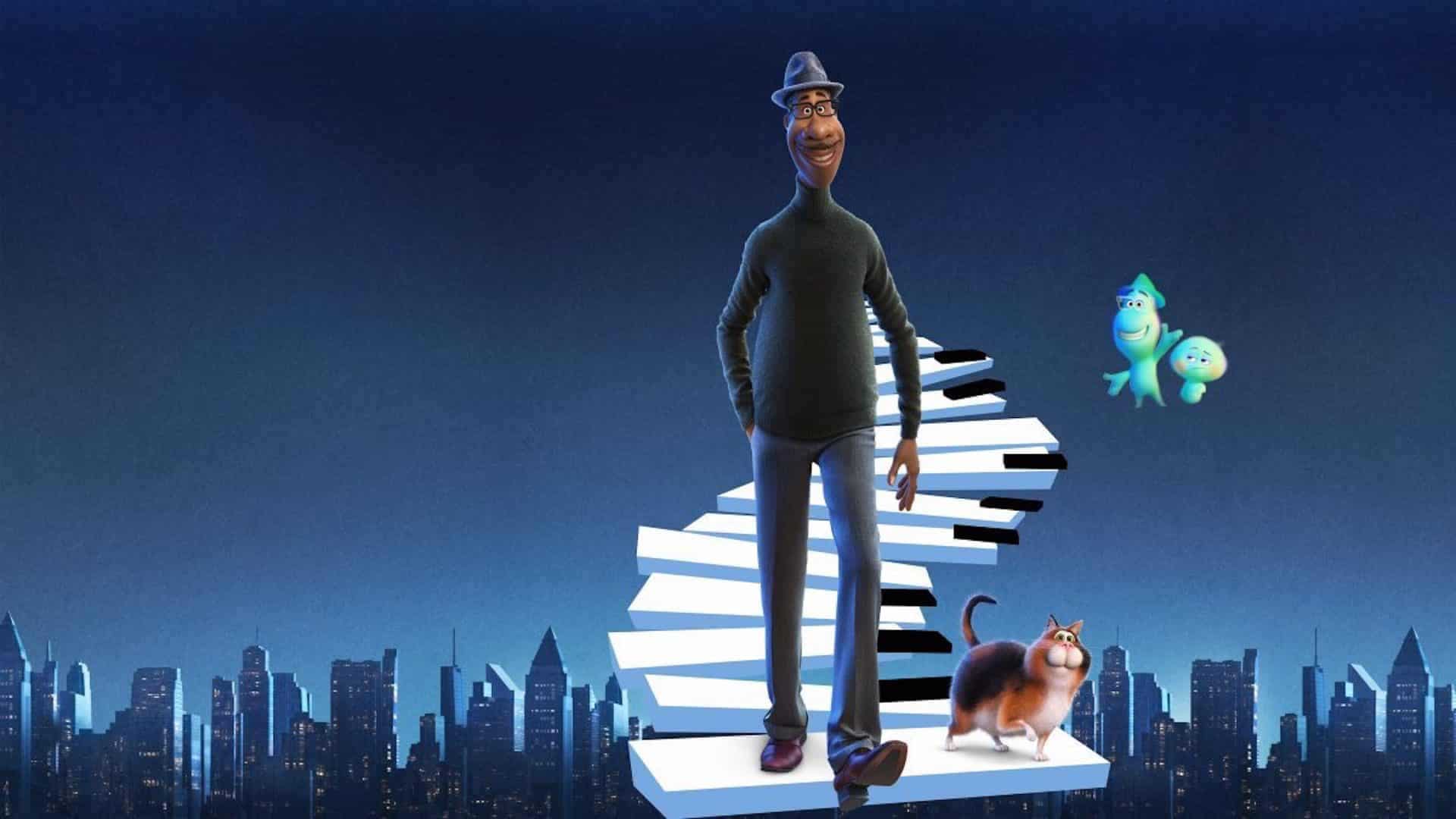
For the film's musical sequences, the animators used footage of several musical artists, including jazz composer Jon Batiste, as reference. By capturing MIDI data from the sessions, the animators could trace every note played on the piano and recreate the performances faithfully.
- #002
The character's name, "22," is a reference to the Catch-22 paradox. In this case, the only way to learn that life is worth living is to live it.
- #003
In the first draft of the story, 22 was the main character instead of Joe. 22 had a strong antipathy toward Earth, and the film took place entirely in the spirit world. Joe was created to show her why Earth is worth living on.
- #004
John Ratzenberger, who has voiced a character in every other Pixar film, is not credited in this one. However, Pete Docter revealed that he does appear in the film: his likeness is used for a character on the subway.
- #005
Joe's family tailoring business is based on the real-life Advanced European Tailoring shop in Berkeley, California. Pixar animators spent hours there taking notes and making illustrations to capture everything from the shop's appearance to the workers' movements. They also spoke with the shop's owners, Zoltan Hajnal and his wife Puje Dorjsure, to learn what inspired them in their work. Hajnal said that he and his wife were not paid for their contributions but were proud to be part of the film.
- #006
At around 20 minutes in, the first soul assigned is number "108,210,121,415." This matches the current (as of the release date) estimate by the Population Reference Bureau (PRB), which estimates that more than 108 billion people have existed on Earth (108 billion people using the European counting system).
- #007
A Dorothea Williams record had previously appeared in Onward (2020), in the scene where Colt Bronco visits the Lightfoot house at the beginning of the film.
- #008
Tina Fey also contributed to the script by helping to write her character's lines.
- #009
At around 19 minutes in, after Jerry explains how new souls find their "spark" and go to Earth, Joe can be heard rhetorically asking "And what is this spark?" before his attention is too distracted by his own Imagine Spot to hear the answer. Without this crucial information, Joe assumes that a "spark" is a person's passion or purpose in life, but it is later revealed that a "spark" is actually just the desire to live.
- #010
At around the 1-hour mark, one of the ads on the subway is for "Brang," the newly founded company Riley's father moved to San Francisco for in Inside Out (2015).
- #011
At around the 41-minute mark, Joe, in the cat's body, encounters a rat dragging a slice of pizza. This is a reference to the famous New York City rat caught in 2015 by comedian Matt Little dragging a piece of pizza down subway stairs, which went viral as Pizza Rat. Above the rat is graffiti resembling the iconic A113, which also appeared as graffiti in Inside Out (2015).
- #012
At around 59 minutes in, the number of the subway train Joe and Mr. Mittens are riding is 2319, the same code from Monsters, Inc. (2001) that indicates a human sock has entered the monsters' world. Monsters, Inc. was also directed by Pete Docter.
- #013
According to Pete Docter, the animators assigned to specific musical instruments generally either had experience playing them or greatly appreciated them.
- #014
At around 26 minutes in, as 22 shows Joe the different voices she can do, her male voice and face resemble Carl Fredricksen from Up (2009), which was also directed by Pete Docter.
- #015
At around the 27-minute mark, as Joe tries to show 22 life's pleasures, a broccoli pizza from Inside Out (2015) appears among the pizzas.
- #016
At around 29 minutes in, as 22 and Joe pass through 22's home and hangout area, they walk by a wall bearing the name tags of most (though not all) of 22's mentors. Along with the mentors shown on screen, 22's mentors include Jack Kirby, Joe Ranft, Aretha Franklin, Grace O'Malley, Mary Johnson, Eleanor Roosevelt, Pablo Picasso, Confucius, Joan of Arc, Amelia Earhart, Harvey Milk, Catherine the Great, Nelson Mandela, Harriet Tubman, Marvin Gaye, George Orwell, Nellie Bly, Marie Curie, Johnny Cash, Vincent van Gogh, Babe Ruth and T'sai Lun.
- #017
Curley wears a T-shirt that reads "classic & free & fusion & modal &," listing types of jazz.
- #018
At around 26 minutes in, the Hall of Everything contains the Pizza Planet Truck. In the same frame is a small street sign reading A113.
- #019
At around 29 minutes in, 22's home is filled with the name tags of her many famous and celebrated mentors, but three names stand out as significant to Disney and Pixar fans: Joe Grant, Joe Ranft and Jack Kirby. Grant was a Disney Animation legend who worked on classic films from the Disney Renaissance back to Snow White and the Seven Dwarfs (1937) and even assisted Pete Docter on Monsters, Inc. (2001). Ranft was a Disney Legend who worked at Disney Animation before moving to Pixar and being nominated for an Oscar for the Toy Story (1995) screenplay; he also voiced Heimlich in A Bug's Life (1998). Kirby was a famous comic book artist, writer and editor at Marvel who helped create many of the company's most famous characters, including Spider-Man, Captain America, the X-Men, Thor and the Hulk.
- #020
According to Pete Docter, after the producers decided the main character would be a jazz musician, they chose to make him African-American because they felt it made sense given how closely African-Americans are tied to the history of jazz.
- #021
Kemp Powers initially joined early in development as a co-writer to help write the character of Joe, originally on a 12-week contract that was later extended. After his extensive contributions to the film, he was promoted to co-director, making him Pixar's first African-American co-director.
- #022
It is the first full-length Pixar film not to be released in cinemas, instead premiering only on the Disney+ streaming service. Unlike Mulan (2020), the film did not require an additional 'premiere access' fee and was free for all subscribers.
- #023
When Kemp Powers came on board as co-writer and co-director, he helped change Joe's character. Joe was initially a white man interested in animation, then became a rock star. In the end he became a Black man with a love of jazz.
- #024
The Jerrys and Terry resemble the macOS Finder icon. There is a widespread suspicion that the Finder icon was influenced by the work of Cubist artist Pablo Picasso. Rather than adopting a strictly photographic approach, Cubism is essentially about representing many perspectives of a subject at once. For example, Cubists believed that by showing a person's face from all sorts of different angles, revealing different moods or different points in time, you could arrive at a truer, more complete version of that person.
- #025
To accurately portray African-American culture in the film, the producers hired several consultants with whom they worked closely throughout the film's development, among them several Pixar employees, musicians Herbie Hancock, Terri Lyne Carrington, Quincy Jones and Jon Batiste, educator Johnnetta B. Cole, and stars Questlove and Daveed Diggs.
- #026
Joe's story about working toward a single goal and then wondering what to do with the rest of his life after reaching it was inspired by a similar existential crisis Pete Docter went through after the massive financial and critical success of Inside Out (2015), when he wondered whether there was anything left for him to achieve as a filmmaker.
- #027
22 is named that way because she is the 22nd soul ever to exist. To give a sense of how long a time that is, the number of souls named before her was in the hundreds of billions.
- #028
Joe Gardner is the first African-American lead character in a Pixar film.
- #029
At around the 33rd minute, one of the characters says they play the saraswathy veena. This is a somewhat rare stringed instrument that is the ancestor of the sitar. It is popular in South India.
Sources & editorial notes
Reference databases
Sources for the entries on this page
- IMDb IMDb kaydı
Information from external sources is independently selected, consolidated and edited by Arka Evren. Sources are listed for verification and further reading. Encyclopedia text is used under its licence (CC BY-SA). How we work