
FILM · 2015 · USA
Spotlight
- Directed by
- Tom McCarthy
- Runtime
- 129 min
- Studio
- Participant, Anonymous Content, Rocklin / Faust
24 archived facts 5 topics 1 source Last reviewed Oct 2026
The true story of how the Boston Globe uncovered the massive scandal of child molestation and cover-up within the local Catholic Archdiocese, shaking the entire Catholic Church to its core.
Summary: TMDB
All facts (24)
- #001
The film never mentions it, but the Boston Globe won the 2003 Pulitzer Prize for Public Service for the Spotlight team's articles on the cover-up of sexual abuse in the church. The citation read: "For its courageous, comprehensive coverage of sexual abuse by priests, an effort that pierced secrecy, stirred local, national and international reaction and produced changes in the Roman Catholic Church."
- #002
During the baseball game, Michael Rezendes, Sacha Pfeiffer and Walter Robinson can be seen in the background.
- #003
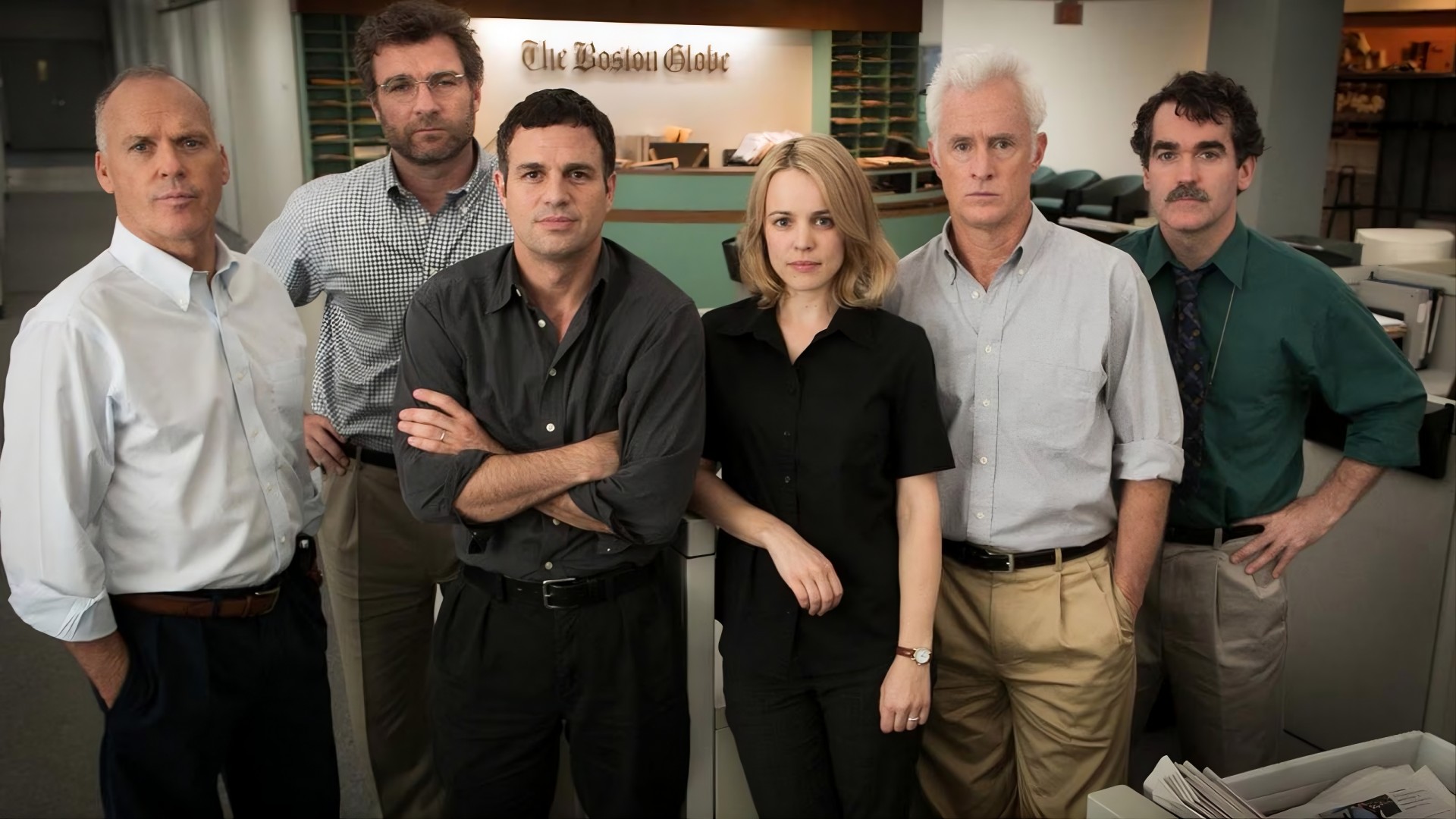
In an interview with National Public Radio's "Fresh Air," director Tom McCarthy said they built an extensive set to depict most of the Boston Globe offices where parts of the story take place. When the reporters portrayed in the film first visited the set, they headed for "their" desks, and many began arranging the items on those desks as they had been at the time.
- #004
As of the film's release, Michael Rezendes was the only journalist involved in the investigation who was still working on the Spotlight team.
- #005
At every break, Mark Ruffalo asked Michael Rezendes to say his lines for him.
- #006
All the journalists use blue pens, their bosses use black pens, and all the editors use red pens.
- #007
Patrick McSorely, who told Mike Rezendes the details of the sexual abuse, later tried to testify with his lawyer Mitchell Garabedian against Cardinal Law and the church. He also supported other victims, including several childhood friends. As depicted in the film, McSorely turned to drugs and alcohol to cope. In 2004, at the age of 29, he died of a drug overdose.
- #008
The credits and title cards are set in Miller, the typeface the Boston Globe used for most headlines and body text.
- #009
Walter Robinson said, "My personality was taken over. If Michael Keaton robs a bank, the police will handcuff me immediately."
- #010
When Walter Robinson visited the set, he was very impressed to see Michael Keaton sitting at an exact replica of his desk, typing with two fingers just like him, pursing his lips and looking at a 2001 Globe computer screen through reading glasses.
- #011
According to Mark Ruffalo, most of the Boston Globe reporters who broke the scandal were Roman Catholics.
- #012
The screenplay for this film was included in the 2013 Black List, a list of the year's "most liked" unproduced screenplays.
- #013
Walter Robinson said, "Watching Michael Keaton turn into me in the film makes me want to apologize to many of the people I interviewed."
- #014
In an interview with National Public Radio's "Fresh Air," Tom McCarthy said that shortly after many cast members agreed to make the film, they reached out to meet the reporters portrayed in it, and most of the reporters spent a significant amount of time on set during filming.
- #015
This film won the first Veritas Award for best film based on or inspired by real events and people. The award, given by members of the Los Angeles Press Club, is based on the film's fidelity to its subject and its artistic excellence. Bridge of Spies (2015) was the runner-up (February 2016).
- #016
Investigative reporter Ben Bradlee Jr. is the son of Ben Bradlee, Sr. The elder Bradlee, executive editor of The Washington Post, led the paper's investigation into the Watergate scandal.
- #017
In the film, a framed photograph of Walter Robinson's daughter Jessica, taken in 2000, stands beside Michael Keaton's desk. Next to it is a framed photo of Keaton with his arm around Elena Wohl, who plays his wife Barbara.
- #018
In 2016, the film was shown as a training resource at the National Center for Victims of Crime, also known as the National Training Institute Conference, in Philadelphia, Pennsylvania. Attendees included victim advocates, law enforcement officers, prosecutors, attorneys and social workers who work with victims and who arrest and prosecute pedophiles. Eric Mac Leish, Phil Saviano, Joe Crowley and Sacha Pfeiffer spoke to 850 conference attendees about their stories, pedophile priests and the national problem of child abuse.
- #019
Michael Keaton said of the role of Walter Robinson: "He's a very powerful and very direct person, but he's actually quite agreeable until he gets to that point, yet he's very cunning in how he gets information. Not in a bad way, in a really cool way, like a bird dog. So there were mannerisms I observed."
- #020
A study published by the John Jay College of Criminal Justice in February 2004 found that 68% of priests accused of sexual abuse were ordained between 1950 and 1979. Priests ordained before 1950 accounted for 21.3% of the allegations, while priests ordained after 1979 accounted for 10.7% of the allegations.
- #021
Liev Schreiber also plays the lead character in Ray Donovan (2013), a character from Boston. Donovan and his brother were abused by a priest, and he was a member of S.N.A.P. (Survivors Network of those Abused by Priests).
- #022
Michael Keaton spent several days with Walter Robinson to learn how to imitate him properly.
- #023
In this film, some characters refer to the September 11, 2001 terrorist attacks as "9/11" immediately afterward, which struck some viewers as anachronistic. However, the term "9/11" was used right after the attacks. For example, on September 13, 2001, The New York Times announced The New York Times 9/11 Neediest Fund, a special campaign to raise money for victims of the attack on the World Trade Center.
- #024
Tom McCarthy cited The Verdict (1982) and Sidney Lumet's directing style in that film as influences on this project.
Sources & editorial notes
Reference databases
Sources for the entries on this page
- IMDb IMDb kaydı
Information from external sources is independently selected, consolidated and edited by Arka Evren. Sources are listed for verification and further reading. Encyclopedia text is used under its licence (CC BY-SA). How we work