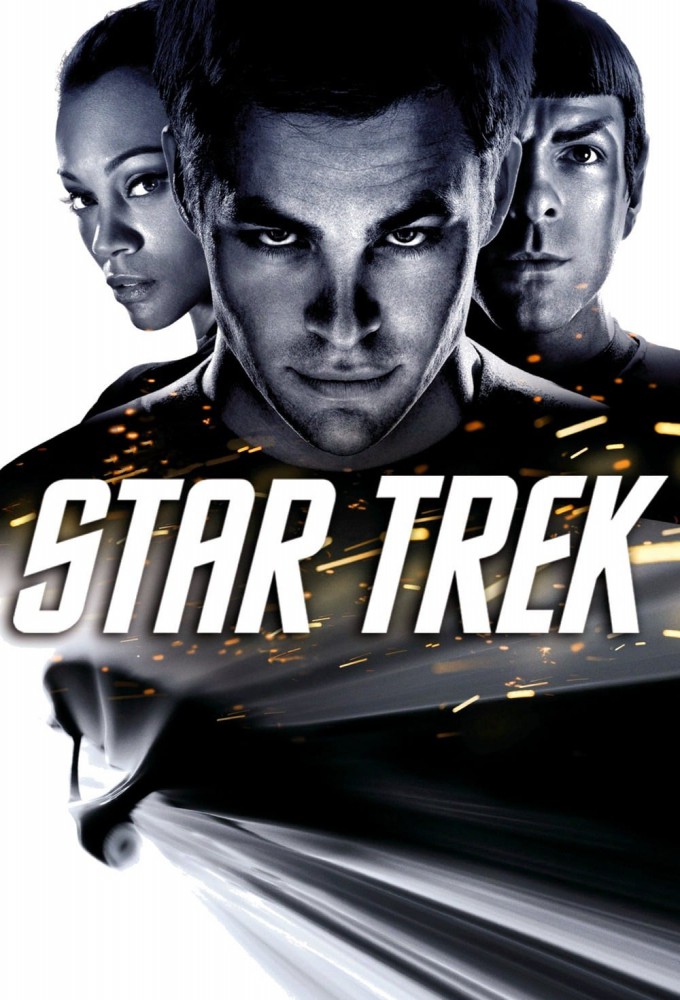
FILM · 2009 · USA
Star Trek
- Directed by
- J.J. Abrams
- Runtime
- 127 min
- Studio
- Paramount Pictures, Spyglass Entertainment, Bad Robot
290 archived facts 8 topics 1 source Last reviewed Sep 2026
The fate of the galaxy rests in the hands of bitter rivals. One, James Kirk, is a delinquent, thrill-seeking Iowa farm boy. The other, Spock, a Vulcan, was raised in a logic-based society that rejects all emotion. As fiery instinct clashes with calm reason, their unlikely but powerful partnership is the only thing capable of leading their crew through unimaginable danger, boldly going where no one has gone before.…
Summary: TMDB
All facts (290)
- #001
Korean-American actor John Cho was initially hesitant about being cast as the Japanese-American officer Hikaru Sulu, but George Takei, who played Sulu in the Star Trek (1966) series, encouraged him to take the role because Sulu represents all of Asia.
- #002
Contains a major spoiler — show
Spock Prime's final line, "thrusters on full," was improvised. The scene originally showed Spock walking away thoughtfully and silently. Leonard Nimoy then approached J. J. Abrams and said, "If you give me one more take, I have a thought I would like to inject here, and see if you like it." They did it, and he said "thrusters on full." Abrams later called Nimoy to tell him how well the final scene, which begins with Sulu mentioning the thrusters, turned out. Nimoy said the inspiration for the line was a way of telling the young cast, "Go ahead. Take the torch and go!"
- #003
In the scene where Kirk takes the Kobayashi Maru test, he is also eating an apple, echoing his story of taking the Kobayashi Maru test in Star Trek II: The Wrath of Khan (1982). According to director J. J. Abrams in the Blu-ray audio commentary, this was not intended as a reference to The Wrath of Khan; at one point he was simply told that lead actors look smug when eating apples.
- #004
Simon Pegg did not audition for the role; he only received an email from J. J. Abrams asking whether he wanted to play Scotty. Pegg said that if he had not been offered a role, he would have done it for free, and would even have paid Abrams to be in the film.
- #005
When Chekov manages to save Sulu and Kirk from falling, he shouts "Yo-moyo!" This is a Russian exclamation of surprise and excitement, roughly equivalent to "Oh man!" in English.
- #006
Roberto Orci, Alex Kurtzman and J. J. Abrams went to Leonard Nimoy's home in person to ask him to appear in the film. According to Orci, the actor displayed a "Who are you guys, and what are you up to?" attitude before being told how important he was to them. He was quiet, and Nimoy's wife, Susan Bay Nimoy, told the creative team that after their conversation he stayed in his chair and was emotionally overwhelmed by his decision to return as Spock after turning down many opportunities to revisit the role. He decided to take part in the film because the scope of the script and its detailing of the characters' backstories excited him: "We dealt with Spock being half human, half Vulcan, but we never got in this script the overall view he has of the character's entire history, the character development, the beginnings and his arrival on the Enterprise crew."
- #007
When Chris Pine was cast as Captain James T. Kirk, he sent William Shatner a letter and received a reply containing Shatner's approval.
- #008
To perfect Spock's Vulcan salute, Zachary Quinto's fingers were taped together by J. J. Abrams.
- #009
When Zachary Quinto met Leonard Nimoy for the first time at Comic-Con, Nimoy told the young actor, "You have no idea what you're in for."
- #010
Majel Barrett, the wife of Star Trek creator Gene Roddenberry, is the voice of the Enterprise computer. She had also provided the computer voice in Star Trek: The Next Generation (1987) (where she also played Lwaxana, the mother of Counselor Deanna Troi), Star Trek: Deep Space Nine (1993) and Star Trek: Voyager (1995), and had played Pike's first officer in The Cage (1966). She completed her voice work at her home two weeks before her death on 18 December 2008.
- #011
Wil Wheaton, who played Wesley Crusher in Star Trek: The Next Generation (1987) and Star Trek: Nemesis (2002), recorded the dialogue (digitally altered) for many of the Romulans on Nero's ship.
- #012
Leonard McCoy mentions that he joined Starfleet after getting divorced. This refers to the backstory for McCoy that D. C. Fontana (one of the original series writers) wrote for the third season but that was never filmed. This unused subplot formed the basis of the failed marriage and also of McCoy's daughter, Joanna.
- #013
Simon Pegg was helped with Scotty's accent by his Glasgow-born wife, Maureen Pegg. Later, however, Pegg said that Scotty is from Linlithgow and that he wanted to bring more of an East Coast sound to the accent, so his resulting performance was a mixture of both accents leaning toward the West sound. The film's Glasgow-born first assistant director, Tommy Gormley, also helped him.
- #014
To prepare for the role of Spock, Zachary Quinto grew out and dyed his hair and shaved his eyebrows. He claimed the change in appearance strengthened his performance: "I felt like a geek. I felt like I was twelve years old again, when you look back at those pictures and you see the bowl cut. I had that look for four or five years. There's no doubt I was born to play Spock."
- #015
In an interview with Edith Bowman on BBC Radio 1 in the UK, Matt Damon said he called J. J. Abrams when he heard rumors that he was being considered for the role of Captain Kirk. Abrams's response was a very polite "no." He explained that Damon was "too old" for the role.
- #016
According to Karl Urban, the film's production and shooting were extremely secretive: "There's a level of security and secrecy that we all have to adopt. It's really kind of paranoid madness, but in a way it's justified. We're not allowed to walk around in public in our costumes, and we had to be driven around everywhere in these golf carts that were completely concealed and covered in black tarpaulins." No precaution was enough: Simon Pegg read the script with a security guard nearby, and supporting actors such as Jennifer Morrison were given only the pages containing their scenes. Among the few people granted access to the film during its highly secretive production were Rod Roddenberry, Ronald D. Moore, Nichelle Nichols, Walter Koenig, Jonathan Frakes, Ben Stiller, Tom Cruise and Steven Spielberg.
- #017
The crew of the Kelvin in the United States uses communicators in the same style as those used in the original series. This can be seen when the engineer enters the frame and when George Kirk's wife contacts him during the ship's evacuation. After Nero changes the timeline and starts the alternate universe, the communicators change substantially.
- #018
J. J. Abrams claimed that directing Leonard Nimoy as Spock was surreal: "This guy has been doing it for forty years!"
- #019
For the space jump scene, the actors were initially filmed in harnesses and looking downward. However, they kept passing out because of the blood rushing to their heads. J. J. Abrams finally came up with the idea of filming the actors standing over mirrors. Shot from a certain angle, the reflection of the sky behind the actors gave the impression that they were really falling from the sky.
- #020
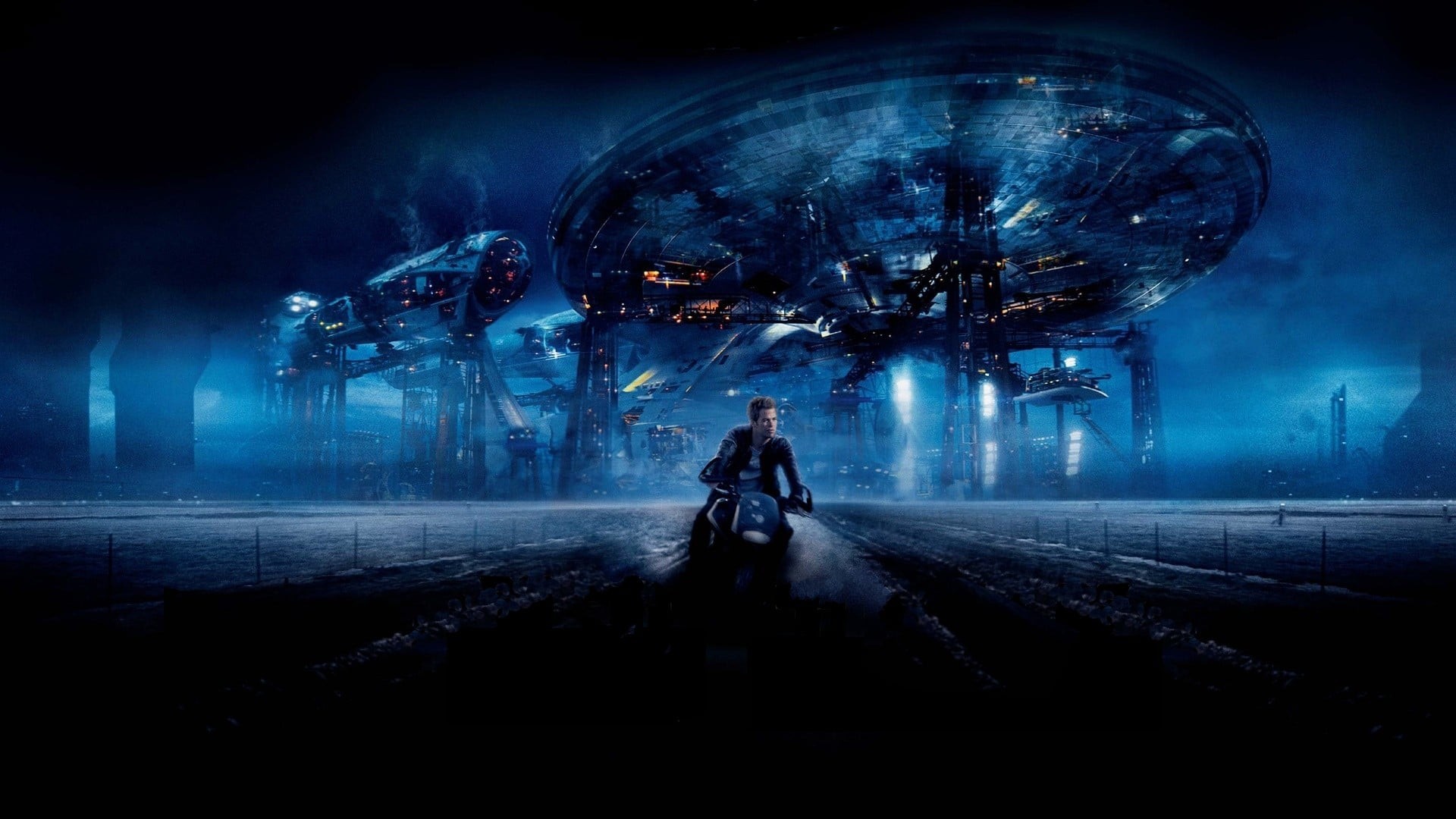
The sound made by the motorcycle Kirk rides to the shuttle bound for Starfleet Academy is the same sound used for the flying cars in The Jetsons (1962).
- #021
To prepare for the role of Captain James T. Kirk, Chris Pine watched the classic episodes and read encyclopedias about the Star Trek universe. His research was nonetheless rudimentary, since he wanted his performance to be original rather than an imitation of William Shatner. He based his performance on Tom Cruise's Maverick (Top Gun (1986)) and Harrison Ford's Han Solo (Star Wars: Episode IV - A New Hope (1977)) and Indiana Jones (Raiders of the Lost Ark (1981)), heroes he felt possessed the archetypal heroic qualities Kirk has: humor, arrogance and determination.
- #022
There is a supposed "odd-numbered movie curse" associated with Star Trek films, according to which odd-numbered films tend to be weaker and even-numbered films tend to be stronger. The curse was proven false by the poor reception of the tenth film, Star Trek: Nemesis (2002). This Star Trek (2009) film is the eleventh. Several years earlier, Simon Pegg's character in Spaced (1999) had joked that every odd-numbered Star Trek film being "shit" was a fact of life. Pegg noted: "Fate put me in the movie to show me I was talking out of my ass."
- #023
This film finally reveals that Uhura's first name in Star Trek canon is Nyota. Gene Roddenberry never gave her a name while Star Trek (1966) was in production, and since only the live-action television series and films are considered canon, non-canon material such as novels invented names of their own. The word Nyota, which means star in Swahili, was first used in 1982 and was frequently used in printed Star Trek literature, including the DC Comics publication "Who's Who in Star Trek", though some material used "Samara" and "Penda".
- #024
Chris Pine described his first audition as terrible, mainly because he could not take himself seriously as a leader. He was lucky where J. J. Abrams was concerned: Abrams did not attend the first audition, and after Pine's manager ran into Abrams's wife and pushed his client, Abrams immediately agreed to another audition.
- #025
Contains a major spoiler — show
After the bar scene, Captain Pike tells Kirk: "You know, your father served aboard a starship as captain for twelve minutes. He saved eight hundred lives. Including your mother's. And yours. I dare you to do better." From the moment Kirk first sits in the chair as the Enterprise's acting Captain to the point where Spock saves everyone on Earth by destroying the Narada's space drill, twelve minutes pass.
- #026
A Star Trek-loving Carnegie Mellon computer science professor, widely known as the author of "The Last Lecture", in which he discussed living the life of his dreams in the face of terminal pancreatic cancer, initially appears as a Kelvin officer. On his blog, Pausch wrote about the experience: "I have a custom-made Star Trek uniform and my own station on the bridge with lots of buttons and controls. I even have a LINE!" ("I have a Captain, we have visuals.") Pausch died on July 25, 2008. The $217.06 salary he earned from working on the film was donated to charity.
- #027
Contains a major spoiler — show
A running joke in the Star Trek universe is the redshirt character, a slang term for an ordinary character whose main purpose in a story's plot is to die shortly after being introduced, thereby demonstrating the dangerous conditions the main characters face. When Kirk and Sulu jump into the space drill, Olsen, wearing a red uniform, joins them and soon meets his death.
- #028
On the ice planet Delta Vega, Scotty says he tested the transporter on Admiral Archer's prized beagle. This refers to Captain Jonathan Archer, who had a beagle named Porthos aboard the Enterprise NX-01 in the prequel series Star Trek: Enterprise (2001).
- #029
Simon Pegg described Scotty as a Scottish stereotype, but a positive one ("Scots are the first people to laugh at the fact that they drink and fight a bit"), and said Scotty comes from a long line of Scots with technical expertise, such as John Logie Baird and Alexander Graham Bell.
- #030
Roberto Orci and Alex Kurtzman reduced the technical jargon and increased the action to make the film appeal to a general audience, and gave it the simple title "Star Trek" to signal to newcomers that they did not need to watch the other films. As a prequel, J. J. Abrams wanted the film's tone to be optimistic, unlike revisions such as Batman Begins (2005) ("being realistic and being dark are not the same thing"), and wanted to preserve the humor and sex appeal that made Star Trek (1966) a success.
- #031
Contains a major spoiler — show
While Kirk is being chased by a predator on Delta Vega, a child was used in place of Chris Pine to make the set appear larger.
- #032
Karl Urban has long described himself as a devout fan of Star Trek (1966). He used to watch the series with his father on Saturday mornings in New Zealand. Shortly before news of this film's development was heard, he bought the complete series on DVD and watched it with his son.
- #033
The U.S.S. Enterprise's engine room was filmed at a Budweiser factory in Van Nuys, California. The U.S.S. Kelvin's engine room was filmed at an old power plant in Long Beach, California.
- #034
The energizing sound of the transporters is the same sound used in Star Trek (1966).
- #035
According to John Cho, after filming ended J. J. Abrams gave the cast small boxes containing small telescopes, which allowed them to read the name of the constellation they were pointed toward: "I think he just wanted each of us to look at the stars a little differently."
- #036
When Cameron Crowe saw the film's rough cut, he kept asking who played the villain. He was stunned to learn it was Eric Bana.
- #037
Zoe Saldaña had never watched Star Trek (1966), but she agreed to play Uhura after J. J. Abrams praised her previous performances ("For an actor, that's all you need, that's all you want: to get the acknowledgment and respect from your peers."). Saldaña's mother, however, was a huge Star Trek fan and sent her voice messages with advice during filming.
- #038
Winona Ryder, who plays Spock's mother Amanda, is only six years older than Zachary Quinto, who plays Spock, and twenty-four years younger than Ben Cross, who plays her husband. Ryder was cast in the role (rather than an actress old enough to be Quinto's mother) because the film was originally going to open with a scene of Amanda giving birth to Spock, but that scene was deleted.
- #039
This film is the first movie of Zachary Quinto, best known as Sylar on the television series Heroes (2006), which contains various references to Star Trek and features George Takei (Hikaru Sulu) in the recurring role of Kaito Nakamura (whose limousine license plates read "NCC-1701").
- #040
Contains a major spoiler — show
William Shatner wanted a major role in this film like Leonard Nimoy's, and wanted James T. Kirk to accompany Spock Prime through time even though Kirk had officially died in Star Trek: Generations (1994). He suggested the film draw on the novels in which Kirk is resurrected, but J. J. Abrams felt that after Kirk accompanied Spock, the film would become a movie about Kirk's resurrection rather than a reintroduction of the Star Trek saga. Nimoy had disliked Kirk's death in Star Trek: Generations (1994) but also agreed that resurrecting Kirk would harm this film.
- #041
J. J. Abrams's only choices for Nero were Russell Crowe and Eric Bana.
- #042
In the scene where students are assigned to starships, Uhura complains to Spock that she has been assigned to the Farragut. In Star Trek lore, the Farragut is the ship Kirk was assigned to after graduating from the Academy and before his promotion to Captain of the Enterprise. It was named after Admiral David G. Farragut, who coined the famous phrase "Damn the torpedoes, full speed ahead!"
- #043
The sound effects were designed by sound effects technician Ben Burtt, known for his work on Star Wars: Episode IV - A New Hope (1977). To recreate the sounds of the photon torpedoes and the warp drive, Burtt attached a long spring to a contact microphone and mixed in the sound of cannon fire. He used an oscillator from the 1960s to give the impact and transport sounds a musical hum.
- #044
Uhura's roommate Gaila is an Orion, a race whose females are presented as ideal sex symbols in a running joke throughout Star Trek (1966) (and its spin-offs).
- #045
This is the first Star Trek film to list its cast alphabetically rather than by who holds the lead roles. This was done to reflect the ensemble nature of the film's cast.
- #046
Scotty makes references suggesting he has finally understood that warp travel is not actually the ship moving through space but space traveling around the ship. This aligns with present-day theories of how faster-than-light travel might actually work, if it is possible. The same idea appears in Futurama (1999) when Professor Hubert Farnsworth's young clone Cubert Farnsworth explains how the starship Planet Express works.
- #047
Contains a major spoiler — show
Captain Kirk, who resets the historical story of the Star Trek universe, became Captain of the U.S.S. Enterprise at a younger age. In the original series, Kirk became Captain at thirty, and Spock had previously served under Captain Pike on the Enterprise for seventeen years. Now Pike was confined to a wheelchair at an earlier date, Spock served under him only briefly, and Kirk became Captain of the Enterprise while attending Starfleet Academy or while still a recent graduate in his mid-twenties. Meanwhile, the Enterprise itself was actually built much later than in the original series. According to data from the films and series, the original ship is launched in 2245. In the alternate universe, the ship is completed in 2258.
- #048
When this film premiered at the Sydney Opera House on April 7, 2009, spontaneous applause rose from the audience the first time Leonard Nimoy appeared on screen.
- #049
Kirk's inflated hands were created by giving Chris Pine large latex gloves.
- #050
The concept of differently colored uniforms indicating crew members' duties was partly inspired by the work uniforms of aircraft carrier flight deck personnel. The different colors provide an instant visual indication of each crew member's area of responsibility, which is crucial given the extreme noise and constant danger of flight operations. Star Trek (1966) also aired at a time when color television was still fairly new, so the brightly colored uniforms gave the series a futuristic look.
- #051
Zachary Quinto's brother, credited as a stunt performer in the titles, appears as a Romulan in a late scene aboard the Romulan ship. Among those recording the Blu-ray audio commentary, J. J. Abrams says how much Joe resembles Zachary in the scene.
- #052
FRANCHISE TRADEMARK: (Sherlock Holmes) Spock (Zachary Quinto) quotes Sherlock Holmes's famous mantra for the second time in a Star Trek film: "If you eliminate the impossible, whatever remains, however improbable, must be the truth." Spock (Leonard Nimoy) uses the same line in Star Trek VI: The Undiscovered Country (1991), referring to Holmes without naming him as "an ancestor of mine," as Lieutenant Commander Data (Brent Spiner) also does. The line is one of several Holmes references, including one in Star Trek: The Next Generation (1987).
- #053
In Star Trek (1966), props used on set (especially McCoy's medical scanner) were actually salt shakers doubling as futuristic equipment. In this film, after choosing (and losing) a bar fight on Earth, Kirk (Chris Pine) sits down at a bar table. Licking his wounds, he picks up a small metal model of a starship from the table. As he handles it, you can see it is actually a salt shaker; the saucer section of the ship's body has an "S" on it, and salt pours out when Kirk turns it over.
- #054
Between scenes, Bruce Greenwood, John Cho and Anton Yelchin played chess against each other.
- #055
The son of the late James Doohan (Scotty in Star Trek (1966)) appears as the assistant to the current Scotty (Simon Pegg).
- #056
J. J. Abrams's "good luck charm" Greg Grunberg had to turn down a role in this film due to other commitments. During post-production, however, Grunberg worked on the film by voicing James T. Kirk's stepfather.
- #057
Captain Pike's whistle (used to end the bar fight) had the pitch of the "boatswain whistle" used for internal communication calls in Star Trek (1966).
- #058
Karl Urban was cast at his first audition, two months after his first meeting with J. J. Abrams. He said he was happy to take a role with plenty of comedy, something he had not done since The Price of Milk (2000), because he was tired of action-oriented roles.
- #059
The exterior scene on Vulcan viewed by Spock's mother Amanda (Winona Ryder) is based on multiple repetitions of the iconic profile of Vasquez Rocks Natural Area Park just north of Los Angeles along California Highway 14. The rocks have a highly recognizable, eroded peak rising at a 45-degree angle to the horizon. Scenes were shot at this location in nine episodes of the original series, including Shore Leave (1966), Arena (1967), The Alternative Factor (1967) and Friday's Child (1967).
- #060
Steven Spielberg persuaded J. J. Abrams to direct this film and gave him advice on some of the action scenes. Zoe Saldaña played a big Star Trek fan in Spielberg's The Terminal (2004), admitting she loves going to conventions as Yeoman Rand.
- #061
Kirk, the "black sheep" of the Enterprise crew, wears only his black undershirt until he is officially given command. Everyone else wears a colored jacket reflecting their area of responsibility.
- #062
The Romulans wear Japanese tabi boots, shoes with a separate section for the big toe. Such shoes actually give the wearer better balance than ordinary shoes.
- #063
Nichelle Nichols, who played Lieutenant Uhura in Star Trek (1966), was to make a cameo as Uhura's grandmother.
- #064
This marks Leonard Nimoy's seventh appearance in a Star Trek film.
- #065
Some scenes with Leonard Nimoy and Eric Bana required parts of their bodies to be reanimated. Nero's teeth were damaged badly enough in some shots that Bana's mouth had to be completely replaced. For Spock Prime's first scene with Kirk, Nimoy's mouth also had to be fully reanimated. The producers had filmed Nimoy re-recording his lines so they could rotoscope his mouth into the film and even recreate the lighting conditions, but they found that the flickering light from the campfire meant they had to digitally recreate his lips.
- #066
According to the Blu-ray audio commentary, J. J. Abrams spoke with George Lucas. During the meeting, Abrams asked how he could make the film better, and Lucas said he should add lightsabers. Abrams understandably did not, but he later directed Star Wars: Episode VII - The Force Awakens (2015), which features plenty of appropriate lightsaber action.
- #067
For Rachel Nichols's green skin, a blueberry alcohol-based paint was used, and brown freckles were added so that the green skin would not look like paint.
- #068
Costume designer Michael Kaplan wanted worn, weathered and durable clothing for the Romulans because of their mining background, and he found some oily-looking fabrics at a flea market. Kaplan tracked down the makers of these garments, whose base turned out to be in Bali, and commissioned them to create his own designs.
- #069
The actors playing the Romulans spent two to four hours in makeup. Three prosthetics were applied to their ears and foreheads, while Eric Bana had a fourth prosthetic made for the bite mark on his head. The actors also shaved their heads to distinguish them from the Vulcans. Earlier series designed the Romulans with prominent brow ridges.
- #070
The film's teaser trailer — which cuts between welders working on the half-built starship Enterprise, US President John F. Kennedy, and narration by Leonard Nimoy as Mr. Spock — was personally edited by J. J. Abrams. Real welders were brought in to shoot the trailer. Spock's and Kennedy's words were taken from the 1960s (the decade in which Star Trek (1966) began), linking past and present to enrich the film (and also hinting at time travel). According to Roberto Orci, Kennedy's words were also chosen because he was the man who started the "space race" and would therefore suit a space film: "If we're going to have a Federation, it makes sense for Kennedy and his words to be in there."
- #071
According to J. J. Abrams, the difficulty of depicting the future in this film was that much of modern technology was inspired by Star Trek (1966), which made it look dated. The production design therefore had to stay consistent with the original series while also feeling more advanced than the real-world technology developed since: "We all have an iPhone that does more than a communicator. I feel like there's something you can't really hold on to, which is a kind of kitsch quality. If it's going to be something you believe is real, it should go."
- #072
Eric Bana improvised Nero's speech patterns.
- #073
The film is dedicated to Star Trek creator Gene Roddenberry and his wife, Majel Barrett.
- #074
Chris Pine and Zachary Quinto, who play the odd pair James T. Kirk and Spock, had met each other before because they worked out at the same gym.
- #075
Referring to his divorce, McCoy says the only thing his wife left him was "his bones," suggesting this is where his nickname comes from. In fact, doctors in the nineteenth century were often called "sawbones" because of the unpleasant task of amputating injured limbs. The term was commonly used throughout much of the twentieth century and would have been quite familiar to Star Trek creator Gene Roddenberry, a World War II veteran.
- #076
When Hikaru Sulu stabs the Romulan, the sword comes out of the body green. This is because Romulans, like Vulcans, have copper-based blood instead of iron-based blood.
- #077
Contains a major spoiler — show
The film contains several similarities to or references to Star Trek II: The Wrath of Khan (1982): Nero uses a parasite to extract information from Captain Pike, as Khan did to Chekov. The Kobayashi Maru test, which Kirk takes three times and reprograms on the third, is shown. Spock serves as the Starfleet instructor overseeing the test. Some lines from that film appear in this one ("I don't believe in no-win scenarios," "Are you out of your Vulcan mind?" and Spock's closing monologue).
- #078
Roberto Orci based the foundation of the relationship between James T. Kirk and Spock on his personal relationship with Alex Kurtzman: "We come from different worlds. I was born and lived in Mexico City until I was nine, and Alex was born in the US. Kirk and Spock are two opposite worlds. In short, they're us. What's missing in each of us draws us together. This film is about two men who are ultimately so opposite they could drown each other. But instead they connect and grow together." Inspiration also came from the friendship of The Beatles members John Lennon and Paul McCartney.
- #079
Shortly before his death in 1991, Gene Roddenberry was asked in an interview what the future of Star Trek would be. He said he hoped "some bright young thing would come along and do it again, bigger and better." The critical and commercial consensus on this film is that Roddenberry's wish was fulfilled by J. J. Abrams.
- #080
Spock Prime and Nero travel back in time from 2387, the year after the events depicted in Star Trek: Nemesis (2002), eight years later. Using the Star Trek: The Next Generation (1987)-based stardate format, this time period would fall between stardates 64000 and 65000.
- #081
Production designer Scott Chambliss used the layout of the Enterprise bridge from Star Trek (1966) but gave it brighter colors to reflect Star Trek's optimism. (J. J. Abrams said the redesigned bridge "made the Apple Store look uncool.") The iconic viewscreen was turned into a window onto which images could be projected to make space feel more tangible. At Abrams's instruction, more railings were added to make the bridge look safer, and the set was built on gimbals so that the rocking motions were more realistic when the ship accelerated and came under attack.
- #082
In the final shot of the U.S.S. Enterprise, the ship's windows are written in Morse code. They spell out "KHAN."
- #083
There is a scene in which the cadets board a shuttlecraft inside a vast, cavern-like hangar. This hangar is real; it is one of two giant blimp hangars at Marine Corps Air Station Tustin in Tustin, California. The base is now operated by the Orange County Sheriff's Academy and consists mostly of student housing.
- #084
At the Spike TV 2009 Scream Awards, Star Trek (2009) won the award for best film. William Shatner accepted the award even though he had absolutely nothing to do with the film. In his acceptance speech, he jokingly accepted it as the director of Star Trek V: The Final Frontier (1989), generally considered the worst Star Trek film.
- #085
Contains a major spoiler — show
As Spock (Zachary Quinto) sits down to pilot the ship from the future that Spock Prime (Leonard Nimoy) brought back in time, the back of the pilot's chair is visible. Viewed from behind and combined with the forward field of view, the arrangement of these elements forms the Vulcan IDIC, the symbol of the Vulcan phrase "Infinite Diversity in Infinite Combinations," which first appeared in the original series.
- #086
As seen in this film, the communicator device was designed by Russell Bobbitt in collaboration with the Finnish mobile phone company Nokia.
- #087
The Kobayashi Maru simulator is the same set as the U.S.S. Kelvin bridge.
- #088
In Star Trek (1966), the transporter beams are normally seen speckled and sparkling, but in this film the beams swirl and flow like a vortex. J. J. Abrams designed this redesign to emphasize the transporters as beams that can pick people up and move them, rather than a signal of mixed atoms that can go anywhere.
- #089
Like his predecessor Walter Koenig, who played the Russian Starfleet officer Pavel Chekov, Anton Yelchin is the son of Russian-Jewish immigrants (Koenig's parents were Lithuanian, and Yelchin's parents were from Leningrad, now called Saint Petersburg, Russia).
- #090
Zachary Quinto was drawn to the role of Spock because he wanted to explore the character's dual heritage and his position caught between both Earth and Vulcan cultures: "He's constantly exploring the idea of how to evolve responsibly and how to evolve respectfully. I think those are all things that we as a society, and certainly the world, can put into practice."
- #091
Although Roberto Orci and Alex Kurtzman were huge fans of Star Trek (1966), they were initially very nervous about accepting the job of writing this film. Both felt that the fan base's expectations were very high.
- #092
The interior of the Romulan mining ship Narada consisted of six sections that could be rearranged to create different rooms.
- #093
The canon-connected comic book "Star Trek: Countdown" establishes various links to the main Star Trek timeline years after the events of Star Trek: Nemesis (2002), including details that Geordi LaForge helped design the Jellyfish, the ship Spock pilots, and that the Narada's immense size and formidable weapons technology were the result of the Romulans using stolen Borg technology to arm the Narada after the destruction of Romulus. This small plot point was also intended to explain how the Narada was able to remain in space after its impact with and destruction of the Kelvin — Borg technology has the ability to regenerate, albeit very slowly, in the absence of a drone collective.
- #094
In the Blu-ray's behind-the-scenes feature, in some scenes J. J. Abrams physically shook the camera to give the impression that the scene was shot handheld. The visual effects team also set up a motion capture rig so that an operator could physically shake the camera for CGI shots. Both techniques are most visible in the space jump scene, where the camera shakes to convey the look of turbulence while free-falling with the away team.
- #095
SERIES TRADEMARK: (47) Continuing the tradition of somehow including the number 47 in a Star Trek feature, the transport shuttle for the new recruits departs from Shipyard 2-1A (SFC Division: Sector 47). Also, before the Kobayashi Maru scenario, Uhura receives a message that 47 Klingon ships were destroyed by the Narada.
- #096
In the hearing over Kirk cheating on the Kobayashi Maru test, when he wants to confront his accuser and Spock stands up, Spock tugs down the hem of his shirt, performing what is officially known as "the Picard maneuver" — just like Sir Patrick Stewart as Captain Jean-Luc Picard in Star Trek: The Next Generation (1987).
- #097
John Cho stated that masculinity is an important aspect of the role of Hikaru Sulu, and he took two weeks of fight training.
- #098
The film was originally supposed to open with Spock's birth.
- #099
According to scientist Hugh Everett, the creator of the theory of parallel universes in 1957, the original Star Trek timeline would not be lost with the time travel of Spock and Nero (which creates a new continuity). It would continue to exist in a parallel dimension, unaffected by the new timeline that was created.
- #100
The armed confrontation aboard the Romulan mining ship was actually written as a fistfight until the day those scenes were shot.
- #101
During the sequence in which Chekov tries to enter the authorization code for the ship-wide broadcast, the computer rejects Chekov's pronunciation of the ICAO phonetic letter "V", which is "Victor", because he pronounces it as "Wiktor". This is a tribute both to Walter Koenig's original performance as Chekov and to Anton Yelchin's father, Viktor Yelchin.
- #102
Initially, many fans expected this film to be a prequel to Star Trek (1966), set a few years before the events of The Cage (1966) and Where No Man Has Gone Before (1966). However, because of the time-travel plot device, the film and its sequels now take place in an alternate timeline separate from the original timeline (depicted in the first five of the six television series and in ten films; the Star Trek: Enterprise timeline remains unaffected). This current timeline and cinematic universe was initially called the "Alternate Timeline", "Abramsverse" (after J. J. Abrams) and "Alternate Original Series", but was officially named the "Kelvin Timeline" in 2016 by the series' longtime collaborators Michael Okuda and Denise Okuda. "Kelvin" is a clear reference to the destruction of the U.S.S. Kelvin, the point at the beginning of the film where the two universes diverge.
- #103
The sets for the ice planet Delta Vega and the Romulan drill were located in the parking lot of Dodger Stadium in Los Angeles, California.
- #104
Zoe Saldaña met with Nichelle Nichols to learn more about the role of Nyota Uhura.
- #105
Contains a major spoiler — show
The time-travel aspect of the story was the hardest part of the story to develop. Time travel had been used several times before in the series, but in this case it would create a serious danger for the crew (by upending the history everyone knows), and it served a good purpose in creating a current adventure series for the original characters. Time travel also made it possible for Leonard Nimoy to appear in the film and help establish the current cast.
- #106
The Romulans were chosen as the Enterprise's enemies because they were less prominent than the Klingons in Star Trek (1966). J. J. Abrams felt it was fun for them to meet Kirk before he meets "Star Trek", and Roberto Orci and Alex Kurtzman noted that having the Klingons as enemies would be backwards, since they later become heroes in the Star Trek series. The presence of the Romulan also references Spock's earlier appearance in Unification I (1991)/Unification II (1991).
- #107
In an interview with the Pittsburgh Post Gazette, Zachary Quinto said he heard that Star Trek was being rebooted and was extremely eager to play the role of Spock. The article was widely distributed and caught the attention of J. J. Abrams, who was very interested in talking to the actor. At the audition, Quinto wore a blue shirt and straightened his hair.
- #108
Russell Bobbitt found a model of the original tricorder from Star Trek (1966) and brought it to the set, but the players found it too large to carry while shooting action scenes, so technical consultant Doug Brady redesigned it to be smaller.
- #109
In the Starfleet shuttle bay scene, a forklift with very unusual wheels is visible. It is a production forklift, not a film prop. The conical rollers around the wheels allow it to move in any direction at any turning speed.
- #110
The U.S.S. Kelvin, on which Kirk's father served, takes its name from Abrams's grandfather, and the hull number NCC-0514 comes from the man's birthday. It is also a scientific reference to the temperature scale named after the physicist and engineer Lord Kelvin. Abrams frequently uses this name in his works, such as "Kelvin Inman" from Lost (2004) and "Kelvin Gasoline" from Super 8 (2011).
- #111
Every existing incarnation of Star Trek (1966) has featured someone from one of the previous series at the gala: DeForest Kelley as Admiral Leonard McCoy in Encounter at Farpoint (1987); Sir Patrick Stewart as Captain Jean-Luc Picard in Emissary (1993); Armin Shimerman as Quark in The Caretaker (1995); James Cromwell as Zefram Cochrane in Star Trek: First Contact (1996) and Broken Bow, Part 1 (2001); and Leonard Nimoy as Spock in this film.
- #112
Contains a major spoiler — show
Alex Kurtzman and Roberto Orci originally wrote a cameo for William Shatner, the original James T. Kirk: Spock Prime would give his younger self a message recorded by Kirk. According to Orci, "It was a Happy Birthday wish from Kirk, knowing that Spock was going to go to Romulus and Kirk would probably be dead by then." This would then dissolve into Shatner reciting the famous "where no one has gone before" line. However, they were split over the cameo and decided not to waste Shatner's time. Orci expressed regret that the scene was not included but was very proud of the final film's ending.
- #113
Contains a major spoiler — show
In the original opening of this film, the Enterprise NCC-1701 was to be commanded by Robert April, with George Kirk as first officer. At the climax of the scene, the Enterprise would have been destroyed, and the ship featured for most of the film would have been its successor, the NCC-1701-A (which, in the original timeline, was not introduced until Star Trek IV: The Voyage Home in 1986). Paramount, however, told Alex Kurtzman and Roberto Orci that the one thing they absolutely could not do, even if they replaced it with a newer one, was destroy the Enterprise, and so the original Enterprise was rewritten in the United States, with Captain April becoming Captain Robau.
- #114
Contains a major spoiler — show
In this film, Spock decides to maroon the uncooperative Kirk on the planet Delta Vega. This mirrors the episode Where No Man Has Gone Before (1966), in which Spock suggested that Kirk's maroon-shirted Lieutenant Gary Mitchell was on the same planet.
- #115
The Romulan mining ship Narada is five miles wide and fifteen miles long.
- #116
During filming, Roberto Orci and Alex Kurtzman asked Leonard Nimoy to voice the lead character in Transformers: Revenge of the Fallen (2009), the next scripted film directed by Nimoy's relative Michael Bay. According to them, Bay was nervous about approaching such a high-profile relative for a small voice role. Nimoy, however, had voiced the robot Galvatron in The Transformers: The Movie (1986) and was eager to do another Transformers film. Unfortunately, Nimoy had other commitments. Nevertheless, in this film he is referred to as "Spock Prime" as a tribute to Transformers (whose artist is the Autobot leader Optimus Prime). Nimoy would later voice Sentinel Prime in Transformers: Dark of the Moon (2011).
- #117
The visual effects team developed a program to realistically depict how an explosion would look in space (short bursts implode inward and debris remains suspended). For the shots of an exploding planet, the same program was used at a higher level, but the animators had to manually assemble multiple layers of rock and wind being drawn into the planet.
- #118
During Chekov's emergency transport, the symbol graphic in the transporter room is the schematic design used on the set of the 1980s Enterprise films.
- #119
Nero is a combination of the ancient emperor of the same name and Captain Nemo from Jules Verne's "20,000 Leagues Under the Sea" and "The Mysterious Island." He is therefore a self-serving commander of the Narada (the Nautilus), from a lost Romulan (Roman) Empire, alongside his first officer Ayel (Aronnax), seeking revenge on the Federation (England) for the destruction of his home and family by means of extremely advanced technology. Furthermore, a fleet is sent with the starship U.S.S. Farragut before the Federation realizes the source of the distress signals. In Verne's novel, Captain Farragut commands the expedition to pursue the "sea monster" that turns out to be Nemo's submarine. Captain Nemo had also previously been imprisoned in the penal colony of Rura Penthe. Nero was held in a Klingon prison, which he boasted Uhura had intercepted a transmission about. This prison was also identified as Rura Penthe in Star Trek VI: The Undiscovered Country (1991).
- #120
To give Keenser a more alien appearance, Deep Roy's eyes were digitally replaced with eye stalks.
- #121
The Beastie Boys, who are featured in this film with the song "Sabotage," had referenced Star Trek (1966) in their songs "Intergalactic," "Ch-Check It Out" and "Brouhaha." "Sabotage" itself was generally a word William Shatner delivered with an emphatic rhythm in the series.
- #122
Paul McGillion auditioned for Scotty, and although he did not get the role, he impressed the producers enough that they gave him another role as the barracks leader.
- #123
While arguing with Kirk, Spock says, "I'm aware of my responsibilities, Mister." His protégé Lieutenant Saavik says the same thing to Mr. Sulu in the simulator at the beginning of Star Trek II: The Wrath of Khan (1982).
- #124
Contains a major spoiler — show
Near the end of the film, the number "12091" appears beside the shuttle behind Spock Prime. This corresponds to December 1991, the premiere date of Star Trek VI: The Undiscovered Country (1991), the last film to feature the entire original cast.
- #125
In the present timeline, Spock confronts Spock Prime with "You lied" — Spock Prime corrects him with "I implied." This is consistent with Spock Prime, who will not admit to lying when confronted but will explain: (A) I exaggerated (to Saavik in Star Trek II: The Wrath of Khan (1982)), (B) a mistake (to Valeris in Star Trek VI: The Undiscovered Country (1991)), (C) an omission (again to Valeris in Star Trek VI: The Undiscovered Country (1991)). KB351.
- #126
In television series, Romulans are usually presented with V-shaped ridges on their foreheads, but in this film they have no such features. This was because Neville Page wanted Nero's crew to ritually scar themselves, forming keloids that resembled the V-ridges; however, this idea was unfortunately not followed through enough and was abandoned.
- #127
The character played by Bruce Greenwood, Captain Christopher Pike, was the commander of the U.S.S. Enterprise in the unaired original pilot The Cage (1966). In that episode, Pike was played by Jeffrey Hunter. The episode was initially rejected, but when a second pilot was ordered Hunter withdrew from the series, so the role was rewritten and reworked as Captain James T. Kirk with William Shatner. Footage from the unaired pilot was later combined into The Menagerie: Part I (1966) and The Menagerie: Part II (1966), in which Sean Kenney appeared as an older Pike.
- #128
The roots of this film go back to the 1968 World Science Fiction Convention, where Gene Roddenberry announced he would make a prequel to Star Trek (1966). The concept would not be heard of again until the late 1980s, between Star Trek IV: The Voyage Home (1986) and Star Trek VI: The Undiscovered Country (1991). David Loughery wrote a script titled "Star Trek: The Academy Years," which was shelved due to objections from the original cast and the fan base. Development finally began in 2005, after the failure of Star Trek: Nemesis (2002) and the cancellation of Star Trek: Enterprise (2001). Another new approach to the beginning of Kirk's command of the Enterprise was told in the novel "Enterprise: The First Adventure" by Vonda N. McIntyre, based on a Star Trek film script that was to be used after the first set was built but no contract could be reached with the original cast.
- #129
Because of the secrecy and confidentiality of the film's production, various fake working titles were used. The official name chosen by Bad Robot Productions was "Corporate Headquarters," but each of the Key Assistant Location Managers also chose additional fake titles for paperwork, permits and signage. Kathy McCurdy named the film "Untitled Walter Lace Project" after her grandfather, Steve Woroniecki named it "Untitled Blake Allen Project" after his son, Golden Swenson named it "Christa & Christan's Big Adventure" after his twin stepdaughters, and Scott Trimble named it "The Ernest Castelhun Chronicles" after his great-great-grandmother, who drowned in beer at the Anheuser-Busch plant in 1937.
- #130
The San Francisco skyline seen from the Starfleet Academy grounds includes the distinctive Transamerica Pyramid building. Although at 253 meters it was the tallest skyscraper in San Francisco at the time, it was almost lost among the taller future buildings. The Salesforce Tower (formerly the "Transbay Tower"), upon its completion in 2018, is now the tallest building in the San Francisco skyline at 370 meters.
- #131
Carol Marcus, Kirk's former love and the mother of his son in Star Trek II: The Wrath of Khan (1982), appeared in the first draft of the script as Kirk's childhood friend in Iowa, but the role was cut from the final draft. She would eventually appear in the next film, Star Trek Into Darkness (2013). Nurse Chapel from the original series is also referenced in the film, and there is a line of dialogue: after Kirk's hands begin to swell, Dr. McCoy orders her to prepare a medication for him, and she replies, "Yes, sir!" However, she does not appear on screen.
- #132
Contains a major spoiler — show
At the end of the film, Leonard Nimoy, in voiceover, repeats the iconic opening lines from the opening titles through to Star Trek (1966). However, one line was changed from "… where no man has gone before" to "… where no one has gone before." (The canon establishes that the Enterprise's mission statement originated with Zefram Cochrane (Broken Bow, Episode 1 (2001)) and that Captain Kirk changed it in Star Trek VI: The Undiscovered Country (1991) to "where no man… where no one has gone before" in his captain's log after receiving lessons about racism and xenophobia in that film. Accordingly, this version of the mission statement was used by Captain Picard in Star Trek: The Next Generation (1987) — since Spock was alive at that time, it makes sense that he would adopt the current version.)
- #133
Leonard Nimoy had in fact been a longtime friend of J. J. Abrams's parents.
- #134
Simon Pegg shot the role of Montgomery "Scotty" Scott in five weeks.
- #135
The role of James T. Kirk came down to Mike Vogel and Chris Pine. Vogel was reported to be the frontrunner for the role, but J. J. Abrams ultimately decided to choose Pine. Sebastian Stan came very close to the final round of selection. Joshua Jackson and Chris Prangley also auditioned for the role, and Abrams cast Jackson in Fringe (2008).
- #136
Leonard Nimoy, Majel Barrett, William Morgan Sheppard, Greg Ellis, Christopher Doohan and Paul Townsend are the only actors in this film who had previously appeared in Star Trek (1966) or another spin-off.
- #137
The film cost 150 million dollars, more than 10 times the total budget of Star Trek (1966), which was 14.5 million dollars.
- #138
In a deleted scene, Nero is interrogated by a Klingon on the prison planet Rura Penthe and escapes. This is the planet that played a major role in Star Trek VI: The Undiscovered Country (1991). In this film, Chekov calls Rura Penthe "the alien's graveyard" because aliens from all over the galaxy convicted by the Klingons are sent there to work in the dilithium mines, and a prisoner's life expectancy there is at most one year.
- #139
The large creature on Delta Vega was named "Big Red" by the producers and has about two hundred and fifty eyes.
- #140
J. J. Abrams chose Michael Kaplan because he had not seen any of the Star Trek films and would therefore approach the costumes from a fresh perspective.
- #141
This was Tyler Perry's first film role outside his own projects. It turned out to be a minor problem, though: at one point Perry delivered a line and called for a cut, forgetting that he was not the director.
- #142
The film was shot in 2.35:1 anamorphic Panavision, the format preferred by cinematographer Dan Mindel (J. J. Abrams's previous film, Mission: Impossible III (2006), was also shot in Panavision). To take full advantage of the format, Mindel captured as many lens flares as possible (a photographic effect in which light glares everywhere) to create a sense of wonder that enriches the film: "There's something about those flares, especially in a movie that could potentially be incredibly sterile and could be overly controlled by CGI, that is incredibly unpredictable and gorgeous." He created the flares by holding a flashlight, aiming a mirror at the camera lens, or using two cameras (and therefore two lighting setups) at once.
- #143
Before this film, the highest-grossing Star Trek film ever made was Star Trek: First Contact (1996), with $146 million worldwide. This film surpassed that gross in only its second weekend of release in the US alone.
- #144
The computer used to help with the production of this film is named Gene Roddenberry in the credits.
- #145
This was Chris Hemsworth's first feature film; he had previously acted on television for several years.
- #146
Hikaru Sulu says his combat training is fencing. This is a nod to the famous scene in the episode "The Naked Time" (1966), in which Sulu appears shirtless and brandishes a fencing sword.
- #147
In this film James T. Kirk was born in 2233; in 2243 he wrecks a 1965 Corvette Stingray, meaning the 10-year-old Kirk destroys a 278-year-old car.
- #148
The snow landscapes were to be shot in Iceland, but that was too expensive, so they were shot in Alaska instead.
- #149
The shuttles of the USS Kelvin are essentially an upgraded version of the Class F shuttles from Star Trek (1966).
- #150
Contains a major spoiler — show
When McCoy deliberately makes Kirk sick and then helps him into sickbay, a Dyson Airblade hand dryer is visible on the wall beside the entrance doors.
- #151
Contains a major spoiler — show
This is the third film in the series in which Leonard Nimoy delivers the famous "where no man has gone before" speech. The other two are at the end of Star Trek II: The Wrath of Khan (1982) and the beginning of Star Trek III: The Search for Spock (1984).
- #152
Kirk, Sulu and Olson space-jump from Captain Pike's shuttle onto the Romulan energy drill. Kirk's first scene in Star Trek: Generations (1994) was meant to show him making a similar orbital parachute jump; the scene was shot but cut from the final film.
- #153
While designing the Romulan ship Narada, Scott Chambliss was heavily influenced by Art Nouveau architect Antoni Gaudí, who created buildings that appear turned inside out. The ship's exposed wires look like bone or ligament, creating a sinister atmosphere.
- #154
Much of the film's cast and crew, including Roberto Orci, Alex Kurtzman, Karl Urban and Eric Bana, are big fans of Star Trek (1966).
- #155
Contains a major spoiler — show
Chief Engineer Olson is the first red-shirt character to die during a mission in the reboot.
- #156
The makeup for the aliens in this film was overseen by makeup artist Barney Burman. His team had to rush the creation of many of the aliens because most of them were originally to appear in a single large scene (to express the diversity of life in the universe). However, toward the end of shooting, J. J. Abrams felt the scene was too similar to the cantina scene in Star Wars: Episode IV and decided to dot the designs throughout the film instead.
- #157
A deleted scene shows Nero imprisoned in the Rura Penthe prison colony, interrogated by a Klingon guard wearing a metal mask. In the Blu-ray audio commentary, J. J. Abrams identified the Klingon interrogator as Garber from Abrams's series Alias (2001).
- #158
J. J. Abrams was born a few months before the first broadcast of Star Trek (1966).
- #159
Tyler Perry took a small role because he was a big fan of the series.
- #160
One of the drinks Uhura orders in the bar scene is a Cardassian sunrise. In the original timeline, the Cardassians were a humanoid species from the Alpha Quadrant native to the planet Cardassia Prime, who eventually became enemies of the United Federation of Planets and the Klingon Empire in the 24th century. Although the species itself never appeared in Star Trek (1966) or in any of the later films tied to the original series, first contact with the Cardassians is assumed to have already occurred during the original series era, which explains why one of their drinks is available on Earth.
- #161
Damon Lindelof likened the Romulans in this film to pirates, with their distinctive tattoos, ragged costumes and practical ships whose mechanics are visible.
- #162
This was the first film in which Industrial Light & Magic used entirely digital ships.
- #163
According to designer Ryan Church, the U.S.S. Enterprise in this film pays homage to the designs from Star Trek (1966) and Star Trek: The Motion Picture (1979). Church also applied the Aztec motif from Star Trek: The Next Generation (1987). The overall exterior design resembles a hot rod, with more moving parts (the saucer expands and the fins on the engines separate).
- #164
Greg Grunberg voiced James T. Kirk's stepfather. Grunberg had been considered for the role of the pimp con man Harry Mudd, which was in the first draft of the script but was ultimately cut. Grunberg was later considered to play Olson, but had to drop out of the film due to a scheduling conflict.
- #165
In earlier drafts of the script, the U.S.S. Kelvin was originally named the U.S.S. Iowa, after the state where James T. Kirk was born.
- #166
William Morgan Sheppard, who plays the Vulcan Council member whom Spock considers for the Vulcan Science Academy or Starfleet Academy, had previously appeared as two Trek guest characters, in The Schizoid Man (1989) and Bliss (1999). He also appeared in Star Trek VI: The Undiscovered Country (1991) as the governor of Rura Penthe, the Klingon prison planet where Nero and his crew were held for twenty years in a deleted scene.
- #167
Contains a major spoiler — show
Kirk's father dies while on duty near the Laurentian system. William Shatner (Kirk from the original series) worked in Canada's Laurentian Mountains as a young adult in real life.
- #168
J. J. Abrams, Roberto Orci and Alex Kurtzman wrote films for Leonard Nimoy's cousin Michael Bay. Kurtzman and Orci wrote Transformers (2007) and The Island (2005), while Abrams co-wrote Armageddon (1998). Transformers has another connection to Star Trek: Leonard Nimoy voiced Megatron and Galvatron in the 1986 animated film; in Transformers (1984), Frank Welker (who voiced Megatron in the original series) and Nimoy took the role of the reformatted Megatron, now named Galvatron. Welker also provided Spock's screams in Star Trek III: The Search for Spock (1984).
- #169
In a fluster, McCoy calls Spock a green-blooded goblin, a nod to the original series, in which an exasperated McCoy calls Spock a green-blooded Vulcan many times and (in Bread and Circuses (1968) McCoy said "I'm trying to thank you, you pointed-eared hobgoblin!").
- #170
It is the Star Trek film with the longest gap since the previous theatrical film (seven years).
- #171
Star Trek canon states that Vulcan orbits the star 40 Eridani A, roughly 16.5 light-years from Earth.
- #172
The film takes place in 2233, the 2240s, 2255, 2258 and 2387.
- #173
When Kirk (Prime) tells Spock, "You know, coming back in time, changing history, that's cheating," Spock replies, "A trick I learned from an old friend." This is a nod to Star Trek IV: The Voyage Home (1986), in which Kirk takes a Klingon Bird-of-Prey back in time to retrieve humpback whales in order to prevent Earth's destruction (timelines/futures).
- #174
When Kirk and McCoy head to Starfleet Academy in a shuttle with new recruits, the starship U.S.S. Enterprise is under construction at the Riverside shipyard. As the shuttle passes the warp engine nacelle on the starboard side, the ship's registry number NCC-1701 is visible on the thrusters.
- #175
Eric Bana shot his scenes toward the end of filming.
- #176
As of 2009, it is the highest-grossing film adapted from a live-action television series.
- #177
Chris Pine's father, Robert Pine, appeared in The Chute (1996) and worked with Michael Dorn (Worf, Star Trek: The Next Generation (1987)) on CHiPs (1977).
- #178
J. J. Abrams preferred to use as many practical effects as possible.
- #179
IDW published a four-issue comic book prequel titled "Star Trek: Countdown," written by the film's writers Alex Kurtzman and Roberto Orci with art by David Messina. It detailed Nero's backstory and the reasons for Spock Prime's involvement in the events. It also featured characters from past films and television series and served as a link between the two eras. IDW also published a six-issue adaptation of the film, again with art by Messina. It was the first Star Trek film adapted into a comic since Star Trek: First Contact (1996).
- #180
It is the first Star Trek film to win an Oscar. It received four nominations in total, tying Star Trek IV: The Voyage Home (1986) for the most nominations in the series. It was also the first film in the series nominated for Best Visual Effects since Star Trek: The Motion Picture (1979).
- #181
Contains a major spoiler — show
The Navy and Star Trek share the traditional verbal exchange for a change of command: "I relieve you," answered with "I stand relieved." When Captain Kirk relieves Admiral Pike of duty, Admiral Pike replies, "I am relieved." This is probably because he is in a wheelchair and cannot stand.
- #182
Gary Sinise, who closely resembles DeForest Kelley, was reportedly considered to play Dr. Leonard McCoy.
- #183
It is the first Star Trek film created without the involvement of Gene Roddenberry or Rick Berman.
- #184
The USS Enterprise was redesigned by Ryan Church using the original's features, reaching a length of 1,200 feet (370 meters). It was later scaled up by a factor of 1.94 to 2.357 feet (718 meters) to make it appear larger.
- #185
Contains a major spoiler — show
When Spock and Spock Prime meet face to face for the only time before the film's end, they do so beside a shuttlecraft that appears to be under repair or construction. The shuttle bears a strong resemblance to the Argo shuttle from Star Trek: Nemesis (2002).
- #186
This is the first Star Trek film made since CBS took over ownership of the Star Trek franchise from Paramount Pictures.
- #187
The first shot of Uhura and Spock in the Starfleet Academy shuttle hangar shows them standing in front of a computer screen. The silver metal knob on its frame is a Griffin PowerMate, a USB device used to control software functions on Macs and PCs.
- #188
When James T. Kirk (Prime) asks Spock how he knew his name, Spock replies, "I have been, and always shall be your friend" — the same words Spock said to Admiral Kirk just before his death in Star Trek II: The Wrath of Khan (1982), and again when he began to regain his memory after being resurrected in Star Trek III: The Search for Spock (1984). KB351.
- #189
One of the buildings near Starfleet Academy in San Francisco resembles the Willis Tower (formerly Sears Tower) in Chicago.
- #190
Early in the film, when McCoy takes Kirk to the Enterprise, they board a shuttle named "Gilliam." This may be a nod to the film's script supervisor, Dawn Gilliam, who was responsible for maintaining the film's internal continuity and tracking the production unit's daily progress while shooting the script.
- #191
In the background of most of the bridge scenes is a blonde woman wearing black trousers. Many fans believe this is Elizabeth Dehner, who appeared in Where No Man Has Gone Before (1966).
- #192
Contains a major spoiler — show
Fans were confused by the film, thinking it was a prequel to the original series, and found that some of the things in it did not happen in the original timeline and that Spock Prime's (Leonard Nimoy) presence in the film made no sense. The film is not a prequel or a remake, and this is explained by Spock Prime when he meets Kirk (Chris Pine). The film takes place in an alternate timeline and is in fact a continuation of Spock's appearance in Star Trek: The Next Generation (1987).
- #193
When the Enterprise first encounters the Narada, the original Enterprise series appears on the Narada's viewscreen for a few brief moments.
- #194
Sarek's statement that marrying a human woman was only logical echoes his dialogue in Journey to Babel (1967), where he said marrying Amanda was "the logical thing to do at the time." (This time, however, he adds that he later came to love her.)
- #195
The film mainly references the alien races introduced by Star Trek (1966), such as Vulcans, Klingons and Romulans, and avoids referring to races introduced in Star Trek: The Next Generation (1987) (for example, Betazoids, Bajorans, Ferengi). One exception is Uhura's mention of a Cardassian sunrise, since Cardassians were introduced in the fourth season of TNG.
- #196
When a hearing is held to investigate Kirk's cheating on the Kobayashi Maru test, an admiral rings a bell (rather than using a gavel) to call the room to order. This is consistent with the Star Trek episodes The First Duty (1992) and Rules of Engagement (1996), in which the admiral presiding over the hearing rings a bell. Update: The bell was first used in the first season episodes The Menagerie: Part I (1966), Court Martial (1967) and Space Seed (1967).
- #197
Although later Star Trek films and series (Discovery and Picard) would later make headlines by using the F-word, this film quietly gave us the first F-word in the Star Trek franchise in the lyrics of the Beastie Boys' song "Sabotage." However, this likely went unnoticed by most viewers, who could not make out the words.
- #198
According to an article in Cinefex magazine, one idea for the Narada's appearance stemmed from the notion that being pulled through the black hole's time tunnel caused a mutation, causing the once-simple mining ship to grow the long, spiked tips seen when it first appears.
- #199
Leonard Nimoy's participation in the film as Spock Prime was intended to connect the film to the original series and feature films; it established that the original timeline Spock comes from is the same timeline as the original series, The Next Generation, Deep Space Nine, Voyager and the previous films between 1979 and 2002, and that the scene where both incarnations of Spock meet was written for Leonard Nimoy to pass the torch to Zachary Quinto.
- #200
This was the first Star Trek film in which Michael Dorn did not appear since Star Trek V: The Final Frontier (1989).
- #201
The scene in which Spock is bullied by other Vulcan children because of his human heritage was recounted by Spock's mother, Amanda, in Journey to Babel (1967) and depicted in animated form in Yesteryear (1973).
- #202
Chris Pratt read for the role of Captain James T. Kirk.
- #203
Ricky Gervais was offered a role in this film but turned it down, saying he was not a big Star Trek fan.
- #204
Three members of the Enterprise crew also served as replacement players in other series: Karl Urban replaced Tommy Lee Jones, Jon Voight, James Garner and Jonny Lee Miller as Woodrow F. Call in Comanche Moon (2008); in Terminator Salvation (2009), Anton Yelchin played Kyle Reese in place of Michael Biehn; and Chris Pine took over the role of Jack Ryan in Jack Ryan: Shadow Recruit (2014) from Alec Baldwin, Harrison Ford and Ben Affleck.
- #205
Pavel Chekov's surname was inspired by that of Anton Chekhov, the classic Russian writer of the late 19th and early 20th centuries. However, Chekhov can be considered a misspelling or simplified form of the real Chekhov surname, since the two share the same sound in English but not in Russian. Of course, in the Russian-dubbed version of this film, Chekov became Chekhov.
- #206
The U.S.S. Enterprise bridge set was built on gimbals so that the actors' swaying movements would look more convincing.
- #207
Since Diane Carey's tie-in novel Best Destiny (1993), Kirk's mother's first name had been established as Winona. In this film, Spock's mother is played by Winona Ryder.
- #208
John Cho and Jennifer Morrison had previously worked together on Love Hurts (2005). Both worked with Kal Penn, who said his character in Don't Ever Change (2008) was the Dahar Master of the Klingon Empire, a title first mentioned in Blood Oath (1994). In the Blu-ray audio commentary, J. J. Abrams mentions that there is an extra on the Enterprise bridge playing a crew member whom many viewers mistook for Kal Penn (assuming Penn had a cameo since John Cho is in this film), but Abrams says the man is not Penn.
- #209
The first teaser trailer and posters for this film showed its original premiere date of 25 December 2008. On 13 February 2008, Paramount Pictures pushed the film to 8 May 2009 to face less competition and become a summer blockbuster contender. The promotional trailer was later changed to show summer 2009. This was the first Star Trek film to be released in the summer since Star Trek V: The Final Frontier (1989).
- #210
In the first Starfleet Academy scene, among the famous buildings hidden within the futuristic San Francisco skyline is Santiago Calatrava's Hemisfèric in Valencia, Spain.
- #211
The captain of the USS Kelvin, Richard Robau (Faran Tahir), was named after Roberto Orci's Cuban uncle. According to Orci, Robau was born in Cuba and raised in the Middle East.
- #212
The set used for the long dark corridor at the Delta Vega Federation outpost looks the same as (or very similar to) the one used for the Dharma station The Staff on Lost (2004), which first appeared in the season's second episode, "Maternity Leave" (2006). J. J. Abrams was, of course, deeply involved in both.
- #213
The film was influenced by: "Balance of Terror" (1966) (Kirk meets the Romulans for the first time); Star Trek II: The Wrath of Khan (1982) (an enemy from the past returns to confuse the crew); "Yesterday's Enterprise" (1990) (a black hole causes past and future Enterprise crew members to meet one another); and the Star Trek novels "Prime Directive", "Spock's World" and "Best Destiny" (the last of which focuses on Kirk and his maturation into a Starfleet Captain).
- #214
It is the first original-series film rated PG-13 in the US and 12 in the United Kingdom. All the other films starring the original series cast were rated PG in the US and 12 in the UK, except for Star Trek: The Motion Picture (1979), rated G in the US and U in the UK, and Star Trek II: The Wrath of Khan (1982), which initially received a 15 certificate (it has since been reclassified as 12 by the BBFC).
- #215
The design of the USS Enterprise was influenced by the flamboyant modernist work of 1960s artist Pierre Cardin and by the realistic sets of the groundbreaking science fiction film 2001: A Space Odyssey (1968).
- #216
Roberto Orci, Alex Kurtzman and J. J. Abrams signed on during the shooting of Mission: Impossible III (2006).
- #217
In this film James T. Kirk is twenty-five years old. This is echoed when Spock Prime says that Nero and the Romulans waited twenty-five years for the Vulcan ship to arrive in the past.
- #218
The film was written before the 2008 writers' strike. J. J. Abrams played a major role in writing the film, but while shooting it under WGA rules he was not allowed to make any changes to his own script on set.
- #219
Contains a major spoiler — show
Kirk, Sulu and Olson parachute down; Olson wears red and is killed during the mission. This reflects the original series, in which Security officers wearing red shirts were frequently killed on missions.
- #220
Adrien Brody had discussed playing Spock with J. J. Abrams.
- #221
A shuttle named Moore is seen (before Starfleet deploys the rescue starships). This may be a reference to Star Trek: The Next Generation (1987) writer Ronald D. Moore.
- #222
The first theatrical trailer uses Two Steps From Hell's track "Down with the Enterprise". It was an adaptation of the track "War Begins" from Brian Tyler's score for Children of Dune (2003).
- #223
To add a sense of realism to the film, J. J. Abrams often followed the camera operator and shook/tapped it rapidly. To replicate this in CG shots, ILM used motion capture on a camera point and tapped the table it sat on.
- #224
James Marsden was considered for the role of Dr. Leonard McCoy.
- #225
The throttle unit used on the Enterprise is the ZF Marine Smart Command 5200 (a throttle unit originally made for motor yachts).
- #226
Admiral James Komack, played by Ben Binswagner, is a tribute to James Komack, the director of "A Piece of the Action" (1968).
- #227
Although the scene depicting Spock's birth was cut from the final edit, it still inspired an argument among the characters of The Big Bang Theory (2007) in the episode "The Bat Jar Conjecture", in which they say they would prefer to see a scene depicting Spock's gestation.
- #228
As young Kirk drives his stepfather's convertible off a cliff, the song playing on the car radio is the Beastie Boys' "Sabotage".
- #229
Production designer John Eaves, who had worked on various Star Trek series and films, was brought onto this film to assist and mentor the younger collaborators Ryan Church and Neville Page.
- #230
Actor Bruce Greenwood (Captain Christopher Pike) starred in the film Thirteen Days (2000) as John F. Kennedy, the President credited in the 1960s with inviting the United States to go to space, which culminated in humans landing on the Moon in 1969.
- #231
Bruce Greenwood drew heavily on the strength of his performance in Thirteen Days (2000).
- #232
The back of Spock's chair on the shuttle, when placed in front of the windshield, forms the IDIC, the symbol of the Vulcan people.
- #233
As of 2023, with a 94% approval rating on Rotten Tomatoes, this is the highest-rated Star Trek film.
- #234
Dominic Keating, who played Malcolm Reed on Star Trek: Enterprise (2001), auditioned for the role of James T. Kirk's uncle.
- #235
Sydney Tamiia Poitier auditioned for the role of Nyota Uhura.
- #236
Fans of this film were confused on this point and believed it was a prequel to the original series. In the original timeline, Captain Kirk's father had not died when Kirk was born, and Vulcan had not been destroyed. This film and all subsequent films take place in an alternate timeline.
- #237
A working Aptera Type-1 automobile was used.
- #238
LeVar Burton later went on record saying he was disappointed with this film.
- #239
This film has over 1,000 special effects shots.
- #240
In this film, McCoy says "I may throw up on you," a line Kirk later repeats. It is also a subtle callback to the pilot episode of Lost (2004), in which Kate says the same thing while stitching up Jack's wound. That episode was directed by J. J. Abrams.
- #241
Josh Lucas was considered for the role of Captain Christopher Pike.
- #242
While William Shatner and Paramount were stuck in contract negotiations over Star Trek IV: The Voyage Home (1986) for months, Leonard Nimoy and producer Harve Bennett began developing a Top Gun (1986)-style prequel about a young Enterprise crew at Starfleet Academy, but the idea was shelved when Shatner agreed to return. Bennett admitted, "the franchise wasn't the same without the stars." He and producer Ralph Winter raised the idea once more for Star Trek VI: The Undiscovered Country (1991), and Winter said: "It's a great story about this cocky young character going to flight school on a farm and meeting the first alien from Vulcan, and how he meets the other characters. It would have been a great gift for the fans on the 25th anniversary." After negative reactions from the cast and fans, the idea was cancelled again. Ethan Hawke and John Cusack were said to be set to play the young Kirk and Spock, respectively.
- #243
Captain Pike challenges James T. Kirk to join Starfleet and discover his potential. In Star Trek: The Next Generation (1987), there was a story in which a mysterious alien entity called the Traveler played a role in Wesley Crusher's destiny, saw his potential in Starfleet, and inspired Captain Picard to ask Starfleet Command for permission to make Wesley an acting ensign aboard the USS Enterprise. He was later promoted to the rank of ensign and accepted into Starfleet Academy.
- #244
Bruce Greenwood (Captain Pike) is the third Quebec-born actor to be cast as a Starfleet captain, after William Shatner and Geneviève Bujold. (Bujold was cast as Captain Janeway on Star Trek: Voyager (1995), then left the role while filming the pilot episode.)
- #245
Composer Michael Giacchino was tasked with writing a completely original new theme. That same year he also won the Oscar for the animated film Up (2009).
- #246
Contains a major spoiler — show
Nyota Uhura (Zoe Saldaña), a human, falls in love with Spock (Zachary Quinto), a half-human, half-alien being. In Avatar (2009), released the same year, the alien Neytiri (Zoe Saldana) falls in love with the human Jake Scully (Sam Worthington).
- #247
This was the first film for Scottie Thompson, who played Nero's wife.
- #248
In Star Trek history, the atmosphere on Vulcan was supposed to be thinner than Earth's, yet a parachute jump is performed at a high altitude where the atmosphere would be even thinner. This would not create enough friction to slow down safely and land without injury. However, the equipment they used was calibrated for the differences in the planets' atmospheres.
- #249
Uhura orders a Budweiser Classic. This is a nod to the Enterprise's engine room having been filmed at a Budweiser factory.
- #250
Eric Bana, Karl Urban, Chris Hemsworth and Zoe Saldaña all appeared in films featuring the Incredible Hulk as a character. Bana played the character in Hulk (2003). Hemsworth appeared in The Avengers (2012), Avengers: Age of Ultron (2015), Avengers: Infinity War (2018) and Thor: Ragnarok (2017). Karl Urban also appeared in the second of those films. Saldaña also appeared in Avengers: Infinity War (2018). The last two films also featured Trek villains Benedict Cumberbatch and Idris Elba.
- #251
Chris Hemsworth (George Kirk) and Chris Pine (James T. Kirk) later played the lead characters in films directed by Sir Kenneth Branagh: Hemsworth in Thor (2011) and Pine in Jack Ryan: Shadow Recruit (2014).
- #252
Keri Russell was considered for a role in this film.
- #253
This is the fourth consecutive Star Trek film in which the main villain (Nero) is bald, following the Borg Queen (First Contact), Ru'afo (Insurrection) and Shinzon (Nemesis). It is also the second consecutive film after Nemesis in which the Romulans are the main enemy, something that had not happened before and has not happened since.
- #254
This was not the first time bright spotlights were aimed directly at the camera on the Enterprise bridge. The first shots on the Enterprise bridge in Star Trek VI: The Undiscovered Country (1991) show bright white spotlights, along with far less lens flare.
- #255
J. J. Abrams said: "Our first 'Star Trek' film was, above all, a great exercise in casting. April Webster and Alyssa Weisberg helped us find absolutely perfect actors. I'm proud of the storytelling and the humor, but of course I only see what's wrong. Among other things, I wish we had given Eric Bana a bit more to do than just be full of rage, given what a good actor he is."
- #256
Ben Cross's best-known role before this film was in Chariots of Fire (1981), which was also the first film of Alice Krige, who played the Borg Queen in Star Trek: First Contact (1996).
- #257
It is possible and likely that Spock's half-brother Sybok had been exiled from Vulcan before Nero destroyed the planet. (See: Star Trek V: The Final Frontier (1989).)
- #258
Derek Mears was the first choice to play the long-faced alien vomit in the Shipyard Bar. He could not take the role due to his schedule and recommended his friend Douglas Tait.
- #259
After Star Trek IV: The Voyage Home (1986), Star Trek: Generations (1994) and Star Trek: First Contact (1996), this is the fourth Star Trek film to involve time travel.
- #260
Zachary Quinto and John Cho appeared in Charmed (1998).
- #261
Rachel Nichols, who plays Uhura's Orion roommate Gaila, makes her first appearance on the big screen in the reboot. Rachel Nichols would later play the female lead Tamara in the Conan the Barbarian remake (2011). In both films, Nichols's characters are seduced by the lead male characters, James T. Kirk and Conan, whose mothers or fathers were killed by the film's main villains when they were born.
- #262
Michael Giacchino is the fourth Oscar winner to score a Star Trek film, after: * Jerry Goldsmith - Star Trek: The Motion Picture (1979), Star Trek V: The Final Frontier (1989), Star Trek: First Contact (1996), Star Trek: Insurrection (1998) and Star Trek: Nemesis (2002) * James Horner - Star Trek II: The Wrath of Khan (1982) and Star Trek III: The Search for Spock (1984) * Leonard Rosenman - Star Trek IV: The Voyage Home (1986).
- #263
Before Simon Pegg was cast, James McAvoy was said to be playing Scotty. McAvoy confirmed that he was offered a role in the film but did not specify which character. Although he is a Trekkie, he turned down the offer because he felt he was not right for the role.
- #264
Eric Bana plays Captain Nero, an inhabitant of the planet Romulus. Bana had previously played a character named Romulus in the film Romulus, My Father (2007).
- #265
Simon Pegg, Roberto Orci, Alex Kurtzman and J. J. Abrams had previously worked together on Mission: Impossible III (2006), a sequel to Mission: Impossible (1966), in which Leonard Nimoy had also appeared.
- #266
Ben Cross, who plays Sarek, tells Spock that he will always be a child of two worlds. In The Far Pavilions (1984), Ben Cross played an Englishman raised as an Indian who believes himself to be Indian. After discovering the truth, he would always be of both worlds (cultures).
- #267
Before becoming a successful actor, Leonard Nimoy held many odd jobs, including driving a taxi. One of his passengers was then-President John F. Kennedy. Bruce Greenwood played President Kennedy in the film Thirteen Days (2000).
- #268
Eric Bana had previously played the title character in Hulk (2003), making him one of four veterans of that role who also appear in Star Trek. Ted Cassidy initially provided the character's voice in The Incredible Hulk (1977), and after his death he was replaced by another Star Trek veteran, Charles Napier. Lou Ferrigno, who played the role on screen and appeared in Lolani (2014), also voiced the role in the animated series The Incredible Hulk (1996) and provided some grunts for The Avengers (2012), in which the role of Thanos was taken on by Chris Hemsworth and Damion Poitier. Several other actors from the reboot series later appeared in the MCU: Karl Urban in Thor: Ragnarok (2017), and Zoe Saldaña, Benedict Cumberbatch and Idris Elba in Avengers: Infinity War (2018).
- #269
Eric Bana had previously appeared in Hulk (2003), in which his father was played by Nick Nolte. Nolte appeared in Mulholland Falls (1996) and Gangster Squad (2013), both of which included a fictional depiction of the L. A. P. D. In the first, Chief Bill Parker was played by Bruce Dern, and in the second, by Nolte himself. Star Trek creator Gene Roddenberry was an officer in the police department and modeled the character of Spock on Parker.
- #270
Chris Prangley and Sebastian Stan auditioned for the role of James T. Kirk.
- #271
The roles of Kirk and McCoy had previously been played by William Shatner and DeForest Kelley, who had appeared as guest actors in The Fugitive (1963). Chris Pine and Karl Urban shared the same roles as the film's leads. Pine and Harrison Ford played Jack Ryan in Jack Ryan: Shadow Recruit (2014) and Patriot Games (1992), while Urban and Tommy Lee Jones played Woodrow Call in Comanche Moon (2008) and Lonesome Dove (1989).
- #272
Anton Yelchin died in an accident on June 19, 2016, at the age of 27: he was crushed on his property when his own car rolled down the gate of his garage entrance.
- #273
This was Majel Barrett Roddenberry's last film. She died on December 18, 2008.
- #274
J. J. Abrams said he decided to direct the film after reading Alex Kurtzman and Roberto Orci's script, which he described as "full of character, passion, emotion, comedy and suspense," and that it made him feel "everything I love about movies." Abrams also admitted that although he had not been a longtime fan of the series, he loved the film immediately after reading the script.
- #275
Kirk's mother, played by Jennifer Morrison, is named Winona. Spock's mother, Amanda, is played by Winona Ryder.
- #276
It is the first Star Trek film without subtitles.
- #277
Martin Compston auditioned for the role of Scotty but, instead of reading the difficult, jargon-heavy text, tried to memorize it and fumbled his lines.
- #278
Jennifer Morrison and John Cho both appeared in the episode Love Hurts (2005).
- #279
The LA County Sanitation Department is listed in the thank-you credits.
- #280
The novelization was written by Alan Dean Foster, who had previously written the screenplay for Star Trek: The Motion Picture (1979) and novelizations of several episodes of Star Trek: The Animated Series (1973).
- #281
Mark Wahlberg turned down the role of George Kirk.
- #282
J. J. Abrams wanted a member of the Japanese girl group AKB48 to appear in the film after seeing her perform live in Akihabara.
- #283
It surpassed Star Trek: Nemesis (2002) in its opening weekend.
- #284
Zoe Saldaña is the fourth Oscar winner to star in a Star Trek film (though she did not win until years later): Christopher Plummer in Star Trek VI: The Undiscovered Country (1991); Whoopi Goldberg in Star Trek: Generations (1994) and Star Trek: Nemesis (2002); and F. Murray Abraham in Star Trek: Insurrection (1998). Seven nominees also appeared in the series: Paul Winfield in Star Trek II: The Wrath of Khan (1982); Dame Judith Anderson in Star Trek III: The Search for Spock (1984); Alfre Woodard and James Cromwell in Star Trek: First Contact (1996); Tom Hardy in Star Trek: Nemesis (2002); Winona Ryder in Star Trek (2009); and Benedict Cumberbatch in Star Trek Into Darkness (2013).
- #285
It is the first Star Trek film to be released in May.
- #286
J. J. Abrams called Zoe Saldaña to offer her the role of Uhura.
- #287
Steven Spielberg taught Zoe Saldaña how to give the Vulcan salute while they were working together on The Terminal (2004).
- #288
Christian Bale cited The Twilight Zone (1959) as an influence for its unexpected twists and its ability to tell emotional stories before introducing something chilling and nearly impossible.
- #289
Zachary Quinto cited the opportunity to work with director J. J. Abrams as the main reason he joined the film.
- #290
This film is Chris Hemsworth's first feature film. Before it he had worked only in television, including four years on an Australian soap opera.
Sources & editorial notes
Reference databases
Sources for the entries on this page
- IMDb IMDb
Information from external sources is independently selected, consolidated and edited by Arka Evren. Sources are listed for verification and further reading. Encyclopedia text is used under its licence (CC BY-SA). How we work