
FILM · 2007 · UK
Sunshine
38 archived facts 4 topics 1 source Last reviewed Oct 2026
All facts (38)
- #001
To create a tangible sense that the characters knew each other on screen, all the actors were required to live together (Cillian Murphy was allowed to go home every night because his wife was pregnant at the time).
- #002
Danny Boyle was so impressed by Michelle Yeoh's audition that he told her she could choose any role in the script and he would give it to her; he was even prepared to change the character's gender if she had chosen a male part. She ultimately settled on the biologist Corazon.
- #003
In the original script, Mace would have slowly frozen to death after becoming too weak to pull himself out of the coolant tank. Danny Boyle was fond of the character and felt that this alone would not stop him, so the trapped leg was designed to seal his fate.
- #004
Captain Kaneda was originally written as an American, but scientists and space experts persuaded director Danny Boyle to change his nationality to better reflect the international nature of space missions. Hiroyuki Sanada was recommended to Boyle by Wong Kar-Wai.
- #005
(At about 1 hour 22 minutes) In the scene where Chris Evans's character Mace tethers himself to the cooler of Icarus 2 so that his breath appears cold, Evans was actually submerged in extremely cold water for every take. His chattering teeth were a genuine reaction.
- #006
The spacesuits' distinctive gold color was intended to make them memorable for science fiction fans. The character "Kenny" from South Park (1997) was used as a design reference for the funnel-shaped helmet. Only a small number of suits and helmets were made as wearable costumes, so that the actors could experience claustrophobia and react accordingly.
- #007
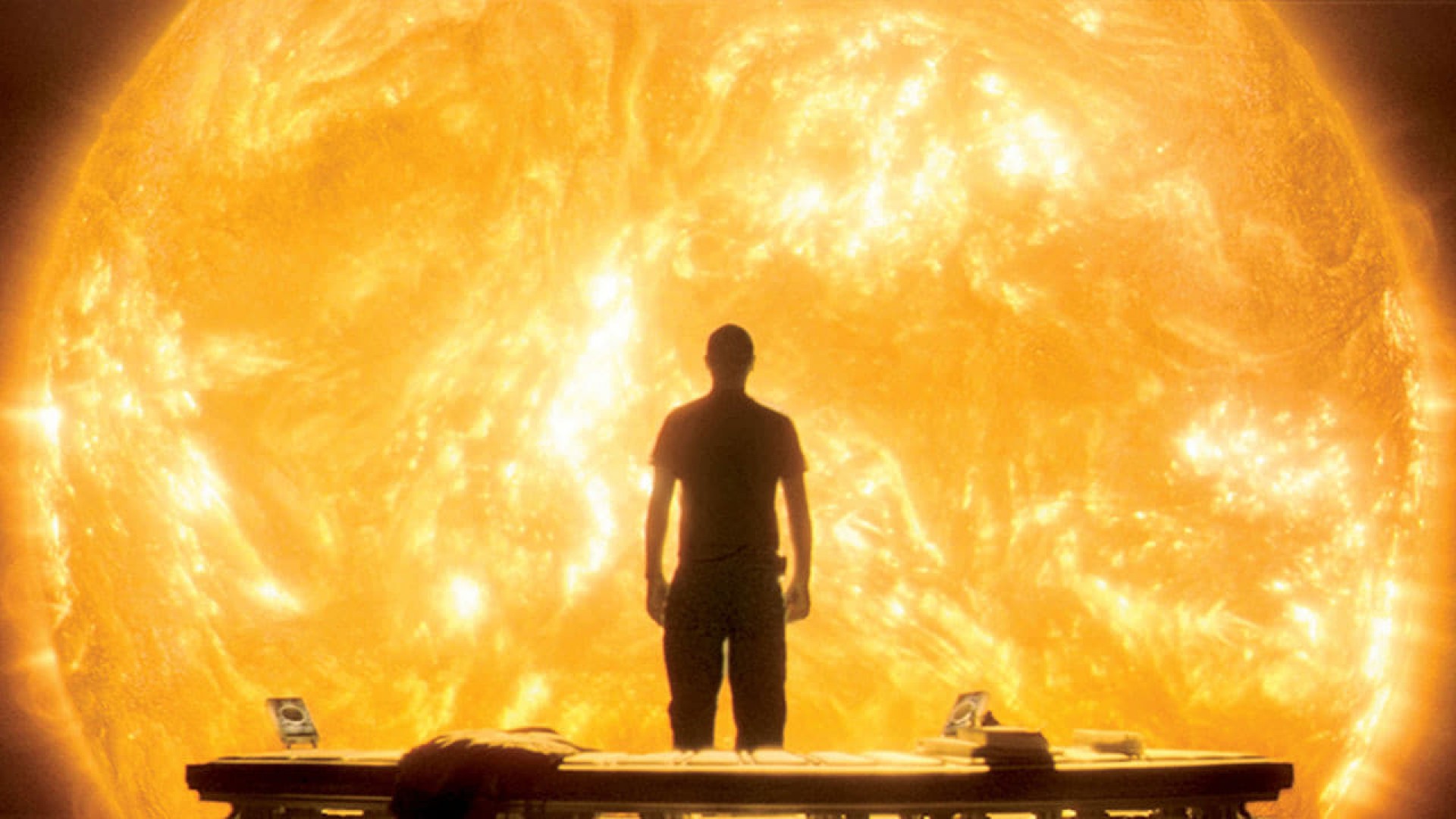
One of the greatest challenges the visual effects team faced was creating the sun itself. It was done with CGI and turned out to be the longest CGI sequence ever produced by a London production company.
- #008
The plot does not revolve around the sun dying in the ordinary sense: according to our understanding of nuclear fusion, that has not been happening for about five billion years. Instead, it has become "infected" with a "Q-ball," a supersymmetric nucleus left over from the big bang that disrupts normal matter. This is a theoretical particle that scientists at CERN are currently trying to verify, and it was one of many contributions from the film's science advisor, Brian Cox. The film's bomb is meant to be fired at the particles that make up the Q-ball; those particles would then decay naturally and allow the sun to return to normal.
- #009
Danny Boyle found working on a science fiction project so exhausting that he swore he would never make another one. Even so, in 2025 Boyle revealed that he and writer Alex Garland had planned this film as the first in a trilogy. Drafts were written, but they were never produced because of Sunshine's poor performance at the box office. Boyle said there was an "extraordinary idea" for one of the two sequels, implying that it covered the sun and interplanetary travel, but he did not share further details because Garland might want to use it for a future film.
- #010
Oscar Isaac auditioned for the film and, although he did not get a role, he praised Alex Garland's script and called it one of the best he had ever read. For that reason, he did not hesitate to work with Garland on his directorial debut Ex Machina (2014) and then on Annihilation (2018).
- #011
In character backstories, Gia Milinovich wrote that Capa (Cillian Murphy) had been obsessed with the Icarus mission since childhood and felt like an outsider because, unlike the rest of the group, he was not an astronaut. Cassie (Rose Byrne) was an air force pilot before joining the space program. She was also pregnant and had an abortion so that she could take part in the mission. Corazon (Michelle Yeoh) had stronger feelings about the plants and the oxygen garden than the other crew members; in her final message to her husband she did not speak and instead gazed lovingly into the camera for a full minute — she was also the only member of the group who never used the Earth Room. Harvey (Troy Garity) served as an assistant engineer on the Icarus I mission; of the whole group, he scored highest on all the fitness tests. His only weak point is his dependence on and devotion to his wife and his fear of never seeing her again, which he struggles with throughout the mission. Kaneda (Hiroyuki Sanada) is very protective of Capa because he knows he feels like an outsider. He is obsessed with Icarus I and with what led to its collapse. Mace (Chris Evans) comes from a military family (both of his parents were pilots) and grew up on military bases. He is quite open-minded, and his attack on Capa was the exception, not the rule. He is proud and honest; unfortunately this comes across to those around him as rude and cold. Mace developed feelings for Cassie during the Icarus II training camp, but he suppressed and ignored them in order to focus on the mission — as a result, he dreams of her every night.
- #012
DVD commentaries by director Danny Boyle and advisor Brian Cox contradict each other on whether Trey really committed suicide as he first appears to, or whether Pinbacker killed Trey and staged it as a suicide, which is what happened according to Boyle. Cox states that he feels Benedict Wong's character did in fact commit suicide. When Mace opened the drawer, two scalpels were missing, which could support either scenario. However, the insane Pinbacker seems unlikely to have had enough motivation or patience to imitate Trey's suicide, especially given that he is later seen trying to kill the rest of the crew as quickly as he can.
- #013
Hiroyuki Sanada's character was originally named Kanada, but he asked Danny Boyle to change it to Kaneda, a more natural Japanese name.
- #014
Real sounds captured from space by a Midwestern university were included in the sound design.
- #015
The bodies of the burn victims in the film were designed based on the victims of Pompeii who died in the eruption of Mount Vesuvius.
- #016
The entire cast underwent space training and learned to scuba dive. Among the films Danny Boyle insisted they all watch were The Right Stuff (1983) and For All Mankind (1989). Boyle also took the cast on a tour of a nuclear submarine to help them better understand cramped living conditions. He also had them experience weightlessness in a zero-gravity environment aboard an acrobatic aircraft.
- #017
Danny Boyle and Alex Garland worked on the script for more than a year and then spent a second year in pre-production. They shot for three months and then spent another year working on editing and visual effects. Boyle later said that the difficulties of depicting space destroyed his excitement for a sequel: "You have to build everything, take it with you and find your own way of doing weightlessness. And it's very hard. You don't see many directors willingly going back to that. I think sometimes they go back for commercial reasons."
- #018
(At about 1 hour 28 minutes) During the airlock breach, Corazon's body passing by Capa was actually a puppet. The crew found the replica of Michelle Yeoh incredibly creepy because of how realistic it was.
- #019
Cillian Murphy worked with leading physicist Brian Cox to learn everything about advanced physics. This included touring the CERN facility in Switzerland and learning to copy the physicists' mannerisms. Murphy began imitating some of Cox's personal traits, such as his frequent hand gestures. The actor also studied Henri-Georges Clouzot's classic The Wages of Fear (1953) to understand the kind of tension Danny Boyle was trying to create. Murphy claimed that his involvement in Sunshine turned him from agnosticism to atheism.
- #020
While promoting his film Annihilation (2018) in 2018, Alex Garland revealed that the character Harvey was in fact named after the since-disgraced producer Harvey Weinstein, citing his rude and brusque manner toward crew members as well as his arrogance and superiority complex. Director Danny Boyle thought paying tribute to Weinstein in this way would be funny; although Weinstein's Miramax had mounted an excellent promotional campaign for the US release of Boyle's Trainspotting (1996), Weinstein himself had struggled with the film and had even tried to cut some of its more disturbing scenes.
- #021
Andrew Smith's book "Moondust," made up of accounts from the men who walked on the Moon, was required reading for the entire cast.
- #022
Danny Boyle took the chance to make a science fiction film because Alien (1979) is one of his favorite films. At one point he was approached for Alien: Resurrection (1997), but as the studio moved toward computer-generated visual effects, Boyle felt he was not yet ready for such a technical challenge and chose to make A Life Less Ordinary (1997) instead.
- #023
It took 5 hours for Mark Strong to get into his fully burned makeup.
- #024
The film consists of 750 visual effects. Normally effects are distributed among several different effects houses. However, Danny Boyle chose just one to make it easier to track progress. This explains why the film was in post-production for a year.
- #025
In some earlier versions of the script, the Icarus ships used rotating sections to provide artificial gravity. This was not used in the finished film, so people experience normal Earth gravity everywhere while aboard the ship (except for a brief moment in the Icarus II airlock before it is repressurized). An early storyboard shows the crew boarding the crashed Icarus I and finding that the only gravity is "sideways" toward the bomb. The plan was to build a second set for Icarus I so that the characters could be seen walking on the walls and ceilings due to the changed gravity, but the budget did not allow it. Instead they reused the set for Icarus II and covered it in dust to clearly distinguish the two ships.
- #026
(At about 1 hour 40 minutes) The final scene was shot in Gärdet, Stockholm, Sweden. To create the impression of snow in Sydney, where such weather is very rare, the Sydney Opera House was added. Directly opposite the monoliths are the Swedish Film Institute and the Dramatiska Institutet film school.
- #027
Many of the computer graphic effects were built around physical effects on set, so that the actors had something to respond to. Most of the actors performed these scenes themselves. Cliff Curtis deserves special mention for plugging his nostrils and ears with cotton so that he would be dusted from every direction.
- #028
The papers attached to the walls of Capa's bunk are the real scientific notes of Brian Cox, who served as the film's science advisor.
- #029
Danny Boyle admitted to being clearly influenced by films such as 2001: A Space Odyssey (1968), Andrei Tarkovsky's Solaris (1972) and Alien (1979).
- #030
Alex Garland's script heavily featured concepts of God and atheism, which Danny Boyle chose to downplay to help the film find an audience.
- #031
The name of the spaceships - Icarus - is symbolic. In Greek mythology, Icarus's father Daedalus built a pair of wings from feathers and wax for himself and his son so they could escape the prison island. Before taking to the air, Daedalus warned his son not to fly too close to the sun, since the wax could melt, and not too close to the sea, since the feathers would get wet. However, overcome by the feeling flying gave him, Icarus soared high into the sky, too close to the sun. His wings melted and Icarus fell into the sea and died.
- #032
Prof. Brian Cox of CERN / the University of Manchester served as the film's science advisor. His wife was involved in making the film's blog.
- #033
The sound of Icarus 1's distress signal was reused as the alien distress signal in the 2011 prequel The Thing (2011).
- #034
Cliff Curtis had to leave the film briefly halfway through production to return to New Zealand because his father fell ill and sadly died.
- #035
In the original script, the Icarus payload was the same size but was made of highly compressed dark matter (with no mention of a need for fissile material) and had the same mass as the Moon, so it had its own gravity (one sixth of Earth normal). The science advisor pointed out the problems with using such a large bomb, since it was reduced to the mass of Manhattan. A shot of the original line can be seen in a deleted scene on the DVD.
- #036
The role of Searle was originally written as a somewhat boring English character. Cliff Curtis was genuinely interested in playing the character and auditioned on the strength of his performances in Training Day (2001) and Whale Rider (2002).
- #037
(At about the 49th minute) When the crew enters Icarus 1, flash frames appear on screen when the flashlights are pointed at the camera. These frames are photographs of the Icarus 1 crew taken from the group photo seen later. (At about 1 hour 13 minutes) Later, when Capa learns there was a fifth crew member aboard the ship, a few more flash frames are seen.
- #038
In the DVD commentary, science advisor Brian Cox bets the viewer £10 that this film's plot (CERN) could not discover the Q-ball particle that disables the Sun. He invites an email to claim the bet. This claim was expected to come to light in 2017. (In the same commentary, Prof. Cox also says that scientists do not gamble!)
Sources & editorial notes
Reference databases
Sources for the entries on this page
- IMDb IMDb kaydı
Information from external sources is independently selected, consolidated and edited by Arka Evren. Sources are listed for verification and further reading. Encyclopedia text is used under its licence (CC BY-SA). How we work