

FILM · 1991 · FRANCE
Terminator 2: Judgment Day
- Directed by
- James Cameron
- Runtime
- 137 min
- Studio
- Carolco Pictures, Pacific Western, Lightstorm Entertainment
1,272 archived facts 8 topics 1 source Last reviewed Nov 2026
Ten years after the events of the original, a reprogrammed T-800 is sent back in time to protect young John Connor from the shape-shifting T-1000. Together with his mother Sarah, he fights to stop Skynet from triggering a nuclear apocalypse.

1272 Interesting Facts About Terminator 2: Judgment Day
Interesting Facts (36)
- #001
- #002
Steven Spielberg said of this film, "I love the original Terminator, but the sequel blew it out of the water as far as I was concerned. That chase in the L.A. river with that truck, oh my God. You watch that chase today, it's powerful cinema. It's got heady ideas about time travel and about the spacetime continuum... but it's also a story about being relentless, and Jim as a filmmaker is relentless."
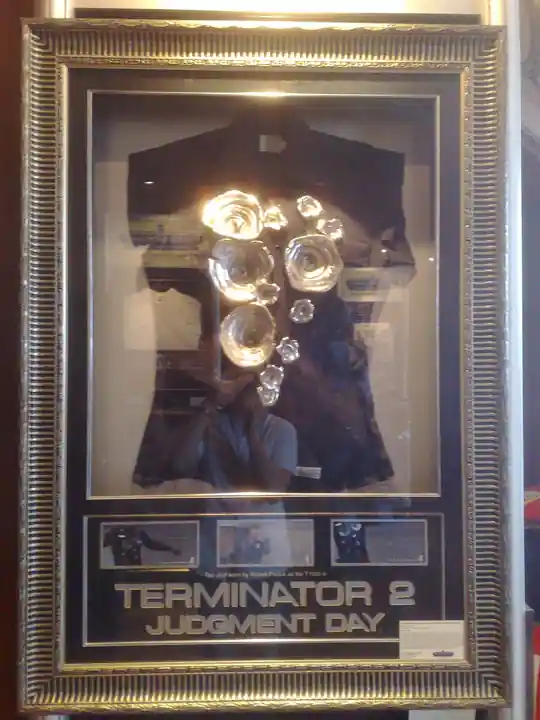
Terminator 2: Judgment Day (1991): Framed jacket and medalsImage: Wikimedia Commons · Steve Lacey from Bristol, UK, CC BY 2.0 - #003
- #004
- #005
- #006
Since the film's release the three of the four Winchester 1887 shotguns have been publicly sold. One is owned by Jason DeBord, the president of the Original Prop Blog, LLC; two were sold in an auction posted by Little John's Auction Service in June 2007. The fourth has been rumored to be in Arnold Schwarzenegger's personal collection.
- #007
- #008
- #009
- #010
- #011
- #012
An alternate ending was filmed, which showed an elderly Sarah sitting at the park, telling the story about the Terminator, watching John playing with his daughter, and tying her granddaughter's shoes. It also showed John Connor working as a Congressman. Director James Cameron decided not to use this ending, and replaced it with the "unknown road" ending.
- #013
Contains a major spoiler — show
As the T-1000 is seen to disintegrate in the steel, which melts at approx. 2500 degrees Fahrenheit. This means that simply loading and firing Dragon's Breath shotgun shells into the T-1000 would stop it/him dead in its/his tracks. The Dragon's Breath rounds burn at anywhere from 3000 - 4000 degrees Fahrenheit.
- #014
Contains a major spoiler — show
The second and last film in the Terminator franchise in which Sarah kills The Terminator. In The Terminator (1984), Sarah kills the T-800 by crushing him. In this film, Sarah assists the battle-damaged T-800 in self-terminating, by lowering him into molten steel. In Terminator: Dark Fate (2019), the Terminator is also destroyed but Sarah has no hand in it. This is also the second and last film to even show a payphone.
- #015
- #016
- #017
- #018
- #019
- #020
- #021
A woman passing by walked toward the biker bar set, convinced it was real, even though she passed all the location trucks, cameras and lights. Seeing Arnold Schwarzenegger standing in the bar in only boxer shorts, she finally asked what was going on, and Schwarzenegger replied that it was male stripper night. Coincidentally or not, in Terminator 3: Rise of the Machines (2003), the Terminator (again played by Schwarzenegger) actually enters a bar on male stripper night.
- #022
- #023
- #024
- #025
- #026
- #027
- #028
- #029
(At about the 27th minute) Co-writer Wisher is the photographer during the mall fight when the Terminator is thrown through the gallery window. Wisher also played the police officer whose car is violently carjacked in The Terminator (1984) (hence the recognizable look he gives while taking the Terminator's photograph).
- #030
- #031
- #032
For the film's early promotion, media materials avoided showing Arnold Schwarzenegger's character, the T-800, together with John Connor (Edward Furlong) in order to conceal the fact that Schwarzenegger played a "good" Terminator this time. Later trailers and images would reveal that he would not be playing the "bad guy" this time.
- #033
(At about 16 minutes) [Special Edition only] The "forced medication" scene had to be reshot several times because Ken Gibbel could not properly hit Linda Hamilton with the nightstick. The scene was physically very demanding, and Hamilton was very angry with Gibbel because he failed to do it repeatedly. She got her revenge in a later scene and beat Gibbel with a broken broom handle, as some of the blows were real.
- #034
The idea of destroying the Cyberdyne Systems building to prevent the future war was in the first Terminator film but was cut from the final version (it can be seen in the deleted scenes section of The Terminator (1984) DVD). Director James Cameron said it was lucky he chose to cut this scene in 1984, since it formed the "nucleus" of Terminator 2: Judgment Day (1991).
- #035
- #036
In the audio commentary, James Cameron said the biker bar scene was shot on the street across from the site of Rodney King's famous beating, and that the production was also shooting on the night of the beating. Cameron got the idea for Strange Days (1995) after the verdict of April 29, 1992.
Production Story (578)
- #037
In 1999, the film's US television rights were acquired by Paramount Pictures, after parent company Viacom acquired full ownership of Spelling Entertainment Group, whose Worldvision Enterprises division had held the syndication rights to the Carolco Pictures library since 1992. Paramount would later produce two "Terminator" movies of their own, "Terminator: Genisys" in 2015 and "Terminator: Dark Fate," which marked the return of James Cameron to the franchise for the first time since "Judgement Day," in 2019. Both films were co-produced with Skydance Media, which has a first-look deal with Paramount, and "Dark Fate" was additionally co-produced by 20th Century Fox, which distributed the film in most international territories.
- #038
- #039
When it came time to shoot the teaser trailer for this film, Stan Winston was working with director Tim Burton on Edward Scissorhands (1990) while Arnold Schwarzenegger was busy shooting Kindergarten Cop (1990). Both Winston and Schwarzenegger agreed to leave both productions for one day in order to shoot the teaser trailer.
- #040
Director James Cameron asked Stan Winston to direct a teaser trailer. Cameron did not want the trailer to just be early footage, and so with a budget of $150,000, Winston created a trailer that showed a futuristic assembly line churning out copies of Terminators, all of which looked like Arnold Schwarzenegger. Cameron was pleased with this trailer, as he had fears about audience reactions to trailers showing Schwarzenegger returning as a Terminator (after the Terminator in the first film was clearly destroyed). The teaser ran over a year in advance of T2's release and was shown before another Schwarzenegger hit film, Total Recall (1990).
- #041
- #042
As stated on the commentary, James Cameron was uncomfortable about putting guns in the hands of Edward Furlong. He eventually decided that John Connor would never wield a gun, but that he would have the knowledge of how to reload a gun for Sarah and the Terminator; a useful skill for a future military leader.
- #043
- #044
- #045
In the teaser trailer, we see the T-800 put into a machine called the "Bio-Flesh Regenerator" at the Endoskeleton factory, which grows and generates living human tissue onto the T-800, giving him his human form and emerges as Schwarzenegger. Kenner released a "Bio-Flesh Regenerator" play-set, which came with T-800 Terminator action figures. Which the T-800 Terminator endoskeleton is put into a clear plastic mold of Arnold Schwarzenegger. A flesh-colored substance, similar to Play-Doh, was injected into the mold around the endoskeleton, creating a "flesh" body that could be peeled off in places to reveal the endoskeleton beneath, mimicking the damage seen in the movie.
- #046
- #047
- #048
After the release of Terminator Genisys (2015), James Cameron said that it was the natural follow up to this film. Arnold Schwarzenegger believes it exceeded Terminator 2 technologically, action-wise, and in intensity. However, Cameron later admitted that the Terminator movies made after T2 did not work for him for various reasons, but he supported them nevertheless because of his close friendship with Schwarzenegger.
- #049
- #050
- #051
This is one of two films from the early 1990s to be at least partially owned by Paramount Pictures that featured a song from the then-upcoming Guns N' Roses album "Use Your Illusion II." This film, distributed on US TV by Paramount since 1999, features the original song "You Could Be Mine." Days of Thunder (1990), a full-fledged Paramount production, featured a cover of Bob Dylan's "Knockin' on Heaven's Door," itself originally recorded for Pat Garrett & Billy the Kid (1973) (an MGM release).
- #052
James Cameron came up with the film's plot when he was tripping on ecstasy. He stated: "I remember sitting there once, high on E, writing notes for Terminator, and I was struck by Sting's song, that "I hope the Russians love their children too." And I thought, 'You know what? The idea of a nuclear war is just so antithetical to life itself. That's where the kid came from.'" He explained that his movies are always about relationships. "Sure, there's going to be big, thunderous action sequences, but the heart of the movie is that relationship," James Cameron said from his home in New Zealand. "I have always loved The Wizard of Oz. This movie is about the Tin Man getting his heart."
- #053
Four sources were enlisted to produce the required 150 visual effects shots Stan Winston, who created the Terminator in the first film, was brought back to create animatronic and special make-up effects; Industrial Light & Magic was assigned the computer-generated visuals; and Fantasy II Film Effects and 4-ward Productions created miniature effects and opticals.
- #054
"Terminator 2" took a little over 12 months to complete from the day James Cameron presented his first rough draft script to Carolco Pictures. Cameron and William Wisher worked for eight weeks collaborating on the new screenplay. After a tight three-month preproduction period, principal photography commenced on October 8, 1990.
- #055
This is the second R-rated Terminator film. Its predecessor and successor, The Terminator (1984) and Terminator 3: Rise of the Machines (2003), respectively, are also rated R. However, Terminator Salvation (2009) and Terminator Genisys (2015) are both rated PG-13, which many people felt contributed to their under-performance at the US box-office. Although, all five films have made money worldwide.
- #056
- #057
Industrial Light & Magic's computer graphics department had to grow from six artists to almost thirty-six to accommodate all the work required to bring the T-1000 to life, costing US $5.5 million, and taking eight months to produce, which ultimately amounted to 3.5 minutes of screen time.
- #058
- #059
Cameron's decision to incorporate CGI to achieve the liquid metal villain was a huge risk. The CGI character from Cameron's previous film The Abyss (1989) was onscreen for only 75 seconds, and it took nine months of work to complete. The team from Industrial Light & Magic, headed by Dennis Muren, were not at all convinced that they could achieve what Cameron and the script demanded. ILM categorized the effects shots as: easy, moderate, difficult and miraculous. In total ILM created fifty effects shots which totaled 3.5 minutes of the film. The rest of the 300 effects in the film were handled by practical effects and astounding puppetry created entirely in-camera by Stan Winston Studio.
- #060
Announced that the film would be digitally remastered in 3D to commemorate its 25th anniversary, with a worldwide re-release planned for summer 2017. The version to be remastered and re released in 3D was the original 137 minute theatrical cut, as the extended edition is not James Cameron's preferred version. Only one camera shot from the opening chase sequence was digitally altered to fix a minor continuity error which had bugged Cameron since the 1991 release. Similar to Cameron's Titanic (1997) 3D, Lightstorm Entertainment oversaw the work on the 3D version of Terminator 2, which took nearly a year to finish.
- #061
- #062
- #063
- #064
- #065
- #066
By the summer of 1990, Cameron had not yet written the script - there wasn't even a concept, but still an announcement was made that Terminator 2: Judgment Day (1991) would be released the following summer. The announcement came in the form of a teaser trailer directed by Stan Winston. All the footage was original and has never been used in any of the films. It showed a Terminator assembly line and the T-800 going through the cyborg tissue generation sequence. Arnold appears after the sequence and utters his famous catch phrase, "I'll be back." "What Jim wanted to tell in the trailer," said Stan in an interview, "was that all Terminators look like Arnold. It was a way to justify Arnold's return after getting killed in the first movie."
- #067
After the release of The Abyss (1989) (featuring the infamous pseudo-pod scene), director James Cameron felt he was ready to start working on this film. However, he knew that half of the film's rights were owned by Hemdale (producer of The Terminator (1984)), which was going bankrupt and could no longer provide funding. While working on Total Recall (1990) with Mario Kassar and Andrew G. Vajna (owners of Carolco Pictures), Arnold Schwarzenegger learned of Cameron's intention to make the film, and it was he who urged Kassar and Vajna to buy the rights from Hemdale. Finally, they bought them in February 1990, and Cameron would only start work the following month.
- #068
For the bad guy in the movie, James Cameron and co-Writer William Wisher briefly considered another 'bad' T-800 (played by Arnold Schwarzenegger) to fight against John and Sarah Connor, but this was quickly dropped. Another unused idea involved two Arnold T-800s being sent back in time, one good, and the other bad, before settling on the T-1000 being the bad Terminator. This idea ended up being used for Terminator Genisys (2015).
- #069
- #070
- #071
An opening segment showing the design of the Time Displacement Machine, which sent the first Terminator and Kyle Reese back in the time in the first film, was rejected for the sequel, as it was too complicated, costly and unnecessary for plot development (also, it featured another rating problem for additional nudity, as Reese was required to go through the portal while naked). It would have consisted of three rings independently rotating around each other, with the subject to be displaced levitating in their center. The design ultimately resurfaced in 1997 as Jodie Foster's space traveling device in Contact (1997). The full Time Displacement Machine would ultimately be seen in the Terminator series in Terminator Genisys (2015).
- #072
- #073
- #074
- #075
- #076
- #077
- #078
- #079
- #080
Shot in eight months, compared to the first film's six-week filming schedule. The film was on a tight deadline as it had to be ready for the summer of 1991 to meet its financial commitments. When writer/director James Cameron got the call from Carolco Pictures that the film was officially green-lit, one of the first things he said to his friend and co-writer William Wisher was: "The good news is, we're making the sequel; the bad news is, we are already several months behind schedule." They used every available hour to write the initial draft, because Cameron wanted to have a finished screenplay before the Cannes Film Festival, where Carolco would announce the film. He did an all-nighter the day before the festival, and the script was printed out while a limousine was waiting to get him to the airport. This delayed the plane to Cannes, much to the chagrin of the Carolco delegation inside (which included filmmakers Paul Verhoeven, Oliver Stone and actor Arnold Schwarzenegger). After boarding, Cameron handed the script to Schwarzenegger and producer Mario Kassar, then slept for the duration of the flight.
- #081
James Cameron fought with Mario Kassar over the ending. Cameron wanted to end the film with an alternate Coda ending (that showed the older Sarah in future) as a bookend, but Kassar wanted to end the film in an another way (as a measure for possible sequels), and demanded a test screening. Cameron eventually relented when test audiences and Kassar himself reacted negatively over the Coda ending, commenting that it was way too positive compared to bleak and dark tone of the rest of the movie, and almost seemed to come from a different movie. He chose the more ambiguous existing ending, arguing that it didn't let the audience off the hook so easily, and implying that the struggle for the future is an ongoing one.
- #082
When the project was first announced in late 1984, the projected budget was $12 million. The final budget was $94 million. Despite initial studio concerns that the movie might be unable to recoup its costs, due to lucrative distribution deals, the film had already earned back its budget before it played on a single screen.
- #083
For the early promotion of the movie, media material avoided showing Arnold Schwarzenegger's character, the T-800, together with John Connor (Edward Furlong), in order to hide the fact that Schwarzenegger played a "good" Terminator this time. Later trailers and pictures would reveal that he would not play the "bad guy" this time.
- #084
- #085
- #086
Carolco studio executives were nervous and concerned when the original budget of US $75 million ballooned up to US $88 million, with more to come. In order to keep the budget manageable, they proposed to eliminate a few scenes, particularly the opening biker bar scene where The Terminator is introduced. They tried to get Arnold Schwarzenegger to persuade James Cameron to remove that scene, but Schwarzenegger turned them down, saying, "Only a studio guy would cut a scene out like that."
- #087
- #088
- #089
- #090
- #091
- #092
- #093
William Wisher, co-writer and long-time friend of writer/director James Cameron, finally got a full screenplay credit for this movie. He had only received an "additional dialogue by" credit for The Terminator (1984) despite writing half the screenplay (Gale Anne Hurd got the co-credit for that movie, even though she only did script editing and did not write a single line of the screenplay). Wisher basically wrote the first half of the T2 screenplay, and Cameron the second half.
- #094
The lead singer of heavy metal band WASP, Blackie Lawless, was considered for the role of the liquid-metal T-1000, although his height proved to be a problem. The role of the original Terminator had been written for a man of average stature, who could easily blend in to a crowd, and James Cameron wanted to apply that original concept to dramatic effect for the T-1000. In an AOL chat, Lawless explained, "Probably the biggest regret that I have, though I didn't turn it down, was a part in Terminator 2 that Robert Patrick got. Arnold Schwarzenegger wanted me to do the part, but when he found out I was 6'4", I couldn't. I regret not being able to do that."
- #095
James Cameron finds a child pointing a gun "morally reprehensible," even naming Stand by Me (1986) as a film he disproves of because it depicts children holding and aiming firearms. This edict is evident in the movie, where John Connor only carries magazines instead of the guns themselves. This decision also gives John Connor more of a feel as a "cerebral leader."
- #096
- #097
- #098
The idea to destroy the Cyberdyne Systems building to prevent the future war was in the first Terminator movie, but it was cut from the final release (it can be seen in the deleted scenes section of the The Terminator (1984) DVD). Director James Cameron said it was lucky he chose to cut that scene in 1984, as it formed the "nucleus" of Terminator 2: Judgment Day (1991).
- #099
"I don't like slow motion for action. I like slow motion for suspense," says James Cameron over the scene where Sarah Connor first encounters the T-800 of this film. He also explains that a dream sequence cut from the film was removed, because the nightmarish quality of this scene would be affected. "It watered us down," he explains.
- #100
It's never explained how the T-1000 was able to go through the time portal even though it has no living flesh. In the original script, it was explained that the T-1000 traveled inside a flesh sac which it would shed immediately upon arrival; the officer on the scene would find the sac just before being killed by the T-1000. This idea was cut because it was deemed too confusing for the audience at this point in the story, so the arrival of the T-1000 was kept off-screen. Later retcons and explanations simply posited that mimetic polyalloy is just that good at mimicking human flesh.
- #101
James Cameron got into a debate with his editors about using George Thorogood's "Bad to the Bone" for when the Terminator appears decked out in his new leather outfit. The song had been used in a couple of films already around that same time. Cameron's response to its overuse was that it was "cool."
- #102
- #103
- #104
- #105
- #106
In 2008, a television series based on the Terminator films entitled Terminator: The Sarah Connor Chronicles (2008) premiered in the United States on January 13, 2008. The series takes place two years after this film, and ignores Terminator 3: Rise of the Machines (2003), and the series followed Sarah (Lena Headey) and John Connor (Thomas Dekker) and a female Terminator called Cameron Phillips (Summer Glau) as they travel forward eight years across time to continue the fight against Skynet and to stop Judgment Day from happening. The series ran for two seasons and was canceled on April 10, 2009.
- #107
- #108
- #109
Both James Cameron and William Wisher realized early on that they wouldn't be able to keep it a secret that Arnold Schwarzenegger was playing a good guy in the film. Nevertheless, they wrote the first part of the film so the audience wouldn't know, leaving ambiguity in Schwarzenegger and Patrick's characters until it's finally revealed about 30 minutes in.
- #110
- #111
The last Terminator film to be written and directed by James Cameron. Cameron was not involved in the following three sequels, only receiving credit as the creator of the characters, but returned to the franchise as producer and writer of the sixth installment, Terminator: Dark Fate (2019).
- #112
- #113
Billy Idol was director James Cameron's original choice to play the T-1000, but a motorcycle accident prevented him from taking on the role. This was somewhat ironic, since the T-1000 rides a motorcycle in many scenes. Idol can be seen on crutches in a small part in Oliver Stone's The Doors (1991), which was released a few months before this film.
- #114
One effect that did not make it into the final cut was the "old Sarah" scene. In the proposed scene, a very old Sarah Connor sits on a park bench after the averted judgment day. A test screening received a negative response for the scene. The audience felt that this ending was "too neat". So director James Cameron cut the scene and re conceived the ending. Nevertheless, the makeup Stan Winston made would no doubt have been completely convincing. On the day of filming the "old Sarah" scene, Stan was leading Linda Hamilton to the set after applying her old age make-up, Cameron didn't even recognize Linda and at first, believed that Stan had brought his grandmother to set.
- #115
- #116
Film debut of Edward Furlong. He won the part of John Connor after being discovered by Casting Director Mali Finn. She had been looking for a 'streetwise kid', but none of the young professional actors who had come for a screentest had been convincing enough. She widened her search to the Boys' Club of Pasadena, California, where she found Furlong. Like John Connor, he had never met his father and was no longer living with his mother. When she approached him, he gave her the right amount of attitude, convincing her that he could be perfect for the role. Although his first audition did not go well (he felt a bit intimidated by the presence of Linda Hamilton), both Finn and James Cameron were impressed by his raw talent and ability to summon emotion on command. After some training with a dialogue coach and displaying a chemistry with Arnold Schwarzenegger, they were convinced he was the right choice.
- #117
- #118
- #119
- #120
- #121
The foreign distributors eagerly signed up for this film, even though it had more than ten times the budget of the original film, making it the most expensive film in history at that time. This was something director James Cameron would outdo on his successive three films, True Lies (1994), Titanic (1997) and Avatar (2009).
- #122
- #123
- #124
Marvel published a three-issue comic book adaptation written by Gregory Wright and drawn by Klaus Janson. This was Arnold Schwarzenegger's sixth film to be adapted into a comic book, after Conan the Barbarian (1982), Conan the Destroyer (1984), Red Sonja (1985), Red Heat (1988), and Total Recall (1990). Marvel also published two sequel comic books titled "Cybernetic Dawn" and "Nuclear Twilight," each four issues, via its subsidiary Malibu. These were the only Terminator comics published by Marvel.
- #125
(at around 1h 2 mins) After the escape from the mental hospital, the Terminator mentions that his internal chip is a learning computer, so the more time he spends with humans, the more he can learn. This was meant as an explanation as to how he picks up more and more human traits from John over the rest of the movie. However, the scene originally continued, with Terminator explaining that Skynet had set the chip to read-only, preventing him from thinking too much and becoming too independent. John and Sarah then reset the chip by surgically removing and reinserting it. The scene was omitted from the theatrical version but restored in the Special Edition.
- #126
W.A.S.P. frontman, Blackie Lawless said that years later after this film was released, he ran into Robert Patrick and told him that he was originally going to play the T-1000, but was let go do to his height being 6ft 4in. Lawless said that Patrick told him he was shown original drawings of ideas for what the T-1000 was going to look like before he was casted and told Blackie that their original concept was supposed to be a "long haired barbarian type" which fit Lawless' description.
- #127
Contains a major spoiler — show
[2:00:00] In the final scene, the lines, "I cannot self-terminate. You must lower me in the steel," were added by Arnold Schwarzenegger in post-production. Originally, The Terminator silently gave Sarah the controls for the winch, but the test audience didn't understand why The Terminator couldn't just drop himself into the steel.
- #128
Contains a major spoiler — show
In the original script and storyboards, the death of the T-1000 was only depicted as the android falling in a pool of molten steel, and seen from above as it turns inside-out into a face; how the T-1000 would exactly react in the steel was still open to interpretation. One idea was for the android to go through every imaginable shape, some for only a few seconds, but it would be too time-consuming to make this look realistic. Another idea was to have the T-1000 grabbing a chain and hauling part of its dissolving body out of the pool, which would turn into a black crusted mass on the floor. James Cameron finally came with the idea to have T-1000 going through its previous impersonations before finally dissolving as a tortured face.
- #129
Contains a major spoiler — show
James Cameron says on the commentary track, which was recorded in 2003, that he had just spoken with Schwarzenegger from the set of Terminator 3: Rise of the Machines (2003). Apparently Schwarzenegger had told him that he had thrown his shoulder out on the set of the new film. That should have been an indicator of a number of things. Cameron points out that Terminator 2 was a summer blockbuster wherein the main character essentially kills himself, a big taboo in Hollywood, especially for blockbuster films. Cameron also notes that the same Summer this film came out, he produced another film where this basically happens. That other film was Point Break (1991).
- #130
Contains a major spoiler — show
An alternate coda was filmed, with an elderly Sarah and John as a US senator sitting peacefully in a park, in a future where Judgment Day never happened. Sarah would originally see a young, non-veteran Kyle Reese walking by, to whom she regrettably cannot say anything. This idea was dropped very early on, as it simply raised too many questions about how this alternate Reese could have fathered John Connor. The entire ending was ultimately deleted, in favor of a more ambiguous and less cheery ending, also because a juvenile delinquent like John could not plausibly have become a senator. The idea did survive in some form: in the novelization of the film, Sarah hires a private investigator to find Reese for her, without success.
- #131
Contains a major spoiler — show
Scenes in the original screenplay but not filmed: * Extended Future War sequence. The original prologue was longer and had a voice-over by John Connor, describing Judgment Day and the events of the previous movie. The extended scene showed the Resistance winning the war when they destroy Skynet's central processor, rendering all Skynet's units inert in an instant. John and his squad enter a Skynet lab where they find the time-portal and a storage facility of Terminators. Reese talks to John before he volunteers to be sent through time; it is implied that Reese learns that he is in fact John's father. After Reese is sent, John enters a storage cabinet full of Terminators (different types even). One of the 101-models is missing (being the Terminator from the first movie). John hints that he needs to send another one himself. After that, the rest of the movie is effectively one long flashback of John. The scene was omitted because it was not deemed narratively important enough to justify the costs of building additional sets, but it did appear later in a similar form in Terminator Genisys (2015). * Sarah's ECT. Sarah is fitted for electro-convulsive therapy, and voltage is pumped into her. The shock causes her to wince in pain, and relive several moments from her life, most prominently the T-800 chasing her through the factory and lunging at her in the previous film. * Alternate nuclear nightmare scene. Before Sarah's psychiatric review, she dreams that the Terminator takes her out of the asylum towards a fence outside, where she sees nuclear silos opening, firing their missiles. One nuclear bomb goes off, ripping off both her flesh and the Terminator's. Then she wakes up. * Extended hospital escape. After getting out of the elevator, the T-800 revs up his motorcycle and directs it unmanned and at full speed at the elevator, causing it to explode as the T-1000 emerges from it, giving John, Sarah, and him some more time to commandeer a vehicle * Gant Ranch. This section was originally a longer version of the scene at Salceda's compound and refers to Travis Gant, the "crazy ex-Green Beret" that John mentions his mother seeing before she was caught (Salceda being one of his subordinates). They arrive at Gant's hacienda, who initially remains skeptic of Sarah's stories about Judgment Day, until she shows that firing two bullets into the T-800's head do not harm it. Sarah and Gant discuss their previous relation (Sarah basically used him to get John and her trained in weapons). It also sees Gant making an attempt to have Terminator smile (later re-written and filmed as a scene for John), and T-1000 learning about the Gant ranch from one of Sarah's tapes found in John's room. After Sarah, John, and the Terminator leave, Gant finds his men dead, and realizes too late that T-1000 has disguised itself as his wife, like it did with John's foster mom. It pierces his body several times to torture him for information, but Gant uses a hand grenade to kill himself before he can reveal anything. T-1000 reforms again and repeats the procedure with one of Gant's surviving men, who tells it about Dyson. * Salceda's death sequence. After Sarah, John, and the Terminator leave, Enrique Salceda's dog starts barking as the T-1000 approaches. Enrique goes out and tries to shoot it, but T-1000 tortures him for information same as it did in the Gant Ranch scene. Enrique grabs a grenade from a crate behind him and blows himself up, and hopefully the T-1000 with it. However, T-1000's head merely falls off, and like the little piece in the asylum escape sequence, it oozes back into his boots. Enrique's wife Yolanda sees this and hugs her baby as T-1000 steps closer. T-1000 picks up the baby and gets the info from her as to where John and others have gone. * Dyson's Vision Sequence. Moments before his death, Dyson sees a picture of his family, and has a vision of a nuclear inferno that turns everything to ash. It then changes into a serene scene of his family happily running against the backdrop of the sun, as it pulls back to reveal Dyson's dying eye before he closes it and drops a book onto the trigger. Scenes of the blazing inferno were ultimately used during the movie's opening credits.
- #132
Contains a major spoiler — show
Filmed scenes not included in the theatrical release (all but two were restored in the Special Edition): * Directly after the pre-med students peer into Sarah Connor's room, Dr. Silberman reminds the orderlies to make sure she takes her medication. The staff then comes in to give her the pills. She refuses, so they smack her in the gut with a baton, zap her with a taser and force the pills down her throat, then kick her while she's on the floor doubled over in pain. * [19:40] After John Connor robs the ATM and heads for the mall, Sarah has a drug-induced dream in the hospital where Reese appears and warns her that she needs to save their son from danger. They kiss and hug, but Reese disappears and walks out. Sarah chases him outside, to find herself in the same spot as the nuclear nightmare scene later in the movie. She sees the large white flash, and then she wakes up. This is the only scene that Michael Biehn was in, and appeared in some promotional trailers. Cameron cut the scene because he thought that audiences who had not seen the first movie would be confused by the appearance of Kyle. * A scene showing the T-1000 at the scene of the crashed truck in the canal, where it steals a police car. * After the T-1000 has killed John's foster parents, it ventures outside and kills the dog to check its name tag, which is stamped with the name "Max." The T-1000 realizes that John has seen through its deception when it confirmed the wrong name by calling the dog "Wolfie." * After killing the dog, knowing that John will no longer come home, the T-1000 goes to John's room to try to find any clues as to where he might be. He stalks around the room "feeling" things on the shelves, on the walls, etc. He eventually stops in front of a poster, realizes there is something behind it, rips it down and finds a box of mementos (pictures, and the like). This must be where the T-1000 figures out about Sarah's current whereabouts, and the desert compound that Sarah, John, and the Terminator head to after the hospital. Director James Cameron decided to cut it because the T-1000's sampling abilities were already sufficiently conveyed in earlier scenes, so this scene became redundant (and because it made the T-1000 look too much like it had x-ray vision). This scene was NOT included in the SE. * An extended scene at the abandoned gas station: when the Terminator talks about how its CPU is a learning computer, he adds that it was switched to read-only before being sent out, as Skynet doesn't want their units to think too much while on their own. John asks if it can be reset. You then see the Terminator's face in a "mirror" talking Sarah through an operation procedure. A puppet was used for the foreground Sarah to work on and Linda Hamilton's twin sister Leslie Hamilton Gearren was in the mirror mimicking Linda's hand movements on Schwarzenegger himself. After the CPU is removed, the Terminator shuts down, and Sarah places it on a table. She picks up a hammer and tries to smash it to render him inoperative. John stops her and says they need him. He starts to show authority for the first time and asks her how he is supposed to be a great military leader if even his own mother won't listen to him. She reluctantly reinserts the chip back in the Terminator's head. * A scene at a truck stop before John, Sarah, and Terminator arrive at the Salceda farm. John points out to the Terminator that he shouldn't be so serious all the time. He encourages him to smile once in a while. The Terminator tries to smile, but the result is less than convincing and even humorous, so John tells him to practice in front of a mirror. * Directly after Terminator tells Sarah about Miles Dyson, there is a scene of Dyson in his private residence, where his wife tells him he is much too focused on finishing his microchip, and Miles explains how his design will revolutionize artificial intelligence. That scene also shows Dyson having a daughter in addition to his son Danny. * Some more dialogue between John and the Terminator as they assemble weapons in the desert. John tells about his unusual childhood and asks Terminator if he experiences emotions. * Before Sarah takes aim at Dyson, she is seen approaching the house and setting up weapons. * A scene at Cyberdyne, where Sarah and Terminator smash hard drives, and Dyson destroys the model of his revolutionary microchip. * In the steel mill, the T-1000 experiences some negative effects from being frozen earlier. It has difficulties maintaining its shape and color when it touches other materials, like steel bars and the floor. * In the climax, John sees the two Sarahs, and recognizes the fake one because her feet are mimicking the steel grating she is standing on. * The Future Coda, where an elderly Sarah Connor sits in a park in a Skynet-free future, giving a monologue about how Judgment Day never occurred, and John became a senator. This scene was NOT included in the SE, because James Cameron felt it just didn't fit the dark, gloomy atmosphere of the rest of the movie. It was, however, included as an Easter egg feature on the Ultimate, Extreme, and Blu-ray editions of the film on DVD.
- #133
Contains a major spoiler — show
[1:55:00] The scene where the Terminator reboots after being "shut down" by the T-1000 was not in the script and was only added during editing because director James Cameron felt that the audience would not be able to understand how the Terminator returns to deliver the final blow to the T-1000. According to the Arnold Schwarzenegger book "The Life and Times," Cameron contacted Schwarzenegger, who was going to visit his friend Bruce Willis for Christmas, to come back to shoot the crucial scene. Ultimately, Schwarzenegger had to cancel his plans and film it. The scene where the Terminator pulls the impaled metal rod out was shot on Christmas day.
- #134
Contains a major spoiler — show
The opening credits sequence, showing Los Angeles burning in a nuclear fire, was originally conceived as part of a vision of a dying Miles Dyson. As he is lying on the floor, mortally wounded, Miles picks up a desk picture of his family. He has a vision of burning landscapes, the result of Judgment Day, which change into a view of his wife and children, happily playing in the sun. With this happy memory becoming his final thought, his arm lowers onto the switch. Although powerful, the sequence was thought to focus too much on a secondary character, so it was re-written as a much more harsh and factual death scene.
- #135
Contains a major spoiler — show
The original script had the T-1000 search John Connor's room early in the film, and find pictures of Enrique Salceda's ranch. The scene was filmed but was cut for pacing reasons, but it was supposed to explain a later scene where the T-1000 makes its way to Salceda's ranch, after Sarah, John and the T-800 have already left. He tries to torture Enrique for their whereabouts by skewering his shoulders with his finger spikes, saying "I know this hurts. Where is John Connor?" Rather than giving up information, Enrique curses him, and blows himself up with a hand grenade. This forces the android to obtain the information from Enrique's wife by threatening her baby. This scene was not filmed, but the idea was recycled in the finale where T-1000 tortures Sarah in a similar way to make her call to John.
- #136
The production ran long enough that Edward Furlong's growth forced the crew to make adjustments during filming. He looks noticeably younger in the desert scene than in the others. His voice began to crack and had to be pitch-adjusted in post-production. He had also grown considerably taller over the months, and in a scene shot late in the schedule he had to stand in a hole in the ground to maintain continuity with Linda Hamilton's height difference.
- #137
Because his voice changed during filming, most of Edward Furlong's dialogue had to be re-recorded by Furlong in post-production. His younger voice was left intact only in the scene where he and the Terminator talk about why people cry, because James Cameron wanted it to be dramatic and thought the original voice was better.
- #138
Director James Cameron asked Stan Winston to direct a promotional trailer. Cameron did not want the trailer to consist only of early footage, so with a budget of $150,000 Winston created a trailer showing a futuristic assembly line producing copies of the Terminator, all resembling Arnold Schwarzenegger. Cameron was pleased with the trailer because he was afraid of how audiences would react to trailers showing Schwarzenegger returning as the Terminator (after the Terminator in the first film was clearly destroyed). The teaser was released a year before T2's release and was shown before another Schwarzenegger hit, Total Recall (1990).
- #139
Filming took so long that Edward Furlong's growth forced the production team to make various adjustments. In the desert scene, he looks noticeably younger than in the other scenes. His vocal cords also began to change, and pitch correction was applied in post-production. Because he had grown considerably over the months, in a scene shot near the end of the shooting schedule he had to stand in a pit to preserve the height difference between him and Linda Hamilton.
- #140
Carolco studio executives were worried as the initial budget of 75 million dollars ballooned to 88 million dollars and continued to rise. To keep the budget under control, they proposed cutting several scenes, particularly the biker bar scene in the opening where the Terminator is introduced. They asked Arnold Schwarzenegger to persuade James Cameron to remove this scene, but Schwarzenegger refused, saying, "Only a studio executive would cut a scene like that."
- #141
- #142
- #143
[2:00:00] The line "I cannot self-terminate. You must lower me into the steel" in the final scene was added by Arnold Schwarzenegger in post-production. Originally, the Terminator silently handed Sarah the crane controls, but test audiences did not understand why the Terminator could not lower himself into the steel.
- #144
- #145
An alternative ending was shot: an older Sarah sits in a park telling the story of the Terminator, watches John play with his daughter, and ties her grandchild's shoes. John Connor is also shown working as a congressman. Director James Cameron decided not to use this ending and replaced it with the "unknown road" ending.
- #146
- #147
- #148
Director James Cameron asked Stan Winston to direct a teaser trailer. Cameron did not want the trailer to consist only of early footage, and with a budget of 150,000 dollars, Winston created a trailer showing a futuristic assembly line producing Terminator copies resembling Arnold Schwarzenegger. Cameron was pleased with this trailer, because he was worried about the audience's reaction to Schwarzenegger returning as the Terminator when the Terminator in the first film had clearly been destroyed. The teaser was released more than a year before T2's premiere and played before another Schwarzenegger hit, Total Recall (1990).
- #149
The idea of destroying the Cyberdyne Systems building to prevent the future war was present in the first Terminator film but was cut from the final edit (it can be seen in the deleted scenes section of The Terminator (1984) DVD). Director James Cameron said it was fortunate that he cut this scene in 1984, because that scene formed the "core" of Terminator 2: Judgment Day (1991).
- #150
[1:55:00] The scene where the Terminator is "shut down" by the T-1000 and then restarted was not in the script and was added only during editing, because director James Cameron thought the audience would not understand how the Terminator came back to deliver the final blow to the T-1000. According to Arnold Schwarzenegger's book "The Life and Times," Cameron called Schwarzenegger, who was going to visit his friend Bruce Willis for Christmas, and asked him to come back to shoot the critical scene. In the end, Schwarzenegger had to cancel his plans and shot the scene. The scene where the Terminator pulls out the embedded metal rod was shot on Christmas Day.
- #151
In the film's early promotion, media materials avoided showing Arnold Schwarzenegger's character, the T-800, together with John Connor (Edward Furlong), thereby concealing the fact that Schwarzenegger was playing a "good" Terminator this time. Later trailers and photos revealed that he would not be playing the "bad guy" this time.
- #152
- #153
It was shot over eight months, compared to the first film's six-week shooting schedule. The film had a strict deadline because it had to be ready for the summer of 1991. When writer/director James Cameron received word from Carolco Pictures that the film was officially greenlit, one of the first things he said to his friend and co-writer William Wisher was: "The good news is we're making the sequel; the bad news is we're already several months behind." They used every spare hour to write the first draft, because Cameron wanted to have a finished script before the Cannes Film Festival, where Carolco would announce the film. He worked until morning the day before the festival, and the script was printed while a limousine waited to take him to the airport. This delayed his flight to Cannes and angered the Carolco delegation (which included producers Paul Verhoeven, Oliver Stone and actor Arnold Schwarzenegger). After boarding the plane, Cameron gave the script to Schwarzenegger and producer Mario Kassar and slept throughout the flight.
- #154
- #155
When the project was first announced in late 1984, the estimated budget was 12 million dollars. The final budget came to 94 million dollars. Despite concerns that the studio would not be able to cover the film's cost, thanks to lucrative distribution deals the film had already recouped its budget before playing in a single theater.
- #156
- #157
James Cameron argued with Mario Kassar over the ending. Cameron wanted to end the film with an alternative Coda ending (showing an elderly Sarah in the future), but Kassar wanted the film to end differently (as a precaution for possible sequels) and demanded a test screening. Cameron eventually gave in after test audiences and Kassar reacted negatively to the Coda ending; it was commented that the ending was too positive compared to the film's bleak and dark tone and looked as if it came from an almost different film. He chose the more ambiguous existing ending and argued that it did not easily rescue the audience and implied that the struggle for the future continues.
- #158
(At about 1 hour 2 minutes) After the escape from the mental hospital, the Terminator mentions that its internal chip is a learning computer, so the more time it spends with humans, the more it can learn. This was thought to be an explanation for it taking on more and more human traits from John throughout the rest of the film. However, the scene actually continued: the Terminator explained that Skynet set the chip to read-only, thus preventing it from thinking too much and becoming too independent. John and Sarah then surgically removed and reinserted the chip, resetting it. This scene was cut from the theatrical version but was restored in the Special Edition.
- #159
- #160
- #161
After the release of The Abyss (1989) (which includes the famous fake-pod scene), director James Cameron felt ready to begin working on this film. However, he knew that half of the film's rights belonged to Hemdale (the producer of The Terminator (1984)), which had gone bankrupt and could no longer provide financing. While working with Mario Kassar and Andrew G. Vajna (the owners of Carolco Pictures) on Total Recall (1990), Arnold Schwarzenegger learned of Cameron's intention to make the film, and it was he who encouraged Kassar and Vajna to buy the rights from Hemdale. They eventually bought the rights in February 1990, and Cameron began working the following month.
- #162
Foreign distributors eagerly signed up for this film, even though it cost more than ten times the original film's budget, making it the most expensive film in history at the time. This was something director James Cameron would go on to do with three consecutive films: True Lies (1994), Titanic (1997) and Avatar (2009).
- #163
Although the T-1000 has no living flesh, how it is able to pass through the time portal is never explained. In the original script, it was explained that the T-1000 traveled inside a flesh sac that it would immediately shed upon arrival; the officer at the scene found the sac just before being killed by the T-1000. This idea was cut because it was found to be too confusing for the audience at that point in the story, so the T-1000's arrival was kept off-screen. Later retcons and explanations suggested that mimetic polyalloy is simply that good at imitating human flesh.
- #164
Filmed scenes not included on the DVD or in the Special Edition: * 1: After a resistance soldier destroys an endoskeleton, another soldier appears and picks up the plasma rifle. * 2: When the T-1000 asks for the Galleria's location, two girls giggle in disbelief. He says, "I'm kind of new around here." * 3: After the Terminator wounds the guard at the entrance, John says "I'm sorry" to the poor man. * 4: The nurse asks the T-1000 (as Lewis) what he is carrying. He replies, "Just a little garbage," and drags the actual corpse into the closet. * 5: When the T-1000 comes to Sarah's cell, the guard Douglas, whom Sarah beat up, screams to be released. The T-1000 ignores him and reverts to its default form. * 6: During the escape from the mental hospital, Sarah asks the Terminator whether the T-1000 can be destroyed. The Terminator says it is unknown (this shot appeared in the trailer).
- #165
An opening section showing the design of the Time Displacement Machine that sent the first Terminator and Kyle Reese back in time in the first film was rejected for the sequel because it was too complex, costly and unnecessary for the plot's development (it also created an additional nudity problem since Reese had to pass through the portal naked). It was to consist of three rings rotating independently around each other, with the person being displaced suspended in the air at their center. The design ultimately reappeared in 1997 as Jodie Foster's space travel device in Contact (1997). The full Time Displacement Machine would finally be seen in Terminator Genisys (2015).
- #166
- #167
- #168
In the original script and storyboards, the death of the T-1000 was depicted only as the android falling into the pool of molten steel and turning inside out from above into a face; exactly how the T-1000 would react in the steel was open to interpretation. One idea was for the android to take every conceivable shape, some lasting only a few seconds, but making this look realistic would have been too time-consuming. Another idea was for the T-1000 to grab a chain and pull part of its dissolving body out of the pool, which would then turn into a black-shelled mass on the ground. James Cameron ultimately came up with the idea of the T-1000 passing through its earlier imitations and finally dissolving into a tortured face.
- #169
- #170
- #171
Shot scenes not included in the theatrical version (all but two were restored in the Special Edition): * Right after the medical students look in on Sarah Connor's room, Dr. Silberman reminds the orderlies to make sure she has taken her medication. The staff enter and give her the pills. Sarah refuses, so they hit her in the stomach with a baton, stun her with a taser, and force the pills down her throat, then kick her as she lies doubled over on the floor. * [19:40] After John Connor robs an ATM and goes to the shopping mall, Sarah, under the influence of the medication, has a dream in the hospital; Reese appears and warns her that she must save their son from danger. They kiss and embrace, but Reese disappears and goes outside. Sarah chases him outside and finds herself in the same place as the nuclear nightmare scene later in the film. She sees a great white flash and wakes up. This is the only scene featuring Michael Biehn, and it appeared in some promotional trailers. Cameron cut the scene because he thought viewers who had not seen the first film would be confused by Kyle's appearance. * A scene showing the T-1000 stealing a police car at the spot where the crashed truck is in the canal. * After killing John's foster parents, the T-1000 goes outside, kills the dog and checks the name tag on it; the tag reads "Max." When the T-1000 confirms the wrong name as "Wolfie," he realizes John has seen through the deception. * After killing the dog, the T-1000, knowing John will not come home now, goes to John's room and searches for clues as to where he might be. He moves around "feeling" the objects on the shelves and walls. Finally he stops in front of a poster, notices something behind it, tears the poster and finds a memory box (photographs and so on). The T-1000 probably learns from here Sarah's location at the time and the desert compound where Sarah, John and the Terminator go after the hospital. Director James Cameron decided to cut this scene because he thought the T-1000's sampling abilities had been conveyed sufficiently in earlier scenes (and because he did not want the T-1000 to seem as if he had X-ray vision). This scene was not included in the Special Edition. * Extended scene at the abandoned gas station: while the Terminator explains that his CPU is a learning computer, he adds that Skynet units were put in read-only mode before being sent because it did not want them thinking too much on their own. John asks whether he can be reset. Then we see the Terminator's face in a "mirror"; he is explaining an operation procedure to Sarah. A dummy was used for the Sarah in the foreground to work on, and Linda Hamilton's twin sister Leslie Hamilton Gearren, in the mirror, mimicked Linda's hand movements on Schwarzenegger. After the CPU is removed, the Terminator shuts down and Sarah places him on a table. She takes a hammer and tries to smash him to disable him. John stops her and tells her they need him. He begins to assert authority for the first time and asks how he will become a great military leader if even his own mother will not listen to him. Sarah reluctantly puts the chip back into the Terminator's head. * A scene set at a truck stop before John, Sarah and the Terminator arrive at the Salceda farm. John tells the Terminator he should not always be so serious. He encourages him to smile once in a while. The Terminator tries to smile, but the result is hardly convincing and even comical, so John tells him to practice in front of a mirror. * A scene set in Dyson's private home, right after the Terminator tells Sarah about Miles Dyson; his wife tells him he is too focused on finishing his microchip, and Miles explains how his design will revolutionize artificial intelligence. This scene also reveals that Dyson has a daughter as well as his son Danny. * A few more exchanges between John and the Terminator in the desert while they assemble weapons. John talks about his unusual childhood and asks the Terminator whether he experiences feelings. * Sarah is seen approaching the house and preparing the weapons before she takes aim at Dyson. * A scene at Cyberdyne in which Sarah and the Terminator smash the hard drives and destroy the model of Dyson's revolutionary microchip. * At the steel factory, the T-1000 experiences some of the negative effects of freezing earlier. When he touches other materials such as steel rods and the floor, he has difficulty maintaining his shape and color. * At the climax, John sees two Sarahs and recognizes the fake one by the way she mimics the steel grating she is standing on. * Future Coda: In a future without Skynet, an older Sarah Connor sits in a park and delivers a monologue about how Judgment Day never happened and John became a senator. This scene was not included in the Special Edition because James Cameron thought it did not fit the film's dark, bleak atmosphere. However, it was included as a surprise feature in the Ultimate, Extreme and Blu-ray releases of the film.
- #172
In a deleted scene from The Terminator (1984), it is revealed that the factory where the final scene takes place is the Cyberdyne Systems factory; one of the workers finds the remains of the Terminator's CPU and, hiding it from the police, sends it to R&D; as Silberman implies during Sarah's psychological evaluation.
- #173
- #174
An alternative ending was shot: an elderly Sarah and John, now a US senator, sit peacefully in a park in a future where Judgment Day never happened. Sarah sees a young Kyle Reese, not a soldier, walking by, but she cannot tell him anything. This idea was shelved at a very early stage because it raised too many questions about how this alternate Reese could possibly be John Connor's father. The entire final scene was ultimately deleted, and a more ambiguous and less cheerful ending was preferred instead; moreover, it did not make sense for a juvenile delinquent like John to become a senator. The idea somehow survived: in the film's novel, Sarah hires a private detective to find Reese, but she is unsuccessful.
- #175
Scenes that were in the original script but not filmed: * Extended Future War sequence. The original prologue was longer and featured a voiceover by John Connor recounting Judgment Day and the events of the previous film. The extended scene showed the Resistance winning the war by destroying Skynet's central processor and disabling all Skynet units instantly. John and his team enter a Skynet laboratory and find the time portal and a Terminator storage room. Reese speaks with John and volunteers to be sent back in time; it is implied that he learns Reese is actually John's father. After Reese is sent, John enters a storage closet full of Terminators (of different types). One of the 101 models is missing (the Terminator from the first film). John implies that he must send one more himself. After this, the rest of the film is actually an extended flashback of John's. The scene was cut because it did not have enough narrative importance to justify the cost of building additional sets, but it later appeared in a similar form in Terminator Genisys (2015). * Sarah's ECT. Sarah is prepared for electroconvulsive therapy and the voltage is pumped up. The shock makes her flinch in pain and relive several moments from her life, most notably the T-800 chasing her in the factory and attacking her in the previous film. * Alternative nuclear nightmare scene. Before Sarah's psychiatric evaluation, she sees the Terminator take her from the mental hospital to a fence outside, where nuclear silos open and launch their missiles. A nuclear bomb explodes, tearing apart the flesh of both her and the Terminator. Then she wakes up. * Extended hospital escape. After exiting the elevator, the T-800 starts his motorcycle and sends it unmanned at full speed toward the elevator, causing an explosion as the T-1000 exits the elevator and buying John, Sarah and himself a little more time to seize a vehicle. * Gant Farm. This section was actually a longer version of the scene at Salceda's compound and refers to Travis Gant, the "crazy old Green Beret" John says his mother saw before she was captured (Salceda is one of his subordinates). They arrive at Gant's farmhouse; Gant is initially skeptical of Sarah's Judgment Day stories until Sarah shows him that shooting the T-800 twice in the head does not harm it. Sarah and Gant discuss their previous relationship (Sarah essentially used him to train John and herself in weapons). It also includes Gant's attempt to make the Terminator smile (later rewritten and filmed for John) and the T-1000 learning of the Gant farm from one of Sarah's tapes found in John's room. After Sarah, John and the Terminator leave, Gant finds his men dead and realizes too late that the T-1000 has taken the form of his wife, just as it did with John's foster mother. The T-1000 pierces his body several times to get information, but Gant uses a grenade to kill himself before saying anything. The T-1000 reforms and repeats the process with one of Gant's surviving men; the man gives it information about Dyson. * Salceda's death scene. After Sarah, John and the Terminator leave, Enrique Salceda's dog starts barking as the T-1000 approaches. Enrique goes outside and tries to shoot, but the T-1000 tortures him for information as in the Gant Farm scene. Enrique grabs a grenade from a crate behind him and blows himself up, and hopefully the T-1000 too. However, only the T-1000's head falls off and seeps toward his boots like the small piece in the hospital escape. Enrique's wife Yolanda sees this and clutches her baby as the T-1000 approaches. The T-1000 takes the baby and learns from it where John and the others went. * Dyson's Vision Sequence. Just before his death, Dyson sees a photograph of his family and has a vision of a nuclear hell that turns everything to ash. It then shifts to a calm scene in which his family runs happily against the backdrop of the sun; it recedes before Dyson's dying eye closes and a book drops onto the trigger. The fiery hell scenes were ultimately used in the film's opening credits.
- #176
- #177
In the summer of 1990, Cameron had not yet written the script - there was not even a concept, yet it was still announced that Terminator 2: Judgment Day (1991) would be released the following summer. The announcement came in the form of a teaser trailer directed by Stan Winston. All the footage was original and was not used in any film. It showed a Terminator assembly line and the T-800 going through a cybernetic tissue production sequence. Arnold appears after the sequence and says his famous line, "I'll be back." In an interview, Stan said, "What Jim wanted to convey in the trailer was that all Terminators look like Arnold. It was a way to legitimize Arnold's return after being killed in the first film."
- #178
To mark the film's 25th anniversary, it was announced that it would be digitally remastered in 3D and re-released worldwide in the summer of 2017. The version reworked and released in 3D was the original 137-minute theatrical cut, because the extended version is not the version James Cameron prefers. Only one camera shot from the opening chase sequence was digitally altered, to fix a small continuity error that had bothered Cameron since 1991. Similar to Cameron's 3D treatment of Titanic (1997), Lightstorm Entertainment oversaw the work on the 3D version of Terminator 2, which took nearly a year to complete.
- #179
- #180
In 2008, a television series based on the Terminator films, Terminator: The Sarah Connor Chronicles (2008), began airing in the United States on January 13, 2008. The series is set two years after this film and ignores Terminator 3: Rise of the Machines (2003); it followed Sarah (Lena Headey) and John Connor (Thomas Dekker) and a female Terminator named Cameron Phillips (Summer Glau) as they traveled eight years forward in time to continue fighting Skynet and stop Judgment Day. The series ran for two seasons and was canceled on April 10, 2009.
- #181
- #182
One scene was shot but deleted: Douglas and another guard enter Sarah's cell and order her to take her medication; Sarah refuses because the drugs make her sleepy. Douglas insists she comply because she has a psychological evaluation that afternoon. Sarah says she doesn't need the medication and won't cause trouble. But Douglas beats Sarah, striking her stomach with his baton, tells the other guard to stun her with a taser, forces the medication down her throat and leaves Sarah unconscious on the floor. This later leads into a dream sequence in which Sarah sees Kyle, who tells her she must protect John and that the end of the world is near. Linda Hamilton loved this scene because it showed Sarah at her most vulnerable rather than as the hardened soldier seen through most of the film. However, director James Cameron said he had to cut these scenes for time during additional dialogue recording. Both scenes were re-added for the Special Version.
- #183
The original script had the T-1000 searching John Connor's room early in the film and finding photographs of Enrique Salceda's farm. The scene was shot but cut for pacing, though it was later needed to explain why the T-1000 goes to Salceda's farm after Sarah, John and the T-800 leave. The T-1000 tortures Enrique by piercing his shoulders with the pointed tips of his fingers and says, "I know this hurts. Where is John Connor?" Instead of giving information, Enrique curses at him and blows himself up with a hand grenade. This forces the android to get information from Enrique's wife by threatening her baby. This scene was not shot, but the idea was reused in the final film when the T-1000 tortures Sarah in a similar way while searching for John.
- #184
William Wisher, co-writer and a longtime friend of writer/director James Cameron, finally received a full screenplay credit for this film. Although he had written half the script for The Terminator (1984), he had received only an "additional dialogue" credit (Gale Anne Hurd received a shared credit on that film even though she had only done script editing and had not written a single line of screenplay). Wisher essentially wrote the first half of the T2 script, and Cameron the second half.
- #185
- #186
Cameron's decision to use CGI to achieve his liquid-metal villain was a major risk. The CGI character in Cameron's previous film, The Abyss (1989), had appeared on screen for only 75 seconds and had taken nine months to complete. The Industrial Light & Magic team led by Dennis Muren was never convinced they could achieve what Cameron and the script demanded. ILM categorized the effects shots as follows: easy, medium, hard and miraculous. In total, ILM created fifty effects shots making up 3.5 minutes of the film. The other 300 effects in the film were handled with practical effects and the stunning puppeteering created entirely in-camera by Stan Winston Studio.
- #187
Both James Cameron and William Wisher realized early on that they could not keep it a secret that Arnold Schwarzenegger plays a good guy in the film. Even so, they wrote the first part of the film so that the audience would not know, leaving ambiguity about Schwarzenegger's and Patrick's characters until it is revealed about 30 minutes in.
- #188
- #189
James Cameron finds a child aiming a gun "morally repugnant" and even names Stand by Me (1986) as a film he disapproves of for depicting children holding and aiming guns. This principle is clearly visible in the film; John Connor carries only magazines rather than the guns themselves. This decision also gives John Connor a greater sense of being an "intellectual leader."
- #190
In a deleted scene from The Terminator (1984), Sarah looks up Cyberdyne Systems in a phone book and tries to convince Reese that they could blow up Cyberdyne, thereby preventing Judgment Day and the future war against the machines. Reese disagrees, telling Sarah that such a move would be tactically dangerous and that blowing up Cyberdyne is not his mission. In this film, Sarah, John, Dyson and the T-800 actually do blow up Cyberdyne Systems, and Sarah wears Reese's trench coat while doing it.
- #191
- #192
- #193
For the villain of the film, James Cameron and co-writer William Wisher briefly considered the idea of another 'evil' T-800 (played by Arnold Schwarzenegger) fighting against John and Sarah Connor, but this was quickly shelved. Another unused idea involved two Arnold T-800s sent back in time before it was decided that the T-1000 would be the evil Terminator; one good, one evil. This idea was eventually used in Terminator Genisys (2015).
- #194
- #195
This is the second R-rated Terminator film. Its predecessor and successor, The Terminator (1984) and Terminator 3: Rise of the Machines (2003), are also R-rated. However, Terminator Salvation (2009) and Terminator Genisys (2015) are PG-13, and many believe this contributed to their poor performance at the US box office. Even so, all five films made money worldwide.
- #196
One effect that did not make the final cut was the "old Sarah" scene. In the proposed scene, a very old Sarah Connor sits on a park bench after Judgment Day has been prevented. A test screening reacted negatively to this scene. Audiences felt this ending was "too neat." Director James Cameron therefore cut the scene and redesigned the ending. Even so, the makeup by Stan Winston would undoubtedly have been completely convincing. On the day the "old Sarah" scene was shot, Stan was taking Linda Hamilton to the set after applying the old-age makeup; Cameron did not recognize Linda and at first thought Stan had brought his grandmother to the set.
- #197
- #198
- #199
After Terminator Genisys (2015), James Cameron said that this film was the natural continuation of Terminator 2. Arnold Schwarzenegger, meanwhile, believes Genisys surpasses T2 in terms of technology, action and intensity. However, Cameron later admitted that the Terminator films after T2 did not work for him for various reasons, though he supported them because of his close friendship with Schwarzenegger.
- #200
The film and the novel contradict each other on why the T-800 cannot destroy itself. In the novel, the T-800 destroys itself by stepping into the molten steel immediately after the T-1000 is destroyed. In the film, this moment is stretched out to create an emotional reaction to the T-800's impending end. Yet as a soldier, the T-800 would not need help to destroy itself, especially when the future is in danger. The T-800's death scene in the official novel: The Terminator put his hand on John's shoulder. "I have to complete my mission." As he said this, the human side of his face came into the light again. He reached out to John and his metal finger touched the tear rolling down his cheek. It was a revelation. "Now I know why you cry, even though I never can." He turned to Sarah and said, "Goodbye." "Are you afraid?" A very brief moment passed before he answered. "Yes," he said. Not because he would cease to function as a terminator, but because, beyond his programming, far beyond Skynet's understanding, he felt a vision of a cosmic order. And it made him feel his first emotion. Fear. About where his next step would take him, if it took him anywhere. Of course, no further detail was asked for in his answer, so he said none of this. He simply turned and stepped off the edge. [page 235] While gathering weapons from the hidden cache at Enrique's camp, John Connor asks the T-800 whether it feels fear. The T-800 simply replies, "No." John asks, "Not even of dying?" The T-800 again says, "No." John Connor presses: "You have no emotion about this at all?" At this point the T-800 contradictorily says, "No, I must stay functional until my mission is complete. After that it doesn't matter."
- #201
James Cameron came up with the film's story while under the influence of ecstasy. He said: "One time I was sitting around on E writing notes for Terminator and the line from the Sting song, 'I hope the Russians love their children too,' stuck in my head. And I thought, 'You know? The idea of nuclear war is so antithetical to life itself.' The idea of the child came from there." He explained that his films are always about relationships. "Sure, there will be big, loud action scenes, but the heart of the film is that relationship," James Cameron said from his home in New Zealand. "This film is about the Tin Man winning his heart."
- #202
- #203
- #204
- #205
- #206
- #207
In 1999, the film's US television rights were bought by Paramount Pictures, because parent company Viacom had acquired full ownership of Spelling Entertainment Group, and Spelling's Worldvision Enterprises division had held the syndication rights to the Carolco Pictures library since 1992. Paramount later made two Terminator films: Terminator: Genisys in 2015 and Terminator: Dark Fate in 2019, in which James Cameron returned to the series for the first time since Judgment Day. Both films were co-produced with Skydance Media, which has a first-look deal with Paramount, and Dark Fate was also co-produced with 20th Century Fox, which distributed the film in most international territories.
- #208
- #209
- #210
- #211
Marvel published a three-issue comic book adaptation written by Gregory Wright and drawn by Klaus Janson. It was Arnold Schwarzenegger's sixth film adapted into a comic book, after Conan the Barbarian (1982), Conan the Destroyer (1984), Red Sonja (1985), Red Heat (1988) and Total Recall (1990). Marvel also published two sequel comics through its subsidiary Malibu, titled 'Cybernetic Dawn' and 'Nuclear Twilight', each four issues long. These were the only Terminator comics published by Marvel.
- #212
- #213
- #214
- #215
- #216
- #217
This is one of two films from the early 1990s in which Paramount Pictures was a part-owner and which featured a song from the era's upcoming Guns N' Roses album 'Use Your Illusion II'. Distributed in US television by Paramount since 1999, this film includes the original song 'You Could Be Mine'. Days of Thunder (1990), a full Paramount production, featured a cover of Bob Dylan's 'Knockin' on Heaven's Door', a song actually recorded for Pat Garrett & Billy the Kid (1973) (an MGM production).
- #218
- #219
- #220
- #221
- #222
- #223
- #224
- #225
"Terminator 2" was completed in about 12 months from the time James Cameron presented his first draft screenplay to Carolco Pictures. Cameron and William Wisher worked on the new script for eight weeks. After a tight three-month pre-production period, principal photography began on October 8, 1990.
- #226
"Terminator 2" was released over the July 4 weekend in 1991 and set a record with a gross of 32 million dollars. The film continued to break the 100 million dollar box office record and eventually grossed over 200 million dollars in the United States and over 500 million dollars worldwide.
- #227
- #228
Steven Spielberg said of this film: "I love the original Terminator but the sequel overshadowed it for me. That truck chase in the L.A. river, oh my God. Watch that chase today, powerful cinema. There are mind-blowing ideas about time travel and the space-time continuum... but it's also a story about relentlessness and Jim is relentless as a director."
- #229
- #230
- #231
The production took so long that Edward Furlong's growth required certain adjustments during filming. In the desert scene he looks noticeably younger than in the other scenes. Because his voice was cracking, pitch adjustment was done in post-production. He had grown so much over the months that in a scene shot near the end of the shooting schedule, he had to stand in a hole in the ground to preserve the height difference with Linda Hamilton.
- #232
- #233
- #234
Carolco studio executives were worried as the original 75 million dollar budget soared to 88 million dollars and kept rising. To keep the budget under control, they proposed cutting several scenes, especially the opening biker bar scene in which the Terminator is introduced. They asked Arnold Schwarzenegger to persuade James Cameron to cut this scene, but Schwarzenegger refused, saying, 'Only a studio executive would cut a scene like that.'
- #235
- #236
Special effects guru Stan Winston and his team watched hours of nuclear test footage to make Sarah Connor's 'nuclear nightmare' scene as realistic as possible. A miniature Los Angeles was built to simulate the scene. Some of the materials used to imitate the destroyed walls in the miniature were Matzo crackers and Shredded Wheat. Rebuilding the model after each shot took an average of two days. In late 1991, members of several US federal nuclear test laboratories declared it 'the most accurate depiction of a nuclear explosion ever created for a fictional film.' Members of the special effects team stated that no scene they had worked on since had received such praise or emotional feedback from audiences.
- #237
During the Los Angeles River sequence, Arnold Schwarzenegger was suffering because he could not wear gloves while cocking his weapon and his fingers kept getting caught in the mechanism. He tore the skin on his fingers and hand many times, and while doing so he often hit Edward Furlong with the gun, once nearly knocking the young actor unconscious. While doing all this, he was simultaneously trying to control a Harley and listening to James Cameron tell him where to look. He could not look away because that would ruin the take. Hitting the doors also required weeks of practice because he had to 'look cool' while doing it.
- #238
- #239
- #240
Stunt pilot Charles A. Tamburro, while playing the unfortunate pilot forced by the T-1000 to jump from his helicopter, also performed the stunt in which the helicopter flies under an overpass in the final chase scene. A camera car that would bring the Steadicam operator close to the helicopter was going to be used, but the camera crew refused the shot because of the high risk. Director James Cameron shot the scene himself twice: once with the camera car traveling behind the helicopter and once in front of it.
- #241
- #242
Much of Edward Furlong's voice had to be re-recorded by Furlong in post-production because it changed during filming. His young voice remained intact only in the scene where he talks with the Terminator about why humans cry, because James Cameron wanted it to be dramatic and thought the original voice was better.
- #243
- #244
In the final scene, the line 'I cannot self-terminate. You must lower me into the steel' was added by Arnold Schwarzenegger in post-production. Originally, the Terminator silently handed Sarah the crane controls, but test audiences did not understand why the Terminator could not lower himself into the steel.
- #245
A woman passerby entered the biker bar set thinking it was real, despite passing all the equipment trucks, cameras and lights. Seeing Arnold Schwarzenegger standing at the bar in nothing but boxer shorts, she finally asked what was going on, and Schwarzenegger replied, 'Male stripper night.' Coincidence or not, in Terminator 3: Rise of the Machines (2003), the Terminator (again Schwarzenegger) really does enter a bar during a male stripper night.
- #246
- #247
- #248
Edward Furlong, having grown up without a father, bonded with Arnold Schwarzenegger immediately, and Schwarzenegger was able to fill that role both on and off camera. Linda Hamilton said she suffered having to listen while Schwarzenegger gave Furlong advice about women, and that the pair got along so well because they were 'emotionally the same age'.
- #249
- #250
- #251
- #252
- #253
An alternative ending was shot: an elderly Sarah sits in a park, narrating the story of the Terminator, watching John play with his daughter and tying her grandchild's shoes. It also showed John Connor working as a congressman. Director James Cameron decided not to use this ending and replaced it with the 'unknown road' ending.
- #254
- #255
- #256
For the sound of the T-1000 passing through metal bars, sound designer Gary Rydstrom turned a can of dog food upside down and recorded the sound of the food slowly pouring out. He joked, 'They spent 6 million dollars on special effects, I only spent 35 cents on a can of dog food.' The 'metallic' sound of it flowing like mercury was achieved by spraying Dust-Off onto a mixture of flour and water and using a microphone covered with a condom dipped into the mixture. For the sound of a bullet hitting the T-1000, an inverted yogurt cup was struck to create a sound blending a hard edge with a gooey mixture.
- #257
- #258
- #259
Director James Cameron asked Stan Winston to direct a teaser trailer. Cameron did not want the trailer to consist only of early footage, and with a budget of 150,000 dollars Winston prepared a trailer showing a futuristic assembly line where Terminators resembling Arnold Schwarzenegger are manufactured. Cameron was pleased with this trailer because he was worried about the audience's reaction to Schwarzenegger returning as the Terminator after the Terminator in the first film had clearly been destroyed. The trailer was released more than a year before T2's premiere and played before another of Schwarzenegger's hit films, Total Recall (1990).
- #260
(At about the 16th minute) [Special Edition Only] The 'forced medication' scene had to be reshot several times because Ken Gibbel did not hit Linda Hamilton properly with his baton. The scene was physically very demanding, and Hamilton grew very angry at Gibbel's constant mistakes. She got her revenge in a later scene by beating Gibbel with a broken broom handle; some of the blows were real.
- #261
The idea of destroying the Cyberdyne Systems building to prevent the future war was present in the first Terminator film but was cut from the final version (it can be seen in the deleted scenes section of The Terminator (1984) DVD). Director James Cameron said he was lucky to have chosen to cut this scene in 1984, because it formed the 'core' of Terminator 2: Judgment Day (1991).
- #262
(At about the 27th minute) Co-writer Wisher is the photographer during the fight in which the Terminator is thrown through the shopping mall window. Wisher had also played the policeman violently mugged in The Terminator (1984) (which is why he gives the Terminator a look of recognition while photographing him).
- #263
[1:55:00] The scene in which the Terminator is "shut down" by the T-1000 and then rebooted was not in the script and was added only during editing, because director James Cameron felt audiences would not understand how the Terminator came back to deliver the final blow to the T-1000. According to Arnold Schwarzenegger's book "The Life and Times," Cameron called Schwarzenegger, who was about to visit his friend Bruce Willis for Christmas, and asked him to come back to shoot the critical scene. Schwarzenegger ultimately had to cancel his plans and shot the scene. The scene in which the Terminator pulls out the metal rod that has been driven into him was filmed on Christmas Day.
- #264
In the film's early promotion, media materials avoided showing Arnold Schwarzenegger's character, the T-800, together with John Connor (Edward Furlong), thereby concealing the fact that Schwarzenegger was playing a "good" Terminator this time. Later trailers and photos revealed that he would not be playing the "villain" this time.
- #265
- #266
- #267
It was shot over eight months, compared with the first film's six-week shooting schedule. The film had a tight deadline because it had to be ready for the summer of 1991. When writer/director James Cameron received the phone call from Carolco Pictures confirming that the film was officially greenlit, one of the first things he said to his friend and co-writer William Wisher was: "The good news is we're making the sequel; the bad news is we're already several months behind schedule." They used every spare hour to write the first draft, because Cameron wanted to have a finished script before the Cannes Film Festival, where Carolco would announce the film. He worked through the night the day before the festival, and the script was printed while a limousine waited to take him to the airport. This delayed the Cannes flight and angered the Carolco delegation on board (including producers Paul Verhoeven, Oliver Stone and actor Arnold Schwarzenegger). After boarding the plane, Cameron gave the script to Schwarzenegger and producer Mario Kassar and slept throughout the flight.
- #268
- #269
When the project was first announced in late 1984, the estimated budget was $12 million. The final budget was $94 million. Despite concerns that the studio would not be able to cover the film's cost, thanks to lucrative distribution deals the film had already recouped its budget before it played on a single screen.
- #270
- #271
- #272
- #273
The Foley work (sound design) on this film is so extensive that almost every incidental movement on screen is replaced: the creaks of the Terminator's leather jacket, the clinks of his buckle and his footsteps. The entire sequence in which Sarah escapes from her hospital bed using a paperclip, picking the strap buckle and the door lock, contained none of the originally recorded sound, only Foley and music. Most of the sounds of the guns in the film were boosted in post-production to create a kind of 'hyperreality'; handguns received the sound of higher-caliber weapons, while shotguns sounded like cannons. The minigun at the end initially produced a single monotonous sound because the shots were fired so rapidly; in post-production the sound was slowed down significantly so that individual shots could be heard.
- #274
The highway chase near the end caused several problems. Permission was obtained to close a five-mile stretch of highway for a few hours at night. However, at one point, all the electrical cables that were supposed to light the highway were stolen. Since there was not enough time to replace them all, the company had to rent or borrow every cable connected to the lighting on the highway and placed security guards around them to prevent them from being stolen again. This took five days. On some nights, heavy rain prevented filming outdoors. The production solved the shots of Sarah and John Connor inside the armored van with a "poor man's method" by parking the van under a bridge, having some crew members shake it and passing lights by its side to imply that the van was traveling at high speed.
- #275
Linda Hamilton trained for thirteen weeks before shooting, six days a week, three hours a day, receiving weapons training from former Israeli commando Uzi Gal and personal physical training from Anthony Cortés. She worked intensively on weapons and weights with both of them, learning judo and heavy military training techniques. Even during filming she had to maintain a grueling lean diet and lost twelve kilos. After the training, despite having no prior weapons experience, she managed to impress director James Cameron by hitting every target with a machine gun at a shooting range, and on the first day of filming she received a special compliment from Arnold Schwarzenegger (a former bodybuilder) on her muscular physique. Because of this punishing regimen, she refused to reprise her role for Terminator 3: Rise of the Machines (2003). Ironically, her identical twin sister Leslie Hamilton Gearren only had to "go to the gym" a few hours a week, and the difference is noticeable in the two scenes in which they appear together.
- #276
(At approximately the 38th minute) The photographs of the 1984 attack were still frames from the reshoot. Director James Cameron had a corridor set built, dressed Arnold Schwarzenegger in the original Terminator costume and reenacted a shot, then took the photographs. (Clues from Schwarzenegger's hair and facial structure can be seen.)
- #277
- #278
- #279
- #280
James Cameron argued with Mario Kassar over the ending. Cameron wanted to end the film with an alternative Coda ending showing an elderly Sarah in the future, but Kassar wanted the film to end differently (as a precaution for possible sequels) and demanded a test screening. Cameron eventually gave in after the test audience and Kassar reacted negatively to the Coda ending, stating that it was too positive compared to the film's bleak and dark tone and that it seemed to come from almost a different film. He chose the more ambiguous existing ending and argued that it did not easily rescue the audience and implied that the struggle for the future continues.
- #281
Despite being a central point in this film, the line "There is no fate but what we make for ourselves" is never spoken in The Terminator (1984). In the original script, Kyle's message from the future John to Sarah was: "I cannot help you in what you must soon face, the only thing I can tell you is that the future is not set... there is no fate but what we make for ourselves." However, the second part was cut from the film. Sarah later repeated the line in a scene in which she tried to convince Kyle to fight back by destroying the Cyberdyne building before it invented the Terminator, but that scene was also deleted from the final cut.
- #282
- #283
- #284
After the escape from the mental hospital, the Terminator says that its internal chip is a learning computer; the more time it spends with humans, the more it can learn. This was meant to explain its picking up increasingly more human traits from John over the rest of the film. But the scene actually continued: the Terminator explained that Skynet set the chip to read-only mode so that it would not think too much and become independent. John and Sarah were to reset the chip by surgically removing it and reinserting it. This scene was cut from the theatrical version but was added back in the Special Edition.
- #285
- #286
- #287
The scene in which the T-800 jumps into the storm drain on a motorcycle was performed by stuntman Peter Kent wearing a face mask resembling Arnold Schwarzenegger. The motorcycle was supported by one-inch cables, so that when it hit the ground the bike and rider weighed only 180 pounds (without this support it would have been too dangerous for the stuntman). The cables were later digitally erased.
- #288
The T-1000 has four arms while in the helicopter: two to fly the helicopter, two to fire and reload the MP-5K submachine gun. James Cameron recalled that while shooting the highway scene at night, the special effects team made a special costume for the extra arms. Because the highway was to open to traffic at 5 a.m., he had to wake up the crew members so they would be on set in time.
- #289
- #290
- #291
Edward Furlong's first film. He won the role of John Connor after being discovered by Casting Director Mali Finn. Finn was looking for 'a kid who knows the streets', but none of the young professional actors were convincing enough. She expanded her search to the Boys' Club in Pasadena, California, and found Furlong there. Like John Connor, he had never known his father and was no longer living with his mother. When Finn approached him, he mouthed off just the right amount and convinced her he might be perfect for the role. Although his first audition didn't go well (he was a little affected by Linda Hamilton's presence), Finn and James Cameron were impressed by his raw talent and his ability to summon emotion. After working with a dialogue coach and showing his chemistry with Arnold Schwarzenegger, they were convinced he was the right choice.
- #292
- #293
- #294
After the release of The Abyss (1989), James Cameron felt ready to work on this film. However, he knew that half the rights to the film belonged to Hemdale (the producer of The Terminator), which had gone bankrupt and could no longer provide financing. While Arnold Schwarzenegger was working with Mario Kassar and Andrew G. Vajna (the owners of Carolco Pictures) on Total Recall (1990), he learned of Cameron's intention to make the film and was the one who encouraged them to buy the rights from Hemdale. They eventually bought the rights in February 1990, and Cameron began work the following month.
- #295
- #296
- #297
- #298
In the opening credits, Cameron shows the playground three times: once on a normal day, once covered in apocalyptic ash, and once while burning. This was meant to symbolize heaven, hell and purgatory. In the same scene he shows four mechanical horses; these symbolize the four horsemen of the apocalypse.
- #299
The special effects team had to incorporate Robert Patrick's limp from a football injury into the T-1000's animation. They then shot the scenes in which the T-1000 pretends to drive a right-hand-drive car (wearing a reversed police uniform); the real driver was hidden under a black cover over a real steering wheel that had been lowered. In the final film, the scenes were flipped from left to right so everything would look correct, and combined with footage shot with a normal truck on the channel. This was done so Patrick could concentrate on acting rather than driving. A street sign was accidentally caught; after the scene was mirrored, the text on the sign was digitally reversed so it would look correct.
- #300
- #301
- #302
- #303
When Sarah hits Douglas in the face with the mop handle, a single white frame is added at the moment of impact. This trick accurately conveys the flash a person sees when struck on the head. The same technique was used in The Abyss (1989) in the scene where Cat punches Coffey in the face.
- #304
It is never explained how the T-1000 can pass through the time portal despite having no living flesh. The original script described the T-1000 traveling inside a flesh sac and immediately shedding it upon arrival; the officer at the scene found the sac just before being killed by the T-1000. This idea was cut because it was found too confusing for the audience at that point in the story, and the T-1000's arrival was kept off-screen. Later explanations suggested that mimetic polyalloy is simply that good at imitating human flesh.
- #305
Director James Cameron was so impressed by Linda Hamilton's performance that he campaigned for her to be nominated for the Academy Award for Best Actress, but failed. Cameron's previous film Aliens (1986) had earned Sigourney Weaver a Best Actress nomination, but she lost to Marlee Matlin. Both actresses played a character named 'Ellen': Linda Hamilton in Mr. Destiny (1990), and Sigourney Weaver in Aliens.
- #306
Scenes that were shot but do not appear on the DVD or in the Special Edition: * 1: After a resistance soldier destroys an endoskeleton, another soldier appears and picks up its plasma rifle. * 2: When T-1000 asks for the location of the Galleria, two girls giggle in disbelief. He replies, "I'm a little new here." * 3: After the Terminator wounds the security guard at the entrance, John says "I'm sorry" to the poor man. * 4: A nurse asks T-1000 (as Lewis) what he is carrying. He says, "Just a little garbage," and drags the real corpse into the closet. * 5: When T-1000 comes to Sarah's cell, the guard Douglas, whom Sarah beat up, screams to be released. T-1000 ignores him and reverts to his default form. * 6: During the escape from the mental hospital, Sarah asks the Terminator whether T-1000 can be destroyed. The Terminator says it is unknown (this shot appeared in the trailer).
- #307
The Terminator is the only character to appear on the American Film Institute's 100 Heroes and Villains list as both a villain (for The Terminator) and a hero (for this film). Al Pacino and Arnold Schwarzenegger are the only actors to appear on the list as both a villain and a hero, but Pacino played two different characters. The other thirteen actors appear two or more times, but either all as heroes or all as villains.
- #308
- #309
James Cameron and Linda Hamilton began a relationship during the film's shoot, while Cameron was in the process of divorcing Kathryn Bigelow. They married in 1997, but divorced two years later because of Cameron's relationship with another actress he met on the set of Titanic (1997), Suzy Amis. Hamilton later cited her bipolar disorder as one of the reasons for their separation. They nevertheless remained on good terms, and Hamilton returned to the series with Terminator: Dark Fate (2019), which Cameron produced.
- #310
An opening sequence for the first film showing the design of the Time Displacement Machine that sent the Terminator and Kyle Reese into the past was rejected for the sequel on the grounds that it was too complex, costly and unnecessary for the story's development (there was also the added nudity problem of Reese having to pass through the naked portal). This sequence was to consist of three independently rotating rings with the person suspended in the air at their center. The design finally resurfaced in 1997 as the space travel device in Jodie Foster's Contact (1997). The full Time Displacement Machine was finally seen in Terminator Genisys (2015).
- #311
- #312
(At about the 27th minute) In the first film, William Wisher plays a police officer, code-named "1 L 19," who witnesses the T-800 being thrown from Kyle Reese's car and is later attacked by the T-800, who steals his car. In this film, Wisher appears in the shopping mall after the battle between the T-1000 and the T-800. After the T-800 is thrown through a store window, Wisher can be seen photographing him as he gets up, and his expression shows that he recognizes the T-800 (he does not know this is a different machine). James Cameron confirmed that this is the same character as the police officer in the first film.
- #313
- #314
At the climax, after the T-1000 traps the T-800's arm in the gears, the T-1000 can briefly be seen "glitching." Although the theatrical version does not explain why, several scenes restored in the Special Edition reveal that the android was damaged while freezing in liquid nitrogen; it has difficulty maintaining its form and color and therefore has to "reset" itself regularly.
- #315
Blackie Lawless, the lead singer of the heavy metal band WASP, was considered for the role of the liquid metal T-1000, but his height was a problem. The original Terminator role was written for an average-height man who could easily blend into a crowd, and James Cameron wanted to use this original concept for the T-1000 to create a dramatic effect. In an AOL chat, Lawless said, "Probably my biggest regret, even though I didn't turn it down, was a role in Terminator 2 that Robert Patrick got. Arnold Schwarzenegger wanted me to do the role, but when he found out I was 6'4" I couldn't do it. I regret not being able to do it."
- #316
- #317
- #318
- #319
- #320
In every scene where Edward Furlong had to ride his Honda XR80R motocross bike, a car towing him created the impression that he was riding. In his DVD commentary, director James Cameron said the man driving the tow vehicle would be filmed at a speed Robert Patrick could not match while running at full pace. The driver must have underestimated him, because when Robert began chasing Furlong, he not only caught up with him but also touched his shoulder. Robert is an incredibly fast runner.
- #321
- #322
- #323
- #324
Robert Patrick would reprise the role of the T-1000 as a cameo in Wayne's World (1992). He pulls Wayne (Mike Myers) aside and, as he did in the film, asks, "Have you seen this boy?", referring to John Connor. When Wayne realizes who has stopped him, he screams and quickly drives away as the T-1000 walks toward the accelerating car.
- #325
Although Arnold Schwarzenegger and Robert Patrick appear together in many scenes, they never have a face-to-face dialogue. At one point the T-800 says "Hasta la vista, baby" to the frozen T-1000, but the T-1000 cannot respond, so this is not a dialogue. There is a phone conversation in which the T-800 speaks in John's voice and the T-1000 in Janelle's, but it is not face-to-face.
- #326
[1:10:14] The gas station pumps shown before the chip surgery scene bear the Benthic Petroleum logo. Benthic Petroleum was the company that owned the underwater drilling platform in James Cameron's previous film The Abyss (1989). The same logo can also be seen on the tanker semi-trailer that crashes into the steel mill.
- #327
Billy Idol was director James Cameron's first choice for the role of the T-1000, but a motorcycle accident prevented him from taking the role. This was somewhat ironic, since the T-1000 rides a motorcycle in many scenes. Idol can be seen in a small role on crutches in Oliver Stone's The Doors (1991), which was released a few months before this film.
- #328
Director James Cameron asked Arnold Schwarzenegger whether he could turn faster on his motorcycle, but Schwarzenegger replied, "Not with me on it." Cameron solved the problem by filming every shot in which the T-800 makes a sharp turn at a 'low frame rate', that is, at a lower frame rate than the normal 24 frames per second (fps). When these shots were later played back at the normal 24 fps, they were effectively sped up. The same technique was used in most of the fight scenes between the T-800 and the T-1000 to heighten the impact of the shots and punches.
- #329
- #330
Director James Cameron consulted real police officers and SWAT leaders to make the raid on the Cyberdyne building and the assault as realistic as possible. The SWAT team in the film consists of real SWAT members, except for Dean Norris, who plays the SWAT leader and who portrayed a DEA agent in the critically acclaimed series Breaking Bad (2008).
- #331
In the original script and storyboards, the T-1000's death was depicted only as the android falling into the pool of molten steel and turning over from above into a face; exactly how the T-1000 would react in the steel was open to interpretation. One idea was for the android to take every conceivable shape, each lasting only a few seconds, but making this look realistic would have been too time-consuming. Another idea was for the T-1000 to grab a chain and pull part of its melting body out of the pool, which would turn into a black-shelled mass on the ground. James Cameron finally came up with the idea of the T-1000 running through its previous imitations and finally melting into a suffering face.
- #332
- #333
- #334
- #335
- #336
Stan Winston invented special foam rubber squibs to simulate the gunshot wounds inflicted on the T-1000. When the T-1000 is shot, these squibs were integrated into Robert Patrick's costume, folded shut and held together with specially rigged clamps. On command, the clamps were released by remote control and the squib instantly bloomed open like a flower. Patrick wore several of these squibs in various sizes to simulate impact wounds from different-caliber weapons. The wounds closing was later done with computer-generated visual effects created by Industrial Light & Magic. During one night shoot the squibs were unavailable, so co-producer Stephanie Austin created squibs from scratch out of aluminum foil and a felt-tip pen. Although the correct squibs were brought in at the last moment, James Cameron appreciated the work and used several of Austin's squibs during filming.
- #337
Even before meeting John, the Terminator keeps his promise not to kill anyone; despite all the chaos and violence in the film, the death toll is at most 16 (not counting the 3 billion losses in Judgment Day). If animals and androids are counted, the visible death toll is 13 (14 in the extended version), and only two of them (a mall employee and Miles Dyson) die by firearm. For comparison: in The Terminator (1984) the death toll was nearly 40. The deaths in chronological order: three Future War soldiers, an armored truck driver and its gunner; a patrol officer who encounters the newly arrived T-1000; a mall employee; Todd and Janelle Voight (the latter implied); a dog named Max (extended version); the guard Lewis; a motorcycle officer (implied to have been killed off-screen by the T-1000); Dr. Miles Bennett Dyson, a tanker truck driver and finally the T-1000 and the T-800. The trucker pulled from his truck by the T-1000 and the pilot forced out of the police helicopter take bad falls, but they probably survive with only a few broken bones. The pickup driver is probably not in mortal danger, because he does not jump off the bridge, he crosses the divider in the middle of the bridge. Enrique Salceda being tracked down and killed by the T-1000 was in the script but was not shot and is not referenced in the finished film (it is implied that he followed Sarah's suggestion and went into hiding). The T-1000 is directly or indirectly responsible for most of the (implied) deaths (8); the Terminator only wounds people. According to a biographical documentary, Arnold Schwarzenegger agreed to make the sequel if the role were more family-friendly, so a 'no-kill rule' was written for his character. However, James Cameron has stated many times in the DVD audio commentary that he had to persuade Schwarzenegger of this. Schwarzenegger finally admitted in 2023 that, because he was in a 'body count competition' with his friend and action star Sylvester Stallone, he thought the T-800's kill count should be doubled and that the film should be more violent than the first. Cameron told him he was a 'very sick man' for using that as a lousy excuse for more violence, and responded by giving the T-800 a zero death toll and reducing the violence. Schwarzenegger had worried that fans would react negatively to the reduced violence (as with Conan the Destroyer), but later admitted that Cameron's solution was 'brilliant'.
- #338
- #339
- #340
- #341
- #342
- #343
Arnold Schwarzenegger said James Cameron 'did an extraordinary job of creating this character (the Terminator) and the whole phenomenon.' 'I never thought we would make a sequel, that catchphrases like "I'll be back" or "Hasta la vista, baby" would catch on and be repeated, or that thirty years later I would be called back to play the Terminator in this series, unlike Batman or James Bond.'
- #344
- #345
- #346
James Cameron asked Stan Winston to make 10 skulls for the opening scene in which a T-800 Terminator crushes a human skull under its foot. The scene was very complicated because the endoskeleton's movements had to be timed with the explosion effects in the background while the camera moved. Knowing Cameron's perfectionism, Winston made 26 skulls to be on the safe side. As expected, Cameron used all of them in 26 different shots. The fifth one was used in the film.
- #347
[2:00:00] After killing the T-1000, the Terminator says, "I need a vacation"; Arnold Schwarzenegger had said this line before in Kindergarten Cop (1990). It had previously been suggested that this line was not in the script and was improvised. However, the book "Terminator 2: Judgment Day - The Book of the Film - An Illustrated Screenplay" shows that this line was written in the script from the beginning.
- #348
- #349
- #350
- #351
- #352
Scenes cut from the film (all but two were restored in the Special Edition): * Right after the medical students look in on Sarah Connor's room, Dr. Silberman reminds the orderlies to make sure she has taken her medication. Staff come in and give her the pills. Sarah refuses, so they hit her in the stomach with a baton, stun her with a taser, force the pills down her throat, and then kick her as she lies doubled over in pain on the floor. * [19:40] After John Connor robs an ATM and goes to the mall, Sarah, under the influence of drugs in the hospital, has a dream; Reese appears and warns her that she must save their son from danger. They kiss and embrace, but Reese disappears and goes outside. Sarah chases him and finds herself in the same place as the film's nuclear nightmare scene. She sees the great white flash and wakes up. This is the only scene Michael Biehn appears in, and it was included in some promotional trailers. Cameron cut the scene because he thought viewers who had not seen the first film would be confused by Kyle's appearance. * The scene in which the T-1000 steals a police car at the spot where the crashed truck is in the canal. * After killing John's foster parents, the T-1000 goes outside, kills the dog and checks the name tag on it that reads 'Max'. When the T-1000 confirms the wrong name as 'Wolfie', he realizes John has seen through the deception. * After killing the dog, the T-1000, knowing John will no longer come home, goes to John's room and tries to find clues about where he might be. He moves around the room, 'feeling' the objects on the shelves and walls. Finally he stops in front of a poster, notices there is something behind it, tears the poster and finds a memory box (photographs etc.). The T-1000 probably learns from this Sarah's location at the time and the desert compound where Sarah, John and the Terminator go after the hospital. Director James Cameron decided to cut this scene because the T-1000's sampling abilities had been conveyed sufficiently in earlier scenes, this scene was unnecessary (and because it made the T-1000 appear to have X-ray vision). This scene was not included in the Special Edition. * Extended scene at the abandoned gas station: While the Terminator mentions that his CPU is a learning computer, he adds that before being sent, it was put in read-only mode because Skynet did not want its units thinking too much on their own. John asks whether it can be reset. Then you see the Terminator's face in a 'mirror' as he explains an operation procedure to Sarah. A dummy was used for Sarah in the foreground, and Linda Hamilton's twin sister Leslie Hamilton Gearren appeared in the mirror over Schwarzenegger, imitating Linda's hand movements. After the CPU is removed, the Terminator shuts down and Sarah places him on a table. She takes a hammer and tries to smash it to disable him. John stops her and tells her they need him. He begins to assert authority for the first time and asks her how he will become a great military leader if even his own mother will not listen to him. Sarah reluctantly puts the chip back into the Terminator's head. * Scene at a truck stop before John, Sarah and the Terminator arrive at the Salceda farm. John tells the Terminator he should not always be so serious. He encourages him to smile occasionally. The Terminator tries to smile, but the result is not very convincing and is even comical, so John tells him to practice in front of a mirror. * Right after the Terminator tells Sarah about Miles Dyson, there is a scene at Dyson's private home; his wife tells him he is too focused on finishing his microchip, and Miles explains how his design will revolutionize artificial intelligence. John talks about his unusual childhood and asks the Terminator whether he experiences emotions. * Sarah is seen approaching the house and setting up the weapons before she targets Dyson. * Scene at Cyberdyne: Sarah and the Terminator smash the hard drives and Dyson destroys the model of his revolutionary microchip. * At the steel factory, the T-1000 experiences some negative effects of having been frozen earlier. When he touches other materials such as steel rods and the floor, he has difficulty maintaining his shape and color. * At the climax, John sees two Sarahs and recognizes the fake one because it is imitating the steel grating it is standing on. * Future Coda: An older Sarah Connor sits in a park in a future without Skynet and delivers a monologue about how Judgment Day never happened and John is a senator. This scene was not included in the Special Edition because James Cameron thought it did not fit the dark, bleak atmosphere of the rest of the film. However, it appeared as an Easter egg on the DVD's Ultimate, Extreme and Blu-ray releases.
- #353
In a deleted scene from Terminator (1984), it is revealed that the factory where the final scene takes place is the Cyberdyne Systems factory; one of the workers finds the remains of the Terminator's CPU and, hiding it from the police, sends it to R&D; just as Silberman refers to it during Sarah's psychological evaluation.
- #354
In the teaser trailer, we see the T-800 placed into a machine called the 'Bio-Flesh Regenerator' in the Endoskeleton factory; this machine grows and produces living human tissue over the T-800, giving it its human form and emerging as Schwarzenegger. Kenner released a 'Bio-Flesh Regenerator' playset that came with T-800 Terminator action figures. The T-800 Terminator endoskeleton is placed inside a transparent plastic mold of Arnold Schwarzenegger. A Play-Doh-like flesh-colored substance is injected into the mold around the endoskeleton, creating a 'flesh' body that can be peeled away in places to reveal the endoskeleton underneath, mimicking the damage seen in the film.
- #355
The scene where the semi-truck tips onto its side required two takes, because in the first take the truck flipped completely over and crushed its cab. James Cameron notes that the only thing that saved the lives of the two men inside was the protective cage they were wearing. 'Being overly paranoid and overly safe really pays off,' he adds.
- #356
- #357
An alternative coda was filmed: an older Sarah and John, now a US senator, sit peacefully in a park in a future where Judgment Day never happened. Sarah sees a young, non-veteran Kyle Reese walk past, but she cannot tell him anything. This idea was shelved at a very early stage because it raised too many questions about how this alternate Reese could be John Connor's father. The entire final scene was ultimately deleted and replaced with a more ambiguous and less cheerful ending; also, it didn't make sense for a young delinquent like John to become a senator. The idea persisted in some form: in the film's novel, Sarah hires a private detective to find Reese, but fails.
- #358
In the audio commentary, James Cameron says the opening credits scene was shot using three hundred frames per second; when played at normal speed (24 frames per second), the image is slowed down by nearly 12 times. The scenes were shot indoors for maximum control over the flames, and the walls were painted red and yellow to conceal them.
- #359
When the time came to shoot this film's teaser trailer, Stan Winston was working with director Tim Burton on Edward Scissorhands (1990), while Arnold Schwarzenegger was shooting Kindergarten Cop (1990). Both Winston and Schwarzenegger agreed to leave both productions for a day to shoot the teaser trailer.
- #360
- #361
When Dr. Silberman brings Sarah to see the other doctors on a tour of Pescadero, he casually says he has 'followed her case for years.' In Terminator (1984), he was the psychiatrist brought in to evaluate Kyle Reese when he was captured by police, and he also helped provide Sarah with mundane explanations for everything she saw that night. He had narrowly missed the original T-800's attack by leaving the police station just as it entered; this explains why Silberman does not recognize the second T-800 that comes to rescue Sarah.
- #362
- #363
- #364
- #365
- #366
The ten-gauge shotgun Arnold Schwarzenegger uses for much of the film is a six-shot Winchester Model 1887. The weapon was invented by gun designer John Browning and was the first commercially successful repeating pump-action shotgun. In the commentary, James Cameron confirms that it is a ten-gauge shotgun, not a twelve-gauge.
- #367
- #368
- #369
Scenes that were in the original script but never filmed: * The extended Future War sequence. The original prologue was longer and featured a voiceover by John Connor describing Judgment Day and the events of the previous film. The extended scene showed the Resistance winning the war by destroying Skynet's central processor, which instantly disabled all Skynet units. John and his team enter a Skynet laboratory and find the time portal and a facility where Terminators are stored. Reese speaks with John and volunteers to be sent back in time; it is implied that he learns he is actually John's father. After Reese is sent, John enters a storage locker filled with Terminators (of different types). One of the 101 models is missing (the Terminator from the first film). John implies that he must send one back as well. After this, the rest of the film is in fact an extended flashback of John's. The scene was cut because it was not deemed narratively important enough to justify the cost of building additional sets, but it later appeared in a similar form in Terminator Genisys (2015). * Sarah's ECT. Sarah is prepared for electroconvulsive therapy and the voltage is pumped up. The shock jolts her in pain and makes her relive several moments from her life, in particular the T-800 chasing her through the factory in the previous film and leaping onto her. * The alternate nuclear nightmare scene. Before Sarah's psychiatric evaluation, she sees the Terminator take her out of the mental hospital to a fence outside, where nuclear silos open and launch their missiles. A nuclear bomb explodes, tearing apart the flesh of both her and the Terminator. Then she wakes up. * The extended hospital escape. After exiting the elevator, the T-800 starts his motorcycle and sends it unmanned at full speed toward the elevator, causing an explosion as the T-1000 exits the elevator and buying John, Sarah and himself a little more time to seize a vehicle. * Gant Ranch. This section was in fact a longer version of the scene at Salceda's ranch and refers to Travis Gant, the "crazy old Green Beret" John's mother said she saw before she was captured (Salceda is one of his subordinates). They arrive at Gant's ranch, and Gant is initially skeptical of Sarah's Judgment Day stories until Sarah shows him that shooting the T-800 twice in the head does not harm it. Sarah and Gant discuss their previous relationship (Sarah essentially used him to train John and herself in weapons). It also includes Gant trying to make the Terminator smile (later rewritten and shot for John) and the T-1000 learning about Gant's ranch from one of Sarah's tapes that he finds in John's room. After Sarah, John and the Terminator leave, Gant finds his men dead and realizes too late that the T-1000 has taken the form of his wife, just as it did with John's foster mother. The T-1000 pierces his body several times to get information, but Gant kills himself with a hand grenade and reveals nothing. The T-1000 reforms and repeats the process with one of the surviving men, who gives up information about Dyson. * Salceda's death sequence. After Sarah, John and the Terminator leave, Enrique Salceda's dog begins barking as the T-1000 approaches. Enrique goes outside and tries to shoot, but the T-1000 tortures him as in the Gant Ranch scene. Enrique takes a hand grenade from a crate behind him and blows himself up, and hopefully the T-1000 too. However, only the T-1000's head falls off and seeps toward his boots like the small piece in the hospital escape sequence. Enrique's wife Yolanda sees this and clutches her baby as the T-1000 approaches. The T-1000 takes the baby and learns where John and the others have gone. * Dyson's vision sequence. Just before his death, Dyson sees a picture of his family and has a vision of a nuclear hell that turns everything to ash. It then shifts to a calm scene of his family running happily against the backdrop of the sun, and pulls back as Dyson closes his dying eye and leaves a book on the trigger. The fiery hell scenes were used in the film's opening credits.
- #370
"We basically rented a building and blew it up," James Cameron says of the building representing Cyberdyne Systems. All the sets were built inside the building, including a completely different third floor. About a thousand glass panels were also brought in just to be broken. He later notes that much of the damage to the building was water damage after the sprinkler system went off.
- #371
Arnold Schwarzenegger's favorite moments in the series are the ones where the Terminator tries to act human, because it is not just action and violence but something funny, and the most important thing for the Terminator is to fit in. When he tries to do this he fails miserably and gets a big laugh from the audience.
- #372
Though it is hard to choose, the object the dying Miles Dyson (Joe Morton) holds over the detonator at Cyberdyne is a piece of a giant model of his future microprocessor. The film's Special Edition restores a scene in which Dyson takes the model apart, arguing that he must destroy it because he has worked so hard on it. When the chip piece falls onto the detonator, Dyson is using it to save something that could destroy humanity. Ironically, he uses an axe, one of humanity's oldest known tools, to smash the chip from the future.
- #373
- #374
In the first three Terminator films, the villain's death is somehow met with the word "terminated." In The Terminator (1984), Sarah Connor says "You're terminated, fucker!" as she destroys the T-800. In T2, John Connor asks whether the molten T-1000 is dead, and the Terminator replies, "Terminated." In Terminator 3: Rise of the Machines (2003), the T-850 tells the T-X "You're terminated" before the explosion.
- #375
- #376
- #377
- #378
Before landing the role of the T-1000 in this film, Robert Patrick was living in his car while working nights at a bar in Los Angeles. With his drinking and drug use escalating, Patrick decided to get clean and sober, because he felt the role could be the turning point he so badly needed in his life. After the film's great success, however, he returned to his old habits and continued using alcohol and drugs for another 3-4 years before quitting them entirely.
- #379
Cameron shot the film using two colors: orange and blue. Orange was the color of humanity, blue the color of the machines. This reached its peak in the steel mill finale, where humanity (and a humanized Terminator) makes its last stand against the machines. The orange tones of the molten steel (which will destroy the machines) were shot against the cold blue of the surrounding machinery.
- #380
- #381
- #382
- #383
In his DVD commentary, James Cameron states that the Terminator does not blink in the film. This is not entirely accurate, however. For example, the T-800 can be seen blinking right after he gets on the motorcycle at the start of the film, when the bar owner fires a shotgun into the air. The T-1000 can also be seen blinking for a very brief moment as he fires in the corridor at the Galleria.
- #384
In the Director's Cut, during Sarah's dream sequence, Kyle tells her how strong she has become and that she must go protect John. When Sarah says she can't, Kyle insists, "on your feet, soldier." At the end of the first film, Sarah had said the same words to Kyle as he lay dying from his wounds.
- #385
- #386
Sarah's recurring nightmare about nuclear war, her aggressive behavior when she attacks Dr. Silberman, her attempt to assassinate Miles Dyson, her hysteria when she encounters the T-800 and her behavior toward John are possible signs that Sarah suffers from PTSD (Post-Traumatic Stress Disorder) following her deadly encounter with the T-800 in 1984. Symptoms of PTSD include distressing dreams about the traumatic event, difficulty maintaining close relationships, hopelessness about the future, irritability, angry outbursts or aggressive behavior, and being constantly on guard against danger. All of this also indicated that Sarah Connor was in danger of losing her own humanity and turning into a cold-blooded killer like the first Terminator and the T-1000.
- #387
- #388
- #389
As John and the T-800 look at the message Sarah has carved into the table, the T-800 sits slightly hunched forward with his hands in his lap, like a human; he does not sit completely upright and motionless like a robot. This is a subtle hint that the T-800 is gradually becoming more "human."
- #390
By the summer of 1990, Cameron had not yet written the script - there wasn't even a concept - yet Terminator 2: Judgment Day (1991) was still announced as opening the following summer. The announcement came in the form of a teaser trailer directed by Stan Winston. All the footage was original and was never used in any film. It showed a Terminator assembly line and the sequence of the T-800's cyborg tissue being manufactured. Arnold appears after the sequence and delivers his famous line, "I'll be back." "What Jim wanted to convey in the trailer," Stan said in an interview, "was that all Terminators look like Arnold. It was a way of legitimizing Arnold's return after being killed in the first film."
- #391
Before the final revelation that the T-800 is this time the good guy and the T-1000 the villain, the film leaves several hints about their true natures: the T-800 cleans up the bar to take the biker's clothes and motorcycle, but unlike his ruthless introduction in the first film, he kills no one. This is a clear hint that this T-800 may not be programmed as the previous one was, especially when he gets the "Bad to the Bone" treatment. Clearly, Janelle and Todd are still alive when the T-1000 interrogates them, and Todd mentions "a big guy" who had earlier asked about John, whereas the previous T-800 model had entered Sarah's home by killing everyone he encountered in order to find her. The T-1000's introduction, meanwhile, is a distinctly more malevolent scene, with more ominous music. He runs naked and empty-handed at his victim, yet the victim dies instantly. Later, John Connor's dog begins barking frantically when the T-1000 questions his foster parents about John and where he is. In the first film, it was established that dogs can tell who is a Terminator and who is not.
- #392
It was announced that, to mark the film's 25th anniversary, it would be digitally reworked in 3D and re-released worldwide in the summer of 2017. The version to be reworked and released in 3D would be the original 137-minute theatrical cut, because the extended version is not the version James Cameron prefers. Only one camera shot in the opening chase scene was digitally altered to correct a small continuity error that had bothered Cameron since the 1991 production. Similar to Cameron's 3D version of Titanic (1997), Lightstorm Entertainment oversaw the work on the 3D version of Terminator 2, and that work took nearly a year.
- #393
The steel mill finale included some of the most complex liquid-metal-man displays created by Winston's team, among them the 'split man' costume worn by Robert Patrick, which was used for the scenes in which the Terminator cuts the T-1000 in two with a steel rod. Initially, Winston thought he would have to build a full puppet for this effect; but when Cameron said he was willing to shoot from a fixed angle rather than having the camera move around the T-1000, Winston realized a simpler approach would work. Christopher Swift built a vacuum-metalized foam rubber body appliance for the central liquid metal splash area. This appliance was then pressed tightly against Robert Patrick's body to simulate his right shoulder and side, while the actor bent his real shoulder and side backward. From a certain camera angle, Patrick appeared to be standing in a normal position. When Schwarzenegger brought the steel rod down along the dividing line between Patrick's body and the appliance, the device opened.
- #394
James Cameron and William Wisher state that they found Linda Hamilton's performance in the film impressive, both in terms of her acting ability and in terms of how she transformed her body from the first film to the second. Cameron and Hamilton were frustrated that, while promoting the film, everyone talked about her physical appearance rather than her acting. "I think she's a complete character and the physicality was part of that," Cameron says. "People didn't know how to deal with the other part she created; they didn't know how to deal with someone as dark and spiritually desolate as she is in this film, but also capable and resourceful." Wisher notes that being in a film with action scenes is a curse. He also says Hamilton "gave it everything she had."
- #395
- #396
James Cameron explains that he had been afraid of nuclear annihilation since childhood, after seeing images of nuclear explosions, saying, "The paranoia of these two films is very valuable to me." He wrote his own fears into the character of Sarah Connor and into her reaction to knowing that the end of the world is approaching.
- #397
The opening title sequence, showing Los Angeles burning in a nuclear fire, was actually designed as part of a vision of the dying Miles Dyson. Lying fatally wounded on the ground, Miles takes the family photo from his desk. He sees a vision of the burning landscapes that are the aftermath of Judgment Day; these images turn into an image of his wife and children playing happily in the sun. As this happy memory becomes his final thought, his arm falls toward the switch. Despite being powerful, the sequence was thought to focus too much on a secondary character and was rewritten as a much harsher and more realistic death scene.
- #398
- #399
- #400
In 2008, a television series based on the Terminator films, Terminator: The Sarah Connor Chronicles (2008), premiered in the United States on January 13, 2008. The series takes place two years after this film and ignores Terminator 3: Rise of the Machines (2003); it follows Sarah (Lena Headey) and John Connor (Thomas Dekker) and a female Terminator named Cameron Phillips (Summer Glau) as they travel eight years forward in time to continue fighting Skynet and prevent Judgment Day. The series ran for two seasons and was cancelled on April 10, 2009.
- #401
For a dream sequence, the script called for Sarah Connor (Linda Hamilton) to stand at the chain-link fence of a playground and burst into flames, her charred skeleton still clinging to the fence as she screams in agony. The sequence would require three 'Sarah' puppets for three stages of disintegration. Rather than have Hamilton perform the screaming face position — which would have been impossible for the actress to hold for the time required for the material to set — Winston used a relatively new technology called cyber scanning, with which Hamilton's head was scanned in seconds while she held the screaming pose. The data from the scan was output as a styrofoam bust that served as the basis for the puppet sculptures. For the sequence in which Sarah is destroyed in the nuclear blast, the puppets made by Stan Winston Studio had to match the live-action footage of Hamilton performing the scene. The third and final puppet, in the form of ash blowing away in the wind to reveal the charred skeleton beneath, was the most difficult and required a great deal of research and development. To create the effect, Shannon Shea reinforced a medical demonstration skeleton with a steel armature and then positioned it to match the final position of the second-stage puppet. To create the ash material, Shea placed tissue paper and tempera paint into the mold of the first screaming Sarah form. Once dry, he removed this 'skin' from the mold and carefully placed it over the skeleton-like papier-mâché. Additional floating ash was simulated with gray and black paper napkins shredded in a kitchen blender and packed inside the form. Just before the cameras rolled, Winston's team scored the form with an X-Acto knife. When the special effects team burst it with air cannons, all the delicate skin and shredded napkin material blew away from the skeleton-like ash.
- #402
- #403
- #404
- #405
James Cameron says, 'We did digital penis erasing in this shot,' when the naked Robert Patrick appears. The director notes that the effect was not completed and that Patrick can be seen slightly in the 'rise of the machines' home video format of the film. Cameron says he wants his penis-erasing money back because the work wasn't done properly.
- #406
- #407
- #408
- #409
- #410
- #411
- #412
- #413
James Cameron argued with his editors about using George Thorogood's song 'Bad to the Bone' for the scene in which the Terminator appears in his new leather outfit. The song had been used in several other films around the same period. Cameron's response to the charge of overuse was that it was 'cool'.
- #414
The Terminator begins the film by putting on a leather jacket and sunglasses and riding a motorcycle. During the hospital escape, he loses his sunglasses and his motorcycle. This was done, in contrast to the original film, so that he only acquires these items in the middle of the film and to symbolize the two cyborgs' opposing moral journeys.
- #415
- #416
One scene was shot but cut: Douglas and another guard enter Sarah's cell and order her to take her medication; Sarah refuses because the drugs make her drowsy. Douglas insists she comply because she has a psychological evaluation that afternoon. Sarah says she doesn't need the medication and won't cause trouble. But Douglas beats Sarah by striking her stomach with his baton, has the other guard stun her with a shock baton, forces the medication down her throat and leaves Sarah unconscious on the floor. This later leads into a dream sequence in which Sarah sees Kyle; Kyle tells her she must protect John and that the end of the world is near. Linda Hamilton loved this scene because it showed Sarah in her most vulnerable state rather than as the hardened soldier she plays for most of the film. However, director James Cameron said he had to cut these scenes for time during additional dialogue recording. Both scenes were re-added for the Special Version.
- #417
- #418
The grenade launcher T-800 uses to blow up a door wouldn't work as it does in the film. According to James Cameron's brother, a Marine who served in Desert Storm, the grenade must spin seven times before firing. Because of T-800's short distance to the door, the grenade would ricochet and explode behind him. Cameron says, 'I didn't know that then.' Also, the minigun T-800 uses to disable police cars was modified to fire 2,000 rounds per minute. Normally they fire 6,000 rounds per minute. Cameron wanted this change so the individual bursts from the weapon could be seen, because usually it is a continuous flash.
- #419
In the original script, T-1000 searches John Connor's room early in the film and finds pictures of Enrique Salceda's farm. The scene was shot but cut for pacing; however, it was later needed to explain T-1000's arrival at Salceda's farm after Sarah, John and T-800 leave. He tortures Enrique by piercing his shoulders with his finger tips and says, 'I know this hurts. Where is John Connor?' Instead of giving information, Enrique curses at him and blows himself up with a grenade. This forces the android to get information from Enrique's wife by threatening her baby. This scene was not shot, but the idea was reused in the final scene where T-1000 tortures Sarah in a similar way while searching for John.
- #420
William Wisher, writer/director James Cameron's longtime friend and co-writer, finally received a full screenplay credit for this film. Previously he had received only an 'additional dialogue' credit for The Terminator (1984), even though he wrote half of the script (Gale Anne Hurd received a shared credit for that film, but only did script editing and didn't write a single line). Wisher basically wrote the first half of the T2 script, and Cameron the second half.
- #421
- #422
The Terminator was planned to use a MAC-10 to shoot at the police, but James Cameron decided to go back to the weapon used in Predator (1987). The weapon was the same as the special Y-frame in Predator but with some changes. The modified M60 foregrip assembly was removed entirely and a 'chainsaw' grip was fitted to the Y-frame instead; the M16-style carrying handle was also removed. This carrying style became the 'standard' for handheld miniguns in films and video games. The Y-frame was still attached to the weapon's mounting shoes, but without the carrying handle the sling attachment point was lost and Arnold had to carry the entire weight of the weapon with his hands. To fire it, the Terminator carries a duffel bag full of ammunition and possibly batteries; in some shots cables running from the weapon to the bag are visible. The bag may also have been used to hide the cables running to the set's power supply and the weapon control unit.
- #423
Cameron's decision to use CGI to create the liquid metal villain was a big risk. The CGI character in his previous film The Abyss (1989) was on screen for only 75 seconds and took nine months to complete. The Industrial Light & Magic team led by Dennis Muren was never convinced they could achieve what Cameron and the script wanted. ILM categorized the effects shots as easy, medium, hard and miraculous. In total, ILM created fifty effects shots making up 3.5 minutes of the film. The other 300 effects in the film were handled by Stan Winston Studio entirely with practical effects done in camera and magnificent puppetry.
- #424
- #425
- #426
- #427
Stan Winston made a copy of Arnold Schwarzenegger's head and body so that squibs could be used in the head area and people would see the Terminator being shot in the head. It was also used for T-1000 crushing his head without harming Arnold. The puppet walked strangely, so Arnold matched his walk to the puppet's to make the difference less noticeable.
- #428
Sarah is diagnosed by Dr. Silberman with acute Schizoaffective Disorder (SAD), a mental health condition characterized by a combination of schizophrenia symptoms such as hallucinations or delusions and mood disorder symptoms such as depression or mania. Although Silberman's diagnosis is wrong, he is not entirely unjustified in making that assumption: from his point of view, Sarah displays all the symptoms of SAD and appears to have adopted the delusional views Kyle held; namely, that a robot is following her and that she herself came from the future. As Silberman states in the first film, the nature of these paranoid delusions is clever in that they cannot easily be disproved, since the robot looks like a normal human being and time travel does not allow anyone to bring futuristic weapons. Silberman's most sinister aspect is that he allows his staff to physically mistreat Sarah (assuming he knows about it).
- #429
- #430
- #431
- #432
- #433
The mall scenes were shot at two different shopping malls. The exterior scenes were shot outside the Northridge Fashion Center in Northridge, California. This mall remained closed for months after being largely destroyed in the 1994 Northridge earthquake. Some parts of the parking garage in the film were destroyed in that earthquake.
- #434
Although they are far more advanced and technologically superior, the T-800 endoskeletons, Terminator makeups and Arnold dummies were challenges the Stan Winston Studio team had faced before. With the unprecedented T-1000 liquid metal effects, they would be entering entirely new territory. Stan Winston Studio supervisor and Legacy Effects co-founder John Rosengrant says, 'The endoskeletons, which were the big event in Terminator, were the least of our problems in Terminator 2. The most challenging things we did for Terminator 2 were these physical effects involving the T-1000 character. For that we did magic tricks with multiple cameras - splitting bodies, finger blades, exploding heads, bullet wound effects. There was something new and difficult every day.' The T-1000 of Terminator 2: The 'Splash Head' Effect. When young John Connor and the Terminator break Sarah out of the state hospital, the T-1000 is after them; when the Terminator fires at close range, the T-1000's head is split in two in an elevator door. Stan Winston Studio built two articulated puppets for the 'splash head' effect. The first was used for the shot in which the moment the head first opens is seen from behind the T-1000. Studio artists sculpted Robert Patrick in clay, then cut this clay sculpture in half and carved out a 'splash' area in the middle. The foam rubber puppet was then made from molds of this sculpture. The puppet had a hinged fiberglass core that opened when a single pin was pulled. The front view of the 'splash head' required a more detailed puppet with independently operating eye mechanisms on either side of the T-1000's split face. Pulley mechanisms pulled the sides of the head toward the center to suggest the beginning of the healing effect, which was completed with ILM's computer graphics.
- #435
James Cameron believes the real horror of both Terminator films is not the idea of robots coming from the future to kill people, which was unprecedented at the time. What worries him more is people turning on people and what it would take for someone to essentially become a Terminator themselves; this concept is seen in Sarah Connor in this film.
- #436
James Cameron and William Wisher understood from the start that they could not keep it a secret that Arnold Schwarzenegger plays a good man in the film. Even so, they wrote the first part of the film so that the audience would not know; they left ambiguity in the characters of Schwarzenegger and Patrick until it emerges about 30 minutes in.
- #437
- #438
- #439
- #440
For the scene in which Sarah Connor first encounters the T-800 in this film, James Cameron says, 'I don't like slow motion for action. I like slow motion for tension.' He also explains that a cut dream sequence was removed because it would have affected the nightmarish quality of this scene. 'It was diluting us,' he explains.
- #441
W.A.S.P. frontman Blackie Lawless recounted that years after the film's release he ran into Robert Patrick and told him he was originally going to play the T-1000, but was passed over because of his height of 1.93 meters. Lawless stated that Patrick told him he had been shown original drawings of how the T-1000 would look before he was cast in the role, and that the original concept was a 'long-haired barbarian type,' which matched Lawless's description.
- #442
Shooting the sequence in which the T-1000 pursues the three main characters in a helicopter from behind the camera as they flee in a SWAT truck involved two helicopters: the one seen in the film, which James Cameron and his crew dove just a few meters above the road. Cameron describes this as one of his most exciting moments as a director.
- #443
- #444
- #445
William Wisher asks, 'What did you use for the liquid nitrogen?' James Cameron replies, 'Liquid nitrogen,' and explains that there is no real way to simulate liquid nitrogen. He also states that dealing with liquid nitrogen on set is like dealing with fire on set. The scenes in which Robert Patrick walks through it and has it poured on him were done with water.
- #446
The blank rounds used for the minigun were powerful enough to create a flash but had only a fraction of the power of a real cartridge. As shown on MythBusters, the recoil of a minigun is so strong that no human could use it as in the film. The robot built for the original film weighed 200 pounds. Even at twice that weight, a terminator would struggle to handle the recoil. A NATO-standard 7.62 round produces about 8.6 foot-pounds of recoil. At 6,000 rounds per second, that means 8,600 foot-pounds of recoil per second. (CORRECTION: This math is wrong: the minigun in the film was set to fire 1,650 rounds per minute, and a standard M134 can be geared for a maximum of 6,000 rounds per minute; there is no weapon system in the world that can fire 6,000 rounds per second, this is entirely fictional.)
- #447
To make the Terminator's time portal appear to have torn a piece off a truck, scotch light is painted on the rim and light is concentrated on it to give a heated glow. The same method is used in the T-1000's introduction. The inconsistency in the fence post on the left, in the form of an irregular cut, should be noted as an error.
- #448
- #449
The badge on the T-1000's uniform reads 'Austin' (after producer Stephanie Austin), but it is not fully visible in the film. Austin is also the name of Robert Patrick's daughter. Steve Austin was the name of the lead character in The Six Million Dollar Man. Austin can be considered a cyborg, since one eye, one arm and both legs are bionic; these were implants replacing his lost limbs and eye.
- #450
In the opening battle sequence, there is a quick shot of a soldier running with a weapon resembling the 'Smart Gun' used by Vasquez and Drake in director James Cameron's previous film Aliens (1986). The actress who played Vasquez, Jenette Goldstein, appears in this film as John's stepmother.
- #451
- #452
James Cameron finds a child aiming a gun 'morally repugnant' and even states that he did not approve of the 1986 film Stand by Me because it shows children holding and aiming guns. This understanding is clearly visible in the film: John Connor carries only magazines, not guns. This decision also gives John Connor more of an 'intellectual leader' air.
- #453
- #454
In a deleted scene from the first Terminator film (1984), Sarah looks up Cyberdyne Systems in the phone book and tries to persuade Reese to blow up Cyberdyne to prevent Judgment Day and the future war against the machines. Reese objects, saying this is tactically dangerous and that blowing up Cyberdyne is not his mission. In this film, Sarah, John, Dyson and the T-800 do indeed blow up Cyberdyne Systems, and Sarah wears Reese's trench coat while doing it.
- #455
The film opens with the future war sequence and the classic shot of an endoskeleton's foot crushing a child's skull. Winston said, "It's one of those scenes you always see from this movie." "The skull is crushed, the camera rises toward the endoskeleton's head, with its glowing eyes and its head searching for its next victim. It was a full animatronic robot! And it was a big step up from what we did for the first Terminator." A team of twelve puppeteers standing off-camera used a series of cables, rods and radio controls to create the endoskeleton's performance in the opening scene. Shane Mahan and the team made twenty-eight breakable, fragile wax child skulls for this scene. Mahan commented, "I thought twenty-eight skulls was overkill." "I thought it would be more than enough. But we shot that scene over and over, and every time something small went wrong. It was very complicated because there were many things that had to work together. There were explosions in the distance and they had to be timed exactly. Also the look of the leg hitting the skull, how it shattered, how the camera rose, how the endoskeleton looked as it rose, pulling the rod out on time - all of it had to be coordinated. We were shooting this big scene at three in the morning at an old steel factory in Fontana, and my skulls were running out. We were using them on every take and I was hoping to get the scene before we ran out of skulls. By the fifteenth take, I was thinking, 'Okay, we've used a lot of them, but we'll get it on the next take.' By the twentieth take, I was thinking, 'God! Only eight left! What am I going to do if they run out?' Of course, I didn't tell anyone the skulls had run out. I just quietly sweated, wondering how I was going to tell Jim. With another director, ten skulls would have been enough. But with Jim you do more of everything than you need - and it's still not enough. There were only two skulls left in the box when we finally got the shot. I was very grateful." "Jim wasn't very happy anyway," recalled SWS 'Lifer' and Legacy Effects mechanical designer Richard Landon. "He just said, 'I think this is the best I can get,' and moved on. And we were very disappointed, we thought we had disappointed him, and we hoped he had gotten something he could use. But when we came in the next day, Jim called me, John and Shane into his trailer and put on a video of the scene from the night before, and he was very excited. 'Watch this! It's perfect!' And it was the fourth or fifth take! That was the take used in the film."
- #456
- #457
Since the film's release, three of the four Winchester 1887 shotguns have been sold publicly. One belongs to Jason DeBord, president of Original Prop Blog, LLC; two were sold at an auction held by Little John's Auction Service in June 2007. The fourth is said to be in Arnold Schwarzenegger's personal collection.
- #458
- #459
Stan Winston designed a replica of the T-1000 frozen with liquid nitrogen, built with a fiberglass shell containing pieces inside. When "shot", primacord was used to shatter the shell and release the pieces. Since fiberglass is not as heavy as ice, a fan blew the pieces along the ground, giving the prop the effect of shattering.
- #460
- #461
- #462
- #463
- #464
The idea of flying the Bell JetRanger under the overpass was entirely James Cameron's. Cameron has made a career as an 'all or nothing' style director, and his approach to the helicopter stunt was no different. In fact, the storyboards initially showed the entire chase scene taking place in a tunnel using miniatures. When that proved impossible, the location was moved to the Long Beach freeway and Cameron's tunnel chase was reduced to the big dream overpass stunt.
- #465
T-1000 kills his stepmother Janelle (Jenette Goldstein) and takes her form. Later in the film, the T-1000 transforms into a security guard at a mental hospital and then kills the original guard with the pointed tip of his finger. Stan Winston Studio built and produced a sculpture of a tapering blade arm strapped to Goldstein's shoulder for a scene in which the woman stabs her husband Todd (Xander Berkeley) to death. As the T-1000's weapon of choice, the blades made for the show numbered in the hundreds. Despite their apparent simplicity, the blades posed constant difficulties for Stan Winston Studio's artists and technicians, because the vacuum metallizing process revealed even the smallest flaws in their forms. For example, the Janelle blade arm, made of fiberglass and ABS plastic, had to be built and rebuilt repeatedly before the team produced a perfect example. Thinner urethane blades were used for the shots of the T-1000 driving a stiletto into the hospital security guard's eye. Richard Landon said, 'For the blade going into the eye, we had made three hand-and-blade hard accessories that fit the actor's hand - one a finger tapering into a short blade, one a finger tapering into a medium-length blade, and the third a finger tapering into a long blade. We were going to shoot it almost like a stop-motion animation replacement effect. We'd shoot the short blade, then replace it with the longer blade, shoot that, and so on. ILM would then do a morph between each blade, and when it was all put together, the blade would appear to grow on screen.'
- #466
At the steel mill, liquid nitrogen leaking from the tanker that crashes surrounds the T-1000 and causes him to freeze. Stan Winston Studio glued shattered Christmas tree ornaments to Robert Patrick's body and then sprayed it with artificial snow to create a frosty appearance. The team repeated the treatment in sections, starting at Patrick's feet and finishing at his head. Over five nights, James Cameron shot each stage separately; when the film was played back, it created the illusion of freezing moving upward across the character's body. The frozen T-1000 continues to advance, and his frozen limbs break apart. To create the illusion of the T-1000's legs breaking, double amputee Larry Johnson wore custom urethane boots cut into jigsaw pieces held together by a cable device. When Johnson took a step, the cable device was activated and broke the boot apart. A jacket worn by Robert Patrick, containing a cable-controlled fake arm, was built to capture shots of a frozen hand breaking at the wrist when he falls. The fake arm was aligned with a fake hand mounted on the set floor. When Patrick rose and pulled his arm, a cable-operated mechanism caused the floor-mounted hand to break apart. The pieces fit together like a jigsaw puzzle. Stan Winston Studio made a Patrick puppet for the final shots, in which the T-1000 freezes completely and is then shattered by the Terminator's gunfire. Winston's team filled the puppet with metallic flakes and vacuum-metallized urethane foam pieces. The special effects team blew the form apart with a primer cord. At Cameron's request, air cannons aimed directly downward over the sculpture caused the pieces to collapse to the ground from the primer cord explosion instead of flying outward.
- #467
- #468
When the T-1000 first uses the police computer as a police officer to find John, it lists his birth year as 1985, meaning months after the first film. Speculation about John being a teenager in 1991, the year the film was released (clearly not 6 years old, or 10 as the synopsis states), suggests the story should take place in 1995, if John really is 10 years old and Dyson's work is months from completion, in order to reach Judgment Day in 1997. Edward Furlong was 13 during filming.
- #469
For the villain in the film, James Cameron and co-writer William Wisher considered another 'evil' T-800 (played by Arnold Schwarzenegger) fighting John and Sarah Connor, but this was quickly shelved. Another unused idea involved two Arnold T-800s, one good and one evil, being sent back in time, and it was ultimately decided that the T-1000 would be the evil Terminator. This idea was eventually used for Terminator Genisys (2015).
- #470
- #471
This is the second R-rated Terminator film. Its predecessor and successor, The Terminator (1984) and Terminator 3: Rise of the Machines (2003) respectively, are also R-rated. However, Terminator Salvation (2009) and Terminator Genisys (2015) were rated PG-13, and many believe this contributed to their poor performance at the US box office. Even so, all five films made money worldwide.
- #472
At the beginning of the film, Schwarzenegger's Terminator arms himself three times while fighting people but kills no one. The only person he tries to kill is the 'jock punk' threatening John. Unlike the more lethal Terminator of the first film, this Terminator appears to be programmed not to kill anyone unless they threaten John or John directly orders it.
- #473
In the extended cut, Douglas (Ken Gibbel) tries to force-feed Sarah her medication by striking her in the stomach with a baton. Gibbel kept pulling his swing back because he did not want to hurt Linda, but each time he had to drop to his knees on the ground. He did this so many times that after the many takes required to get the shot Cameron wanted, his knees were badly bruised. The footage of the scene is clearly sped up to heighten the effect. When Sarah escapes from her cell, she breaks a broom handle and uses it to strike Douglas repeatedly until he is knocked out.
- #474
One effect that did not make the final cut was the 'old Sarah' scene. In the proposed scene, a very old Sarah Connor sits on a park bench after the apocalypse has been prevented. A test screening responded negatively to the scene. The audience felt this ending was 'too neat.' So director James Cameron cut the scene and redesigned the ending. Even so, the makeup Stan Winston created would undoubtedly have been completely convincing. On the day the 'old Sarah' scene was shot, Stan was taking Linda Hamilton to the set after applying the old-age makeup, and Cameron did not even recognize Linda, initially believing Stan had brought his grandmother to the set.
- #475
Throughout the film the Terminator uses the following weapons: * Colt/Detonics 1911 9mm * Winchester 1887 lever-action ten-gauge short-barreled shotgun, no trigger guard * M79 'Blooper' grenade launcher - Hawk MM-1 37mm twelve-shot gas grenade launcher * GE-134 Minigun 7.62x51mm, cyclic rate set to six hundred rounds per minute. Sarah, on the other hand, uses the following weapons: - Detonics 1911 custom long-slide 45ACP - CAR-15 rifle (at Dyson's house and in the truck) * Remington 870 twelve-gauge shotgun with folding stock (steel mill).
- #476
Stan Winston's team built three final T-1000 puppets for the 'pretzel man' effect, in which the character explodes after the Terminator fires a bomb into his stomach. The first puppet was a replica of Robert Patrick in a sprung, arms-outstretched pose; it was closed with cables and then released to create the initial explosion motion while a pneumatic ram pushed the head upward. The second-stage puppet was made for shots of the split T-1000 staggering toward the molten steel pit. The puppet was mounted on gimbals at the ankles to create the swaying motion; other body movements were provided by rods puppeteered by crew members positioned beneath the set. The initial jaw and eye movements were radio-controlled, while the rotating head movement was cable-controlled. The third, jointless puppet had a thirty-five-kilogram weight on its back to help it fall into the molten steel; the molten steel was actually a gelatinous mixture created by the special effects team and lit from below.
- #477
- #478
In an interview with Female for the film's 3D re-release, Cameron addresses the obvious: 'We could have flown a CG helicopter under the highway overpass, but doing it for real was much more fun.' In other words: the alternatives to flying a real helicopter under the overpass were not impossible, those alternatives were just for cowards. The stunt was performed by Charles A. 'Chuck' Tamburro, a veteran stunt pilot and also a war veteran. Tamburro learned to fly helicopters in Vietnam.
- #479
The practical effects created included the T-1000's body 'wounds,' blade arms, and the T-800 taking progressively more battle damage throughout the film. The most deceptive effects Stan's team was able to create were the T-1000 puppets. The puppets helped minimize or entirely eliminate the amount of CG needed in a given scene. The most complex puppets were given nicknames: Splash Head, Donut Head, Cleave Man and Pretzel Man.
- #480
- #481
Dr. Silberman says Sarah Connor has been prescribed Thorazine (chlorpromazine). This is a real drug, used to treat psychotic disorders such as schizophrenia and manic depression, as well as serious behavioral problems in children. Because of its heavy sedative effects, it was often preferred for difficult patients. Although the Thorazine brand has been discontinued in the US, generic forms are still available; however, its use has declined over time with the introduction of newer antipsychotics with fewer side effects.
- #482
- #483
- #484
Thirty years after the film's release, Michael Edwards returned to the role of an older John Connor in the fan film Skynet (2021). In the short film, the human resistance has lost the war against Skynet, the human race has been wiped out, and a dying John Connor encounters a woman (Laura Van Yck) who identifies herself as Skynet. The woman says she wants to make amends for Judgment Day and offers John Connor the chance to go back in time, prevent her own creation and erase Judgment Day.
- #485
- #486
- #487
- #488
This is the second and last film in the Terminator series in which Sarah kills a Terminator. In the first film, Sarah kills the T-800 by crushing it. In this film, Sarah helps the damaged T-800 destroy itself. In Terminator: Dark Fate (2019), a Terminator is destroyed, but Sarah has no part in it. This is also the second and last film in which a payphone is seen.
- #489
The Terminator says that Skynet began to learn at a geometric rate. This means that each learning cycle takes place faster than the previous one. Unlike linear speed, geometric speed multiplies knowledge by combining what has been learned with new information at the same time. For example, it learns the melting temperatures of a series of metals, then learns the amount of heat produced by certain fuels, and automatically combines this information to instantly calculate metal and fuel combinations.
- #490
While John Connor and the Terminator are rescuing Sarah Connor from the state hospital, the T-1000's head is split in two when the Terminator fires at close range. Stan Winston Studio made two articulated puppets for the 'splitting head' effect. The first was used for the moment the head is seen opening from behind the T-1000. The artists made a clay sculpture of Robert Patrick and cut it in half to create a 'splash' area in the middle. The foam rubber puppet was made from molds of this sculpture. Inside the puppet was a hinged fiberglass core that opened when a single pin was pulled. The next shot required a more detailed puppet for the front view of the head; this puppet had independently operating eye mechanisms on both sides of the T-1000's split face. Pulley mechanisms pulled the sides of the head toward the center to show the beginning of the healing effect, which was completed with ILM's computer graphics. The puppet head, made from a mold of Robert Patrick, was made of foam rubber coated with a vacuum-metallized interior and Krylon Crystal Clear to give it a liquid metal appearance. Patrick's stunt double wore a final 'splitting head' makeup in the scenes where he staggers backward as the head wound heals.
- #491
The T-1000 effects also included rigs showing the splash effect of bullets hitting the liquid metal man. Stan Winston and his team spent weeks firing bullets into mud to study the impact patterns for this look, then copied them in sculpted form and produced the rigs. The vacuum-metallized slippery latex material was backed with soft foam rubber or poly foam to achieve a chrome appearance. The splash rigs were made in various patterns and sizes and fitted with a spring-loaded mechanism to open the bullet wounds. This mechanism was mounted on a fiberglass chest plate that Robert Patrick wore under his pre-cut costume and was operated by a single radio-controlled cable pin. When the pin was pulled, the leaves opened, replacing that area of the costume with a chrome bullet splash.
- #492
After the release of Terminator Genisys (2015), James Cameron said that this film was the natural continuation of Terminator 2. Arnold Schwarzenegger believes that Genisys surpasses T2 in terms of technology, action and intensity. However, Cameron later admitted that the Terminator films made after T2 did not work for him for various reasons, but that he supported them because of his close friendship with Schwarzenegger.
- #493
- #494
There is a theory that the later films in the series, Terminator 3: Rise of the Machines (2003), Terminator Genisys (2015) and the TV series Terminator: The Sarah Connor Chronicles (2008), are non-canon and take place in alternate timelines created by Miles Dyson blowing up the Cyberdyne building. However, Terminator: Dark Fate (2019) is a direct continuation of T2 and is set 24 years after the second film. Interestingly, the fan film Skynet (2021) resolved the logic errors in the sequels.
- #495
- #496
- #497
Moments using slow motion: various shots in the opening scene, future John during the Skynet war, the semi falling into the canal, the Terminator jumping the bike into the canal, the semi exploding, the moment the Terminator tells John to duck before firing at the T-1000, the Terminator exiting the elevator, Sarah swinging to safety during the SWAT shootout, Dyson being shot, the Cryoco truck being split open, the frozen T-1000 shattering, Sarah pulling John to the ground in the steel factory, and the T-1000 falling into the steel and being destroyed.
- #498
In the scene in the opening credits showing the nuclear fire engulfing the playground in Los Angeles, four children's riding toys are visible in the park; they resemble small horses (and one pig). This sequence depicting Judgment Day has led to the interpretation that the four toys represent the Four Horsemen of the Apocalypse in Christian mythology.
- #499
- #500
- #501
- #502
The film and the novel contradict each other on why the T-800 cannot destroy itself. In the novel, the T-800 destroys itself by stepping into the molten steel immediately after the T-1000 is destroyed. In the film, however, this moment is stretched out to create an emotional reaction to the T-800's impending death. But as a soldier, the T-800 would not need help to destroy itself, especially when the future is in danger. The death scene in the novel: The Terminator put his hand on John's shoulder. "I have to complete my mission." As he said this, the human side of his face turned toward the light again. He reached out to John and his metal finger touched the tear rolling down his cheek. It was a revelation. "Now I know why you cry, even though I can never do it." He turned to Sarah and said, "Goodbye." "Are you afraid?" There was a brief moment before he answered. "Yes," he said. Not because he would cease to function as a terminator, but because, beyond his programming, far beyond Skynet's understanding, he felt a vision of a cosmic order. And this made him feel his first emotion. Fear. Then, about where he would go, if he was going anywhere. Of course, no further detail was asked for in his answer, so he said none of this. He simply turned and stepped off the edge. [page 235] While gathering weapons from the hidden weapons cache at Enrique's farm, John Connor asks the T-800 whether it feels fear. The T-800 simply says, "No." John asks, "Not even of dying?" The T-800 again says, "No." John Connor persisted, "You have no feeling about this at all?" That is when the T-800 says, contradictorily, "No, I must stay functional until my mission is complete. After that it doesn't matter."
- #503
James Cameron said he came up with the film's story while under the influence of ecstasy: "I was sitting around one time on E, writing notes for Terminator, and the line from the Sting song 'I hope the Russians love their children too' stuck in my head. And I thought, 'The idea of nuclear war is so antithetical to life itself. The idea of the child came from there too.'" He explained that his films are always about relationships. "There will of course be big, loud action scenes, but the heart of the film is that relationship," he said. "I have always loved The Wizard of Oz. This film is about the Tin Man finding his heart."
- #504
According to Stan Winston: "When a certain amount of flesh is removed from Arnold's face and some limbs are torn from his body, we had to design the makeup effects that make him look like the Terminator. We learned these from the first film and made them better; we made them sit flatter on his face and made the illusion of the chrome under-skull more acceptable. There were scenes where we had to duplicate Arnold completely from head to toe as an animatronic. Although the puppets worked much better than in the first film, they were needed less thanks to how good the makeup was. This allowed Jim to use Arnold in makeup much more than in the first film. When you see Arnold, then the puppet, then Arnold again, it is seamless. No one will notice. That is what we have to do. And I don't think the audience will ever know what is real and what is Memorex, especially unless they look for it."
- #505
Other improvements included a more authentic chrome plating. "The first Terminator robot was made from a plastic material," said SWS supervisor and Legacy Effects co-founder Shane Mahan, "chrome-looking but actually plastic, like a lens cap. We would put the robot parts through an electrostatic process to get a metallic surface; but on the first film we saw that this cracked very easily. This was a heavy action film too -and so was this one going to be- and we were constantly slamming that thing into walls. So by the end of the Terminator shoot, the Endoskeleton puppets were literally patched with paint and aluminum foil. There were little patches everywhere to hide where the metallic coating had flaked off. When we got to Terminator 2, we used a real chrome plating process for the Endoskeleton. It was a heavier material, but it made the Endoskeleton puppets more durable and the metallic sheen looked much more authentic. It made a big difference." Although chrome is a heavier material, the Endoskeleton puppets made for Terminator 2 were generally lighter because the more durable outer structure eliminated the need for solid steel supports inside. As a result, the full-body puppet weighed half of the original's 100 pounds. "Advances in materials and engineering allowed us to make something both lighter and more durable," said Mahan. "We didn't have to put steel and solid epoxy inside these. Everything was prepared with weight in mind. Still, they had enough weight to feel authentic; but they were more manageable." The weight of the Endoskeleton puppets was especially important for Mahan and 25-year SWS supervisor and Legacy Effects co-founder John Rosengrant; both of them operated the puppets in medium shots by strapping the head and torso configurations to their backs.
- #506
- #507
In the commentary track recorded in 2003, James Cameron says he had just spoken with Schwarzenegger on the set of Terminator 3. Apparently Schwarzenegger had told him he had dislocated his shoulder on the set of the new film. This should have been a sign of many things. Cameron notes that the main character of Terminator 2 commits suicide and that it was a summer box-office monster, which is a major taboo in Hollywood, especially for blockbusters. Cameron also notes that the same thing happened in another film he produced that same summer: Point Break (1991).
- #508
- #509
At the end of the film, the T-800's arm is torn off and he escapes to save John and Sarah. While everything is destroyed in the lava so that no trace of future technology remains, that arm is still left behind. Perhaps it was left as proof that there would be another film; this leads to Rise of the Machines.
- #510
- #511
- #512
- #513
- #514
The battle at the beginning of the film was planned to be shot by a second unit, but they were having trouble getting the shots they needed. James Cameron left the editing room and shot the entire sequence in one night. He states that shooting it in one night gave the scene an energy he could not have achieved otherwise.
- #515
- #516
- #517
- #518
- #519
- #520
- #521
- #522
- #523
The last Terminator film in which a payphone appears. In The Terminator (1984), the Terminator pulls a biker out of a booth and uses the phone book to call Sarah Connor. In this film, John Connor uses a payphone to warn his foster parents Todd and Janelle Voight. It is also the last film in the series set in the 20th century/3rd millennium.
- #524
- #525
In 1999, the film's US television rights were purchased by Paramount Pictures, because its parent company Viacom had acquired full ownership of Spelling Entertainment Group, and Spelling's Worldvision Enterprises division had held the syndication rights to the Carolco Pictures library since 1992. Paramount later made two Terminator films, Terminator: Genisys in 2015 and Terminator: Dark Fate in 2019; Dark Fate was James Cameron's first return to the series since Judgment Day. Both films were produced in partnership with Skydance Media, which had a first-look deal with Paramount, and Dark Fate was also co-produced with 20th Century Fox, which distributed the film in international territories.
- #526
In a scene where much was at stake and there was no room for error, in Chuck Tamburro's own words: "If I made a mistake, I would die." The stunt was so dangerous that the camera crew slated to shoot the close-ups refused to take part. Cameron said "fine, I'll shoot it," proving he would not ask others to do something he was unwilling to do himself, and he shot the stunt with the help of a very brave vehicle driver. More impressive than Tamburro pulling off this stunt is that he did it twice. James Cameron wanted to capture two different angles: one from behind the helicopter, the other from in front of it. A full crew worked for two weeks on preparation alone. In the chase scene (excluding the overpass), the police helicopter T-1000 uses was suspended from a moving crane to make it appear to be flying; this allowed for safe shots of Robert Patrick firing and reloading his weapon. One of the most difficult parts, according to the film's DP Adam Greenberg, was lighting the scene: "We had to light the Long Beach Freeway for five and a half miles; for that scene alone the director's requirement was that we do all five and a half miles in one piece, at the same time, so that we could shoot the chase continuously. Jim wanted to be able to shoot the sequence from the helicopter, from the vehicle, from everywhere. It was hard." Apparently they had to rent every cable available at every studio; "there wasn't enough cable in Hollywood to run that five and a half miles!" According to Greenberg, the shoot consisted of night filming on the freeway that lasted about three weeks.
- #527
The 1993 Special Edition is based on the catalog/spine number "82997" of the three US Laserdisc releases issued on November 24, 1993; this stands for August 29, 1997, Judgment Day: 82997-2 (4:3 version), 82997-2WS (widescreen), PSE82997-6WS (widescreen box set). Normally these are just sequential codes. 82997 is also a secret code for opening the film's Extended Special Edition on the Ultimate Edition DVD and the Skynet Edition Blu-ray.
- #528
Both the arrival scenes of the T-800 and the T-1000 give hints about who has come to protect or kill John. When the T-800 arrives, he can get what he needs without killing anyone. When the T-1000 arrives, however, he kills an officer to take what he needs (although it appears the T-1000 attacks him rather than kills him).
- #529
The scene in which Miles Dyson discusses the broken chip with a colleague at Cyberdyne closely resembles a scene cut from James Cameron's Aliens (1986) but restored in the Special Edition. In both scenes, an older and a younger employee walk through a building while the younger one asks the other about a mysterious subject (in T2, the arm and chip of unknown origin; in Aliens, the significance of certain coordinates in the LV-426 colony). In both scenes, the older employee says that when they asked the company a similar question, the answer was "Don't ask."
- #530
- #531
Sarah tries to kill Miles Dyson to prevent Judgment Day and later to destroy his work. However, not only does she know that John's father came from the future, she has also learned that Dyson's research leading to Skynet is based on the remains of the previous Terminator. Therefore, she must know that she is trapped in a "predestination paradox" in which time travelers can only cause the future from which they came.
- #532
- #533
Marvel published a three-issue comic book adaptation written by Gregory Wright and drawn by Klaus Janson. This was Arnold Schwarzenegger's sixth film adapted into a comic book, after Conan the Barbarian (1982), Conan the Destroyer (1984), Red Sonja (1985), Red Heat (1988) and Total Recall (1990). Marvel also published two four-issue sequel comics, "Cybernetic Dawn" and "Nuclear Twilight," through its subsidiary Malibu. These were the only Terminator comics Marvel published.
- #534
- #535
- #536
- #537
- #538
- #539
After the canal chase, as the Terminator slides his rifle into the holster on the side of his motorcycle, he gently strokes the back of John's head. In his director's commentary, James Cameron stated that this shot was done several times and that the reason this take was used was that in all the other takes Arnold Schwarzenegger slapped Edward Furlong on the back of the head, because Schwarzenegger was looking in the opposite direction while making the gesture.
- #540
- #541
(Around the 13-minute mark) The film takes place ten years after the original. Dr. Silberman says Sarah is 29 years old, which means Sarah was eighteen in 1984 and was born in 1965. However, in Terminator Genisys (2015), which takes place in an alternate timeline, Sarah tells Kyle Reese that Pops rescued her in 1973, when she was nine years old, which means she was born in 1964, was twenty in the alternate 1984, and would be twenty-one in 1985.
- #542
- #543
- #544
- #545
The film resembles two classic Lost in Space episodes: The Android Machine and Revolt of the Androids. In these episodes, the Robinsons meet Verda, a good android who promises to protect them and Dr. Smith from anything that threatens them. Later, an evil android named IDAK goes after Verda and the family. Verda stops the android and reshapes it, making it more human. Then another evil android threatens the robots and the Robinsons, and Verda, IDAK and the Robinsons join forces to kill the evil android. Very similar dynamics: a good android devoted to protecting the heroes (Verda, Arnold) and an evil android sent to kill them (IDAK, Robert Patrick), followed by the struggle that represents the war between human and machine.
- #546
The T-1000's police disguise may have been inspired by a scene in Lost in America (1985), in which Albert Brooks talks to a motorcycle cop wearing a helmet and sunglasses to get out of a speeding ticket. At the end of the scene, Brooks asks the cop whether he has seen The Terminator (1984). The cop says he hasn't, but Brooks says 'You look a little like him.' Brooks later cast James Cameron in a small role in The Muse (1999).
- #547
- #548
- #549
- #550
- #551
- #552
- #553
In the first Terminator film, when the T-800 approaches to kill the first Sarah Connor, his car runs over a toy truck that may be a scale model of the truck cab the T-1000 uses to chase John Connor in this film. It is not known whether this 'foreshadowing' was intentional or coincidental.
- #554
Robert Winley plays the cigar-smoking biker who encounters a naked terminator (named Robert Pantelli in the script). In Joy Ride (2001), he encounters two naked men. It was his last film before he died of brain cancer. He appeared with The Terminator (1984) star Lance Henriksen in Stone Cold (1991).
- #555
It is one of two films from the early 1990s in which Paramount Pictures was a partial owner and which featured a song from the then-upcoming Guns N' Roses album "Use Your Illusion II." Distributed by Paramount on US television since 1999, the film includes the original song "You Could Be Mine." Days of Thunder (1990), a fully Paramount production, used a cover of Bob Dylan's "Knockin' on Heaven's Door," a song originally recorded for the MGM production Pat Garrett & Billy the Kid (1973).
- #556
- #557
- #558
- #559
- #560
- #561
James Cameron, as he had done on The Abyss (1989), prepared a highly detailed framing scheme to ensure compositional consistency across all formats and media. Expanding on the Super 35 "common top" method (in which a 2.35:1 frame shares the same top line as a centered 1.85:1 frame), Cameron added a 2.2:1 frame for 70mm blow-ups sharing the same top line, and a 2:1 cropping area for CGI shots shifted 25% down from the center of the 2.35:1 frame. The overall negative was masked at 1.66:1, and the 4:3 TV crop was centered within that frame.
- #562
- #563
Many aural and visual motifs from the first film are repeated: being thrown from vehicles and commandeering vehicles, truck chases involving people, truck explosions, cyborgs crushed in hydraulic presses (especially their arms), the T-800's appearance making Sarah Connor shout "No!" repeatedly, and of course the T-800 riding a motorcycle in Los Angeles.
- #564
- #565
The Terminator speaks to only five people over the course of the film: Sarah, John, the motorcyclist, the Cyberdyne security guard and Miles. He also speaks to the T-1000, but only in two sentences, both by telephone and in disguise. He says only one sentence each to the motorcyclist and the security guard.
- #566
- #567
- #568
In 2025, Robert Patrick said of the film: "I really think it's one of the best films of all time. Action, science fiction, a family story... A horror film, a post-apocalyptic film, there are so many elements. People ask me why the other Terminators aren't as good... I say James Cameron. I mean, that's all you can say. That man. That man."
- #569
- #570
- #571
- #572
- #573
- #574
- #575
While shooting the scene in the steel factory in which the T-1000 strikes the T-800 with a metal rod, Robert Patrick was supposed to hit a marked spot next to Arnold Schwarzenegger but accidentally struck his arm for real. Schwarzenegger did not break character and said nothing until the camera stopped.
- #576
- #577
- #578
Robert Patrick said he was not interested in returning to the role of the T-1000 in later Terminator films. He explained: "I feel I've made my mark on that franchise... Personally, I should leave that performance and let it stand on its own." He added that his age was also a factor: "I don't know if I could do it as effectively as I used to, and that performance is a physical performance."
- #579
- #580
- #581
- #582
- #583
- #584
- #585
- #586
In the scene where Arnie arrives at the shopping mall (said to be the same location used years earlier in Commando), there is a shot of John Connor and his friend playing arcade games; one of the games is Rampage. Arnie's action co-star Dwayne Johnson would years later star in a film adapted from that game.
- #587
- #588
- #589
- #590
- #591
- #592
The future Terminator crushes a skull under his foot. After he puts on the leather clothes, the Terminator's feet are the first thing shown. When the Terminator and the T-1000 first meet, the Terminator takes the gun from the flower box and walks over the roses. While Sarah, John and the Terminator are being chased by the T-1000 in the psychiatric clinic, the T-1000 walks over the sunglasses the Terminator threw down.
- #593
Terminator 2 was completed in about 12 months from the time James Cameron presented his first draft script to Carolco Pictures. Cameron and William Wisher worked on the new script for eight weeks. After a tight three-month pre-production period, principal photography began on October 8, 1990.
- #594
- #595
Four sources were used for the 150 visual effect shots required: Stan Winston, who created the Terminator in the first film, was brought back for animatronics and special makeup effects; Industrial Light & Magic took on the computer-generated imagery; Fantasy II Film Effects and 4-ward Productions created miniature effects and optics.
- #596
- #597
The most difficult aspect of the film's creation was the T-1000's liquid metal 'transformation' effect. After the success of the water droplet effect ILM created for 'The Abyss', Cameron believed that advancing technology could be taken to the next level and used to develop a main character in a film. Faced with this difficult task, Dennis Muren and the ILM C.G.I. team accepted the challenge and thus set a new standard for computer-generated special effects.
- #598
- #599
- #600
- #601
- #602
- #603
DeVaughn Nixon (Miles Dyson's son) was 7 years old during filming. Edward Furlong (John Connor) was 13, Danny Cooksey (Tim) 15, Robert Patrick (T-1000) 32, Linda Hamilton (Sarah Connor) 34 (even though Dr. Silberman said she was 29). Michael Biehn (Kyle Reese) was 34, Arnold Schwarzenegger 43, Joe Morton (Miles Dyson) 43, Michael Edwards (older John Connor) 46.
- #604
It is the first of two James Cameron films featuring a plane suspended in the air outside the windows of an office building; the second is True Lies. Here the police helicopter hovers outside the Cyberdyne offices and shines its spotlight onto the production floor. In True Lies, Harry's Harrier jet does this outside the Miami office building where the final scene takes place.
- #605
Twelve slow-motion moments are used in the film: the children on the swing in the opening scene, older John looking through binoculars, the fire in the credits, several times in the back area of the Galleria, the tow truck falling into the canal, the T-800's motorcycle jump, the T-800 emerging from the elevator at Pescadero, Sarah's nightmare, Dyson being shot, the frozen T-1000 shattering, the T-800 coming through the machine gears and shooting the T-1000, and the T-1000 falling and being destroyed. (A thirteenth slow-motion moment is in a deleted scene, in which the T-1000 moves in the Voight house, and a fourteenth is in another deleted scene in which Sarah has a nightmare, opens the Pescadero doors outward and it is revealed to be the playground in her nuclear nightmare.)
- #606
In the first film Robert Patrick appeared in, a metal tool approaches a character's eye menacingly; the second film is Fire in the Sky. In the former, the T-1000 extends his finger like a spear to make Sarah call out to John. In Fire in the Sky, the creatures on the ship insert their probes into Travis Walton.
- #607
- #608
James Cameron said that during the motorcycle chase, about 90% of the T-800's scenes were shot with Arnold Schwarzenegger's stunt double Norman Howell. Schwarzenegger had trouble balancing the motorcycle while using the pump-action shotgun, and Cameron thought Schwarzenegger was turning the motorcycle too slowly. After one take, Cameron asked Schwarzenegger whether the motorcycle could turn faster; Schwarzenegger replied, "Not with me on it."
- #609
Steven Spielberg said the following about this film: "I love the original Terminator, but the sequel, for me, eclipsed it. That truck chase in the LA river, oh my God. Watch that chase today, it's powerful cinema. It has mind-bending ideas about time travel and the space-time continuum... but it's also a story about relentlessness, and Jim is relentless as a director."
- #610
- #611
- #612
- #613
- #614
The technique that enables the T-1000's shapeshifting ability is called morphing. Although it had been used before in films such as Willow (1988), after this film it became so popular in the 1990s that it was used repeatedly in many films and music videos, especially Michael Jackson: Black or White (1991). Michael Jackson's birthday falls on August 29, which is Judgment Day.
Behind the Scenes (310)
- #615
For a dream sequence, the script required a shot of Sarah Connor (portrayed by Linda Hamilton) who stands at the chain-link fence of a playground and bursts into flame, her charred skeleton still clinging to the fence as she lets out an anguished cry. The sequence would require three 'Sarah' puppets for three stages of disintegration. Rather than lifecast Hamilton in the screaming facial position - which would be impossible for the actress to hold for the length of time it took the material to set - Winston took advantage of a relatively new technology called cyber scanning, in which Hamilton's head was scanned in a matter of seconds as she held the scream position. Data from the scan was output as a styrofoam bust, which served as the foundation for the puppet sculptures. For the sequence in which Sarah is disintegrated in a nuclear blast, the puppets built by Stan Winston Studio had to match live-action footage of Hamilton performing the scene. The third and final puppet, an ashen form that blows away in the wind, exposing the charred skeleton beneath, was the most difficult, requiring much research and development. To create the effect, Shannon Shea reinforced a medical demonstration skeleton with a steel armature and then positioned it to match the ending pose of the stage two puppet. To create the ashen material, Shea laid tissue paper and tempera paint into the mold of the initial screaming Sarah form. When it dried, he pulled that 'skin' out of the mold and carefully laid it on the skeleton-like paper-mâché. Additional floating ash was simulated with gray and black paper napkins, shredded in a kitchen blender, and stuffed into the form. Just prior to cameras rolling, Winston's crew scored the form with an X-Acto knife. When the special effects crew blasted it with air mortars, all the delicate skin and shredded napkin material blew off the skeleton-like ash.
- #616
- #617
(at around 38 mins) The photos of the 1984 attack were still shots of a re-shoot. Director James Cameron had a hallway set built, dressed Arnold Schwarzenegger in his original Terminator outfit and had him recreate one take, from which they took the pictures. (Telltale signs can be spotted from Schwarzenegger's hair and facial structure.)
- #618
Director James Cameron asked Arnold Schwarzenegger if he could make faster turns on his motor bike, but Schwarzenegger replied "Not with me on it." Cameron solved it by 'undercranking' every shot where the T-800 makes a sharp turn, i.e. filming it with a frame rate slower than the usual 24 frames per second (fps). When those shots were then played at normal 24 fps speed, they were effectively sped up. The same technique was used in many of the fight scenes between the T-800 and T-1000, to heighten the impact of the throws and punches.
- #619
The special effects crew had to incorporate Robert Patrick's football-injury limp in their animation of the T-1000. Next, they filmed the stuff with the T-1000 pretending to be driving from the right-hand steering wheel (wearing a mirror-image police uniform), while the real driver was hidden under a black hood at the lowered real steering wheel. For the final film, the scenes were flipped left-to-right to make it all look right, and combined with footage shot with a normal truck driving in the drain. This was done so that Patrick could concentrate on acting rather than driving. They accidentally caught a street sign; after they mirror-imaged the scene, they digitally reversed the text on the sign so it would appear correct.
- #620
- #621
- #622
- #623
- #624
- #625
- #626
(at around 31 mins) The T-800's bike jump into the storm drain was performed by stuntman Peter Kent wearing a face mask to resemble Arnold Schwarzenegger. The motorbike was supported by one-inch cables, so that when it hit the ground, the bike and rider only weighed 180 pounds (the stunt would simply have been too dangerous without such support). The cables were later digitally erased.
- #627
Among the T-1000 effects were appliances that would suggest the splash impact of bullet hits on the liquid metal man, first seen in an early sequence at a shopping mall, where the original Terminator fires on the T-1000. To research the look, Stan Winston and his crew spent weeks shooting pellets into the mud, studying the patterns made by the impact, then duplicating them in sculpted form and producing appliances. Vacumetalizing slip rubber latex material, backed with soft foam rubber or polyfoam, achieved the chrome look. The splash appliances were sculpted and produced in a variety of patterns and sizes, and were fitted with an irising, petal-like spring-loaded mechanism that would open the bullet wounds on cue. This flowering mechanism was attached to a fiberglass chest plate worn by Robert Patrick under a prescored costume and was actuated by a single radio-controlled cable pin release. The pin's release would open the petals, replacing that area of the costume with the chromed bullet splash.
- #628
The shot of the semi truck flipping over on its side required two takes, since during the first shot the truck flipped completely over crushing its cab. James Cameron notes that the only thing that saved the lives of the two men inside was the roll cage they had installed. "Being ultra paranoid and ultra safe really pays off," he adds.
- #629
With a lot at stake and not a lot of room for error (quite literally), as Chuck Tamburro, himself put it: "If I made a mistake, I would be killed." The stunt was so obviously dangerous that the scheduled camera crew tasked with shooting the close-ups refused to take part in it. Proving that he's not one to ask of others what he isn't willing to do himself, Cameron said "okay fine, I'll shoot it" and shot the stunt with the help of a very courageous insert car driver. The only thing more impressive than Tamburro pulling off this stunt is that he pulled it off twice. James Cameron needed to capture two different angles: one from behind the helicopter and one in front of it. A full crew worked for two weeks just on the pre-rig. During the chase scene (overpass excluded) the police helicopter used by the T-1000 was hung by a moving crane to make it look like it was flying, which safely allowed for shots of Robert Patrick firing and reloading his gun. One of the most challenging parts was lighting the sequence, according to the film's DP Adam Greenberg: "we had to light up the Long Beach Freeway for five and a half miles, just for this one scene the requirement of the director was that we do all five and a half miles in one piece, at one time, so we would be able to continuously shoot the run. Jim wanted to be able to shoot the sequence from the helicopter, from an insert car, from all over. It was tricky." Apparently they had to rent every existing cable from every studio; "there weren't enough cables in Holywood to run this five and a half miles!" According to Greenberg, the shoot lasted for about three weeks of night shoots on the freeway.
- #630
"We basically rented a building and blew it up," says James Cameron regarding the building standing in for Cyberdine Systems. Entire sets were built inside the building used including a completely different third floor. Also about a thousand panes of glass were brought in for the sole purpose of getting smashed. He points out later that most of the damage done to the building itself was water damage after the sprinkler system turned on.
- #631
- #632
In the audio commentary, James Cameron said that the biker bar scene was filmed across the street from the infamous beating of Rodney King and that production was filming on the night of the beating. Cameron got the idea for Strange Days (1995) after the outcome of the verdict on April 29, 1992.
- #633
The artificial substance used instead of melted steel (which would have been far too dangerous to use, or even impossible) actually needed to be kept pretty cool to maintain the right density. This meant that the temperature on set was quite cold, so the actors had to be sprayed with fake sweat in between takes.
- #634
- #635
"We did digital willie removal in this shot," says James Cameron when a naked Robert Patrick shows up. The director notes the effect wasn't complete, and Patrick's "rise of the machines" could somewhat be seen on the home video format of the film. Cameron notes he wants his willie removal money back, since the job didn't get done.
- #636
The technique used to give T-1000 the ability to transform is called morphing. Although it had been used previously in movies like Willow (1988), it became so popular in the 1990s after this movie, being used repeatedly in several movies and music videos, most notably Michael Jackson: Black or White (1991). Michael Jackson's birthday happens to be August 29, Judgement Day.
- #637
- #638
The most challenging aspect of the film to create was the liquid metal "morphing" effect of the T-1000. After the success of the water-pod effect that ILM created for "The Abyss," Cameron felt confident that the burgeoning technology could be taken to the next level and be utilized to enhance a major character in a film. Faced with his formidable task, Dennis Muren and the ILM C.G.I. team rose to the challenge and thus heralded in a new standard for computer generated special effects.
- #639
- #640
- #641
In the audio commentary, James Cameron says the opening credits sequence was filmed using three hundred frames per second; when played at normal speed (24 frames per second), the footage is slowed down almost 12 times. The scenes were filmed indoors for maximum control of the flames, with the walls painted red and yellow to conceal them.
- #642
- #643
- #644
Stan Winston built a copy of Arnold Schwarzenegger's head and torso so squibs could be used on the head region and people would see the Terminator shot in the head. It was also used so the T-1000 could smash his head without injuring Arnold. The dummy walked awkwardly, so Arnold matched his walk to the dummy's to make the difference less obvious.
- #645
The mall scenes were spread out over two malls. The scenes shot outside the mall were filmed outside of the Northridge Fashion Center in Northridge California. This mall was closed for months after the Northridge earthquake destroyed much of it in 1994. Parts of the parking garage in the movie were destroyed in that earthquake.
- #646
- #647
Originally the Terminator was going to use a MAC-10 to shoot at the police, but James Cameron decided to revisit the gun used in Predator (1987). The gun used the same custom Y-frame as in Predator with some modifications. The modified M60 fore-grip assembly was removed in its entirety. To replace it a "chainsaw" grip was mounted on the Y-frame and the M16-style carry handle was removed. This style of carry has become the "standard" for hand-held Miniguns in movies and video games. The Y-frame is still attached to the weapon's mounting lugs, though with no carry handle, the weapon lost its sling attachment point, forcing Arnold to carry all the weight of the weapon in his hands. In order to fire it, the Terminator carries a duffel bag full of ammo and possibly the batteries as well, as there are some shots that show what appear to be cables leading from the gun and into the duffel bag. It is also possible that the duffel bag was simply used to hide the fact that the cables trailed off set to the power supply and gun control unit.
- #648
Within the steel mill, liquid nitrogen leaking from the crashed tanker surrounds the T-1000, causing him to freeze. Stan Winston Studio adhered shredded Christmas tree tinsel to Robert Patrick's body with adhesive, then sprayed it with fake snow to create a frosted look. The crew repeated the treatment in sections, starting at Patrick's feet and ending at his head. Over the course of five nights, James Cameron shot each subsequent stage separately; and when the film ran, it created the illusion of frost moving up the character's body. The freezing T-1000 continues to move forward, his frozen limbs shattering into pieces. To create the illusion of the T-1000's legs breaking apart, double-amputee Larry Johnson wore special urethane boots that were cut into jigsaw puzzle segments, all held together by a cable device. As Johnson stepped forward, the cable device was activated, which broke up the boot into shards. A jacket with a cable-controlled false arm in it, worn by Robert Patrick, was built to capture shots of a frozen hand breaking off at the wrist when he falls. The fake arm was lined up to a fake hand mounted on the set floor. As Patrick rose and pulled his arm away, a cable-actuated mechanism made the floor-mounted hand collapse into pieces. The parts fit together like a puzzle. Stan Winston Studio built a Patrick dummy for final shots of the T-1000 frozen solid, then shattering from Terminator gunfire. Winston's crew filled the dummy with metallic flakes and vacumetalized urethane foam shards. The special effects team blew the form apart with a primer cord. Air mortar cannons aimed straight down at the sculpture caused the shards to collapse onto the floor with the primer cord blast rather than fly outward, as per Cameron's request.
- #649
So extensive is the Foley teamwork (sound design) in this movie, that just about every incidental movement on screen is replaced: the creaks of the Terminator's leather jacket, his buckle clinks and footsteps. The entire sequence where Sarah escapes from her hospital bed using a paper clip to pick the strap buckle and door lock featured no originally recorded sounds, only Foley and music. Most of the sounds coming from weapons in the film were upgraded in post-production to create a sort of 'hyperreality'; handguns would get the sound of higher caliber guns, while shotguns would sound like cannons. The minigun used at the end originally made one loud monotonous sound because the shots are fired in such quick succession; the sound was slowed down considerably in post-production so that separate shots could be heard.
- #650
When Terminator sheaths his shotgun onto the side of his bike after the canal chase, he softly brushes the back of John's head while doing so. James Cameron noted, in the director's commentary, that this shot was done in several takes, with this take used because Arnold Schwarzenegger had bonked Edward Furlong on the back of the head in every other one, as he looks in the opposite direction while performing the movement.
- #651
The blank ammunition for the minigun was powerful enough to create the flash but with only a fraction of the power found in a genuine cartridge. As demonstrated on MythBusters (2003), the recoil of a minigun is so strong that no human being could operate it as shown in the film. The robot constructed for the original film weighed 200 pounds. At even twice that weight, a terminator would have difficulty dealing with the recoil. The NATO standard 7.62 round produces approximately 8.6 foot/pounds of recoil. Firing at 6,000 rounds a second, that is a combined 8,600 foot/pounds of recoil a second. (EDIT: This is inaccurate mathematics: The minigun in the movie was set up to fire 1,650 rounds per *minute,* and a standard M134 can be geared for a maximum 6,000 rounds per minute--there is no weapon system in the world that can fire 6,000 rounds per second, that is pure fiction)
- #652
Stan Winston designed a replica of the T-1000 frozen in liquid nitrogen that was built with a fiber glass shell with fragments inside. When "shot," primacord is used to shatter the shell and release the fragments. Since fiber glass is not as heavy as ice, a fan blew the fragments to the ground to give the prop a shattering effect.
- #653
- #654
- #655
[31:00] The original script did not call for the top of the heavy tow truck to be ripped off during the chase through the storm drain. However, when they arrived on location they found that the cab would not fit under one overpass, so director James Cameron decided that the roof was going to have to come off.
- #656
- #657
- #658
- #659
- #660
- #661
- #662
[1:40:00] Stunt pilot Charles A. Tamburro, who plays the unfortunate pilot who is forced to jump out of his helicopter by the T-1000, also performed the stunt where the helicopter flies under an overpass in the final chase scene. A camera car would be driving the Steadicam operator close to the helicopter to capture close-up shots, but the camera crew refused to film it because of the high risk involved. Director James Cameron filmed the shot himself, twice: once with the camera car driving behind the helicopter, and once in front of it.
- #663
- #664
- #665
- #666
- #667
The ten-gauge shotgun used by Arnold Schwarzenegger during the majority of the film is a six-shot Winchester Model 1887. It was invented by gun designer John Browning, and was the first commercially successful repeating shotgun. James Cameron confirmed in the commentary that it is a ten-gauge shotgun, not a twelve-gauge.
- #668
The steel mill finale featured some of the more complex liquid-metal-man gags created by Stan Winston's team. In one, Sarah Connor (Linda Hamilton) shoots the T-1000 (Robert Patrick) at point-blank range, creating a giant hole in the character's head. Dubbed 'donut head' by the crew, the effect was achieved with a mechanical head-and-shoulders puppet that had some radio-controlled eye and jaw movement, as well as some cable-actuated closing-up movement, much like the mechanism in 'splash head,' suggesting the hole is beginning to close. "Nobody realized that was a puppet," Stan Winston commented. "Everybody assumed that was really Robert Patrick and that the hole in his head was done with CG. But that was a puppet that we built. It turns around and looks right at the camera."
- #669
The idea of flying the Bell JetRanger under the overpass was all James Cameron's idea. Cameron has made a career out of being an "all or nothing" kind of director, and his approach to this helicopter stunt was no different. In fact, storyboards indicate that originally, believe it or not, the entire chase scene was going to take place in a tunnel with the use of miniatures. When this proved unfeasible, the location was moved to the Long Beach freeway, and Cameron's big dream of a tunnel chase was relegated to the overpass stunt.
- #670
For the Los Angeles River sequence, Arnold Schwarzenegger was in pain because he could not wear a glove while cocking the gun, so his fingers would get stuck in the mechanism. He tore the skin from his fingers and hand many times before he mastered it, and he frequently hit Edward Furlong with the gun while doing it, one time almost knocking the young actor out. He had to achieve all this while trying to act and control a Harley at the same time as James Cameron told him where to look. He could not dart his eyes either because it would have ruined the shot. Shooting the gates also took weeks of practice because he had to also "act cool" while doing it.
- #671
- #672
(at around 16 mins) [Special Edition only] The "forced medication" scene had to be re-shot several times because Ken Gibbel would not hit Linda Hamilton properly with his nightstick. The scene was very physically demanding, and Hamilton was furious with Gibbel because he repeatedly botched it. She got her revenge in a later scene where she beats Gibbel with a broken-off broom handle, as some of the blows were real.
- #673
Other improvements included a more authentic chrome finish. "The first Terminator robot was made of a plastic material," said SWS supervisor and Co-Founder of Legacy Effects, Shane Mahan, "like a lens cap that might have the look of chrome, but is really plastic. We'd run the robot pieces through an electrostatic process to apply a metallic finish; but, in shooting the first Terminator, we'd found that it chipped very easily. That was a heavy action film -as this one would be -and we were constantly bashing that thing through walls. So, by the end of shooting Terminator, the Endoskeleton puppets were literally patched together with paint and tin foil. There were little patches all over them to hide where the metallic finish had flaked off. By the time we got to Terminator 2, we used an actual chroming process for making the Endoskeleton. It was a heavier material, but it made the Endoskeleton puppets more durable, and the metallic luster was much more authentic looking. It made a huge difference." Although the chrome was a heavier material, the Endoskeleton puppets created for Terminator 2 were lighter overall, because the more durable exterior structure obviated the need for solid steel supports internally. As a result, the full- body puppet weighed half the 100 pounds of the original. "The advance of materials and engineering allowed us to make something that was both lighter and more durable," Mahan said. "We didn't have to put steel and solid epoxy inside these things. Everything was laid up with more consideration for the weight. They still had enough weight to feel authentic; but they were more operational." The weight of the Endoskeleton puppets was of particular concern to Mahan and 25-year SWS supervisor and Co-Founder of Legacy Effects, John Rosengrant, both of whom would strap head-and-torso configurations of the puppets onto their backs to make them ambulatory in mid-range shots.
- #674
- #675
- #676
- #677
- #678
- #679
- #680
- #681
- #682
- #683
Stan Winston invented special foam rubber squibs to imitate gunshot wounds inflicted on the T-1000. Whenever the T-1000 was shot, these squibs were integrated in Robert Patrick's suit, folded shut and held together with specially rigged clamps. Upon cue, these clamps were released by remote, and the squib would instantaneously open up like a flower. Patrick wore several of these squibs in varying sizes, to simulate impact wounds from different caliber firearms. The closing of the impact wounds was later done via computer-generated visual effects created by Industrial Light & Magic. During one night of shooting, the squibs were not available, so co-producer Stephanie Austin created some from scratch with tin foil and a magic marker. Even though the correct squibs were brought in at the last moment, James Cameron appreciated the work, and used several of Austin's squibs during filming.
- #684
The battle at the beginning of the film was planned to be shot by the second unit, but they were running into issues getting the shots they needed. James Cameron left the editing room and shot the entire sequence in one night. He notes shooting it all in one night gave the scene an energy it otherwise wouldn't have achieved.
- #685
- #686
To give the effect that the Terminator's time portal burned a chunk out of a truck, scotch light is painted onto the rim and has light concentrated on it to give it a heated glow. The same method is used for the introduction of the T-1000. Note the blooper here in the form of the inconsistent, non-uniform cut on the leftward fence pole.
- #687
Scenes filmed but not included in DVD or Special Edition releases: * 1st: After a resistance soldier destroys an endoskeleton, another soldier enters into view and picks up the plasma rifle. * 2nd: When the T-1000 asks the location of the Galleria, the two girls giggle in disbelief. He replies, "I am kind of new here." * 3rd: After the Terminator injures the gatehouse guard, John says "Sorry" to that poor bloke. * 4th: The nurse asks the T-1000 (as Lewis) what he is carrying. He replies, "Just some trash." before dragging the real body into the closet * 5th: When the T-1000 arrives at Sarah's cell, Douglas, the guard whom Sarah beat up, is screaming for his release. The T-1000 ignores him and changes back to his default form * 6th: During the escape from the asylum, Sarah asks the Terminator whether the T-1000 can be destroyed. Terminator answers that this is unknown (this shot was in the trailer)
- #688
- #689
The film includes Robert Patrick's first nude scene. In the shot when he squats down naked to retrieve the policeman's gun, his genitals are partially visible, but this has been fixed in the 3D and 4K editions of the movie, where part of a concrete curb was digitally extended to obscure Patrick's private parts.
- #690
- #691
Although they were all much improved and technologically far more advanced, the T-800 endoskeletons, Terminator makeups and Arnold puppets were challenges the Stan Winston Studio crew had met before. They would be breaking all new ground with the unprecedented T-1000 liquid metal effects. "The endoskeletons, which had been the big deal on Terminator, were the least of our problems on Terminator 2," Stan Winston Studio supervisor and Legacy Effects co-founder John Rosengrant said. "By far, the most challenging things we did for Terminator 2 were these physical effects involving the T-1000 character. We did a lot of in-camera magic tricks for that -- splitting open bodies, finger blades, heads blowing open, bullet-hit wounds. Every day, there was something new and challenging to do." Terminator 2's T-1000: The 'Splash Head' Effect When the young John Connor and the Terminator break out Sarah from the state hospital, with the T-1000 in pursuit, the T-1000's head is split apart at an elevator door by the Terminator's point-blank gunfire. Stan Winston Studio built two articulated puppets for what was dubbed the 'splash head' effect. The first was employed for the shot of the head initially springing open, viewed from behind the T-1000. Studio artists sculpted Robert Patrick in clay, then split that clay sculpture down the middle and pulled it open, sculpting a 'splash' area into the middle of it. The foam rubber puppet was then made from molds of that sculpture. The puppet had a hinged fiberglass core that would spring open with the pulling of a single pin. The frontal view of 'splash head' required a more detailed puppet that featured eye mechanisms working independently on either side of the T-1000's split face. Pulley mechanisms pulled the sides of the head toward the middle to suggest the beginning of the healing effect, which was finished off with ILM's computer graphics.
- #692
- #693
The freeway chase near the end posed a few problems. Permission was granted to close down a five-mile section of freeway for several hours per night for filming. However, at one point, all the electrical cabling meant to light the freeway was stolen. Not having enough time to replace all of it, the company had to rent or borrow every wire connected to the lighting on the freeway, and posted security guards around it to prevent it from being stolen again. That lasted for five days. On some nights, heavy rainfall prevented shooting outside. The production solved this by filming the shots of Sarah and John Connor inside the armored van with a "poor man's process": they parked the van under an overpass, had some crew members rock it, and passed lights alongside it to suggest that the van was driving at high speed.
- #694
- #695
- #696
Director James Cameron consulted with real police officers and SWAT leaders to make the siege and raid of the Cyberdyne building as realistic as possible. The SWAT team in the movie is made up of real SWAT members, with the exception of Dean Norris playing the SWAT leader, who played a DEA agent on the critically acclaimed television show Breaking Bad (2008).
- #697
Twelve instances of slow-motion used in the film: the children on the swing in the opening scene, adult John looking through the binoculars, the fire in the credit sequence, several times in the back area of the Galleria, the tow truck falling into the canal, T-800 making the bike jump, T-800 walking out of the elevator in Pescadero, Sarah's nightmare, Dyson getting shot, frozen T-1000 exploding, T-800 arriving between the machine gears and shooting T-1000, and T-1000's subsequent fall and termination. (A thirteenth instance occurs in a deleted scene, where T-1000 moves through the Voight home, and a fourteenth occurs during another deleted scene, when Sarah has a nightmare, opening the Pescadero doors to the outside, which turns out to be the playground from her nuke nightmare.)
- #698
In an interview with Female for the film's 3D re-release, Cameron addresses the obvious: "we could've run a CG helicopter under the freeway overpass, but it was so much more fun to do the real thing." In other words: it's not that alternatives to flying an actual helicopter under an overpass weren't possible, it's just that those alternatives were for cowards. The stunt was performed by Charles A. "Chuck" Tamburro, a veteran stunt pilot as well as a war veteran. Tamburro learned to fly helicopters in Vietnam.
- #699
- #700
- #701
Most of Edward Furlong's voice had to be re-dubbed by Furlong again in post-production, because it changed during shooting. His young voice is left intact only in the scene where he and the Terminator are talking about why people cry, because James Cameron wanted it to sound dramatic and thought the original audio was better.
- #702
- #703
- #704
- #705
- #706
- #707
For the sound of T-1000 passing through metal bars, sound designer Gary Rydstrom simply inverted an open can of dog food and recorded the close-packed food as it oozed slowly out. He jokingly stated that "they spent $6 million on special effects, I spent only 35 cents on a can of dog food." When transforming and flowing like mercury, the "metallic" sound was the spraying of Dust-Off into a mixture of flour and water, with a condom-sealed microphone submerged in the goo. For the sound of bullets striking the T-1000, an inverted glass was slammed into a container of yogurt, creating a combo sound of hard edge and goop.
- #708
- #709
- #710
James Cameron ordered Stan Winston to create 10 skulls for the opening shot in which a T-800 Terminator crushes a human skull under its foot. The shot was very complicated because the movements of the endoskeleton had to be timed with explosive effects in the background while the camera was moving. Winston, familiar with Cameron's perfectionism, went on the safe side and created no fewer than 26 skulls. As expected, Cameron went through all of them over 26 different takes. The fifth one ended up in the movie.
- #711
- #712
James Cameron said that nearly 90% of the T-800's scenes during the motorcycle chase were filmed with Arnold Schwarzenegger's stunt double Norman Howell. Schwarzenegger had difficulty balancing the motorcycle while using the shotgun, and Cameron felt Schwarzenegger turned the bike too slowly. After a take, Cameron asked Schwarzenegger if the bike could turn faster, and Schwarzenegger responded, "Not with me on it."
- #713
- #714
- #715
- #716
A female passer-by wandered onto the biker bar set thinking it was real, despite walking past all the location trucks, cameras and lights. Seeing Arnold Schwarzenegger standing in the bar dressed only in boxer shorts, she finally asked what was going on, only for Schwarzenegger to reply that it was male stripper night. Whether it was a coincidence or not, in Terminator 3: Rise of the Machines (2003), the Terminator (played again by Schwarzenegger) actually steps into a bar during male stripper night.
- #717
The steel mill finale featured some of the more complex liquid-metal-man gags created by Winston's team, including the 'cleave man' suit worn by Robert Patrick, for shots of the T-1000 after the Terminator has sliced through his body with a steel rod. Originally, Winston had assumed that he would have to build an entire puppet for the effect; but when Cameron suggested that he would be willing to shoot it from a locked-off camera angle - rather than having the camera move around the T-1000 - Winston realized that a more simple approach would work. Christopher Swift sculpted a foam rubber body appliance that was vacumetalized in the center liquid metal splash area. That appliance was then pressed firmly against Robert Patrick's body to simulate his right shoulder and side, while the actor bent his real shoulder and side backwards. From one specific camera angle, Patrick appeared to be standing in a normal position. When Schwarzenegger brought the steel rod down through the split line between Patrick's body and the appliance, the device sprang open.
- #718
- #719
Linda Hamilton received weapons training from former Israeli commando Uzi Gal and personal physical training from Anthony Cortés for three hours a day, six days a week for thirteen weeks before filming. Under both, she trained intensely with weapons and weights, and learned judo and heavy military training techniques. She had to maintain a demanding non-fat diet, even during filming, and lost twelve pounds. After training, she was able to impress director James Cameron by hitting every mark with a machine gun on a shooting range despite having no weapon experience beforehand, and she got a special compliment from Arnold Schwarzenegger (a former bodybuilder) on the first day of filming for her ripped physique. Because of this punishing regimen, she declined to reprise her role for Terminator 3: Rise of the Machines (2003). Ironically, her identical twin sister Leslie Hamilton Gearren was only required to "hit the gym" for a few hours a week, and the difference is noticeable in the two scenes in which they appear together.
- #720
- #721
- #722
- #723
- #724
Pulling off the shot where the camera follows behind the T-1000 in a helicopter chasing the three leads in a SWAT truck involved both helicopters The one seen in the film and the one where James Cameron and his crew were filming swooping down to only feet off the road. Cameron calls it one of his most exhilarating moments as a director.
- #725
- #726
For any scene in which Edward Furlong had to ride his Honda XR80R dirtbike, a tow dragged him along to give the illusion he is driving. Director James Cameron mentions in the DVD commentary that the the guy driving the tow said he would be pulled out fast enough that Robert Patrick would not be able to catch him while running full speed. The driver evidently underestimated him because when Robert started chasing Furlong, he not only caught up with Eddie, he tapped him on the shoulder. Robert is an insanely fast runner.
- #727
"What did you use for the liquid nitrogen," asks william Wisher. "Uh, liquid nitrogen," responds James Cameron, who explains there is no real way to simulate liquid nitrogen. He also notes that dealing with liquid nitrogen on set is like dealing with fire on set. The shots of Robert Patrick walking through it and getting doused was done with water.
- #728
According to Stan Winston "We had to design the makeup effects that made Arnold, himself, the actor, appear to be the Terminator when a certain amount of flesh was removed from his face and certain appendages were ripped off of his body and the revealing of the robotic aspect underneath him all of these things we learned from [The Terminator] to make them better, how to make them lay flatter to his face, how to make the illusion of the chrome underskull be more acceptable as a makeup, so it was not sitting out as far on his face as the makeup. We had to duplicate Arnold completely from head-to-toe animatronically for certain shots. Although the puppets actually worked much better than they did in the first, the need is less because of how well the makeup worked. And because of that, Jim [Cameron] was able to use Arnold in the makeup much more extensively than in the first movie. When you see Arnold, and then the puppet, and then Arnold, it's seamless. No one will know. That's what we need to do. And I don't believe that the audience, unless they're looking for it, will ever know when is it real or when is it Memorex?"
- #729
- #730
- #731
- #732
While filming the scene in the steel mill of the T-1000 hitting the T-800 with a bar, Robert Patrick was supposed to hit a marked spot next to Arnold Schwarzenegger, but he accidentally hit his arm for real. Schwarzenegger remained in character, and didn't say anything until the camera stopped rolling.
- #733
As he had done with The Abyss (1989), James Cameron concocted a highly elaborate framing chart to ensure compositional consistency across all formats and media types. Expanding upon the Super 35 "common top" method (in which the 2.35:1 frame shares a common top line with a centered 1.85:1 frame), Cameron also added a 2.2:1 frame for 70mm blow-ups sharing the same top line, and a 2:1 extraction area for CGI shots (which were rendered in that ratio) shifted downward by 25% from the center of the 2.35:1 frame. The overall negative was masked off at 1.66:1, and the 4:3 TV extraction was centered within that frame.
- #734
- #735
The film opens with the future war sequence, and the classic shot of an endoskeleton's foot crushing a child's skull. "That is one of the shots you always see from this movie," said Winston. "The skull is crushed, the camera moves up to the endokeleton's head, with its glowing eyes, and its head turning this way and that, looking for its next victim. That was a full- blown animatronic robot! And it was a big advancement over what we had done for the first Terminator." A team of twelve puppeteers standing off-camera operated a series of cable, rod and radio controls to create the endoskeleton performance in the opening shot -- some on the crushing leg, some on a waist twist mechanism, some on the neck, some operating a hydraulic bicep action, and others on the various head and eye movements. "This tracking shot moves up to the child's skull buried in the dirt," explained Mahan, "and then the foot smashes down on top of it, and the camera pulls back to reveal the whole endoskeleton." Mahan continued, "So the illusion is that this endoskeleton has walked up and stepped on this skull. How it worked, though, was that the endoskeleton's left leg was planted on the set, and its right leg was smashed down on the skull with a rod that was connected to the calf, which would then trigger-release so that the guy operating it could grab the rod and get out of shot before the camera moved up. It was a five or six-foot rod, so the puppeteer was pretty well out of frame anyway. He could just hoist it up, smash the leg down, pull it out, and step back out of the shot as the camera moved up." Shane Mahan and the crew had fashioned twenty-eight crushable, brittle wax child skulls for the shot, which they brought to the Terminator 2 set. "I thought twenty-eight skulls was overkill," Mahan commented. "I thought that would be way more than enough. But we did take after take of that shot, and each time, some little thing would go wrong. It was very complicated, because there was a lot of stuff that all had to work together. There were explosions going off in the distance that had to time out just right. Plus, just getting the look of the leg crashing down on the skull, how it shattered, how the camera pulled up, how the endoskeleton looked when it pulled up, getting the rod out in time -- all of that had to be coordinated. So here we were, out in some old steel yard in Fontana, shooting this huge scene at three o'clock in the morning, and I'm running out of skulls. We're using them up in take after take, and I'm just praying that we get the shot before we run out of skulls. By take fifteen, I was thinking, 'Okay, well, we've used a lot, but we're going to get this shot in the next take or two.' By take twenty, I was thinking: 'God Almighty! I've only got eight left! What am I going to do if we run out?' Of course, I didn't mention to anybody that we were running out of skulls. I was just sweating it out secretly, wondering how I was going to break the news to Jim. Any other director, ten skulls would have been plenty. But with Jim, you make a lot more of everything -- and it still isn't enough. We had two skulls left in the box when we finally got it. I was so thankful." "Jim still wasn't really happy, though," SWS "Lifer" & Legacy Effects mechanical designer Richard Landon recalled. "He just said, 'Well, I guess that's the best I'm going to get,' and he moved on. And we were so disheartened, thinking we'd failed him, and hoping against hope that he got something he could use. But then, when we came in the next day, Jim called me and John and Shane into his trailer, and he popped in a videotape of the shot from the night before, and he was all excited. 'Watch this! It's perfect!' And it was like the fourth or fifth take! That's the take that is in the movie."
- #736
- #737
Production took sufficiently long that Edward Furlong's growth caused the production team to have to make certain adjustments during the shoot. He is noticeably younger in the desert scene than in other scenes. His voice began to break and had to be pitch adjusted in post-production. He had also grown quite tall over the months that, for one scene shot late in the production schedule, he had to stand in a hole in the ground in order to maintain continuity in height difference with Linda Hamilton.
- #738
- #739
Various shots in the opening scene, on future-John during the Skynet battle, the tow truck falling into the canal, Terminator's bike jump into the canal, the tow truck exploding, when Terminator tells John to get down before firing at T-1000, when Terminator walks out of the elevator, Sarah sliding to safety during the SWAT shootout, Dyson getting shot, the Cryoco truck splitting open, when the frozen T-1000 shatters, when Sarah drags John to the ground in the steel mill, and when T-1000 falls into the steel and destructs.
- #740
Special effects guru Stan Winston and his crew studied hours of nuclear test footage in order to make Sarah Connor's "nuclear nightmare" scene look as realistic as possible. A miniature Los Angeles was made to simulate the scene. Some of the materials used in the miniature that mimicked all the destroyed masonry were Matzos crackers and Shredded Wheat. After each take, it would take on average two days to set the model up to shoot again. In late 1991, members of several US federal nuclear testing labs unofficially declared it "the most accurate depiction of a nuclear blast ever created for a fictional motion picture." The special effects team members have stated several times that no scene they've worked on since has received an equivalent amount of praise or emotional feedback from viewers.
- #741
- #742
[1:40:00] The T-1000 has four arms while in the helicopter: two for flying the helicopter and two for firing and reloading the MP-5K sub-machine gun. While shooting the freeway scene at night, James Cameron remembered that the special effects crew had made a special suit for the additional arms. He had to wake them up in order for them to bring it to the set in time for filming since the freeway would reopen for traffic at 5:00 AM.
- #743
When John Connor and the Terminator break out Sarah Connor from the state hospital, the T-1000's head is split apart by the Terminator's point-blank gunfire. Stan Winston Studio built two articulated puppets for what was dubbed the 'splash head' effect. The first was employed for the shot of the head initially springing open, viewed from behind the T-1000. Studio artists sculpted Robert Patrick in clay, then split that clay sculpture down the middle and pulled it open, sculpting a 'splash' area into the middle of it. The foam rubber puppet was then made from molds of that sculpture. The puppet had a hinged fiberglass core that would spring open with the pulling of a single pin. The following shot, a frontal view of the 'splash head,' required a more detailed puppet that featured eye mechanisms working independently on either side of the T-1000's split face. Pulley mechanisms pulled the sides of the head toward the middle to suggest the beginning of the healing effect, which was finished off with ILM's computer graphics. Created from a lifecast of Robert Patrick, the puppet head was made of foam rubber with a vacumetalized inner portion coated with Krylon Crystal Clear, suggesting the look of liquid metal. A final 'splash head' makeup appliance was worn by Patrick's double for shots of the T-1000 stumbling backward as his head wound continues to heal.
- #744
- #745
(at around 48 mins) When Sarah clocks Douglas in the face with the mop handle, a single solid white frame is spliced in at the moment of impact. This trick accurately conveys the flash a person sees when they get hit in the head. It was also used in The Abyss (1989) when Cat punches Coffey in the face.
- #746
The practical effects created ranged from T-1000 body "wounds," blade arms, to a progressively more battle damaged T-800 throughout the film. The most deceiving effects Stan's team were able to create were the T-1000 puppets. The puppets help to minimize CG required in a scene, or eliminate it entirely. The most complex puppets received nicknames: Splash Head, Donut Head, Cleave Man and Pretzel Man.
- #747
- #748
Sarah Connor (Linda Hamilton) was originally envisioned in the movie as having a scar on her upper lip. Make-up tests were done, and the effect looked convincing. However, due to her screen time, this meant that Hamilton would have to spend long hours in make-up before filming, so the idea was abandoned.
- #749
- #750
- #751
Contains a major spoiler — show
In the extended cut, Douglas (Ken Gibbel) hits Sarah in the stomach with his billy club so he can force feed her her medication. Gibbel didn't want to hurt Linda so he kept pulling the swing, but she had to fall to the ground on her knees every time. He did this so much, her knees were bruised quite badly after the many takes it took to get the shot Cameron wanted. The footage of the scene is clearly sped up to increase the effect. When Sarah escapes her cell, she breaks off a broom handle and uses it to hit Douglas repeatedly until he is unconscious.
- #752
Contains a major spoiler — show
The T-1000 kills his foster mother, Janelle (Jenette Goldstein), and takes her form. Later in the film, the T-1000 morphs into a security guard at a state mental hospital, then uses his finger spike to kill the original guard. Stan Winston Studio sculpted and produced a tapered blade arm, attached by a strap to Goldstein's shoulder, for a shot of the woman driving the blade through the head of her husband, Todd (Xander Berkeley). As the T-1000's weapon of choice, blades built for the show would number in the hundreds. Although seemingly simple, the blades posed continual challenges to Stan Winston Studio artists and technicians since the vacuum-metalizing process revealed even the most minute flaws in their form. The Janelle blade arm, for example, which was made of fiberglass and ABS plastic, had to be made and remade multiple times before the crew produced a perfect specimen. Thinner urethane blades were employed for shots of the T-1000 inserting a stiletto into the eye of the hospital security guard. "For the blade going into the eye," said Richard Landon, "we'd built three hand-and-blade rigid props that would fit on the actor's hand - one with a finger that tapered into a short blade, one with a finger tapering into a medium length blade, and a third finger tapering into a long blade. We were going to shoot it almost like a stop-motion animation replacement effect. We'd shoot the short blade, then replace it with the longer blade, shoot that, and so on. ILM would then do a morph between each blade, and by the time it was all put together, it would look like the blade was growing on screen."
- #753
- #754
Contains a major spoiler — show
A scene was filmed but deleted where Douglas and another guard enter Sarah's cell and order her to take her medication; Sarah refuses because they make her drowsy. Douglas insists that she comply, since she is up for a psychological review that afternoon. Sarah says that she doesn't need the drugs and won't be causing any trouble. However, Douglas subsequently beats Sarah up by hitting her in the stomach with his baton, gets the other guard to zap her with a stun gun, forces the medication down her throat and leaves Sarah lying unconscious on the floor. This later leads into a dream sequence where Sarah sees Kyle, who tells her that she needs to protect John, and the end of the world is coming closer. Linda Hamilton loved this scene because it showed Sarah at her most vulnerable, rather than the hardened soldier she portrays for most of the film. However, director James Cameron told her during additional dialogue recording that he had to cut these scenes for time. Both scenes were reinstated for the Special Edition.
- #755
Contains a major spoiler — show
Stan Winston's crew built three final T-1000 puppets for the 'pretzel man' effect, which has the character blowing open after the Terminator has launched a grenade into his mid-section. The first puppet was a spring-loaded replica of Robert Patrick in splayed-open position, which could be closed up through cables, then released to create the initial exploding action, while a pneumatic ram drove the head upward. A stage two puppet was built for shots of the cleaved T-1000 stumbling towards a pit of molten steel. The puppet was mounted onto gimbals at the ankles to create a teetering motion, while other body movements were achieved through rods, puppeteered by crewmembers stationed below the set. Jaw and eye movement in the head were radio-controlled while spinning head action was cable-controlled. A third non-articulated puppet had a thirty-five-pound weight in its back to aid its fall into the molten steel, which was actually an underlit gelatinous concoction created by the special effects team.
- #756
- #757
Stunt pilot Charles A. Tamburro, who played the unfortunate pilot forced to jump from his helicopter by the T-1000, also performed the stunt in the final chase scene in which the helicopter flies under an overpass. A camera car was to bring a Steadicam operator close to the helicopter for close-ups, but the camera crew refused to film it because of the high risk involved. Director James Cameron shot the take himself twice: once with the camera car traveling behind the helicopter and once in front of it.
- #758
- #759
The scene in which the Terminator is rebooted after being "shut down" by the T-1000 was not in the script and was added only during editing because director James Cameron thought the audience would not understand how the Terminator came back to deliver the final blow to the T-1000. According to Arnold Schwarzenegger's book "The Life and Times," Cameron contacted Schwarzenegger, who was going to visit his friend Bruce Willis at Christmas, to come back and shoot the key scene. In the end Schwarzenegger had to cancel his plans and film it. The scene in which the Terminator pulls out the metal rod impaling him was shot on Christmas Day.
- #760
- #761
- #762
Special effects master Stan Winston and his team spent hours studying nuclear test footage to make Sarah Connor's 'nuclear nightmare' scene as realistic as possible. A miniature Los Angeles was built to simulate the scene. Some of the materials used to imitate collapsed walls in the miniature were Matzos crackers and Shredded Wheat. After each shot, it took an average of two days to prepare the model for filming again. In late 1991, members of several US federal nuclear test laboratories unofficially declared it 'the most accurate depiction of a nuclear explosion ever created for a fiction film.' Members of the special effects team have said several times that no scene they have worked on since has received such praise or emotional feedback from audiences.
- #763
In the Los Angeles River sequence, Arnold Schwarzenegger was suffering because he could not wear gloves while cocking his weapon, and his fingers kept getting caught in the mechanism. He tore skin off his fingers and hand many times before mastering it, and while doing so he often hit Edward Furlong with the gun, once nearly knocking the young actor unconscious. While doing all this, he was simultaneously trying to control a Harley and following James Cameron's directions on where to look. He could not look away either, because that would ruin the shot. Slamming the doors also required weeks of practice because he had to 'look cool' while doing it.
- #764
- #765
[1:40:00] Stunt pilot Charles A. Tamburro played the unfortunate pilot forced by the T-1000 to jump from his helicopter, and he also performed the stunt in which the helicopter flies under an overpass in the final chase scene. For close-ups, a camera car was going to bring a Steadicam operator close to the helicopter, but the camera crew refused to shoot it because of the high risk. Director James Cameron shot the scene himself twice: once with the camera car behind the helicopter and once with it in front.
- #766
- #767
A woman passerby, despite passing all the equipment trucks, cameras and lights, thought the biker bar set was real and walked inside. Seeing Arnold Schwarzenegger standing at the bar in nothing but boxer shorts, she asked what was going on, and Schwarzenegger told her it was male stripper night. Coincidentally or not, in Terminator 3: Rise of the Machines (2003), the Terminator (again played by Schwarzenegger) really does enter a bar on male stripper night.
- #768
- #769
- #770
- #771
- #772
For the sound of the T-1000 passing through metal bars, sound designer Gary Rydstrom turned a box of dog food upside down and recorded the sound of the food slowly pouring out. Joking, he said, 'They spent 6 million dollars on special effects, I only spent 35 cents on a box of dog food.' The 'metallic' sound as it transforms and flows like mercury was achieved by spraying Dust-Off on a mixture of flour and water and using a microphone covered with a condom dipped in the mixture. For the sound of bullets hitting the T-1000, an inverted yogurt cup was struck to create a sound combining a hard edge and a sticky substance.
- #773
- #774
(about 16 minutes) [Special Edition Only] The 'forced medication' scene had to be reshot several times because Ken Gibbel did not hit Linda Hamilton properly with his baton. The scene was physically very demanding, and Hamilton was very angry at Gibbel for constantly making mistakes. She got her revenge later in a scene in which Hamilton beats Gibbel with a broken broom handle; some of the blows were real.
- #775
(approx. 27 minutes) Co-writer Wisher is the photographer in the mall fight where the Terminator is thrown through the store window. Wisher had also played the police officer whose car is violently stolen in The Terminator (1984) (which is why he has a line of recognition while photographing the Terminator).
- #776
- #777
- #778
- #779
- #780
- #781
The Foley (sound design) collaboration on this film is so extensive that almost every incidental movement on screen is replaced: the creaks of the Terminator's leather jacket, the clinks of his buckle and his footsteps. The entire sequence in which Sarah escapes from her hospital bed using a paperclip and picks the buckle lock and the door lock contained no originally recorded sounds; there was only Foley and music. Most of the sounds from the guns in the film were boosted in post-production to create a kind of 'hyperreality'; handguns received the sound of higher-caliber weapons, while pump-action shotguns sounded like cannons. The minigun at the end actually produced a single high, monotonous sound because the shots were fired so fast; in post-production the sound was slowed down significantly so that individual shots could be heard.
- #782
The highway chase at the end caused several problems. Permission was obtained to close a five-mile stretch of highway for a few hours at night. However, at one point, all the electrical cables that were supposed to light the highway were stolen. Since there was not enough time to replace them all, the company had to rent or borrow every cable connected to the lighting on the highway and placed security guards around them to prevent them from being stolen again. This took five days. On some nights, heavy rain prevented filming outdoors. The production solved the scenes of Sarah and John Connor inside the armored van with a 'poor man's method': they parked the van under an overpass, had some crew members shake it, and passed lights by its side to imply that the van was traveling at high speed.
- #783
(approx. 38 minutes) The photographs of the 1984 attack were still frames from the reshoot. Director James Cameron had a corridor set built, dressed Arnold Schwarzenegger in the original Terminator costume and had a shot filmed, and the photographs were taken from this shot. (Hints can be seen from Schwarzenegger's hair and facial structure.)
- #784
- #785
- #786
- #787
- #788
The scene at about the 31st minute in which the T-800 jumps into the canal on a motorcycle was performed by stuntman Peter Kent, wearing a face mask to resemble Arnold Schwarzenegger. The motorcycle was supported by one-inch cables, so that when it hit the ground the bike and rider weighed only 180 pounds (without this kind of support, the stunt would have been too dangerous). The cables were later digitally erased.
- #789
At 1:40:00, the T-1000 has four arms in the helicopter: two to fly the helicopter, two to fire and reload the MP-5K submachine gun. While filming the night highway scene, James Cameron remembered that the special effects team had made a special suit for the additional arms. Since the highway was to open to traffic at 5:00 a.m., he had to wake them up to make sure they brought the suit to the set in time.
- #790
- #791
- #792
- #793
- #794
The special effects team had to incorporate Robert Patrick's limp from a football injury into the T-1000's animation. They then shot the scenes in which the T-1000 pretends to drive on the right-hand side (wearing a mirrored police uniform), while the real driver was hidden under a black hood at the actual lowered steering wheel. For the final film, the scenes were flipped from left to right so everything would look correct, and combined with footage shot in the sewer using an ordinary truck. This was done so Patrick could focus on acting rather than driving. They accidentally caught a street sign; after mirroring the scene, they digitally reversed the text on the sign so it would look correct.
- #795
- #796
- #797
- #798
At around the 48th minute, when Sarah hits Douglas in the face with a mop handle, a single solid white frame is inserted at the moment of impact. This trick accurately conveys the flash a person sees when struck on the head. The same technique was used in The Abyss (1989) in the scene where Cat punches Coffey in the face.
- #799
In the first chase scene at around the 31st minute, the lever of the T-800's pump-action shotgun has an extra-large finger loop to make it easier to loop the motion by spinning it. This trick was used by John Wayne in many westerns, including True Grit (1969), Stagecoach (1939) and El Dorado (1966).
- #800
- #801
- #802
- #803
- #804
- #805
In any scene where Edward Furlong had to ride his Honda XR80R dirt bike, a car towing him pulled him along to create the illusion of riding. In the DVD commentary, director James Cameron notes that the man driving the tow vehicle said it would be driven too fast for Robert Patrick to keep up with while running at full speed. The driver must have underestimated him, because when Robert started chasing Furlong, he not only caught up with him but also touched his shoulder. Robert is an incredibly fast runner.
- #806
- #807
- #808
Director James Cameron asked Arnold Schwarzenegger whether he could make faster turns on his motorcycle, but Schwarzenegger replied, "Not with me on it." Cameron solved this by shooting every take in which the T-800 makes a sharp turn at a 'low frame rate', meaning he filmed it at a slower frame rate than the normal 24 fps. When these shots were later played back at the normal 24 fps, they were effectively sped up. The same technique was used in most of the fight scenes between the T-800 and the T-1000 to enhance the impact of the shots and punches.
- #809
- #810
To make the siege and raid of the Cyberdyne building as realistic as possible, director James Cameron consulted with real police officers and SWAT leaders. The SWAT team in the film consists of real SWAT members, except for Dean Norris, who played a DEA agent in the critically acclaimed television series Breaking Bad (2008).
- #811
- #812
Stan Winston invented special foam rubber squibs to simulate gunshot wounds on the T-1000. When the T-1000 is shot, these squibs were integrated into Robert Patrick's clothing, closed with folds and held in place with specially equipped clamps. On cue, these clamps were released by remote control and the squib instantly opened like a flower. Patrick wore several of these squibs in various sizes to simulate impact wounds from different calibers of weapons. The closing of the impact wounds was later done with computer-generated visual effects created by Industrial Light & Magic. During one night shoot, the squibs were not available, so co-producer Stephanie Austin created some squibs from scratch with aluminum foil and a felt-tip pen. Although the correct squibs arrived at the last moment, James Cameron appreciated this work and used several of Austin's squibs during the shoot.
- #813
- #814
- #815
- #816
James Cameron ordered Stan Winston to make 10 skulls for the opening scene in which a T-800 Terminator crushes a human skull underfoot. The shoot was very complicated because the endoskeleton's movements had to be timed with the explosive effects in the background while the camera moved. Winston, familiar with Cameron's perfectionism, made no fewer than 26 skulls to be on the safe side. As expected, Cameron used all of them across 26 different takes. The fifth one made it into the film.
- #817
- #818
In the promotional trailer, we see the T-800 being placed into a machine called a "Bio-Flesh Regenerator" in the Endoskeleton factory. This machine grows and forms living human tissue on the T-800, giving it its human form and producing it as Schwarzenegger. Kenner released a "Bio-Flesh Regenerator" playset that came with T-800 Terminator action figures. In this set, the T-800 Terminator endoskeleton is placed into a transparent plastic mold of Arnold Schwarzenegger. A flesh-colored substance similar to Play-Doh is injected into the mold around the endoskeleton, creating a "flesh" body that mimics the film's damage scenes and peels away in places to reveal the skeleton beneath.
- #819
The scene in which the semi-trailer truck tips onto its side required two takes, because in the first take the truck rolled over completely and crushed its cab. James Cameron notes that the only thing that saved the lives of the two men inside was the roll cage they were wearing. "Being overly paranoid and overly safe really pays off," he adds.
- #820
In the audio commentary, James Cameron says the opening credits scene was shot using three hundred frames per second; when played at normal speed (24 frames per second), the images slow down by nearly a factor of 12. The scenes were shot indoors to give maximum control over the flames, with the walls painted red and yellow to conceal them.
- #821
When the time came to shoot this film's promotional trailer, Stan Winston was working with director Tim Burton on Edward Scissorhands (1990), while Arnold Schwarzenegger was shooting Kindergarten Cop (1990). Both Winston and Schwarzenegger agreed to leave both productions for a day to shoot the promotional trailer.
- #822
- #823
- #824
The ten-gauge shotgun Arnold Schwarzenegger uses for much of the film is a six-shot Winchester Model 1887. The weapon was invented by gun designer John Browning and is the first commercially successful repeating shotgun. In the commentary, James Cameron confirmed that it is a ten-gauge shotgun, not a twelve-gauge.
- #825
- #826
- #827
"We basically rented a building and blew it up," says James Cameron about the building representing Cyberdyne Systems. Inside the building, complete sets were built, including an entirely different third floor. In addition, about a thousand glass panels were brought in just to be broken. He later notes that most of the damage to the building was water damage after the sprinkler system went off.
- #828
- #829
- #830
Cameron lit and filtered the film using two colors: orange and blue. Orange was the color of humanity, and blue was the color of the machines. This reached its peak in the steel factory finale, where humanity (and a humanized Terminator) makes its last stand against the machines. The orange tones of the molten steel (which will destroy the machines) were shot against the cold blue of the surrounding machinery.
- #831
- #832
- #833
In his DVD commentary, James Cameron mentions that the Terminator does not blink in the film. However, this is not entirely accurate. For example, the T-800 can be seen blinking as he gets on his motorcycle at the beginning of the film after the bar owner fires a shotgun into the air. The T-1000 can also be seen blinking very briefly as he fires in the corridor at the Galleria.
- #834
- #835
The steel mill finale included some of the more complex liquid-metal-man gags created by Winston's team, among them the 'split man' suit worn by Robert Patrick for shots of the T-1000 after the Terminator splits his body in two with a steel rod. Initially Winston assumed he would have to build a full puppet for the effect; but when Cameron said he would be willing to shoot from a fixed camera angle rather than moving the camera around the T-1000, Winston realized a simpler approach would work. Christopher Swift built a vacuum-metalized foam rubber body appliance for the central liquid metal splash area. This appliance was then pressed tightly against Robert Patrick's body to simulate his right shoulder and side, while the actor bent his real shoulder and side backward. From a specific camera angle, Patrick appeared to be standing in a normal position. When Schwarzenegger brought the steel rod down along the separation line between Patrick's body and the appliance, the device split open and sprang apart.
- #836
- #837
- #838
For a dream sequence, the script called for Sarah Connor (played by Linda Hamilton) to stand at the chain-link fence of a playground and burst into flames, screaming in agony while her charred skeleton still clung to the fence. The sequence would require three 'Sarah' puppets for three stages of disintegration. Rather than live-casting Hamilton in the screaming face position — which would have been impossible for the actress to hold for the time the material needed to set — Winston took advantage of a relatively new technology called cyber scanning, with which Hamilton's head was scanned in seconds while she held the screaming position. The data from the scan was output as a styrofoam bust that served as the basis for the puppet sculptures. For the sequence in which Sarah is destroyed in the nuclear blast, the puppets built by Stan Winston Studio had to match the live-action footage of Hamilton performing the scene. The third and final puppet, in the form of ash blowing away in the wind to reveal the charred skeleton beneath, was the most difficult and required a great deal of research and development. To create the effect, Shannon Shea reinforced a medical demonstration skeleton with a steel armature and then positioned it to match the final position of the second-stage puppet. To create the ash material, Shea placed tissue paper and tempera paint into the mold of the first screaming Sarah form. Once dry, he removed this 'skin' from the mold and carefully placed it over the skeleton-like papier-mâché. Additional floating ash was simulated with gray and black paper napkins shredded in a kitchen blender and packed into the form. Just before the cameras began rolling, Winston's team scored the form with an X-Acto blade. When the special effects team blasted it with air cannons, all the delicate skin and shredded napkin material blew away from the skeleton-like ash.
- #839
"We did digital penis removal on this shot," says James Cameron, when a naked Robert Patrick appears. The director notes that the effect was not completed and that Patrick can be seen somewhat in the "rise of the machines" home video format. Cameron says he wants his penis removal money back because the work was not completed.
- #840
- #841
- #842
- #843
- #844
The grenade launcher the T-800 uses to blow up a door would not work as it does in the film. According to James Cameron's brother, a Marine who served in Desert Storm, the grenade must spin seven times to fire. At the short distance the T-800 is from the door, the grenade would ricochet back and explode behind him. "I didn't know that at the time," says Cameron. The minigun the T-800 uses to disable the police cars was also modified to fire 2,000 rounds per minute. Normally they fire 6,000 rounds per minute. Cameron wanted the modification so that the individual bursts from the gun could be seen, because usually it is a continuous flash.
- #845
Initially, the Terminator was going to use a MAC-10 to fire at the police, but James Cameron decided to reuse the weapon used in Predator (1987). With some modifications, the gun used the same custom Y-frame as in Predator. The modified M60 foregrip assembly was removed entirely. Instead, a "chainsaw" grip was mounted on the Y-frame, and the M16-style carrying handle was removed. This carrying method became the "standard" for handheld Miniguns in films and video games. The Y-frame was still attached to the weapon's mounting shoes, but without the carrying handle, the weapon lost its sling attachment point, forcing Arnold to carry the entire weight of the gun in his hands. To fire it, the Terminator also carries a duffel bag full of ammunition and possibly the batteries, as there are shots showing cables running from the gun to the bag. It is also possible that the duffel bag was used to conceal the fact that the cables ran to an on-set power source and weapon control unit.
- #846
- #847
- #848
Stan Winston made a replica of Arnold Schwarzenegger's head and torso so that squibs could be used on the head area and the Terminator could be seen being shot in the head. It was also used for the T-1000 crushing Arnold's head without harming him. The puppet walked strangely, so Arnold adjusted his own walk to match the puppet's, making the difference less noticeable.
- #849
- #850
- #851
- #852
The mall scenes were shot at two different shopping malls. The exterior scenes were shot outside the Northridge Fashion Center in Northridge, California. This mall remained closed for months after being heavily damaged in the 1994 Northridge earthquake. Some parts of the parking garage seen in the film were destroyed in that earthquake.
- #853
Although the T-800 endoskeletons, Terminator makeup and Arnold dummies were far more advanced and technologically sophisticated, they were challenges the Stan Winston Studio team had faced before. With the unprecedented T-1000 liquid metal effects, they were stepping into entirely new territory. Stan Winston Studio supervisor and Legacy Effects co-founder John Rosengrant says, "The endoskeletons, which were the big event in Terminator, were our smallest problem in Terminator 2. By far the most challenging thing was the physical effects involving the T-1000 character. We did a lot of in-camera magic tricks for that - splitting bodies, finger blades, exploding heads, bullet wounds. There was something new and difficult every day." The T-1000 in Terminator 2: The 'Splitting Head' Effect When young John Connor and the Terminator break Sarah out of the state hospital, with the T-1000 in pursuit, the T-1000's head is split in two by an elevator door when the Terminator fires at close range. Stan Winston Studio built two articulated puppets for the 'splitting head' effect. The first was used for the shot showing the moment the head first opens from behind the T-1000. Studio artists modeled Robert Patrick in clay, then split this clay sculpture down the middle and opened it, creating a 'splash' area in the center. The foam rubber puppet was then made from molds of this sculpture. The puppet had a hinged fiberglass core that opened when a single pin was pulled. The front view of the 'splitting head' required a more detailed puppet with independently operating eye mechanisms on either side of the T-1000's split face. Pulley mechanisms pulled the edges of the head toward the center, suggesting the beginning of the healing effect; this effect was completed with ILM's computer graphics.
- #854
- #855
For the scene in which Sarah Connor first encounters the T-800 in this film, James Cameron says, "I don't like slow motion in action. I like slow motion for tension." He also explains that a dream sequence cut from the film was removed because the nightmarish quality of the scene would be affected. "It was diluting us," he says.
- #856
Shooting the sequence in which the T-1000 chases the three main characters in a helicopter in a SWAT truck involved two helicopters: the one seen in the film and the one from which James Cameron and his crew filmed, diving to within just a few meters of the road. Cameron describes this as one of his most exciting moments as a director.
- #857
- #858
"What did you use for the liquid nitrogen?" asks William Wisher. "Uh, liquid nitrogen," replies James Cameron, explaining that there is no real way to simulate liquid nitrogen. He also notes that working with liquid nitrogen on set is like working with fire on set. The shots in which Robert Patrick walks through it and has it poured on him were done with water.
- #859
The blank rounds used for the minigun were powerful enough to create the flash but had only a fraction of the power found in a real cartridge. As shown on MythBusters (2003), the recoil of a minigun is so strong that no human could use it as shown in the film. The robot built for the original film weighed 200 pounds. Even at twice that weight, a terminator would struggle to handle the recoil. A NATO standard 7.62 round produces roughly 8.6 foot-pounds of recoil. At 6,000 rounds per second, that means 8,600 foot-pounds of recoil per second. (CORRECTION: This is incorrect math: the minigun in the film was set to fire 1,650 rounds per minute, and a standard M134 can be geared for a maximum of 6,000 rounds per minute; there is no weapon system in the world that can fire 6,000 rounds per second, that is entirely fiction.)
- #860
To create the effect of the Terminator's time portal burning a piece off a truck, scotch light is painted onto the rim and the light is intensified to give a heated glow. The same method is used in the T-1000's introduction. Note the inconsistent, irregularly cut blooper in the fence post on the left side.
- #861
- #862
The film opens with the future war sequence and the classic shot of an endoskeleton's foot crushing a child's skull. Winston said, "That's one of the shots you always see from this film." "The skull is crushed, the camera moves toward the endoskeleton's head, to its glowing eyes, and the head turns from side to side searching for its next victim. It was a complete animatronic robot! And it was a big step forward from what we did for the first Terminator." A team of twelve puppeteers stood off camera and created the endoskeleton's performance with a series of cables, rods and radio controls - some on the crushing leg, some on the waist rotation mechanism, some on the neck, some on the hydraulic biceps movement and others on the various head and eye movements. "This tracking shot moves toward the child's skull buried in the ground," explained Mahan, "and then the foot slams down on it and the camera pulls back to reveal the entire endoskeleton." Mahan continued: "So the illusion is that this endoskeleton walks and steps on this skull. But how it actually worked was this: the endoskeleton's left leg was fixed to the set, and its right leg slammed down on the skull with a rod attached to the calf; that rod was then triggered to release, so that the man operating it could grab the rod and get out of the shot before the camera moved up. It was a five or six meter rod, so the puppeteer was already well outside the frame. He could lift the rod, lower the leg, pull it out and step back out of the shot as the camera moved up." Shane Mahan and the team had prepared twenty-eight breakable child skulls made of wax for the shot and brought them to the Terminator 2 set. Mahan commented, "I thought twenty-eight skulls was overkill." "I thought that would be more than enough. But we did that shot over and over and something small went wrong every time. It was very complicated because there were many things that had to work together. There were explosions in the distance and they had to be timed exactly. Also the image of the leg hitting the skull, how it shattered, how the camera pulled up, how the endoskeleton looked as it rose, pulling the rod out in time - all of it had to be coordinated. So there we were, in an old steel yard in Fontana, shooting this big scene at three in the morning, and my skulls were running out. We were using them on every take and I was hoping to get the shot before the skulls ran out. By the fifteenth take, I was thinking, 'Okay, we've used a lot of them, but we'll get this shot in the next take or two.' By the twentieth take, I was thinking, 'God! Only eight left! What will I do if they run out?' Of course, I didn't tell anyone the skulls were running out. I just quietly sweated, wondering how I was going to break the news to Jim. For any other director, ten skulls would have been enough. But with Jim you do far more of everything than you think - and it's still not enough. There were only two skulls left in the box when we finally got the shot. I was very grateful." "Jim still wasn't very happy," recalled SWS 'Lifer' and Legacy Effects mechanical designer Richard Landon. "He just said, 'I think this is the best I can get,' and moved on. And we were very disappointed, we thought we had disappointed him, and we hoped he had gotten something he could use. But when we came in the next day, Jim called me, John and Shane into his trailer and put on a video of the shot from the previous night and he was very excited. 'Watch this! It's perfect!' And it was the fourth or fifth take! That's the shot used in the film."
- #863
Since the film's release, three of the four Winchester 1887 shotguns have been sold publicly. One belongs to Jason DeBord, president of Original Prop Blog, LLC; two were sold in an open auction published by Little John's Auction Service in June 2007. The fourth is said to be in Arnold Schwarzenegger's personal collection.
- #864
Stan Winston designed a replica of the T-1000 frozen in liquid nitrogen; it was made from a fiberglass shell containing pieces inside. When 'shot', primacord was used to shatter the shell and release the pieces. Since fiberglass was not as heavy as ice, a fan blew the pieces along the ground, giving the prop the effect of shattering.
- #865
The idea of flying the Bell JetRanger under the bridge belonged entirely to James Cameron. Cameron built his career as an 'all or nothing' style director, and his approach to this helicopter stunt was no different. In fact, the storyboards initially showed the entire chase scene taking place in a tunnel using miniatures. When this proved unworkable, the location was moved to the Long Beach freeway, and Cameron's tunnel chase was reduced to the grand dream of the under-bridge stunt.
- #866
The T-1000 kills his stepmother Janelle (Jenette Goldstein) and takes her form. Later in the film, the T-1000 transforms into a security guard at a state mental hospital, then kills the original guard with the pointed tip of his finger. For a shot in which the woman stabs the knife into the head of her husband Todd (Xander Berkeley), Stan Winston Studio built and produced a sculpture of a tapering knife arm attached to Goldstein's shoulder with a strap. As the T-1000's weapon of choice, the knives made for the show would number in the hundreds. Despite their apparent simplicity, the knives posed constant challenges for Stan Winston Studio's artists and technicians, because the vacuum-metalizing process revealed even the smallest flaws in their forms. For example, the Janelle knife arm, made of fiberglass and ABS plastic, had to be made and remade many times before the team produced a perfect example. Thinner urethane blades were used for the shots of the T-1000 inserting a stiletto into the hospital security guard's eye. Richard Landon said, "For the knife going into the eye, we had made three hand-and-knife hard props to fit the actor's hand - one a finger tapering into a short blade, one a finger tapering into a medium-length blade, and the third a finger tapering into a long blade. We were going to shoot it almost like a stop-motion animation replacement effect. We would shoot the short blade, then replace it with the longer blade, shoot that, and so on. ILM would then do a morph between each blade, and when it was all put together, the blade would appear to grow on screen."
- #867
At the steel mill, the liquid nitrogen leaking from the crashing tanker surrounds the T-1000 and causes it to freeze. Stan Winston Studio glued shattered Christmas tree tinsel to Robert Patrick's body with adhesive and then sprayed artificial snow to create a frozen look. The team repeated the process in sections, starting at Patrick's feet and working up to his head. Over five nights, James Cameron shot each successive stage separately; when the film was run, it created the illusion of freezing moving upward across the character's body. The frozen T-1000 continues to advance, and its frozen limbs break apart. To create the illusion of the T-1000's legs breaking, double amputee Larry Johnson wore specially made urethane boots cut into jigsaw-like pieces held together by a cable device. When Johnson took a step forward, the cable device was activated and broke the boot apart. A jacket worn by Robert Patrick, containing a cable-controlled fake arm, was made to capture shots of a frozen hand breaking at the wrist as he fell. The fake arm was aligned with a fake hand mounted on the set floor. When Patrick got up and pulled his arm, a cable-operated mechanism caused the floor-mounted hand to break apart. The pieces fit together like a jigsaw. Stan Winston Studio made a Patrick puppet for the final shots of the fully frozen T-1000, which was then shattered by the Terminator's gunfire. Winston's team filled the puppet with metallic flakes and vacuum-metalized urethane foam pieces. The special effects team broke the form apart with a primer cord. Air cannons aimed directly at the sculpture caused the pieces, at Cameron's request, to collapse to the ground from the primer cord explosion rather than fly outward.
- #868
In the extended cut, Douglas (Ken Gibbel) tries to force-feed Sarah her medication by striking her in the stomach with a baton. Gibbel kept softening his blow because he did not want to hurt Linda, but each time he had to fall to his knees. He did this so many times that, after many takes made to get the shot Cameron wanted, his knees were badly bruised. The footage of the scene is clearly sped up to heighten the effect. When Sarah escapes from her cell, she breaks a broom handle and strikes Douglas with it repeatedly until he is knocked out.
- #869
Throughout the film, the Terminator uses the following weapons: * Colt/Detonics 1911 9mm * Winchester 1887 lever-action ten-gauge sawed-off stock shotgun, no trigger guard * M79 'Blooper' grenade launcher - Hawk MM-1 37mm twelve-shot gas grenade launcher * GE-134 Minigun 7.62x51mm, set to fire six hundred rounds per minute. Sarah, on the other hand, uses the following weapons: - Detonics 1911 special long-slide 45ACP - CAR-15 rifle (at Dyson's house and in the truck) * Remington 870 folding-stock twelve-gauge shotgun (steel mill).
- #870
Stan Winston's team built three final T-1000 puppets for the 'pretzel man' effect, in which the character explodes after the Terminator fires a bomb into his stomach. The first puppet was a spring-loaded replica of Robert Patrick in a split-in-two pose; it was closed with cables and then released to create the initial explosion motion, while a pneumatic ram pushed the head upward. The second-stage puppet was made for the shots in which the split T-1000 staggers toward the molten steel pit. The puppet was mounted on gimbals at the ankles to create the swaying motion; other body movements were achieved with rods puppeteered by crew members positioned beneath the set. The jaw and eye movements were radio-controlled, while the rotating head movement was cable-controlled. The third, jointless puppet had a thirty-five-kilogram weight on its back to facilitate its fall into the molten steel; the molten steel was in fact a gelatinous mixture created by the special effects team and lit from below.
- #871
In an interview with Female for the film's 3D re-release, Cameron states the obvious: "We could have flown a CG helicopter under the highway bridge, but doing it for real was much more fun." In other words: alternatives to flying a real helicopter under the bridge were not possible, only these alternatives were for cowards. The stunt was performed by Charles A. "Chuck" Tamburro, a veteran stunt pilot and also a war veteran. Tamburro learned to fly helicopters in Vietnam.
- #872
Among the practical effects created were T-1000 body 'wounds', blade arms, and the T-800, which takes increasingly more battle damage throughout the film. The most deceptive effects Stan's team was able to create were the T-1000 puppets. The puppets helped minimize or entirely eliminate the amount of CG required in a scene. The most complex puppets were given nicknames: Splash Head, Donut Head, Cleave Man and Pretzel Man.
- #873
- #874
- #875
When John Connor and the Terminator break Sarah Connor out of the state hospital, the T-1000's head is split in two by the Terminator firing at close range. Stan Winston Studio built two articulated puppets for the 'splash head' effect. The first was used for the shot showing the moment the head first opens from behind the T-1000. Studio artists modeled Robert Patrick in clay, then split this clay sculpture in two and opened it, creating a 'splash' area in the middle. The foam rubber puppet was then made from molds of this sculpture. The puppet had a hinged fiberglass core that opened when a single pin was pulled. The next shot, the front view of the 'splash head', required a more detailed puppet with independently operating eye mechanisms on either side of the T-1000's split face. Pulley mechanisms pulled the edges of the head toward the center, implying the beginning of the healing effect; this effect was completed with ILM's computer graphics. The puppet head, created from a live cast of Robert Patrick, was made of foam rubber with a vacuum-metallized interior coated with Krylon Crystal Clear to suggest the liquid metal look. A final 'splash head' makeup appliance was worn by Patrick's stunt double for the shots in which the T-1000 staggers backward while the head wound continues to heal.
- #876
Among the T-1000 effects were appliances suggesting the splash effect of bullet hits on the liquid metal man; it is first seen in an early sequence in a shopping mall where the original Terminator fires at the T-1000. To research the look, Stan Winston and his team spent weeks firing pellets into mud, studying the patterns created by the impacts, then copied these in sculpted form and produced the appliances. The chrome look was achieved by vacuum-metallizing a slick rubber latex material backed with soft foam rubber or poly foam. The splash appliances were sculpted and produced in various patterns and sizes and fitted with a spring-loaded, petal-like mechanism that would open the bullet wounds on cue. This blooming mechanism was mounted on a fiberglass chest plate that Robert Patrick wore under a pre-cut costume and was operated by a single radio-controlled cable pin release. Releasing the pin opened the petals, replacing that area of the costume with a chrome bullet splash.
- #877
- #878
- #879
Moments where slow motion was used: various shots in the opening scene, the future John during the Skynet war, the truck falling into the canal, the Terminator jumping his motorcycle into the canal, the truck exploding, the moment the Terminator tells John to get down before firing at the T-1000, the Terminator exiting the elevator, Sarah sliding to safety during the SWAT shootout, Dyson being shot, the Cryoco truck being split open, the frozen T-1000 shattering, Sarah pulling John down in the steel mill, and the T-1000 falling into the steel and being destroyed.
- #880
- #881
According to Stan Winston: "We had to design the makeup effects that make Arnold himself, the actor, look like the Terminator when a certain amount of flesh is taken off his face and some limbs are torn from his body. The robotic side underneath emerging... we learned all of this from the first film and made it better; we made it sit flatter on the face, made the illusion of the chrome under-skull more acceptable as makeup, so the makeup didn't stand out so much on the face. For some shots we had to duplicate Arnold head to toe as an animatronic. Although the puppets worked much better than in the first film, the need was less because the makeup worked so well. This allowed Jim [Cameron] to use Arnold in makeup far more than in the first film. When you see Arnold, then the puppet, then Arnold again, it's seamless. No one will notice. That's what we have to do. And I don't think the audience will ever know what's real and what's Memorex, especially unless they're looking for it."
- #882
Other improvements included a more authentic chrome plating. "The first Terminator robot was made from a plastic material," said SWS supervisor and Legacy Effects co-founder Shane Mahan, "like a lens cap that looks chrome but is actually plastic. We would put the robot parts through an electrostatic process to get a metallic surface; but while shooting the first Terminator we found that it cracked very easily. It was an action-packed film - and this one would be too - and we were constantly banging that thing against walls. So by the end of shooting Terminator, the Endoskeleton puppets were literally patched with paint and aluminum foil. They had little patches all over them to hide where the metallic coating had flaked off. When we got to Terminator 2, we used a real chrome plating process to make the Endoskeleton. It was a heavier material, but it made the Endoskeleton puppets more durable and the metallic sheen looked much more authentic. It made a big difference." Although chrome is a heavier material, the Endoskeleton puppets created for Terminator 2 were generally lighter, because the more durable outer structure eliminated the need for solid steel supports inside. As a result, the full-body puppet weighed half of the original's 100 pounds. "Advances in materials and engineering allowed us to make something both lighter and more durable," said Mahan. "We didn't have to put steel and solid epoxy inside these. Everything was prepared with weight in mind. Still, they had enough weight to feel authentic; but they were more practical." The weight of the Endoskeleton puppets was a particular concern for Mahan and 25-year SWS supervisor and Legacy Effects co-founder John Rosengrant, who strapped head-and-torso configurations to their backs in order to walk them in medium shots.
- #883
In the commentary track recorded in 2003, James Cameron says he had just spoken with Schwarzenegger from the set of Terminator 3: Rise of the Machines (2003). Apparently Schwarzenegger told him he had dislocated his shoulder on the new film's set. This should have been a sign of many things. Cameron points out that Terminator 2 is a summer box-office monster in which the main character essentially kills himself; that is a major taboo in Hollywood, especially for blockbusters. Cameron also notes that the same summer this film came out, he produced another film in which basically the same thing happens. That other film was Point Break (1991).
- #884
- #885
- #886
- #887
The battle at the beginning of the film was planned to be shot by the second unit, but they were having trouble getting the shots they needed. James Cameron left the editing room and shot the entire sequence in one night. He notes that shooting it in one night gave the scene an energy it could not otherwise have achieved.
- #888
- #889
- #890
- #891
- #892
With so much at stake and little room for error (literally), in Chuck Tamburro's own words: "If I made a mistake, I would die." The stunt was so obviously dangerous that the camera crew assigned to shoot the close-ups refused to take part. Cameron, proving himself to be someone who would not ask others to do something he was unwilling to do himself, said "fine, I'll shoot it," and filmed the stunt with the help of a very brave vehicle driver. More impressive than Tamburro pulling off this stunt is that he pulled it off twice. James Cameron needed to capture two different angles: one from behind the helicopter, the other from in front of it. A full crew worked for two weeks on the preparation alone. During the chase scene (excluding the overpass), the police helicopter used by the T-1000 was suspended from a moving crane to make it appear to be flying; this allowed Robert Patrick to fire and reload his weapon safely while filming. One of the most difficult parts, according to the film's cinematographer Adam Greenberg, was lighting the sequence: "We had to light five and a half miles of the Long Beach Freeway just for this scene; the director's requirement was that we do all five and a half miles in one piece, in a single pass, so that we could shoot the run continuously. Jim wanted to be able to shoot the sequence from a helicopter, from a vehicle, from anywhere. It was hard." Apparently they had to rent every cable available at every studio; "there wasn't enough cable in Hollywood to run that five and a half miles!" According to Greenberg, the shoot consisted of night filming on the freeway that lasted about three weeks.
- #893
After the canal chase, as the Terminator places his pump-action shotgun on the side of his motorcycle, he gently touches the back of John's head while doing so. James Cameron noted in the director's commentary that this shot was done several times and that the reason this take was used is that in every other take Arnold Schwarzenegger hit Edward Furlong on the back of the head, because he was looking in the opposite direction while making the movement.
- #894
- #895
- #896
- #897
- #898
- #899
- #900
- #901
- #902
James Cameron, as he had done on The Abyss (1989), prepared a highly detailed framing chart to ensure compositional consistency across all formats and media types. Expanding on the Super 35 "common top" method (in which the 2.35:1 frame shares a common top line with a centered 1.85:1 frame), Cameron added a 2.2:1 frame for 70mm blow-ups sharing the same top line and a 2:1 cropping area for CGI shots (processed at that ratio) shifted 25% down from the center of the 2.35:1 frame. The overall negative was masked at 1.66:1, and the 4:3 TV crop was centered within this frame.
- #903
- #904
- #905
- #906
- #907
- #908
While filming the scene in the steel mill in which the T-1000 strikes the T-800 with a metal rod, Robert Patrick was supposed to hit the marked spot next to Arnold Schwarzenegger but accidentally hit his arm. Schwarzenegger did not break character and said nothing until the camera stopped.
- #909
- #910
- #911
- #912
- #913
The future Terminator crushes a skull underfoot. After he puts on his leather clothes, the Terminator's feet are the first thing shown. When the Terminator and the T-1000 first meet, the Terminator takes a gun from a flower box and walks over the roses. As Sarah, John and the Terminator are chased by the T-1000 through the psychiatric clinic, the T-1000 walks over the sunglasses the Terminator threw down.
- #914
- #915
Four sources were commissioned for the 150 visual effects shots required: Stan Winston, who created the Terminator in the first film, was brought back for animatronic and special makeup effects; Industrial Light & Magic took on the computer-generated imagery; Fantasy II Film Effects and 4-ward Productions created miniature effects and optics.
- #916
- #917
The most challenging aspect of creating the film was the T-1000's liquid metal 'transformation' effect. After the success of the water pod effect ILM created for 'The Abyss', Cameron was confident that the advancing technology could be taken to the next level and used to develop a main character in a film. Faced with this difficult task, Dennis Muren and the ILM C.G.I. team accepted the challenge and thereby set a new standard for computer-generated special effects.
- #918
- #919
- #920
The first of two James Cameron films in which a plane hovers outside the windows of an office building, looking in at them; the second is True Lies. Here a police helicopter hovers outside the Cyberdyne offices and shines its spotlight onto the production floor. In True Lies, Harry's Harrier jet does the same outside the Miami office building where the final scene takes place.
- #921
Twelve slow-motion moments are used in the film: the children on the swing in the opening scene, adult John looking through binoculars, the fire in the credits, several times in the back area of the Galleria, the tow truck falling into the canal, the T-800's motorcycle jump, the T-800 emerging from the elevator at Pescadero, Sarah's nightmare, Dyson being shot, the frozen T-1000 shattering, the T-800 coming between the machine gears and shooting the T-1000, and the T-1000 falling and dissolving after him. (A thirteenth slow-motion moment is seen in a deleted scene, in which the T-1000 moves in the Voight house, and a fourteenth in another deleted scene, when Sarah has a nightmare and opens the Pescadero doors to the outside, which turns out to be the playground from her nuclear nightmare.)
- #922
James Cameron said that about 90% of the T-800's scenes during the motorcycle chase were shot with Arnold Schwarzenegger's stunt double, Norman Howell. Schwarzenegger had trouble balancing on the motorcycle while using the pump-action shotgun, and Cameron thought Schwarzenegger turned the motorcycle too slowly. After one take, Cameron asked Schwarzenegger whether the motorcycle could turn faster, and Schwarzenegger replied, "Not with me on it."
- #923
- #924
The technique that gives the T-1000 its ability to transform is called morphing. Although it had been used before in films such as Willow (1988), after this film it became so popular in the 1990s that it was used repeatedly in many films and music videos, most notably in the Michael Jackson: Black or White (1991) video. Michael Jackson's birthday is August 29, that is, Judgment Day.
Characters & Cast (105)
- #925
Arnold Schwarzenegger said James Cameron "did an extraordinary job creating that character (The Terminator) and whole phenomenon. I never thought we would do a sequel, catchphrases like "I'll be back" or "Hasta la vista, baby" would catch on and be repeated or think that thirty years later, I would be asked to come back to a franchise like this, playing The Terminator, unlike Batman or James Bond."
- #926
James Cameron and William Wisher both point out how impressive Linda Hamilton is in the film, both in terms of her acting ability and how she transformed her body from the first film to the second. Both Cameron and Hamilton became frustrated while promoting the film, as everyone was talking about her physical presence instead of her acting. "I think she's a complete character, and the physicality was part of it," says Cameron, "People didn't know how to cope with the other part of it that she had created, somebody as dark and desolate in their soul as she is in this film and yet as capable and resourceful as she is, they didn't know how to process it." Wisher points out that it's a curse of being in a movie with action scenes. He also notes Hamilton "scared the s*it" out of him.
- #927
- #928
- #929
Sarah is diagnosed by Dr. Silberman with acute Schizoaffective Disorder (SD), which is is a mental health disorder marked by a combination of schizophrenia symptoms such as hallucinations or delusions, and mood disorder symptoms such as depression or mania. Although Silberman's diagnosis is incorrect, he is not totally wrong for making the assumption: from his point of view, Sarah displays all the signs of SD, and seems to have taken over the same delusional views that Kyle had, i.e. that a murderous robot is following her and that he himself also came from the future. As mentioned by Silberman in The Terminator (1984), the nature of these paranoid delusions is clever in the sense that they cannot be easily disproven, as the robot looks like a normal human and the time-travel doesn't allow anyone to bring futuristic weapons. The most villainous part of Silberman is that he allows his staff to physically abuse Sarah (provided that he knows about this).
- #930
Edward Furlong immediately got along with Arnold Schwarzenegger, as the young actor had grown up without a father figure, and Schwarzenegger could fill that role both in front and behind the camera. Linda Hamilton joked that she experienced excruciating moments when she was forced to listen as Schwarzenegger gave Furlong advice about women, and stated that they did so well together because they were "emotionally the same age."
- #931
- #932
- #933
- #934
The Terminator uses the following weapons throughout the movie: * Colt/Detonics 1911 9mm * Winchester 1887 lever action ten-gauge sawed-off shotgun, minus trigger guard * M79 'Blooper' Grenade Launcher - Hawk MM-1 37mm twelve-shot gas grenade launcher * GE-134 Minigun 7.62x51mm cycle rate geared at six hundred r.p.m. On the other hand, Sarah uses the following weapons: - Detonics 1911 custom long slide 45ACP - CAR-15 rifle (at Dyson's house and at the truck) * Remington 870 shotgun with folding stock twelve-gauge (steel mill).
- #935
- #936
- #937
- #938
Arnold Schwarzenegger's favorite moments from the franchise are when the Terminator tries to be human, because it's something funny, and not just action and violence, and the most important thing to the Terminator is to blend in. When he does he fails miserably, drawing a big laugh from the audience.
- #939
- #940
- #941
Robert Winley plays the cigar biker (whose name is listed in the script as Robert Pantelli) who encounters a naked terminator. In Joy Ride (2001) he encounters two naked men. It was his final film before passing away from brain cancer. He starred with The Terminator (1984) star Lance Henriksen in Stone Cold (1991).
- #942
Robert Patrick said he was not interested in returning as the T-1000 in further Terminator films. He explained, "I feel like I've put my stamp on that franchise... I personally feel like I should leave that performance, and just let it stand [on its own]." He added that his age was also a factor, "I don't know if I could do it... as effectively as I did it, and that performance is a physical performance."
- #943
DeVaughn Nixon (Miles Dyson's son) was 7 years of age during filming. Edward Furlong (John Connor) was 13. Danny Cooksey (Tim; John Connor's friend) turned 15 during filming. Robert Patrick (The T-1000) turned 32 during filming. Linda Hamilton (Sarah Connor) was 34, although Dr. Silberman says Sarah Connor is 29. Michael Biehn (Kyle Reese) was 34. Arnold Schwarzenegger was 43. Joe Morton (Miles Dyson) turned 43 during filming. Michael Edwards(old John Connor) was 46.
- #944
- #945
While Arnold Schwarzenegger and Robert Patrick share several scenes together, they never exchange dialogue face-to-face. At one point the T-800 tells the frozen T-1000 "Hasta la vista, baby", but the T-1000 could not respond so it is not a dialogue. They exchange words with the T-800 speaking in John's voice and the T-1000 speaking in Janelle's, but this occurs over the phone while impersonating, and not face-to-face.
- #946
- #947
- #948
- #949
- #950
- #951
- #952
- #953
- #954
- #955
- #956
- #957
- #958
- #959
Most of Edward Furlong's voice had to be re-dubbed in post-production because it changed during filming. His younger voice was preserved only in the scene where they talk about why he cries over the Terminator, because James Cameron wanted it to be dramatic and thought the original voice was better.
- #960
- #961
Edward Furlong hit it off with Arnold Schwarzenegger immediately; the young actor had grown up without a father, and Schwarzenegger was able to fill that role both on and off camera. Linda Hamilton said she had painful moments having to listen while Schwarzenegger gave Furlong advice about women, and that the two got along very well because they were "emotionally the same age."
- #962
- #963
- #964
Before filming, Linda Hamilton trained for thirteen weeks, six days a week, three hours a day, in weapons with former Israeli commando Uzi Gal and in personal physical training with Anthony Cortés. Together with the two of them she worked intensively on weapons and weights, learning judo and heavy military training techniques. Even during filming she had to follow a strict fat-free diet and lost twelve kilos. After the training, despite having had no previous experience with firearms, she impressed director James Cameron by hitting all the targets with a machine gun at the shooting range, and on the first day of filming she received a special compliment from Arnold Schwarzenegger (a former bodybuilder) on her muscular physique. Because of this grueling regimen, she refused to reprise her role for Terminator 3: Rise of the Machines (2003). Ironically, her twin sister Leslie Hamilton Gearren only had to go to the gym a few hours a week, and the difference is noticeable in the two scenes in which they appear together.
- #965
- #966
- #967
Edward Furlong's feature film debut. He won the role of John Connor after being discovered by Casting Director Mali Finn. Finn was looking for "a kid with street smarts," but none of the young professional actors who came to the auditions were convincing enough. She expanded her search to the Boys' Club in Pasadena, California, and found Furlong there. Like John Connor, he had never known his father and was no longer living with his mother. When Finn approached him, Furlong showed just the right amount of cockiness to convince her he might be perfect for the role. Although his first audition did not go well (he was a little intimidated by Linda Hamilton's presence), both Finn and James Cameron were impressed by his raw talent and his ability to summon emotion on command. After some training with a dialogue coach and once his chemistry with Arnold Schwarzenegger emerged, they were convinced he was the right choice.
- #968
- #969
- #970
- #971
Director James Cameron was so impressed by Linda Hamilton's acting that he campaigned for her to be nominated for the Academy Award for Best Actress, but he failed. In Cameron's previous film Aliens (1986), Sigourney Weaver had been nominated for Best Actress but lost to Marlee Matlin. Both actresses played a character named "Ellen." Linda Hamilton in Mr. Destiny (1990) and Sigourney Weaver in Aliens.
- #972
James Cameron and Linda Hamilton began a relationship during the making of the film, while Cameron was still divorcing Kathryn Bigelow. They married in 1997, but divorced two years after Cameron began a relationship with another actress he met on set, Suzy Amis (on the set of Titanic (1997)). Hamilton later cited her bipolar disorder as one of the reasons for their separation. Nevertheless, they remained on good terms, and Hamilton returned to the franchise with Terminator: Dark Fate (2019), which Cameron produced.
- #973
(at about the 27th minute) In the first film, William Wisher plays the police officer "1 L 19" who witnesses the T-800 being thrown from Kyle Reese's car and is later attacked by the T-800, who steals his car. In this film, Wisher appears in the shopping mall after the battle between the T-1000 and the T-800. After the T-800 is thrown through a store window, Wisher can be seen photographing it as it gets up, and his expression shows that he recognizes the T-800 (he does not know it is a different machine). James Cameron confirmed that this is the same character as the police officer in the first film.
- #974
Blackie Lawless, the lead singer of the heavy metal band WASP, was considered for the role of the liquid-metal T-1000, but his height was a problem. The original Terminator role had been written for an average-height man who could easily blend into a crowd, and James Cameron wanted to use that original concept for the T-1000 to create a dramatic effect. In an AOL chat, Lawless said, "Probably my biggest regret, even though I didn't turn it down, was a role in Terminator 2 that Robert Patrick got. Arnold Schwarzenegger wanted me to do the role, but when he found out I was 1.93 tall, I couldn't do it. I regret not being able to do it."
- #975
- #976
Robert Patrick reprised the role of the T-1000 as a cameo in Wayne's World (1992). He stops Wayne (Mike Myers) and asks, as he does in this film, "Have you seen this boy?", referring to John Connor. When Wayne realizes who has stopped him, he screams and quickly drives away as the T-1000 walks toward the accelerating car.
- #977
Although Arnold Schwarzenegger and Robert Patrick appear together in many scenes, they never have a face-to-face dialogue. At one point the T-800 says "Hasta la vista, baby" to the frozen T-1000, but since the T-1000 cannot respond, this does not count as a dialogue. When impersonating on the phone, the T-800 speaks in John's voice and the T-1000 in Janelle's voice, but this is not face to face.
- #978
Billy Idol was director James Cameron's first choice for the T-1000, but a motorcycle accident prevented him from taking the role. This was somewhat ironic because the T-1000 rides a motorcycle in many scenes. Idol can be seen in a small role on crutches in Oliver Stone's The Doors (1991), which was released a few months before this film.
- #979
- #980
Arnold Schwarzenegger said that James Cameron "did an extraordinary job of creating this character (the Terminator) and the whole phenomenon." "I never thought we would make a sequel, that catchphrases like 'I'll be back' or 'Hasta la vista, baby' would catch on and be repeated, or that thirty years later I would be asked to come back to this series to play the Terminator, unlike Batman or James Bond."
- #981
[2:00:00] After killing the T-1000, the Terminator says, "I need a vacation"; this is a line Arnold Schwarzenegger had previously said in Kindergarten Cop (1990). It had previously been suggested that this line was not in the script and was improvised. However, the book "Terminator 2: Judgment Day- The Book of the Film- An Illustrated Screenplay" shows that this line was written in the script from the beginning.
- #982
- #983
While Dr. Silberman guides the other doctors at Pescadero and takes them to see Sarah, he says that he has "been following her case for years." He is the psychiatrist brought in to evaluate Kyle Reese after his capture by the police in The Terminator (1984), and he also helps Sarah come up with ordinary explanations for everything she saw that night. He narrowly misses the original T-800's attack by leaving the police station just as it enters; this explains why Silberman does not recognize the second T-800 when it comes to rescue Sarah.
- #984
- #985
Arnold Schwarzenegger's favorite moments in the series are the scenes where the Terminator tries to behave like a human, because this is not just action and violence but also a comical situation. The most important thing for the Terminator is to adapt to the environment, but when he tries to do so he fails miserably and makes the audience laugh.
- #986
- #987
- #988
- #989
Robert Patrick was living in his car and working nights at a bar in Los Angeles until he landed the role of the T-1000 in this film. Because of his growing drinking and drug habits, he decided to get clean, thinking this role could be the turning point he needed in his life. However, after the film's great success he returned to his old habits and continued using for another 3-4 years before finally giving up alcohol and drugs.
- #990
As John and the T-800 look at the message Sarah has carved into the table, the T-800 leans slightly forward with his hands in his lap, sitting like a human; he does not sit completely upright and motionless, like a robot. This is a subtle hint that the T-800 is gradually becoming more 'human'.
- #991
James Cameron and William Wisher find Linda Hamilton's performance in the film impressive, both in terms of her acting ability and the way she transformed her body from the first film to the second. While promoting the film, Cameron and Hamilton were bothered that everyone talked about her physical appearance and ignored her acting. Cameron says, 'I think she's a complete character and the physicality was part of that. People didn't know how to receive the other part she created, someone with a soul as dark and desolate as in this film, yet also capable and resourceful.' Wisher, for his part, states that being in a film with action scenes is a curse and says Hamilton 'scared him a lot'.
- #992
- #993
- #994
- #995
- #996
- #997
Years after the film was released, when W.A.S.P. frontman Blackie Lawless ran into Robert Patrick, he told him that he had actually been considered for the role of the T-1000 but was passed over because of his height of 1.93 m. Lawless stated that Patrick told him the original drawings made for the role were of a 'long-haired barbarian type' character, which matched Lawless's description.
- #998
- #999
- #1000
- #1001
At the beginning of the film, Schwarzenegger's Terminator arms himself three times while fighting people but kills no one. The only person he tries to kill is the 'bully' threatening John. Unlike the more lethal Terminator of the first film, this Terminator seems to be programmed not to kill anyone unless they threaten John or John directly orders it.
- #1002
Thirty years after the film's release, Michael Edwards returned as an older John Connor in the fan film Skynet (2021). In the short film, the human resistance has lost the war against Skynet and the human race has been wiped out; the dying John Connor meets a woman (Laura Van Yck) who identifies herself as Skynet, and the woman wants to make amends for Judgment Day and offers John Connor the chance to go back in time, prevent her own creation and erase Judgment Day.
- #1003
This is the second and last film in the series in which Sarah kills the Terminator. In The Terminator (1984), Sarah kills the T-800 by crushing it. In this film, Sarah helps the damaged T-800 destroy itself and lowers it into molten steel. In Terminator: Dark Fate (2019), the Terminator is destroyed, but Sarah has no part in it. This is also the second and last film in which a payphone appears.
- #1004
- #1005
- #1006
- #1007
- #1008
- #1009
- #1010
- #1011
- #1012
- #1013
Robert Winley plays the cigar-smoking biker who encounters a naked terminator (named Robert Pantelli in the script). In Joy Ride (2001) he encounters two naked men. It was his last film before he died of brain cancer. He had appeared with The Terminator (1984) star Lance Henriksen in Stone Cold (1991).
- #1014
- #1015
- #1016
The Terminator speaks to only five people over the course of the film: Sarah, John, the biker, the Cyberdyne security guard and Miles. He also speaks with the T-1000, but only in two sentences, and only by telephone and in disguise. To the biker and the security guard he says only one sentence each.
- #1017
- #1018
Robert Patrick assessed the film in 2025: "I really think it's one of the best films of all time. Action, science fiction, a family story... It's also a horror film, a post-apocalyptic film; there are so many elements in it. People ask me, 'Why aren't the other Terminator films as good?'... And I say, 'James Cameron.' I mean, that's all you can say. He's the man."
- #1019
- #1020
- #1021
Robert Patrick said he was not interested in returning to the role of the T-1000 in later Terminator films. "I feel I've made my mark on that franchise... Personally, I think I should leave that performance as it is." He added that his age was also a factor: "I don't know if I could do it as effectively as I used to, and that performance is a physical performance."
- #1022
- #1023
- #1024
- #1025
- #1026
DeVaughn Nixon (Miles Dyson's son) was 7 years old during filming. Edward Furlong (John Connor) was 13, Danny Cooksey (Tim; John Connor's friend) was 15, Robert Patrick (T-1000) was 32, and Linda Hamilton (Sarah Connor) was 34 (even though Dr. Silberman says Sarah Connor is 29). Michael Biehn (Kyle Reese) was 34, Arnold Schwarzenegger 43, Joe Morton (Miles Dyson) 43, and Michael Edwards (the older John Connor) 46.
- #1027
- #1028
- #1029
Easter Eggs & References (82)
- #1030
- #1031
James Cameron mentions on the DVD commentary that the Terminator does not blink in the film. However, this is not exactly true. For example, the T-800 can be seen blinking right after he gets on the motorbike at the beginning of the film when the bar owner fires a shotgun into the air. Additionally, the T-1000 can be seen blinking very briefly when firing in the hallway at the Galleria.
- #1032
- #1033
- #1034
- #1035
- #1036
While Dr. Silberman is showing the other doctors around Pescadero and brings them to see Sarah, he off-handedly mentions that he's been "following [her] case for years." He was the psychologist brought in during The Terminator (1984) to evaluate Kyle Reese after he was captured by the police, and also to help provide mundane explanations to Sarah for everything she'd seen that night. He just barely missed the original T-800's rampage by leaving the station just as it was coming in, explaining why Silberman doesn't recognize the second T-800 that comes to save Sarah.
- #1037
(at around 13 mins) This film takes place ten years after the original film. Dr. Silberman states that Sarah is 29 years old, which means Sarah was eighteen in 1984 and was born in 1965. But, in Terminator Genisys (2015), which took place in an alternate timeline. Sarah tells Kyle Reese that Pops saved her in 1973, when she was nine, which means that she was born in 1964, not 1965, and was twenty in alternate 1984, and would be 21 in 1985.
- #1038
While a central point in this movie, the phrase, "There is no fate but what we make for ourselves," is never said in The Terminator (1984). In the original script, Kyle's message from future John to Sarah was, "I can't help you with what you must soon face, except to tell you that the future is not set... there is no such thing as fate but what we make for ourselves by our own will." However, the second part was edited out of the movie. Sarah later repeated the phrase in a scene where she tries to convince Kyle to fight back, by destroying the Cyberdyne building before they can invent the Terminator, but this scene also got deleted from the final print.
- #1039
(at around 31 mins) In the first chase scene, the T-800's shotgun has an extra-large finger loop in its lever to make it easier to cycle the action by twirling. This trick was performed by John Wayne in several of his Westerns, including True Grit (1969), Stagecoach (1939), and El Dorado (1966).
- #1040
- #1041
- #1042
The first of two James Cameron films to feature an aircraft hovering outside the windows of an office building, facing them, with the second being True Lies. Here, the police chopper hovers outside of the Cyberdyne offices, shining its search light on the production floor. In True Lies, Harry's Harrier jet does so outside of the Miami office building that serves as the final act's set piece.
- #1043
- #1044
- #1045
All three US Laserdisc releases of the 1993 Special Edition, released 11/24/93, have a catalog/spine number based on "82997," for August 29, 1997, Judgment Day: 82997-2 (4:3 version), 82997-2WS (widescreen), PSE82997-6WS (widescreen boxed set). Normally, those are simply sequential codes. 82997 is also a secret code to unlock the Extended Special Edition of the movie on the Ultimate Edition DVD and Skynet Edition Blu-ray.
- #1046
- #1047
The policeman disguise for the T-1000 may have been inspired by a scene from the film Lost in America (1985), when Albert Brooks talks his way out of a speeding ticket with a police officer on a motorcycle who wears a helmet and sunglasses. At the end of the scene, Brooks asks if the cop has seen The Terminator (1984). The cop says he hadn't, but Brooks says, "You kind of look like him." Brooks later used James Cameron in a cameo for his film The Muse (1999).
- #1048
- #1049
- #1050
In a deleted scene of The Terminator (1984), it is revealed that the factory where the final scene takes place is the Cyberdyne Systems factory; one of the workers finds remains of the Terminator's CPU, and sends it to R&D, concealing the evidence from the police, as alluded to by Silberman during his psychological review of Sarah.
- #1051
Robert Patrick would go on to reprise his role as the T-1000 as a cameo in Wayne's World (1992). He pulls over Wayne (Mike Myers) to ask him, as he does in this film, "Have you seen this boy?," referring to John Connor. Wayne screams as he realizes who just pulled him over and quickly drives off as the T-1000 walks towards the speeding car.
- #1052
- #1053
- #1054
The grenade launcher wouldn't have worked as it does when the T-800 uses it to blow open a door. According to James Cameron's brother, a Marine who served in Desert Storm, the grenade would have to spin seven times before it arms. With the short distance the T-800 was from the door, the grenade would have bounced back and exploded behind him. "I didn't know this at the time," says Cameron. Also the minigun the T-800 uses to take out the police cars was modified to fire 2,000 rounds per minute. They usually fire 6,000 rounds per minute. Cameron asked for the modification so you could see the individual blasts coming from the gun, as it is usually a continuous flash.
- #1055
- #1056
(at around 15 mins 8s) Dr. Silberman mentions that the drug Thorazine (chlorpromazine) is being prescribed to Sarah Connor. This is a real-world drug, used to treat psychotic disorders such as schizophrenia or manic-depression, and severe behavioral problems in children. The drug was often used in difficult patients due to its heavily sedative effects (something Sarah complains about in an extra scene in the Special Edition). The brand name Thorazine has since been discontinued in the US and generic forms are still available, but the drug was gradually phased out when newer antipsychotics with fewer side effects became available.
- #1057
The Terminator in the future crushes a skull with its foot. After donning the leather gear, the Terminator's feet are the first thing shown. When the Terminator and the T-1000 meet for the first time, the Terminator takes the gun out of the flower box and walks over the roses. When Sarah, John and the Terminator are chased by the T-1000 through the psychiatric clinic, the T-1000 walks over the sunglasses that the Terminator had discarded.
- #1058
In the Director's Cut, during Sarah's dream sequence, Kyle tells her how strong she's become and that she needs to go and protect John. When she tells him she doesn't think she can, Kyle insists "on your feet, soldier." The same words Sarah said to him near the end of the first film when he collapsed from his injuries.
- #1059
- #1060
- #1061
(at around 27 mins) In the first film, William Wisher portrays a police officer, "1 L 19," who witnesses the T-800 being thrown from Kyle Reese's car after he and Sarah escape Tech-Noir. He is then attacked by the T-800 and has his car stolen. In this film, Wisher appears in the mall following the battle between the T-1000 and T-800. After the T-800 is thrown through a store window, Wisher can be seen photographing him as he is climbing to his feet, and his facial expression shows that he recognizes the T-800 (not knowing that this is a different machine). James Cameron confirmed that this is the same character as the police officer in the first film.
- #1062
Robert Patrick reprises his role as the T-1000 in Wayne's World (1992). He reprises his role again as the T-1000 in a cameo at the fictional police station in the Schwarzenegger action spoof, Last Action Hero (1993). The scene in which he in was filmed only ½ mile (¾Km) from where the T-1000 first appears in this film. John Connor's house was filmed in The Karate Kid (1984)'s apartment, and only 2½ miles (4Km) from Crown Pawn in Pulp Fiction (1994).
- #1063
When T1000 as a cop first uses the police computer to find John it says his birthday is in 1985, months after the first movie in 1984. Speculation on how John could be a teenager during the film year of release as 1991 (clearly not being 6 years old, nor 10 as synopsis states) it would stand to reason that the story would take place in 1995 if John is really 10 & Dyson's work is months away from completion to then evolve to reach the Judgment Day in 1997. Edward Furlong was 13 during filming.
- #1064
- #1065
- #1066
- #1067
The first film with Robert Patrick in the cast to feature a scene where a character has a metallic instrument grow threateningly close to their eye, with the second being Fire in the Sky. Here, the T-1000 extends his finger-"spear" toward Sarah's eye in an effort to get her to call out to John. In Fire in the Sky, the creatures aboard the ship set their probing machine on Travis Walton.
- #1068
- #1069
Several audio and visual motifs from the first film are repeated here: people being thrown out of vehicles and their vehicles then commandeered, cyborgs chasing humans in trucks, trucks exploding, cyborgs being crushed in hydraulic presses (with an emphasis on arms), the sight of the T-800 triggering Sarah Connor into screaming "No!" repeatedly, and of course, the T-800 using a motorcycle to get around Los Angeles.
- #1070
When John and the T-800 are looking at the message that Sarah carved into the table, the T-800 is sitting down slightly hunched over and with his hands resting in his lap similar to a human, as opposed to sitting completely upright and still similar to a robot. This is a subtle hint that the T-800 is slowly becoming more "human-like."
- #1071
- #1072
(at around 27 mins) Co-writer Wisher is the photographer during the mall fight when the Terminator is thrown through the galleria window. Wisher also played the police officer who was violently carjacked in The Terminator (1984) (hence his look of recognition as he photographs the Terminator).
- #1073
The badge on the T-1000's uniform reads "Austin" (after Producer Stephanie Austin), although it is not fully visible in the film. Austin is also the name of Robert Patrick's daughter. Steve Austin was also the title character's name in The Six Million Dollar Man (1974). Austin could be considered a cyborg because one eye, one arm, and both legs were bionic, implants to replace his missing limbs and eye.
- #1074
The scene where Miles Dyson is discussing the broken chip with a co-worker at Cyberdyne is very similar to a scene that was cut from the theatrical version of Aliens (1986) (also directed by James Cameron), but restored in the Special Edition. In both scenes, an older and a younger employee are walking through a building, with the younger one asking the other about a mysterious issue (the arm and chip of unknown origin in T2, and the significance of certain coordinates on the LV-426 colony in Aliens). In both scenes, the older employee responds that when they asked the company a similar question, the answer was "Don't ask."
- #1075
- #1076
- #1077
- #1078
- #1079
As Arnie pulls up at the galleria (which is reported to be the same one he was in years earlier for Commando), there is a cut to John Connor and his friend playing arcade games, one of which is called Rampage. Arnie's action colleague Dwayne Johnson would go on to play the leading man in a film based on the game many years later.
- #1080
- #1081
During the climax, after T-1000 has pushed the T-800's arm into the gears, the T-1000 can be briefly seen 'glitching.' Although the theatrical version does not explain why this is happening, a few scenes restored in the Special Edition reveal that the android was damaged while being frozen in liquid nitrogen; it has problems maintaining its form and color, so it regularly has to 'reset' itself.
- #1082
- #1083
- #1084
- #1085
In the first Terminator film, as the T 800 pulls up to murder the first Sarah Connor, his car crushes a toy semi truck that could easily be a scale model of the semi truck cab that the T 1000 uses to chase John Connor in this film. Whether this "foreshadowing" was intentional or coincidental is unknown.
- #1086
- #1087
- #1088
- #1089
[1:10:14] The pumps in the gas station forecourt, shown prior to the chip surgery scene, display the Benthic Petroleum logo. Benthic Petroleum was the company that owned the submersible drilling rig in James Cameron's previous movie, The Abyss (1989). The same logo can be seen on the tanker semi that crashes into the steel foundry.
- #1090
- #1091
- #1092
- #1093
- #1094
- #1095
- #1096
- #1097
During the opening battle sequence there is quick shot of a soldier running with a weapon that appears to be the "Smart Gun" used by Vasquez and Drake in director James Cameron's previous movie Aliens (1986). The actress who played Vasquez, Jenette Goldstein, appears in this movie as John's foster mother.
- #1098
- #1099
This movie resembles two classic Lost in Space Episodes: The Android Machine and Revolt of the Androids. In these episodes the Robinsons meet a good Android named Verda who vows to protect Dr. Smith and the Robinsons from anything that threatens them. Later an evil android named IDAK comes after Verda and the family. Verda stops the android and reforms him, making him more human. Then another evil android threatens the robots and the Robinsons, and Verda, IDAK and the Robinsons all team up to kill the bad android. Very similar dynamics, with a good Android (Verda, Arnold) dedicated to protecting the protagonists, and a bad android (IDAK, Robert Patrick) set up to assasinate them, and the battle that ensues, representing a battle between man and machine.
- #1100
In a deleted scene from The Terminator (1984), Sarah looks up Cyberdyne Systems in a phone book and tries to convince Reese that they could blow up Cyberdyne, thus preventing Judgment Day and the future war against the machines. Reese disagrees, telling Sarah that such a move would be tactically dangerous and that blowing up Cyberdyne is not his mission. In this movie, Sarah, John, Dyson and the T-800 actually do blow up Cyberdyne Systems and Sarah wears Reese's trench coat whilst doing so.
- #1101
- #1102
- #1103
- #1104
- #1105
- #1106
Contains a major spoiler — show
(at around 27 mins) After throwing the T-800 out the store window in the mall fight scene, T-1000 examines a mannequin's silver colored head. It foreshadows his true shape (at around 38 mins) when he walks out the flames after the truck exploded at Los Angeles River bridge.
- #1107
Contains a major spoiler — show
It is hard to make out, but the object that the dying Miles Dyson (Joe Morton) holds over the detonator at Cyberdyne is a piece from a giant model of his future microchip. The Special Edition of the movie restores a scene that shows him smashing the model into pieces, arguing that since he worked on it so hard, he should be the one to destroy it. When the chip fragment drops on the detonator, Dyson is thus using something that could destroy mankind in order to save it. Ironically, he uses an axe, one of the earliest tools known to mankind, to break the chip from the future.
- #1108
- #1109
Contains a major spoiler — show
In the first three Terminator films, the villainous character's death is greeted with the word "terminated" in some way. In The Terminator (1984), Sarah Connor says, "You're terminated, fucker!" as she destroys the T-800. In T2, John Connor asks, "Is it dead?" (of the melted T-1000) to which the Terminator replies, "Terminated." In Terminator 3: Rise of the Machines (2003), the T-850 says, "You are terminated" to the T-X before they explode.
- #1110
Contains a major spoiler — show
[2:00:00] After he kills the T-1000, The Terminator says, "I need a vacation", which Arnold Schwarzenegger previously said in Kindergarten Cop (1990). It was previously suggested the line was not in the script, but ad-libbed. However, the book "Terminator 2: Judgment Day- The Book of the Film- An Illustrated Screenplay" shows this line was written in the script from early on.
- #1111
Deeper Meaning (113)
- #1112
- #1113
The Terminator says that Skynet begins to learn at a geometric rate. This means that each cycle of learning is done at a rate that is faster than the previous cycle. Unlike linear rate, which means learning one thing at a time, a geometric rate means that it applies what it has already learned to the new information at the same time it is received, which multiplies the amount of knowledge rather than simply adding to it. For example, say that it learns the melting temperature of a range of metals, then it learns the amount of heat generated by certain accelerants or fuels. It automatically combines this information together to instantly calculate combinations of metals and accelerants.
- #1114
Sarah's recurring nightmare about the nuclear war, her aggressive behavior when she attacks Dr Silberman, her attempted assassination on Miles Dyson, freaking out when she meets the T-800, and her behavior towards John are possible signs that Sarah is suffering from PTSD (Post Traumatic Stress Disorder), following her deadly encounter with the T-800 in 1984. Among the symptoms of PTSD are upsetting dreams about the traumatic event, difficulty maintain close relationships, hopelessness about the future, irritability, angry outbursts, or aggressive behavior, and always being on guard for danger. All of this also showed that Sarah Conner was in danger of losing her own humanity and become a cold-blooded killer like the first Terminator and the T-1000.
- #1115
- #1116
"The paranoia of both of these films is something very near and dear to my heart," says James Cameron explaining that he has feared nuclear annihilation ever since seeing footage of nuclear explosions as a child. He wrote his own fears into the Sarah Connor character and how she reacts to knowing the end of the world is fast approaching.
- #1117
Sarah attempts to assassinate Miles Dyson and, later, destroy his work, in an attempt to prevent Judgment Day. However, she not only know that John's father came from the future, but has learned that Dyson's research; which will lead to Skynet; was based on the remains of the previous Terminator. She should therefore know that she is stuck in a "predestination paradox," in which time travelers can only cause the future they came from.
- #1118
During the opening title sequence showing the nuclear fire encompassing the playground in Los Angeles, California, there is a lingering shot of four kiddie rides in the playground which resemble little horses (and one pig). Given the fact that the opening title sequence is depicting Judgement Day, it's safe to conclude the four kiddie rides are representative of the Four Horsemen of the Apocalypse from Christian Mythology.
- #1119
It's theorized that the following installments of the franchise, Terminator 3: Rise of the Machines (2003), Terminator 3: Rise of the Machines (2003), Terminator Genisys (2015) and the TV series Terminator: The Sarah Connor Chronicles (2008), are non-canon and that all take place in multiple alternate time lines created as consequence of Miles Dyson blowing up the Cyberdyne building, since that people feel as canon only The Terminator (1984) and this movie. However, Terminator: Dark Fate (2019) is a direct sequel to T2 which takes place 24 years after the events of the 2nd film. Very interestingly, fan short film, Skynet (2021), solved the trouble of the plot holes in the sequels (See: Doctor Strange in the Multiverse of Madness (2022)).
- #1120
During the opening title sequence, Cameron shows the playground three times. Once during a normal day, next covered in apocalyptic ashes, and again on fire. This was meant to symbolize heaven, hell and purgatory. During the same sequence, he shows four mechanical horses, meant to symbolize the horsemen of the apocalypse.
- #1121
- #1122
Both of the arrival scenes of T-800 and T-1000 give hints on who is here to defend John or kill him. When the T-800 arrives, he is able to acquire what he needs without killing a person. But when the T-1000 arrives, he kills an officer to get what he needs (altough actually it is seen only how T-1000 is attacking him, not killing him).
- #1123
- #1124
The Terminator begins the film wearing leather and sunglasses and riding a motorcycle. He loses the sunglasses and motorcycle around the hospital escape. This was done as a deliberate reversal of the original film, in which he only acquired these things past the midway point, and to symbolize the opposite moral journeys the two cyborgs take.
- #1125
- #1126
- #1127
Before the ultimate reveal that the T-800 is the good guy this time around and that the T-1000 is the villain, the film leaves a few hints as to their true nature: The T-800 cleans house at the bar to get the biker's clothes and ride, but doesn't kill anyone, unlike his brutal introduction in the first film. This is a clear tip that this T-800 may not have been programmed as before, especially when he gets the cool "Bad to the Bone" treatment. Tellingly, Janelle and Todd are still alive when the T-1000 questions them and Todd mentions "a big guy" inquiring about John earlier, whereas the previous T-800 model simply broke into Sarah's house, killing everyone it encountered in order to find her. The T-1000's introduction, meanwhile, is a distinctly more sinister scene, with more foreboding music. He runs up to his victim naked and empty handed, and yet his victim dies instantly. Later, John Connor's dog can be heard barking frantically when the T-1000 asks his foster parents about him and his whereabouts. In the first film, it's established that dogs can sense who is and isn't a Terminator.
- #1128
End of the movie T800's "arm" is broken off so it can escape to save John & Sarah. When everything is destroyed in the lava so no evidence of future tech is used, that arm has still been left behind. Perhaps as it plants evidence that there will be another movie which leads to Rise of the Machines.
- #1129
At the beginning of the film, Schwarzenegger's Terminator is armed on three occasions while fighting people but doesn't kill anyone. The only person it tries to kill is the "jock douchebag" who threatens John. Unlike the more lethal Terminator of the first film, it seems that this Terminator was programmed not to kill anyone unless they were threatening John, or if John orders it directly.
- #1130
- #1131
- #1132
James Cameron feels that the real terror of both Terminator films is not in the idea of robots coming from the future to kill human beings, since that, to date, is unprecedented. What he's more concerned with is humans turning on humans and what it takes for someone to essentially become a Terminator themselves, a concept seen with Sarah Connor in this film.
- #1133
- #1134
Contains a major spoiler — show
James Cameron shot the movie with two colors used as lighting and filtering: orange and blue. Orange was the color of humanity while blue was the color of machines. This was brought to a head in the steel mill finale, where humanity (and a humanized Terminator) makes its final stand against the machines. The orange hues of the molten steel (which would destroy the machines) was filmed opposite of the cold blue of the machinery around it.
- #1135
Contains a major spoiler — show
The movie and the novel are in conflict concerning the question of why the T-800 can't self-terminate. In the novel, the T-800 immediately self-destructs by stepping into the molten steel once the T-1000 has been destroyed. In the movie, this moment is drawn out to create an emotional response to the T-800's impending demise. However, as a soldier doing a duty, the T-800 probably would not have required assistance to destroy itself, especially as the future was at stake. The T-800's death sequence from the official novel: Terminator put his hand on John's shoulder. "I must complete my mission." And as he said that, the human side of his face came back into the light. He reached toward John and his metal finger touched the tear trickling down his cheek. It was the revelation. "I know now why you cry, although it is something I can never do." He turned to Sarah and said, "Goodbye." "Are you afraid?" There was the briefest instant before he responded. "Yes," he said. Not because he was going to cease functioning as a terminator, but because he had sensed a vision beyond his programming of a cosmic order vastly beyond Skynet's comprehension. And it gave him a sense of his first feeling. Fear. Of where he was going next, if anywhere. Of course, he hadn't been asked for further details in his answer, so he didn't say any of this. He simply turned and stepped off the edge. [page 235] During the scene when collecting weapons from the hidden cache at the compound of Enrique, John Connor asks the T-800 if it felt fear. To this the T-800 simply replies, "No." John then asks, "Not even of dying?" The T-800 again replies, "No." John Connor presses further, "You don't feel any emotion about it one way or another?" This is when the T-800 says conflicting, "No, I have to stay functional until my mission is complete. Then it doesn't matter."
- #1136
Contains a major spoiler — show
The Terminator makes good on his promise not to kill anyone even before he meets John, as for all of the mayhem and violence in this movie, the body count is 16 at most (not counting the 3 billion casualties from Judgment Day), depending on whether animals and androids count. If yes, visible body count is 13 (14 in the extended version), and only two of these die by gunfire (the mall employee and Miles Dyson). For comparison: The Terminator (1984) had a body count of almost 40. The deaths are (in chronological order): three Future War soldiers, an armored truck driver and his gunner; the patrol cop who encounters the newly-arrived T-1000; a mall employee; Todd and Janelle Voight (the latter implied); Max the dog (extended version); Lewis the guard; the motorcycle cop (implied to have been terminated by T-1000 off-screen); Dr. Miles Bennett Dyson, the tanker truck driver, and finally the T-1000 and T-800. Both the trucker pulled from his truck and the pilot forced out of his police helicopter by T-1000 make bad falls, but probably survived with some broken bones only. The pickup truck driver is probably not in danger of dying, as he does not jump off the bridge but over the center divider in the middle of the bridge. Enrique Salceda was originally scripted to be tracked down and killed by T-1000, but it was not filmed and not alluded to in the finished movie (it is implied that he follows Sarah's suggestion and goes into hiding himself). The T-1000 is directly or indirectly responsible for most (8) of the (implied) deaths; the Terminator only injures people. According to a biographical documentary, Arnold Schwarzenegger only agreed to do the sequel if his role was more family-friendly, hence the "no killing" rule written for his character. However, on multiple occasions and on the DVD audio commentary, James Cameron has stated that he had to convince Schwarzenegger of this. Schwarzenegger finally admitted to this in 2023: as he was in a "body count rivalry" with fellow action star and later friend Sylvester Stallone, he felt that the T-800's kills should be doubled and more violent compared to the first film. Cameron told him he was a "very sick guy" to use this bad excuse for more violence, and responded by giving the T-800 a zero body count and toning down the violence. Schwarzenegger was genuinely concerned that fans response to decreased violence would be negative, which had happened with Conan the Destroyer (1984), but he later admitted that Cameron's solution was "brilliant."
- #1137
- #1138
- #1139
Although it is a central point in the film, the line "There's no fate but what we make for ourselves" never appears in the 1984 Terminator. In the original script, Kyle's message from the future John to Sarah reads: "I can't help you with what you're about to face, but I can tell you that the future is not set... there's no fate but what we make for ourselves." However, the second part was cut from the film. Sarah later repeats this line in a scene where she tries to convince Kyle to destroy the Cyberdyne building before it invents the Terminator, but that scene was also removed from the final cut.
- #1140
- #1141
During the opening credits, Cameron shows the playground three times: once on an ordinary day, once covered in apocalyptic ash, and once while burning. This is meant to symbolize heaven, hell and purgatory. During the same sequence, he shows four mechanical horses; these symbolize the four horsemen of the apocalypse.
- #1142
The Terminator is the only character to appear on the American Film Institute's 100 Heroes and Villains list as both a villain (for the 1984 Terminator) and a hero (for this film). Al Pacino and Arnold Schwarzenegger are the two actors who appear on the list as both a villain and a hero, but Pacino played two different characters. The other thirteen actors appear two or more times, but either entirely as heroes or entirely as villains.
- #1143
At the climax, after T-1000 wedges T-800's arm into the gears, T-1000 can briefly be seen 'malfunctioning.' Although the theatrical version does not explain why this happens, several scenes restored in the Special Edition reveal that the android was damaged while freezing in liquid nitrogen; it struggles to maintain its form and color, so it must regularly 'reset' itself.
- #1144
- #1145
At 1:10:14, the gas station pumps shown before the chip surgery scene bear the Benthic Petroleum logo. Benthic Petroleum was the company that owned the deep-sea drilling platform in James Cameron's previous film The Abyss (1989). The same logo can also be seen on the tanker semi-truck that crashes into the steel foundry.
- #1146
- #1147
- #1148
Even before meeting John, the Terminator keeps his promise not to kill anyone; despite all the chaos and violence in this film, the death toll is at most 16 (not counting the 3 billion victims of Judgment Day), depending on whether animals and androids are counted. If they are, the visible death toll is 13 (14 in the extended version), and only two of these die by firearm (the mall employee and Miles Dyson). For comparison: in the 1984 Terminator, the death toll was nearly 40. The deaths in chronological order: three Future War soldiers, an armored truck driver and his gunner; the patrol officer who encounters the newly arrived T-1000; a mall employee; Todd and Janelle Voight (the latter implied); a dog named Max (extended version); the guard Lewis; a motorcycle cop (implied to have been killed off-screen by T-1000); Dr. Miles Bennett Dyson; a tanker truck driver; and finally T-1000 and T-800. The trucker pulled from his truck by T-1000 and the pilot forced out of the police helicopter take bad falls, but they probably survive with only a few broken bones. The pickup truck driver is probably not in mortal danger, because he does not jump off the bridge, he jumps over the divider wall in the middle of the bridge. Enrique Salceda was planned in the script to be tracked down and killed by T-1000, but this was not filmed and is not referenced in the finished film (it is implied that he followed Sarah's suggestion and went into hiding). T-1000 is directly or indirectly responsible for most of the (implied) deaths (8); the Terminator only wounds people. According to a biographical documentary, Arnold Schwarzenegger agreed to make the sequel only if the role were more family-friendly, so a "no-kill rule" was written for his character. However, James Cameron has stated in the DVD audio commentary and on various occasions that he had to convince Schwarzenegger of this. Schwarzenegger finally admitted this in 2023: because he was in a 'body count rivalry' with fellow action star and later friend Sylvester Stallone, he thought the T-800's kill count should be doubled compared to the first film and that it should be more violent. Cameron told him he was a "very sick man" for using that as a sick excuse for more violence, and in response gave the T-800 a zero death toll and reduced the violence. Schwarzenegger had worried that the fan reaction to the reduced violence would be negative (as with Conan the Destroyer), but later admitted that Cameron's solution was "brilliant."
- #1149
- #1150
- #1151
- #1152
- #1153
- #1154
- #1155
- #1156
- #1157
It is hard to make out the object the dying Miles Dyson (Joe Morton) holds over the detonator at Cyberdyne; it is a piece of a giant model of his future microprocessor. The film's Special Edition restores a scene in which he takes it apart; he argues that he must destroy it because he worked so hard on it. When the chip piece falls onto the detonator, Dyson is thus using it to save something that could destroy humanity. Ironically, he uses an axe, one of humanity's oldest known tools, to break the chip from the future.
- #1158
In the first three Terminator films, the villain's death is in some way met with the word "terminated." In the 1984 Terminator, Sarah Connor says "You're terminated, fucker!" as she destroys the T-800. In T2, John Connor asks whether the melted T-1000 is dead, and the Terminator replies, "Terminated." In Terminator 3: Rise of the Machines (2003), the T-850 tells the T-X "You are terminated" before the explosion.
- #1159
- #1160
In the Director's Cut, during Sarah's dream sequence, Kyle tells her how much stronger she has become and that she must go and protect John. When Sarah says she cannot, Kyle insists, "on your feet, soldier." At the end of the first film, Sarah had said the same words to Kyle when he was collapsing from his wounds.
- #1161
- #1162
Sarah's recurring nightmare about nuclear war, her aggressive behavior when she attacks Dr. Silberman, the assassination attempt on Miles Dyson, her hysteria when she encounters the T-800, and her attitude toward John are possible signs that Sarah suffers from PTSD (Post-Traumatic Stress Disorder) after her deadly encounter with the T-800 in 1984. Symptoms of PTSD include distressing dreams about the traumatic event, difficulty maintaining close relationships, hopelessness about the future, irritability, anger outbursts or aggressive behavior, and being constantly on guard against danger. All of this also shows that Sarah Connor is in danger of losing her own humanity and turning into a cold-blooded killer like the first Terminator and the T-1000.
- #1163
- #1164
- #1165
Before the final reveal that the T-800 is the good guy this time and the T-1000 is the villain, the film leaves several hints about their true natures: the T-800 clears out the bar to take the bikers' clothes and motorcycle, but unlike his savage introduction in the first film, he kills no one. This is a clear hint that this T-800 may not be programmed like the earlier one, especially when he gets the 'Bad to the Bone' treatment. Significantly, Janelle and Todd are still alive when the T-1000 interrogates them, and Todd mentions a 'big guy' who earlier asked about John, whereas the previous T-800 model had entered Sarah's home by killing everyone in his path to find her. The T-1000's introduction, meanwhile, is a distinctly darker scene with more ominous music. He runs at his victim naked and empty-handed, yet the victim dies instantly. Later, John Connor's dog begins barking frantically when the T-1000 asks his stepparents about John and where he is. In the first film, it was established that dogs can tell who is or is not a Terminator.
- #1166
James Cameron explains that he has been afraid of nuclear annihilation since he saw footage of nuclear explosions as a child, saying, "The paranoia of these two films is very precious to me." He wrote his own fears into the character of Sarah Connor and how she reacts to knowing the end of the world is approaching.
- #1167
The opening credits sequence, in which Los Angeles burns in a nuclear fire, was originally conceived as part of a vision experienced by the dying Miles Dyson. Lying fatally wounded on the ground, Miles picks up the family photograph on his desk. He sees a vision of the burning landscapes that are the aftermath of Judgment Day; these landscapes transform into an image of his wife and children playing happily in the sun. As this happy moment becomes his final thought, his arm falls onto the switch. Although it was powerful, the sequence was thought to focus too much on a secondary character, so it was rewritten as a much harsher and more realistic death scene.
- #1168
- #1169
- #1170
- #1171
- #1172
At the beginning of the film, the Terminator appears with a leather jacket, sunglasses and a motorcycle. During the hospital escape, he loses his sunglasses and his motorcycle. This is a deliberate reversal of his acquiring these items only midway through the first film, and was done to symbolize the two cyborgs' opposing moral journeys.
- #1173
- #1174
- #1175
Sarah is diagnosed by Dr. Silberman with acute Schizoaffective Disorder (SAD). This is a mental health disorder characterized by a combination of schizophrenia symptoms such as hallucinations or delusions and mood disorder symptoms such as depression or mania. Although Silberman's diagnosis is wrong, he is not entirely unjustified in his assumption: from his point of view, Sarah displays all the symptoms of SAD and appears to have adopted the delusional views Kyle held; namely, that there is a robot that wants to kill her and that Kyle came from the future. As Silberman states in The Terminator (1984), the nature of these paranoid delusions is cunning enough that they cannot easily be refuted, because the robot looks like a normal human being and time travel does not allow anyone to bring futuristic weapons. Silberman's most sinister aspect is that he allows his staff to physically mistreat Sarah (assuming he is aware of it).
- #1176
- #1177
James Cameron believes the true horror of both Terminator films is not the idea of robots coming from the future to kill people, because that is something unprecedented to this day. What worries him more is people being enemies to people and what it takes for someone to essentially become a Terminator himself; this concept is seen in Sarah Connor in this film.
- #1178
- #1179
- #1180
The badge on the T-1000's uniform reads "Austin" (after Producer Stephanie Austin), but it is not fully visible in the film. Austin is also the name of Robert Patrick's daughter. Steve Austin was the name of the lead character in the series The Six Million Dollar Man (1974). Austin can be considered a cyborg because one eye, one arm and both of his legs are bionic.
- #1181
- #1182
- #1183
- #1184
When the T-1000, as a police officer, first searches for John using the police computer, his date of birth is shown as 1985, which is months after 1984, the year of the first film. If one speculates about John being a teenager in the film's year of 1991 (clearly not being 6 years old, or 10 as the synopsis states), it can be assumed that the story takes place in 1995; if John really is 10 years old and Dyson's work is months from completion, Judgment Day is reached in 1997. Edward Furlong was 13 years old during filming.
- #1185
- #1186
- #1187
(approx. 15 min 8 sec) Dr. Silberman states that Sarah Connor has been prescribed Thorazine (chlorpromazine). This is a real drug used to treat psychotic disorders such as schizophrenia or manic depression, and severe behavioral problems in children. Because of its heavy sedative effects, the drug was often used on difficult patients (as Sarah complains in an additional scene in the Special Edition). The Thorazine brand has been discontinued in the US and generic forms are still available, but the drug has been gradually phased out with the introduction of newer antipsychotics with fewer side effects.
- #1188
- #1189
The Terminator says that Skynet began learning at a geometric rate. This means each learning cycle happens faster than the previous one. Unlike linear speed (learning one thing at a time), geometric speed multiplies the amount of information by applying what has been learned simultaneously with new information. For example, it learns the melting temperatures of a range of metals, then learns the amount of heat produced by certain accelerants or fuels. By automatically combining this information, it instantly calculates metal and accelerant combinations.
- #1190
- #1191
There is a theory that the sequels Terminator 3: Rise of the Machines (2003), Terminator Genisys (2015) and the TV series Terminator: The Sarah Connor Chronicles (2008) are non-canon and take place in multiple alternate timelines created as a result of Miles Dyson blowing up the Cyberdyne building, because many people consider only The Terminator (1984) and this film to be canon. However, Terminator: Dark Fate (2019) is a direct sequel to T2 and takes place 24 years after the second film. Interestingly, the fan short film Skynet (2021) solved the problem of plot holes in the sequels (See: Doctor Strange in the Multiverse of Madness (2022)).
- #1192
During the opening credits showing the nuclear fire engulfing the playground in Los Angeles, California, there is a long shot of four children's toys resembling small horses (and a pig) in the playground. Given that the opening credits depict Judgment Day, it is safe to conclude that the four toys represent the Four Horsemen of the Apocalypse in Christian mythology.
- #1193
- #1194
At the end of the film, the T-800's "arm" is torn off so that he can escape to save John and Sarah. When everything is destroyed in the lava so that no trace of future technology remains, that arm is still left behind. Perhaps it was left as evidence that there would be another film, which leads to Rise of the Machines.
- #1195
- #1196
(approx. 27 min) In the mall fight scene, after throwing the T-800 through the store window, the T-1000 examines a mannequin's silver-colored head. This foreshadows his true form (approx. 38 min) when he walks out through the flames after the truck explodes on the Los Angeles River bridge.
- #1197
[42:11] The last Terminator film in which a payphone is seen. * In The Terminator (1984), the Terminator pulls a biker out of a booth to use the phone book to find Sarah Connor. * In this film, John Connor uses a payphone in a failed attempt to warn his foster parents Todd (Xander Berkeley) and Janelle (Jenette Goldstein) about Voight. * It is also the last film of the 20th century/3rd millennium.
- #1198
The catalog/spine numbers of the three US Laserdisc editions of the Special Edition released in 1993 are based on "82997," a reference to August 29, 1997, which is Judgment Day: 82997-2 (4:3 version), 82997-2WS (widescreen) and PSE82997-6WS (widescreen box set). Normally these are just sequential codes. 82997 is also a secret code to unlock the Extended Special Edition of the film on the Ultimate Edition DVD and Skynet Edition Blu-ray.
- #1199
The arrival scenes of the T-800 and the T-1000 give clues as to who has come to protect or kill John. When the T-800 arrives, he gets what he needs without killing anyone. However, when the T-1000 arrives, he kills a police officer to take what he needs (though it is only shown that the T-1000 attacks him, not kills him).
- #1200
The scene in which Miles Dyson discusses the broken chip with a colleague at Cyberdyne is very similar to a scene in Aliens (1986), directed by James Cameron, which was cut from the theatrical version and added to the Special Edition. In both scenes, an older and a younger employee walk through a building while the younger one asks the other about a mysterious subject (the arm and chip of unknown origin in T2; the significance of certain coordinates in the LV-426 colony in Aliens). In both scenes, the older employee says that when they asked the company a similar question, the answer they got was "Don't ask."
- #1201
- #1202
Sarah attempts to assassinate Miles Dyson to prevent Judgment Day and later tries to destroy his work. However, she not only knows that John's father came from the future, but also learns that Dyson's research leading to Skynet was based on the remains of the previous Terminator. She must therefore know that she is trapped in a "paradox of fate," meaning that time travelers can only cause the future from which they came.
- #1203
- #1204
- #1205
(around the 13th minute) This film takes place ten years after the original film. Dr. Silberman says Sarah is 29 years old, which means Sarah was eighteen in 1984 and was born in 1965. However, in Terminator Genisys (2015), which takes place in an alternate timeline, Sarah tells Kyle Reese that Pops rescued her in 1973, when she was nine years old, which means she was born in 1964 and was twenty in the alternate 1984.
- #1206
- #1207
- #1208
This film resembles two classic episodes of Lost in Space: The Android Machine and Revolt of the Androids. In these episodes, the Robinsons meet Verda, a good android who promises to protect Dr. Smith and the family from anything that threatens them. Later, an evil android named IDAK goes after Verda and the family. Verda stops the android and reforms it by making it more human. Then another evil android threatens the robots and the Robinsons, and Verda, IDAK and the Robinsons join forces to kill the evil android. Very similar dynamics: a good android devoted to protecting the heroes (Verda, Arnold) and an evil android sent to kill them (IDAK, Robert Patrick), and the ensuing battle represents a war between human and machine.
- #1209
The T-1000's police disguise may have been inspired by a scene in Lost in America (1985), in which Albert Brooks talks to a motorcycle police officer wearing a helmet and sunglasses to get out of a speeding ticket. At the end of the scene, Brooks asks the officer whether he has seen The Terminator (1984). The officer says he has not, but Brooks says "You look a little like him." Brooks later gave James Cameron a cameo role in The Muse (1999).
- #1210
- #1211
- #1212
- #1213
- #1214
- #1215
- #1216
- #1217
Several visual and auditory motifs from the first film are repeated here: people thrown from vehicles and their vehicles being commandeered, cyborgs chasing people with trucks, exploding trucks, cyborgs crushed in hydraulic presses (with particular emphasis on the arms), Sarah Connor repeatedly shouting "No!" upon seeing the T-800, and of course the T-800 riding a motorcycle in Los Angeles.
- #1218
- #1219
- #1220
- #1221
As Arnie approaches the shopping mall (said to be the same place as in Commando years earlier), a segment is shown in which John Connor and his friend play arcade games; one of the games is called Rampage. Arnie's action colleague Dwayne Johnson would years later star in a film based on that game.
- #1222
- #1223
- #1224
In the first film Robert Patrick appeared in, there is a scene in which a metallic tool menacingly approaches a character's eye; the second is Fire in the Sky. Here, the T-1000 extends his finger like a spear to force Sarah to call out to John. In Fire in the Sky, the creatures aboard the ship aim a probe machine at Travis Walton.
Career & Awards (42)
- #1225
- #1226
- #1227
- #1228
- #1229
- #1230
The Terminator is the only character to be listed in the American Film Institute's 100 Heroes and Villains as both a villain (for The Terminator (1984)) and a hero (for this film). Al Pacino and Arnold Schwarzenegger are the only two actors to be on the list as playing a villain and a hero, but Pacino played two different characters. Thirteen other actors and actresses appear twice or more, but either all as heroes, or all as villains.
- #1231
- #1232
- #1233
- #1234
- #1235
Director James Cameron was so impressed by Linda Hamilton's acting that he campaigned for her to be nominated for an Academy Award for Best Actress, although it was unsuccessful. Cameron's previous film, Aliens (1986), Sigourney Weaver was nominated for Best Actress, but she lost to Marlee Matlin. Both actresses played a character named "Ellen." Linda Hamilton in Mr. Destiny (1990), and Sigourney Weaver in Aliens.
- #1236
- #1237
- #1238
- #1239
- #1240
- #1241
- #1242
- #1243
- #1244
- #1245
- #1246
- #1247
- #1248
- #1249
- #1250
- #1251
- #1252
- #1253
- #1254
- #1255
- #1256
- #1257
- #1258
- #1259
Robert Patrick reflected on the film in 2025, "I really think it's one of the greatest films of all time. It's action, it's sci-fi, it's a family story... It's a horror film, it's a post-apocalyptic movie, there's so many elements to it. People will ask me, well, why do you think the other Terminators aren't as good... I'll say, James Cameron. I mean, that's the only thing you could say. I mean, he's the guy. He's the guy."
- #1260
- #1261
- #1262
- #1263
- #1264
- #1265
Contains a major spoiler — show
30 years after the movie's release, Michael Edwards returned as old John Connor in the fan film Skynet (2021). In the short film, the human resistance has lost the war with the Skynet and the human race is extinct and an dying John Connor encounters a woman (Laura Van Yck) who reveals herself to be Skynet and wishes to makes amends for Judgement Day and offers John Connor to go back in time herself and prevent her own creation and erase Judgement Day.
- #1266
Life & Family (6)
- #1267
- #1268
James Cameron and Linda Hamilton got into a relationship during the making of the movie, while Cameron was still divorcing Kathryn Bigelow. They married in 1997, but divorced 2 years later after Cameron had started an affair with Suzy Amis, another actress he had met on a set (of Titanic (1997)). Hamilton would later name her bipolar disorder as one of the reasons why they had grown apart. They remained on good terms though, with Hamilton returning to the franchise in Terminator: Dark Fate (2019) which was produced by Cameron.
- #1269
- #1270
- #1271
- #1272
Up until he landed the T-1000 role in this film, Robert Patrick was living out of his car while working nights in an L.A. bar. With a drinking and drug habit escalating, Patrick decided to get clean and sober, feeling this role might be the transformational milestone in his life he badly needed. After the immense success of the film, however, he returned to his old ways and continued using for 3-4 years thereafter before finally calling it quits with drink and drugs.
Continue through the archive




Sources & editorial notes
Reference databases
- Wikipedia
- IMDb
Information from external sources is independently selected, consolidated and edited by Arka Evren. Sources are listed for verification and further reading. Encyclopedia text is used under its licence (CC BY-SA). How we work