

FILM · 1963 · USA
The Birds
- Directed by
- Alfred Hitchcock
- Runtime
- 119 min
- Studio
- Alfred J. Hitchcock Productions
380 archived facts 8 topics 1 source Last reviewed Nov 2026
Thousands of birds flock into a seaside town and terrorize the residents in a series of deadly attacks.

380 Interesting Facts About The Birds
Interesting Facts (32)
- #001
The cast has some spooky astrological coincidences. Tippi Hedren was born on January 19 and Suzanne Pleshette died on January 19. Suzanne's father Gene Pleshette was born on January 7 and Rod Taylor died on January 7. Gene died on September 11 and Jessica Tandy died on September 11.
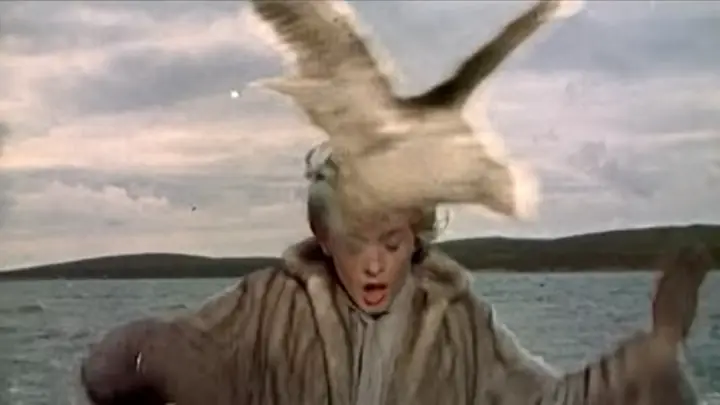
The Birds (1963): Melanie Daniels in a fur coat and a flying gullImage: Wikimedia Commons · Trailer screenshot, Public domain - #002
In the film, Mrs. Bundy refers to the Archaeopteryx as the oldest known bird. It was a bird-like dinosaur of the Late Jurassic era, living around 150 million years ago. Though it was considered the earliest bird during the 19th and 20th centuries, 21st-century discoveries identified even older bird-like dinosaurs (such as the Anchiornis).
- #003
In the film, Mrs. Bundy treats "crow" as a synonym for the bird species "Corvus brachyrhynchos". The term "crow" can actually be used for all species in the genus "Corvus". "Corvus brachyrhynchos" (translating to "short-billed crow") is commonly known as the "American crow". It is a species whose habitat covers most of the United States, Canada, northern Mexico, and various Caribbean islands.
- #004
Dinard, France, hosts a British Film Festival, with a Golden Hitchcock as the prize. There is also a statue of Sir Alfred Hitchcock (standing on what appears to be a very large egg, and with birds on each shoulder) near the beach in Dinard. The statue is moved down to the beach for the festival.
- #005
According to her dialogue, Cathy Brenner cannot distinguish whether her pet lovebirds are male or female. In real-life, determining the sex of a lovebird is difficult, since the physical and behavioral differences between males and females may be minor. The only certain method is DNA testing.
- #006
- #007
A subplot of the film is Melanie Daniels transporting lovebirds as a gift for Cathy Brenner. "Lovebird" is the common name for the 9 species of birds in the genus "Agapornis". The scientific name derives from the Greek terms "agape" ("love") and "ornis" ("bird" ). The Lovebirds are a type of Old World parrot, native to Africa. They have been named for their behavioral trait of monogamous pair bonding, and for the long periods which paired birds spend sitting together.
- #008
- #009
In the film, Mitch Brenner uses the Latin phrase "caveat emptor", which translates to "Let the buyer beware". The legal phrase typically means that the buyer can not recover damages from the seller, following the sale of defective property. There are exceptions to this rule if the sale involved intentional fraud, or if the law acknowledges an "implied warranty" concerning the sale of certain goods.
- #010
- #011
In the film, Mrs. Bundy treats "blackbird" as a synonym for the bird species "Euphagus cyanocephalus". That is the scientific name for "Brewer's blackbird", a medium-sized New World blackbird. They are native to the Western United States, but they migrate to the Southeastern United States and Mexico during the winter. They are a protected species in the United States, by the terms of the Migratory Bird Treaty Act of 1918.
- #012
- #013
- #014
- #015
Sir Alfred Hitchcock spotted Tippi Hedren in a commercial that aired during the Today (1952) show in 1961 and signed her to a contract. In the diet drink commercial, she is seen walking down the street and a man whistles at her slim, attractive figure, and the woman turns her head with an approving smile. The same thing happens in this film's opening scene as she walks toward the bird shop. It was an inside joke by Hitchcock.
- #016
Sir Alfred Hitchcock approached Joseph Stefano (screenwriter of Psycho (1960)) to write the screenplay, but he was not interested in the story. The final screenplay (from a short story by Daphne Du Maurier) was written by Evan Hunter, best known to mystery fans under the pen name Ed McBain.
- #017
- #018
- #019
- #020
- #021
Tippi Hedren's age was listed as 28 in press releases when the film was released, a fabrication hardly surprising given that 33 was considered old for a Hollywood star just breaking into acting. Until Hedren put an end to it by revealing her real age, the widely reported birth year would be 1935 for the next forty years.
- #022
The headline of the August 18, 1961 edition of the Santa Cruz Sentinel read "Seabird Invasion Hits Coastal Homes" and detailed how "millions" of migratory birds crashed into cars and buildings, broke television antennas and streetlights, and genuinely tried to enter homes. When residents went out at 3 a.m. to investigate, the birds flew toward the flashlight beams and drove the residents back into their homes. Although Hitchcock had optioned the DuMaurier story in 1955, he began making this film shortly after reading about the 1961 attack.
- #023
- #024
- #025
As the children run from in front of the school building toward the street, extra footage was shot on Universal's sound stages to make the scene even more frightening. Several of the children were brought back and placed in front of a process screen on a treadmill. As they ran on the treadmill in front of the screen with footage of Bodega Bay behind them, real and fake crows attacked them. There were three rows of children, and when the treadmill sped up it ran very fast. Several times some of the children in front fell, causing the children behind them to fall as well. It was a very difficult scene to shoot and took several days to fix. The birds used were mechanical hand puppets, and a few were trained live birds.
- #026
- #027
- #028
Most of the birds in the large long shots were fake. For example, the birds on the swing set in the school building ambush scene, according to a recent interview with Veronica Cartwright (Cathy Brenner), were made of paper, fabric or dolls, along with one or two real props scattered there to fool you.
- #029
The crow perched on Alfred Hitchcock's shoulder in all the promotional photos was not in the film. It was purchased after filming ended. A studio employee saw the tame bird on the shoulder of a twelve-year-old boy walking down the street and bought it. The boy was offered about ten dollars, but he hesitated until he understood why it was needed.
- #030
Apart from the bird sounds Oskar Sala created on the mixtrautonium, an early electronic musical instrument, Tippi Hedren's performance of Debussy's Two Arabesques on the piano (about 35 minutes) and the children singing Risseldy Rosseldy a cappella at school, this film has no musical score.
- #031
- #032
Production Story (149)
- #033
- #034
- #035
- #036
There is no musical score for this movie except for the bird sounds created on the mixtrautonium, an early electronic musical instrument, by Oskar Sala, Tippi Hedron playing Debussy's Two Arabesques on the piano (at about 35 min), and the children singing Risseldy Rosseldy (a cappella) in the school.
- #037
- #038
- #039
This was not the first dramatization of Daphne Du Maurier's short story. It was previously adapted for radio at least twice, once starring Herbert Marshall, and again in 1954. Furthermore, it was adapted by writer James P. Cavanagh for a half-hour episode of the television series Danger (1950). Cavanaugh also wrote at least five episodes of Alfred Hitchcock Presents (1955), including two directed by Sir Alfred Hitchcock, and was the first writer to adapt Robert Bloch's novel of "Psycho" for Hitchcock's production. However, his script was jettisoned in favor of the Joseph Stefano adaptation.
- #040
- #041
- #042
- #043
- #044
- #045
The film is based on the 1952 horror short story "The Birds" by Daphne du Maurier, an author known primarily for writing "moody" Gothic fiction and so-called "Weird fiction" (tales suggesting paranormal influences). According to du Maurier, she wrote the story after witnessing a farmer being attacked by a flock of gulls.
- #046
- #047
The headline in the August 18, 1961 edition of the Santa Cruz Sentinel screamed "Seabird Invasion Hits Coastal Homes" and detailed how "millions" of migrating birds crashed into cars and buildings, broke television antennas, streetlights, and actually tried to enter houses. When residents went outdoors at 3 a.m. to investigate, the birds flew at the flashlight beams and drove residents back into their houses. Although Hitchcock had optioned the DuMaurier story in 1955, he began filming this movie shortly after reading about the 1961 attack.
- #048
- #049
- #050
- #051
Sir Alfred Hitchcock approached Joseph Stefano (screenwriter of Psycho (1960)) to write the script, but he wasn't interested in the story. The final screenplay (from a Daphne Du Maurier short story) was written by Evan Hunter, best known to detective story fans under the pen name Ed McBain.
- #052
Originally, a scene took place between Melanie and Mitch after Lydia Brenner left for the Fawcett farm. This scene was shot, but ultimately cut from the movie. All that survived are the script pages and some production photographs. The script pages and photographs appear as a bonus feature on the DVD.
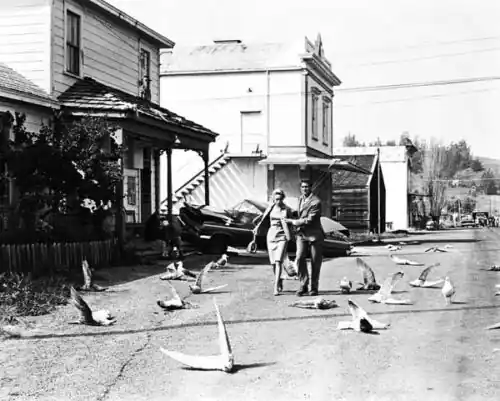
The Birds (1963): Melanie Daniels and Mitch Brenner in a street full of birdsImage: Wikimedia Commons · Alfred J. Hitchcock Productions, Universal Pictures, Public domain - #053
- #054
- #055
- #056
Suzanne Pleshette wanted to play Melanie, but settled for the role of Annie just to get to work with Sir Alfred Hitchcock. The part was originally written as a middle-aged schoolteacher who just lived in the community, but Hitchcock revised the script specifically for Pleshette, making the character much younger and adding backstory and depth. Hitchcock enjoyed her so much that he asked her to play Sean Connery's sister-in-law in his next film Marnie (1964). Pleshette, who thought of herself as a leading lady rather than in supporting roles, quipped, "Is the sister's name 'Marnie'? I don't think so! I don't think that's the lead!"
- #057
According to Tippi Hedren, she signed a seven year contract with Sir Alfred Hitchcock to work on this movie before she even met him. She thought he meant to feature her in his television show, but he flew in Martin Balsam to do screentests of her in scenes from Rebecca (1940), Notorious (1946), and To Catch a Thief (1955).
- #058
This picture was a departure from Hitchcock's usual suspense film. He recognized it as a horror film. He said, "I was interested in making the film because it was a horror film - horror coming from a different quarter. It wasn't science fiction at all. I treated the subject naturally and quite straightforwardly."
- #059
- #060
- #061
The film is based on a highly pessimistic horror short story, "The Birds" by Daphne du Maurier. In the original short story, Nat Hocken (the protagonist) eventually realizes that he is the sole survivor of the bird attacks in Cornwall, and that he is unlikely to survive the next attack. His reaction is to smoke his last cigarette, and calmly wait for his inevitable death.
- #062
- #063
- #064
In Northern Monterey Bay in Northern California in 1961, the region found itself inundated with crazed birds. They flew into buildings, seemed disoriented, and the ground was littered with their carcasses. Alfred Hitchcock heard of this "attack" when he was developing this movie, and incorporated much of this incident in his film. The same region experienced the same problem in 1991. Turns out that single celled algae will occasionally become toxic. It works its way up the food chain to the fish that the sea birds eat. None of the other animals are bothered by this toxin, but it has a devastating effect on birds. It causes disorientation, seizures and even death. The dead birds in 1961 weren't tested, but a lab had a sample of a small organism that fed on algae from 1961, so that specimen was tested. It was rife with the toxin.
- #065
- #066
Alfred Hitchcock's legendary attention to detail was evident during research and preparation for this movie. He had every resident of Bodega Bay photographed for the costume department. The restaurant scenes were filmed inside an exact reconstruction of the real one in the seaside village. The interior of Dan Fawcett's farmhouse was also an exact replica of a nearby farm. Hitchcock also sent a camera crew to the San Francisco landfill to film seagulls diving, perching, and feeding so he would obtain the most realistic results for the bird attacks and build-ups in the movie.
- #067
- #068
Mitch Zanich, owner of the Tides Restaurant at the time of shooting, told Alfred Hitchcock he could shoot there if the lead male in the movie was named after him, and Hitchcock gave him a speaking part in the movie. Hitchcock agreed: Rod Taylor's character was named Mitch Brenner, and Mitch Zanich was given a speaking part. After Melanie is attacked by a seagull, Mitch Zanich can be heard saying to Mitch Brenner, "What happened, Mitch?"
- #069
- #070
- #071
This movie and the original story by Daphne Du Maurier share no characters, and in fact have only in common the bayside town setting, the birds' bizarre behavior, their inexplicable tendency to launch frenzied attacks then fall dormant, only to attack again later, and of course the title. In Du Maurier's story, the main character discovers that this pattern is directly related to the rise and fall of the tides and uses this to their advantage, as opposed to this movie, which seems to follow the same pattern, but never makes a direct connection. Also, the original story takes place in Britain, and centers around a man protecting his wife and two children at their isolated cottage, as opposed to this movie, which centered on the spirited but troubled city dweller Melanie Daniels, who travelled to the California coast on a whim.
- #072
Screenwriter Evan Hunter, a.k.a. Ed McBain, wrote a short book called "Me and Hitch" about his successful collaboration with Hitchcock on this movie, and his "not so much" experience with Hitchcock on their next movie, Marnie (1964). The book is no longer in print, but available as an e-book.
- #073
The song Annie's pupils are singing in the school house, while Melanie watches the birds gathering their ranks in the playground, waiting to ambush them, is "Risseldy Rosseldy". It's an old Mother Goose nonsense rhyme song that kids have been singing for decades. Hitchcock uses this music to build suspense, because, in part, he makes the decision early on not to use any conventional symphonic background music in the score; because he wants to establish an aura of brutal unvarnished realism for the murder scenes; the attack scenes; and all the disasters that go on. Without conventional music he has to use devices like the school children singing to build suspense. The lyrics of this traditional nursery rhyme/hymn go like this: "I married my wife In the month of June, Risseldy, rosseldy, Mow, mow, mow, I carried her off In a silver spoon, Risseldy, Rosseldy, Hey bambassity, Nickety, nackety, Retrical quality, Willowby, wallowby, Mow, mow, mow."
- #074
- #075
- #076
- #077
During shooting, Mitch Zanich, the owner of Tides Restaurant, told Hitchcock that he could use the location on the condition that the male lead be given his name. Hitchcock agreed: Rod Taylor's character became Mitch Brenner, and Mitch Zanich was given a speaking role. After Melanie is attacked by a gull, Mitch Zanich can be heard saying to Mitch Brenner, "What happened, Mitch?"
- #078
The headline of the Santa Cruz Sentinel of August 18, 1961, proclaimed "Seabird Invasion Hits Coastal Homes" and described "millions" of migratory birds striking cars and buildings, breaking television antennas and streetlights, and trying to enter houses. Although Hitchcock had acquired the rights to DuMaurier's story in 1955, he began shooting the film immediately after reading about this 1961 attack.
- #079
- #080
The film and Daphne Du Maurier's original story share no characters; only the setting of a town on the bay, the strange behavior of the birds, their inexplicable frenzied attacks followed by calm, and of course the title are common to both. In Du Maurier's story, the main character discovers that this cycle is directly linked to the tides and turns it to his advantage, while the film follows the same cycle but never establishes a direct connection. The original story also takes place in Britain and concerns a man protecting his wife and two children in their isolated cottage, whereas the film focuses on Melanie Daniels, a lively but troubled city woman who impulsively travels to the California coast.
- #081
In 1961, the North Monterey Bay area of Northern California was overrun with birds gone mad. Birds were striking buildings, appearing disoriented, and the ground was covered with their carcasses. Hitchcock heard about this "attack" while developing the film and incorporated much of the event into it. The same region experienced the same problem in 1991. It turned out that single-celled algae occasionally become toxic, and this toxin reaches fish through the food chain, which seabirds eat. While other animals are unaffected, in birds it causes disorientation, seizures and death. The dead birds from 1961 were not tested, but there was a sample in the laboratory of a small organism from 1961 that fed on the algae; when tested, it was found to be full of the toxin.
- #082
- #083
- #084
Screenwriter Evan Hunter, also known as Ed McBain, wrote a short book titled "Me and Hitch," in which he recounted his successful collaboration with Hitchcock on this film and his less than brilliant experience on their next film, Marnie. Although the book is out of print, it can be found as an e-book.
- #085
- #086
- #087
The film is based on Daphne du Maurier's extremely bleak horror story "The Birds." In the original story, the protagonist Nat Hocken realizes that he is the only survivor of the bird attacks in Cornwall and that he will not survive the next one. His response is to smoke his last cigarette and calmly await his inevitable death.
- #088
- #089
- #090
- #091
This production was a departure from Hitchcock's usual thrillers. He himself regarded it as a horror film: "I was interested in making the film because it was a horror film – horror from a different source. It was not science fiction at all. I treated the subject in a natural and quite straightforward way."
- #092
- #093
This was not the first dramatization of Daphne Du Maurier's short story. It had previously been adapted for radio at least twice; Herbert Marshall starred in one, and the other was made in 1954. It was also adapted by the writer James P. Cavanagh for a half-hour episode of the television series Danger. Cavanaugh also wrote at least five episodes for Alfred Hitchcock Presents; Hitchcock himself directed two of them, and he was the writer who first adapted Robert Bloch's novel "Psycho" for Hitchcock's production. However, his screenplay was shelved in favor of Joseph Stefano's adaptation.
- #094
- #095
- #096
- #097
- #098
- #099
- #100
The classic scene in which Tippi Hedren watches the birds attacking the townspeople was shot in a telephone booth on a studio set. When Melanie opens the door of the booth, the gulls, which the trainers had taught to fly toward the door, came into play. Behind-the-scenes photographs of the scene were published in Bill Krohn's book 'Hitchcock at Work'.
- #101
- #102
Additional shots were made at Universal studios to make the scene of the children running through the street after fleeing school more frightening. Several children were called back and made to run on a treadmill in front of a screen onto which footage of Bodega Bay was projected, while real and fake crows attacked them. When the children in the front of the three rows lined up fell, those behind them also collapsed; the scene took several days to shoot. Most of the birds used were hand puppets or mechanical, and only a few were trained live birds.
- #103
- #104
The crow perched on Hitchcock's shoulder in the publicity photographs does not appear in the film. This tame bird was bought after filming ended. One of the studio employees bought it when he saw it on the shoulder of a twelve-year-old boy walking down the street. The boy was offered about ten dollars, but he would not agree to sell until he learned why the bird was wanted.
- #105
The standard blue screen technique became unusable for the matte shots of the birds. The rapid movement of the birds, especially their wings, caused excessive blue fringing in the frames. It was then determined that the sodium vapor process could be used for the compositing work. The only studio in America equipped for this process was Walt Disney, and the world's leading sodium vapor expert, Ub Iwerks, was assigned to this production.
- #106
Apart from the bird sounds Oskar Sala created with an early electronic instrument called the mixtrautonium, Tippi Hedren's piano performance of Debussy's Two Arabesques (at about the 35th minute) and the children's a cappella singing of 'Risseldy Rosseldy' at the school, no music was used in the film.
- #107
- #108
- #109
During the birthday party attack, pins were placed inside the gulls' beaks and their beaks were taped shut so they could burst the balloons. One of the gulls flew off with its beak taped; the trainers searched for it for hours because it would die if it could not open its beak. Their efforts paid off and they found the bird.
- #110
In the film, an explosion occurs at a gas station when the gasoline flowing from the hose in the hand of the attendant struck by a bird catches fire. This station stands opposite 'The Tides' restaurant and the pier. In reality there was no gas station there during filming; however, one was built a few years later and still stands at the spot seen in the film.
- #111
Hitchcock's legendary attention to detail showed itself during the research and preparation phase of this film as well. Everyone living in Bodega Bay was photographed for the costume department. The restaurant scenes were shot on an exact replica of the real location in the coastal village. The interior of Dan Fawcett's farmhouse was likewise an exact copy of a nearby farm. Hitchcock also sent a camera crew to the San Francisco dump to film gulls diving, perching and feeding.
- #112
- #113
- #114
The 'Risseldy Rosseldy' sung by the students at the school is a device Hitchcock used to build tension. Hitchcock had decided early on not to use traditional symphonic music, as he wanted to create an air of raw realism in the murder and attack scenes. The lyrics of the song are as follows: 'I married my wife In the month of June, Risseldy, rosseldy, Mow, mow, mow...'
- #115
According to Hedren's account, she was harassed by Hitchcock. For example, during the shooting of the final scene with the bird attack, Hitchcock had the scene repeated many times as real and wooden birds were thrown at her. One of the birds struck Hedren's eye, causing a retinal hemorrhage; the blood and wounds in the scenes were real. This treatment stemmed from Hedren's rejection of Hitchcock's sexual advances. However, Hitchcock's secretary Suzanne Gauthier said in a letter to a fan shortly after the film's release, 'Miss Hedren was not injured during the shooting, she only had to rest for three days because she was very tired in that scene.'
- #116
- #117
The Potter School in the film is actually in the small town of Bodega, 8 km from Bodega Bay. Hitchcock resorted to cinematic tricks to combine the locations. The panoramic view in which the school appears in the background as Melanie takes the boat to the Brenners' is actually a matte painting.
- #118
- #119
- #120
- #121
- #122
Alfred Hitchcock saw Tippi Hedren in a diet drink commercial broadcast on the Today (1952) program in 1961 and signed her immediately. In the commercial, a man whistles at the slim and attractive woman walking down the street, and she turns her head with a smile. In the film's opening scene, the same thing happens as she walks toward the bird shop; this is a private joke of Hitchcock's.
- #123
The bird named Archine seemed to genuinely dislike Rod Taylor, who played Mitch Brenner. The feathered star would look for opportunities to attack the actor even when the cameras were not rolling. Taylor admitted, 'If we were together on the set every morning, it would come and bite me,' 'I hated it, and it hated me.'
- #124
When the film was released, Tippi Hedren's age was listed as 28 in press releases; this was an unsurprising fabrication for a Hollywood star just starting her acting career, considering that 33 was considered especially old. For the next forty years, the widely reported birth year was 1935, until Hedren put an end to it by revealing her real age.
- #125
- #126
For the scene in which Annie (Suzanne Pleshette) is killed, Pleshette told Hitchcock that it would be good for her ear to look bloody and drooping; Hitchcock then sent her to the props department. When it came time to shoot, Hitchcock positioned Annie so that she was looking the other way, so the audience never saw the ear; Pleshette recalls that this was 'part of his delicious sense of humor.'
- #127
- #128
- #129
According to Tippi Hedren, before meeting Alfred Hitchcock, she signed a seven-year contract to work on this film. She thought he was considering having her appear on the television program, but Hitchcock brought in Martin Balsam for her to do screen tests with scenes from Rebecca (1940), Notorious (1946) and To Catch a Thief (1955).
- #130
Suzanne Pleshette wanted to play the role of Melanie, but agreed to the role of Annie just to be able to work with Alfred Hitchcock. The role was originally written as a middle-aged teacher living in the community, but Hitchcock revised the script specifically for Pleshette, making the character much younger and adding depth. Hitchcock enjoyed her so much that he wanted her to play Sean Connery's sister-in-law in his next film, Marnie (1964). Pleshette, who saw herself as a leading actress rather than a supporting player, joked, 'Is the sister's name Marnie? I don't think so! I don't think she's the lead!'
- #131
- #132
Two versions of the scene in which Melanie brings Lydia tea in bed were shot. In the first, Alfred Hitchcock instructed Tippi Hedren to play the scene very irritably. When they watched it in the screening room, Jessica Tandy did not like it, so the set was rebuilt and the scene was shot again with Hedren playing it more affectionately.
- #133
Some viewers found the age gap between Mitch and Cathy unrealistic for two biological siblings. But this scenario is entirely possible, because their mother is played by Jessica Tandy; her character would have been 20 when she gave birth to Rod Taylor and 39 when she gave birth to Veronica Cartwright 19 years later. (A 19-year gap is hardly a stretch; the youngest mother is 5 and the oldest is 74, and the average fertility range is 12-50, meaning biological siblings can be born decades apart.)
- #134
- #135
On March 29, 2023, the 60th anniversary of the film's release, only 2 of the 18 actors credited in the film were still alive. Lead actress Tippi Hedren was 32 during the March-July 1962 shoot and had reached the age of 93. Veronica Cartwright, who played Cathy Brenner, had turned 13 in April 1962, midway through filming, and was 72.
- #136
Jessica Tandy, who plays Mitch's mother in The Birds, married Hume Cronyn one year before he appeared in a supporting role in Hitchcock's 1943 film Shadow of a Doubt (1943). When The Birds was released 20 years later, they were still married, making them the only married couple to appear in Hitchcock films.
- #137
Although their characters barely interact here, this production is the second of three films starring Rod Taylor and Suzanne Pleshette together. A few years earlier, they had played love interests in the Lesson in Fear (1961) episode of Taylor's series Hong Kong (1960), and a year later both appeared in Fate Is the Hunter (1964).
- #138
Doreen Lang plays a panicked woman in the diner scene; she hysterically and mistakenly blames Tippi Hedren's character for the bird attacks on the Bodega Bay community. Years earlier, Lang had played a tense secretary in another Hitchcock film, The Wrong Man (1956), who mistakenly accuses Henry Fonda's character after having previously been victimized by a lookalike robber.
- #139
Doodles Weaver (the fisherman who helps Melanie with the rental boat) was Sigourney Weaver's uncle; Sigourney worked with Veronica Cartwright on Alien (1979) and with Tippi Hedren's daughter Melanie Griffith on Working Girl (1988). Griffith, in turn, starred alongside Suzanne Pleshette in The Star Maker (1981).
- #140
- #141
- #142
- #143
- #144
- #145
- #146
- #147
- #148
- #149
During filming, the owner of Tides Restaurant, Mitch Zanich, told Hitchcock that he could use the location on the condition that the male lead be given his name. Hitchcock agreed: Rod Taylor's character became Mitch Brenner, and Mitch Zanich was given a speaking role. After Melanie is attacked by a gull, Mitch Zanich can be heard saying to Mitch Brenner, "What happened, Mitch?"
- #150
The Santa Cruz Sentinel headline of 18 August 1961 proclaimed "Seabird Invasion Hits Coastal Homes" and described "millions" of migratory birds striking cars and buildings, breaking television antennas and streetlights, and trying to enter houses. Although Hitchcock had acquired the rights to Du Maurier's story in 1955, he began making the film immediately after reading about this 1961 attack.
- #151
- #152
The film and Daphne Du Maurier's original story share no characters; only the setting of a town on a bay shore, the strange behaviour of the birds, their inexplicable frenzied attacks followed by calm, and of course the title are common to both. In Du Maurier's story, the protagonist discovers that this cycle is directly linked to the tides and turns it to his advantage, whereas the film follows the same cycle but never establishes a direct connection. The original story also takes place in Britain and concerns a man protecting his wife and two children in their isolated cottage, while the film focuses on Melanie Daniels, a lively but troubled city woman who impulsively travels to the California coast.
- #153
In 1961, North Monterey Bay in Northern California was overrun with birds gone berserk. Birds struck buildings, appeared disoriented, and the ground was covered with their carcasses. Hitchcock heard about this "invasion" while developing the film and incorporated much of the event into it. The same region experienced the same problem in 1991. It turned out that single-celled algae occasionally become toxic, and this toxin travels up the food chain to fish eaten by seabirds. While other animals are unaffected, in birds it causes disorientation, seizures and death. The dead birds of 1961 were not tested, but a laboratory held a sample from 1961 of a small organism that fed on the algae; when tested, it was found to be full of the toxin.
- #154
- #155
- #156
- #157
The film is based on Daphne du Maurier's deeply bleak horror story "The Birds". In the original story, the protagonist Nat Hocken realises he is the only survivor of the bird attacks in Cornwall and that he will not survive the next one. His response is to smoke his last cigarette and calmly await his inevitable death.
- #158
- #159
- #160
The production was a departure from Hitchcock's usual thrillers. He regarded it as a horror film: "I was interested in making the film because it was a horror film – horror from a different source. It was not science fiction at all. I treated the subject in a natural and quite straightforward way."
- #161
- #162
This was not the first dramatisation of Daphne Du Maurier's short story. It had been adapted for radio at least twice before; Herbert Marshall starred in one, and the other was made in 1954. It was also adapted by the writer James P. Cavanagh for a half-hour episode of the television series Danger. Cavanagh also wrote at least five episodes for Alfred Hitchcock Presents, two of which Hitchcock himself directed, and he was the first writer to adapt Robert Bloch's novel "Psycho" for Hitchcock's production. However, his screenplay was shelved in favour of Joseph Stefano's adaptation.
- #163
- #164
- #165
At around the twenty-ninth minute, as Melanie Daniels presses cotton to her wound, the position of her hand and arm forms the silhouette of a bird; the ring on her little finger resembles the bird's eye. Tippi Hedren confirmed that Hitchcock placed such subtle meanings about the impending bird attack throughout the film.
- #166
Although the film never explains why the birds attack, the trailer offers an important clue: in his usual idiosyncratic style, Hitchcock delivers a 'lecture' on the relationship between birds and humanity. He lists countless examples, from cave paintings to the mistreatment of chickens on farms to duck hunting; the implication is that indifference and cruelty toward nature come at a price.
- #167
- #168
By offering no rational explanation for the birds' behavior, Hitchcock knew how to create a far greater anxiety in the audience. His aim was to evoke a universal sense of fear, chaos and helplessness; for this reason he also removed the classic 'The End' title at the film's conclusion, ensuring the unease continued after the cinema release.
- #169
- #170
- #171
A subplot of the film involves Melanie bringing a lovebird to Cathy Brenner as a gift. 'Lovebird' is the common name for nine species in the genus Agapornis; the scientific name comes from the Greek words 'agape' (love) and 'ornis' (bird). These Old World parrots of African origin are known for their monogamous pair bonds and the behavior of pairs sitting side by side for long periods.
- #172
Hitchcock's films are known for their strong scripts, in which the director participated to varying degrees. In this story, Mitch begins as a somewhat conceited lawyer and gradually becomes a caring, brave and responsible person. Melanie evolves from a spoiled, rich girl into a mature person who shows affection even to Lydia, who treats her coldly. Lydia undergoes the greatest change; from a weak, possessive and threatened woman she becomes strong, accepting and compassionate. Annie, though she appears unhappy and somewhat jealous, proves self-sacrificing enough to give her life for the children when the moment comes.
- #173
Throughout the film, Hitchcock repeatedly uses pale green and reddish orange to echo the colors of the lovebirds Tippi Hedren brings. First Hedren's dress and lipstick, then the school's shutters and Suzanne Pleshette's red sweater, the green of Mitch's truck, the green sign of the Tides Restaurant and finally the green dress she wears while making tea... Just then, as Rod Taylor approaches from behind and kisses her, a reddish-orange vase appears behind the sink. At that moment, they too become a pair of 'lovebirds.' Years later, after a chance encounter with Tippi Hedren in Hollywood, American actress and screenwriter Beau Dare used this theme in a 2023 screenplay as a tribute to Hitchcock.
- #174
In the film, Mrs. Bundy mentions Archaeopteryx as the oldest known bird. This bird-like dinosaur, which lived in the Late Jurassic period about 150 million years ago, was accepted as the first bird in the 19th and 20th centuries, but in the 21st century older bird-like species such as Anchiornis have been discovered.
- #175
- #176
Melanie notes the license plate of Mitch's departing car and calls her father's newspaper to have his address traced. The California Department of Motor Vehicles no longer fulfills such requests, after actress Rebecca Schaeffer was killed in 1989 by an obsessed fan who obtained her address through a private detective.
- #177
- #178
In the film, Mrs. Bundy uses the word 'crow' as a synonym for the species Corvus brachyrhynchos. However, the term 'crow' covers all species in the genus Corvus. Corvus brachyrhynchos, meaning 'short-billed crow', is commonly known as the American crow and lives across much of the United States, in Canada, in northern Mexico and on various islands in the Caribbean.
- #179
- #180
In the film, Mitch Brenner uses the Latin legal term 'caveat emptor', meaning 'let the buyer beware'. Although this principle holds that a buyer cannot seek compensation from the seller after the sale of defective goods, exceptions apply in cases of deliberate fraud or legal 'implied warranty'.
- #181
Behind the Scenes (90)
- #182
- #183
- #184
Two versions of the scene where Melanie brings Lydia tea in bed were filmed. For the first, Sir Alfred Hitchcock instructed Tippi Hedren to play it in a very shrewish manner. This didn't sit well with Jessica Tandy when they watched it in the screening room, so the set was reassembled and they re-shot the scene with Hedren acting in a more compassionate way.
- #185
- #186
- #187
- #188
The use of standard bluescreen techniques for doing matte shots of the birds proved to be unacceptable. The rapid movement of the birds, especially their wings, caused excessive blue fringing in the shots. It was determined that the sodium vapor process could be used to do the composites. The only studio in America that was equipped for this process was the Walt Disney studio. Ub Iwerks, who had become the world's leading expert on the sodium vapor process, was assigned to this production.
- #189
- #190
- #191
The audio special effects included the use of spring and plate reverb units, as well as an Echoplex - an endless loop tape recorder with a fixed record head and a playback head that slides on a rail. This arrangement of record and playback heads creates an echo that can be time-adjusted. By turning up the record volume you can create an echo that repeats endlessly. Typically this would only be used for limited lengths of time because the hiss from the magnetic tape would build up to the point of creating a whirling wind-like sound. In order to create the density of bird sounds without amplifying the wind effect, they used a separate recorder and many takes from the Echoplex, layering the result while adding other types of bird sounds to produce the final result. There are a few moments at the end of an attack that the bird sounds drop in pitch and speed. This is created by sliding the playback head away from the record head. In some rock recordings in the 1970s this was used for UFO sounds.
- #192
During the birthday party attack, in order to ensure that the gulls could pop the balloons, pins were placed inside the birds' mouths and their beaks were taped closed. One of the gulls, with its mouth still taped, flew away, and the trainers spent hours looking for it because it would've died if it couldn't open its mouth. Their efforts paid off, and they found the bird.
- #193
The main setting of the film is Bodega Bay, California. It is a real-life village in Sonoma County, California, named after the nearby shallow, rocky inlet of Bodega Bay. The inlet is located about 40 miles (60 kilometers) northwest of San Francisco and 20 miles (32 kilometers) west of Santa Rosa.
- #194
The schoolhouse in the movie, Potter schoolhouse, is actually in the small town of Bodega, 5 miles from Bodega Bay. Alfred Hitchcock used some movie magic to combine the locations. In the scene where Melanie is driving the boat to the Brenner's and we see a panoramic view of Bodega Bay with the schoolhouse in the background, that is actually a scenic matte painting.
- #195
The crow that sits on Alfred Hitchcock's shoulder in all of the promotional photos was not in the movie. It was purchased after the movie had wrapped. A studio staff member bought it when he spotted the tamed bird on the shoulder of a twelve-year-old boy walking down the street. The boy was offered around ten dollars, but was hesitant until he discovered why it was needed.
- #196
(May 26, 2012) The green suit worn by Tippi Hedren in this movie was showcased at Ireland's "Museum of Style Icons" in Newbridge (Co. Kildare) as part of the permanent collection at the center. In Ireland for the first time, Hedren made a personal appearance at the event for the special occasion.
- #197
- #198
One bird, named Archine, really seemed to dislike Taylor, who played Mitch Brenner. The feathered star went out of his way to attack the actor, even when the cameras weren't rolling. "Every morning, if we were on the set together, he'd come over and bite me," Taylor revealed, "I hated him and he hated me."
- #199
- #200
When the children are running down the street from the schoolhouse, extra footage was shot back on the Universal soundstages to make the scene more terrifying. A few of the children were brought back and put in front of a process screen on a treadmill. They ran in front of the screen on the treadmill with the Bodega Bay footage behind them while a combination of real and fake crows were attacking them. There were three rows of children, and when the treadmill was brought up to speed, it ran very fast. On a couple of occasions, several of the children in the front fell and caused the children in the back to fall as well. It was a very difficult scene to shoot, and took a few days to get it right. The birds used were hand puppets, mechanical, and a couple were trained live birds.
- #201
- #202
In this movie, it appears as if the schoolhouse is within the bay town limits. The frightened children are clearly shown running downhill toward the town and the water. In real life, the schoolhouse used for those shots is located five miles southeast, and inland of Bodega Bay in the separate town of Bodega, California. However, since this is a fictional story, its geography doesn't have to match reality.
- #203
- #204
The schoolhouse in Bodega, California has been known to be haunted, even back during filming. According to Tippi Hedren, the entire cast was spooked to be there. She also mentioned how she had the feeling while there that "the building was immensely populated, but there was nobody there." When Alfred Hitchcock was told about the schoolhouse being haunted, according to Hedren, he was even more encouraged to film there.
- #205
- #206
The classic scene in which Tippi Hedren watches birds attacking the townsfolk was filmed in the studio from a phone booth. When Melanie opens the phone-booth door, a bird trainer had trained gulls that were taught to fly at it. Surviving photos of the shooting of the scene were published in the book "Hitchcock at Work" by Bill Krohn.
- #207
- #208
- #209
Contains a major spoiler — show
Near the end of the movie, when Mitch carries Melanie down the stairs, it is actually Tippi Hedren's stand-in being carried by Rod Taylor. Hedren was in the hospital recovering from exhaustion after a week of shooting the scene where Melanie is trapped in the upstairs room with the birds.
- #210
Contains a major spoiler — show
The climactic scene, in which Melanie (Tippi Hedren) is attacked in the bedroom, took seven days to shoot. Hedren said, "It was the worst week of my life." The physical and emotional tolls of filming this scene were so strong on her that production was shut down for a week afterwards and Hedren ended up in the hospital.
- #211
- #212
Contains a major spoiler — show
When Lydia goes to Dan Fawcett's house and suddenly discovers his dead body, eyes pecked out by murderous birds, Hitchcock first gives the audience a semi-long shot view of the body, followed quickly by a semi-closeup, followed quickly by an extreme closeup, all in a matter of a few seconds. This cinematic device was first used by director James Whale in the film Frankenstein (1931) as the audience gets its first look at the monster.
- #213
Contains a major spoiler — show
Allegedly, according to Hedren she was the victim of harassment by Hitchcock. For example, during the recording of the last scene in which the birds attack, Hitchcock forced her to replay the scene numerous times while real and wooden birds were thrown at her. One of them hit Hedren's eye, causing a retinal bleed. The blood and injuries with which the actress appears in the scenes are real. The dislike with which Hitchcock made Hedren work stemmed from Hedren's refusal of the director's sexual advances. After the scene, Hedren was so exhausted that she sat in the middle of the set and began to cry. She had to be taken to the emergency room. However, according to Hitchcock's secretary Suzanne Gauthier (in regards to a fan enquiry) on May 15th 1963, shortly after the film was released, "Miss Hedren was not injured in the shooting of the picture, however she had to take a three day rest after working so strenuously during that sequence."
- #214
- #215
Contains a major spoiler — show
For the scene in which Annie (Suzanne Pleshette) is killed, Pleshette told Sir Alfred Hitchcock it would look good if her ear was all bloody and hanging off, so he sent her to the Prop Department. When it came to shooting the scene, Hitchcock had Annie facing the other way, so the viewer never sees the ear, which Pleshette recalled "was part of his delicious sense of humor."
- #216
Contains a major spoiler — show
A scene in the movie shows a service station where a bird knocks over an attendant filling a car with gas. The gas flows across the street where a man lighting his cigar proceeds to drop the match igniting the gas. The fire follows the gas stream back to the pump and explodes. The service station was located across from "The Tides" restaurant and pier. In reality, this service station did not exist at the time of filming. However, several years later, a service station was built, and is still located at the spot shown in the movie.
- #217
Standard blue-screen techniques proved unacceptable for shooting the matte work on The Birds. The rapid movement of the birds' wings in particular caused excessive blue fringing in the shots. It was determined that the sodium vapor process could be used to create the composites. The only studio in America equipped for this process was the Walt Disney studio, and Ub Iwerks, who became the world's leading expert on the sodium vapor process, was assigned to the production.
- #218
- #219
- #220
- #221
- #222
- #223
- #224
The classic scene in which Tippi Hedren watches the birds attacking the townspeople was shot in a telephone booth on the studio lot. When Melanie opens the door of the booth, the gulls, which the trainers had taught to fly towards the door, came into play. Behind-the-scenes photographs of the scene were published in Bill Krohn's book 'Hitchcock at Work'.
- #225
- #226
- #227
Additional shots were filmed at Universal Studios to make the scene of the children running through the street after fleeing school more frightening. Several children were called back and made to run on a treadmill in front of a screen onto which footage of Bodega Bay was projected, while real and fake crows attacked them. When the children in the front of the three rows fell, those behind them also collapsed; the scene took several days to shoot. Most of the birds used were hand puppets or mechanical, with only a few trained live birds.
- #228
The school building in Bodega was said to be haunted even during filming. According to Tippi Hedren, the whole crew was afraid to be there. Hedren said that while she was in the building she had the feeling that 'it was as if it were extremely crowded inside, but there was no one there.' When Hitchcock was told the school was haunted, according to Hedren, he became even more eager to shoot there.
- #229
- #230
- #231
- #232
The crow perched on Hitchcock's shoulder in the publicity photographs does not appear in the film. This tame bird was bought after filming ended. One of the studio employees bought it after seeing it on the shoulder of a twelve-year-old boy walking down the street. The boy was offered about ten dollars, but he refused to sell until he learned why the bird was wanted.
- #233
The standard blue-screen technique became unusable for the matte shots of the birds. The rapid movement of the birds, especially their wings, caused excessive blue fringing in the frames. It was therefore determined that the sodium vapour process could be used for the compositing work. The only studio in America equipped for this process was Walt Disney, and Ub Iwerks, the world's leading sodium vapour expert, was assigned to the production.
- #234
Apart from the bird sounds created by Oskar Sala on an early electronic instrument called the mixtrautonium, Debussy's Two Arabesques played by Tippi Hedren on the piano (at about the 35th minute) and 'Risseldy Rosseldy' sung a cappella by the children at the school, no music was used in the film.
- #235
- #236
- #237
- #238
During the birthday party attack, pins were placed inside the gulls' beaks and their beaks taped shut so that they could burst the balloons. One of the gulls flew off with its beak taped shut; the trainers searched for it for hours because it would die if it could not open its beak. Their efforts paid off and they found the bird.
- #239
- #240
In the film, an explosion occurs at a petrol station when the petrol flowing from the hose held by the attendant, who is struck by a bird, catches fire. This station stands opposite 'The Tides' restaurant and the pier. In reality there was no petrol station there during filming; however, one was built a few years later and still stands at the spot seen in the film.
- #241
- #242
When Lydia enters Dan Fawcett's house and finds his body with the eyes pecked out, Hitchcock first presents a medium-wide shot, immediately followed by a medium close-up and then an extreme close-up, offering three different angles within a few seconds. This cinematic technique was first used by James Whale in Frankenstein (1931), in the scene where the monster first appears.
- #243
- #244
- #245
Hitchcock's legendary attention to detail showed itself during the research and preparation phase of this film as well. Everyone living in Bodega Bay was photographed for the costume department. The restaurant scenes were shot in an exact replica of the real location in the coastal village. The interior of Dan Fawcett's farmhouse was also an exact copy of a nearby farm. Hitchcock also sent a camera crew to the San Francisco dump to film gulls diving, perching and feeding.
- #246
- #247
- #248
- #249
- #250
- #251
- #252
For the sound effects, spring and plate reverb units were used, along with an Echoplex, a tape echo device with a fixed record head and a playback head sliding on a rail. By turning up the recording volume, an endlessly repeating echo could be created. However, to achieve the density of bird sounds without increasing the wind effect, many recordings were taken from the Echoplex with a separate recording device and layered, and other bird sounds were added. The moments at the ends of the attacks where the pitch and speed of the bird sounds drop were achieved by moving the playback head away from the record head.
- #253
The 'Risseldy Rosseldy' sung by the students at the school is a device Hitchcock used to build tension. Hitchcock had decided early on not to use traditional symphonic music because he wanted to create an air of raw realism in the murder and attack scenes. The lyrics of the song are as follows: 'I married my wife In the month of June, Risseldy, rosseldy, Mow, mow, mow...'
- #254
- #255
According to Hedren's account, she was harassed by Hitchcock. For example, during the shooting of the final scene with the bird attack, Hitchcock had the scene repeated many times as she was thrown at with real and wooden birds. One of the birds struck Hedren's eye, causing a retinal hemorrhage; the blood and wounds in the scenes were real. This treatment stemmed from Hedren's rejection of Hitchcock's sexual advances. However, Hitchcock's secretary Suzanne Gauthier said in a letter to a fan shortly after the film's release, 'Miss Hedren was not injured during the shooting, she merely had to rest for three days because she was very tired in that scene.'
- #256
- #257
- #258
- #259
- #260
In the film, the school appears to be within the boundaries of the bay town; the frightened children run downhill toward the town and the water. In reality, the school is in the inland town of Bodega, 8 km southeast of Bodega Bay. However, since it is a fictional story, the geography does not need to match reality.
- #261
- #262
- #263
- #264
- #265
- #266
- #267
- #268
- #269
- #270
- #271
Characters & Cast (42)
- #272
- #273
- #274
Some viewers found the age gap between Mitch and Cathy unrealistic for two full-blooded siblings. However, the scenario is totally feasible, since their mother is played by Jessica Tandy who would've been 20 years old when her character gave birth to Rod Taylor and 39 when she had Veronica Cartwright 19 years later. (A 19-year difference is hardly a stretch, with the youngest mother ever being 5 and the oldest being 74 (with the average fertility span being 12-50) which means full biological siblings can be decades apart.)
- #275
Though their characters barely interact here, this is the second of three filmed productions starring Rod Taylor and Suzanne Pleshette. A couple of years earlier, they played love interests in the episode Lesson in Fear (1961) of Taylor's series Hong Kong (1960), and a year later, both acted in the film Fate Is the Hunter (1964).
- #276
- #277
- #278
- #279
Alfred Hitchcock saw Tippi Hedren in a diet drink commercial broadcast on the Today (1952) program in 1961 and signed her immediately. In the commercial, a man whistles at the slim, attractive woman walking down the street, and she turns her head with a smile. In the film's opening scene, the same thing happens as she walks toward the bird shop; this is a private joke of Hitchcock's.
- #280
The bird named Archine seemed to genuinely dislike Rod Taylor, who played Mitch Brenner. Even when the cameras were not rolling, the feathered star would look for a chance to attack the actor. Taylor admitted, 'Every morning, if we were together on the set, he would come and bite me,' adding, 'I hated him, and he hated me.'
- #281
- #282
When the film was released, Tippi Hedren's age was listed as 28 in press releases; this was an unsurprising fabrication for a Hollywood star just starting her acting career, especially considering that 33 was regarded as particularly old. For the next forty years, the widely reported birth year was 1935, until Hedren put an end to it by disclosing her real age.
- #283
- #284
- #285
For the scene in which Annie (Suzanne Pleshette) is killed, Pleshette told Hitchcock that it would be good for her ear to look bloody and dangling; Hitchcock then sent her to the props department. When the time came to shoot, Hitchcock positioned Annie so that she was facing the other way, so the audience never saw the ear; Pleshette recalls that this was 'part of his delicious sense of humor.'
- #286
- #287
- #288
According to Tippi Hedren, before meeting Alfred Hitchcock she signed a seven-year contract to work on this film. She thought he was considering her for a television program, but Hitchcock brought in Martin Balsam to do screen tests with her in scenes from Rebecca (1940), Notorious (1946) and To Catch a Thief (1955).
- #289
- #290
Suzanne Pleshette wanted to play the role of Melanie, but she agreed to the role of Annie just to be able to work with Alfred Hitchcock. The role was originally written as a middle-aged teacher living in the community, but Hitchcock revised the script specifically for Pleshette, making the character much younger and adding depth. Hitchcock enjoyed her so much that he wanted her to play Sean Connery's sister-in-law in his next film, Marnie (1964). Pleshette, who saw herself as a leading actress rather than a supporting player, joked, 'Is the sister's name Marnie? I don't think so! I don't think she's the lead!'
- #291
- #292
- #293
Two versions of the scene in which Melanie brings Lydia tea in bed were shot. In the first, Alfred Hitchcock instructed Tippi Hedren to play the scene very sulkily. When they watched it in the screening room, Jessica Tandy did not like it, so the set was rebuilt and the scene was shot again with Hedren playing it more affectionately.
- #294
- #295
Some viewers found the age gap between Mitch and Cathy unrealistic for two biological siblings. However, this scenario is entirely possible, because their mother is played by Jessica Tandy; she would have been 20 when she gave birth to Rod Taylor's character and 39 when she gave birth to Veronica Cartwright 19 years later. (A 19-year gap is hardly a stretch; the youngest mother is 5 and the oldest is 74, and the average fertile range is 12-50, meaning biological siblings can be born decades apart.)
- #296
- #297
- #298
On March 29, 2023, the 60th anniversary of the film's release, only 2 of the 18 credited actors in the film were still alive. Lead actress Tippi Hedren was 32 during the shoot between March and July 1962 and had reached the age of 93. Veronica Cartwright, who played Cathy Brenner, turned 13 in April 1962, in the middle of the shoot, and was 72.
- #299
Jessica Tandy, who plays Mitch's mother in The Birds, married Hume Cronyn one year before he appeared in a supporting role in Hitchcock's Shadow of a Doubt (1943). They were still married when The Birds was released 20 years later, making them the only married couple to appear in Hitchcock films.
- #300
Although their characters barely interact here, this is the second of three films in which Rod Taylor and Suzanne Pleshette appeared together. A few years earlier they had played love interests in the Lesson in Fear (1961) episode of Taylor's series Hong Kong (1960), and a year later both appeared in Fate Is the Hunter (1964).
- #301
Doreen Lang plays a panicked woman in the diner scene; hysterically and mistakenly, she blames Tippi Hedren's character for the bird attacks on the Bodega Bay community. Years earlier, Lang had played a tense secretary in another Hitchcock film, The Wrong Man (1956), who wrongly accuses Henry Fonda's character of having previously victimized her as a lookalike robber.
- #302
Doodles Weaver (the fisherman who helps Melanie with the boat rental) was Sigourney Weaver's uncle; Sigourney worked with Veronica Cartwright on Alien (1979) and with Tippi Hedren's daughter Melanie Griffith on Working Girl (1988). Griffith, in turn, appeared alongside Suzanne Pleshette in The Star Maker (1981).
- #303
- #304
- #305
- #306
Tippi Hedren and Suzanne Pleshette both smoked in real life at the time. Hedren quit about five years after making this film, while Pleshette did not quit for another 35 years. As a result, Suzanne Pleshette died at the age of 70, whereas Tippi Hedren was still alive at 95 as of October 2025.
- #307
- #308
- #309
- #310
- #311
- #312
- #313
Easter Eggs & References (22)
- #314
- #315
- #316
- #317
- #318
- #319
- #320
- #321
- #322
- #323
- #324
- #325
- #326
- #327
Melanie notes Mitch's license plate number as he drives away, and then calls her father's newspaper to have someone obtain his address. The California DMV no longer complies with such a request, as actress Rebecca Schaeffer was murdered by an obsessed stalker in 1989 after he obtained her address by hiring a private investigator who contacted the DMV.
- #328
- #329
The speech of Mrs. Bundy «It is mankind, rather, who insists upon making it difficult for life to exist upon this planet» is included, in its Spanish original dubbed version, in the "Abriendo la puerta del mal" remix of the Fangoria and Lemon Fly version of "Cebras", the 1983 song by Alaska y Dinarama. The remix is included in Fangoria and Lemon Fly 1998 album "Vital".
- #330
- #331
Sir Alfred Hitchcock saw Tippi Hedren in a 1961 commercial aired during the Today (1952) show and put her under contract. In the commercial for a diet drink, she is seen walking down a street and a man whistles at her slim, attractive figure, and she turns her head with an acknowledging smile. In the opening scene of this movie, the same thing happens as she walks toward the bird shop. This was an inside joke by Hitchcock.
- #332
- #333
Contains a major spoiler — show
Doreen Lang plays a panicked woman in the diner scene who hysterically, and mistakenly, blames Tippi Hedren's character for the bird attacks on the Bodega Bay community. Years earlier, Lang appeared in another Hitchcock film, The Wrong Man (1956), playing a high-strung secretary who mistakenly blames Henry Fonda's character for her earlier victimization by a robber who resembles him.
- #334
- #335
Deeper Meaning (30)
- #336
Hitchcock deliberately omitted any rational explanation for the behavior of birds. He knew that this created much greater concern in the spectators, his purpose was only one: to instill fear, chaos and defenselessness in a universal way. He also deleted the classic "The End" at the end, to ensure that the public's discomfort continued even after the film was finished.
- #337
- #338
Hitchcock films are well known for good scripts, which he is known to have participated in the development of himself, to various degrees, depending on the movie. They tend to have strong character development, and most experts agree that well-written stories contain characters who evolve, either for good or bad, influenced by events, by circumstances, or by other characters. In this story, Mitch starts out as the slightly cocky lawyer who eventually shows he can be tender and caring, as well as brave and responsible. Melanie progresses from being the haughty, spoiled rich girl to kind and nurturing, even toward Lydia who's been unwelcoming toward her. Lydia herself perhaps transitions the most significantly; at first the weak, possessive, threatened woman, she becomes a strong, accepting, and compassionate person. Annie early on is a bit threatened, maybe jealous, and a not-so-happy or fulfilled woman, who nonetheless, when the moment calls for it, shows great caring toward children, even to the point of being self-sacrificing.
- #339
(At around twenty-nine minutes) Melanie Daniels (Tippi Hedren) holds the cotton ball against her wound. The way her hand and forearm are positioned makes the appearance of a bird and the ring on her pinky represents the eye. Tippi Hedren confirms this and said that Alfred Hitchcock wanted to put subtle meanings throughout this movie about the upcoming bird attack.
- #340
Contains a major spoiler — show
In the film Hitchcock uses the colors pale green and reddish orange many times to match the colors of the "lovebirds" that Tippi Hedren delivers to "Mitch" Rod Taylor. First, Hedren's dress and lipstick. Then the shutters on the schoolhouse behind Suzanne Pleshette in her red sweater, also, the green color of Mitch's truck parked in front of the barn, also the green sign on the "Tides Restaurant", and lastly, Tippi's green dress while she is making tea, as Rod Taylor steps up behind her, and as she turns and kisses him, a reddish, orange vase appears on the sink behind them. Of course at that moment, "they" become "lovebirds"... Years later, American actor/screenwriter Beau Dare, who once had a chance meeting with Tippi Hedren in Hollywood, also used this theme from the film, in one of his film scripts, (2023), as a tribute to Hitch.
- #341
Contains a major spoiler — show
While it is never revealed why the birds started attacking people, the film's trailer provides a clue: it features a typically deadpan Hitchcock providing insight into a forthcoming "lecture" of his about birds and their relationship with humanity. He then goes on to provide numerous examples of humanity's ill treatment of birds, including everything from violent cave drawings to the abuse of chickens on farms to duck hunting. The implication is that the birds are attacking due to humanity's indifference/cruelty towards nature.
- #342
(About twenty-nine minutes in) Melanie Daniels (Tippi Hedren) holds the cotton ball toward her wound. The position of her hand and forearm gives the appearance of a bird, and the ring on her little finger represents the eye. Tippi Hedren confirms this and said Alfred Hitchcock wanted to load the film with subtle meanings about the impending bird attack.
- #343
- #344
At roughly the twenty-ninth minute, as Melanie Daniels presses cotton to her wound, the position of her hand and arm forms the silhouette of a bird, while the ring on her little finger resembles the bird's eye. Tippi Hedren confirmed that Hitchcock placed such subtle meanings throughout the film regarding the impending bird attack.
- #345
Although the film never explains why the birds attack, the trailer offers an important clue: in his usual inimitable style, Hitchcock delivers a 'lecture' on the relationship between birds and humanity. He lists countless examples, from cave paintings to the mistreatment of chickens on farms to duck hunting; the implication is that indifference and cruelty toward nature come at a price.
- #346
- #347
By offering no rational explanation for the birds' behavior, Hitchcock knew how to create a far greater anxiety in the viewer. His aim was to evoke a universal sense of fear, chaos and helplessness; that is why he also removed the classic 'The End' title at the film's conclusion, ensuring the unease continued after viewers left the cinema.
- #348
Shortly before his death, Japanese director Akira Kurosawa compiled an unranked list of what he considered the hundred best films of all time, limited to one film per director. The only Hitchcock work he chose was this film; in his comment, he stated that seeing so many birds together aroused 'terror' in him and that he wondered how Hitchcock was able to shoot those scenes.
- #349
- #350
- #351
- #352
A subplot of the film involves Melanie bringing a lovebird to Cathy Brenner as a gift. 'Lovebird' is the common name for nine species in the genus Agapornis; its scientific name comes from the Greek words 'agape' (love) and 'ornis' (bird). These Old World parrots of African origin are known for their monogamous pair bonds and the behavior of pairs sitting side by side for long periods.
- #353
Hitchcock's films are known for their strong scripts, in which the director was involved to varying degrees. In this story, Mitch begins as a somewhat conceited lawyer and gradually becomes a caring, brave and responsible person. Melanie evolves from a spoiled, rich girl into a mature person who shows warmth even to Lydia, who treats her coldly. Lydia undergoes the greatest change; from a weak, possessive and threatened woman, she becomes strong, accepting and compassionate. Annie, though she appears unhappy and somewhat jealous, proves selfless enough to sacrifice herself for the children when the moment comes.
- #354
Throughout the film, Hitchcock repeatedly uses pale green and reddish orange to echo the colors of the lovebirds Tippi Hedren brings. First Hedren's dress and lipstick, then the school's shutters and Suzanne Pleshette's red sweater, the green of Mitch's truck, the green sign of the Tides Restaurant, and finally the green dress she wears while making tea... Just then, as Rod Taylor approaches from behind and kisses her, a reddish-orange vase appears behind the sink. At that moment, they too become a pair of 'lovebirds.' Years later, after a chance encounter with Tippi Hedren in Hollywood, American actress and screenwriter Beau Dare used this theme in a 2023 screenplay as a tribute to Hitchcock.
- #355
- #356
In the film, Mrs. Bundy mentions Archaeopteryx as the oldest known bird. This bird-like dinosaur, which lived during the Late Jurassic period around 150 million years ago, was accepted as the first bird in the 19th and 20th centuries, but in the 21st century older bird-like species such as Anchiornis have been discovered.
- #357
- #358
- #359
Melanie notes the license plate of Mitch's departing car and calls her father's newspaper to have his address traced. The California Department of Motor Vehicles no longer fulfills such requests after actress Rebecca Schaeffer was killed in 1989 by an obsessed fan who obtained her address through a private detective.
- #360
- #361
- #362
In the film, Mrs. Bundy uses the word 'crow' as synonymous with the species Corvus brachyrhynchos. However, the term 'crow' covers all species in the genus Corvus. Corvus brachyrhynchos, meaning 'short-billed crow,' is commonly known as the American crow and lives across much of the United States, in Canada, in northern Mexico and on various islands in the Caribbean.
- #363
- #364
In the film, Mitch Brenner uses the Latin legal term 'caveat emptor,' meaning 'let the buyer beware.' Although this principle states that a buyer cannot seek compensation from the seller after the sale of defective goods, exceptions apply in cases of deliberate fraud or legal 'implied warranty.'
- #365
Career & Awards (9)
- #366
- #367
- #368
On the 60th anniversary of the release of this film, March 29, 2023, only 2 of the 18 credited actors in this film were still alive. The main character, Tippi Hedren, who was 32 years old at the time of filming from March to July, '62, was 93 years old. Veronica Cartwright, who played Cathy Brenner turned 13 in April '62 in the middle of filming, was 72 years old.
- #369
- #370
- #371
- #372
- #373
Shortly before he died, Japanese director Akira Kurosawa created an unranked, chronological list of the movies he considered the one hundred greatest of all time. (However, because he deliberately limited himself to only one movie per director, it is actually more of a "greatest directors" than a "best films" list.) The single Alfred Hitchcock movie that he chose to include was this movie. In his accompanying commentary, he noted that the sight of so many birds massed together caused him to feel "dread" and wondered how Hitchcock had managed to shoot those scenes.
- #374
Life & Family (6)
- #375
- #376
Tippi Hedren's age was listed as 28 in press releases when the film came out, an unsurprising fabrication considering 33 was especially old for a Hollywood starlet making her acting debut. 1935 would be her commonly reported birth year for the next four decades until Hedren herself put a stop to it by coming out with her real age.
- #377
Jessica Tandy, who plays Mitch's mother in "The Birds", married Hume Cronyn the year before he appeared in a supporting role in Hitchcock's 1943 film, Shadow of a Doubt (1943). They were still married when The Birds was released 20 years later, making them the only married couple to appear in Hitchcock films.
- #378
- #379
- #380
Doodles Weaver (fisherman who helps Melanie with the rental boat) was the uncle of Sigourney Weaver, who worked with Veronica Cartwright in Alien (1979), and with Tippi Hedren's daughter, Melanie Griffith, in Working Girl (1988). Griffith was in The Star Maker (1981) with Suzanne Pleshette.
Sources & editorial notes
Reference databases
- Wikipedia
- IMDb
Information from external sources is independently selected, consolidated and edited by Arka Evren. Sources are listed for verification and further reading. Encyclopedia text is used under its licence (CC BY-SA). How we work