FILM · 2007 · USA
Zodiac
- Directed by
- David Fincher
- Runtime
- 157 min
- Studio
- Paramount Pictures, Warner Bros. Pictures, Phoenix Pictures
111 archived facts 7 topics 1 source Last reviewed Sep 2026
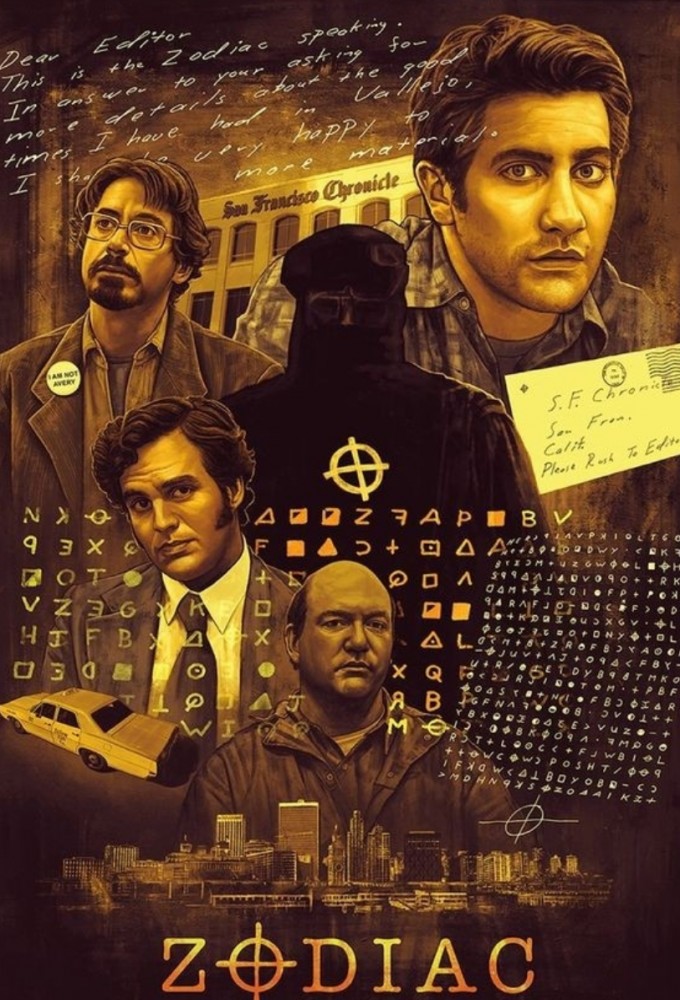
The story follows the manhunt for the Zodiac Killer, a serial killer who terrorized the San Francisco Bay Area during the late 1960s and early 1970s, taunting police with letters, bloodstained clothing, and ciphers mailed to newspapers.
Summary: TMDB

85 Interesting Facts About Zodiac
- #001
Contains a major spoiler — show
The Zodiac case was reopened after the film's premiere.
- #002
To preserve authenticity, all of the murder victims' costumes were painstakingly recreated from forensic evidence loaned to the production, down to the blue and white floral pattern on Darlene Ferrin's corset top.
- #003
Contains a major spoiler — show
The only real comment Robert Graysmith made about the finished script was: "God, now I see why my wife divorced me."
- #005
The producers hired a private detective to track down Michael Renault Mageau, a real-life survivor of the Zodiac.
- #006
Because David Fincher wanted the film to be as realistic as possible, he decided not to depict any of the alleged Zodiac murders for which no surviving victim or witness could be found.
- #008
Because the area had changed substantially since 1969, trees had to be flown in by helicopter to Lake Berryessa, and David Fincher wanted it to resemble the murder site as closely as possible.
- #009
Zodiac's first confirmed attack — the murders on Lake Herman Road — was cut from the film because there was no surviving victim to confirm the details. The filmmakers therefore decided to open the film with the July 4 murders, considered Zodiac's second double homicide.
- #010
The real-life survivor of the Lake Berryessa attack appears as an extra beside his wife in the background of the scene in which Marty Lee suggests that David Toschi take some time off work.
- #011
Robert Graysmith and Paul Avery were not actually friends. Their relationship was fictionalized for the film.
- #012
Hair was digitally added to close-ups of Jake Gyllenhaal's knuckles while he draws or writes letters. David Fincher felt Gyllenhaal's hands "were too hairless and pretty."
- #013
Dermot Mulroney had to wear a thick suit for several of his short scenes because David Fincher thought he looked too fit for his character.
- #015
Nancy Slover, the Vallejo operator who took the first Zodiac call, was asked to help with voice direction by selecting from recordings of various unidentified actors' readings. After choosing the recording with the voice closest to Zodiac's, it turned out she had picked a reading by John Carroll Lynch, who plays prime suspect Arthur Leigh Allen.
- #018
The film begins and ends with the character of Michael Renault Mageau, a real-life survivor of the Zodiac.
- #019
In an interview with Empire magazine, George Lucas once said that the Zodiac murders had captured his imagination when he was a high school student and then a college student at USC, and that he always felt Toschi was harshly judged over how the investigation was conducted. He explained that this was why he named a location at Tosche Station on Tatooine in honor of the SFPD inspector.
- #020
In one of the Zodiac's letters, he speculated about who would play him in a film about himself. In this film he is portrayed by three different actors, and in any shot featuring the Zodiac the actor's face is always out of focus or obscured. This allowed viewers to speculate and perhaps created a barrier against the real Zodiac killer, so that he was not portrayed by a visible or famous actor.
- #021
To save time, David Fincher decided to add all the blood in the murder scenes digitally.
- #022
Contains a major spoiler — show
Paul Avery did not retreat into a dark life away from his work at the San Francisco Chronicle as the film suggests. In the mid-1970s he reported on the kidnapping of Patricia Hearst and turned his reporting into a book: "The Voices of Guns" (1976). He was also married and the father of two daughters, which the film mentions only briefly.
- #024
Initially, before settling on Robert Downey Jr., David Fincher wanted to give the role of Avery to Brad Pitt.
- #025
Toschi spends the entire film eating food that comes from the people around him (animal crackers, sandwiches). At the film's climax, when Graysmith lays out the solution in the restaurant, Toschi pays for both of their meals.
- #027
The taxi scene at Washington and Cherry Streets in San Francisco could not be shot entirely in San Francisco because of filming restrictions and opposition from neighborhood residents. The production team therefore built a set at Downey Studios just outside Los Angeles replicating the intersection, including the street, the apartment buildings and the crime scene. San Francisco backgrounds were digitally inserted to complete the scene. Only a few seconds of actual footage shot at the original crime scene location remain in the film.
- #028
(At about one hour and thirty-five minutes) The scenes in which Dave Toschi and Robert Graysmith watch Dirty Harry (1971) were shot at the Mann National Theatre in Westwood, California. The cinema's flashy color schemes were not added by the art department. The theater's quite retro interiors had remained unchanged since the National was first built in 1969. Interestingly, this film was shown at the Mann National Theatre in mid-March 2007. Thus, real moviegoers watched celluloid moviegoers occupy seats on the National's signature wide screen. The theater has since been demolished.
- #029
Mark Ruffalo said: "I'll never forget the time they negotiated for my deal [on Zodiac]. The studio negotiator literally told my manager: 'Look, we don't care about Mark Ruffalo. We don't even want Mark Ruffalo in this movie, so you'll take what we're offering you or forget it.'".
- #030
Robert Downey Jr. was so unaccustomed to David Fincher's multiple-take approach and digital shooting process that he rebelled against Fincher on set by hiding glass jars filled with his urine, because of "having no time to get my shit together in my trailer." Downey eventually accepted Fincher's demands and recalled: "Except for the few times I wanted to strangle him, I decided to give him what he wanted. I think I'm the perfect person to work for him because I understand gulags."
- #031
Jake Gyllenhaal was somewhat surprised when David Fincher gave him a doll and an old-fashioned diaper to prepare for the role of a young father.
- #033
Contains a major spoiler — show
The song playing during the first attack and also over the end title sequence is Donovan's "Hurdy Gurdy Man." Donovan's daughter, Ione Skye, plays the woman who survives being abducted by a man who may be the Zodiac.
- #034
South Korean film director Bong Joon Ho classified David Fincher's film as a "masterpiece," writing: "There was really nothing to find fault with about it, down to the cinematography, art direction, and action."
- #035
In real life, when Michael Mageau picked Arthur Leigh Allen out of a series of photographs, he shouted: "That's him! He's the man who shot me!"
- #036
In real life, Melvin Belli never touched the Zodiac letter sent to him.
- #037
Contains a major spoiler — show
After the studio insisted that the film not run longer than two hours and fifteen minutes, negotiations with Sony fell through. Warner Bros. and Paramount agreed to share the production costs even though a "talky" film with an inconclusive ending would be hard to sell.
- #038
Mark Ruffalo said: "If you understand who these cops were, you understand that they had to set aside their hunches and personal beliefs. Dave Toschi told me: 'The moment that man (Arthur Leigh Allen) walked in the door, I knew it was him.' He was sure he had him, but he never had solid evidence. So he had to keep investigating all the other leads."
- #039
Jake Gyllenhaal and Mark Ruffalo were cast partly thanks to Jennifer Aniston. During pre-production, director David Fincher asked her who her favorite co-stars were, and she named Gyllenhaal and Ruffalo, with whom she had worked on The Good Girl (2002) and Rumor Has It… (2005).
- #040
Although the film was shot digitally, certain sequences, especially slow-motion ones, had to be captured on film.
- #041
The template David Fincher used for the film was Alan J. Pakula's All the President's Men (1976).
- #042
For location shoots, digitally erasing satellite dishes was always cheaper than physically removing them.
- #044
Contains a major spoiler — show
When surviving victim Michael Renault Mageau was tracked down and shown a photo lineup to identify the man who shot him, the array included a photo of Bob Stephenson, one of the three actors who portray the killer in the film.
- #045
David Fincher wanted to cast Jake Gyllenhaal based on his performance in Donnie Darko (2001).
- #047
The scene in which Jake Gyllenhaal receives information from Mark Ruffalo outside at night and appears with his baby in a stroller was complicated by the fact that Gyllenhaal was suffering from a severe case of the flu at the time and did not want to shoot it. David Fincher insisted he do it because they had the location for only one night.
- #048
While Robert Graysmith is driving his son to school, the radio announcer in his car mentions the free concert The Rolling Stones were about to give at the Altamont Speedway. It was Melvin Belli who, one day before the event, suggested the Stones hold their concert there after the original venue fell through.
- #049
The film pays tribute to Dirty Harry (1971), whose antagonist Scorpio was based on the Zodiac killer. Another fictional policeman also faced an enemy named Scorpio around that time. In his book, Robert Graysmith notes that during the Zodiac murders police investigated a possible connection to the Dick Tracy comic strip, in which Dick Tracy confronts a Zodiac-themed gang led by a mastermind named Scorpio.
- #051
When David Fincher's planned adaptation of "The Black Dahlia" fell through, he was given James Vanderbilt's one-hundred-and-fifty-eight-page screenplay.
- #052
David Fincher was especially eager for David Shire to provide the film's score, much as he had done so effectively on All the President's Men (1976). Sound editor Ren Klyce contacted the legendary Walter Murch, who had worked with Shire on The Conversation (1974), and Murch in turn contacted Shire.
- #053
About David Fincher's endless demands for takes, Mark Ruffalo said "[he] makes Michael Mann look like he's working on a McDonald's hamburger line during rush hour." He noted that he and Mann had worked together on Collateral (2004).
- #054
Shane Salerno bought Robert Graysmith's book "Zodiac" when he was just nineteen years old and developed it with Graysmith over several years, then sold it to Disney's Touchstone Pictures in a seven-figure deal. Salerno wrote several drafts of the screenplay before management changes at Touchstone derailed the project.
- #055
Kathleen Johns appears as the female driver who was abducted by a man who threatened to kill her and her baby (whom she would later identify as the Zodiac, based on a composite sketch of the man wanted for killing Paul Stine).
- #056
In the film, the cipher sent to the Chronicle was actually sent to the Examiner.
- #059
The US Blu-ray released by Paramount Home Video had a very limited print run. For a time it became one of the rarest Blu-rays on the market, fetching close to a hundred dollars from second-hand online retailers until Warner Home Video bought the Paramount catalog in 2012 and reissued it the following year.
- #060
Contains a major spoiler — show
The two surviving male victims of the Zodiac's attacks, Mike Mageau and Bryan Hartnell, actually met and chatted in the courtroom many years later. The first was there as a defendant, the second as a lawyer on a different case.
- #061
Robert Graysmith's cocktail is made with vodka, gin, lemon-lime and Blue Curaçao.
- #062
Screenwriter James Vanderbilt read Robert Graysmith's book in 1986 while in high school and met the man at the premiere of Auto Focus (2002).
- #063
(About twenty-four minutes in) The phone number 626-2345 seen on the Yellow Cab in the film was the real phone number of the Yellow Cab Company in San Francisco. By the time the film was released, the number had changed.
- #064
Over the years changes were made at Blue Rock Springs, so the murders committed there had to be re-created at a different location that more closely resembled the park as it was in 1969.
- #065
It was sent to theaters under the title "Gemini."
- #067
On July 6, 2005, Variety reported that Sir Gary Oldman had signed on to play attorney Melvin Belli in the film, and a later story in the Hollywood Reporter stated that he had done so. On February 14, 2006, Gary Oldman's management company, The Douglas Management Group, stated that the Hollywood Reporter story was not true and that "Mr. Oldman is not in the film, and never was." In an interview with Cinematical on March 2, 2007, "Zodiac" author Robert Graysmith said: "Now Gary Oldman was supposed to play Melvin Belli. He got into a lot of trouble, he had the tools but it just physically wasn't going to be. The work, he just didn't have the surroundings." Oldman went on to work with David Fincher on Mank (2020).
- #068
Philip Baker Hall (Sherwood Morrill) appeared in The Zodiac (2005), another film about the murders.
- #069
Arthur Leigh Allen told Bill Armstrong that he was left-handed. However, while most people wear a watch on their non-dominant hand, he wore his watch on his left hand, a possible indication that Allen's claim was not true. John Carroll Lynch, who plays him, is himself left-handed. Most, though not all, left-handed people wear a wristwatch on the same wrist as right-handed people (the left arm), because all but a few watches are set up that way (the winding crown, push buttons for complications, etc., are on the right side of the watch).
- #070
The Paramount and Warner Bros. logos used at the start of the film are almost, but not exactly, the same as the logos those studios used in 1969. In the Warner Bros. case, the 1969 versions did not use their classic shield as shown here; instead they carried a "Warner Bros.-Seven Arts" logo, used when the studio merged with Ray Stark and Eliot Hyman's production company Seven Arts. The Paramount logo, written in 1969 as "A Gulf+Western company," now reads "A Viacom Company," reflecting the new ownership.
- #071
(About one hour and forty-five minutes in) In the restaurant scene where Robert Graysmith buys David Toschi a hamburger, Toschi chews the burger for a while before spitting the chewed food into a napkin. This was because Mark Ruffalo, who plays Toschi, is a vegetarian and refused to eat meat. (However, one hour and twenty minutes into the film, Toschi takes half of his partner's BLT and, rather than removing the bacon before eating, picks the tomato out of it.)
- #073
Although Toschi and Armstrong are San Francisco Police Department inspectors, their actual responsibilities are the same as those of detectives in other municipal police forces. The San Francisco Police Department calls its detectives "inspectors."
- #074
In the special promotional film This Is Zodiac (2007), director David Fincher explains that he spoke with Zodiac survivor Michael Renault Mageau, and that the information Mageau gave him showed Fincher how to stage the scene in which Mageau and his girlfriend are attacked.
- #076
It was edited using Final Cut Pro.
- #078
Arthur Leigh Allen is played by John Carroll Lynch. On October 6, 1969, the real Arthur Leigh Allen was interviewed by the Vallejo Police Department, in the person of a detective named John Lynch.
- #079
(At roughly forty-three minutes) The theme music in the newsroom scene is the music used by National Nine News (Australia) in the 1980s and 1990s.
- #080
Contains a major spoiler — show
Bob Vaughan, whom Graysmith followed home after they met outside the theater, was Captain Ken Narlow's real favorite suspect. Pointing the finger at the theater projectionist at first was a way of adding Vaughan, another major suspect, to the story that Graysmith was also part of. Both Graysmith and the SFPD later speculated that Vaughan's handwriting and background were used by Zodiac as a way of deceiving the police in his letters.
- #083
In the overhead shot of the Transamerica Pyramid's early construction, the "box" foundation is completely devoid of any piles or columns. Unlike most conventional high-rise foundations, the Pyramid was uniquely built without any piles driven into bedrock. The building's weight actually rests on the trusses of the first two levels, and the trusses in turn stand on this "box."
- #085
The terrifying basement was inspired by Dermot Mulroney's actual basement. The production team recreated it because "it had these concrete foundation pieces placed with a walkway that made you feel like you were going through a tunnel."
- #086
Zodiac received a total of 28 nominations across all the different award programs but won only one (the Dublin Film Critics' Circle Award for Best Director for David Fincher). This is believed to be because Zodiac was released so early in the year (March 2007) and came up against heavyweight contenders such as No Country for Old Men (2007), There Will Be Blood (2007) and Atonement (2007).
- #087
(At roughly fourteen minutes) The bar Paul Avery frequents in the film is called Morti's. Mortis means death in Latin.
- #088
Clint Eastwood did not allow any scene from Dirty Harry (1971) to be used in the screening attended by Graysmith and Toschi. David Fincher told Total Film: "He didn't want to be in a serial killer movie. I guess he's done enough of them."
- #089
It was chosen by "Les Cahiers du cinéma" (France) as one of the ten best films of 2007 (ranking 5th, tied with La France (2007)).
- #090
When the suspect killer Arthur Leigh Allen is brought in for questioning in the film, a title appears on screen: SEPT. 14, 1972. After his release for lack of evidence, Inspector David Toschi attends a SPECIAL SCREENING - SFPD, a showing of DIRTY HARRY in the marquee of the NORTH POINT THEATRE. DIRTY HARRY premiered on December 22, 1971. In reality, a worldwide gala charity performance was held for the San Francisco Police Activities League, most likely a few days before the December 22 opening.
- #091
The KYA radio station's jingle can be heard in the opening scene. KYA began broadcasting in San Francisco in 1926 and, according to the film's time period, had adopted the Top 40 format.
- #094
(At roughly one hour and thirty-five minutes) Captain Lee tells Toschi to take a break and "go to Candlestick." Candlestick Park was home to the San Francisco Giants from its construction in 1960 until 2000, to the San Francisco 49ers from 1971 to 2013, and to the Oakland Raiders in 1961. In 2014 the 49ers moved to their new home at Levi's Stadium in Santa Clara. And Candlestick Park was demolished in 2015.
- #095
The film contains a deliberate anachronism: when Melanie orders penne with vodka cream sauce at dinner, the dish had not been invented until the 1980s. Fincher knew it was wrong but said, "being a gourmand, I let it slide."
- #096
Toschi flies to Riverside on PSA (Pacific Southwest Airlines). PSA was one of the first major discount airlines, operating from 1949 until it was integrated into USAir in 1988. It has no connection to Southwest Airlines.
- #097
Many of the film's most striking images were created on computers, including the rocket explosions in the opening scene, the shot looking at the foggy traffic from the Golden Gate Bridge, and the overhead tracking shot of the taxi. The accelerated construction of the Transamerica Pyramid was done using 2D and 3D digital mattes.
- #098
Toschi's wife says she is wearing "the Folgers," meaning she is making coffee. A month before that scene takes place, Abigail Folger (whose grandfather founded Folgers Coffee) was killed along with Voytek Frykowski, Sharon Tate and Jay Sebring by members of Charles Manson's "family."
- #101
Clea DuVall had previously appeared in Helter Skelter (2004). Both films deal with the murders that took place in California in 1969.
- #102
The real bar declined to be featured. The tavern where the reporters hang out would not allow its name to be used because the film depicts cocaine use.
- #103
Contains a major spoiler — show
December 18, Arthur Leigh Allen's birthday, is also the birthday of David Fincher's friend and frequent collaborator Brad Pitt, as well as other famous figures such as Steven Spielberg, Ray Liotta and Katie Holmes.
- #104
Robert Downey Jr. won the Best Supporting Actor award (for Oppenheimer) in competition with his co-star in this film and in the Avengers series, Mark Ruffalo.
- #105
Contains a major spoiler — show
Zodiac called lawyer Melvin Belli a week before Christmas and told him he had to kill because "today is my birthday." After learning that Arthur Leigh Allen was born on December 18, Robert Graysmith concluded that Allen was the Zodiac. Jake Gyllenhaal, who plays Graysmith in the film, was born on December 19.
- #106
Philip Baker Hall and Ione Skye appeared in Say Anything... (1989).
- #107
Donal Logue also worked with Mark Ruffalo on Just Like Heaven (2005).
- #109
John Carroll Lynch and Clea DuVall appeared in Carnivàle (2003).
- #110
The character Mike Majeu is mocked by Darlene on July 4 for being cold. July night temperatures in Vallejo average below the 50s.
Sources & editorial notes
Reference databases
Sources for the entries on this page
- IMDb IMDb
Information from external sources is independently selected, consolidated and edited by Arka Evren. Sources are listed for verification and further reading. Encyclopedia text is used under its licence (CC BY-SA). How we work