
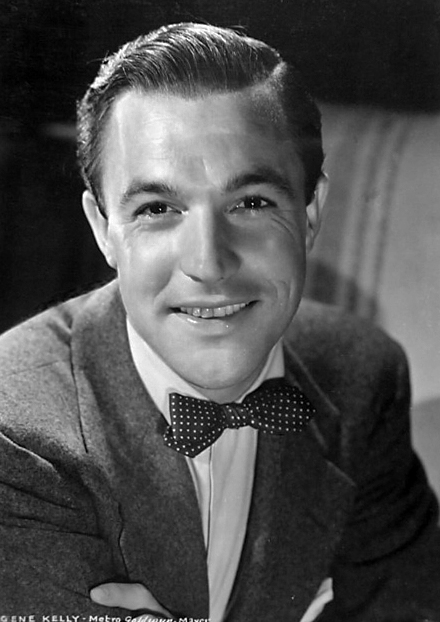
ACTOR · BORN 1912 · DIED 1996
Gene Kelly
- Born
- 23 August 1912, Pittsburgh, Pennsylvania, USA
- Died
- 2 February 1996
- Known for
- Singin' in the Rain (1952), An American in Paris (1951), Inherit the Wind (1960), Xanadu (1980)
99 archived facts 7 topics 1 source Last reviewed Nov 2026
Gene Kelly (23 August 1912 – 2 February 1996) was an actor best known for Singin' in the Rain, An American in Paris and Inherit the Wind.
99 Interesting Facts About Gene Kelly
Interesting Facts (15)
- #001
- #002
- #003
- #004
- #005
- #006
- #007
- #008
- #009
- #010
The distinctive scar on the left side of Gene Kelly's face came from a bicycle accident he had at the age of five. The accident required stitches, and the scar remained for life. Over time the scar became one of Kelly's signature features and made him even more recognizable. Kelly never hid the accident and accepted the scar as a natural part of himself.
- #011
In an interview with the American Film Institute (AFI), Gene Kelly said his favorite film was A Tree Grows in Brooklyn (1945), the Elia Kazan-directed drama in which he starred. Kelly's choice shows that he valued dramatic productions, not only the musical genre, and the film is an important work displaying his acting ability.
- #012
Martial arts stars Jackie Chan and David Carradine cite Gene Kelly as an inspiration. The acrobatic movements and physical expression in Kelly's dancing resemble choreography in the martial arts, showing that his art influenced not only the dance world but also action cinema; Chan and Carradine developed their own styles by drawing on Kelly's movement language.
- #013
Gene Kelly has a star on the Hollywood Walk of Fame at 6153 Hollywood Boulevard. The star is a mark of his contributions to cinema and the entertainment world, and Kelly received the honor in 1960. His star is frequently photographed by visitors on the Walk of Fame, one of Hollywood's most famous landmarks.
- #014
Gene Kelly's second wife, Jeanne Coyne, had previously been married to Kelly's business partner and director Stanley Donen. The marriage reinforced the professional relationship between Kelly and Donen with a personal bond. Coyne had worked with both men, which complicated the dynamics between them, and the fact illustrates how intertwined relationships were in Hollywood's small world.
- #015
MGM allowed Gene Kelly to shoot in New York for only five days for his film 'On the Town.' The restriction stemmed from the studio's budget and scheduling concerns. Kelly managed to capture the city's energy on film in that short time, and the shoot inspired the unforgettable dance scenes in the film's opening sequence.
Production Story (8)
- #016
In order to secure the film rights to the hit musical "Best Foot Forward," MGM loaned Kelly's to Columbia for one picture. Although it was assumed the studio would mount an adaptation of Kelly's stage hit "Pal Joey," for which it owned the screen rights, Columbia instead co-starred him with its top star, Rita Hayworth, in Cover Girl (1944). Ironically, when they did finally film the property over a decade later with Frank Sinatra, Hayworth again co-starred.
- #017
- #018
- #019
He and MGM studio head Louis B. Mayer shared a long-standing feud stemming from even before Kelly entered the motion picture business. One evening after seeing Gene perform in "Pal Joey" on Broadway, Mayer met him backstage and offered to sign him to MGM without a screen test. When Kelly later received a call from an MGM representative requesting a screen test, he insisted there was some sort of mistake, saying he had Mayer's word he did not have to make one and told the rep to ask Mayer himself. When the rep did, he called back days later stating that he did talk to Mayer and that he still had to make a test. Kelly was furious and wrote a scathing letter to Mayer for retracting his promise. For the first couple of years he worked for Mayer, Kelly was uncertain that Mayer even read the letter until he brought it up in an argument one evening.
- #020
Producer David O. Selznick signed Kelly to his first Hollywood contract after seeing him star in "Pal Joey" on Broadway. Though Gene had had other offers from studios, he chose to sign with Selznick mostly because his was the only studio that did not insist on a screen test before signing him. Selznick sold Kelly's contact to MGM before he could find a suitable role for him to appear in.
- #021
With the film of 'Hello Dolly' he devoted a year on the script, casting, and working with choreographer Michael Kidd in developing concepts of the musical sequences and integrating them into the overall production. He involved himself in all the minute preparation then taking charge of the crew and putting it into the film.
- #022
Judy Garland was responsible for MGM's Arthur Freed buying out David O. Selznick's personal exclusive contract with Kelly, who arrived in town in 1941. He came direct to Hollywood from his 1940 successful Broadway musical production of "Pal Joey." He planned to return to New York City, to the Broadway stage, after fulfilling his one-picture deal with Selznick. However, Selznick basically kept him off the screen after he arrived in Hollywood, basically putting his career on hold. Garland, who knew about Kelly's reputation on Broadway, told Freed--who was the producer in charge of making MGM's musicals--that she wanted Kelly as her partner in her next musical for the studio. Freed negotiated a deal with Selznick that resulted in MGM buying out Kelly's contract, which enabled him to play opposite Judy in For Me and My Gal (1942). The film was a huge success and jump-started Kelly's (up to that point) faltering film career.
- #023
Behind the Scenes (16)
- #024
- #025
- #026
- #027
Gene Kelly was originally set to play the role of Don Hewes in Easter Parade (1948) alongside Judy Garland. However, before filming began he broke his ankle and reported that he could not take on the role. MGM then brought Fred Astaire into the cast, postponing his retirement. Astaire's performance in the film was widely praised, and Kelly's injury led to an unexpected change in cinema history.
- #028
- #029
There was a long-running friction between Gene Kelly and MGM studio head Louis B. Mayer that began before Kelly entered films. One evening, after watching Kelly in the play "Pal Joey" on Broadway, Mayer visited him backstage and offered him a place at MGM without any screen test. However, Kelly later received a phone call from an MGM representative asking him to do a screen test. Trusting Mayer's word, Kelly thought this was a mistake and told the representative to ask Mayer. When the representative asked, Mayer said Kelly needed to do the test, which damaged the trust between them and deepened the hostility.
- #030
During World War II, Gene Kelly joined the United States Navy and served at the Navy Photographic Center in Anacostia, D.C. This center was where the documentary Victory at Sea (1952), later produced for NBC-TV, was compiled. Kelly appeared in many Navy films while on active duty; during his leave, he continued to act in civilian films. This experience combined both his military and artistic identities.
- #031
Gene Kelly's father, James Kelly, worked as the tour manager for the famous singer Al Jolson in the 1920s. This connection allowed Gene to become familiar with the entertainment world at an early age. Thanks to his father's work, Gene grew up immersed in the performing arts. This experience formed an important foundation for his future career.
- #032
- #033
Gene Kelly appeared in three films selected for the National Film Registry by the Library of Congress as being "culturally, historically, or aesthetically" significant: On the Town (1949), An American in Paris (1951) and Singin' in the Rain (1952). He also directed two of these films (On the Town and Singin' in the Rain).
- #034
Gene Kelly devoted a year to the film 'Hello Dolly,' developing the script, the casting and the concepts for the musical sequences with choreographer Michael Kidd. During this process, he prepared meticulously to integrate the musical numbers into the overall production. After attending to every detail, Kelly took charge of the team and brought the film to life.
- #035
- #036
- #037
- #038
- #039
Gene Kelly's birthday is August 23, and his zodiac sign is Leo. The Leo sign is generally associated with leadership, creativity and flamboyance. Kelly's stage charisma and artistic talent seem consistent with these zodiac traits. This astrological information is an interesting detail for his fans.
Characters & Cast (3)
- #040
- #041
- #042
Gene Kelly's last film musical was Xanadu, made in 1980. In the film he shared the lead with Olivia Newton-John, who would pass away shortly afterward. Although Xanadu received mixed reviews when it was released, it gradually became a cult classic. Kelly's presence in the production is regarded as the final link in his contribution to the movie musical.
Easter Eggs & References (3)
Career & Awards (26)
- #046
- #047
- #048
- #049
He and his younger brother Fred Kelly appeared together in a dancing vaudeville act. When Gene got his big break as Harry the hoofer in the dramatic Broadway production of "The Time of Your Life" in 1939, he was eventually replaced by brother Fred, who took it on the road and won a Donaldson award for his efforts.
- #050
- #051
- #052
He has appeared in three films that have been selected for the National Film Registry by the Library of Congress as being "culturally, historically or aesthetically" significant: On the Town (1949), An American in Paris (1951) and Singin' in the Rain (1952). He has also directed two films that are in the registry: On the Town and Singin' in the Rain.
- #053
- #054
- #055
- #056
- #057
- #058
- #059
- #060
- #061
- #062
- #063
- #064
In a video interview in the late 1990s, director Jules Dassin recounted that after being blacklisted in Hollywood he fled to Europe and continued his career there. When they met at the Cannes Film Festival in the 1950s, he said, Kelly was the only American willing to be seen with him in public. Dassin also recalled another famous American who hid under a table to avoid being seen with him, but he did not reveal who it was. The episode shows Kelly's courage in maintaining friendships despite the blacklist.
- #065
Gene Kelly served as dance consultant for Madonna's 1993 "Girlie Show" tour. The collaboration shows how Kelly's dance knowledge and experience were passed on to the pop music world. Kelly's influence can be felt in the choreographic elements of Madonna's shows. In this way, Kelly continued to contribute to the dance world beyond his film career.
- #066
In the early 1970s, Bob Fosse considered Gene Kelly for the lead in a musical film adaptation of Maurine Dallas Watkins's play "Chicago." Kelly turned the role down, and Fosse then decided to develop the project as a stage musical, a decision that led to one of the most famous musicals in Broadway history.
- #067
Judy Garland played an important role in Gene Kelly's joining MGM. When Kelly came to Hollywood in 1941 he had made a one-film deal with David O. Selznick, but Selznick could not find a suitable role for him and kept him off the screen; Garland knew Kelly's talent and persuaded MGM producer Arthur Freed to buy out Selznick's contract with Kelly, allowing Kelly to continue his career at MGM and appear in some of the most unforgettable productions in film history.
- #068
Gene Kelly was inducted into the International Tap Dance Hall of Fame in 2014. The honor recognizes his contributions to tap dance and his mastery of the field. Kelly was one of the key figures who popularized tap dance in cinema, and the award shows that his art has been kept alive after his death.
- #069
- #070
- #071
Gene Kelly's biography appears in Supplement 1 of the encyclopedia "American National Biography" (pages 309-312). The work was published by Oxford University Press in New York in 2002. The biography examines Kelly's life and career from an academic perspective and is an important reference for those researching Kelly.
Life & Family (28)
- #072
- #073
- #074
- #075
During World War II, he was a sailor stationed at the United States Naval Photographic Center in Anacostia, D.C. (where the documentary Victory at Sea (1952) was later assembled for NBC-TV). He starred in several Navy films while on active duty there and in "civilian" films while on leave.
- #076
- #077
- #078
His first two wives were dancers. Betsy Blair met him while she was a performer and he a choreographer in the show "Diamond Horseshoe". Second wife Jeanne Coyne was Gene's dancing assistant for many years before they married in 1960. A major talent in her own right, her dazzling footwork can be seen in the "From This Moment On" number alongside partner Bobby Van, Ann Miller, Tommy Rall, Carol Haney and Bob Fosse in Kiss Me Kate (1953). She died of leukemia in 1973.
- #079
- #080
- #081
- #082
- #083
In a video interview in the late 1990s, Jules Dassin recalled that, after he had been blacklisted in Hollywood and escaped to Europe to continue his film directing and writing career, Kelly was the only American who was willing to be seen in public with him when they ran into each other at a Cannes Film Festival in the 1950s. Dassin recalled (but did not identify) another American celebrity who actually hid under a table to avoid being seen with him.
- #084
- #085
- #086
- #087
- #088
- #089
- #090
- #091
- #092
- #093
- #094
- #095
Both of Gene Kelly's first two wives were dancers. He met his first wife, Betsy Blair, during the show "Diamond Horseshoe," when Blair was a dancer and Kelly the choreographer; his second wife, Jeanne Coyne, worked for many years as Kelly's dance assistant before they married in 1960. Coyne was a talented dancer in her own right, and in the "From This Moment On" number in the film Kiss Me Kate (1953) she displayed dazzling footwork alongside her partner Bobby Van, Ann Miller, Tommy Rall, Carol Haney and Bob Fosse; she died of leukemia in 1973.
- #096
Gene Kelly said that his favorite dance number in Singin' in the Rain was "Broadway Melody." The number is one of the film's most complex and lavish scenes, depicting the Broadway show that Kelly's character, Don Lockwood, dreams of staging. Kelly's choice reflects his artistic taste and his passion for musical theater, and "Broadway Melody" is regarded as one of the film's unforgettable moments.
- #097
Gene Kelly first attended Penn State University, then transferred to the University of Pittsburgh, from which he graduated with a degree in economics. This academic path shows his scholarly achievement and disciplined work habits. Kelly also kept up his interest in dance during his university years, a balance that developed both his intellectual and artistic sides.
- #098
While studying at the University of Pittsburgh, Gene Kelly joined the student fraternity Phi Kappa Theta. The fraternity gave him a social circle during his university years. Kelly kept the friendships and experiences he gained there throughout his life, and the membership is an important detail of his youth.
- #099
After Gene Kelly's death, it was alleged that in the 1970s he had donated money to the Provisional Irish Republican Army (IRA). This was a period when the IRA carried out bombing campaigns in the United Kingdom and the conflict known as "the Troubles" peaked in Northern Ireland. Kelly's Irish origins brought the allegation to public attention, but the matter sparked controversy after his death and was never conclusively verified.
Sources & editorial notes
Reference databases
- Wikipedia
- IMDb
Information from external sources is independently selected, consolidated and edited by Arka Evren. Sources are listed for verification and further reading. Encyclopedia text is used under its licence (CC BY-SA). How we work