

ACTOR · BORN 1939
John Cleese
- Born
- 27 October 1939, Weston-Super-Mare, Somerset, England, UK
- Known for
- Monty Python and the Holy Grail (1975), The Day the Earth Stood Still (2008), A Fish Called Wanda (1988), Fawlty Towers (1975)
94 archived facts 7 topics 1 source Last reviewed Nov 2026
John Cleese (born 27 October 1939) is an actor best known for Monty Python and the Holy Grail, The Day the Earth Stood Still and A Fish Called Wanda.
John Cleese over the years


94 Interesting Facts About John Cleese
Interesting Facts (41)
- #001
- #002
- #003
- #004
He has said he loves 'really rude questions' because they're original and make him think of a fitting answer. The best one he ever got was "If you were a part of a plane, which part would you be?" His answer: 'the joystick.'
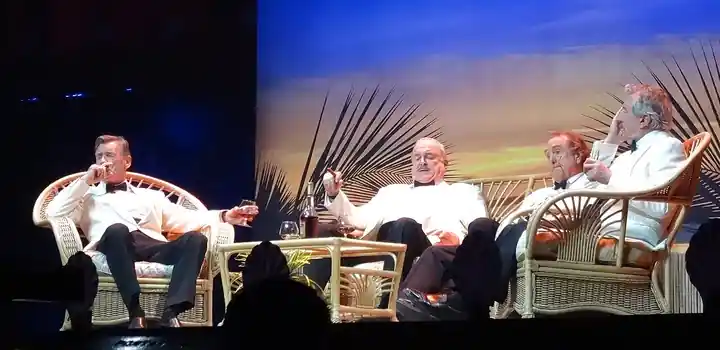
John Cleese: GuvImage: Wikimedia Commons · Eduardo Unda-Sanzana, CC BY 2.0 - #005
- #006
Terry Gilliam observed a split among his Monty Python colleagues between the taller, more "aggressive" Cambridge men (Cleese, Graham Chapman & Eric Idle) and the shorter, gentler-humored Oxford men (Michael Palin & Terry Jones), to whom the American Gilliam felt closer. He considered Cleese, the tallest and most "aggressive" Python, the most "Cambridge" of them all.
- #007
On a Dutch talk show in 2014, he set the record straight on the story that he had offered to write speeches for Democratic presidential candidate Barack Obama in 2008. All he had said was that he liked many of the Democrats' plans for the American people and would love to help in any way. A local paper took that as an offer to write Obama's speeches, but Cleese thought Obama more than capable of writing his own.
- #008
Just to see if anyone noticed, Cleese slipped one obviously fake film a year into his filmography in Who's Who during the early 1970s: "The Bonar Law Story" (1971), "Abbott & Costello Meet Sir Michael Swann" (1972), "The Young Anthony Barber" (1973) and "Confessions of a Programme Planner" (1974). He owned up to the joke in the 1980s, yet the bogus titles still turn up now and then in scholarly writing on him, including his entry in the Encyclopedia of Television, 1st ed. (1996), edited by Horace Newcomb.
- #009
- #010
- #011
- #012
- #013
- #014
- #015
- #016
- #017
- #018
- #019
- #020
- #021
- #022
- #023
- #024
- #025
- #026
- #027
- #028
- #029
- #030
- #031
- #032
- #033
- #034
- #035
- #036
- #037
- #038
- #039
- #040
- #041
Production Story (6)
Behind the Scenes (13)
- #048
- #049
Brian Henson says Cleese had a great time guest-starring on The Muppet Show (1976) and grew close to the writers because he wanted to help write. Together they cooked up a premise in which Cleese was being held on the show against his will, trying to get away while the Muppets kept pushing him to do his scheduled bits. Life didn't imitate art, of course: a few years later he was back with the Muppets in The Great Muppet Caper (1981).
- #050
The inspiration for Fawlty Towers (1975) came from a hotel stay he had with the other Pythons at the Gleneagles Hotel in Torquay, England. The hotel manager's name was Donald Sinclair, a man Cleese considered the rudest he had ever encountered. He later played a character named Donald P. Sinclair in Rat Race (2001).
- #051
When the Globe Theatre in London was rebuilt, a service was offered whereby you could have your name written on a tile in the courtyard in order to donate to the project. Cleese and fellow Python Michael Palin signed up for the paving, but Palin's was misspelled. Cleese paid extra to make sure his was written as "Pallin."
- #052
- #053
- #054
Terry Gilliam noted that among his Monty Python colleagues there was a distinction between the taller, more "aggressive" Cambridge men (Cleese, Graham Chapman and Eric Idle) and the shorter, more gently humorous Oxford men (Michael Palin and Terry Jones); the American Gilliam found himself closer to the latter. Gilliam regarded Cleese as the tallest and most "aggressive" member of Monty Python, and the group's most "Cambridge."
- #055
According to Brian Henson, when Cleese appeared as a guest star on The Muppet Show (1976) he enjoyed the series greatly and grew very close to the writers because he wanted to be involved in the writing. Once he was involved in the writing, he and the other writers came up with a concept in which Cleese was being kept on the show against his will and would try to get off it while the Muppets tried to make him do the things they had planned. Of course, in this case life did not imitate art, because a few years later Cleese reappeared with the Muppets in The Great Muppet Caper (1981).
- #056
He helped his daughter Camilla Cleese overcome her drug habit (which began when she was 11) by sending her to a psychiatric ward and then to a rehabilitation clinic. After spending more time in rehabilitation, she finally overcame her drug and alcohol habit in 2007 and praised her father for helping her change her life (21 December 2008).
- #057
- #058
- #059
- #060
To see whether anyone would notice, in the early 1970s Cleese openly added a fake film to his annual filmography listing in Who's Who every year. For the record, these fake films were "The Bonar Law Story" (1971), "Abbott & Costello Meet Sir Michael Swann" (1972), "The Young Anthony Barber" (1973) and "Confessions of a Programme Planner" (1974). Although Cleese admitted in the 1980s that he had been joking, these fake films are still occasionally mentioned in scholarly works about Cleese, including the entry in the 1st edition of The Television Encyclopedia. (1996) edited by Horace Newcomb.
Characters & Cast (3)
Deeper Meaning (1)
Career & Awards (8)
- #065
- #066
- #067
- #068
- #069
- #070
- #071
In 1996 he was offered a C.B.E. (Commander of the Order of the British Empire) and declined, explaining: "The title doesn't get the same admiration and respect from the general public that it does from those who actually bestow it - you don't get to be addressed as 'Commander Cleese,' in my case - which somewhat nullifies the point of it all." He turned down a seat in the House of Lords too: "It would have had a very nice ring - 'Lord John of Cleese', I mean - but on the other hand, I would have been obligated to stay in London all through the winter... because that's when they meet in Parliament to vote on whatever-have-you. And *nobody* in their right mind lives in London during the bloody winter!"
- #072
Life & Family (22)
- #073
- #074
- #075
Three of his marriages ended in divorce. He stayed on good terms with Connie Booth and Barbara Trentham, but relations with his third wife, Alyce Faye Eichelberger, turned very sour in a bitter alimony fight that reportedly cost him over $13 million in cash and assets, plus a court order to pay her $1 million a year for seven years, more than $20 million in all. He went back on stage to raise the money, jokingly calling it "The Alimony Tour," and said the settlement would have been even worse had they had children.
- #076
- #077
- #078
He helped his daughter, Camilla Cleese, beat the drug habit she'd had since 11 by sending her to a psychiatric ward and then a rehab clinic. After more spells in rehab, she finally gave up drugs and alcohol in 2007 and credited her father with helping turn her life around (December 21, 2008).
- #079
- #080
- #081
- #082
- #083
- #084
- #085
- #086
- #087
- #088
- #089
- #090
- #091
- #092
- #093
- #094
Continue through the archive
Sources & editorial notes
Reference databases
- Wikipedia
- IMDb
Information from external sources is independently selected, consolidated and edited by Arka Evren. Sources are listed for verification and further reading. Encyclopedia text is used under its licence (CC BY-SA). How we work