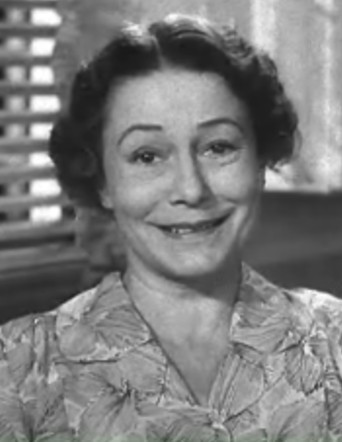
ACTOR · BORN 1902 · DIED 1969
Thelma Ritter
- Born
- 14 February 1902, Brooklyn, New York, USA
- Died
- 5 February 1969
- Known for
- Rear Window (1954), All About Eve (1950), Miracle on 34th Street (1947), How the West Was Won (1962)
22 archived facts 4 topics 1 source Last reviewed Sep 2026
All facts (22)
- #001
Thelma Ritter and Deborah Kerr share a unique record in Oscar history: both were nominated six times in competitive categories but never won the statuette. All six of Ritter's nominations were for supporting roles, a record in that category that still stands. Kerr was nominated six times in the lead actress category. As of 2021, Glenn Close has surpassed that total with eight nominations — four lead and four supporting — though she too has never won an Oscar.
- #002
For her performance in the 1958 Broadway musical "New Girl in Town," Thelma Ritter won the Tony Award for Best Actress in a Musical. She shared the award with Gwen Verdon, her co-star in the same production, making them among the first performers in Tony history to win in a tie. The achievement is remembered as one of the brightest moments of Ritter's stage career.
- #003
For the 2013 TV series "Kirstie," actress Rhea Perlman modeled her character Thelma Katz on Thelma Ritter's on-screen presence and mannerisms. Perlman paid tribute to Ritter by bringing the actress's sharp wit and sharp tongue to the role. The detail shows that Ritter's influence extended beyond her own era and deeply affected later generations of actors.
- #004
In the early years of their careers, Thelma Ritter and her husband Joseph took on many different jobs to make a living, from jingle contests to vaudeville shows. The experience they gained during this period laid the foundation for Ritter's stage and radio career. The couple's versatile efforts foreshadowed the success Ritter would later achieve in Hollywood.
- #005
Before entering the film world, Thelma Ritter worked for many years in radio and on the stage. The turning point in her career came when writer-director George Seaton, a former neighbor, offered her a role in the 1947 film "Miracle on 34th Street." The film was Ritter's first major break in cinema and made her one of Hollywood's most beloved character actresses.
- #006
Thelma Ritter was the mother of actress Monica Moran, and the two appeared together in the 1966 road show tour of the musical "Bye Bye Birdie," which also starred Tab Hunter. Mother and daughter appearing in the same production highlights the balance Ritter struck between her private and professional lives. It was one of the rare occasions when she combined her bond with her family and her passion for the stage.
- #007
Thelma Ritter appeared opposite legendary actor James Stewart in three different films: "Call Northside 777" (1948), "Rear Window" (1954) and "How the West Was Won" (1962). The three films allowed Ritter to display both dramatic and comic performances alongside Stewart. Her role as the nurse in "Rear Window" in particular is etched in memory as one of cinema history's unforgettable characters.
- #008
Thelma Ritter appeared alongside one of Hollywood's most iconic stars, Marilyn Monroe, in three films: "All About Eve" (1950), "As Young as You Feel" (1951) and "The Misfits" (1961). These films gave Ritter the chance to play both supportive and strong characters beside Monroe. "The Misfits" holds particular importance in cinema history as Monroe's last completed film.
- #009
Thelma Ritter appeared in six films selected for the National Film Registry by the Library of Congress as "culturally, historically or aesthetically" significant: "Miracle on 34th Street" (1947), "All About Eve" (1950), "Pickup on South Street" (1953), "Rear Window" (1954), "Pillow Talk" (1959) and "How the West Was Won" (1962). These films stand among the cornerstones of American cinema, and Ritter's performances in them are part of her lasting legacy.
- #010
Thelma Ritter's first Oscar nomination, for "All About Eve" (1950), began a run of four consecutive nominations. Ritter shares that feat with Jennifer Jones (1943-1946), Marlon Brando (1951-1954), Elizabeth Taylor (1957-1960) and Al Pacino (1972-1975), placing her in a rare group. Greer Garson and Bette Davis hold the record with five consecutive nominations each (1942-1946 and 1939-1943 respectively).
- #011
Thelma Ritter appeared in four productions nominated for the Best Picture Oscar: "Miracle on 34th Street" (1947), "A Letter to Three Wives" (1949), "All About Eve" (1950) and "How the West Was Won" (1962). Of these, "All About Eve" won Best Picture, marking one of the most prestigious achievements of Ritter's career. The four films attest to her presence in works acclaimed by both critics and audiences.
- #012
Thelma Ritter was nominated for an Oscar six times over the course of her career. All of the nominations came in the supporting actress category, setting a record in that field that still stands. Although Ritter never won the award, the six nominations show that she was one of Hollywood's most respected character actresses.
- #013
Thelma Ritter's husband, Joseph Ritter, gave up his acting career and moved into advertising, going to work for Young & Rubicam, one of the leading agencies of the day. His success there quickly earned him a senior executive position. The change eased the couple's finances and allowed Thelma to focus more comfortably on acting.
- #014
Throughout her career, Thelma Ritter generally played sardonic, sharp-tongued characters. These roles allowed her to display her sharp wit and her distinctive comic talent. Such characterizations earned her the title of "everyone's favorite supporting actress" during Hollywood's classic era.
- #015
The major breakthrough in Thelma Ritter's career came when director George Seaton offered her a role in the 1947 film "Miracle on 34th Street." The film was Ritter's first major break in cinema and made her one of Hollywood's most beloved character actresses. Seaton's offer allowed Ritter to carry her radio and stage experience over into film.
- #016
In the 1961 film "The Second Time Around," Thelma Ritter played a character named Aggie. A year later, in the 1962 film "How the West Was Won," she played Agatha (known as "Aggie"). Both roles were opposite Debbie Reynolds and featured nearly identical personalities, backgrounds and situations. The similarity shows how skillfully Ritter handled this kind of role.
- #017
In 1958, Thelma Ritter and Gwen Verdon became the first performers to tie and share a Tony Award. Both were honored for Best Actress in a Musical for their performances in "New Girl in Town." After that, ties occurred nine more times in various Tony categories, but Ritter and Verdon's first tie still holds a special place.
- #018
Thelma Ritter's biography appears in Axel Nissen's book "Actresses of a Certain Character: Forty Familiar Hollywood Faces from the Thirties to the Fifties." The book examines the lives and careers of forty women who stood out as character actresses in Hollywood from the 1930s to the 1950s. Ritter's inclusion in the book is an indication of her lasting impact on film history.
- #019
In 1937, Thelma Ritter and her husband Joseph bought a house at 65 Greenway Terrace in the Forest Hills neighborhood of New York. The house was where the couple lived for many years and where Ritter spent an important part of her career. Forest Hills was a neighborhood favored by artists and intellectuals at the time.
- #020
Thelma Ritter graduated from the American Academy of Dramatic Arts (AADA) in 1922. The prestigious school gave her a solid foundation for her acting career. Her training at AADA was one of the key factors behind her success on both stage and screen.
- #021
Thelma Ritter's father, Charles Vaname Ritter, was a shoe salesman, and her mother, Lucy B. Hale, was a housewife. The couple married on April 25, 1900. Ritter's family provided an environment that supported her interest in the arts, which influenced her later turn toward an acting career.
- #022
When Thelma Ritter's films were released in Italy, her voice was dubbed by different actresses. Rina Morelli voiced her in "Pickup on South Street" (1953), Tina Lattanzi in "Daddy Long Legs" (1955), Wanda Tettoni in "Pillow Talk" (1959), Lia Orlandini in "How the West Was Won" (1962) and Franca Dominici in "Rear Window" (1954). The talented Maria Saccenti dubbed Ritter only once, in "All About Eve" (1950). This shows how wide-ranging Ritter's presence in Italian cinema was.
Sources & editorial notes
Reference databases
Sources for the entries on this page
- IMDb IMDb
Information from external sources is independently selected, consolidated and edited by Arka Evren. Sources are listed for verification and further reading. Encyclopedia text is used under its licence (CC BY-SA). How we work