

TV SERIES · 1989–2013 · UK
Agatha Christie's Poirot
- Network
- ITV1
- Seasons
- 13
- Episodes
- 70
- Studio
- The Computer Film Company, Picture Partnership Productions, Carnival Films
48 archived facts 8 topics 1 source Last reviewed Nov 2026
From England to Egypt, accompanied by his elegant and trustworthy sidekicks, the intelligent yet eccentrically-refined Belgian detective Hercule Poirot pits his wits against a collection of first class deceptions.

48 Interesting Facts About Agatha Christie's Poirot
Interesting Facts (7)
- #001
- #002
- #003
- #004
By the 2020s, as every episode had since been released on home entertainment formats, such as dvd, etc, each episode had then been retro-fitted with a rating, as was common practice for cinema film releases. For example, in the UK the BBFC, and in Ireland, the IFCO had rated most episodes as either 12 or 15 - not suitable for children under those ages. The usa clearly has the overall series run rated as TV-14, but note that globally some episode age ratings may vary across the run, depending on story content, and bloody imagery.
- #005
Originally developed for television by Picture Partnership Productions, the series was initially produced for television, by then independent ITV franchise contractor LWT (London Weekend Television), which was then bought over by Granada Television, and in turn Granada merged with Carlton to ultimately form ITV Studios. The later 2010s restoration of the earlier pre-ITV Studios copyright versions were then retro-fitted so the Copyright was to ITV Studios, not the original owner LWT or Granada. The distribution conpany was also revised to the new consolidated ITV Studios Global Entertainment.
- #006
- #007
While preparing for the role, Sir David Suchet read every book and short story featuring Poirot: "I had my file on one side and a pile of stories on the other, and day after day, week after week, I examined most of Agatha Christie's novels about Hercule Poirot and wrote down his characteristics until I had a file full of documentation on the character. Then my job was not just to know what he was like, but gradually to become him."
Production Story (17)
- #008
Hercule Poirot was named after two other fictional detectives of the time: Marie Belloc Lowndes's Hercule Popeau and Frank Howel Evans's Monsieur Poiret, a retired Belgian Police Officer living in London. Poirot also bore a resemblance to A.E.W. Mason's Inspector Hanaud of the French Sûreté.
- #009
In the 2010s, ITV in the UK replaced their showings of the original broadcast tapes of the late 1980s/early 1990s "dirty" telecine versions of the series with the re-mastered pristine telecine versions, originally released as DVD/Blu-ray box sets. With the cleanup, and revealing more of the negative, this early part of the run felt like a remake to viewers who saw it first-run. The side-by-side comparisons show a sometimes remarkable difference in the earlier episodes' re-mastered versions.
- #010
Very occasionally picture quality may drop for a very short sequence, in the restored versions of the earlier seasons, usually also appearing vaguely pixelated. It appears to only be certain stock footage shots, where the original film elements were unable to be sourced for re-scanning, and/or montage sequences that were created using video post-production. Additionally, where the original negatives weren't able to be used for a restored shot, occasionally a shot may have been re-used from the earlier unrestored master tape, inserted in its original timecode position.
- #011
- #012
- #013
Suchet was recommended for the part by Dame Agatha Christie's family, who had seen his performance in the mid-80s BBC series Blott on the Landscape (1985). Curiously, that series was also made by Picture Partnership Productions, later renamed Carnival Films, which are later credited with developing and producing Poirot with the ITV network. Both series share producer Brian Eastman. Previously, Christie's daughter Rosalind Hicks and writer/producer Nick Evans had considered Suchet for the role of Poirot in the then upcoming production Murder by the Book (1986). But Suchet was not approached at that time and the role went to Ian Holm.
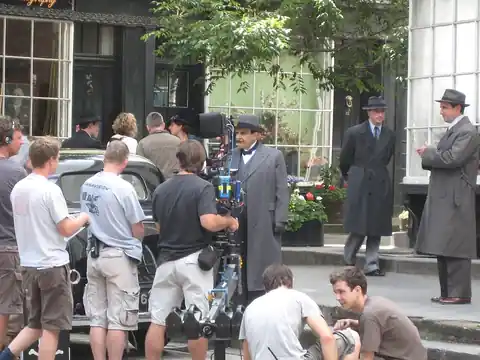
Poirot (1989): Poirot in a hat and the period-costumed crew on the streetImage: Wikimedia Commons · hairyeggg, CC BY-SA 2.0 - #014
- #015
- #016
The name Hercule Poirot was inspired by two fictional detectives of the period: Marie Belloc Lowndes's Hercule Popeau and Frank Howel Evans's Monsieur Poiret, a retired Belgian police officer living in London. Poirot also bore a resemblance to Inspector Hanaud of the French Sûreté in the work of A.E.W. Mason.
- #017
- #018
The series was filmed in genuine Art Deco-era buildings from the 1930s as well as other structures suited to the story. Some scenes, such as the interior of Hercule Poirot's flat, were shot at Twickenham Film Studios. Apart from the ultra-distinctive houses and buildings used only once in specific episodes, the era's Hoover UK (vacuum cleaner) factory and the Boots the Chemists site were industrial/corporate locations frequently used as different settings across multiple episodes; usually only minimal set dressing and "matte paintings" were relied upon.
- #019
In the 2010s, in the UK, ITV replaced the "dirty" telecine versions of the original broadcast tapes from the late 1980s/early 1990s with the re-graded, sparkling-clean telecine versions released in DVD/Blu-ray box sets. With the cleanup and more of the negative being revealed, this early part of the series seemed like a remake to viewers seeing it for the first time. Side-by-side comparisons show that the re-graded versions of the early episodes sometimes differ noticeably.
- #020
In restored versions of the early seasons, image quality can drop for a very short time and slight pixelation is often visible. This appears only in certain stock footage shots and/or montage sequences created using video post-production, where the original film elements could not be found for rescanning. Also, when the original negatives were unavailable for a restored shot, a shot from the earlier unrestored master tape may sometimes have been inserted at the original timecode position.
- #021
- #022
While preparing for the role, Sir David Suchet read every book and short story in which Poirot appears: 'For days and weeks I combed through Agatha Christie's Hercule Poirot novels with my file on one side and a pile of stories on the other, noting down character traits. After that, my job was not just to know what he was like, but gradually to become him.'
- #023
While some actors try to keep their distance from a long-running series role, believing it can typecast them and damage their careers, David Suchet appears to have fully accepted that he may be known worldwide only as Hercule Poirot. Just as Basil Rathbone became identified with Sherlock Holmes, he has hosted various Agatha Christie and Hercule Poirot documentaries and taken part in spin-off 'brand extensions'.Throughout the series, several British and Irish acting families appeared in episodes (usually not together): James Fox and his brother Edward Fox; the Cusack sisters Niamh Cusack, Sorcha Cusack and Sinéad Cusack; David Yelland and his daughter Hannah Yelland; Peter Penry-Jones and his son Rupert Penry-Jones; David Burke, his wife Anna Calder-Marshall and their son Tom Burke; Christopher Guard and his brother Dominic Guard; Phyllida Law and her daughter Sophie Thompson.
- #024
Behind the Scenes (14)
- #025
The series was shot on a variety of appropriate 1930s Art Deco period real buildings, as well as other buildings that would suit the story, with certain locations such as Hercule Poirot's apartment interior shot at Twickenham Film Studios. Apart from ultra distinct houses and buildings used one-off in specific episodes, the period Hoover UK (vacuum cleaner) factory and the Boots the Chemists estate were among the few industrial/corporate locations that were versatile and large enough to be often used in multiple episodes as different locations, often with minimal set dressings and "matte paintings".
- #026
- #027
- #028
- #029
- #030
- #031
- #032
In preparation for the role, Sir David Suchet read every book and short story in which Poirot appeared: "I had my file on one side of me and a pile of stories on the other side and day after day, week after week, I ploughed through most of Agatha Christie's novels about Hercule Poirot and wrote down characteristics until I had a file full of documentation of the character. And then it was my business not only to know what he was like, but to gradually become him."
- #033
Contains a major spoiler — show
Sir David Suchet had grown so attached to the character that he knew shooting his death scene in Curtain: Poirot's Last Case (2013) would be emotionally painful. He asked that this scene be shot early on the schedule, so that the last scene shot would still feature the character alive.
- #034
- #035
The series was filmed at genuine Art Deco buildings from the 1930s as well as other structures suited to the story. Some scenes, such as the interior of Hercule Poirot's flat, were recorded at Twickenham Film Studios. Aside from the ultra-distinctive houses and buildings used only once in specific episodes, the era's Hoover UK (vacuum cleaner) factory and the Boots the Chemists site were industrial/corporate locations frequently used as different settings across multiple episodes; generally, minimal set dressing and "matte paintings" sufficed.
- #036
In the 2010s, in the UK, ITV replaced the "dirty" telecine versions of the original broadcast tapes from the late 1980s/early 1990s with the remastered, pristine telecine versions released in DVD/Blu-ray box sets. With the cleanup and the negative being revealed more fully, this early part of the series seemed like a remake to viewers seeing it for the first time. Side-by-side comparisons show that the remastered versions of the early episodes sometimes differ noticeably.
- #037
When watching the series back to back, it becomes clear that they had a limited number of period-appropriate vehicles. The same two very distinctive red and bright blue cars appear regularly in many street scenes. It is also sometimes easy to spot places where they tried to hide modern fixtures and fittings; the most obvious are round light switches mounted on square blocks, with those blocks in the same frame as modern (1980s etc.) light switches. Also, an external modern intercom buzzer disguised as a building number plate.
- #038
In the restored versions of the early seasons, the image quality can drop for a very short time and slight pixelation is often visible. This appears only in certain stock footage shots and/or montage sequences created using video post-production, where the original film elements could not be found for rescanning. Also, when the original negatives were unavailable for a restored shot, a shot from the earlier unrestored master tape may sometimes have been inserted at the original timecode position.
Characters & Cast (3)
- #039
Twenty-four actors have appeared in two episodes as different characters within the show: Nicholas Farrell, Pip Torrens, Haydn Gwynne, Simon Shepherd, Richard Lintern, Carol MacReady, Beth Goddard, Lucy Liemann, David Yelland, Fenella Woolgar, Beatie Edney, Frances Barber, Sean Pertwee, Danny Webb, Ian Hallard, Jane How, Patrick Ryecart, Barbara Barnes, Tim Stern, John Carson, Richard Durden, Geoffrey Beevers, Catherine Russell, and Phyllida Law.
- #040
While preparing for the role, Sir David Suchet read every book and short story in which Poirot appears: 'With my file on one side and a pile of stories on the other, I combed through Agatha Christie's Hercule Poirot novels for days and weeks and took notes on the character's traits. After that, my job was not just to know who he was, but gradually to become him.'
- #041
Sir David Suchet would often dress and act as Hercule Poirot for several days before filming. Even at home with his family, he would take on the role by behaving like the detective. This made it easier for him to slip into the role once filming began. Whether or not the cameras were rolling on set, he always remained in character as Poirot.
Easter Eggs & References (3)
- #042
- #043
When binge watching the series, it becomes apparent that they had a limited supply of appropriate period vehicles. In many street scenes, the same 2 very distinctive red and bright blue cars regularly appear. Additionally, it's sometimes easy to spot where they've tried to disguise modern fixtures and fittings, most obvious is the round light switches mounted on square blocks, that happened to be the same square as modern (1980s, etc) light switches. Also, an external modern intercom buzzer, disguised as the building number sign.
- #044
When watching the series back to back, it becomes clear that the supply of appropriate period vehicles was limited. In many street scenes the same two very distinctive red and bright blue cars appear regularly. In addition, it is easy to notice that modern fixtures and fittings were sometimes concealed; the most obvious are round light switches mounted on square blocks in the same frame as modern (1980s etc.) light switches. There is also an external modern intercom buzzer disguised as a building number sign.
Deeper Meaning (1)
Career & Awards (2)
- #046
While some actors may try to distance themselves from a long-term television series role that they feel may typecast them and potentially hurt their career potential, David Suchet appears to have fully embraced that he may only be known worldwide as Hercule Poirot, not unlike Basil Rathbone as Sherlock Holmes, and has appeared as a host in various Agatha Christie and Hercule Poirot documentaries and spin-off "brand extensions".
- #047
Life & Family (1)
- #048
Numerous British and Irish acting families appeared in episodes throughout the course of the series (though usually not together): James Fox and his brother Edward Fox; the Cusack sisters Niamh Cusack, Sorcha Cusack and Sinéad Cusack; David Yelland and his daughter Hannah Yelland; Peter Penry-Jones and his son Rupert Penry-Jones; David Burke, his wife Anna Calder-Marshall, and their son Tom Burke; Christopher Guard and his brother Dominic Guard; Phyllida Law and her daughter Sophie Thompson.
Sources & editorial notes
Reference databases
- Wikipedia
- IMDb
Information from external sources is independently selected, consolidated and edited by Arka Evren. Sources are listed for verification and further reading. Encyclopedia text is used under its licence (CC BY-SA). How we work