
TV SERIES · 2011–2018 · DENMARK
Bron/Broen
- Created by
- Hans Rosenfeldt
- Network
- SVT1
- Seasons
- 4
- Episodes
- 38
- Studio
- Filmlance International, Nimbus Film
112 archived facts 7 topics 1 source Last reviewed Nov 2026
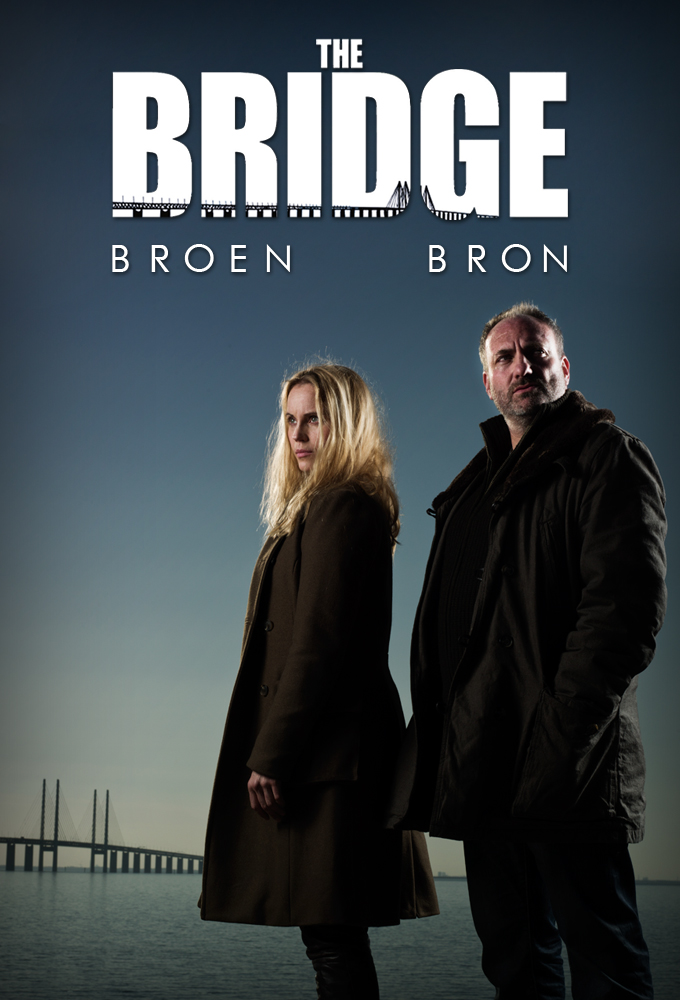
When a body is found on the bridge between Denmark and Sweden, right on the border, Danish inspector Martin Rohde and Swedish Saga Norén have to share jurisdiction and work together to find the killer.

112 Interesting Facts About Bron/Broen
Interesting Facts (28)
- #001
The car that Saga Norén drives is a 1977 Porsche 911S, originally sold in the Unites States with US specifications. The car was sold in 2010 and imported to Sweden where the car was modified to meet the European specifications, namely the taillights with separate amber-colored turn signal indicators and rear bumper with thinner bumper guards. Saga Norén revealed in Avsnitt 4 (2018) that she won the bet with her instructor who didn't believe she could graduate from the police academy. She did graduated and received his 911S as a prize.
- #002
- #003
- #004
Contrary to what the series suggests, Danes and Swedes don't always understand each other's languages; the creators chose to ignore that for the sake of fluent dialogue. Then again, people in the Malmö/Copenhagen region generally do understand each other when they speak their own languages as clearly as TV actors do.
- #005
- #006
- #007
- #008
- #009
Saga Norén drives a 1977 Porsche 911S first sold in the United States to US specifications. It was sold in 2010 and imported to Sweden, where it was converted to European spec, meaning rear lights with separate amber turn signals and a rear bumper with slimmer guards. In Avsnitt 4 (2018), Saga reveals that she won the car in a bet with her instructor, who didn't think she'd make it through the police academy; she graduated and the 911S was her prize.
- #010
- #011
- #012
Kim Bodnia told Walla! that, being Jewish, he wanted to bring in something about the anti-Semitic tensions in Malmö and Copenhagen. In seasons 1 and 2 the actors had been encouraged to suggest additions like that, but by season 3 things had changed and actors' ideas rarely got through. When his request was turned down, Bodnia decided to leave.
- #013
The third series launched in Scandinavia on 27 September 2015. As a nod to Kim Bodnia's exit, the opening episode's titles showed only Sofia Helin's name, leaving Bodnia's spot empty. From the second episode on, the opening titles presented Sofia Helin and Thure Lindhardt as the two leads.
- #014
- #015
- #016
- #017
- #018
- #019
- #020
- #021
- #022
- #023
- #024
- #025
- #026
- #027
- #028
Production Story (69)
- #029
- #030
- #031
- #032
- #033
- #034
- #035
- #036
- #037
During pre-production, series creator Hans Rosenfeldt never told the cast, including Sofia Helin, outright that Saga's social awkwardness came from being on the autism spectrum. He did describe to Ms. Helin the behavioral traits he wanted to see in Saga, but "feared any labels bestowed on Saga's odd-behaviour would prevent the actors from relating to the character in an individual and authentic manner." "I did not want them to all rush off and learn a "textbook" approach to Asperger's syndrome or autism from the same source material". By not giving cast and crew a label or category for Saga's behavior, "I hoped that each individual cast and crew member would have a more personal reaction to Saga's character traits and research accordingly".
- #038
- #039
- #040
- #041
- #042
- #043
- #044
- #045
- #046
- #047
- #048
- #049
- #050
- #051
- #052
Contains a major spoiler — show
Series three launched in Scandinavia on 27 September 2015. In a nod to Kim Bodnia's departure, the opening episode's titles showed Sofia Helin's name alone, with Bodnia's spot left blank. From episode two, the credits introduced Sofia Helin and Thure Lindhardt as the series' two protagonists.
- #053
- #054
Contains a major spoiler — show
Kim Bodnia was cast before Sofia Helin, but he left after the first 4 episodes of Season 3 had been written, because his character, now in prison, would have had a smaller role. The writers called his exit a "blessing in disguise": though they had to rewrite those first 4 episodes, it let them bring in a new character, Henrik, who opened up new possibilities for the series.
- #055
Danes and Swedes do not always understand each other's languages as much as the series suggests. However, the producers chose to ignore this fact for the sake of fluent dialogue. In the Malmö-Copenhagen region, after all, people can generally understand each other when they speak as clearly as television actors do.
- #056
- #057
This production set off a boom in interest in Scandinavian series and was sold to more than 100 countries. According to Sveriges Television, as of November 2013 the first season had found buyers for broadcast rights in 134 countries. The Daily Telegraph wrote in February 2014 that the series had aired in exactly 174 countries.
- #058
Kim Bodnia was cast before Sofia Helin. But when he learned that his character would have a smaller role in prison in season 3, he left the series after the first four episodes had been written. The writers described this departure as a 'blessed accident', because the new character Henrik allowed fresh opportunities to be added to the story, though they had to rewrite the first four episodes. In an interview with Walla!, Bodnia said he was of Jewish origin and wanted to reflect the antisemitic tensions in Malmö and Copenhagen in the script. While such contributions from actors were encouraged in the first two seasons, when the acceptance of suggestions became harder in season 3, Bodnia withdrew from the project.
- #059
Britain and France adapted the series into their own versions under the title The Tunnel. The American adaptation, set on the US-Mexico border and starring Diane Kruger and Demián Bichir, aired on FX between 2013 and 2015. This version, which begins with a body found on a bridge between El Paso and Juárez, was cancelled after two seasons. In 2018, Austria and Germany produced Pagan Peak, inspired by the series.
- #060
- #061
- #062
- #063
- #064
- #065
- #066
- #067
- #068
- #069
- #070
- #071
- #072
- #073
- #074
- #075
- #076
The third season had its Scandinavian premiere on 27 September 2015. As a nod to Kim Bodnia's departure, the credits of the first episode listed only Sofia Helin's name, and the spot previously occupied by Kim Bodnia was left empty. From the second episode onward, the credits showed Sofia Helin and Thure Lindhardt as the series' two leads.
- #077
The title sequence displays locations and landmarks closely familiar to residents around Malmö and Copenhagen. In the first season, the following appear in order: the Øresund Bridge; the view from the bridge toward Bunkeflostrand; the railway yard of Malmö Central Station, with Slagthuset on the left; Malmö's famous high-rise Turning Torso; the view toward Rådhuspladsen in Copenhagen, with the world's second-oldest amusement park, Tivoli, faintly visible on the left; the Öresundsverket power plant in Malmö, with the town of Arlöv in the background; Rigshospitalet, Denmark's largest specialised hospital and the setting of the series The Kingdom (1994); Slottsmöllan, an 1850s windmill near Malmöhus Castle; Den Lille Havfrue, Copenhagen's iconic statue inspired by Danish author Hans Christian Andersen's fairy tale The Little Mermaid; and the view from the bridge toward Amager and Copenhagen Airport.
- #078
The series' creator, Hans Rosenfeldt, avoided linking Saga's social awkwardness to the autism spectrum and did not state this explicitly to the actors, including Sofia Helin. He described certain behavioural traits of the character to Helin but said he 'feared that putting a label on Saga's quirks would prevent the actors from forming an individual and original connection with the character.' Rosenfeldt did not want the team to learn a 'textbook' style approach to Asperger's or autism from the same source; instead, he hoped everyone would develop a personal response to Saga's traits and do their own research.
- #079
- #080
The car driven by Saga Norén is a 1977 Porsche 911S originally produced for the US market. The vehicle was imported to Sweden in 2010 and adapted to European standards; in particular, orange-indicator tail lights and slimmer bumper guards were added. In a 2018 episode, Saga reveals that she won a bet with her instructor that she would not graduate from the police academy, and received this Porsche as the prize.
- #081
Danes and Swedes do not always understand each other's languages as much as the series shows. However, the producers chose to ignore this fact in favour of fluent dialogue. In the Malmö-Copenhagen region, after all, people can generally understand one another when spoken as clearly as television actors do.
- #082
- #083
This production sparked the boom in interest in Scandinavian series and was sold to more than 100 countries. According to Sveriges Television, as of November 2013 the first season had found buyers for broadcast rights in 134 countries. The Daily Telegraph wrote in February 2014 that the series had aired in exactly 174 countries.
- #084
Kim Bodnia was cast before Sofia Helin. However, when he learned that his character would have a smaller role in prison in season 3, he left the series after the first four episodes had been written. The writers described this departure as a 'blessed accident', because the new character Henrik allowed fresh opportunities to be added to the story, though they had to rewrite the first four episodes. In an interview with Walla!, Bodnia said he is of Jewish origin and wanted to reflect the antisemitic tensions in Malmö and Copenhagen in the script. While such contributions from actors were encouraged in the first two seasons, when it became harder to get suggestions accepted in season 3, Bodnia withdrew from the project.
- #085
The UK and France adapted the series into their own versions under the title The Tunnel. The American adaptation, set on the US-Mexico border and starring Diane Kruger and Demián Bichir, aired on FX between 2013 and 2015. That version, which begins with a body found on a bridge between El Paso and Juárez, was cancelled after two seasons. In 2018, Austria and Germany produced Pagan Peak, inspired by the series.
- #086
- #087
- #088
- #089
- #090
- #091
- #092
- #093
- #094
- #095
- #096
- #097
Behind the Scenes (5)
- #098
- #099
- #100
- #101
The third season's Scandinavian premiere took place on 27 September 2015. As a nod to Kim Bodnia's departure, only Sofia Helin's name appeared in the credits of the first episode, and the spot previously occupied by Kim Bodnia was left empty. From the second episode onward, the credits listed Sofia Helin and Thure Lindhardt as the series' two leads.
- #102
The title sequence displays locations and landmarks around Malmö and Copenhagen that are closely familiar to local residents. In the first season, the following appear in order: the Øresund Bridge; the view from the bridge toward Bunkeflostrand; the railway yard at Malmö Central Station, with Slagthuset on the left; Malmö's famous high-rise Turning Torso; the view toward Rådhuspladsen in Copenhagen, with the world's second-oldest amusement park, Tivoli, faintly visible on the left; the Öresundsverket power plant in Malmö, with the town of Arlöv in the background; Rigshospitalet, Denmark's largest specialised hospital and the setting of the series The Kingdom (1994); Slottsmöllan, an 1850s windmill near Malmöhus Castle; Den Lille Havfrue, Copenhagen's iconic statue inspired by Danish author Hans Christian Andersen's fairy tale The Little Mermaid; and the view from the bridge toward Amager and Copenhagen Airport.
Characters & Cast (4)
- #103
- #104
The series' creator, Hans Rosenfeldt, avoided linking Saga's social ineptitude to the autism spectrum and did not state this explicitly to the actors, including Sofia Helin. He described certain behavioral traits of the character to Helin, but said he 'feared that putting a label on Saga's quirks would prevent the actors from forming an individual and original connection with the character.' Rosenfeldt did not want the team to learn a 'textbook' style Asperger's or autism approach from the same source; instead, he hoped everyone would develop a personal response to Saga's traits and do their own research.
- #105
- #106
The car driven by Saga Norén is a 1977 Porsche 911S originally produced for the US market. The vehicle was imported to Sweden in 2010 and adapted to European standards; in particular, orange turn-signal taillights and slimmer bumper guards were added. In an episode in 2018, Saga explains that she won a bet with her instructor that she would not be able to graduate from the police academy, and that she received this Porsche as a reward.
Easter Eggs & References (3)
- #107
- #108
- #109
The intro shows places and landmarks that people in the Malmö and Copenhagen areas know well. In the first season they are, in order: * The bridge itself, in the title. * The view from the bridge toward Bunkeflostrand in Malmö. * Malmö Central Station, with Slagthuset on the left. * Turning Torso, Malmö's famous high-rise. * A view toward Copenhagen's Rådhuspladsen, with Tivoli, the world's second-oldest amusement park, just visible on the left. * Öresundsverket, a Malmö power plant, with the neighboring town of Arlöv behind it. * Rigshospitalet, Denmark's largest hospital and the setting of The Kingdom (1994). * Slottsmöllan, a windmill from 1850 near Malmöhus Castle. * Den Lille Havfrue, Copenhagen's iconic statue based on The Little Mermaid by Danish author Hans Christian Andersen. * A view from the bridge toward Amager and Copenhagen Airport.
Deeper Meaning (2)
Life & Family (1)
Sources & editorial notes
Reference databases
- Wikipedia
- IMDb
Information from external sources is independently selected, consolidated and edited by Arka Evren. Sources are listed for verification and further reading. Encyclopedia text is used under its licence (CC BY-SA). How we work