
TV SERIES · 2004–2012 · USA
House
- Created by
- David Shore
- Network
- FOX
- Seasons
- 8
- Episodes
- 176
- Studio
- Universal Television, Bad Hat Harry Productions, Heel & Toe Films
277 archived facts 8 topics 2 sources Last reviewed Nov 2026
Dr. Gregory House, a drug-addicted, unconventional, misanthropic medical genius, leads a team of diagnosticians at the fictional Princeton–Plainsboro Teaching Hospital in New Jersey.

277 Interesting Facts About House
Interesting Facts (37)
- #001
According to his book "Hamilton: The Revolution," Lin-Manuel Miranda says that the inspiration for the "Hamilton" song "You'll Be Back" came from his friendship with Hugh Laurie, which in turn came from his time as an actor on "House": "I was having a drink with Hugh Laurie, with whom I'd worked on his series House, and I told him I wanted to write a big breakup letter from King George to the colonies. Without blinking, he improvised at me, 'Awwww, you'll be back,' wagging his finger. I laughed and filed it away. Thanks, Hugh Laurie."
- #002
- #003
- #004
Dr. Robert Chase was written initially as a British man. Although, shortly before production began, producers wanted to change him to an American. However, while he can perform an American accent (and does in a couple of episodes of the show), Jesse Spencer, who is Australian, successfully lobbied for the character to be Australian instead. He wanted it because scripts had to be changed anyway, and he felt that American television had rarely seen a non-stereotypical Australian character.
- #005
- #006
- #007
- #008
Contains a major spoiler — show
Lisa Edelstein left the show after shooting the season seven finale. According to series creator David Shore, if Edelstein had told them she wasn't coming back, he wouldn't have ended the season as he did and would have written the character out as she deserved it.
- #009
- #010
- #011
- #012
- #013
- #014
- #015
- #016
- #017
- #018
- #019
Dr. Robert Chase was initially written as an Englishman. Shortly before production began, however, the producers wanted to change him into an American. Although he can display an American accent (and does so in several episodes of the series), the Australian Jesse Spencer successfully lobbied for the character to be Australian instead. He wanted this because the scripts already had to be changed and he felt that American television rarely showed a non-stereotypical Australian character.
- #020
- #021
- #022
Although the Diagnostic Medicine team deals with all kinds of illnesses, Dr. Gregory House (Hugh Laurie) and his colleagues hold titles in various subspecialties: Dr. Eric Foreman (Omar Epps) is a neurologist; Dr. Allison Cameron (Jennifer Morrison) is an immunologist/allergist; Dr. Robert Chase (Jesse Spencer) is an intensivist; Dr. Chris Taub (Peter Jacobson) is a plastic surgeon; Dr. Lawrence Kutner (Kal Penn) specialized in sports medicine; Dr. Remy "Thirteen" Hadley (Olivia Wilde) is an internist; and Dr. House is double board-certified in infectious diseases and nephrology (as stated in season one, episode three, "Occam's Razor").
- #023
At the beginning of the first season, FOX insisted that House needed an adversary, or someone who would tell him he could not behave that way. Although creator David Shore was hesitant about the idea, he created Edward Vogler (Chi McBride) and said from the start that he would appear in only five episodes and then leave the series.
- #024
- #025
- #026
- #027
- #028
- #029
- #030
- #031
The series was inspired by the New York Times Magazine's Diagnosis column, which highlighted unusual medical cases. Executive producer Paul Attanasio developed the concept and pitched it to the networks as a medical procedural. Creator David Shore turned the idea into a character drama in which the medical cases became a device rather than the focus of the storytelling.
- #032
After receiving an honorary doctorate in fine arts, television satirist Stephen Colbert placed several pictures of the famous television doctors who inspired him on the front cover of his show's set. One of them is Hugh Laurie as Dr. Gregory House. The others are Bill Cosby as Dr. Cliff Huxtable and Noah Drake from General Hospital (1963). In response, the creators of this series placed a picture of Colbert on Gregory House's desk, where it can occasionally be seen during the show's fifth season. Because Laurie's show won an Emmy against Colbert's and Laurie received an OBE (Officer of the Most Excellent Order of the British Empire), which Colbert could not receive (he could not receive it because he is not British), Colbert named House on his enemies list.
- #033
- #034
Although Hugh Laurie's American accent for the character of Gregory House seems effortlessly flawless, the actor himself has said he never felt fully comfortable performing it. He dropped it as soon as the cameras stopped, and in talk show interviews during the series' heyday he never agreed, when asked, to use the American accent instead of his natural voice, even for a single sentence. Laurie said that when reading his lines in a new script, the words he most feared seeing were "New York"; saying those words made him feel the strangest and most exposed he had ever felt while performing the American accent.
- #035
- #036
Carlos Sanson Jr., who will take a lead role, is known for 'Bump' and 'Paper Dolls'. Rosario Dawson's notable credits include 'Ahsoka' and '25th Hour'. George Lopez has appeared in 'Lopez vs. Lopez' and 'Blue Beetle'. Gina Rodriguez will both sit in the director's chair and appear in the cast.
- #037
Production Story (92)
- #038
- #039
- #040
- #041
At the beginning of the first season, FOX insisted that House must have some enemy or someone telling him he couldn't behave like that. However, while creator David Shore was hesitant about the idea, he created Edward Vogler (Chi McBride), saying from the beginning that he would only be in five episodes and then leave the show.
- #042
The show was inspired by the New York Times Magazine's Diagnosis column, which spotlights unusual medical cases. Executive producer Paul Attanasio developed the concept and pitched it to the networks as a medical procedural. Creator David Shore revised the idea into a character drama where the medical cases became a device instead of the focus of the storytelling.
- #043
- #044
- #045
- #046
On Inside the Actors Studio (1994), Hugh Laurie admitted that when he first read the script for this show (which did not have the title of "House M.D." at the time), he believed that the character of Wilson was the lead. He couldn't think that a man such as House could be the star of the show.
- #047
- #048
- #049
- #050
- #051
- #052
- #053
Dr. Robert Chase was initially written as a British man, although shortly before production began, producers wanted to change him to an American. However, while he can perform an American accent (and does in a couple of episodes of the show), Jesse Spencer, who is Australian, successfully lobbied for the character to be Australian instead. He wanted it because scripts had to be changed anyway, and he felt that American television had rarely seen a non-stereotypical Australian character.
- #054
- #055
Contains a major spoiler — show
Lisa Edelstein left the show after shooting the season seven finale. According to series creator David Shore, if Edelstein had told them she wasn't coming back, he wouldn't have ended the season as he did and would have written the character out as she deserved.
- #056
Contains a major spoiler — show
In April 2009, Kal Penn told Entertainment Weekly magazine that the writers killed off his character on this show because he had asked to be allowed to leave the show to work for the Barack Obama administration as the Associate Director in the White House Office of Public Liaison.
- #057
Contains a major spoiler — show
According to series creator David Shore, House was inspired by the fictional character Sherlock Holmes, created by Arthur Conan Doyle for the 1887 novel A Study in Scarlet. Holmes himself was inspired by a real-life doctor, Dr. Joseph Bell, who was Doyle's teacher and mentor when he was a university student and whose specialty was diagnostic medicine. House also uses Holmesian deductive techniques to diagnose his patients' problems. Some of the parallels between the two characters include: both characters are noted for their drug use and their desire (and ability) to solve the seemingly unsolvable; House's apartment number is 221B, the same as Sherlock Holmes' famous Baker Street address; House's close friendship with Dr. James Wilson parallels the relationship between Holmes and Dr. Watson; in addition, even though they are best friends, House and Wilson address each other only by their last names, as Holmes and Watson always did; in the pilot episode, the patient's last name is Adler, referencing Irene Adler from the very first of the Sherlock Holmes short stories, A Scandal in Bohemia; in the season two finale, the man who shoots House is named Moriarty, the same name as Holmes' greatest enemy, Professor Moriarty; in season three, episode fifteen ("Half-Wit"), House pretends to have cancer, similar to the Holmes story "The Adventure of the Dying Detective," in which Holmes fakes a deadly Eastern disease to catch a criminal; in season five, episode eleven ("Joy to the World"), Wilson gives House Joseph Bell's Manual of the Operations of Surgery as a Christmas present, Bell being the real-life doctor who inspired Sherlock Holmes; Wilson jokingly claims that House once had an infatuation with a patient named Irene Adler, referencing the Holmes character who famously outwitted him; House once believed that his biological father was a family friend named Thomas Bell, echoing the name of Dr. Joseph Bell, the real-life inspiration for Holmes; in the series finale, House fakes his own death, mirroring how Sherlock Holmes was believed to have died after his final struggle with Moriarty. Sherlock Holmes has also inspired fictional 21st-century detectives such as Dr. Gil Grissom and D.B. Russell from CSI: Crime Scene Investigation (2000), Detective Robert Goren from Law & Order: Criminal Intent (2001), Adrian Monk from Monk (2002), Shawn Spencer from Psych (2006), and Patrick Jane from The Mentalist (2008).
- #058
- #059
- #060
- #061
- #062
- #063
- #064
- #065
- #066
- #067
- #068
Dr. Gregory House's (Hugh Laurie's) most famous line, "Everybody lies," was used by another doctor about a year and a half earlier, in the pilot episode of the sitcom Scrubs (2001), another medical program. In the second season, twelfth episode, "My New Old Friend," Bob Kelso (Ken Jenkins) says, "Everybody lies, Dr. Turk," after being unable to stop an elderly woman who says Dr. Chris Turk (Donald Faison) is well enough to drive and needs to pick up his grandchildren from going home.
- #069
- #070
- #071
- #072
- #073
- #074
- #075
- #076
Dr. House's Hungarian voice actor, Sándor Szakácsi, passed away in March 2007. Unfortunately, he had only completed dubbing eleven episodes of the second season. The television channel decided to use the unfinished work as a tribute to him; for this reason, in the first half of the second season's twelfth episode, 'Distractions,' Sándor's voice is still heard, while the new voice actor, János Kulka, took over. The commercial break (only one in Hungary) was placed at the point of this change, in the middle of a scene.
- #077
One of the show's main settings, 'House,' takes place in the Mercer County area of New Jersey, and the credits feature footage of various locations around Princeton, Trenton, West Windsor and Plainsboro, including Princeton University. However, the hospital, Princeton-Plainsboro Teaching Hospital, is based on a real hospital in Princeton, Princeton Hospital, Princeton University Medical Center. One of the show's producers and the director of the pilot episode, Bryan Singer, is from this area and attended West Windsor-Plainsboro High School.
- #078
- #079
- #080
- #081
- #082
- #083
- #084
- #085
Dr. Robert Chase was initially written as British. However, shortly before production began, the producers wanted to make him American. Jesse Spencer, who is Australian, successfully lobbied for the character to be Australian, since the scripts already had to change and he thought a non-stereotypical Australian character was rarely seen on American television.
- #086
On Inside the Actors Studio, when a student asked Hugh Laurie whether Dr. House should have a romantic relationship with Dr. Allison Cameron, Dr. Lisa Cuddy or Dr. James Wilson, Laurie said, 'I suspect if the show goes on long enough, he'll be with all of them. It's not up to me in what order that happens. I think each of those relationships is of course believable. Two people can always find a comfort or an attraction, so they're all possible. Robert (Robert Sean Leonard, who plays Dr. Wilson) might have something to say about that. I don't know how Robert would take it. But I'm in.'
- #087
Although the diagnostic team deals with all kinds of diseases, Dr. Gregory House (Hugh Laurie) and his colleagues have titles in various subspecialties: Dr. Eric Foreman (Omar Epps) is a neurologist. Dr. Allison Cameron (Jennifer Morrison) is an immunologist/allergist. Dr. Robert Chase (Jesse Spencer) is an intensivist. Dr. Chris Taub (Peter Jacobson) is a plastic surgeon. Dr. Lawrence Kutner (Kal Penn) specializes in sports medicine. Dr. Remy 'Thirteen' Hadley (Olivia Wilde) is an internist. Dr. House is double board-certified in infectious diseases and nephrology (as stated in the first season's third episode, 'Occam's Razor').
- #088
According to the book 'Hamilton: The Revolution', Lin-Manuel Miranda says the inspiration for the song 'You'll Be Back' from 'Hamilton' came from his friendship with Hugh Laurie: 'I was having a drink with Hugh Laurie, we had worked together on his show House, and I told him I wanted to write a big breakup letter from King George to the colonies. Without any hesitation he improvised for me: 'Awwww, you'll be back,' wagging his finger. I laughed and took note. Thank you, Hugh Laurie.'
- #089
- #090
- #091
- #092
- #093
Although the American accent Hugh Laurie used for the character of Gregory House seems flawless, the actor said he never felt fully comfortable with it. As soon as the cameras stopped he would immediately drop the accent, and at the height of the series he refused to use the American accent in talk show interviews even when asked. Laurie said that what he feared most was seeing the word 'New York' in a new script; saying those words were the moments he felt strangest and most exposed while using the American accent.
- #094
- #095
- #096
- #097
At the start of season 4, Dr. Remy Hadley's (Olivia Wilde) nickname 'Thirteen' comes from the first episodes. House tries to build a new team from thirty candidates and gives them numbers from one to thirty. Dr. Hadley gets the number 'Thirteen', which many consider unlucky. Despite the bad omen she makes the team, but the nickname sticks.
- #098
- #099
House actors also appeared in the series Psych (2006). For example, Anne Dudek played Lucinda in the pilot episode, and appeared in House as Dr. Amber Volakis in season 4 and part of season 5. Jimmi Simpson appeared as Mary in the sixteenth episode of Psych's third season, and as Daniel Bresson in the fifteenth episode of House's fifth season. Michael Weston played Adam Hornstock in the twelfth episode of Psych's first season, and Lucas Douglas in part of House's fifth season. Frank Whaley appears as Robert in the seventh episode of Psych's first season, and as Mr. X in the fifth episode of House's fourth season. Kurtwood Smith played Brett Connors in the tenth episode of Psych's first season, and Dr. Obyedkov in the fifteenth episode of House's third season. Scott Michael Campbell appears as Wes Hildenbach in the sixth episode of Psych's first season, and as Joe Luria in the twentieth and twenty-first episodes of House's second season. Mackenzie Astin played Jason Cunningham in the fifteenth episode of Psych's third season, and Alan Alston in the seventeenth episode of House's second season. Franka Potente appeared as Nadia in the ninth episode of Psych's fifth season, and as Lydia in the first and second episodes of House's sixth season.
- #100
- #101
- #102
- #103
- #104
- #105
- #106
- #107
- #108
At the start of the first season, FOX insisted that House have an adversary who told him he could not treat people that way. Although David Shore was not keen on the idea, he created the character Edward Vogler, played by Chi McBride, and said from the outset that he would appear in only five episodes before leaving.
- #109
- #110
The series was inspired by the New York Times Magazine's Diagnosis column, which dealt with unusual medical cases. Producer Paul Attanasio developed the concept and pitched it to the networks as a medical procedural. Creator David Shore, however, turned the idea into a character drama in which medical cases are the vehicle rather than the focus of the storytelling.
- #111
- #112
- #113
Although the age of consent in New Jersey, where the series is set, is 16, the producers chose to use 18 as the threshold. This was to avoid 'underage' storylines and prevent viewer backlash. However, in season 7, episode 10, when Dr. Robert Chase learns that a woman is 17, she tells him it is not illegal.
- #114
- #115
- #116
- #117
- #118
- #119
According to series creator David Shore, House was inspired by the fictional character Sherlock Holmes, created by Arthur Conan Doyle in his 1887 novel A Study in Scarlet. Holmes, in turn, was inspired by Dr. Joseph Bell, a real doctor who specialized in diagnostic medicine and was Doyle's teacher and mentor when Doyle was a university student. House also uses Holmesian deductive techniques to diagnose his patients' problems. Some of the parallels between the two characters are as follows: Both are known for their drug use and their desire (and ability) to solve the seemingly unsolvable. House's apartment number is 221B, just like Sherlock Holmes's famous Baker Street address. House's close friendship with Dr. James Wilson mirrors the relationship between Holmes and Dr. Watson. Furthermore, despite being best friends, House and Wilson address each other only by their surnames, just as Holmes and Watson do. In the pilot episode, the patient's surname is Adler, a nod to Irene Adler in A Scandal in Bohemia, the first of the Sherlock Holmes stories. In the second season finale, the man who shoots House is named Moriarty, the same name as Holmes's greatest enemy, Professor Moriarty. In the fifteenth episode of the third season ("Half-Wit"), House fakes cancer, similar to the story "The Adventure of the Dying Detective," in which Holmes feigns a deadly Eastern disease to catch a criminal. In the eleventh episode of the fifth season ("Joy to the World"), Wilson gives House Joseph Bell's Manual of the Operations of Surgery as a Christmas gift. Bell is the real doctor who inspired Sherlock Holmes. Wilson jokingly claims that House was once interested in a patient named Irene Adler, a nod to the character who outwitted Holmes. House once believes that his biological father was a family friend named Thomas Bell, reflecting the name of Dr. Joseph Bell, the real-life inspiration for Holmes. In the series finale, House fakes his own death, reflecting how Sherlock Holmes was believed to have died after his final struggle with Moriarty. Sherlock Holmes also inspired 21st-century fictional detectives: Dr. Gil Grissom and D.B. Russell from CSI: Crime Scene Investigation, Detective Robert Goren from Law & Order: Criminal Intent, Adrian Monk from Monk, Shawn Spencer from Psych and Patrick Jane from The Mentalist.
- #120
- #121
After receiving an honorary doctorate of fine arts, television satirist Stephen Colbert placed pictures of other famous television doctors who inspired him on the mantelpiece on the set of his show. One of them was Dr. Gregory House, played by Hugh Laurie. The others were Bill Cosby as Dr. Cliff Huxtable and Noah Drake from General Hospital. In return, the creators of this series placed a picture of Colbert on Gregory House's desk in the fifth season, and it could occasionally be seen. Because Laurie's series won an Emmy against Colbert's show and Laurie received an OBE (Order of the British Empire) while Colbert could not (which he could not receive since he is not British), Colbert added House to his enemies list.
- #122
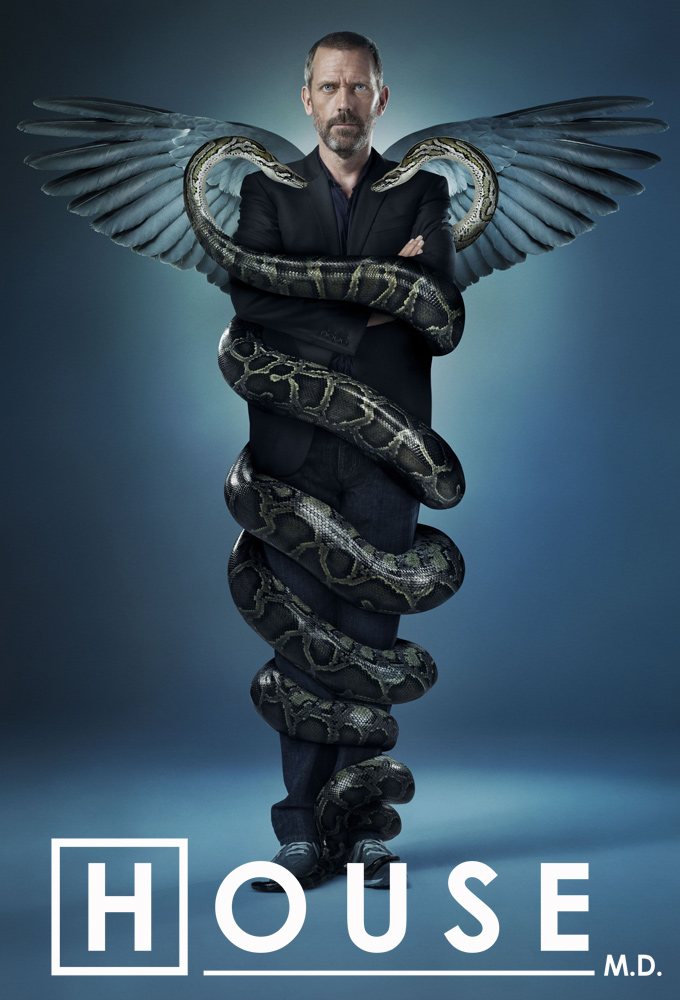
In one of the promotional posters, Hugh Laurie appeared entwined by two snakes with a pair of wings behind him, a recreation of the Greek Caduceus symbol. International fans may also find this confusing because the correct symbol is the Rod of Asclepius, which has a single snake and no wings. However, in the US, the Caduceus is used just as commonly as the correct Rod of Asclepius and became popular at the turn of the century. Because the Caduceus is a symbol associated with the Greek god Hermes, its use has long been a subject of debate and satire in the US medical community.
- #123
Dr. Gregory House's (Hugh Laurie) most famous line, "Everybody lies," had been used about a year and a half before the pilot episode in another medical series, the comedy Scrubs. In the second season's twelfth episode, "My New Old Friend," Dr. Bob Kelso (Ken Jenkins) says "Everybody lies, Dr. Turk" when Dr. Chris Turk (Donald Faison) is unable to stop an elderly woman from going home after she says she is well enough to drive and needs to pick up her grandchildren.
- #124
- #125
- #126
- #127
- #128
- #129
Behind the Scenes (37)
- #130
As one of the primary show settings, "House" takes place in the Mercer County area of New Jersey, and in opening credits, there are shots of various locations around the area of Princeton, Trenton, West Windsor, and Plainsboro, including Princeton University. However, the hospital, Princeton-Plainsboro Teaching Hospital, was based on a real hospital in Princeton, Princeton Hospital, the University Medical Center at Princeton. An executive producer and the pilot episode director, Bryan Singer, is from the area and attended West Windsor-Plainsboro High School.
- #131
- #132
- #133
- #134
- #135
- #136
According to his book, "Hamilton: The Revolution," Lin-Manuel Miranda says that the inspiration for the "Hamilton" song "You'll Be Back" came from his friendship with Hugh Laurie, which in turn came from his time as an actor on "House": "I was having a drink with Hugh Laurie, with whom I'd worked on his series House, and I told him I wanted to write a big breakup letter from King George to the colonies. Without blinking, he improved at me, 'Awwww, you'll be back,' wagging his finger. I laughed and filed it away. Thanks, Hugh Laurie. "
- #137
- #138
Bryan Singer, who directed the pilot and had significant input in casting the primary roles, said the pilot's title was Everybody Lies and that this was the premise of House; Shore has said several early episodes drew their central storylines from the work of Berton Roueché, a New Yorker staff writer from 1944 to 1994 who specialized in unusual medical cases.
- #139
- #140
- #141
- #142
- #143
House frequently employs the "walk and talk" filming technique, in which tracking shots follow two or more characters as they move between locations while talking. Executive producer Katie Jacobs said the show relies on the technique because putting a scene on the move creates urgency and intensity.
- #144
- #145
- #146
- #147
- #148
- #149
- #150
Dr. House's Hungarian voice actor, Sándor Szakácsi, passed away in March 2007. Unfortunately, he had only completed the dubbing for eleven episodes of the second season. The television channel decided to use the unfinished work as a tribute to him; therefore, in the first half of the second season's twelfth episode, 'Distractions', Sándor's voice is still heard, while the new voice actor, János Kulka, took over. The commercial break (only one in Hungary) was placed at the point of this change, in the middle of a scene.
- #151
'House', one of the series' main locations, is set in Mercer County, New Jersey, and the opening credits include footage of various places around Princeton, Trenton, West Windsor and Plainsboro, including Princeton University. However, the hospital, Princeton-Plainsboro Teaching Hospital, is based on Princeton Hospital, a real hospital in Princeton, and Princeton University Medical Center. One of the series' producers and the director of the pilot episode, Bryan Singer, is from this area and attended West Windsor-Plainsboro High School.
- #152
- #153
- #154
- #155
- #156
- #157
- #158
At the beginning of the first season, FOX insisted that House have an enemy who told him he could not treat people that way. Although David Shore was not warm to the idea, he created the character Edward Vogler, played by Chi McBride, and said from the outset that he would appear in only five episodes and then leave.
- #159
- #160
The series was inspired by the New York Times Magazine's Diagnosis column, which dealt with unusual medical cases. Producer Paul Attanasio developed the concept and pitched it to the networks as a medical procedural. Creator David Shore, however, transformed the idea into a character drama in which medical cases were the vehicle rather than the focus of the storytelling.
- #161
- #162
- #163
Although the age of consent in New Jersey, where the series is set, is 16, the producers chose to use a limit of 18. This was to avoid 'underage' scenarios and prevent viewer backlash. However, in season 7, episode 10, when Dr. Robert Chase learns that a woman is 17, she tells him that this is not illegal.
- #164
- #165
- #166
Characters & Cast (78)
- #167
Dr. Eric Foreman (Omar Epps) never wears the same outfit twice.
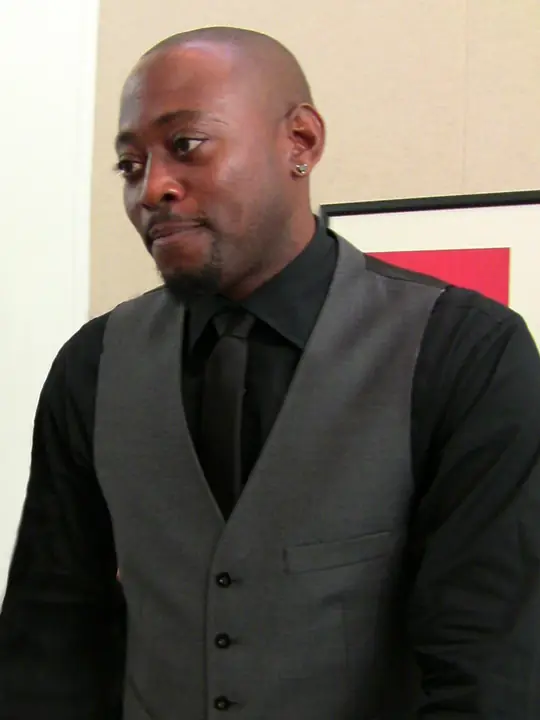
House (2004): Omar Epps in formal attire at an eventImage: Wikimedia Commons · Kristin Dos Santos, CC BY-SA 2.0 - #168
- #169
- #170
- #171
- #172
Although the Diagnostic Medicine team deals with all types of diseases, Dr. Gregory House (Hugh Laurie) and his colleagues hold titles in various subspecialties: Dr. Eric Foreman (Omar Epps) is a neurologist; Dr. Allison Cameron (Jennifer Morrison) is an immunologist/allergist; Dr. Robert Chase (Jesse Spencer) is an intensivist; Dr. Chris Taub (Peter Jacobson) is a plastic surgeon; Dr. Lawrence Kutner (Kal Penn) specialized in sports medicine; Dr. Remy "Thirteen" Hadley (Olivia Wilde) is an internist; and Dr. House is double-certified in infectious disease and nephrology (as mentioned in season one, episode three, "Occam's Razor").
- #173
Though Hugh Laurie's American accent for the Gregory House character seems effortlessly flawless, the actor himself has said he never once felt fully comfortable performing the accent. He immediately stepped out of it when cameras stopped rolling, and in talk show interviews held while the series was in its heyday, he never acceded to using the American accent instead of his natural voice when asked (not even for a single sentence). Laurie has said that he most dreaded seeing the words "New York" when reading his lines in a new script; saying those words made him feel the most awkward and exposed he ever did while performing the American accent.
- #174
At the beginning of Season 4, Dr. Remy Hadley's (Olivia Wilde) nickname "Thirteen" originates from the first few episodes. House tries to hire a new team from a possible thirty candidates. He assigns them numbers from one to thirty. Dr. Hadley has the number "Thirteen," which many consider unlucky. Despite the bad omen, she makes the team, but the name sticks.
- #175
After a student in the audience of Hugh Laurie's edition of Inside the Actors Studio (1994) asked Laurie if he thought Dr. House should be romantically involved with Dr. Allison Cameron, Dr. Lisa Cuddy or Dr. James Wilson, Laurie said, "I suspect that if the show runs long enough, he's going to run through all of them. What order that unfolds in is not for me to say. I think any of those relationships is, of course, believable. Two people can always find some comfort or attraction, so I think all are possible. I think Robert (Robert Sean Leonard, who plays Dr. Wilson) might have something to say about it. I don't know how Robert would take that. But you know, I'm game."
- #176
- #177
- #178
- #179
- #180
- #181
- #182
- #183
- #184
- #185
- #186
- #187
- #188
- #189
- #190
- #191
Jennifer Morrison considered her audition for Dr. Allison Cameron on House a total failure, yet the director Singer had already seen some of her work, including on Dawson's Creek, and wanted her for the part; she departed the series when the character was written out midway through season six.
- #192
- #193
Contains a major spoiler — show
House's new team is revealed in the ninth episode of season four as Foreman alongside doctors Lawrence Kutner, Chris Taub and Remy "Thirteen" Hadley; rejected candidates did not return except Amber Volakis, who recurred as Wilson's girlfriend and later as a hallucination of House's.
- #194
- #195
- #196
- #197
- #198
- #199
- #200
- #201
- #202
- #203
- #204
Dr. Robert Chase was initially written as English. However, shortly before production began, the producers wanted to make him American. Jesse Spencer, who is Australian, successfully lobbied for the character to be Australian, since the scripts already had to be changed and he thought a non-stereotypical Australian character was rarely seen on American television.
- #205
On Inside the Actors Studio, when a student asked Hugh Laurie whether Dr. House should have a romantic relationship with Dr. Allison Cameron, Dr. Lisa Cuddy or Dr. James Wilson, Laurie said, "I suspect that if the series runs long enough, he will be with all of them. It is not up to me in what order that happens. I think each of those relationships is of course believable. Two people can always find a comfort or an attraction, so they are all possible. Robert (Robert Sean Leonard, who plays Dr. Wilson) might have something to say about that. I do not know how Robert would take it. But I am in."
- #206
Although the diagnostic team deals with all kinds of diseases, Dr. Gregory House (Hugh Laurie) and his colleagues have titles in various subspecialties: Dr. Eric Foreman (Omar Epps) is a neurologist. Dr. Allison Cameron (Jennifer Morrison) is an immunologist/allergist. Dr. Robert Chase (Jesse Spencer) is an intensivist. Dr. Chris Taub (Peter Jacobson) is a plastic surgeon. Dr. Lawrence Kutner (Kal Penn) specializes in sports medicine. Dr. Remy 'Thirteen' Hadley (Olivia Wilde) is an internist. Dr. House, meanwhile, is double board-certified in infectious diseases and nephrology (as stated in the first season's third episode, "Occam's Razor").
- #207
According to the book "Hamilton: The Revolution," Lin-Manuel Miranda says the inspiration for the song "You'll Be Back" from "Hamilton" came from his friendship with Hugh Laurie: "I was having a drink with Hugh Laurie, we had worked together on his show House, and I told him I wanted to write King George writing a big breakup letter to the colonies. Without any hesitation he improvised for me: 'Awwww, you'll be back,' wagging his finger. I laughed and took a note. Thank you, Hugh Laurie."
- #208
- #209
- #210
- #211
- #212
- #213
- #214
Although the American accent Hugh Laurie uses for the character of Gregory House seems flawless, the actor said he never felt fully comfortable with it. He would drop the accent as soon as the cameras stopped, and at the height of the series he refused to use the American accent in talk show interviews even when asked. Laurie said what he feared most was seeing the word "New York" in a new script; saying those words was when he felt the strangest and most exposed while using the American accent.
- #215
- #216
- #217
- #218
- #219
- #220
- #221
At the start of season four, Dr. Remy Hadley's (Olivia Wilde) nickname 'Thirteen' comes from the first episodes. House tries to build a new team from thirty candidates and gives them numbers from one to thirty. Dr. Hadley receives the number 'Thirteen', which many consider unlucky. Despite the bad omen she makes the team, but the nickname sticks.
- #222
- #223
House cast members also appeared on the series Psych (2006). For example, Anne Dudek played Lucinda in the pilot episode, and appeared on House as Dr. Amber Volakis in season four and part of season five. Jimmi Simpson appeared as Mary in the sixteenth episode of Psych's third season, and as Daniel Bresson in the fifteenth episode of House's fifth season. Michael Weston played Adam Hornstock in the twelfth episode of Psych's first season, and Lucas Douglas in part of House's fifth season. Frank Whaley appears as Robert in the seventh episode of Psych's first season, and as Mr. X in the fifth episode of House's fourth season. Kurtwood Smith played Brett Connors in the tenth episode of Psych's first season, and Dr. Obyedkov in the fifteenth episode of House's third season. Scott Michael Campbell appeared as Wes Hildenbach in the sixth episode of Psych's first season, and as Joe Luria in the twentieth and twenty-first episodes of House's second season. Mackenzie Astin played Jason Cunningham in the fifteenth episode of Psych's third season, and Alan Alston in the seventeenth episode of House's second season. Franka Potente appeared as Nadia in the ninth episode of Psych's fifth season, and as Lydia in the first and second episodes of House's sixth season.
- #224
- #225
- #226
- #227
- #228
- #229
One of the movie posters in Dr. James Wilson's (Robert Sean Leonard) office is Orson Welles's 1958 film Touch of Evil. In the film, Welles plays a detective with a lame leg who solves crimes entirely through his intuition; this character is an inspiration for Dr. Gregory House (Hugh Laurie).
- #230
According to series creator David Shore, House was inspired by the fictional character Sherlock Holmes, created by Arthur Conan Doyle in his 1887 novel A Study in Scarlet. Holmes, in turn, was inspired by Dr. Joseph Bell, a real doctor specializing in diagnostic medicine who was Doyle's teacher and mentor when he was a university student. House also uses Holmesian deductive techniques to diagnose his patients' problems. Some of the parallels between the two characters are as follows: Both are known for their drug use and their desire (and ability) to solve the seemingly unsolvable. House's apartment number is 221B, just like Sherlock Holmes's famous Baker Street address. House's close friendship with Dr. James Wilson mirrors the relationship between Holmes and Dr. Watson. Also, despite being best friends, House and Wilson address each other only by their last names, just as Holmes and Watson do. In the pilot episode, the patient's last name is Adler; this is a nod to Irene Adler in A Scandal in Bohemia, the first of the Sherlock Holmes stories. In the second-season finale, the man who shoots House is named Moriarty; this is the same name as Holmes's greatest enemy, Professor Moriarty. In the fifteenth episode of the third season ("Half-Wit"), House fakes cancer; this resembles the story "The Adventure of the Dying Detective," in which Holmes feigns a deadly Eastern disease to catch a criminal. In the eleventh episode of the fifth season ("Joy to the World"), Wilson gives House Joseph Bell's Manual of the Operations of Surgery as a Christmas gift. Bell is the real doctor who inspired Sherlock Holmes. Wilson jokingly claims that House was once interested in a patient named Irene Adler; this is a nod to the character who outwitted Holmes. House once believes that his biological father was a family friend named Thomas Bell; this echoes the name of Dr. Joseph Bell, Holmes's real-life inspiration. In the series finale, House fakes his own death; this mirrors the belief that Sherlock Holmes died after his final struggle with Moriarty. Sherlock Holmes has also inspired 21st-century fictional detectives: Dr. Gil Grissom and D.B. Russell from CSI: Crime Scene Investigation, Detective Robert Goren from Law & Order: Criminal Intent, Adrian Monk from Monk, Shawn Spencer from Psych and Patrick Jane from The Mentalist, among others.
- #231
- #232
- #233
- #234
After receiving an honorary doctorate of fine arts, television satirist Stephen Colbert placed pictures of other famous television doctors who inspired him on the mantelpiece on his show's set. One of them was Dr. Gregory House, played by Hugh Laurie. The others were Bill Cosby as Dr. Cliff Huxtable and Noah Drake from General Hospital. In return, the creators of this series placed a picture of Colbert on Gregory House's desk in the fifth season, and it could occasionally be seen. Because Laurie's series won an Emmy against Colbert's show and Laurie received an OBE (Order of the British Empire) while Colbert did not (which he could not, as he is not British), Colbert added House to his enemies list.
- #235
In one of the promotional posters, Hugh Laurie appeared wrapped in two snakes with a pair of wings behind him; this was a recreation of the Greek Caduceus symbol. International fans may also find this confusing, because the correct symbol is the staff of Asclepius, which has a single snake and no wings. In the US, however, the Caduceus is used just as commonly as the correct Rod of Asclepius and became popular at the turn of the century. Because the Caduceus is a symbol associated with the Greek god Hermes, its use has long been a subject of debate and satire in the American medical community.
- #236
- #237
Dr. Gregory House's (Hugh Laurie) most famous line, "Everybody lies," had been used about a year and a half before the pilot episode in another medical series, the comedy Scrubs. In the second-season, twelfth episode "My New Old Friend," when Dr. Chris Turk (Donald Faison) cannot stop an elderly woman from going home after she says she is well enough to drive and needs to pick up her grandchildren, Dr. Bob Kelso (Ken Jenkins) says, "Everybody lies, Dr. Turk."
- #238
- #239
- #240
- #241
- #242
- #243
- #244
Easter Eggs & References (19)
- #245
One of the promotional posters featured Hugh Laurie wrapped in two snakes with a pair of wings behind him, a re-creation of the Greek Caduceus symbol. Additionally, international fans might be confused by this because the correct symbol is the rod of Asclepius, the healer, a similar symbol having only one coiled snake and no wings. However, within the U.S., the Caduceus is as commonly used as the correct rod of Asclepius, popularized around the turn of the century. As the Caduceus is the symbol associated with the Greek god Hermes, a symbol of wisdom, its use has long been a point of controversy and satirical humor within the U.S. medical community.
- #246
- #247
- #248
- #249
- #250
- #251
- #252
Dr. Gregory House's (Hugh Laurie's) most famous line, "Everybody lies," was used by another doctor about a year and a half before the pilot episode in another medical show, the sitcom Scrubs (2001). Dr. Bob Kelso (Ken Jenkins) says, "Everybody lies, Dr. Turk," in season two, episode twelve, "My New Old Friend," after Dr. Chris Turk (Donald Faison) failed to prevent an old lady from driving home because she said she was fine enough to drive and that she had to pick up her grandkids.

House (2004): Hugh Laurie in a pinstripe suit in a director's chair at a panelImage: Wikimedia Commons · LaurieJacobsShore.jpg : Photograph taken and granted by Flickr user X…, CC BY 2.0 - #253
- #254
- #255
- #256
In Dead Poets Society (1989), Robert Sean Leonard played a character under pressure from his father to become a doctor, but whose passion was to become an actor.
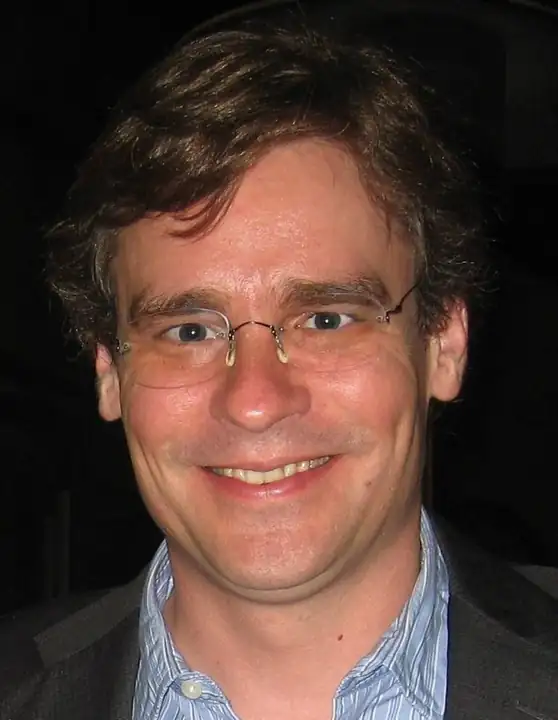
House (2004): Robert Sean Leonard in glasses, a suit and smilingImage: Wikimedia Commons · Robert_Sean_Leonard_with_Roberta_Romero.jpg : Roberta Romero, alias b…, CC BY 2.0 - #257
- #258
- #259
- #260
- #261
After receiving his honorary doctorate in fine arts, television satirist Stephen Colbert placed several pictures of other famous television doctors who inspired him on the mantelpiece of his show's set. One of these is Hugh Laurie as Dr. Gregory House. The others are Bill Cosby as Dr. Cliff Huxtable and Noah Drake from General Hospital (1963). In response, the creators of this show placed a picture of Colbert on the desk of Gregory House in the show's fifth season, which can be seen from time to time. Because Laurie's show won an Emmy over Colbert's, and because Laurie received an OBE (Officer of the Most Excellent Order of the British Empire) while Colbert did not (nor could he, since he is not British), Colbert named House to his enemies list.
- #262
- #263
Deeper Meaning (2)
- #264
- #265
One of the promotional posters featured Hugh Laurie wrapped in two snakes with a pair of wings behind him, a recreation of the Greek Caduceus symbol. International fans may also be confused, because the correct symbol, the staff of Asclepius the healer, is a similar symbol with a single coiled snake and no wings. In the US, however, the Caduceus is used as widely as the Staff of Asclepius, which became popular at the turn of the century. Since the Caduceus is a symbol associated with the Greek god Hermes, the symbol of Wisdom, its use has long been a subject of debate and satirical humor in the US medical community.
Career & Awards (6)
- #266
- #267
- #268
- #269
- #270
After receiving his honorary doctorate in fine arts, television satirist Stephen Colbert placed several pictures of other famous television doctors who inspired him on the mantle-piece of his show's set. One of these is Hugh Laurie as Dr. Gregory House. The others are Bill Cosby as Dr. Cliff Huxtable and Noah Drake from General Hospital (1963). As a response, the creators of this show placed a picture of Colbert on the desk of Gregory House in the show's fifth season, which can be seen from time to time. Due to Laurie's show winning an Emmy over Colbert's, and because Laurie received an OBE (Officer of the Most Excellent Order of the British Empire) while Colbert did not (nor could he, since he's not British), Colbert named House to his enemies list.
- #271

Life & Family (6)
- #272
- #273
- #274
Sándor Szakácsi, the Hungarian voice of Dr. House, died in March 2007. Unfortunately, he could only finish the dubbing of eleven episodes of the second season. As a tribute to him, the television channel decided to use the unfinished work; therefore, in the first half of season two, episode twelve, "Distractions," they still heard Sándor, then the new voice, János Kulka took over the job. The commercial break (only one in Hungary) was inserted where the change occurred, in the middle of a scene.
- #275
- #276
- #277
Continue through the archive


Sources & editorial notes
Reference databases
- Wikipedia
- IMDb
Sources for the entries on this page
- Wikipedia House (TV series) — Wikipedia
Information from external sources is independently selected, consolidated and edited by Arka Evren. Sources are listed for verification and further reading. Encyclopedia text is used under its licence (CC BY-SA). How we work