
TV SERIES · 1998–1999 · JAPAN
カウボーイビバップ
- Network
- TV Tokyo, WOWOW Prime
- Seasons
- 1
- Episodes
- 26
- Studio
- SUNRISE, Bandai Visual
22 archived facts 4 topics 1 source Last reviewed Oct 2026
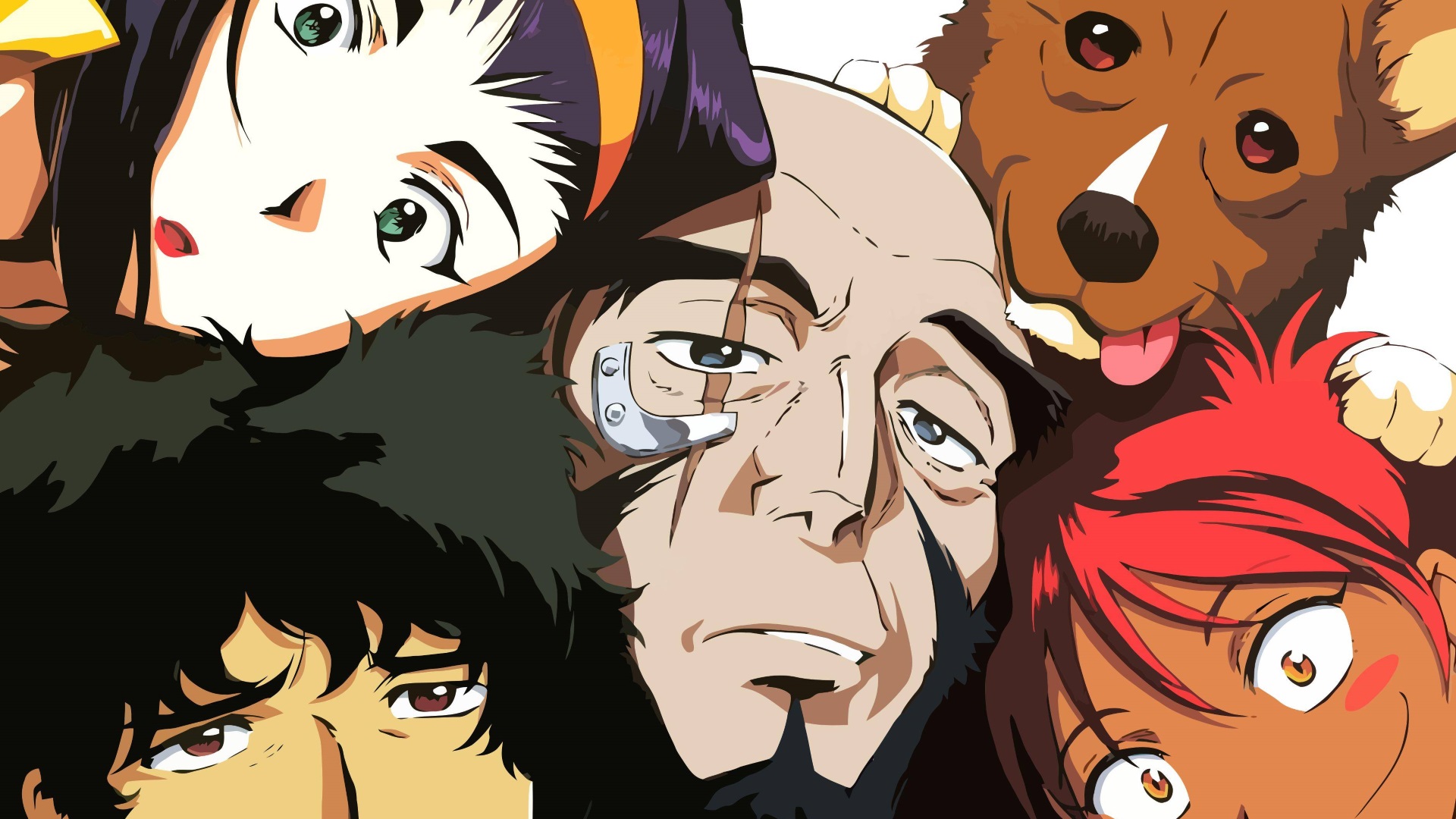
In 2071, roughly fifty years after an accident with a hyperspace gateway made the Earth almost uninhabitable, humanity has colonized most of the rocky planets and moons of the Solar System. Amid a rising crime rate, the Inter Solar System Police (ISSP) set up a legalized contract system, in which registered bounty hunters, also referred to as "Cowboys", chase criminals and bring them in alive in return for a reward.
Summary: TMDB
All facts (22)
- #001
The phrase "three years ago" is used quite frequently. Three years ago Spike and Jet came together, three years ago Faye was taken out of the freezer, and Ed also left the orphanage three years ago.
- #002
The city in Faye's memories is recognizably Singapore.
- #003
In Episode 2, "Stray Dog Strut," the fight between Spike and Abdul Hakim on the bridge is a tribute to the fight scene between Bruce Lee and Kareem Abdul-Jabbar in Game of Death (1978). All of Spike's fights use Bruce Lee's "Jeet Kune Do" fighting style.
- #004
Ed's father is named Appledelhi Siniz Hesap Lutfen. In Turkish, "Afedersiniz" (pronounced exactly like Appledelhi Siniz) means "Excuse me." The rest of the name is spelled correctly and means exactly this: "Excuse me! Check please!" There are other references to Turkey and scenes in which they use Turkish. The colony on Venus resembles 19th-century Istanbul. There is also a particular store shown on screen for a long time. Its name is Aile Pazarı, which means "Family Market" in Turkish.
- #005
The capsule in which Faye was kept in cryogenic preservation bears the code NCC-1701-B, a reference to Star Trek and the ship Enterprise.
- #006
Spike is frequently shown smoking cigarettes with the stems bent upward or downward. This is a subtle nod to jazz pioneer Dizzy Gillespie, one of the founders of bebop, whose trademark was a trumpet with a tilted bell.
- #007
Jet Black takes his name from Jet Black, the drummer of the English punk band The Stranglers.
- #008
Lupin III had a major influence on this series, and the main characters of both series resemble each other in appearance and personality. Spike/Lupin both wear ties, are tall and easygoing. Jet/Jigen are partners, both have beards and are the more pragmatic members of their groups. Faye/Fujiko uses her looks to get what she wants and betrays her group. Vicious represents Goemon with his swordsman skills. Spike's bent cigarettes are also a tribute to Jigen.
- #009
In the finale, Spike and Vicious exchange gunfire as a tribute to the deadly quick-draw in John Woo's A Better Tomorrow II (1987).
- #010
Six episodes received a TV-MA rating but never aired on Adult Swim without being edited to receive a TV-14 rating.
- #011
Spike's English voice actor, Steve Blum, has a tattoo of the sound waveform of Spike's final line — "Bang."
- #012
This was the first anime shown on Adult Swim at its launch on September 2, 2001, but the episodes Sympathy for the Devil (1998), Waltz for Venus (1998) and Cowboy Funk (1999) were skipped due to violent content after the September 11 attacks the following week.
- #013
The dog is a Pembroke Welsh Corgi.
- #014
Faye's gun is a Glock 30.45.
- #015
Spike regularly uses an IWI Jericho 941 pistol. This is the same gun seen firing in the opening title sequence.
- #016
The official lyrics at the beginning of the opening theme (as stated in the "Session 0" bonus feature): "I think it's time to blow this scene; get everybody and their stuff together. Okay, 3, 2, 1, let's jam."
- #017
The pistol Jet Black uses throughout the series is a Walther P99.
- #018
Although Shinichiro Watanabe claims it is a coincidence, Spike Spiegel may take his name from Spike Jonze, who was a music video director and later a filmmaker, and whose surname is Spiegel.
- #019
A Cowboy Bebop manga drawn by Cain Kuga was produced concurrently with the anime and published in Monthly Asuka Fantasy DX from October 1997, six months before the anime's premiere, until June 1998, the month the anime ended. Another manga drawn by Yutaka Nanten was published in the same magazine from November 1998 to March 2000. Both manga series followed storylines different from the anime, and the Nanten series was collected in a special issue released in September 2001 to promote the premiere of Cowboy Bebop: The Movie (2001).
- #020
Two linked video games were produced, Cowboy Bebop (1998) and Cowboy Bebop: Serenade of Reminiscence (2005), but neither was released outside Japan. A full English dub of the second game was completed before the North American release was cancelled. Sound director Mary Elizabeth McGlynn also holds backups of the English audio, but cannot release them for legal reasons.
- #021
In 2001, director Shinichirô Watanabe supervised remixes of the episodes Asteroid Blues, Ballad of Fallen Angels and Wild Horses. All three episodes were remixed in Dolby 5.1 with various new sound effects and enhanced musical cues. Later that same year, Watanabe released a second batch of episodes consisting of Waltz for Venus, Mushroom Samba and Hard Luck Woman. These were also remixed. For the US release, the episodes were issued as a two-disc set and remixed to a Japanese DTS 5.1 soundtrack. An English and Japanese Dolby 5.1 soundtrack was also included.
- #022
The text in the opening sequence is strongly tied to the series' themes and its creator's stylistic approach. It reads: "Once upon a time, in New York in 1941… At a club called 'Minston's Play House' in Harlem, a club open to anyone to play at every night, they play jazz sessions competing with each other. Young jazzmen with a new sense gather together. In the end they created a new genre. They are tired and fed up with traditional fixed-style jazz. Now they are eager to play freer jazz as they wish… 2071." The bounty hunters gathered on the spaceship "BEBOP" will play freely, breaking with traditional styles.
Sources & editorial notes
Reference databases
Sources for the entries on this page
- IMDb IMDb kaydı
Information from external sources is independently selected, consolidated and edited by Arka Evren. Sources are listed for verification and further reading. Encyclopedia text is used under its licence (CC BY-SA). How we work