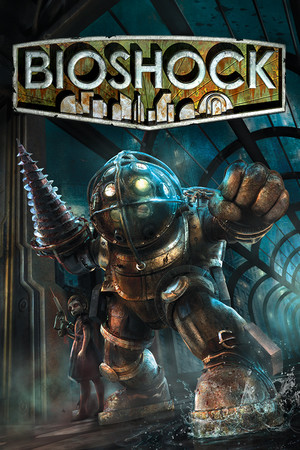
GAME · 2007
BioShock
- Developer
- Irrational Games
- Publisher
- 2K
- Platforms
- PlayStation 3, Microsoft Windows, macOS
65 archived facts 5 topics 2 sources Last reviewed Sep 2026
All facts (65)
- #001
Some of the mutants' distorted faces were based on photographs of World War I veterans who had undergone facial reconstructive surgery.
- #002
The appearance of the "Bouncer" Big Daddies (the ones with the drill) was inspired by nineteenth-century French diving suits.
- #003
The voice of the Circus of Value vending machines is actually that of the games' director, Ken Levine.
- #004
Ken Levine pitched a sequel to System Shock 2 to Electronic Arts, but the publisher rejected it because of System Shock 2's disappointing sales.
- #005
Contains a major spoiler — show
At the start of the game, Atlas tells the player that he has a wife and a son named Patrick and Moira. Later, in Fort Frolic, the player can find posters for a show titled "Patrick and Moira." This shows that Atlas used these names to lie to the player about having a family, and it also foreshadows the "Would You Kindly" plot in later parts of the game.
- #006
Irrational Games wanted to return to a free-form game with a strong narrative in the style of System Shock 2, while making the successor more accessible to a wider range of players.
- #007
Although she is always referred to as "Little Sisters" in the game design documents, the Little Sister was not always designed as a little girl; she was always meant to be a sympathetic character. Initially the Little Sister was going to be a slug, but it had no appendages and could not express emotion without a face. Other designs, such as a crab and a crippled dog, were also tried. However, none of these designs were sympathetic enough, and the Little Sister became a small human girl.
- #008
By 2002, the BioShock team had developed a core gameplay mechanic built around three groups: drones carrying a desirable resource, protectors guarding the drones, and harvesters trying to take the resource. These groups became the Little Sisters, Big Daddies, and Splicers in the final game.
- #009
At one point the game featured bosses known as Savants, consisting of brains in jars that had essentially evolved beyond having physical bodies. This was scrapped when they realized that fighting a brain in a jar was not fun gameplay.
- #010
A 2002 demonstration version of BioShock was built on Unreal Engine 2 for the Xbox and was set primarily aboard a space station overrun by genetically mutated monsters. Its main character was Carlos Cuello, a cult deprogrammer hired by a Senator, in a story described as more political in nature.
- #011
Tenenbaum is seen only twice, and both times she is hidden. This was because BioShock's budget was so limited that the developers could not afford to create another character model.
- #012
The BioShock team collectively agreed that the space-station direction was not what they had set out to make, and they struggled to find a publisher because immersive sims did not sell well. They considered ending development.
- #013
As news about the team's efforts to create a spiritual successor to System Shock 2 appeared in gaming magazines and websites, the BioShock team chose to continue development and performed a full revamp.
- #014
During development, the game went through multiple incarnations set in time periods ranging from the 1930s to the future. Rapture was intended to be very functional, resembling an underground subway system rather than an underwater base. The style was considered too soft, and Art Deco was settled on.
- #015
In 2004, 2K Games, a subsidiary of Take-Two Interactive, offered to publish BioShock, largely on the strength of its drone/protector/harvester concept.
- #016
During the game's development, the creators wanted Jack to mutate more and more through his use of Plasmids. This would have required players to decide whether they wanted to look more like a Mutant in order to survive, or refuse at the cost of less security and preserve their humanity. Unfortunately, this idea did not make it into the final game.
- #017
At the time of the 2004 reveal, BioShock was set in an abandoned World War II-era Nazi laboratory unearthed by 21st-century scientists, where decades of genetic experiments had grown into a drone/protector/harvester ecosystem.
- #018
The Big Daddy sounds are recordings of the voice actor's lines played back at a slower speed.
- #019
BioShock's 2004 version already carried gameplay elements that survived into the released game, including plasmids, weapon upgrades and stealth used to evade enemies, drawing on concepts from System Shock 2.
- #020
Many thematic and plot elements were strongly inspired by most of Ayn Rand's novels, including "Atlas Shrugged," in which one of the characters is named "The Fountainhead."
- #021
Rapture's lighthouse in the game can be found on Google Maps by entering the coordinates 63° 2' North, 29° 55' West.
- #022
It was explained that the reason the player can see the ghosts of Rapture's inhabitants is that the ADAM in the city constantly moves from person to person as it is killed. The ghosts you see are a result of the residual RNA (memories) injected along with the ADAM.
- #023
Andrew Ryan's philosophy about a man having the "Right to the sweat of his own brow" is an indirect reference to Ayn Rand's philosophy of "Objectivism," in which morality is full respect for individual rights. Ryan's name is even a reversed partial anagram of Rand's surname: ANDRew rYAN.
- #024
Early focus tests of BioShock's first level produced negative feedback: players were lost and confused, did not understand how to use newly acquired powers, and missed key story information. Testers also distrusted the Atlas character, then voiced with a southern accent that one tester described as a "lecherous Colonel Sanders".
- #025
Contains a major spoiler — show
Before settling on "Would you kindly" as the magic words to control the player's mind, the developers considered several different key phrases, among them "Excelsior." In the end, that phrase was too cumbersome and became noticeable to players.
- #026
Project lead Alyssa Finley described the early playtest feedback on BioShock as "brutal" but humbling, and the team concluded it was building a complex game that was not accessible to a variety of players. In response, the opening levels were redesigned as more deliberate experiences that taught key mechanics, with adjusted lighting, a quest marker for way finding, and an Irish accent for Atlas to make him sound more trustworthy.
- #027
A third Big Daddy model was scrapped before release, to the horror of some developers. Called SLOPRO, this Big Daddy was designed with a shoulder-mounted cannon and a large hook it could use for deadly melee attacks.
- #028
Contains a major spoiler — show
In a late-stage BioShock playtest, when the game was described as "ninety-nine percent" complete according to Levine, testers disliked it and felt no connection to the player-character Jack; the person overseeing the tests told Levine the game was likely to fail. Levine and the lead group then devised a "cheap" fix the next day by adding the opening cutscene inside the plane and the ensuing plane crash, which set the time frame, placed the player in the character's role, and alluded to the "would you kindly" twist.
- #029
Contains a major spoiler — show
There is an early hint about the game's twist. In Neptune's Bounty, there is a soundtrack that details Andrew Ryan's effort to restrict the use of bathyspheres to certain members chosen by Ryan. However, this method does not work properly, since people related by blood to Ryan can also travel.
- #030
Levine compared the approach of opening BioShock with a plane crash to the aircraft crash at the start of the television show Lost, saying it quickly established character and setting.
- #031
In one of Dr. Suchong's audio diaries, he explains the science behind the Vita-Chambers and remarks on "plasmid reconstruction this and quantum entanglement that." In System Shock II, the older game on which BioShock's FPS-RPG gameplay is based, players had to provide examples of quantum entanglement to reconstruct their character after death.
- #032
BioShock's total development costs came to roughly $25 million.
- #033
The Gene Bank was originally called Plasmi-Quik, but the name was changed because playtesters were unsure of its purpose and generally avoided the machine. The first released video of the game showed the Plasmi-Quik.
- #034
At its busiest, BioShock's development drew on 93 developers from 2K Boston, 2K Australia and 2K Shanghai, plus over 30 contractors and game testers.
- #035
Contains a major spoiler — show
Jack is the only playable character in the BioShock series whose face is never fully seen. He is also the only one who never dies, no matter what.
- #036
Because BioShock's development was difficult, many members of the team left Irrational after the game shipped.
- #037
Contains a major spoiler — show
In Germany, much of Dr. Tenenbaum's backstory was altered because of its connection to Nazism. At the time, German law prohibited references to Nazi Germany in video games, including symbols and even names. Her nationality was also changed to Russian.
- #038
Scott Sinclair was the art director for BioShock. After the Rapture setting was selected, the art team started creating concepts for the city's interior and exterior appearance.
- #039
Contains a major spoiler — show
One of the first things Atlas says to you at the start of the game is "Would you kindly find a crowbar or something?" This is a subtle nod to the iconic weapon used in the Half-Life series. The wrench Jack carries throughout the game also bears a strong resemblance to the wrench Adrian Shepard uses in Half-Life: Opposing Force.
- #040
BioShock's art team chose Art Deco for the environments because its large, simple shapes could be replicated with few polygons.
- #041
For Rapture's skyline, BioShock's artists drew on a Gotham-style metropolis, Hugh Ferriss's architectural illustrations and New York City's Art Deco architecture for the look and massing.
- #042
Contains a major spoiler — show
Atlas was originally voiced with a Southern drawl. The accent led BioShock's playtesters to distrust him immediately (and to uncover his betrayal early), so the character was completely redesigned as Irish.
- #043
Bill Gardner served as the lead level designer on BioShock. He cited Capcom's survival horror series Resident Evil as a significant influence on the game, saying that nods and small elements show where Resident Evil inspired the team.
- #044
Andrew Ryan is a kind of anagram of Ayn Rand, the main inspiration for both the game's architecture and its theme.
- #045
BioShock's team was particularly influenced by Resident Evil 4, including its environments, combat, tools, game design, tactical elements, gameplay-driven storytelling, inventory system, and its opening village level.
- #046
The Irrational Games logo can be found on the projection wheel in Sander Cohen's office in Fort Frolic.
- #047
BioShock's focus on a console release led Irrational to refine and simplify the gameplay for accessibility. Instead of convoluted interface menus for modifying weapons, upgrading plasmids, or buying items, these functions were placed in vending machines scattered around the game world.
- #048
A BioShock film was greenlit and was initially planned for release in 2011, to coincide with the premiere of a third BioShock game. The film was to be directed by Gore Verbinski, director of the Pirates of the Caribbean series. However, on 24 August 2009, it was announced that Verbinski had stepped down from directing due to budget problems and the possibility of shooting some footage abroad. Verbinski stayed on as producer and is working with new director Juan Carlos Fresnadillo, known for the horror film 28 Weeks Later, to manage the film's budget.
- #049
During early level development on BioShock, levels were roughly blocked out but the art department's attempts to decorate them dissatisfied the team. Level designer Jean Paul LeBreton and artist Hoagy de la Plante then co-developed a level that became part of the released game's "Tea Garden" area, which Levine held up as a prime example of a "great BioShock space" and of the need for departments to work together.
- #050
BioShock runs on a heavily modified version of Unreal Engine 2.5 that incorporates some advanced technologies from Unreal Engine 3.
- #051
The game was first released in Germany in a censored version, yet it still received an 18 rating. Unusually for a game of its genre, the uncensored version was not banned in Germany. Since the release of "BioShock: Ultimate Rapture Edition," the game has been officially available in its uncensored form.
- #052
Contains a major spoiler — show
There are numerous hints of Atlas's betrayal early in the game. Among the biggest are: (1) Atlas mentions regretting bringing Moira and Patrick to Rapture, which confirms that he and Moira were together before coming to the city, yet he later claims his first date with Moira was at Fighting McDonagh's bar. (2) The names "Patrick & Moira" appear on posters in Rapture, showing where Atlas got the names of his fictional family. (3) Atlas, who claims to be Irish, references American football (Ryan "moving the goalposts further down the field") and references the Fourth of July.
- #053
Because of BioShock's underwater setting, the team made a significant improvement to the game's water systems, hiring a dedicated programmer and artist to focus on water effects.
- #054
Although the character is apparently German, Tenenbaum's accent sounds distinctly more Russian than German. In the German release of the game, her nationality was even changed to Russian.
- #055
BioShock uses the Havok Physics engine, which enables ragdoll physics and more lifelike movement of environmental elements.
- #056
False information circulates online that Greg Baldwin voiced the character Frank Fontaine, while Karl Hanover voiced the character only in his Atlas persona. In reality, although Greg Baldwin was the original choice to voice Frank Fontaine during development, he ultimately never voiced the character in the final product because the developers felt he was not the right fit for the role; instead Karl Hanover was chosen and voiced the character as both Frank Fontaine and Atlas. It also does not help that Karl Hanover was not listed in the credits of the first game because he was not a member of the Screen Actors Guild at the time he was hired, while Greg Baldwin was mistakenly credited as voicing the character. Greg Baldwin, despite never having done so, is also known for lying in interviews that he voiced the character in the final game.
- #057
The Xbox 360 version of BioShock became backward compatible on Xbox One on 13 December 2016. Although this is the Xbox 360 version of the game running on Xbox One hardware, BioShock sees a tremendous performance boost. BioShock has an option to unlock the frame rate. When this option is enabled on Xbox One, the game runs mostly at 60 frames per second, with only some momentary drops. When the frame rate is capped at 30 frames per second on Xbox One, BioShock never drops frames. While BioShock was running on its native Xbox 360 hardware, it continued to experience some frame drops when the frame rate was capped. With the frame rate unlocked on Xbox 360, the game encountered extremely inconsistent frame rates ranging from the high 20s to the low 40s, combined with constant screen tearing (which the Xbox One fixed, since it enforces v-sync). The BioShock games were among the first announced to be coming to the backward compatibility program. It took nearly a year for them to finally arrive on the program, and in the meantime the BioShock remaster collection was released for Xbox One and PlayStation 4.
- #058
Once Rapture's setting was established, BioShock's team still had not determined how to implement the drone-protector-harvester model from their original idea. The Big Daddy was developed first as the protector, but the team struggled to devise a satisfying drone concept, considering designs such as bugs and dogs in wheelchairs.
- #059
The mutants were originally going to be called Aggressors, and concept art shows their appearance was much more mutant-like. They also bear strong similarities to the hybrid enemies in System Shock 2.
- #060
The idea of using little girls as the drones in BioShock emerged from brainstorming but was initially controversial and shocking within the team, who recognized the children could easily be killed and make the game more horrific in the style of Night Trap. As Levine developed the story, he incorporated ideas from 20th-century dystopian and utopian thinkers including Ayn Rand, Aldous Huxley and George Orwell, finding Objectivism ludicrous and perfect for an antagonist.
- #061
Most of the enemies in BioShock share many similarities with the enemies in System Shock 2 (also developed by Irrational Games). The traits and behavior of the Mutant Hybrids are based on those of the Mutant Hybrids, the Baby Jane Mutants share the same black bob haircut as the Cyborg Midwives, the behavior and attack tools of the Spider Splicers are based on the Cyborg Assassins, and the Big Daddies resemble the Security/Maintenance/Assault Robots. Both games feature Turrets and Cameras that the player must destroy or avoid.
- #062
2K Games raised concerns about BioShock's initial Little Sister mechanic, in which the player would actively prey on a Little Sister, alerting a Big Daddy and triggering a fight; the publisher asserted it would not ship a game where the player gets punished for doing the right thing. The approach was altered so Little Sisters were invulnerable until the player dealt with their Big Daddy, though LeBreton considered this a massive kludge into the game's fiction.
- #063
The mind control imposed on Jack in BioShock was proposed by LeBreton, drawing on films such as The Manchurian Candidate, to give a stronger reason for restricting player movement than locked doors.
- #064
BioShock features both licensed music and an original score. The licensed tracks, drawn from the 1930s, 1940s and 1950s, play on phonographs throughout Rapture, with 30 licensed songs heard across the game.
- #065
Garry Schyman composed BioShock's original score. He wrote the pieces to blend with the licensed music and preserve its feel, while also aiming for something eerie, frightening and at times beautiful that would mesh with Rapture's environments.
Sources & editorial notes
Sources for the entries on this page
- Wikipedia BioShock — Wikipedia
- IMDb IMDb
Information from external sources is independently selected, consolidated and edited by Arka Evren. Sources are listed for verification and further reading. Encyclopedia text is used under its licence (CC BY-SA). How we work