
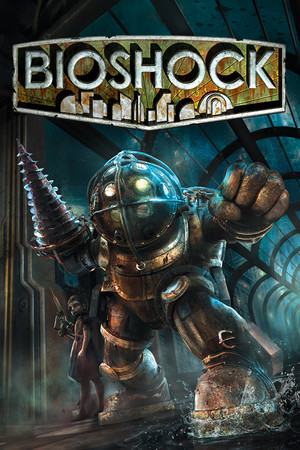
GAME · 2007 · USA
BioShock
- Developer
- Irrational Games
- Publisher
- 2K
- Platforms
- PlayStation 3, Microsoft Windows, macOS
56 archived facts 6 topics 2 sources Last reviewed Nov 2026
56 Interesting Facts About BioShock
Interesting Facts (14)
- #001
The voice of the Circus of Value vending machines is actually the games's director, Ken Levine.
- #002
Even though they were always called "Little Sisters" in the game design documents, the Little Sister was not always designed as a little girl, but always needed to be a sympathetic character. Originally the Little Sister was going to be a slug, but it had no appendages and could not present emotion without a face. Several other designs were attempted, such as a crab and a crippled dog. However, none of these designs were sympathetic enough, and the little sister became a small human girl.
- #003
The game went through multiple incarnations during development ranging in time periods from the 1930s to the future. Rapture was intended to be very functional, looking more like an underground subway system rather than an underwater base. The style was considered just too bland and Art Deco was decided on.
- #004
While in the game's development, the creators wanted Jack to mutate more and more with Plasmid use. This would then make the players have to decide if they wanted to become more like a Splicer to survive, or refuse and keep their humanity at the cost of less safety. Unfortunately, the idea didn't make it into the final game.
- #005
The Big Daddy voices are recordings of the voice actor's vocalizations played at a slower speed.
- #006
In the game's opening cutscene, where Jack is on the plane, an Irrational Games business card can be found inside his wallet.
- #007
The Rapture lighthouse in the game can be found on Google Maps by typing in the coordinates 63' 2' North 29' 55' West.
- #008
It was explained that the reason the player can see the ghosts of the residents of Rapture is because the ADAM in the city is moving constantly from person to person as they are killed. The ghosts you're seeing are just a result of the leftover RNA (memories) that you inject along with the ADAM.
- #009
The original name for the Gene Bank was Plasmi-Quik, but it was changed when play testers commonly avoided the machine because they were unsure of its purpose. The first video released of the game showed the Plasmi-Quik.
- #010
The game underwent many development changes from the time it was pitched top the final product. The original concept for the game was set in a fifties style futuristic city that took place on land and inside interconnected controlled environment chambers. These laboratories would be full of dead human bodies and be filled with various insectiod life forms. One of these life forms, called Gatherers, would collect genetic material while being protected by a second form of life forms called Protectors from the last form of life forms, The Predatory Aggressors. These eventually developed into the Little Sisters, Big Daddy's, and Splicers respectively. When the developers decided that they wanted a more human angle to the game.
- #011
- #012
The Xbox 360 version of BioShock became backwards compatible for Xbox One on December 13th, 2016. Despite this just being the Xbox 360 version of the game running on Xbox One hardware, BioShock sees a massive performance boost. BioShock features an option to unlock its frame rate. When this option is engaged on Xbox One it causes the game to mostly run at 60 frames per second with only some momentary drops. When the frame rate is capped to 30 fames per second on Xbox One, BioShock never drops a frame. When running on its native Xbox 360 hardware, BioShock would still experience some frame drops when the frame rate was capped. When the frame rate was unlocked on Xbox 360 the game would experience wildly inconsistent frame rates that could range from the the high 20's to the low 40's, and this was coupled with non stop screen tearing (something that the Xbox One remedies since it enforces v-sync). The BioShock games were some of the first announced to be coming to the backwards compatibility program. It took nearly a year for them to finally come to the program, and in that meantime a BioShock remaster collection was released for Xbox One and PlayStation 4.
- #013
Contains a major spoiler — show
Jack is the only playable character in the Bioshock series whose face is never completely seen. He's also the only one who doesn't die no matter what.
- #014
Contains a major spoiler — show
Atlas was originally voiced with a Southern twang. The accent led Bioshock's play-testers to immediately distrust him (and deduce his betrayal early on), so the character was completely redone as Irish.
Production Story (17)
- #015
The game underwent many development changes from the time it was pitched to the final product. The original concept for the game was set in a fifties-style futuristic city that took place on land and inside interconnected controlled environment chambers. These laboratories would be full of dead human bodies and be filled with various insectoid life forms. One of these life forms, called Gatherers, would collect genetic material while being protected by a second form of life forms called Protectors from the last form of life forms, The Predatory Aggressors. These eventually developed into the Little Sisters, Big Daddies, and Splicers respectively, when the developers decided that they wanted a more human angle to the game.
- #016
The original name for the Gene Bank was Plasmi-Quik, but it was changed when play testers commonly avoided the machine because they were unsure of its purpose. The first video released of the game showed the Plasmi-Quik.
- #017
The game was initially released in a censored version in Germany, but was still rated 18. Unusual for a game of its kind, the uncensored version was not banned in Germany. Since the release of BioShock: Ultimate Rapture Edition, the game has been officially available in its uncensored form.
- #018
The game went through multiple incarnations during development, ranging in time periods from the 1930s to the future. Rapture was intended to be very functional, looking more like an underground subway system rather than an underwater base. The style was considered just too bland and Art Deco was decided on.
- #019
Even though they were always called "Little Sisters" in the game design documents, the Little Sister was not always designed as a little girl, but always needed to be a sympathetic character. Originally the Little Sister was going to be a slug, but it had no appendages and could not present emotion without a face. Several other designs were attempted, such as a crab and a crippled dog. However, none of these designs were sympathetic enough, and the Little Sister became a small human girl.
- #020
A BioShock film had been confirmed and was originally planned to be released in 2011, coinciding with the release of a third BioShock game. The film was set to be directed by Gore Verbinski, director of the Pirates of the Caribbean series. However, it was announced on August 24, 2009 that because of budget issues and the prospect of filming some footage overseas, Verbinski had dropped out as director. Verbinski remained as the film's producer and is working with the new director, Juan Carlos Fresnadillo, best known for his horror sequel 28 Weeks Later, to manage the film's budget.
- #021
While in the game's development, the creators wanted Jack to mutate more and more with Plasmid use. This would then make the players have to decide if they wanted to become more like a Splicer to survive, or refuse and keep their humanity at the cost of less safety. Unfortunately, the idea didn't make it into the final game.
- #022
The Splicers were originally going to be called Aggressors, and concept art shows that their appearances were much more mutant-looking. They also bear a strong resemblance to the hybrid enemies from System Shock 2.
- #023
A third Big Daddy model was scrapped prior to release, much to the dismay of some of the developers. Called SLOPRO, this Big Daddy was designed with a shoulder-mounted cannon and a large hook which it would use for lethal melee attacks.
- #024
At one point the game was to feature bosses known as Savants, which were basically brains in a jar which had evolved beyond having physical bodies. This was scrapped when they realized fighting brains in a jar was just not fun game play.
- #025
Tenenbaum is only seen twice, obscured both times. This was because BioShock's budget was so tight that the developers couldn't afford to generate another character model.
- #026
The look of the "Bouncer" Big Daddies (the ones with the drills) was inspired by a nineteenth century French diving suit.
- #027
Some of the Splicers' distorted faces were based on photos of WWI veterans who had undergone facial reconstructive surgery.
- #028
In one of Dr. Suchong's audio-diaries, he expounds on the science of the Vita-Chambers and comments on "plasmid reconstruction this and quantum entanglement that." In System Shock II, an earlier game that Bioshock's FPS-RPG gameplay is based on, you had to provide quantum entanglement samples to reconstruct your character after death.
- #029
Contains a major spoiler — show
Atlas was originally voiced with a Southern twang. The accent led BioShock's play-testers to immediately distrust him (and deduce his betrayal early on), so the character was completely redone as Irish.
- #030
Contains a major spoiler — show
Before they settled on "Would you kindly" as the magic words for controlling the player's mind, the developers went through several different key phrases, including "Excelsior." Ultimately, that phrase ended up being too clunky and noticeable by the players.
- #031
Contains a major spoiler — show
In Germany, a great deal of Dr. Tenenbaum's backstory was changed due to its connection to Nazism. At the time, German law prohibited any reference to Nazi Germany in video games, which also included symbols and even names. Additionally, her nationality was changed to Russian.
Behind the Scenes (3)
- #032
The Big Daddy voices are recordings of the voice actor's vocalizations played at a slower speed.
- #033
The voice of the Circus of Value vending machines is actually the game's director, Ken Levine.
- #034
Some of the Splicers' distorted faces were based on photos of WWI veterans who had undergone facial reconstructive surgery.
Characters & Cast (3)
- #035
Despite her character apparently being German, Tenenbaum's accent noticeably sounds more Russian than German. Her nationality was even changed to Russian in the German release of the game.
- #036
Contains a major spoiler — show
Misinformation circulates online claiming that Frank Fontaine was voiced by Greg Baldwin, while Karl Hanover supposedly only voiced the character under his Atlas persona. In reality, although Greg Baldwin was the original pick to voice Frank Fontaine during development, he ultimately never voiced the character in the final product because the developers felt he wasn't the right choice for the role, and Karl Hanover was chosen instead, voicing the character both as Frank Fontaine and as Atlas. It also doesn't help that Karl Hanover was uncredited in the first game because he was not a member of the Screen Actors Guild at the time of his hiring, while Greg Baldwin was accidentally credited as voicing the character in the credits despite never having done so, along with the fact that Greg Baldwin has been known for telling lies in interviews that he did voice the character in the final game.
- #037
Contains a major spoiler — show
Jack is the only playable character in the BioShock series whose face is never completely seen. He's also the only one who doesn't die no matter what.
Easter Eggs & References (17)
- #038
In the game's opening cutscene, where Jack is on the plane, an Irrational Games business card can be found inside his wallet.
- #039
The Rapture lighthouse in the game can be found on Google Maps by typing in the coordinates 63° 2' North 29° 55' West.
- #040
In one of Dr. Suchong's audio diaries, he expounds on the science of the Vita-Chambers and comments on "plasmid reconstruction this and quantum entanglement that." In System Shock II, an earlier game that BioShock's FPS-RPG gameplay is based on, you had to provide quantum entanglement samples to reconstruct your character after death.
- #041
There is an easter egg that can be found in the Arcadia Farmer's Market. If the player enters the Worldly Winery and goes to the right corner of the main lobby, they can find a Pac-Man reference, with Pac-Man being made out of cheese and bullet holes implied to simulate pellets.
- #042
Most of the enemies in BioShock share many similarities with the enemies from System Shock 2 (which was also developed by Irrational Games). The Splicers' characteristics and behavior are based on those of the Mutant Hybrids, the Baby Jane Splicers share the same black bob-cut as the Cyborg Midwives, the Spider Splicers' behavior and means of attacking are based on the Cyborg Assassins, and the Big Daddies look similar to the Security/Maintenance/Assault Robots. Both games also have Turrets and Cameras that the player needs to either destroy or avoid.
- #043
The code "0451" is used to open one of the first locked doors in the game. The same code can be seen in other games like Deus Ex, Dishonored, System Shock and Thief.
- #044
The Irrational Games logo can be found on the projection wheel in Sander Cohen's office inside Fort Frolic.
- #045
There is an easter egg that can be found in the Arcadia Farmer's Market. If the player enters the Worldly Winery and goes to the right corner of the main lobby, they can find a Pac Man reference, with Pac Man being made out of cheese and bullet holes implied to simulate pellets.
- #046
Andrew Ryan's philosophy of a man having a "Right to the sweat of his own brow" is a sidelong reference to Ayn Rand's philosophy of "Objectivism", where morality is full respect for individual rights. Ryan's name is even a surname-reversed quasi-anagram of Rand's: ANDRew rYAN.
- #047
Contains a major spoiler — show
At the beginning of the game, Atlas tells the player that he has a son and wife named Patrick and Moira. Later, in Fort Frolic, the player can find posters for a show there titled "Patrick and Moira". This implies that Atlas used these names to lie to the player about having a family and also foreshadows the "Would You Kindly" plot twist later in the game.
- #048
Contains a major spoiler — show
At the very beginning of the campaign, just before the plane crashes, Jack holds up a gift from his "parents" with a note attached that includes three simple words: Would you kindly
- #049
Contains a major spoiler — show
There are numerous clues to Atlas's betrayal early in the game. Among others, some of the biggest are: (1) Atlas mentions regret at having brought Moira and Patrick to Rapture, which would confirm he and Moira were together before they came to the city, but later claims to have had his first date with Moira in Fighting McDonagh's bar. (2) The names "Patrick and Moira" are seen on posters in Rapture, showing where Atlas got the names for his fictional family. (3) Atlas, a supposed Irishman, makes allusions to American football (Ryan "moving the goalposts further down the field") and references the Fourth of July.
- #050
Contains a major spoiler — show
There is an early hint to the game's twist. In Neptune's Bounty, there is an audiotape detailing an endeavour of Andrew Ryan's to limit usage of the bathyspheres to specific members of Ryan's choosing. However, it doesn't work correctly as those related by blood to Ryan are also able to travel.
- #051
Contains a major spoiler — show
At the start of the game, one of the first things Atlas says to you is "Would you kindly find a crowbar or something?". This is a subtle reference to the iconic weapon used in the Half-Life series. Additionally, the wrench that Jack carries throughout the game bears a strong resemblance to the wrench used by Adrian Shephard in Half-Life: Opposing Force.
- #052
Contains a major spoiler — show
In Germany, a great deal of Dr. Tenenbaum's backstory was changed due to its connection to Nazism. At the time, the German law prohibited any reference to Nazi Germany in video games, which also included symbols and even names. Additionally, her nationality was changed to Russian.
- #053
Contains a major spoiler — show
At the start of the game, one of the first things Atlas says to you is "Would you kindly find a crowbar or something?". This is a subtle reference to the iconic weapon used in the Half Life series. Additionally, the wrench that Jack carries throughout the game bears a strong resemblance to the wrench used by Adrian Shepard in Half Life: Opposing Force.
- #054
Contains a major spoiler — show
There are numerous clues to Atlas' betrayal early in the game. Among others, some of the biggest are: (1)Atlas mentions regret at having brought Moira & Patrick to Rapture, which would confirm he and Moira were together before they came to the city, but later claims to have had his first date with Moira in Fighting McDonagh's bar. (2) The names "Patrick & Moira" are seen on posters in Rapture, showing where Atlas got the names for his fictional family. (3) Atlas, a supposed Irishman, makes allusions to American football (Ryan "moving the goalposts further down the field") and references the Fourth of July.
Deeper Meaning (2)
- #055
Andrew Ryan's philosophy of a man having a "Right to the sweat of his own brow" is a sidelong reference to Ayn Rand's philosophy of Objectivism, where morality is full respect for individual rights. Ryan's name is even a surname-reversed quasi-anagram of Rand's: ANDRew rYAN.
- #056
It was explained that the player can see the ghosts of Rapture's residents because the ADAM in the city is constantly moving from person to person as they are killed. The ghosts you see are just a result of the leftover RNA (memories) that you inject along with the ADAM.
Related pages
- BioShock Infinite — BioShock comes up in the facts on that page