
GAME · 2001 · UK
Grand Theft Auto III
- Publisher
- Capcom
- Platforms
- Microsoft Windows, macOS, PlayStation 3
250 archived facts 8 topics 2 sources Last reviewed Nov 2026
250 Interesting Facts About Grand Theft Auto III
Interesting Facts (117)
- #001
Lazlow's Career goes in this order: 3D Universe Timeline * 1984 - Co-host and Intern at V-Rock in Vice City with Couzin Ed (Grand Theft Auto: Vice City Stories (2006)). * 1986 - Host on the rock station V-Rock in Vice City (Grand Theft Auto: Vice City (2002)). * 1992 - Replacing a host on Entertaining America in San Andreas (Grand Theft Auto: San Andreas (2004)). * 1998 - Field reporter on the show Chatterbox (as opposed to the channel) in Liberty City (Grand Theft Auto: Liberty City Stories (2005)). * 2001 - Host of Chatterbox in Liberty City (Grand Theft Auto III). HD Universe Timeline. * 2008 - Host of Integrity in Liberty City (After a long stint of being pulled off the air for rudeness) (Grand Theft Auto IV (2008)). * 2013 - Co-host on WCTR and host of Fame or Shame (Grand Theft Auto V (2013)).
- #002
Despite its generic physics compared to later editions especially in such drastic changes as the HD Universe Liberty City introduction, there was a bug in getting a car lodged between the stairsteps at the Francis International Airport helipad where the car will automatically become self-dislodged after having had a sparks frenzy and the car will drive itself away.
- #003
- #004
In the opening cutscene, three prisoners can be clearly identified: the protagonist, 8-Ball and the old oriental gentleman - a friend of Donald Love. He is broken out by the Colombians to hold Love to ransom. Love has you rescue the old oriental gentleman from the Colombians custody in the mission 'Liberator'. The irony is that the protagonist's constant enemy, the Colombians, unwittingly helped him escape and begin his revenge on Catalina.
- #005
In the mission 'Waka-Gashira Wipeout!', Donald Love quotes his former mentor Avery Carrington: 'Nothing drives down real-estate prices like a good old fashioned gang war, apart from an outbreak of plague... but that might be going too far in this case.' Love then sends the protagonist on a mission to start a war between two rival gangs so the property values in the area will go down. In Grand Theft Auto: Vice City (2002) - which takes place 15 years before - there is a similar mission, 'Two Bit Hit', that Carrington gives Tommy Vercetti. When he gives Vercetti this mission, a young Donald Love is present as Carrington's protégé. Carrington tells Love to pay attention as he might learn something, and then utters the original quote.
- #006
Claude, the game's protagonist, does not speak a single word throughout the entire game, though you can hear him grunt when he falls after jumping and groan if he drowns in a river. Rockstar Games later admitted that the decision to make him a silent character was made so the player could identify more with him.
- #007
- #008
- #009
- #010
- #011
There is a billboard in the game advertising a film called "Badfellas." It is a parody of Martin Scorsese's GoodFellas (1990), which starred Frank Vincent (Salvatore Leone) and Debi Mazar (Maria), who played Billy Batts and Sandy respectively in the film. The film also had a major influence on the game's story and setting.
- #012
- #013
Three prisoners are clearly visible in the opening scene: the protagonist, 8-Ball, and an elderly Oriental gentleman — a friend of Donald Love. He is kidnapped by the Colombians to hold Love for ransom. In the "Liberator" mission you rescue the elderly Oriental gentleman from the Colombians' custody. The irony is that the Colombians, the protagonist's constant enemy, unwittingly help him escape and begin taking revenge on Catalina.
- #014
- #015
In the "Waka-Gashira Wipeout!" mission, Donald Love quotes his former mentor Avery Carrington: "Nothing can lower property values like an old-fashioned gang war… except maybe the plague, but in this case that might be going too far." Love then sends the protagonist on a mission to start a war between two rival gangs so that property values in the area drop. Fifteen years earlier, in Grand Theft Auto: Vice City (2002), Carrington gives Tommy Vercetti a similar mission: "Two Bit Hit." When he gives Vercetti this mission, a young Donald Love is present under Carrington's wing. Carrington tells Love to watch carefully so he can learn something, and then delivers the original quote.
- #016
- #017
- #018
- #019
- #020
- #021
- #022
- #023
There is speculation that Claude, the main character officially introduced in Grand Theft Auto: San Andreas (2004), is Claude Speed, the main character of Grand Theft Auto 2 (1999). This was never officially confirmed. Even if they are the same character, they are in different "universes", because in the Grand Theft Auto world the 2D universe and the 3D universe are two separate things.
- #024
Rockstar was initially developing an Expansion Pack for Grand Theft Auto III called Grand Theft Auto: Miami, which would have followed the events of this game. The clues to this are billboards advertising "Visit Miami" and the final mission, called "Marked Man", for the character Ray Machowski, in which the player takes Ray to Liberty City Francis International Airport, where he boards a plane bound for Miami, implying the character's return appearance. However, Rockstar decided to go in a different direction and set the next Grand Theft Auto game in the 1980s, naming it Grand Theft Auto: Vice City (2002) after one of the cities used in Grand Theft Auto (1997).
- #025
- #026
- #027
- #028
As mentioned in the book Jacked: The Outlaw Story of GTA, the Houser brothers discussed cancelling the game because they thought it was too early to release such a violent game set in a place not unlike New York City. However, Rockstar continued with the game despite the changes made due to some cuts and sensitivity.
- #029
- #030
- #031
- #032
- #033
- #034
- #035
- #036
- #037
- #038
Lazlow's career progresses in the following order: 3D Universe Timeline: 1984 - intern at V-Rock in Vice City and co-host with Couzin Ed (GTA: Vice City Stories); 1986 - host of the rock station V-Rock in Vice City (GTA: Vice City); 1992 - host on the Entertaining America program in San Andreas (GTA: San Andreas); 1998 - field reporter on the Chatterbox program in Liberty City (GTA: Liberty City Stories); 2001 - host of Chatterbox in Liberty City (GTA III). HD Universe Timeline: 2008 - host of Integrity in Liberty City (after a long suspension for rudeness) (GTA IV); 2013 - co-host on WCTR and host of Fame or Shame (GTA V).
- #039
- #040
Donald Love's fate after his disappearance is unknown. Love appears only in GTA: Vice City, set in 1986, and GTA: Liberty City Stories, set in 1998; both take place before this 2001 game. Since GTA IV, set in 2008, rebooted the series and contains no recurring characters (except Lazlow), Love's fate will probably never be resolved. In GTA V he is remembered only with a star on the Vinewood Walk of Fame.
- #041
- #042
Three prisoners are clearly visible in the opening scene: the protagonist, 8-Ball and the elderly oriental gentleman who is a friend of Donald Love. He is kidnapped by the Colombians for ransom; Love asks you to rescue him in the 'Liberator' mission. Ironically, the Colombians, the protagonist's constant enemy, unwittingly help him escape and take revenge on Catalina.
- #043
The game was temporarily withdrawn from sale in Australia for re-rating. The objectionable content was that when the player picks up a prostitute in his car and stops in a secluded spot, the vehicle shakes violently (implying sex). The real problem was that the prostitute could be killed after the act; this was deemed 'sexual violence'. A censored version was released for Australia; the same applied to Vice City.
- #044
- #045
- #046
- #047
- #048
In the 'Waka-Gashira Wipeout!' mission, Donald Love quotes his mentor Avery Carrington: 'Nothing can lower property values like an old-fashioned gang war, except maybe a plague... but then we'd be going too far.' Love tries to lower property values in the area by pitting two rival gangs against each other. In Vice City, set 15 years earlier, a young Donald Love is present as an apprentice in a similar mission Carrington gives Tommy Vercetti, and Carrington tells him to 'pay attention so you can learn'.
- #049
- #050
There are countless references to films and Broadway shows all over the city: 'BadFellas' (GoodFellas), 'Fannie' (Annie), 'Saturday Night Beaver' (Saturday Night Fever), 'Duck Pond' (Swan Lake), 'Rats' (Cats), 'Half-Cocked' (police films like Dirty Harry), 'Top Down City' (Arnold Schwarzenegger and Sylvester Stallone action films; also a reference to the top-down view of the older GTA games), '69th Street' (42nd Street), 'Soldiers of Misfortune' (war films), 'Pirates In Men's Pants' (Pirates of Penzance).
- #051
- #052
- #053
Two characters were cut from the final version of the game, but their names remained in the manual and credits: Darkel (voiced by Bill Fiore) and Curtly (Curtis McClarin). It is thought that Darkel gave terrorist-like missions and was removed because of the September 11 attacks, or that he gave rampage missions but skull icons were preferred instead. In December 2011, Rockstar stated that the character had been removed long before the attacks.
- #054
Police cars were originally going to use the New York Police Department's blue-and-white color scheme. These screenshots can be seen on the poster included with the game. It is thought that, because of the September 11 attacks, they were changed to black-and-white so they would not resemble NYPD cars.
- #055
- #056
- #057
- #058
- #059
- #060
- #061
- #062
- #063
- #064
- #065
This game and GTA 2 are the only games that do not include motorcycles. A forum user discovered a failed motorcycle physics attempt in the game's.exe file. A newspaper article in Liberty City Stories provides an in-universe explanation, saying that motorcycles were banned as a result of a campaign for four-door cars and SUVs.
- #066
- #067
- #068
- #069
- #070
- #071
- #072
- #073
- #074
- #075
- #076
- #077
Claude's character shows similarities to Ryan O'Neal's character in Walter Hill's The Driver (1978): Claude is mute, and O'Neal's character barely speaks; neither is addressed by name, their pasts are unclear, they show no emotion, and they work as getaway drivers for criminals. Years later, Rockstar adapted another Walter Hill film, The Warriors (1979), into a game.
- #078
- #079
- #080
- #081
Various rumors circulated among fans about the original version of the game: that Claude was considered as a speaking protagonist (because a leftover voice from GTA 2 could be heard in the trailer), content cut after September 11 (such as crashing a plane into a building in Donald Love's final mission), a drivable version of the Maibatsu Monstrosity, Fernando Martinez being a mission giver, and Claude being able to reach the lighthouse and the observatory.
- #082
- #083
- #084
The planes at the airport were coded to explode when hit with a rocket launcher, but this feature was hastily disabled after the September 11 attacks. It is possible to restore the function by editing the code. In the next game, Vice City, this feature returned only for the airship and only with an attack helicopter.
- #085
- #086
The game was initially banned in South Korea by the Korea Media Rating Board, but with the 10th Anniversary edition it was made available for purchase and offered with a Korean localization. When the Game Rating Board replaced the KMRB, the ban was lifted, and GTA III became the first 3D GTA game to be officially translated into Korean.
- #087
- #088
In a 2012 question-and-answer session, Rockstar revealed that the sound of pedestrians being run over was made by crushing fruit and raw chicken. In the same session, to the question of whether the gunshot in the final scene was Claude shooting Maria, the answer given was 'probably yes, probably no'; Maria was planned to give a speech but it was removed during the sound production stage.
- #089
In 2001 promotional documents, Dan Houser had hinted that the original GTA characters Brother Marcus and Bubba and the GTA: London characters would return, but these were not added to the game. Designer James Worrall had said the mob boss's name would be Frankie; this character later became Salvatore. Houser stated that because only four people were motion capture actors, the emphasis was placed on voice recordings.
- #090
- #091
- #092
- #093
- #094
Rockstar's December 2000 development plans included the following: shipyards with forklifts (inspired by the Leith shipyards in Scotland), chemical and power plants in northwest Portland, a waste site full of scrap vehicles, an auto junkyard with a stolen vehicle delivery mission, a pimp named 'JJ' in Red Light, a dog food factory with an interior, a rainwater drainage area, Salvatore's bodyguards, an airport in the north of Staunton, a city hall modeled as an art museum, a Wall Street area, a ferry dock, a boatyard, a member recruitment mission at the cathedral, Yakuza leader Toshiro Kasen giving Donald Love's missions, an illegal fight ring, Ray Machowski giving missions in a cafe, a skate park, a golf course on Cliffside Drive, a car dealership in Shoreside Vale, a hearse, a larger Morningstar Industries presence, a military base and Major Hale, the return of the Zaibatsu Corporation, Nixon Island prison, Maria giving missions at the hotel, the Yakuza rescuing the prisoner in the opening scene, a rocket launcher roadblock, street names in 'The Fuzz Ball', a Molotov cocktail in 'Taking Out the Laundry', the Triads being named the Thongs, the FBI targeting Claude in the 'Sniper Surveillance' mission, the PHUQU-2 tank, Japanese and Portuguese subtitles, a country music station, pedestrians being arrested, police informants, a pedestrian who could rob Claude, traffic density changing during the day, the 'Grand Theft Auto' mission being named 'Gone in 60 Seconds', bus and train stops, Duncan's Body and Paintshop, the blue seating area of the Liberty Memorial Coliseum, airbags, windows that open and close, a special weapon for each vehicle, a Fiat 128-like Panto, two modified vehicles.
- #095
In 2023, Obbe Vermeij said that missions came before the story and that the bank robbery scenes were added later. Characters and locations were constantly changing; things became clear once the voice recordings were finished. He explained that Donald Love was not there at the beginning, that cars in garages disappeared for memory reasons, that textures were reduced because of PS2 limitations, and the reason planes were absent. He stated that Leslie Benzies separated missions with yellow sticky notes, connections with green, and locations with pink. He described how vehicles out of focus were deleted when the player looked back and then forward again, that newspaper litter existed only in this game, that the fog effect had four stages, and that tree shadows were absent for performance reasons.
- #096
- #097
- #098
In 2011, Dan Houser said the game was initially planned to include additional US cities besides New York, such as Chicago, Detroit, Philadelphia and Pittsburgh. He described the development difficulties not as 'problems' but as 'challenges'; such as streaming data from the disc, motion capture, and the transitions between driving and combat in a game that was not level-based. The final mission taking place near a dam in the suburbs was planned from the very beginning.
- #099
In 2025, Obbe Vermeij stated that he designed the hidden packages, stunt jumps and the train camera; that the train camera was initially conceived as an exterior view of the car roof without showing the player, that skipping stations would strain the infrastructure, that this was possible in GTA IV, and that GTA V had an interior view and a glitch for moving into the cockpit.
- #100
- #101
Lead artist Aaron Garbut stated that in the first weeks of the prototype the game already had brown stone buildings, docks, shops and traffic as in the final version; that the game being 3D was Sam Houser's idea, and that this was the first sign of their ongoing collaboration in the future.
- #102
In 2024, former PlayStation Europe executive Chris Deering admitted that GTA III being exclusive to PS2 was a move against Microsoft Xbox competition, and that with the deal at the end of 2001, three GTA games came to PS2. While GTA SA became the best-selling PS2 game of all time, GTA III was in fifth place.
- #103
- #104
In GTA IV's 'The Cousins Bellic' mission, Roman does not get out of the car like 8 Ball; if Niko gets in through the passenger door, he passes through Roman. As Niko gets out and back in, Roman says additional dialogue. 8 Ball, however, never speaks, and the system says 'Hey! Get back in the vehicle!' The police cars in the Callahan Bridge scene never get out, and even if they explode, no new unit arrives. Because the mission has two stages, police response is not programmed; the fire cannot be extinguished, the bridge view loads automatically, and Claude can swim to the other islands to collect hidden packages.
- #105
In 2024, Lazlow explained that he went to the first creative meeting for GTA III with a yellow notebook, but immediately started using a laptop to catch the brainstorm, and continued this way until the end of the game. This is not surprising considering the tens of thousands of lines of dialogue.
- #106
Code designer Obbe Vermeij explained that traffic lights worked on a north-south, east-west cycle, that pedestrian traffic and model orientation controlled the cycle, and that even a knocked-over light worked the same way. Running a red light leading to being stopped by police was only considered in GTA III but never implemented in any game. The feature of cars appearing in the air before physical contact, as in GTA IV, also comes from this code.
- #107
In 2013, Obbe Vermeij said that the innovative approach of the 1998 game Space Station Silicon Valley, which focused more on exploration than objectives, was carried over to GTA III. Every detail was present even before missions began; gangs became more aggressive with each betrayal mission.
- #108
- #109
- #110
- #111
Donald Love, who mysteriously disappeared in the 2001 universe, was never explained in any modern-day game. The scene in the second trailer in 2025 where Jason and Lucia joke on the pier resembles an episode of the animated series Archer; in that episode, the character Burt Reynolds voices Burt Reynolds. Reynolds had voiced Avery Carrington in Vice City and appeared in the same mission as Donald Love. Reynolds died in 2018, and Carrington was never seen again. Kyle MacLachlan said in 2024 that he believed the theory that his character survived. Aspatria, which Love mentions in the 'Liberator' mission, is a town in England and the hometown of a bus manufacturer from the 1800s.
- #112
A taxi driver's line in III, 'I don't deserve this!', is a line spoken to a taxi driver by a character in The Color of Money (1986). 'what in the name!' is the line of the black police chief in RoboCop 3 (1993). The city of Atlanta is connected both to the film and to Atlanta, Cass County, Texas, which took its name in 1845.
- #113
- #114
The first 3D NYC model contains realistic media references specific to 2001: the Millennium Medieval Fair resembles the Newport Folk Festival in South Africa; the German dancer/destroyer named Hans evokes Spokes Mashiyane, who played the pennywhistle against Bob Dylan's use of electric instruments in 1965. The El Salvador, Paraguay, Zambia, NFL founded in 1959 and Central African Federation references in the HEAD Radio advertisement point to that era. The founder of the NFL, George Wein, is also the founder of the Newport Jazz Festival. The 2001 release date precedes Dylan's 2002 return. Mississippi John Hurt is also connected to the 1963 change. Claude Williamson's 1958 album 'Kwele Claude' and the West Side connections with the first black character in GTA SA are also part of this network.
- #115
- #116
In Liberty City, recreated in 2008 with GTA IV, Sam Houser said that although the second game did not directly reference the September 11 attacks, the theme of terror was handled throughout the game. In 2025, a code programmer stated that a remote-controlled plane being able to pass through a building was preserved in the Definitive Edition, but that the plane was planned to disappear after a certain period of time, and that he prevented this outcome by changing the flight path with his own coding.
- #117
The Greyhound bus line in the game is parodied as Whippet Express Coach. Whippet Coach is in reality a bus company based in Cambridgeshire, England, and its founder used an American ambulance as its first vehicle. Unrelated to the Australian-American War references on Chatterbox radio, the company was bought by an Australian travel company in 2014 and sold again in 2018 to a company based in England.
Production Story (68)
- #118
Lead art designer Aaron Garbut noted that the earliest weeks of prototype development consisted of the same scenery the game would ultimately consist of, these being: brownstones, docks, retail areas with street pedestrian and vehicular traffic. He also confirmed it was Sam Houser's idea to have the game be 3D and this being an earliest sign of what would continue to be constant development teamwork across the future game releases.
- #119
- #120
As noted by Dan Houser in 2011, the game was originally intended to feature additional U.S. cities beyond the now-recurring New York and its various neighborhood counterparts, including Chicago, Detroit, Philadelphia, and Pittsburgh. He also echoed the designers' commentary regarding development hurdles, referring to them not as "problems" but as "challenges." He confirmed that the team faced unprecedented obstacles, such as implementing streamed data from disc, using motion-capture for cutscenes, and achieving seamless transitions between gameplay modes-combining driving and shooting in a game that wasn't level-based, which was a rarity at the time. He further explained that the final mission, set near a dam in a suburban environment, had been planned as the game's ending sequence since the early stages of development.
- #121
In 2008 with the reinvented Liberty City in GTA IV, Sam Houser noted that while the second game would not specifically reference the September 11 attacks, it would carry on a terrorist premise which was entirely throughout the game, Internet, radio, stories and TV. In 2025, the game's code programmer noted that, while it seemed an auto-pilot remote plane was capable of driving through a building and this preserved in the Definitive Edition, this was never intended since the plane was scheduled to disappear after a certain time, with his coding ultimately lifting the flightpath it was on to change this result.
- #122
In 2024, Lazlow revealed that, though he went into the first creative content development meeting in GTA III with the same yellow legal notepad and the same clipboard he had used before, he quickly realized he needed something to actively collect everything that was emerging in ideas which is when he started and continued using a laptop to the final game. This not surprising given the dozens of thousands in dialogue lines in the game alone, an incomparable difference from GTA III.
- #123
In 2013, designer Obbe Vermeij had commented how the 1998 Take-Two Interactive game Space Station Silicon Valley (1998), predating the 1999-2001 game development, was considered an innovative approach on a game and what it could include in exploring, instead of the ultimate game objectives, which was transferred to every detail in the game being available. Including before the missions start changing the environment, with the game's gangs become aggressive with each new landmark mission as each one is betrayed ranging from the Leones, Triads and Yardies, though the Colombians being the only initially aggressive ones considering the first game cutscenes, and layout.
- #124
Unlike the previous Grand Theft Auto games which took place in the 2D universe (Grand Theft Auto (1997), Grand Theft Auto: London, 1969 (1999), Grand Theft Auto: London, 1961 (1999) & Grand Theft Auto 2 (1999)) This game is a soft reboot and takes place in the 3D universe and no characters from the 2D universe exist in this 3D universe.
- #125
Originally Rockstar were developing an Expansion Pack for Grand Theft Auto III called Grand Theft Auto: Miami, which would have followed the events of this game. Hints to this are billboards advertising "Visit Miami" and in the last mission for the character of Ray Machowski, called "Marked Man" where the player drove Ray to Liberty City Francis International Airport where he caught a plane for Miami, hinting at the characters return appearance. However, Rockstar decided to go in a different direction and set the next Grand Theft Auto game in the 1980s and re-titled it Grand Theft Auto: Vice City (2002) after one of the cities used in Grand Theft Auto (1997).
- #126
Some fans spread various rumors about original version of the game including: Claude was originally conceived as a speaking protagonist, because of a leftover sound from Grand Theft Auto 2 (1999) appearing in a trailer for the game. Though Rockstar continues to deny that Claude was ever supposed to speak. There were a ton of rumors about what content had been cut after 9/11, including a persistent one that Donald Love's last mission would have involved crashing a plane into a building, despite Rockstar Games saying that there were never plans for large aircraft. A drivable version of the Maibatsu Monstrosity, a car that is frequently advertised on the in-game radio. Fernando Martinez was going to be a mission giver in the game. That Claude could get to the lighthouse and the observatory in the game.
- #127
Online multiplayer was originally planned but was scrapped early on to focus on Grand Theft Auto: Vice City (2002). Text strings for it, as well as a "Powered by GameSpy" logo, are still in the game's code. It would take until Grand Theft Auto IV (2008) for the series to get online multiplayer in an official capacity.
- #128
In the December 2000 Rockstar development blueprint documents, several items were noted, including: * Originally the dockyards would feature forklifts, something that would be eliminated later in the pre-release stage. These dockyards were actually modeled after the Leith, Scotland dockyards in the same town as the Rockstar North development team * Chemical and power plants would have existed in northwest Portland with the same environmental features as other city areas, consisting of commercial forklifts and trucks and pedestrian employees, with the power plant having had audio and lighting files there as well * A waste ground that would have served for driving sessions or dumping grounds surrounded by wrecked cars and the only pedestrians being winos, this would ultimately be succeeded by its closest alternative: the auto junkyard. * The auto junkyard would have had a mission familiar in other later Grand Theft Auto installments in bringing stolen vehicles there for the unnamed junkyard owner, a similar mission that also was intended for the bank side jobs. * The Red Light district strip club was initially intended to have a pimp named "JJ" for side jobs there. * The dog food factory slaughterhouse was intended to have had interiors along with employees. * The game also had a planned storm drain area similar to those of later Grand Theft Auto based games that would have served for a mission and racing. * Salvatore Leone, whose development name was Frankie Sorvino, initially had bodyguards present at his safe house that were later cut in production. * The north part of Staunton Island was initially the location for the game's airport. * Also in Staunton alone the City Hall building was initially modeled as an international art museum as City Hall was going to be a planned separate building, there was also an inaccessible cinema, a rough draft of what would be an unnamed corporate headquarters building and a separate courthouse building that was ultimately later combined into the City Hall building. All of this was confirmed in what DMA Design environment artist Andrew Soosay's concept draft images detailing the same illustrations. * On Staunton Island, there was also a designated "Wall Street" area that would have a mission and another side job of stealing cars. * There was also a "ferry port" concept located on North Portland where, unlike in the released game, the protagonist could travel across the water with his vehicle, though this was later included in Grand Theft Auto: Liberty City Stories (2005). * There was also a Southwest Staunton Island boatyard with located gangs, missions and weapons. * Another concept mission location was the cathedral and consisting of recruiting new members. * Original Yakuza leader Toshiro Kasen would have been the original Donald Love missions based on Staunton Island, as well as a new addition of an illegal fighting ring bet mission as well another mission spawn location at Toshiro's house * Ray Machowski missions would have been a cafe for the spawn location, not Belleville Park. * A concept skate park that was ultimately removed and later only introduced in Los Santos, San Andreas in Grand Theft Auto: San Andreas (2004). * A concept golf course with surrounding mansions on a "Cliffside Drive", that was later only preserved as the renamed neighborhood Cedar Grove. * The Portland car dealership, originally drafted to appear in Shoreside Vale, would have been the grounds for another mission that was later added into Grand Theft Auto: Liberty City Stories (2005). * Considering there was already a graveyard on Staunton Island, there would be a hearse included in the vehicle arsenal list that was later removed. * The Morningstar Industries advertisement billboards were concept plans of a larger company presence in which their name would be brandished on a high-security facility and housing with company employees, besides what was later reduced to the one Torrington Morningstar Building and Morningstar Plaza. * The game was also drafted to include a military base with personnel including a mission by a Major Hale, who was designed with the same Donald Love model. * Although still kept in Liberty Tree newspaper articles, the Grand Theft Auto 2 (1999)-era Zaibatsu Corporation was going to be reintroduced with conglomerate outlook consisting of housing, pharmaceuticals, skyscraper and testing facility. * The Grand Theft Auto (1997)-era Nixon Island (equivalent to New York's Roosevelt Island, once a prison) would have been a prison with police radio dispatch audio files and what was instead introduced in the rebooted HD era Grand Theft Auto IV (2008) Liberty City location Colony Island. * Maria's mission location was originally intended to be a hotel, instead of Asuka's apartment, the latter character originally named Kemuri in concept drafts. * Instead of the first cut scene showing the Colombians attacking the prison convoy, it was originally intended to be the Yakuza rescuing the Japanese inmate. The same cut scene was originally intended to include a roadblock, ahead of the prison van, where assailants are armed with a rocket launcher to explode the first police escort vehicle * Story script documents show the mission "The Fuzz Ball" would have listed street names for a vehicle location as did the mission "Van Heist", something non-existent until Grand Theft Auto IV (2008) introducing street names. * The mission Taking Out the Laundry, originally included Molotov cocktails instead of grenades as the weapon of choice for the mission. * The Portland gang Triads were originally named Thongs as initial script drafts show. * The mission "Sniper Surveillance", later renamed "Under Surveillance", the mission would have had the FBI targeting Claude after he assassinated them. * Concept vehicle drafts included a military tank named PHUQU-2 (pronounced fuck you too) that, along with an AmCo Petroleum tanker, were dropped from later stages * Early draft concepts showed the game would have included Japanese and Portuguese subtitles, the former which was later added into the game. * Along with radio stations being unlocked only after completing phases of the game story mode, there would have also been a country music station. * Originally pedestrians could be arrested and pursued by police as well as pedestrian reactions to injuries, things that were only included in its entirety in Grand Theft Auto IV (2008). * There also was a concept of an idea of police informants who would call police when they witnessed Claude's criminal activities, something also later introduced in the fellow Rockstar Games release The Warriors (2005) * Another concept was to include a pedestrian criminal who could rob Claude. * Vehicle traffic rates were originally to change throughout the day depending on the time. * The mission "Grand Theft Auto", was originally named "Gone in 60 Seconds" a reference to the 2000 film Gone in 60 Seconds (2000), following the trend of American film inspirations in Rockstar releases. * Buses and train traffic stops was an initial concept where pedestrians would board and unload as well as the player being able to drive them as a side mission. * The game also would have featured the Duncan's Body and Paintshop in its 1999 beta and early development phase, but was instead added into Grand Theft Auto IV (2008)'s Algonquin Island. * The Liberty Memorial Coliseum originally had a blue seating arena with no "Cocks" lettering on it, comparable to the game release which doesn't have it. * An early concept vehicle graphic was air bag features in vehicles, opening and shutting its windows and front hood mechanism allowing it to open. * Early concepts showed the potential to have a designated weapon in driving each vehicle but this was never pursued to any detail * In early vehicle designs, there was a potential equivalent to the real-life 4-door compact light-weight Fiat 128 called the Panto. * Two particular vehicles had modified appearances, the Infernus with an initial rounder front body and the Mule with a flatter longer front hood * Original concept images showed the Grand Theft Auto 2 (1999) vehicle the Maurice was going to return but it was changed into the game release vehicle the Perennial instead. * The taxi vehicle was initially to have include two particular characters (one of whom was still kept in the game script files, listed as "special ped"), a Martin Scorsese-esque cuckold (resembling the film Taxi Driver (1976)) and a Sean Penn-esque lawyer among other 5 to 6 total character options, this also was later mentioned in a separate 2001 document of a "taxi driver for hire for assassination job". * Ariant was the initial concept name for the 2-door sedan the Manana and that it would initially be a 4-door. * The Hachura was the original name for the Idaho. * The police radio initially had additional codes for other crimes, such as assaulting police, running red lights, speeding, with only the dispatcher codes staying in the game, but this otherwise removed from the final game release. * The white male pedestrian with a blue hat and shirt was initially designed to have a quote, saying "I designed the PS2" but this was only kept in the audio text files. * In the design stage, two Staunton Island towers were initially going to spell a vulgarity only visible to a sky view of it, but this was never in the final game. * There was an initially drafted and still script-preserved cinematic pedestrian camera mode that would follow Claude as he walked, accompanying all other cinematic modes. * The Perennial spawning location near the Portland Police Station was also going to be accompanied by a Manana at the same time (this was still displayed in pre-release promotion before being cut). * The Cipriani restaurant was going to have an Idaho spawn next to the Mafia Sentinel, a rotating spawn location of the Mule and Rumpo outside the sawmill and another rotating spawn location of the 2 taxi cars outside the taxi depot, and a last additional bus at the bus depot. * In the January 2001, PlayStation 2 Official Magazine UK #2 with promotional information released, including from Dan Houser and James Worrall, Claude could initially speak insults to rival characters and gangs before that idea was dropped. Worrall continued in relating the game with influences Scarface (1983) and Payback (1999), both relating to the entire Grand Theft Auto III character and story premise. However, it was something present in the previous Grand Theft Auto 2 installment. In the same media release, Houser continues to mention the game's gang aspect were influenced by the The Warriors (1979), a later released Rockstar game, in addition to Taxi Driver, which continued to explain the later eliminated "taxi client character" concept. This same announcement included production phase images that rendered the limousine Stretch tail lights closer to the 1999 Lincoln Towncar as it is based on, instead of the later modified "thinner frame" version. * In addition, a February 2001 DMA Design pre-release announcement noted pedestrians would use phones to call the police on Claude, something that would not exist until the HD universe of Grand Theft Auto games. In 2011, initial script producer Brian Baglow shared the game was also influenced by Reservoir Dogs (1992) and that he had asked Quentin Tarantino for feedback on the game, but never received a response. GTA and GTA 2's Keith R. Hamilton was also listed on early game development. Programmer Alan Campbell also shared he named the car suspension creak, "hump rate" in the script. Also, these notes follow also what developer Obbe Vermeij has shared before about PS2 memory being a major challenge and having prevented other innovations at the time, or also because of bug reports which would grow weekly.
- #129
- #130
In 2024, designer Obbe Vermeij elaborated that the parallel road west of the Portland Hospital was initially an ongoing road before this was replaced with the subsequent 2 set of buildings with 1 shared alleyway, this occurring because of the repetitive PS2 streaming problems that meant having to place something to cause the character to go around instead on an open road.
- #131
- #132
- #133
- #134
- #135
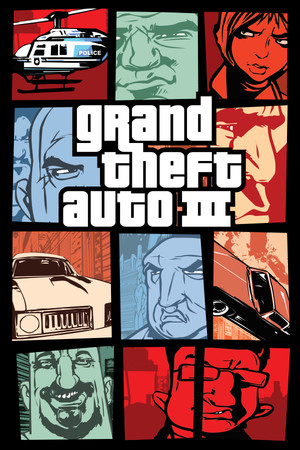
In a 2012 Q&A session, Rockstar Games responded to a question on how the iconic GTA III squish sound of pedestrians being run over was made, and the result was "crushing fruit and raw chicken... and a few more layers from SFX", as noted by the audio and music production team. In the same session, a question was asked if the last gunshot heard after the final scene leading to a black fade was Claude shooting Maria, they had a vaguer answer of possibly and possibly not but had noted that there was a planned speech Maria would give but this was removed in audio phase of production. Continuing with questions, one specifically addressing the GTA III cover artwork featuring a centrally located man with a baseball bat in his hands who was never featured in the game (nor on the game display case because it was behind the lettering but it is still there), was "from an early piece of concept art... that embodied the game".
- #136
As mentioned in the book Jacked: The Outlaw Story of GTA, the Houser brothers discussed cancelling the game as they felt it was too soon to release such a violent game taking place in a locale not unlike New York City. But Rockstar pushed through with the game, albeit with some cuts and changes made out of sensitivity.
- #137
- #138
This game and Grand Theft Auto 2 (1999) are the only ones that don't feature motorcycles. A forum user discovered a failed attempt by Rockstar Games to implement motorcycle physics in the game's.exe file. However, Grand Theft Auto: Liberty City Stories (2005) (a prequel to Grand Theft Auto III) offers an in-universe explanation: a newspaper article states that motorcycles were banned in Liberty City as a result of a pro-four-door car and SUV campaign. These vehicles were promoted as safer alternatives to motorcycles, which were described as "the number one killer in Liberty City."
- #139
- #140
In 2025, Obbe Vermeij, who designed both the hidden packages in every detail, stunt jumps in the activation zone phase, along with the train ride camera positioning, noted it was initially planned to serve as the outside car roof view without ever seeing the player ride along unlike the final game's release which shows the player from outside, and player interior movement would have been challenging. Skipping to the next station also would have stressed the game infrastructure to rapidly load the next environment setting and something that would instead be implemented altogether in GTA IV, where train ride skipping was possible. Advanced movement inside a train to a sophisticated level would not exist in any other way, besides GTA IV finally having in-train camera view and a skip train ride option, until GTA 5 where, besides interactive interior view of the train ride, a drinking player glitch also could launch them into the driver cockpit.
- #141
The game was temporarily removed from sale in Australia, for re-rating. The objectionable content was the player's ability to collect a prostitute, who would sit in the car's passenger seat; if the car came to rest in a secluded area, it would begin to rock violently, implying sex (although both characters remain, unmoving, in their respective seats and stare forwards). What made the content objectionable for the Australian Censorship Board is that you could kill the prostitute after the act was done, therefore deeming it "sexualised violence". A censored version for Australia, removing this ability, was thus released, as was done for Grand Theft Auto: Vice City (2002).
- #142
This game was initially banned in South Korea through the Korea Media Rating Board, but by the time the 10th Anniversary version was released it finally became available for purchase as well as localized within South Korea. This was because rating games through KMRB was replaced by rating games through the Game Rating Board, its subsidiary, in which GTA III was subsequently lifted. This officially made the game the very first Grand Theft Auto 3D Universe game to be officially translated into Korean.
- #143
- #144
- #145
- #146
Two characters were removed from the final version of the game. Yet the character names are left in the book, and in the game's credits: * The first one is named Darkel, voiced by Bill Fiore. There is nothing left of him in the game except for Darkel's character skin, who appears to be a homeless person. Two popular ideas about Darkel's removal are: 1) He gave terrorist-like missions, and was removed due to the 9/11 attacks. 2) He gave you the rampages, but the company decided the traditional skull icons would be better. Darkel was voiced by Bill Fiore. * Another character named Curtly is credited in the manual for the game, although nothing else is known about him apart from his intended voice actor Curtis McClarin. However, in December 2011, Rockstar responded to this in a published Q&A session, stating that the character was removed a considerable amount of time before the attacks as those intended missions were moved into their final result places in the game.
- #147
The airplanes at the airport were coded to be able to explode when shot at with the rocket launcher, but it was hastily disabled after the 9/11 attacks happened. Editing the code can allow you restore that functionality. The next game, Grand Theft Auto: Vice City (2002), sort of brings this back but only for the blimp, and only an attack helicopter can blow it up.
- #148
In 2024, former PlayStation Europe executive Chris Deering confessed the PlayStation 2 exclusive system game was as a result of the company's ongoing concern with then-future product Microsoft Xbox competition, resulting in the 3 GTA games being a PS2 product as the initial offer agreement in late 2001. This was a continuous benefit to PlayStation as GTA SA was the best selling PS2 game of all time with GTA III as a close fifth.
- #149
Originally the police cars were going to use the New York City Police Department's blue and white paint scheme. A few screenshots of them can be seen in the poster that comes with the game (the best one is right under the word "Liberty" in the title "Welcome To Liberty City"). It is believed that the police cars were changed to the standard black and white paint scheme to make them not look like the NYPD cars because of the terrorist attacks on the USA of 11 September 2001.
- #150
In 2023, Rockstar North's Obbe Vermeij shared that missions were always primary to the initial game development and the story being secondary, this being the reason the initial bank robbery cut scenes were actually added in later into the game. As a result, missions and the characters that would be located in specific places would regularly change and result in varied location graphic differences. It was only when voice actor recording sessions were saved that meant leaving things in solid place. Along with this, he noted 2001 was a significant turning stage for the game's final plat of development, especially as Donald Love was not yet a character. In the same series of analysis, Vermeij noted that, in reality, the game's garages containing cars inside it would actually despawn to free loading space for vehicle population around the player. PS2 memory limitations were the reason textures would be reduced and reused elsewhere, resulting in city appearance variations as well vehicle reasons in why there were no flyable planes besides the Dodo. In a separate 2024 occasion, he confirmed this comparing the differences between the color change availability and what the PS 2 would efficiently operate with. Vermeij continued in saying that, during production, the game concept was separated with Leslie Benzies's yellow sticky notes for missions, green for contacts and pink for locations which other archive photos confirm this revelation as well. In 2024, Vermeij also continued to elaborate that the character looking behind and back again, all vehicles that were not focused on were removed as an example what was eliminated. Regarding the littered newspapers found in the streets, it was also his contribution although this would be the only installment to feature newspaper litter. He also explained the fog effect which consisted of 4 steps: fading clouds and grey clouds, camera distance altering the color, the halo glow effect of surrounding lights and the duplicated cloud graphic in billboards relating to the surrounding traffic lights. He also noted the explanation for no tree shadows in the game were because of performance reasons.
- #151
Code designer Obbe Vermeij revealed how the traffic signal street lights functioned and this being explained as using a North-South, East-West cycle and pedestrian traffic and model orientation controlling its cycle with the earliest development storing all controls inside the road nodes, meaning a fallen traffic signal post would still function the same to drivers. His code also transferred over to IV except that only III ever had the earlier consideration of red light running near a police car resulting in a traffic stop, which would never be implemented in a final release game. Another shared characteristic with IV would be that cars would be in flying motion before physics and wheel contact would bring them onto the road, especially as IV's advanced physics meant randomly altered car appearance (crashes or falling helicopters) would appear among the traffic without any witnessed car-to-car contact.
- #152
Pre-game release and also pre-September 11, there was a beta gameplay video which demonstrated the animated living video as what the game would consist, however, this video also boasts a "Felly Tours" brand Coach bus that was never included in final release. Though felly is an existing word for the exterior or also segment rim of a spokes-supported wheel, it is also an intended relation to the word fellator, a noun for the word fellatio oral sex.
- #153
In 2001 promotional documents for the game, Dan Houser gave clues that original Grand Theft Auto (1997) characters Brother Marcus and Bubba would return as well as Grand Theft Auto: London, 1969 (1999) & Grand Theft Auto: London, 1961 (1999) characters, but these were never included in the final game. At the time, designer James Worrall was quoted as saying Frankie would be the mafia kingpin, later renamed Salvatore. In December 2011, Houser later shared that, because only 4 people were the motion capture actors for all characters, there was extra emphasis that all voice actor recording sessions would compensate for this limitation of Hollywood big-name actor quantity.
- #154
Although it is known Lazlow brought real-life radio industry experience into the video game and the following series titles, that real-life syndicated radio show he hosted since the 1995 actually covered the same subject, from latest electronics to video games. This is considering Rockstar Games was not founded until 3 years later and longer before this video game would be released.
- #155
Designer Obbe Vermeij commented that, meanwhile the police behavior of ramming any other vehicle was initially a bug, it was preserved into final release given the content this would lead to as well as that all road nodes were driving the police vehicle's behavior except when then there was none, but this being implemented in off-road examples such as parking lots.
- #156
The fate of Donald Love after his disappearance is not known. Love's only other appearances are in Grand Theft Auto: Vice City (2002) in the year 1986, and in Grand Theft Auto: Liberty City Stories (2005) in the year 1998; both set before the events of this game, in 2001. With Grand Theft Auto IV (2008) being set in 2008 and essentially being a reboot of the Grand Theft Auto series, with no recurring characters (except Lazlow), Love's fate is unlikely to be ever resolved. The only future mention of anything Donald Love-related would be in GTA V where he has a Vinewood Walk of Fame star without any other information.
- #157
Contains a major spoiler — show
According to a design document, Kenji Kasen was originally called Toshiro Kasen and would not be killed by Claude on Donald Love's orders. He was going to give missions in Shoreside Vale once it was unlocked and eventually be murdered by the Colombian Cartel.
- #158
- #159
- #160
- #161
- #162
- #163
- #164
Lazlow's career unfolds in the following order. 3D Universe timeline: 1984 — co-host and intern alongside Couzin Ed at Vice City's V-Rock (Grand Theft Auto: Vice City Stories (2006)); 1986 — host of the rock station V-Rock in Vice City (Grand Theft Auto: Vice City (2002)); 1992 — replacement host on Entertaining America in San Andreas (Grand Theft Auto: San Andreas (2004)); 1998 — field reporter (as opposed to the channel) on Chatterbox in Liberty City (Grand Theft Auto: Liberty City Stories (2005)); 2001 — host of Chatterbox in Liberty City (Grand Theft Auto III). HD Universe timeline: 2008 — host of Integrity in Liberty City, long after being taken off the air for rudeness (Grand Theft Auto IV (2008)); 2013 — co-host on WCTR and host of Fame or Shame (Grand Theft Auto V (2013)).
- #165
- #166
- #167
- #168
- #169
- #170
- #171
- #172
- #173
- #174
- #175
- #176
- #177
- #178
- #179
- #180
- #181
- #182
- #183
- #184
- #185
Behind the Scenes (7)
- #186
- #187
- #188
Software engineer Alan Campbell recalled that animating non-player characters entering and driving cars was difficult for the Grand Theft Auto III team because of the variety of vehicle designs, requiring dozens of different animations to be chained together and key frames altered in code.
- #189
- #190
- #191
- #192
Characters & Cast (13)
- #193
- #194
- #195
- #196
- #197
- #198
- #199
The main character of this game, Claude, does not say a single word throughout the entire game, though you can hear him grunting when he falls after jumping and groaning if he ends up drowning in the river. Rockstar Games later admitted that the decision of a non-speaking character was made so that the player could identify more with him.
- #200
Claude's character shows similarities to the Ryan O'Neal character in Walter Hill's film The Driver (1978). Whereas Claude is mute, O'Neal's character is mostly without dialogue as well, neither character is referred to by name, both have little backstory or personal history, both show zero emotion and both characters are shown acting as exceptional getaway drivers for criminals performing robbery jobs. Ironically, years later Rockstar Games would adapt an actual Walter Hill film, The Warriors (1979), into a video game (The Warriors (2005)).
- #201
There is speculation that the main character, Claude, formally introduced as such in Grand Theft Auto: San Andreas (2004), is the main character from Grand Theft Auto 2 (1999), Claude Speed. This has never been officially confirmed. Even if they are the same character, they are in different "universes", since the 2D universe and the 3D universe are two separate things within the Grand Theft Auto world.
- #202
- #203
- #204
- #205
Easter Eggs & References (36)
- #206
- #207
- #208
The St. Marks district would have a restaurant called Marco's Bistro in it, the restaurant which is part of a car bombing mission involving one of the Forelli Brothers. Interestingly, the name Marco is the Italian variant of the name Mark, as there's some Italian Mafia presence in the St. Marks district.
- #209
In the GTA IV mission "The Cousins Bellic", the game programming is automatically set that Roman exits any car, similar to 8 Ball never exiting and nor will he if changing vehicles, including if Niko enters through the passenger door he will ghost travel through Roman as if he is not physically there. As a result of Niko continually exiting the car, this will also result in an additional Roman dialogue line each time Niko exits and re-enters the car in both English and Serbo-Croatian. This was in contrast to 8 Ball who would never speak, but instead the system prompter saying "Hey! Get back in the vehicle!", with his continued silence even if Claude fled the scene in another car and for several hours lasting to several days. The Callahan Bridge scene also has several prop mannerisms, such as the two police cars responding to the bridge explosion whose officers never exit the car nor will any gunfire to the cars result in their exit either, including if the vehicles are shot to ultimate fiery explosion. Additionally, once the police cars are exploded they will not resurface again as new responding units as this was obviously only intended for that initial witnessing of arriving to the bridge as Claude and 8-Ball flee the scene of their prison van escape. As the mission was intended to be a two-step process of getting to the safehouse and changing clothes and going around the corner to Luigi's there will be no programmed police response, as a result of the vehicular vandalism or any gunfire, nor will it ever advance to 2 stars nor will attempting to extinguish the vehicular fires result in any actual fire extinguishing. The reasons for this was the game programming automatically implementing bridge scenery and there being no intention that the fires or the prison van be accessible or altered, besides that the Claude was free to explore his surroundings and as extensive as jumping to the other 2 islands to continue exploring and gathering hidden packages and weapons.
- #210
- #211
- #212
- #213
- #214
All the games in the 3D universe refer to the Federal Bureau of Investigation (FBI), the Central Intelligence Agency (CIA), the Drug Enforcement Administration (DEA) and Special Weapons and Tactics (SWAT) by their actual names, unlike in the HD era counterparts where they are parodied as the Federal Investigation Bureau (FIB), the International Affairs Agency (IAA), the Drug Observation Agency (DOA) and National Office of Security Enforcement (NOOSE).
- #215
With the first 3D Universe setting to have a NYC-model, there would be heavier NYC examples in the content media that would relate to realism with the following: * with the 2001 setting being the exact year (as compared to then-future LCS which would be a dated 1998 setting), the commercial Millennium Medieval Fair with an extensive attraction roster as well as a German dancer Hans who is also an exterminator, this would be comparable to referencing the Newport Folk Festival in Johannesburg, South Africa * especially as that festival and this individual Hans who would exterminate using only a pennywhistle, this would bridge into the 1965 appearance by South African pennywhistler performer Spokes Mashiyane in contrast of Minneapolis, Minnesota-native (but also 1961 transplant to NYC) Bob Dylan who would an electric instrument-performer * with the HEAD Radio commercial jingle mentioning El Salvador, Paraguay and tertiary country Zambia, this would be another media-inserted clue to the time era when the NFL would be founded in 1959 and when Zambia and Zimbabwe united with the Federation of Rhodesia and Nyasaland to become the 1959-1963-duration Central African Federation as British colonial territories * NFL founder Boston, Massachusetts-native George Wein also would be the founder of the US Newport, Rhode Island Newport Jazz Festival and found the NFL with Bob Dylan's Woodstock, NYC-based manager Albert Grossman, NYC-native folk singers Oscar Brand and Pete Seeger * the 2001 release date (which ranged from the earlier planned release before the October delay) that would predate BD's return again in 2002 with a costume, that would one of numerous clues in the Millennium Medieval Fair in comparison of the electric instrument controversy in 1965 * the NFL also would feature folk singer Mississippi John Hurt who would attend, as well with the Philadelphia Folk Festival that same year, with the 1963 societal change in the US and record a new album in 1964 soon before his 1966 death * returning to Spokes Mashiyane also would record content after the NFL with a US record label that would result in 1965's New York City and subsequently 5th Avenue and 1969's Newport and also subsequently America * the NFL establishment also would predate Northeast Coast, US-based pianist Claude Williamson who would note recognition in the 1958 release Kwele Claude liner notes * it is also in connecting with the first Black character in 2004 release SA that there would be heavier West Coast connections ranging from the 1951 arrival of CW to San Francisco (his trumpeter-valve trombonist brother Stu arriving to the city 2 years later where a big band career would begin) as well as that CW's middle name Berkeley would reminisce of the RC Zero rival of the same name * with SW's early encounters in the 1950s scene being brief before his 1962 collapse from narcotic use, this also would be comparable to the SA-era SF-UR house music radio station host Hans Oberlander who is portrayed as a bilingual English-German-speaking with emotional collapse
- #216
It would not be a coincidence that the one III-era taxi driver would have the scripted dialogue that appear in previous 20th century films before the 2001 universe would be released: * "I don't deserve this!" in its variations of recurring quotes, as this is what a character said to the taxi driver, as they engage in an intense argument, in Atlantic City-filmed The Color of Money (1986) with the 2008 universe being the first to officially include East New Jersey and its communities into an introduced borough * "what in the name!" is another recognizable quote from the lead black cop said in Atlanta, Georgia-filmed RoboCop 3 (1993), and a city where it would both accompany the similar naming structure as the previous city and also a city founded in 1837 and the Atlanta name appearing in 1845. Texas becoming a state that same year and later introducing an 1871-founded Atlanta, Cass County that was named after the Georgia city, and with its other city Dallas being the first RoboCop filming location.
- #217
- #218
- #219
- #220
- #221
Around the city, there are numerous spoofs to movies and Broadway shows. They are: * "BadFellas", which is a spoof of GoodFellas (1990). * "Fannie", which is a spoof of "Annie". * "Saturday Night Beaver", which is a spoof of Saturday Night Fever (1977). * "Duck Pond" (from Liberty Ballet Co.), which is a spoof of "Swan Lake". * "Rats," which is a spoof of "Cats". * "Half-Cocked", which could be a spoof of cop movies, such as Dirty Harry (1971). * "Top Down City," starring "Arnold Steelone", which could be a spoof of Arnold Schwarzenegger & Sylvester Stallone action films (it's also a reference to Grand Theft Auto (1997), Grand Theft Auto: London, 1969 (1999), Grand Theft Auto: London, 1961 (1999) and Grand Theft Auto 2 (1999), which all featured a top down view). * "69th Street," a spoof of "42nd Street". * "Soldiers of Misfortune" a spoof of war films. * "Pirates In Men's Pants," a spoof of "Pirates of Penzance".
- #222
- #223
- #224
The recurring mission boss character Donald Love who mysteriously disappeared in that 2001 universe, that was still never explained in any chronological future release in modern times, besides the past-revisitation of 1980s VC and 1998 LCS, would be connected to the following future-based observations relating to him, though never explicitly reappearing himself again: * the peculiarly unique placement of the May 2025 second trailer where it shows Jason and Lucia joking and laughing on a pier ramp, with Lucia stating "you broke my nose, that's what!" which would have reminiscent tones of the Archer TV series episode of a similar setting where a character teases another who states the other broke his nose and the first character ridiculing him for it. In addition, that Archer episode featured a Burt Reynolds-voiced character Burt Reynolds dating one of the cast characters and this occurring in post-chronological timing since 2002 VC Burt Reynolds-voiced Texas-speaking accent and Western-dressed Avery Carrington who is a mission boss in several missions in that 2002 series, appearing alongside Donald Love in mission Two Bit Hit. Carrington would also appear again in 2005 release LCS where he would be assassinated by the lead character there in mission Panlantic Land Grab. In comparing the 1980s-set VC and 1998-set LCS, both feature 2001 III character Donald Love, with the VC Avery Carrington repeating a quote DL said in the III mission Waka-Gashira Wipeout. * Reynolds would die in 2018 in Jupiter, Florida without his Avery Carrington character ever resurfacing in the series meanwhile the other, Donald Love, also would never physically appear in modern times since the 2001-set III. * in different comparison, Donald Love voice actor Twin Peaks-starring Kyle MacLachlan would note in 2024 that he was surprised at what he was voicing in 2001 but he believed a theory his character would have survived * in the Donald Love mission Liberator, he notes how his Oriental Gentleman associate is being held in an Aspatria, Northwest Staunton Island which would bear the same name as the northwest Cumberland, Cumbria, England town near its neighboring frontier with Scotland and Aspatria being the hometown of 1800s-1900s English coach manufacturer William Thompson Casson whose coach titling was similar to the 3D Universe-only Coach bus
- #225
In the game, Lips 106 references the same city that another Rockstar Games release Manhunt would feature as the city, Carcer City, referencing it was a close proximity to Liberty City considering The Liberty Tree covered a news story about a police chief cleared of any criminal corruption charges. This considering Manhunt would be released after this game.
- #226
- #227
- #228
In the game there's a sign adverting a movie called "Badfellas". That's a spoof on Martin Scorsese's GoodFellas (1990), in which Frank Vincent (Salvatore Leone) and Debi Mazar (Maria) were cast members. In the film they played Billy Batts and Sandy respectively. The film was also a huge influence on the story and setting of the game.
- #229
- #230
- #231
- #232
Not only is the Greyhound bus line parodied in the game with Whippet Express Coach, one of the dog varieties referenced, but also that Whippet Coach is realistically a Cambridgeshire, England bus line and having originated from the founder using an American ambulance as the first vehicle. Unrelated to the game considering it originates in the supposed Australian American War references in the Chatterbox radio, the company would later be bought in 2014 by an Australian travel company also owning other related London bus companies before selling it back to another England-based company in 2018, the new parent company being a previous Australian company CEO.
- #233
- #234
- #235
- #236
- #237
- #238
- #239
- #240
- #241
Deeper Meaning (5)
- #242
After Donald Love's disappearance, his fate remains unknown. Love's other appearances were in Grand Theft Auto: Vice City (2002), set in 1986, and Grand Theft Auto: Liberty City Stories (2005), set in 1998; both take place before the events of this game in 2001. Since Grand Theft Auto IV (2008) is set in 2008 and effectively rebooted the Grand Theft Auto series with no recurring characters (aside from Lazlow), it is unlikely that Love's fate will be resolved. The only future reference to anything related to Donald Love would be in GTA V, where he has a Vinewood Walk of Fame star with no further information.
- #243
The game was temporarily withdrawn from sale in Australia for re-rating. The objectionable content was the player's ability to pick up a prostitute who sits in the passenger seat of the car; if the car stops in a secluded area, it begins rocking violently, implying sex (although both characters remain in their seats without moving and face forward). What made the content objectionable to the Australian Censorship Board was that you could kill the prostitute after the act, allowing it to be classed as "sexualised violence." A censored version removing this ability was therefore released for Australia, as was done for Grand Theft Auto: Vice City (2002).
- #244
Two characters were cut from the final version of the game, though their names were left in the manual and the game's credits. The first is named Darkel and is voiced by Bill Fiore; nothing of him remains in the game except his character model, which looks like a homeless man. Two popular ideas about Darkel's removal are: 1) he gave terrorist-like missions and was cut because of the September 11 attacks; 2) he sent you on rampage-style attacks, but the company decided the traditional skull icons would be better. Darkel's voice was provided by Bill Fiore. The game's manual mentions another character named Curtly, but nothing else is known about him apart from his voice actor, Curtis McClarin. However, in December 2011 Rockstar responded to this in a published Q&A session, stating that the character had been removed well before the attacks because the intended missions were moved to their final locations in the game.
- #245
- #246
Career & Awards (3)
Life & Family (1)
- #250
In 2024, The Lord of the Rings: The Fellowship of the Ring (2001)' Dominic Monaghan confessed he had not thought anything of the game series before Elijah Wood encouraged him to buy the then-latest PlayStation 2, to which a friend later giving him the GTA III copy to play, which was an evolving point for him in games considering the open-world system, player driving, soundtrack and what he noted as a new age since the early Pac-Man days.
Sources & editorial notes
Sources for the entries on this page
- Wikipedia Grand Theft Auto III — Wikipedia
Information from external sources is independently selected, consolidated and edited by Arka Evren. Sources are listed for verification and further reading. Encyclopedia text is used under its licence (CC BY-SA). How we work