GAME · 2001
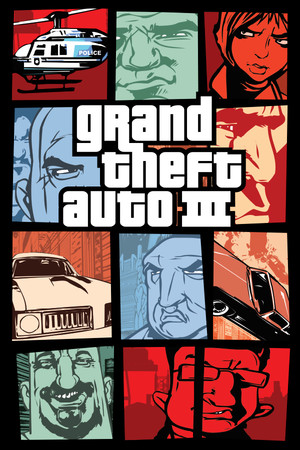
Grand Theft Auto III
- Publisher
- Capcom
- Platforms
- Microsoft Windows, macOS, PlayStation 3
39 archived facts 5 topics 1 source Last reviewed Sep 2026
All facts (39)
- #001
Grand Theft Auto III was developed by a core team of roughly 23 people at DMA Design in Edinburgh, working in close collaboration with publisher Rockstar Games in New York City.
- #002
The original tech demo for Grand Theft Auto III was built on Sega's Dreamcast around the end of Grand Theft Auto 2's development in 1999.
- #003
Rockstar Games had been pushing its teams toward creating a 3D open world, and the DMA group that had made Space Station Silicon Valley in 1998 started work on a project separate from the Grand Theft Auto 2 team.
- #004
According to DMA support engineer Alan Jack, the project combined the exploration of Body Harvest (1998) with the city level of Space Station Silicon Valley.
- #005
The team developing Grand Theft Auto III initially avoided the Grand Theft Auto branding to prevent conflict with the Grand Theft Auto 2 team, and started work on the game as a Godzilla project.
- #006
Grand Theft Auto III was initially in development for the Dreamcast, but the combined team moved it to the PlayStation 2 after four months.
- #007
Technical director Obbe Vermeij said the platform shift was not caused by hardware constraints but by the Dreamcast becoming commercially unviable, and he called the decision disappointing because DMA Design staff were fans of Phantasy Star Online (2000).
- #008
During the Dreamcast phase of development, DMA Design built city blocks for Grand Theft Auto III that included brownstones, docks and retail areas, as well as vehicles and pedestrians.
- #009
Grand Theft Auto III was the first game in the series to use 3D, built on Criterion Games's RenderWare engine.
- #010
Executive producer Sam Houser had long wanted the series to move to 3D, and DMA Design had previously experimented with 3D worlds in Body Harvest and Space Station Silicon Valley.
- #011
The team behind Grand Theft Auto III believed a large 3D world was finally possible after the PlayStation 2 was released in 2000.
- #012
The PlayStation 2's DVD support, an upgrade over the PlayStation's compact disc format, gave Grand Theft Auto III's developers more storage space for animations, music and environments.
- #013
Grand Theft Auto III's scale left its team feeling limited by the PlayStation 2's 32 megabytes of RAM, and the game's variety of scenarios made testing difficult.
- #014
Integrating every part of Grand Theft Auto III into a fully 3D world proved difficult for its developers, including the sounds, radio stations, and the design and voicing of the open world's many non-player characters.
- #015
By mid-2000, the Grand Theft Auto III team had the game's basic technical elements working together, including a prototype of the carjacking mechanic and a stable streaming model.
- #016
Streaming in Grand Theft Auto III was first meant only to load music and map geometry, but the team widened its scope after realising there was more game data to process.
- #017
For Grand Theft Auto III, the developers first built a "hybrid city" that Dan Houser called "a post industrial Midwest slash east coast generic" city.
- #018
After beginning development within that world, the team concluded that basing the design on a real location meant "you have a lot of things you can say about it", and redesigned Liberty City to be loosely based on New York City.
- #019
Liberty City had previously appeared in the first Grand Theft Auto (1997) before being redesigned for Grand Theft Auto III.
- #020
DMA Design collaborated with a Rockstar team in New York for cultural references, and the Rockstar team regularly worked long hours for entire weeks to ensure references such as in-game car manufacturers suited the city.
- #021
Dan Houser described Grand Theft Auto III's Liberty City as a "hybrid of a generic American city", drawing on Chicago, Pittsburgh, Detroit, New York and Philadelphia. In his view, the parallel realism of the world let the team make more social commentary.
- #022
Sam Houser cited films and television such as Heat (1995) and The Sopranos (1999–2007) as inspiration for Grand Theft Auto III's setting, wanting to emulate them in the game.
- #023
Sam Houser also pointed to the Legend of Zelda franchise, the video game Super Mario 64 (1996) and the film Goodfellas (1990) as influences, describing Grand Theft Auto III as "a cross between a gangster movie and an RPG".
- #024
Dan Houser said the team developed the story and game design for Grand Theft Auto III at the same time, using the story to expose the mechanics and the mechanics to tell the story.
- #025
Dan Houser found writing the narrative for Grand Theft Auto III difficult because the game prioritised player freedom of choice, and he wanted a story more nuanced than the generic rise and fall of a superhero bad guy.
- #026
Dan Houser and co-writer James Worrall drew on films including The Warriors, Taxi Driver, Scarface and Payback, as well as the depiction of mafiosos in Martin Scorsese's films, when writing Grand Theft Auto III.
- #027
While writing Grand Theft Auto III, Dan Houser and James Worrall met regularly with the designers and filled a room with post-it notes to construct the plot and shape the game.
- #028
Grand Theft Auto III animated many of its characters through motion capture, which was recorded at a rented studio in the Brooklyn Navy Yard, though technical constraints limited the process.
- #029
Software engineer Alan Campbell recalled that animating non-player characters entering and driving cars was difficult for the Grand Theft Auto III team because of the variety of vehicle designs, requiring dozens of different animations to be chained together and key frames altered in code.
- #030
For Grand Theft Auto III, the team used varying camera angles when animating cutscenes to evoke different emotions.
- #031
According to motion capture director Navid Khonsari, the Grand Theft Auto III team sought natural, subtle voice performances, but many actors believed that because video games are animated, their performances needed to be animated as well.
- #032
Claude, the protagonist of Grand Theft Auto III, is unnamed in the game; his name is not officially revealed until his appearance in Grand Theft Auto: San Andreas in 2004.
- #033
Claude is a silent protagonist who never speaks in his appearances across the series.
- #034
The development team chose to make Claude silent mainly because it "did not seem like a major issue" next to other development challenges, and partly to help players identify with the character and define him as they wished.
- #035
The developers had no single inspiration for Claude, but liked the idea of a "strong, silent killer, who would be juxtaposed with all of these neurotic and verbose mobsters".
- #036
Grand Theft Auto III contains roughly three and a half hours of in-game radio content.
- #037
The development team behind Grand Theft Auto III aimed for a wide range of music so players could switch between stations as they would in real life, echoing the gangster film culture the game draws on.
- #038
Grand Theft Auto III's talk radio stations were used to give the city character and offer what Sam Houser called "a very iconoclastic look at America".
- #039
For Grand Theft Auto III, real DJs were cast for the in-game stations and given unusual dialogue, with the team pursuing "high production values and absurd content"; music director Craig Conner assembled the radio assets, including music, advertisements, DJ dialogue and station imaging.
Sources & editorial notes
Sources for the entries on this page
- Wikipedia Grand Theft Auto III — Wikipedia
Information from external sources is independently selected, consolidated and edited by Arka Evren. Sources are listed for verification and further reading. Encyclopedia text is used under its licence (CC BY-SA). How we work