
GAME · 2002 · UK
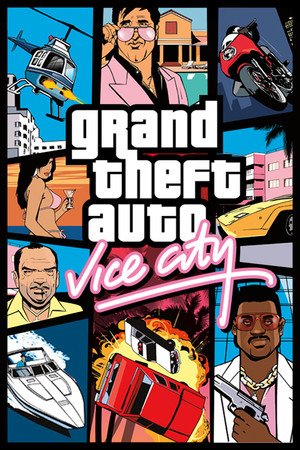
Grand Theft Auto: Vice City
- Platforms
- Microsoft Windows, macOS, PlayStation 3
70 archived facts 6 topics 2 sources Last reviewed Nov 2026
70 Interesting Facts About Grand Theft Auto: Vice City
Interesting Facts (52)
- #001
The script was over 1000 pages long.
- #002
While in the office of the Vercetti Estate, if you stand in front of the security monitors and look at them with a sniper rifle, you will see that the monitors display a completely different design from Tommy Vercetti's mansion. The image shown is Tony Montana's mansion from Scarface (1983), with its wide staircase, the "The World Is Yours" statue and its small swimming pool.
- #003
If you buy a boat and search the waters off the Leaf Links coast near Downtown, you can see a fat man wearing cement shoes at the bottom of the sea.
- #004
After entering the upstairs office of the Malibu Club, if you look at the left wall you will see a large mural of palm trees bathed red by the setting sun. It is the same mural that decorates the office wall of Lopez Motors, which belongs to Tony Montana's boss Frank Lopez in Scarface (1983).
- #005
If the player somehow obtains a police uniform from outside via a cheat code, they automatically reach a wanted level.
- #006
When it was released on PC, many people complained about the difficulty of the "Demolition Man" mission, in which the player controls a toy helicopter. The player must guide the aforementioned toy into a building containing explosives. Many keyboards could not handle as many simultaneous key presses as the controls required, causing the helicopter to crash. Many game modification programs ("Trainers") were designed specifically to make completing the mission easier.
- #007
The cardboard targets in the "The Shootist" mission, in which Tommy Vercetti must impress Phil Cassidy at the shooting range, are characters from Grand Theft Auto III (2001). Cassidy also appears in this game in the "Arms Shortage" mission.
- #008
All of the missions at the film studio take place in a building with the letters D & H on its front, the initials of Dennis Hopper, who voices director Steve Scott.
- #009
Some of the chants heard during the "Riot" mission are the same as those in the game "Hooligans: Storm over Europe."
- #010
The "Publicity Tour" mission is based on the film Speed (1994), since it features a car that will explode if you drive too slowly, and Speed features a bus that will arm itself if the driver goes above 50 and explode if he goes below 50. Dennis Hopper, who played the film's mastermind Howard Payne, also plays film director Steve Scott, though in the game he has no connection to this mission.
- #011
Ricardo Diaz was originally named "Fernando Diaz" and wore a suit instead of a Hawaiian shirt.
- #012
After obtaining a police uniform, the player can enter the Washington Beach police station without attracting police attention and enter Fort Baxter Air Base without being shot by the soldiers.
- #013
When the radio is tuned between 1000 and 1010, there are various references to the Somethingawful.com humor website, including the SA Goon title, and there is a newspaper called Front Page News that references Somethingawful's Front Page.
- #014
The intro of Grand Theft Auto: Vice City features a Commodore 64-style loading screen. VICE was also the name of an emulator for Commodore systems. The music that plays after the C65 "LOAD" screen is also the same music used with Claude's pager in Grand Theft Auto III (2001).
- #015
The game was produced by Rockstar Games, whose logo can be seen in various places around the city. It can even be seen as a constellation in the eastern sky at night and as a swimming pool on Starfish Island.
- #016
An English masochist named Freddy calls K-Chat wanting to be hit with a broom. In Grand Theft Auto III (2001), another English masochist named Freddy discusses being spanked by his nanny on Chatterbox. However, since the voices are slightly different, it can be assumed he is the same person twenty years earlier. In both games the character's voice is provided by series writer/producer Dan Houser.
- #017
When Ray Liotta was asked why he voiced the game's main character, he said 'for the money'. Tommy Vercetti was planned to have a brief voice role in Grand Theft Auto: San Andreas, but Liotta refused to return because he felt he had been paid too little on this game. In 2008, Sam Houser stated that he had not actually been paid little, that he thought he should have asked for more given the game's subsequent success, and that the situation had bothered him considerably.
- #018
A player who completes the game 100% is given 200 health, 200 armor, double vehicle strength for any vehicle Tommy Vercetti drives, a T-shirt reading 'I completed Vice City and all I got was this lousy T-shirt', unlimited ammo on all weapons, and three bodyguards who sometimes sit at the bar of the Vercetti Estate. When you step on the pink markers, you pay $1,000 for each bodyguard to follow you.
- #019
In the cutscene of the 'Supply and Demand' mission, Ricardo Diaz shoots an unplugged VCR for not ejecting 'my favorite El Burro movie'. El Burro is a gang leader in Grand Theft Auto III who specializes in porn videos.
- #020
On one of the game's talk radio stations (VCPR), 'motivational speaker' Jeremy Robard names several of his therapy tapes. When all the titles are abbreviated, drug names emerge: 'Motivate, Demonstrate, then Motivate Again' becomes MDMA (Ecstasy), 'Think, Hold that thought, Complete' becomes THC, and 'Learn, Start, Do' becomes LSD.
- #021
In the opening cutscenes, Tommy Vercetti is picked up from Escobar International Airport to make a cocaine deal. This is a reference to the real-life Pablo Escobar, who was the richest cocaine smuggler from the 1980s to the early 1990s.
- #022
In the mobile version of the game, the player does not lose their weapons after being arrested.
- #023
In 2003, following complaints from Haitian-Americans, Rockstar decided to remove the references to Haitians.
- #024
In Vice City, an NPC model dressed like Michael Knight from Knight Rider can be seen, wearing a black leather jacket, black jeans and a red turtleneck sweater.
- #025
The police cars in the game are green and white. However, their original color designs were white with red and blue stripes. A picture of the original color scheme can be seen on page 8 of the game's manual ('Vice City Tourist Guide').
- #026
The license plate on Love Fist's limousine reads 'LUVF1ST'.
- #027
The game was initially conceived as an expansion pack for Grand Theft Auto III, to be titled Grand Theft Auto: Miami, and was to be a direct continuation of that game's events. Clues to this appear in Grand Theft Auto III through 'Visit Miami' billboards and in Ray Machowski's final mission, 'Marked Man', where the player takes Ray to Francis International Airport in Liberty City so he can board a plane to Miami. However, Rockstar decided to make it a standalone game as a distant prequel set in the 1980s, and renamed it Grand Theft Auto: Vice City, taking the name from one of the cities used in the first Grand Theft Auto.
- #028
According to an IGN interview with Dan Houser, Sonny Forelli and Tommy Vercetti had been friends since childhood. In the same interview, Houser explained that Tommy never told anyone that Sonny had sent him to kill the key mob boss and therefore his men, because he believed in a mafia rule and a sense of honour among thieves.
- #029
Lionel Richie's 'Running with the Night' is found only in the original 1.40 PS2 version of the game and was removed from later releases.
- #030
For the Grand Theft Auto: The Trilogy - The Definitive Edition re-release, both Michael Jackson songs were removed from the soundtrack. When starting a new game, the first time the player enters a vehicle they now hear Laura Branigan's 'Self Control' instead of 'Billie Jean'.
- #031
In 2012, Leslie Benzies stated that the idea of recreating Miami in the game stemmed from Sam Houser's fondness for the Miami Vice series.
- #032
In 2012, Dan Houser revealed that Candy Suxxx's voice actress Jenna Jameson arrived at the recording session with her father, who was visibly uncomfortable, which made Houser tense. Initially, he described her sexually explicit moans simply as expressing happiness or eating chocolate. However, Jameson immediately understood the implication, recognising the automatic association between happiness and a sexual sound, and then the reference to eating chocolate. Houser eventually admitted that the sounds were sexual in purpose, and Jameson agreed to the request.
- #033
All games in the 3D universe name the Federal Bureau of Investigation (FBI), the Central Intelligence Agency (CIA), the Drug Enforcement Administration (DEA) and Special Weapons and Tactics (SWAT) units by their real names; in their HD-era counterparts, these are parodied as the Federal Investigation Bureau (FIB), the International Affairs Agency (IAA), the Drug Observation Agency (DOA) and the National Office of Security Enforcement (NOOSE).
- #034
In an unused phone conversation, Avery Carrington sends Tommy Vercetti on a mission to the 'Gator Keys'. This indicates that a version of the Florida Keys was planned and may even have been partially developed, but was ultimately cancelled.
- #035
Donald Love was planned to have a larger role in the game. However, in the final release his appearance was limited to two short, non-speaking roles.
- #036
Jenna Jameson wanted to appear in a Grand Theft Auto game because her boyfriend at the time was a big Grand Theft Auto fan.
- #037
In 2024, Lazlow revealed that although he went to the first creative content development meeting for Grand Theft Auto: Vice City with the same yellow legal notepad and board he had used for Grand Theft Auto III, he immediately realised he needed something else to actively capture the ideas emerging for the new game. That was when he started using a laptop, and he continued to use one on subsequent Grand Theft Auto games.
- #038
Pastor Richards was meant to have a larger role in the game, which is why he has a brief appearance at Cortez's party.
- #039
For the 10th anniversary edition and Grand Theft Auto: The Trilogy - The Definitive Edition, five more songs were removed in addition to both Michael Jackson songs. These songs are 'Wow' by Kate Bush, 'Bark at the Moon' by Ozzy Osbourne, 'Rockit' by Herbie Hancock, 'Looking for the Perfect Beat' by Afrika Bambaataa and Soul Sonic Force, and 'The Smurf' by Tyrone Brunson.
- #040
The game was briefly removed from Steam and other platforms on the grounds that the copyright for Michael Jackson's song 'Wanna Be Starting Something' had expired. Everything was resolved and the game returned to Steam with the song.
- #041
At the beginning of the game, Lance Vance oversees a drug deal with his brother Vic Vance, who would later become the protagonist of Grand Theft Auto: Vice City Stories, and Vic is shot by Ricardo Diaz's men. Vic's Caribbean accent was changed in the prequel.
- #042
The interior set of Ken Rosenberg's office does not match the exterior of Hotel Harrison; as the beta version proves, his office was supposed to be somewhere else. Also, while having his office inside a hotel may be a good fit for the 'shady, unlucky lawyer' character, knowing that this was a relatively last-minute change better explains this oddity.
- #043
In pre-release promotions, the developers stated that there would be intense conflict and chases between the police and the public, but this was never included in the final game; this feature would only appear in the later San Andreas game.
- #044
The hidden package statues are a reference to the 'Milk Run' episode of Miami Vice, in which drug dealers smuggle cocaine in similar statues.
- #045
The Malibu Club asset mission 'The Driver' was heavily criticized by fans for being both difficult and ultimately completely pointless. In the final Malibu Club asset mission 'The Job,' Hilary King (the person Tommy Vercetti raced against in 'The Driver') is killed during the bank robbery as the getaway driver before he can even complete his job.
- #046
A screenshot from early 2002 showed poolside loungers with the same wooden design and style as the loungers in Asuka's apartment in Grand Theft Auto III; however, the loungers were preserved on the beach. The same early screenshot also showed a palm tree median grove across from the Washington Beach fountain that was later removed.
- #047
The official 2002 Grand Theft Auto Vice City Strategy guide showed a screenshot of Tommy finding a hidden package in a Studio C bathroom in the style of the GTA III-era Belleville Park toilet stall, which is not in the final version; instead there was an empty studio building with the package next to the front door.
- #048
In Downtown, there was a preserved Rusty Brown's Donuts building model that had only a model and no details; however, police radio audio files detailing police presence at this collective location indicate that this was later removed. The game files also contained code fragments indicating there would be multiple traffic signals with US-style protected arrow turn lights; this suggested a multi-lane road, but such a situation or major infrastructure never existed in the game.
- #049
In the same early development series, Sunshine Autos was originally intended to be named BJ Smith's BJ's Used Autos; billboards and K-Chat radio advertisements for it still exist in the city, as well as advertisements on page 14 of the game manual. GTA Vice City Stories carries no other trace indicating a predetermined time in which this other name was used, despite these advertisements.
- #050
In Grand Theft Auto IV, there are several intended recognition hints toward this game: in Funland on Firefly Island, there are two different statues, the first being the Vice City Ocean View Hotel and then the lighthouse; in Vlad's Comrades bar in South Broker, there are Vice City posters on the far back corner wall of the bar mirror (signed with text including kisses to Vlad); in the multi-story building bordered by Dukes Blvd, Hooper St and Stone St, the game's bikini woman appears.
- #051
The names of the two people Tommy Vercetti kills in the Scarface-like mansion, which is later named 'Diaz Mansion' and 'Vercetti Mansion' in the game, Ricardo Diaz and Sonny Forelli, share the same names as two main characters in Miami Vice: Sonny Crockett and Ricardo Tubbs, respectively. Coincidentally, Lance Vance, portrayed by Tubbs's voice actor Philip Michael Thomas, is also killed during the mission in which Sonny Forelli is killed, and previously becomes the person who avenges Ricardo Diaz's death. However, while Vance avenges Ricardo Diaz's death, Diaz, who shares the same first name as Tubbs in Miami Vice, is killed by Tommy before Sonny Forelli arrives in Vice City.
- #052
The word Don, a term used for a mafia boss, like Sonny Forelli, is also the first name of the actor Don Johnson, who played Sonny Crockett in Miami Vice; Crockett also shares the same first name as Forelli in Vice City.
Production Story (4)
- #053
After the Windows release of Grand Theft Auto III, the development team considered a mission pack adding new weapons, vehicles and missions, then chose to turn the idea into a stand-alone game that became Grand Theft Auto: Vice City.
- #054
Producer Leslie Benzies described Miami, the inspiration for Vice City, as "a party town, all sun and sea and sex, but with that same dark edge underneath", while Sam Houser called the era "the grooviest era of crime because it didn't even feel like it was crime".
- #055
The development team drew several themes for Grand Theft Auto: Vice City from the crime films Scarface (1983) and Carlito's Way (1993), using the latter for its portrayal of nuanced criminals.
- #056
The television series Miami Vice (1984–1989) was a major influence on Grand Theft Auto: Vice City, and the team watched it regularly during development; art director Aaron Garbut used it as a reference for emulating neon lighting.
Behind the Scenes (1)
- #057
While Ray Liotta recorded his voice for Grand Theft Auto: Vice City, the team filmed his physical performance against a blue screen so they could judge how to visualise the cutscenes.
Characters & Cast (3)
- #058
Some lines spoken by the hard hat construction worker in the Industrial District are lyrics written by The Village People.
- #059
The character Ken Rosenberg is largely based on the character David Kleinfeld from Carlito's Way (1993), played by Sean Penn. Besides the physical similarities, both are lawyers, cocaine addicts and deal with gangsters. Moreover, Rosenberg's office resembles Kleinfeld's in the film. Luis Guzmán also appears in both Carlito's Way and this game.
- #060
The dynamic between Tommy Vercetti and Lance Vance in Grand Theft Auto: Vice City was designed to echo that of James "Sonny" Crockett and Ricardo Tubbs from Miami Vice.
Easter Eggs & References (9)
- #061
- #062
When changing radio stations, you can hear tracks from Grand Theft Auto III (2001) radio stations hidden in the radio static.
- #063
The game was heavily influenced by the 1983 gangster film Scarface, which stars Al Pacino as Tony Montana. Both feature criminals who leave their homeland in the '80s and move to Miami (Vice City in the game), wear Hawaiian shirts, and take over the city with a drug empire that ends in a chaotic final battle. Their mansions and lifestyles are also very similar; the main difference is that Tony Montana is Cuban while Tommy Vercetti is Italian-American. The film's famous chainsaw scene is referenced in the game through the "Apartment 3c" easter egg. Two nightclubs in the game (The Malibu Club and The Pole Position Club) also reference two nightclubs in the film (The Babylon Club and Little Havana Club). Carlito's Way (1993), which also stars Al Pacino, had a major influence on the game's story and characters. Both films were directed by Brian De Palma.
- #064
The Kaufman Cab company is a reference to comedian Andy Kaufman, who appeared in the television series Taxi (1978).
- #065
In the "Autocide" mission, all the men Tommy must kill have names similar to characters from games based on the Grand Theft Auto games: Mike Griffin is a reference to Mace Griffin from Mace Griffin Bounty Hunter (2003); Dick Tanner is a reference to John Tanner from the Driver (1999) series; Marcus Hammond, Franco Carter and Charlie Dilson also reference Mark Hammond, Frank Carter and Charlie Jolson from The Getaway (2002); and Nick Kong is a reference to Nick Kang from True Crime: Streets of LA (2003).
- #066
The Deluxo car (found on the showroom floor after buying Sunshine Autos) is a reference to the DeLorean, a unique car that was briefly popular. It was produced from 1981 to 1984, and its popularity grew after it "starred" as the time machine in Back to the Future (1985). The Deluxo reappears in Grand Theft Auto Online (2013).
- #067
There are numerous references to Miami Vice (1984), including the casting of Philip Michael Thomas in the role of Lance Vance.
- #068
One of the posters in Phil Cassidy's trailer is actually from the cover of Maxim magazine featuring Joanna Taylor. It is located on the left side of the bed in the bedroom.
- #069
Every license plate in Vice City reads "VC R29."
Deeper Meaning (1)
- #070
Rockstar co-founder Dan Houser stated that his frustrations working with Burt Reynolds on this game led the studio to stop hiring famous actors to appear in its games.
Related pages
- Grand Theft Auto: San Andreas — Grand Theft Auto: Vice City comes up in the facts on that page
Sources & editorial notes
Sources for the entries on this page
- Wikipedia Grand Theft Auto: Vice City — Wikipedia
Information from external sources is independently selected, consolidated and edited by Arka Evren. Sources are listed for verification and further reading. Encyclopedia text is used under its licence (CC BY-SA). How we work