GAME · 2002
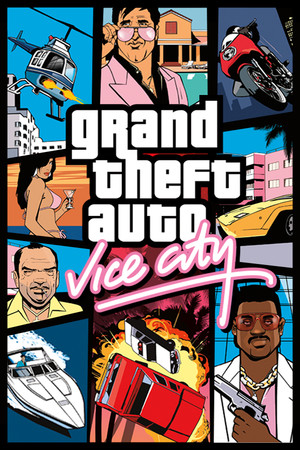
Grand Theft Auto: Vice City
- Platforms
- Microsoft Windows, macOS, PlayStation 3
25 archived facts 4 topics 1 source Last reviewed Sep 2026
17 Facts From the Development of Grand Theft Auto: Vice City
- #001
Grand Theft Auto: Vice City was developed over eighteen months by a core team of 50 people at Rockstar North.
- #002
Full production on Grand Theft Auto: Vice City started in late 2001, while Grand Theft Auto III was close to completion.
- #003
Executive producer Sam Houser said development of Grand Theft Auto: Vice City "really kicked off at the beginning of 2002" and ran for roughly nine months.
- #004
After the Windows release of Grand Theft Auto III, the development team considered a mission pack adding new weapons, vehicles and missions, then chose to turn the idea into a stand-alone game that became Grand Theft Auto: Vice City.
- #005
Grand Theft Auto: Vice City was announced at the Electronic Entertainment Expo on 22 May 2002.
- #006
At the time, Grand Theft Auto: Vice City was Rockstar North's most expensive game, with a development budget of US$5 million and a marketing budget of US$13.2 million.
- #007
Rockstar announced on 5 September 2002 that Grand Theft Auto: Vice City's release date had been postponed from 22 October to 29 October to meet product demand.
- #008
Grand Theft Auto: Vice City was released for the PlayStation 2 on 29 October in North America and on 8 November in Europe, and Capcom published it in Japan on 20 May 2004 for PlayStation 2 and Windows.
- #010
The development team of Grand Theft Auto: Vice City chose to reuse the Vice City location from the original Grand Theft Auto (1997), incorporating ideas from within the studio and from the fanbase.
- #011
The team behind Grand Theft Auto: Vice City aimed to satirise a non-contemporary location, unlike the modern-day Liberty City of Grand Theft Auto III, and sought a setting with similarities and differences to New York City, eventually settling on Miami.
- #012
Producer Leslie Benzies described Miami, the inspiration for Vice City, as "a party town, all sun and sea and sex, but with that same dark edge underneath", while Sam Houser called the era "the grooviest era of crime because it didn't even feel like it was crime".
- #013
Grand Theft Auto: Vice City's visual design, including its clothing and vehicles, was built to reflect the game's 1980s setting.
- #014
The development team drew several themes for Grand Theft Auto: Vice City from the crime films Scarface (1983) and Carlito's Way (1993), using the latter for its portrayal of nuanced criminals.
- #015
The television series Miami Vice (1984–1989) was a major influence on Grand Theft Auto: Vice City, and the team watched it regularly during development; art director Aaron Garbut used it as a reference for emulating neon lighting.
- #016
For Grand Theft Auto: Vice City, the team found recreating a 1980s setting relatively painless because of the era's distinct culture and their own familiarity with it, and they were supplied with large volumes of research and reference photographs taken by development team members.
- #017
For Grand Theft Auto: Vice City, the development team worked through the challenge of creating a speaking protagonist, a marked change from the silent Claude of Grand Theft Auto III.
- #025
For Grand Theft Auto: Vice City's radio stations, the team curated a variety of 1980s songs to reinforce the game's setting, a process that required extensive research.
Sources & editorial notes
Sources for the entries on this page
- Wikipedia Grand Theft Auto: Vice City — Wikipedia
Information from external sources is independently selected, consolidated and edited by Arka Evren. Sources are listed for verification and further reading. Encyclopedia text is used under its licence (CC BY-SA). How we work