GAME · 1998
Half-Life
- Developer
- Gearbox Software
- Platforms
- Microsoft Windows, macOS
31 archived facts 2 topics 1 source Last reviewed Sep 2026
All facts (31)
- #001
For its first product, Valve chose a horror first-person shooter concept, which became Half-Life.
- #002
As the Half-Life project grew, Valve cancelled its fantasy role-playing game Prospero, and the Prospero team moved onto Half-Life.
- #003
Half-Life drew inspiration from the first-person shooter games Doom (1993) and Quake (1996), Stephen King's 1980 novella The Mist, and a 1963 episode of The Outer Limits called "The Borderland".
- #004
During development, Half-Life carried the working title Quiver, taken from the Arrowhead military base in The Mist.
- #005
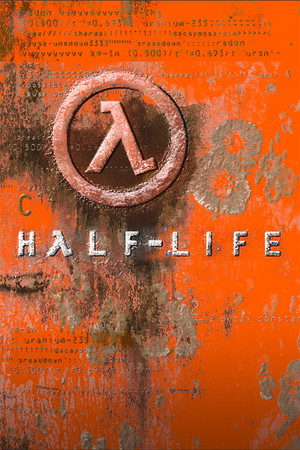
The title Half-Life was selected for its evocative link to the game's theme, its lack of cliché, and its visual symbol: the Greek letter λ (lower-case lambda), the decay constant in the half-life equation.
- #006
According to designer Harry Teasley, Doom was a major influence on Half-Life and the team wanted the game to "scare you like Doom did". Designer Brett Johnson said the level design drew on environments from the manga series Akira, while Newell cited the immersive first-person experience of Ultima Underworld, the horror of Resident Evil 2, and the game design of Super Mario 64 as influences.
- #007
Valve had difficulty securing a publisher for Half-Life because many in the industry considered the game too ambitious for a first-time developer.
- #008
Sierra On-Line signed Valve to a one-game deal, motivated by an interest in producing a 3D action game, particularly one built on the Quake engine.
- #009
Under the agreement with Sierra, Valve received an advance of roughly $1 million; in return Sierra took 30% of revenue and full ownership of the intellectual property, while Newell and Harrington funded the remaining development.
- #010
Half-Life was first shown by Valve in early 1997 and drew a successful reception at that year's E3, where the studio demonstrated its animation and artificial intelligence, including novel features such as fear and pack behavior.
- #011
Valve aimed to release Half-Life in November 1997 so that it could compete with Quake II.
- #012
By September 1997, Valve had built some innovative aspects into Half-Life's weapons, enemies and level design, but the team judged the game not fun and lacking design cohesion.
- #013
Playtesting of Half-Life drew "lukewarm" responses.
- #014
Because Sierra would not agree to extra funding, Newell took out a loan to pay for additional development that reworked Half-Life and pushed back its release date.
- #015
For Half-Life, Valve assigned a small team to build a prototype level containing every element in the game, then spent a month iterating on it. Designer Ken Birdwell described the level as "Die Hard meets Evil Dead", and when the rest of the team played it they agreed to use it as a baseline.
- #016
Half-Life's team developed three theories about what made the prototype level fun, the first being that several interesting things happened in it, all triggered by the player rather than a timer so the player set the pace.
- #017
A second theory behind Half-Life's prototype level was that it responded to any player action, even something as simple as adding graphic decals to wall textures to show a bullet impact.
- #018
The third theory about Half-Life's prototype level was that it warned the player of imminent danger so they could avoid it, rather than killing the player with no warning.
- #019
Valve created a group called the "cabal" to handle design for Half-Life after the company could not find a suitable game designer to carry the unified design forward.
- #020
The cabal began as six people drawn from every department at Valve, and for roughly six months they met four days a week in sessions lasting six hours.
- #021
For Half-Life, the cabal held responsibility for every part of design, from level layouts and key events to enemy designs, narrative and the way gameplay elements were tied to the story.
- #022
Once the cabal settled on which gameplay elements Half-Life needed, smaller mini-cabals were assembled from the departments most affected so those elements could be implemented; membership in the main cabal rotated because the commitment led to burnout.
- #023
The Half-Life cabal created a 200-page design document that covered almost every part of the game.
- #024
For Half-Life's narrative, the cabal prepared a 30-page document and brought in science fiction novelist Marc Laidlaw to help manage the script.
- #025
Marc Laidlaw described his contribution to Half-Life as adding "old storytelling tricks" to the team's ambitious designs, saying he felt he was borrowing from old standards while the team did something truly new.
- #026
Rather than imposing narrative elements from a position of authorial inspiration, Marc Laidlaw improvised ideas with the Half-Life team and drew inspiration from their experiments; he conceived the opening train ride after an engineer implemented train code for another concept.
- #027
Valve originally intended Half-Life to use traditional cutscenes, but the studio moved to a continuous first-person perspective because of a lack of time.
- #028
After the cabal was formed, Valve's other team members began detailed development of Half-Life within a month, and playtesting through Sierra started a month after that.
- #029
The cabal was closely involved in playtesting Half-Life, watching players without otherwise interacting, and logging confusion or unsolvable puzzles as items to fix in the next iteration.
- #030
Once most major adjustments to Half-Life were done, the team added ways to benchmark players' actions and used the collected statistics to further fine-tune the levels.
- #031
According to Birdwell, the cabal approach was critical to Half-Life's success despite early struggles, and Valve reused it for Team Fortress 2 from the start.
Sources & editorial notes
Sources for the entries on this page
- Wikipedia Half-Life (video game) — Wikipedia
Information from external sources is independently selected, consolidated and edited by Arka Evren. Sources are listed for verification and further reading. Encyclopedia text is used under its licence (CC BY-SA). How we work