
ArkaEvren
Half-Life

GAME · 1998 · USA

Half-Life

Developer
Gearbox Software
Platforms
Microsoft Windows, macOS

39 archived facts 4 topics 2 sources Last reviewed Nov 2026

39 Interesting Facts About Half-Life

Interesting Facts (2)

  1. #001

    Quentin Tarantino counts Half-Life among his favourite computer games and has said he'd like to turn it into a film one day.

    INTERESTING FACTS · SOURCED

  2. #002

    The hero Gordon Freeman does not say a word throughout the game.

    INTERESTING FACTS · SOURCED

Production Story (29)

  1. #003

    In the original plan, security guards became your enemies the moment the resonance cascade hit; Barney almost didn't owe you that beer.

    PRODUCTION STORY · SOURCED

  2. #004

    The game has just four types of scientist (four faces) and a single type of security guard.

    PRODUCTION STORY · SOURCED

  3. #005

    Half-Life was Valve Corporation's first game.

    PRODUCTION STORY · SOURCED

  4. #006

    The military first shows up in the chapter "We've got Hostiles!" and is last seen in "Forget about Freeman!"; apparently not a single soldier made it into Lambda Core.

    PRODUCTION STORY · SOURCED

  5. #007

    Half-Life: Blue Shift (2001) was originally meant as a bonus exclusive to the Sega Dreamcast version of Half-Life. When that version was canceled because of poor sales and the impending demise of the Dreamcast console, developers Valve and Sierra released the Blue Shift add-on for PC instead.

    PRODUCTION STORY · SOURCED

  6. #008

    Rather than full lines of dialogue, the Black Mesa PA system uses single words, letting level designers assemble announcements dynamically. Most of the words never appear in the game proper; they exist so that independent level designers can build realistic-sounding PA messages for their levels instead of using the default ones.

    PRODUCTION STORY · SOURCED

  7. #009

    A Dreamcast version was in the works but was canceled over slow loading times; rare copies of the canceled Dreamcast game still surface now and then on eBay or Amazon.

    PRODUCTION STORY · SOURCED

  8. #010

    As Half-Life grew, Valve cancelled Prospero, its fantasy role-playing game, and moved the Prospero team onto Half-Life.

    PRODUCTION STORY · SOURCED

  9. #011

    During development Half-Life went by the working title Quiver, after the Arrowhead military base in The Mist.

    PRODUCTION STORY · SOURCED

  10. #012

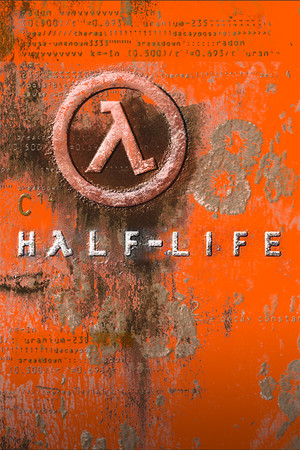
    The name Half-Life was chosen because it evoked the game's theme, avoided cliché and came with a visual symbol: the Greek letter λ (lower-case lambda), the decay constant in the half-life equation.

    PRODUCTION STORY · SOURCED

  11. #013

    Designer Harry Teasley said Doom was a big influence on Half-Life and that the team wanted the game to "scare you like Doom did". Designer Brett Johnson said the level design borrowed environments from the manga series Akira, while Newell named the immersive first-person experience of Ultima Underworld, the horror of Resident Evil 2 and the game design of Super Mario 64 as influences.

    PRODUCTION STORY · SOURCED

  12. #014

    Valve struggled to find a publisher for Half-Life, since much of the industry thought the game too ambitious for a first-time developer.

    PRODUCTION STORY · SOURCED

  13. #015

    Under the deal, Sierra gave Valve an advance of roughly $1 million in exchange for 30% of revenue and full ownership of the intellectual property; Newell and Harrington paid for the rest of development themselves.

    PRODUCTION STORY · SOURCED

  14. #016

    Valve first showed Half-Life in early 1997, and it went down well at that year's E3, where the studio demonstrated its animation and artificial intelligence, including novel features like fear and pack behavior.

    PRODUCTION STORY · SOURCED

  15. #017

    By September 1997 Valve had built some innovative ideas into Half-Life's weapons, enemies and level design, but the team felt the game wasn't fun and lacked a cohesive design.

    PRODUCTION STORY · SOURCED

  16. #018

    Sierra wouldn't put up more money, so Newell took out a loan to pay for the extra development that reworked Half-Life and pushed its release date back.

    PRODUCTION STORY · SOURCED

  17. #019

    Valve set a small team to build a prototype level containing every element of Half-Life, then spent a month refining it. Designer Ken Birdwell called it "Die Hard meets Evil Dead", and when the rest of the team played it they agreed to use it as the baseline.

    PRODUCTION STORY · SOURCED

  18. #020

    The Half-Life team came up with three theories about why the prototype level was fun; the first was that lots of interesting things happened in it, all triggered by the player rather than a timer, so the player set the pace.

    PRODUCTION STORY · SOURCED

  19. #021

    The second theory about Half-Life's prototype level was that it reacted to whatever the player did, even something as small as a decal on a wall texture marking a bullet impact.

    PRODUCTION STORY · SOURCED

  20. #022

    The third theory about Half-Life's prototype level was that it warned the player of danger ahead so they could avoid it, instead of killing them with no warning.

    PRODUCTION STORY · SOURCED

  21. #023

    Unable to find a single game designer to carry a unified design forward, Valve formed a group it called the "cabal" to design Half-Life.

    PRODUCTION STORY · SOURCED

  22. #024

    The cabal started with six people drawn from every department at Valve, and for about six months they met four days a week in six-hour sessions.

    PRODUCTION STORY · SOURCED

  23. #025

    On Half-Life, the cabal was in charge of every part of the design, from level layouts and key events to enemy designs, the narrative and how gameplay tied into the story.

    PRODUCTION STORY · SOURCED

  24. #026

    Once the cabal had decided which gameplay elements Half-Life needed, smaller mini-cabals were formed from the departments most affected to put them in place; membership of the main cabal rotated, because the workload burned people out.

    PRODUCTION STORY · SOURCED

  25. #027

    Marc Laidlaw saw his role on Half-Life as adding "old storytelling tricks" to the team's ambitious designs; he felt he was borrowing from old standards while the team was doing something truly new.

    PRODUCTION STORY · SOURCED

  26. #028

    Instead of handing down story ideas as the inspired author, Marc Laidlaw improvised with the Half-Life team and took inspiration from their experiments; the opening train ride came to him after an engineer wrote train code for a different idea.

    PRODUCTION STORY · SOURCED

  27. #029

    Valve first planned traditional cutscenes for Half-Life, but switched to an unbroken first-person view because it was running out of time.

    PRODUCTION STORY · SOURCED

  28. #030

    With most of the major changes to Half-Life done, the team added ways to measure what players were doing and used the statistics to fine-tune the levels further.

    PRODUCTION STORY · SOURCED

  29. #031

    Birdwell says the cabal approach was key to Half-Life's success despite its early struggles, and Valve used it from the very start on Team Fortress 2.

    PRODUCTION STORY · SOURCED

Behind the Scenes (2)

  1. #032

    The game is full of artillery bombardments, and the 'whistling' before each explosion is the sound of a German Flak 88.

    BEHIND THE SCENES · SOURCED

  2. #033

    The cabal took an active part in Half-Life's playtesting, watching players without interfering and noting any confusion or unsolvable puzzles as problems to fix in the next round.

    BEHIND THE SCENES · SOURCED

Easter Eggs & References (6)

  1. #034

    The book in Freeman's locker, "The 37th Mandala", is by Marc Laidlaw, who wrote Half-Life.

    EASTER EGGS & REFERENCES · SOURCED

  2. #035

    The names on the bathroom lockers at the start of the game, and on the footlockers in the Half-Life: Opposing Force (1999) training level, belong to people who worked on both games.

    EASTER EGGS & REFERENCES · SOURCED

  3. #036

    "Security 7G" is written on several security doors, a reference to Homer Simpson of The Simpsons (1989), the safety inspector for Sector 7-G of the Springfield Nuclear Power Plant.

    EASTER EGGS & REFERENCES · SOURCED

  4. #037

    Before the flooded room in the office complex chapter, a sign gives directions to Dr. Newell, the surname of the game's creator, Gabe Newell.

    EASTER EGGS & REFERENCES · SOURCED

  5. #038

    Level designer Dave Riller slipped his surname into the game at least twice: once on a locker near the beginning, and again as a well-known Easter egg hidden under a HECU outpost in the Materials Transport, on map "c2a2c", where it can only be seen from one particular angle.

    EASTER EGGS & REFERENCES · SOURCED

  6. #039

    The game's files contain a longer version of the G-Man's line for players who refuse to join him. He starts with the familiar "Well, it looks like we wont be working together. No regrets Mr. Freeman," but then mentions "a few survivors of your personal holocaust" who would "like to meet the man responsible for the total annihilation of their race".

    EASTER EGGS & REFERENCES · SOURCED

Sources & editorial notes

Sources for the entries on this page

  1. Wikipedia Half-Life (video game) — WikipediaEncyclopedia · accessed 17 Sep 2026

Information from external sources is independently selected, consolidated and edited by Arka Evren. Sources are listed for verification and further reading. Encyclopedia text is used under its licence (CC BY-SA). How we work