
GAME · 1996 · JAPAN
Mario Kart 64
- Developer
- Nintendo Entertainment Analysis & Development
- Publisher
- Nintendo
- Platforms
- Nintendo 64, Wii U
30 archived facts 4 topics 2 sources Last reviewed Nov 2026

30 Interesting Facts About Mario Kart 64
Interesting Facts (19)
- #001
In early betas, Royal Raceway was called Toadstool Turnpike; Nintendo renamed it so players wouldn't mix it up with Toad's Turnpike.
- #002
The beta went by "Super Mario Kart R" and had Magikoopa as a playable driver, later replaced by Donkey Kong. Magikoopa (also known as Kamek) finally got behind the wheel in Mario Kart Tour in 2021, and in Mario Kart 8 Deluxe in 2023 through the Booster Course Pass.
- #003
For years Wario Stadium was the one course never brought back as a retro track, until Mario Kart World (2025) arrived.
- #004
On Royal Raceway you can drive around Peach's Castle, the same one as in Super Mario 64 (1996), but you can't go inside; fall into the moat or lake and you're put back on the track, so the only way to reach the castle is through a glitch. The castle grounds were meant to host the trophy ceremony at the end of each Mario GP cup, but when the course returned in Mario Kart 8 (2014), Mario Kart 8 Deluxe (2017) and Mario Kart Tour (2019), the castle area was fenced off so players couldn't "camp" there during grand prix and online races.
- #005
In the Japanese version, Wario can be heard swearing in German: "So ein Mist."
- #006
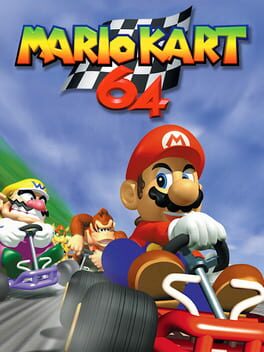
Here Donkey Kong takes the place of his son Donkey Kong Jr., and Wario replaces Koopa Troopa, who didn't come back to Mario Kart until Mario Kart: Double Dash!! (2003) on the GameCube in 2003.
- #007
Royal Raceway was "Peach Circuit" in the Japanese version; in fact, every course name ending in "circuit" (Luigi Circuit, for instance) became "raceway."
- #008
A pre-release version of Mario Kart 64 included Kamek, a villain from the Yoshi series, until Donkey Kong replaced him. Also cut during development: a race mode without items, dropped after testers showed little interest, and two tracks set in a parking garage and a big city.
- #009
In 3- and 4-player modes, the Nintendo 64 hardware couldn't play the background music for courses or battle arenas.
- #010
In every region the playable characters (except Yoshi, Donkey Kong and Bowser) speak English, but the Japanese version's voice cast came from several countries: Tomoko Maruno and Asako Haruhana (Peach and Toad respectively) are Japanese, Julien Bardakoff (Luigi) is French and Thomas Spindler (Wario) is German, with Bardakoff using a high-pitched voice much like Mario's. For the North American release these actors were replaced: Charles Martinet, on top of Mario, also voiced Luigi and Wario in place of Bardakoff and Spindler, and Leslie Swan and Isaac Marshall took over from Haruhana and Maruno respectively. Even the announcer was re-recorded by Martinet in his Mario voice, replacing a generic Engrish voice originally supplied by John Hulaton. * The Japanese version's original voice clips for Luigi, Peach, Wario and Toad were later recycled in Mario Party (1998), Mario Party 2 (1999) and Mario Kart: Super Circuit (2001). (Only Martinet and Haruhana came back to record new clips for Mario Party, and those were reused for Mario Party 2.)
- #011
In the Wii Virtual Console port, available until the Wii Shop Channel closed in January 2019, the wheels of the Kalimari Desert train were changed from red to black for no apparent reason.
- #012
The sponsor signs in the Japanese version parody big brands from around the world: "Marioro" sends up Marlboro cigarettes, "Luigip" the Italian fuel company Agip, "Yoshi 1" the Mobil 1 motor oil brand, and "Koopa Air" Goodyear. In the Western versions they were given more original names to avoid lawsuits from the companies being parodied: "Marioro" became "Mario Star," "Luigip" became "Luigi's," "Yoshi 1" became "Yoshi's," and "Koopa Air" switched from yellow text on blue to purple text with a light effect on white.
- #013
Princess Peach's Castle on Royal Raceway is designed exactly as in Super Mario 64 (1996).
- #014
It was the last Mario Kart game released in the 1990s.
- #015
The music theme of the Rainbow Road course appeared in different arrangements in every subsequent Mario Kart game.
- #016
Banshee Boardwalk was designed with inspiration from the Ghost House courses of the original Super Mario Kart (1992) on the Super NES.
- #017
On Luigi Raceway, there is an item block attached to a Luigi balloon that rises and lowers every few seconds. This block always gives a blue shell and can only be obtained by jumping while the balloon is at its lowest point.
- #018
Toad and Donkey Kong are the only drivers whose engine sounds are not shared with other characters. Peach's voice is shared with Yoshi, Mario's with Luigi, and Wario's with Bowser.
- #019
It is the first Mario spin-off game to feature Donkey Kong, based on a design by Kevin Bayliss of Rare.
Production Story (6)
- #020
Mario Kart 64 was unveiled alongside the N64 console in November 1995 at the Shoshinkai trade show, on a videotape handed out to journalists; it was reportedly "95% complete" at the time.
- #021
Mario Kart 64 was supposed to launch with the N64 in mid-1996, but slipped when development resources were moved to Super Mario 64, the system's launch title.
- #022
With Mario Kart 64, Nintendo wasn't trying to reinvent Super Mario Kart's gameplay; it aimed for broad appeal and focused on what the N64's processing power could do, especially for multiplayer.
- #023
For Mario Kart 64's kart handling, the developers built a simulation of remote-controlled vehicles and studied car physics, but testers found the result too "realistic" to be fun, so the final game uses simpler controls.
- #024
Producer Shigeru Miyamoto credited Mario Kart 64's technical performance to the Nintendo 64's ROM cartridges rather than disc-based CD-ROMs, pointing to the way cartridges handle pre-loading data.
- #025
A hard disk failure during Mario Kart 64's development forced designers to rebuild about 80% of the character models. An early alpha later surfaced in the Nintendo Gigaleak, a 2020 leak of internal Nintendo material, and used Super Mario Kart assets as placeholders.
Behind the Scenes (3)
- #026
Mario Kart 64 director Hideki Konno said the team wanted a race where every player stayed "in it until the end", and that the N64's processing power ruled out keeping eight players on screen for long stretches.
- #027
Mario Kart 64's designers wanted players free to race anywhere on a track, which left the programmers wrestling with collision detection, balancing processor load against shortcuts like letting players overlap.
- #028
Mario Kart 64 draws its characters with billboarding: instead of being rendered in 3D, each is a two-dimensional image kept facing the camera. That saved memory and made Battle mode, and eight players on the track at once, possible.
Deeper Meaning (2)
- #029
In a Mario GP or VS race in the 150cc Engine Class, driving erratically triggers a high-pitched sound within seconds, followed by a spin. Press B at just the right moment and you cancel it, earning a musical note symbol; the same trick works right after hitting a banana peel at full speed, before you spin out.
- #030
In the Extra class, where tracks are mirrored with left and right turns swapped (later known as Mirror Mode in subsequent Mario Kart games), the traffic on Toad's Turnpike drives the wrong way, sending racers head-on into oncoming vehicles and making it the hardest Extra class track to finish.
Related pages
- Super Mario Sunshine — Mario Kart 64 comes up in the facts on that page
Sources & editorial notes
Sources for the entries on this page
- Wikipedia Mario Kart 64 — Wikipedia
Information from external sources is independently selected, consolidated and edited by Arka Evren. Sources are listed for verification and further reading. Encyclopedia text is used under its licence (CC BY-SA). How we work