
FILM · 2013 · USA
42
24 archived facts 4 topics 1 source Last reviewed Oct 2026
24 Interesting Facts About 42
Interesting Facts (21)
- #001
- #002
- #003
- #004
Alan Tudyk claimed that he and Chadwick Boseman deliberately avoided camaraderie while shooting their scenes together, in order to better convey the hostility between Jackie Robinson and Ben Chapman.
- #005
The film cleans up the speech Leo Durocher gave on the eve of the strike he planned against the Dodgers to protest Jackie Robinson's signing. His actual words were: "I don't care if the guy is yellow or black, or if he has stripes like a fucking zebra; I'm the manager of this team, and he plays!"
- #006
Branch Rickey tells a story about a black catcher on his college team and how prejudice against him persisted. As Red Barber noted (played in the film by John C. McGinley), Rickey told him about his integration plans a day before announcing them. Barber said Rickey asked a hotel clerk whether his room had two beds and whether his black teammate could stay with him but not register, and was told yes. He gave the player the key and sent him upstairs. After checking everyone in, he entered the room and saw his teammate crying and wringing his hands, saying that if he could get rid of his color he would be like everyone else. That scene, that anguished cry and the young man's tears, was what stayed with Rickey all those years.
- #007
Broadcaster Red Barber says "Back, back, back…" while calling a fly ball being caught in the film. On another play he shouts "Oh, Doctor!" Contrary to popular belief, Barber did not use either line regularly. Barber said the only time he used those lines in a broadcast was when he called Al Gionfriddo's dramatic, game-saving catch of Joe DiMaggio in the 1947 World Series. Since recordings of Barber's call became so famous, many assumed they were his trademark calls.
- #008
The key figures in this story — Jackie Robinson and Branch Rickey — eventually fell out with Walter O'Malley, the team's co-owner (and later owner) who would become the most powerful man in the game. The man old-timers in Brooklyn hated forever fired co-owner Rickey in 1950 and traded Robinson to the New York Giants in 1956. In his autobiography, Robinson described the man as "viciously antagonistic." After disposing of Robinson and Rickey and moving the Dodgers to Los Angeles, the joke in Brooklyn was that if you were in a room with Hitler, Mussolini and O'Malley and had only two bullets, you would shoot O'Malley twice.
- #009
The Birmingham (Alabama) News reported that Rickwood Field in Birmingham, the oldest surviving professional baseball field in the US, "played" three different roles in this film. Franklin D. Roosevelt Stadium in Jersey City, New Jersey, and the no-longer-existing Forbes Field in Pittsburgh, Pennsylvania, doubled that number. It also appeared as "itself" in a scene recreating the 1945 season, when Jackie Robinson was a member of the Kansas City Monarchs.
- #010
- #011
- #012
The film's final scene takes place at Forbes Field in Pittsburgh. As Jackie Robinson rounds the bases after a hit, one shot includes the Cathedral of Learning, a famous building at the University of Pittsburgh. In real life, Forbes Field stood right next to the university. Forbes Field was demolished after the Pirates moved to Three Rivers Stadium in 1970, and the university kept the main field exactly in place. Home plate from Forbes Field was embedded under glass in the floor of William Posvar Hall at the University of Pittsburgh, in its exact original location.
- #013
- #014
- #015
- #016
- #017
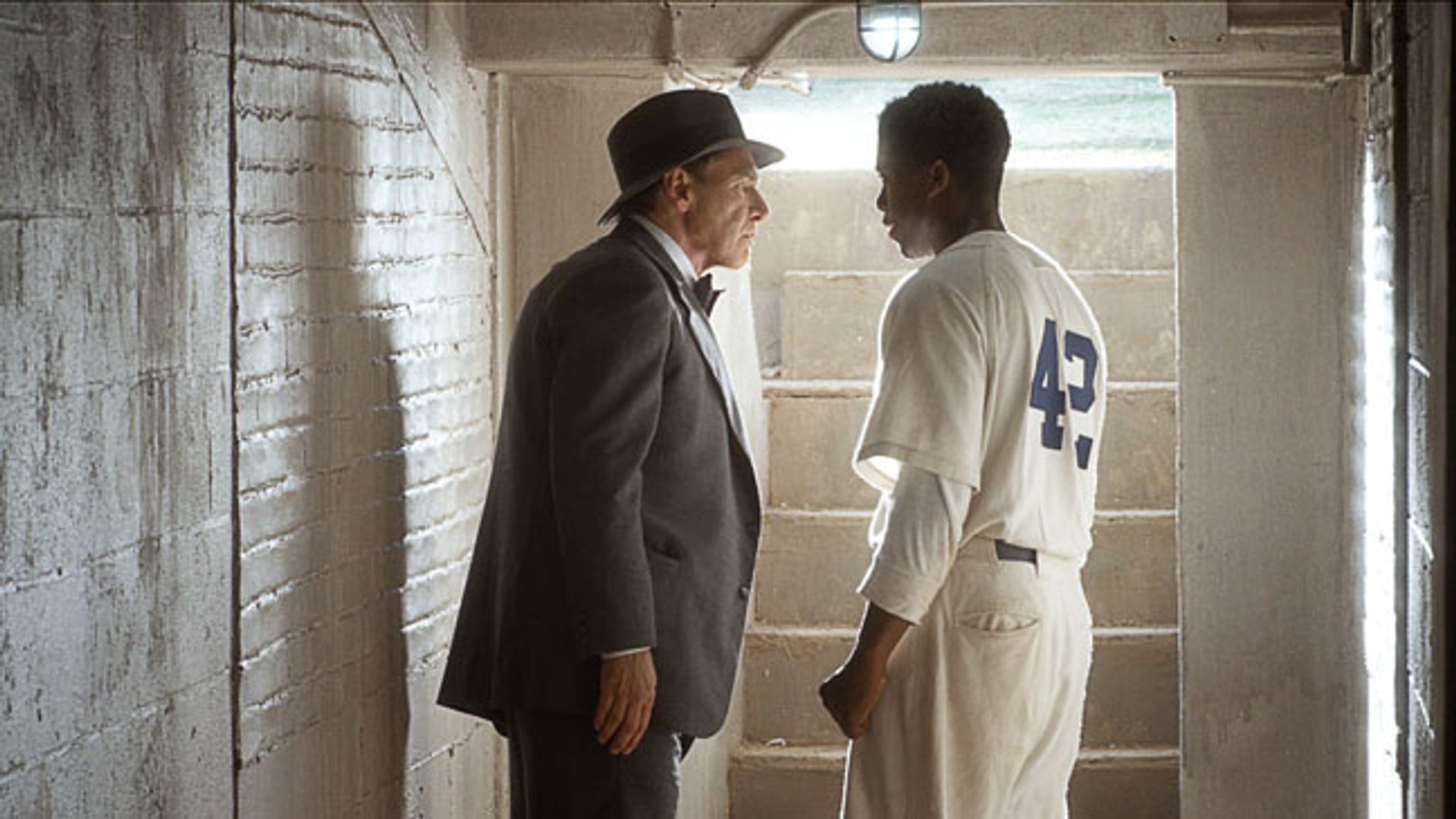
Harrison Ford played Branch Rickey wearing prosthetics and speaking in a different voice to resemble Rickey more closely.
- #018
Although the film depicts Bobby Bragan as one of the last holdouts, in reality he became one of Jackie's first advocates on the team. Later, when Bragan was a minor-league manager, he reached out to developing players such as Maury Wills, Roberto Clemente and Hank Aaron. Bragan protected Wills, Clemente and Aaron in the minor leagues, and was once ejected after an umpire insulted Aaron. Bragan would later praise Branch Rickey for making him a better man.
- #019
Pee Wee Reese is depicted referring to his ancestors losing the Civil War. Racism was so widespread largely because many Southerners had parents or grandparents who grew up during Reconstruction, a radically readjusting period that was extremely stressful for both whites and blacks in the South and led to a tremendous rise in racism. As black Dodgers pitcher Dan Bankhead, who joined the team shortly after Robinson, noted, they — Robinson, Campanella, himself and Branch Rickey — literally began the civil rights era.
- #020
In the film, Branch Rickey punishes some of his rebellious players by trading them, or threatening to trade them, to the Pittsburgh Pirates, one of the worst teams in the National League. Coincidentally, in 2013, the year the film was released, the Pirates ended a 20-season losing streak, reached the playoffs with a 94-68 record and beat the Cincinnati Reds in the Wild Card Game, but lost to the St. Louis Cardinals in the National League Championship Series.
- #021
Behind the Scenes (1)
- #022
Jasha Balcom, a former minor league player, was Chadwick Boseman's stunt double in some scenes; however, because Boseman trained in baseball for months and studied footage of Jackie Robinson, he did most of his own stunts. Boseman said he became furious when he saw a stunt performer portray Robinson incorrectly: "Every time he did something I was like, 'That's wrong. That's wrong. That's wrong.'" Eventually the team let Boseman shoot the scene. It made the film better. It also helped Boseman get into character: "You walk in there with the feeling of 'I actually know what this man went through. I can identify with his emotions, I can identify with how tired he is, I can identify with how abused he is, I can identify with his loneliness. So I can bring that to the moment and use it because, you know, it's real for me right now.'".
Easter Eggs & References (1)
- #023
Chapman's wildly aggressive "tar baby" taunt unwittingly defeated itself. It refers to an old African-American folk tale about a doll made of tar, used as bait to provoke an enemy's notorious temper. The doll stayed silent and infuriated the man, who began to strike it physically, and with every blow the doll stuck to him more, dragging him into complete chaos. This teaches the listener a lesson about tolerance, good behavior and the punishment for bad behavior. In this instance, it showed not only that Chapman was an obvious example of the villain in the story, but also that his unawareness of this revealed his extreme ignorance.
Deeper Meaning (1)
- #024
The film implies that Leo Durocher was suspended for a year because of these sexual escapades. In fact, the misconduct in question concerned his conspiring to run a rigged dice game with the actor George Raft, which, among other things, put an active player seriously in his debt. Beyond being illegal, it was a clear conflict of interest. According to the memoir of former Detroit Tiger Elden Auker, the victim was Tiger pitcher Dizzy Trout.
Sources & editorial notes
Reference databases
- IMDb
Information from external sources is independently selected, consolidated and edited by Arka Evren. Sources are listed for verification and further reading. Encyclopedia text is used under its licence (CC BY-SA). How we work