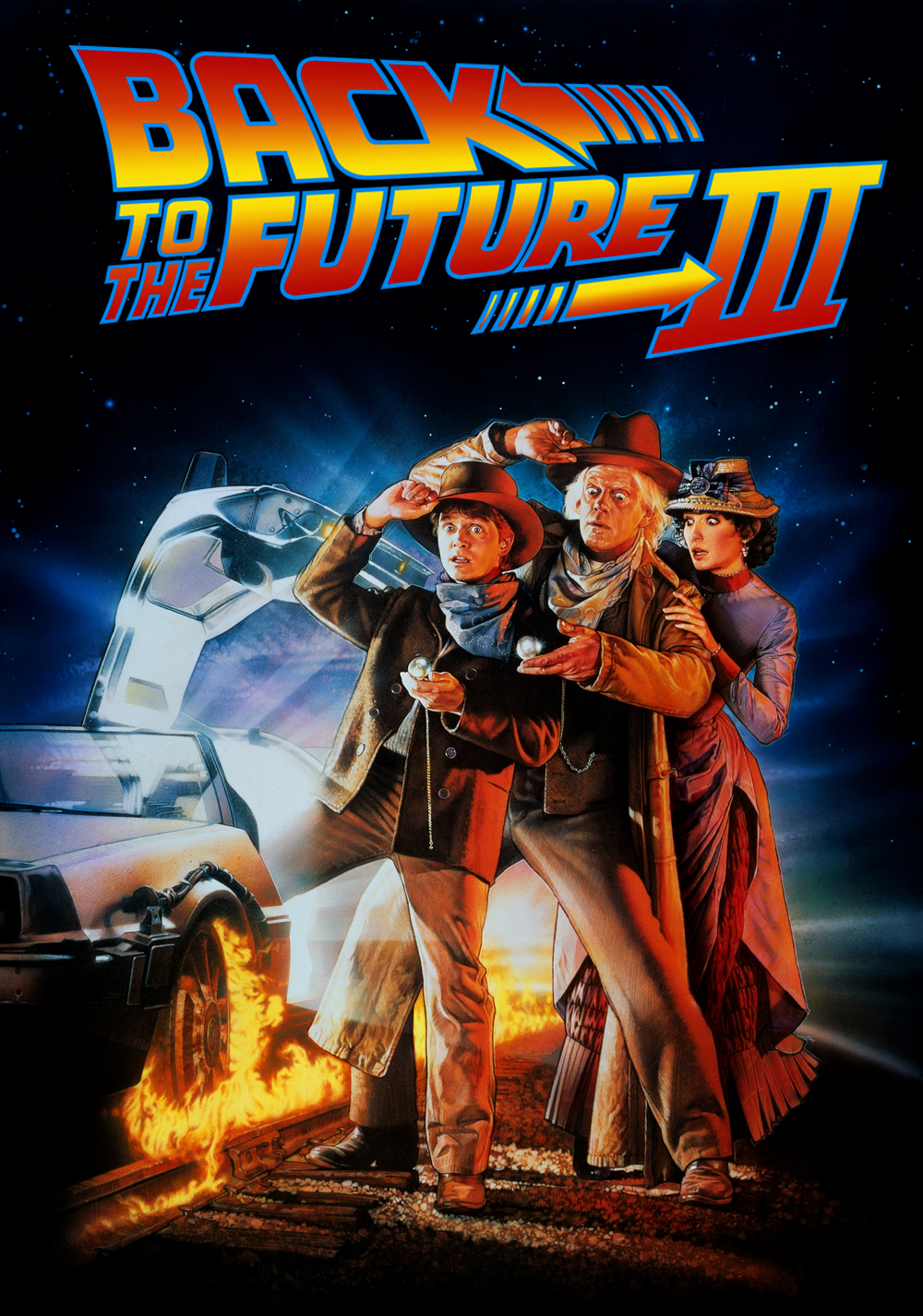
FILM · 1990 · USA
Back to the Future Part III
- Directed by
- Robert Zemeckis
- Runtime
- 119 min
- Studio
- Universal Pictures, Amblin Entertainment
198 archived facts 8 topics 1 source Last reviewed Sep 2026
The final installment finds Marty digging the trusty DeLorean out of a mineshaft and looking for Doc in the Wild West of 1885. But when their time machine breaks down, the travelers are stranded in a land of spurs. More problems arise when Doc falls for pretty schoolteacher Clara Clayton, and Marty tangles with Buford Tannen.
Summary: TMDB
All facts (198)
- #001
While filming the scene in which Buford "Mad Dog" Tannen tries to lynch Marty, Michael J. Fox was accidentally hanged, which briefly rendered him unconscious. He recorded the incident in his autobiography "Lucky Man" (2002).
- #002
Permission was sought from Clint Eastwood to use his name for Marty in the film. He agreed and was said to be tickled by the tribute.
- #003
Marty uses a "Frisbie's" pie plate to knock the gun out of Mad Dog's hand. The Frisbie Pie Company was founded in Connecticut in 1871; its pie tins were thrown around the Yale campus, which ultimately led to the invention of the Frisbee. This is another example of Marty bringing something into the timeline before its official invention and thus potentially giving the original inventors the idea to make them. In Back to the Future (1985) he turned a soapbox car into a prototype skateboard and unknowingly inspired Chuck Berry to write "Johnny B. Goode."
- #004
According to the book "Billy Gibbons: Rock & Roll Gearhead," ZZ Top was hanging around the set and was wanted as the town band. During a shoot the camera broke down. While waiting for it to be repaired, Michael J. Fox asked if they would play "Hey Good Lookin'," and they did. Further requests were granted afterward. Two hours later someone asked whether the camera had been fixed. Robert Zemeckis said it had been fixed long ago but that he did not want to stop the party that had developed.
- #005
The 1885 setting stemmed in part from a suggestion by Michael J. Fox, who told the producers he thought acting in a Western would always be fun.
- #006
Contains a major spoiler — show
To film the destruction of the DeLorean (immediately after Marty McFly's return to 1985), the producers consulted the engineer of the diesel freight train that would tear the DeLorean apart (VCRY #9, belonging to the Ventura County Railway). Asked whether the car's disintegration might derail the train, the engineer replied: "Are you kidding? I've been waiting to do this my whole life!"
- #007
As Doc and Marty prepare the DeLorean in the driveway for the trip to 1885, Marty mentions Clint Eastwood and Doc replies: "Clint who?" In this shot, on the driveway wall, there is a movie poster showing Revenge of the Creature (1955) and Tarantula (1955), some of the first film appearances of a young, then-unknown Eastwood. Marty even glances at the poster and briefly points to it as he tells Doc, "That's right, you haven't heard of him yet."
- #008
Tom Wilson, who plays Buford "Mad Dog" Tannen, performed all of his own riding stunts. He also performed the trick of roping Marty with a lasso just before meeting Doc in 1885.
- #009
The three old-timers in the saloon were played by Dub Taylor, Pat Buttram and Harry Carey Jr., who portrayed sidekicks, town drunks and colorful townsfolk in hundreds of Westerns and television programs.
- #010
Actor and former President Ronald Reagan was initially offered the role of Mayor Hubert because of his fondness for the first film in the trilogy. He reluctantly turned the role down, and it went to Hugh Gillin instead. Had Reagan appeared, it would have been his first film role in about 30 years.
- #011
The saloon in 1885 Hill Valley occupies the same location as Lou's Café in 1955, the gymnasium in 1985 and Cafe 80's in 2015.
- #012
Michael J. Fox compared filming the three movies to "being back in school," because it felt as if someone was always teaching him something for the films. During the shooting of the trilogy, Fox was taught to play the guitar, ride a horse and fire a gun.
- #013
Contains a major spoiler — show
Buford "Mad Dog" Tannen is arrested by Marshal Strickland's Deputy rather than by the Marshal. During the arrest, when the charge of "robbing the Pine City Stage" is read out, the camera cuts to Marty and Emmett. Both of them have a reason: Buford was initially arrested for murdering Marshal Strickland. The murder scene was deleted because it was deemed too dark for a family film, and the line was dubbed.
- #014
Robert Zemeckis and Bob Gale were determined from the start that Back to the Future Part II (1989) and Back to the Future Part III (1990) would be released six months apart. This was so audiences would not have to wait too long between installments.
- #015
Bob Gale and Robert Zemeckis felt they had done all they could with Marty's family in this film, so the film's focus was shifted to Doc Brown.
- #016
Building the sets and completing the scripts for Back to the Future Part II (1989) and this film took two years. To take advantage of the long hiatus Michael J. Fox had from Family Ties (1982), which was nearing the end of its run, they were shot back to back over eleven months. While Part III was being shot, Part II was being edited.
- #017
In 1885 a horse dealership belongs to the Statlers. In Back to the Future (1985) there is a radio advertisement for "Statler Toyota" in 1985. In 1955 "Statler Motors Studebaker" is visible near the town theater.
- #018
The character Clara Clayton references Clara Clemens, the daughter of Samuel Clemens (Mark Twain). Clara Clemens went on a sleigh ride with her future husband, Ossip Gabrilowitsch, when the horse took fright at a windblown newspaper and bolted, causing Gabrilowitsch to lose control. At the top of a hill, beside a fifteen-meter cliff, the sleigh overturned and threw Clemens out. Gabrilowitsch jumped to the ground and caught the horse by the head, stopping it just as it was about to leap over the edge, and dragged Clemens, whose dress had caught on the runner.
- #019
Contains a major spoiler — show
In the novelization, after the small boy returns Marty's gun to him, he asks Marty where he got the idea to strap the oven door under his clothes, and Marty says he saw it in a movie. The boy asks Marty what the movie was. Before Marty can answer, a woman calls out the name "David… David Llewelyn Wark Griffith." This is the real name of pioneering filmmaker D. W. Griffith. Born in 1875, Griffith would have been nine or ten years old in 1885.
- #020
In the first film, Doc tells Marty that he got the inspiration to create the flux capacitor after hitting his head on the bathroom sink while trying to hang a clock above his toilet. In this film, when Doc rushes to the bathroom in a frenzy after seeing Marty at his house, you can see the clock hanging above the toilet he slips on.
- #021
The role of Seamus McFly was originally written for Crispin Glover, who had been offered to return as George McFly in Back to the Future Part II (1989). The joke was that Glover and Lea Thompson would again play a couple, but now in 1885 instead of 1985. However, Glover felt the salary he was offered was too low, so the scripts for Parts II and III were rewritten and Michael J. Fox was cast as Seamus.
- #022
On November 7, 2010, the DeLorean used during filming was returned to the same rail set used in the vehicle's final scene, as part of a week-long celebration of the original film's 25th anniversary.
- #023
FRANCHISE TRADEMARK: In each film of the trilogy, Marty faints and then wakes up and asks "Mom? Is that you?", after which a character played by Lea Thompson tells him to "just relax/there, there now" and mentions exactly how long he has been out in the cold. He then believes the previous events were a "horrible nightmare", and the Thompson character tells him he is "safe and sound now" wherever or whenever he is, making Marty realize it was not a dream. He then stands up and is stunned by the appearance of his "mom."
- #024
In 2011, the DeLorean with the 1950s whitewall tires was finally restored by Back to the Future enthusiast Joe Walser after a good six to seven years. His team cleaned both this version of the DeLorean and the original DeLorean used in the making of the three films.
- #025
The death of Michael J. Fox's father delayed filming by two weeks.
- #026
One of the DeLoreans used in the filming of this movie was displayed at the Planet Hollywood restaurant in Honolulu, Hawaii, until the restaurant closed in 2010. It was hung from the ceiling and suspended upside down so that restaurant patrons could see the vehicle better from above.
- #027
The bandana worn by Doc Brown was made from the shirt he wore in Back to the Future Part II (1989).
- #028
Michael Winslow ("Jones" from the Police Academy fame) performed the sound effects for Michael J. Fox's feet during the breakdancing scene. He received a "Special Thanks" credit.
- #029
The location of 1885 Hill Valley was the same one used in Clint Eastwood's Pale Rider (1985). Ironically, that film took the number one spot at the box office in 1985 with Back to the Future (1985).
- #030
The role of Clara Clayton was written specifically for Mary Steenburgen.
- #031
It was Mary Steenburgen's children who convinced her to take part in the film.
- #032
The first scene of this film, in which Marty travels to the future with the time machine powered by the lightning that strikes the clock tower, appears in all three films.
- #033
This is the only film in the trilogy in which Marty and Doc Brown share each other's catchphrases. Marty says "Great Scott!" and Doctor Brown replies "Yeah, this is heavy" while talking about the photograph of the gravestone.
- #034
Tom Wilson based his characterization of Buford "Mad Dog" Tannen on Lee Marvin's Liberty Valance in The Man Who Shot Liberty Valance (1962).
- #035
In early 2008, many directors, including Steven Spielberg, voted to create a shooting room for Universal Hollywood that would house rare and old costumes and sets. Two items pulled from the warehouse vaults were miniatures of Doc's time-traveling train and the railway version of the DeLorean. The full-size version of the time train can be seen at Universal Studios Orlando.
- #036
Contains a major spoiler — show
In a deleted scene (shown on the DVD), Buford "Mad Dog" Tannen was to shoot Marshal Strickland in the back and kill him, with Strickland's son present. It was cut from the final film because it was considered too depressing. As a result, Strickland's Deputy is the one who arrests Buford at the end of the film instead of Strickland himself. To compensate for the change, the Deputy's dialogue in his second scene had to be re-dubbed.
- #037
The name on the manure wagon in 1885 reads "A. Jones," while the name on the manure truck in 1955 reads "D. Jones."
- #038
Contains a major spoiler — show
When Marty returns from 1885 by train track, you can see that the ravine is no longer called "Clayton Ravine" but "Eastwood Ravine," because Marty, known as Clint Eastwood, presumably died in the accident.
- #039
The inscription on the photograph Doc gives Marty reads "To Marty - Partners in time - September 5, 1885."
- #040
One of the film's composer groups has a miniature version of itself as the 1885 band, and it plays a variation of "Doubleback."
- #041
The fastest steam locomotive in active service in the 1880s was the Eight-Wheeler Steam Engine (wheel configuration 4-4-0), with a top speed of forty-five miles per hour. Marty and Doc Brown therefore faced the task of doubling the speed of the fastest steam engine that existed at the time.
- #042
Clara can be seen behind Marty and Doc as she looks at the map at the train station.
- #043
All three films contain enough clues to reconstruct the DeLorean's journeys exactly (except for Biff's arrival in 1955 in 2015 and Doc's personal trips, at worst within a few minutes). There are several interesting points to note: not counting the time Doc traveled alone, the DeLorean spent nearly seventy-one years in existence from its first journey to its destruction (by its own time scale). When Marty returns to 1985 for the last time, he was about fourteen days, three hours and twenty-seven minutes older than he should have been, while Jennifer was seven hours and twenty-six minutes younger than she should have been. Another interesting consequence is a point of contention. There are two theories about who drops the last item. On November 12, 1955, between the time Biff arrives (or 6 a.m., whichever comes later) and 6:38 p.m. (when he leaves), there were four DeLoreans in Hill Valley (ordered from its own point of view): (1) the instance in which Marty is stranded in 1955 in the first film. (2) the instance in which Biff comes to 1955 to give himself the almanac. (3) the instance in which Marty and Doc return to 1955 to retrieve the almanac. (4) the instance waiting in the abandoned mine. Those who disagree with (4) argue that, according to the "ripple effect" timeline presented in the films, there would be no DeLorean hidden in the mine by Doc until later that evening, when the lightning strike would accidentally send Doc back to 1885 and thus change the timeline. It is *absolutely true* that we never witness a moment in the films when all four instances exist together, but the "ordered from its own point of view" text above should point to a solution. When the DeLorean arrives in 1885, consider what it would detect (if it were in a position to witness the departures and arrivals of its former selves): seventy years of peace, then (1) arrives, then (2) and (3) arrive in some order; (2) then departs at 18:38, (3) departs around 22:00, and (1) departs at 22:04. (4) departs shortly afterward. If we accept that three of these instances (1-3) continue to exist in the "final" timeline, then there should be no problem in accepting this theory. Still not convinced? Consider the hundred-year gap near the end of this film, when Marty takes the DeLorean on its final journey. Seventy years later, for a few hours, there are four instances of the car.
- #044
FRANCHISE TRADEMARK: In every film of the trilogy, Tom Wilson is covered in manure.
- #045
Robert Zemeckis would fly to Los Angeles for about three weeks after the day he shot this film's train climax, in order to approve the sound dubbing that Bob Gale was supervising for Back to the Future Part II (1989). He would then get up at 4:30 the next morning and return to the Northern California set to continue that day's shooting.
- #046
This film marks the only time in the trilogy that Doctor Brown has a dialogue with a member of the Tannen family. Previously, in 1985 in Back to the Future Part II (1989), he "interacted" with Biff by dropping him onto the roof of Biff's Pleasure Palace with the DeLorean's gull-wing door.
- #047
In the "Making of" on the DVD, producer and screenwriter Bob Gale describes the character Buford "Mad Dog" Tannen as "Biff's worst intentions realized."
- #048
In the "wake-up juice" scene, a bottle of Tabasco sauce is visible in the saloon. It has a period-appropriate design.
- #049
Before the new courthouse clock is reset to 8:00 for its official start, Doc and Marty can be seen behind it looking at the valley map, which reads 10:04, the time the clock is destined to stop in the future.
- #050
The town was at Chinese Camp in California, and ironically it was destroyed by a lightning strike in 1996.
- #051
Universal is estimated to have saved between 10 and 15 million dollars by shooting Back to the Future Part II (1989) and Back to the Future Part III (1990) simultaneously.
- #052
While Doc and Marty talk with the conductor about the train's speed, the Hill Valley Clock Tower clock can be seen in the background as it is unloaded from the train. The same clock is also seen empty in Clint Eastwood's film Pale Rider (1985).
- #053
Doc's kiss with Clara is believed to mark the first kissing scene of Christopher Lloyd's film career, but he actually had an on-screen kissing scene with Lesley Ann Warren in Clue (1985).
- #054
Contains a major spoiler — show
When the time machine is destroyed, it is made up of components from every era it visited in the films: the 1980s DeLorean chassis, the 2015 Mr. Fusion and flying conversion, the 1955 vacuum tubes and transistors (replacing a burnt-out microchip), and the 1885 train wheels.
- #055
The scene in which Marty and Jennifer kiss on the porch was the only scene shot during the filming of Back to the Future Part II (1989).
- #056
The festival photographer is the film's director of photography, Dean Cundey.
- #057
Each of Needles' henchmen comes from one of the other gangs in the trilogy. J. J. Cohen played Skinhead in Biff's gang in Back to the Future (1985) and Back to the Future Part II (1989). Ricky Dean Logan played Data in Griff's gang in Back to the Future Part II (1989), and Christopher Wynne played an unnamed member of Buford's gang in this film. Cohen appears in all three films.
- #058
When Marty walks along the railroad tracks and finally reaches the town, he arrives at the train station. He then walks toward the town while the camera slowly rises above the station, eventually showing Marty walking toward the town from a long distance. This scene is shot in exactly the same way as the scene in Once Upon a Time in the West (1968) in which Jill arrives at the station.
- #059
During the filming of Back to the Future Part II (1989) and this film, Michael J. Fox lost his father and gained a son.
- #060
According to the clock behind them, the photo of Doc and Marty is taken at 8:08 p.m. This is probably a reference to the eighty-eight miles per hour the DeLorean must reach before traveling through time.
- #061
Doc Brown states that his German ancestors' surname was "von Braun." This is a nod to Wernher von Braun, one of Germany's leading rocket scientists, who was brought to America after World War II and contributed greatly to the NASA program. He and Clara later discuss the technical aspects of moon rockets, another nod to Doc's supposed lineage. The term "It isn't exactly rocket-science" may also apply, since the time travel experiment Doc Brown conducts truly involved extremely advanced science.
- #062
In 1976, Matt Clark played Kelly, the bartender who serves Josey Wales in The Outlaw Josey Wales (1976). Here, Clark plays Chester, the bartender who serves "Clint Eastwood" (Marty McFly).
- #063
In Back to the Future Part II (1989), Biff watches A Fistful of Dollars (1964) in the alternate 1985, in which Clint Eastwood's character uses a steel plate under his poncho. Marty (who calls himself "Clint Eastwood") uses the stove door under his poncho in 1885. In 1985, the sign at the train crossing identifies the location (formerly Clayton Ravine) as "Eastwood Ravine," dedicated to Marty's character.
- #064
The four pictures above Doc's fireplace in 1955 show, from left to right: Sir Isaac Newton, Benjamin Franklin, Thomas A. Edison and Albert Einstein.
- #065
As a tribute to the Clock Tower scene, the fireworks that are set off have exactly the same pattern as the moment the lightning strikes the tower in the first film.
- #066
The film is the final installment of the Back to the Future trilogy. However, an animated series based on the trilogy premiered on September 14, 1991 and ran for two seasons. The series took place after this film and followed the further adventures of Marty, Doc, Clara, their sons Jules and Verne, and the family dog Einstein. The DeLorean time machine was rebuilt and is now voice-activated. In 2016, Michael J. Fox and Christopher Lloyd unofficially returned to their roles in a trailer for Back to the Future Part IV, a parody of the trilogy, which showed Marty and Doc embarking on one last adventure. Nevertheless, Doc's invention of a time machine from a steam locomotive pointed to a possible second trilogy or spin-off, though Fox's return as Marty is doubtful due to Michael J. Fox's Parkinson's disease.
- #067
At the end of the film, Doc Brown's wardrobe is inspired by Professor Marvel's wardrobe in The Wizard of Oz (1939).
- #068
In some shots of the scene in which Marty is dragged by a horse, Michael J. Fox was actually being dragged by the "Benny the Cab" go-kart from Who Framed Roger Rabbit (1988).
- #069
In a scene cut from the film, Buford "Mad Dog" Tannen shoots Marshal Strickland in the back, just as disgruntled schoolchildren try to shoot their former school principal in Back to the Future Part II (1989). Apparently, the bullying and defiant Hill Valley residents of multiple generations constantly want to kill the tough, "by the book" Strickland men who have become authority figures over the decades.
- #070
Throughout the trilogy, the DeLorean and its time-travel-created duplicates make fifteen time trips, thirteen of them on screen. These are: 1) Doc's dog Einstein is sent one minute into the future to test the machine. 2) Marty travels from 1985 to 1955. 3) Marty returns from 1955 to 1985. 4) Doc travels from 1985 to 2015. 5) (Not seen on screen) Doc travels beyond 2015 to learn that Marty's family has come undone. 6) (Also not on screen) Doc travels from the future to 2015 to find the beginning of Marty's family coming undone. 7) Doc returns from 2015 to 1985. 8) Doc takes Marty and Jennifer from 1985 to 2015. 9) Biff travels from 2015 to 1955 to give himself the sports almanac, creating an alternate timeline. 10) Biff returns from 1955 to 2015. 11) Doc, Marty and Jennifer return from 2015 to the alternate 1985. 12) Marty and Doc travel from the alternate 1985 to 1955 to take the sports almanac from Biff. 13) The DeLorean is struck by lightning as Doc accidentally travels from 1955 to 1885. 14) Marty travels from 1955 to 1885 to save Doc. 15) Marty returns from 1885 to 1985. A sixteenth time trip (the fourteenth on screen) is made by Doc and his family in the Time Train from the future to 1985 to introduce Marty and Jennifer to Jules and Verne and to give Marty an undamaged photo of him and Doc Brown in front of the clock. As Doc Brown stated, additional off-screen time trips also occurred (probably in both the DeLorean and the Time Train), but these are the sixteen confirmed trips.
- #071
FRANCHISE TRADEMARK: The song "The Power of Love" plays in the trilogy's second scene and in the trilogy's second-to-last scene.
- #072
The Colt salesman tells Marty that the shooting game is so easy even a baby could do it. In Back to the Future Part II (1989), the kids at Cafe 80s mock a shooting arcade game by saying it's like a baby's toy.
- #073
A large part of the main cast (Michael J. Fox, Christopher Lloyd, Lea Thompson, Tom Wilson) named this as their favorite of the trilogy. Even Crispin Glover, who was dropped from the series after the first film, said this was the most enjoyable one.
- #074
Back to the Future Part III was the first film to use Universal's new 75th anniversary opening studio logo. The logo remained in use until 1997.
- #075
Michael J. Fox, Christopher Lloyd, Lea Thompson, Tom Wilson, James Tolkan, Marc McClure (who appeared in a deleted scene in Back to the Future Part II (1989)) and J. J. Cohen are the only actors to appear in all three films.
- #076
According to 'The Making of Back to the Future Part III' (1990), the manure consisted mainly of horse feed pellets, and it was noted that the pellets looked almost identical going into and coming out of the horse.
- #077
In this film's 1885, there are two DeLoreans at the same time: the one hidden in the mine in 1955 waiting to be repaired, and the one Marty and Doc use to return home.
- #078
This was Pat Buttram's last on-screen role, as the saloon patron. All of his later roles were voice roles.
- #079
The steam locomotive used in this film is Sierra No. 3, painted and outfitted to resemble Locomotive 131. This type of locomotive was actually built in 1891.
- #080
The location shoot was so dusty that much of the crew began wearing paint masks.
- #081
Each film in the trilogy includes: a scene in which Marty, believing his past experiences were a dream, is woken by someone resembling his mother after being knocked out. There is always a scene in which Marty enters a public drinking establishment and Biff (or one of his relatives) comes in and calls out "Hey McFly?". There is always a scene in which Marty is chased by someone resembling Biff (or Biff) and his gang (on a skateboard in Part I; on a hoverboard in Part II). The time machine always becomes unusable at some point. Characters related to Biff are covered in manure in every film and are always beaten by Marty. And finally, history always changes in some way, either for the better (in Part I and Part III) or for the worse (in Part II).
- #082
The shimmering piano figure heard at the start of the film's main title theme is Alan Silvestri's homage to George Pal's H. G. Wells adaptation The Time Machine (1960). A nearly identical glittering piano or harpsichord motif can be heard at the opening of the piece "Fear" from the 1960 classic's original Russell Garcia score.
- #083
Contains a major spoiler — show
Two versions of the DeLorean were used for the destruction of the time machine. One was cut cleanly in half, while the other was destroyed in small explosions. The half-destroyed one hung upside down at Planet Hollywood in Honolulu, Hawaii, until the restaurant closed in 2010.
- #084
Contains a major spoiler — show
Had Marty killed Buford "Mad Dog" Tannen in the duel, and had Buford not already fathered a son before the events depicted in this film, Biff Tannen would never have been born and would have been erased from existence.
- #085
It was shot back-to-back with Back to the Future Part II (1989). In the four years since Back to the Future (1985) was filmed, Michael J. Fox felt he had forgotten some of his skateboarding techniques, though this was later believed to be an early sign of Parkinson's disease, which he was finally diagnosed with in 1991.
- #086
Each film in the trilogy contains an early scene that foreshadows an event in the third act. In the first film, a figure of a man hanging from a clock is seen in Doc's laboratory, heralding the climax in which Doc similarly hangs from a clock. In the second film, Doc says he wishes the post office were as punctual as the weather, and eventually a postal worker gives Marty a letter in 1955 at the very hour Doc was sent to 1885. In this film, while explaining at Clayton Ravine how the train will push the DeLorean to eighty-eight miles per hour, Doc complains that no one will be there to witness it. In the end, Doc stays with Clara and thus witnesses the event.
- #087
A 'bulletproof vest' appears in all three films of the trilogy. In the first film, Doc wears a bulletproof vest to avoid being killed by the Libyans. In the second film, Biff Tannen watches a scene from A Fistful of Dollars (1964) in which the Man with No Name wears a steel plate under his poncho. And in this film, Marty imitates that scene by putting the door of a cast-iron stove under his clothing to avoid being killed by "Mad Dog" Tannen.
- #088
Waking up in bed and facing Maggie McFly, Marty pauses briefly as he gets out of bed and checks under the covers. This is because he had already been in the same predicament in Back to the Future (1985), when they took off his pants.
- #089
The short clip of Clara pulling the emergency cord in the train car is used as a regular routine on the tram cars of the Universal Backlot Tour as part of its safety regulations.
- #090
Mary Steenburgen, who plays Clara Clayton Brown, shares a birthday with Jules Verne, after whom her character's sons Jules Brown and Verne Brown are named.
- #091
This is the second comedy Western to feature a Christopher Lloyd character falling in love with a character played by Mary Steenburgen. Steenburgen's first such film was Goin' South (1978), in which Lloyd played a supporting character whose unrequited love further fuels her antagonistic relationship with her husband, played by Jack Nicholson.
- #092
The unnamed man Doc Brown speaks to about barbed wire in the saloon is John Warne Gates. He was a salesman at the Southern Wire Company in St. Louis, Missouri, which in 1888 merged with William Edenborn's wire company to form the Braddock Wire Company, where Consolidated Steel and Wire Company was organized. With the help of Chicago lawyer Elbert Henry Gary, he created a monopoly in the American wire industry in 1898 with the American Steel and Wire Company. This was sold to J. P. Morgan in 1901 (again negotiated by Gary) in a deal that made it part of the new US Steel holding. Gates was also the founder of The Texas Company, which became the Texaco oil company. This is another reference to Texaco, which is represented in the first and second films and (because of this reference) in all time periods.
- #093
The train station is close to the site of the station built for Pale Rider (1985), a Clint Eastwood film. The two halves of the "Pale Rider" station became new buildings in "Hill Valley." One of them can be seen at the north end of town with corrals and paths, and the other at the south end by the water wheel.
- #094
While at the Pohatchee Drive-In in 1955, before returning to 1885, Marty asks why they are so far from town (since Marty will probably have to walk the whole way). Doc explains that the area is open, empty, flat land, so Marty won't crash into anything when he appears in 1885. Doc then casually notes that he wouldn't want to run over a tree that could significantly change the future. This is a nod to the first film, in which Marty arrives at Old Man Peabody's farm in 1955. Mr. Peabody, who had a crazy idea about growing pine trees, originally had two pine trees growing near his front fence. By 1985 the farm was long gone, and the shopping mall built on the land was named "Twin Pines Mall," featuring a logo of two pine trees standing side by side. As Marty fled the barn he ran over one of the pine trees, changing the future. When he returns to 1985, Marty passes the mall sign, now named "Lone Pine Mall" and bearing a logo of only a single tree.
- #095
The editor of the Hill Valley newspaper in 1885, "M. R. Gale," is a tribute to trilogy screenwriter Bob Gale.
- #096
FRANCHISE TRADEMARK: In every film of the trilogy, Marty finds himself in a chase through town with a member of the Tannen family and his three henchmen.
- #097
Contains a major spoiler — show
FRANCHISE TRADEMARK: A common theme in each of the three films is that shortly after arriving at his destination, Marty finds himself in a public place and comes face to face with a Tannen shouting "Hey McFly!" In Back to the Future (1985), shortly after his arrival in 1955, Marty enters Lou's Cafe and is drinking a cup of coffee while his father George sits beside him. Biff Tannen walks in and shouts "Hey McFly!," which Marty acknowledges, not realizing that Biff is shouting at his father. In Back to the Future Part II (1989), this happens twice: shortly after arriving in 2015 with Doc, Marty enters the Cafe 80's, where Griff Tannen (Biff's grandson) shouts "Hey McFly!" at Marty's future son (Marty Jr.), who has just walked in after old Biff does the same to Marty, mistaking him for his son. In this film, shortly after arriving in 1885, Marty enters the saloon and comes face to face with Buford "Mad Dog" Tannen shouting "Hey McFly!" after mistaking Marty for his great-great-great-grandfather Seamus.
- #098
When Doc blows the train whistle, he shouts, "I've wanted to do that all my life!" The boy who blows the train whistle in The Polar Express (2004) said the same thing. Both films were directed by Robert Zemeckis.
- #099
In the Back to the Future trilogy, the "present" date is October 26, 1985 (2015 is the future, while 1885 and 1955 are the past). Exactly twenty-five years later, on October 26, 2010, the trilogy made its first Blu-ray release with the 25th Anniversary Edition.
- #100
The steam locomotive in Sierra #3 recently returned to service at Railtown 1897 State Historic Park in California (also known as "The Movie Railroad") after an extensive overhaul.
- #101
After Marty arrives in 1885 there are two DeLoreans: the one Marty arrived in (placed at Doc's cabin and used during the finale) and the one Doc Brown arrived in (hidden inside the cave). Doc's DeLorean had burnt-out time circuits but was otherwise fine; Marty's DeLorean had working circuits but its fuel tank had been punctured and drained. The idea was raised that they could assemble one working, time-traveling DeLorean from the parts of both cars: as long as Doc's car still had gasoline, they could theoretically repair Marty's tank and fill it with Doc's fuel. The reverse (taking Doc's car out of the cave and fixing it with Marty's time circuits) would probably create a time paradox (if Doc's car isn't left in the cave, Marty can't pick it up in 1955 and go to 1885). However, either of these points is already moot: since gasoline sitting in a tank for 70 years would partly evaporate and partly turn into substances that would irreparably clog the engine, Doc would certainly have drained the tank before hiding his car in 1885.
- #102
Contains a major spoiler — show
The train that falls into the ravine is actually a miniature model.
- #103
In the scene where Doc and Marty analyze the map and discuss how Clayton Ravine came to be called Shonash Ravine, Miss Clara Clayton can be seen in the background in her purple dress. The courthouse's recently installed clock is also visible.
- #104
In this film, Mary Steenburgen played Clara Clayton, a 19th-century woman who falls in love with a time traveler from the 20th century. In Time After Time (1979), she played Amy Robbins, a 20th-century woman who falls in love with a time traveler from the 19th century.
- #105
Doc Brown stands at the bar all night with a shot of whiskey and passes out right after drinking it, after which the bartender mixes a special concoction called "wake up juice" to revive him. In Support Your Local Gunfighter (1971), an already quite drunk Doc Schultz (Dub Taylor) similarly drinks a single shot of whiskey at a bar and passes out immediately afterward, and the bartender then prepares a special drink of Doc's own design to revive him quickly. In this film, Dub Taylor plays one of the three old men who accost Marty and Doc Brown in the bar.
- #106
Contains a major spoiler — show
If the DeLorean had been equipped with a time odometer that measured years traveled backward or forward incrementally (just as a standard odometer incrementally measures miles traveled forward), it would have traveled a total of five hundred seventy years through time before being destroyed. How the time odometer would be measured is explained below (for simplicity, short jumps such as Einstein's one-minute jump into the future in 1985 and Doc's one-day jump into the future in 2015 are ignored, as are exact times for each listed jump): 1) 1985 to 1955 = thirty years (Marty's original trip to 1955). 2) 1955 to 1985 = sixty years (Marty's return to 1985). 3) 1985 to 2015 = ninety years (Doc's trip to 2015). 4) 2015 to 1985 = one hundred twenty years (Doc's return to 1985 to warn Marty and Jennifer). 5) 1985 to 2015 = one hundred fifty years (Doc, Marty and Jennifer's trip to 2015). 6) 2015 to 1955 = two hundred ten years (Old Biff's trip to 1955 to give the almanac to his younger self). 7) 1955 to 2015 = two hundred seventy years (Old Biff's return). 8) 2015 to 1985A = three hundred years (Doc and Marty's trip to Alternate 1985). 9) 1985A to 1955 = three hundred thirty years (Doc and Marty's trip to 1955 to retrieve the almanac and restore the 1985 timeline). 10) 1955 to 1885 = four hundred years (the Doc's trip to 1885, when the DeLorean was struck by lightning). 11) 1955 to 1885 = four hundred seventy years (the DeLorean was buried in 1885 and remained undisturbed for seventy years before being unearthed in 1955, having traveled to 1885). 12) 1885 to 1985 = five hundred seventy years (Marty's return to 1985 and the DeLorean's final journey).
- #107
This film marked the second time Christopher Lloyd (Doc) worked with Pat Buttram (the black-hatted cowboy, credited as Saloon Old Timer), as they also both appeared in Who Framed Roger Rabbit (1988), with Lloyd playing Judge Doom and Buttram voicing one of the Talking Bullets. Both films were directed by Robert Zemeckis.
- #108
While filming the scene with the train and the DeLorean, for safety reasons the builders arranged it so that the DeLorean could flip over at any moment.
- #109
The film premiered in North America on May 25, 1990, which was writer/producer Bob Gale's 39th birthday.
- #110
The clock on the clock tower started running at 8:00 PM on September 5, 1885. The date is given in the caption of the photograph Doc gives Marty at the end of the film. Lightning struck the clock tower at 10:04 PM. This means the clock tower ran for exactly seventy years, two months, seven days, two hours and four minutes.
- #111
In 1886, 80 dollars is equivalent to 2,545.37 dollars adjusted for inflation in 2024.
- #112
Two members of Buford's gang were stuntmen chosen solely for their horseback-riding ability.
- #113
In the scene at the town festival, just as Marty and Doc are about to have their photograph taken in front of the newly dedicated clock, Marty says "Smile Doc." The photo is then taken and Doc smiles but Marty does not, a humorous nod to the fact that people did not smile in photographs at that time.
- #114
The DeLorean's wheels are in a position suitable for driving on railroad tracks. The car's track width is 62.6", and the front wheels are 6" wide. The standard gauge used on US railroads is 56.5".
- #115
It ranked 35th on Empire Magazine's 2009 list of the 50 Best Sequels.
- #116
In each film, Doc always builds a miniature model of a town to help explain his plan to Marty. He also always apologizes for it being 'crude' because it is 'not to scale' — but the models are, very amusingly, always quite detailed and astonishing and prepared impossibly quickly.
- #117
The film takes place on November 12–16, 1955, September 2–7, 1885, and October 27, 1985.
- #118
This is the only film in the series to receive no Oscar nominations.
- #119
It was the sixth highest-grossing film of 1990.
- #120
FRANCHISE TRADEMARK: At some point in each film of the trilogy, Marty is in both 1955 and 1985.
- #121
The time machine model in this film was built using spent shotgun shells.
- #122
Buford says "Well, looky what we have here" to Doc's dance date (Clara). In the first film, Biff says the same thing to Marty's dance date (Lorraine).
- #123
FRANCHISE TRADEMARK: By the end of the trilogy, Marty, Biff, Griff, Doc and Jennifer all either faint or have fainted.
- #124
Contains a major spoiler — show
At the end of the film there is a hint that Marty has no intention of racing Needles. If you are used to driving a manual transmission, it is clear that Marty puts the truck in reverse before the traffic light turns green.
- #125
It was shot over a period of five and a half months.
- #126
Despite acquiring six shooters, Marty is never seen firing a gun (except at targets). He carries one and even threatens to use it, but never does. Even against Mad Dog he chooses to punch him and drop him into manure. Marty never harms anyone, and apart from his fists and a metal plate he is never seen using a weapon. Using a single weapon and a surprising fighting strength, he effectively defeats Biff in all three films.
- #127
The scene in which Marty enters the Palace Saloon in 1885 and tries to order ice water mirrors the scene in the first film in which Marty enters Lou's Cafe in 1955 and tries to order a Tab.
- #128
As noted before, ZZ Top guest-star as the town band in the big dance scene; if you watch closely, right after Marshal Strickland breaks up the fight between Marty and Tannen, they do their signature guitar spins and say, "Let's have some fun!"
- #129
In Back to the Future Part II (1989), during his crash in the Rolls-Royce, Marty uses his injured hand to clumsily try to play "The Power of Love" on his guitar; the same song plays on the radio in Needles' truck when Needles tries to goad Marty into racing him, and if Marty had agreed to the race, it would have been the same event in which Marty broke his hand.
- #130
The scene in which Doc explains to Clara that he is from the future resembles the scene in Back to the Future (1985) in which Marty first meets the 1955 version of Doc. In this film Doc tells Clara: "I'm from the future. I came here in a time machine that I invented. And tomorrow I must return to the year 1985." In Back to the Future (1985) Marty tells Doc: "I'm from the future. I came here in a time machine that you invented. And now I need your help to get back to the year 1985." In both scenes the explanations are immediately rejected.
- #131
In real life, Mary Steenburgen's father, Maurice Hoffman Steenburgen, was a freight train conductor who worked on the Missouri Pacific Railroad.
- #132
During the drag race, Marty blocks Needles by driving in reverse. Steve McQueen pulls the same trick in The Blob (1958).
- #133
Just as in the first film (when Lorraine surprises them in Doc's garage), when Clara suddenly appears in Doc's workshop, both Marty and Doc are forced to hide the DeLorean in a hurry.
- #134
Bill McKinney plays the train engineer when Doc and Marty miss the engine. He also played the villain Red Legs Quantrill in The Outlaw Josey Wales (1976).
- #135
The scene in which Marty crashes into the fences and is found by his paternal great-great-grandfather resembles the scene in Back to the Future (1985) in which his maternal grandfather's car hits him.
- #136
Although several scenes had already been shot during the production of Back to the Future Part II (1989), official production on the third film began 8 days after filming on the second film was completed.
- #137
The Pohatchee Drive-In marquee lists a triple feature of Francis in the Navy (1955), Ma and Pa Kettle at Waikiki (1955) and Abbott and Costello Meet the Mummy (1955). One of the leads in that Francis film is Clint Eastwood, who is named in the film. All three films are Universal films and, like this film, are sequels.
- #138
Marty and Needles were supposed to have the right of way in their short-distance race; because they had the green light, meaning the Rolls-Royce driver had to yield, they instead ran the stop sign on the side road and sped forward without looking at or checking for oncoming traffic in either direction, so the accident that ultimately ruins Marty's life and career in Back to the Future Part II (1989) is blamed entirely on that vehicle.
- #139
Michael J. Fox said he enjoyed shooting this in Back to the Future Part II (1989) and found coming to the previous film much more relaxing.
- #140
The number of people shown on the film poster/DVD cover matches which film of the trilogy: the first film shows only Marty, Part II shows Marty and Doc (two people), and Part III shows Marty, Doc and Clara (three people).
- #141
The scenes shot in Monument Valley took place in unusually cold weather, even though Doc and Marty wear summer clothing.
- #142
The hammer sound on the Hill Valley clock tower built in 1885 echoes the ticking of the clock in Back to the Future (1985) when Doctor Brown runs to repair the cable in 1955.
- #143
In Back to the Future Part II (1989), Biff's hotel in the alternate 1985 is called "Biff's Pleasure Palace." In this film the saloon is known as the "Palace Saloon."
- #144
Although Marty mentions Clara's name several times throughout the film, he never actually addresses her that way, choosing instead to refer to her respectfully as "ma'am."
- #145
EXECUTIVE PRODUCER TRADEMARK (Steven Spielberg): [stars]: Doc and Clara kiss while looking at the stars.
- #146
When Marty first returns to 1885, he is wearing a cowboy shirt with an atom design on the collar and sleeves.
- #147
Doc and Marty go to Boot Hill Cemetery to retrieve the DeLorean, and Biff Tannen mentions "Fine Kentucky Red Eye" whiskey. Red Eye whiskey was made by Boot Hill Distillery.
- #148
Robert Zemeckis worked 18 hours a day, shooting this film during the day and overseeing the editing of the second film at night.
- #149
Throughout the entire Back to the Future trilogy, it is never explained why the Tannens hate, bully and antagonize the McFly family.
- #150
When Buford shoots Marty (who has put a stove lid under his poncho), you can hear the bullet hit the metal.
- #151
After the scene in the saloon where Marty prepares for the duel, you can hear the clock strike 8:00 in the morning (presumably after breakfast). The "bongs" clearly belong to "Big Ben" at the Elizabeth Tower in London, United Kingdom. The bells or bongs are unique.
- #152
As Marty is about to enter the Palace Saloon, the Wells Fargo building is visible. The company was founded in 1852.
- #153
The design of Doc's bathroom door, whose horizontal section slopes upward, is the same as that of garage doors. This reflects an unusual level of detail that almost no one would notice.
- #154
In the scene where they prepare the DeLorean at the Pohatchee Drive-In Theater, Marty says, "You know, Doc, it's gonna be a hell of a long walk back to Hill Valley." He really isn't joking. From Monument Valley, UT, where they built the drive-in set, to the zip code of the fictional Hill Valley, CA, 95420 (actually Caspar, CA), the shorter of the two main routes (by car) is 1,792 miles along Interstate 40. If Doc really walked it, the most direct route is 1,002 miles/334 hours, and walking eight hours a day would take about 42 days.
- #155
Marty talks with Doc about love and says love hits you "like lightning." Doc replies, "Don't say that!" Lightning was used at the end of Back to the Future (1985) to send Marty back to 1985, and at the end of Back to the Future Part II (1989) Doc was struck by lightning, which sent him back in time to 1885.
- #156
It is the seventh project directed by Robert Zemeckis with music by Alan Silvestri.
- #157
The steam engine blows black smoke from its chimney as if it were burning coal, but the tender is full of wood, which gives off blue smoke when it burns.
- #158
Buford "Mad Dog" Tannen makes Marty dance by shooting at the ground. After Marty spits at him, Tannen tries to shoot Marty directly, but he is out of bullets. In the first film, the Libyans shoot Doc at the Twin Pines Mall. The Libyan terrorist then tries to shoot Marty directly, but Marty is saved because the Libyan terrorist's gun jams.
- #159
After stopping Mad Dog Tannen from shooting Doc Brown, Marty tells Mad Dog and his gang to "lighten up," which brings puzzled looks to their faces and prompts Mad Dog to call them "mighty strong words." The phrase "lighten up" had not become popular until the 1940s, making this another example of Marty using a phrase ahead of his time, much as he uses "This is heavy" in Back to the Future (1985), which surprises Doc Brown.
- #160
Contains a major spoiler — show
The diesel locomotive that destroys the DeLorean near the end of the film is an Alco S6 (S = Switcher type), a train engine built by the American Locomotive Co. in Schenectady, NY, in June 1956. The manufacturer produced only 130 of them, and because it was not very popular with railroads, the S6 is a fairly obscure and rarely seen model. In the film (serial no. 81730) it was then number 9 on the Ventura County Railroad's motive power roster and appeared in the yellow and blue VCRR livery. It was originally built for and used by the Southern Pacific RR (numbered 1226 there), and a few years after the film it began working on the Fillmore and Western Railway as locomotive number 1059.
- #161
Apparently, ZZ Top's manager repeatedly but unsuccessfully tried to persuade producer/co-writer Bob Gale to turn the band's famous car into the time machine for the film. The car appears in the video for "Doubleback," the song the band provided for the film.
- #162
The scene in which a machine prepares breakfast may be a reference to Caractacus Pott, another eccentric inventor, in Chitty Chitty Bang Bang (1968).
- #163
Over the years many fans have suggested that Dannel Evans's behavior in the film's final scene was the child actor cheekily goofing around. The explanation from those involved in the production is more mundane: the poor kid was desperately trying to signal that he needed to pee.
- #164
When Biff says he "has a lot of room to talk" while accusing Marty of being "the little hothead" in Back to the Future Part II (1989), his own great-grandfather Buford had lost his composure and begun firing wildly into the saloon when Marty said, "You're Mad Dog Tannen." It seems that being extremely upset, offended and defensive when called a name that is not complimentary or flattering ("chicken," yellow, etc.) is a long-running trait of certain men in both the McFly and Tannen families.
- #165
Contains a major spoiler — show
When Marty finally returns to the restored 1985 timeline, he meets his parents and siblings and says, "Thank God, you guys are all back to normal," even though he had seen what happened to his parents in the alternate, dystopian 1985 of Back to the Future Part II (1989). In the original script for Part II, Marty was also to meet his brother Dave (a drunk bum) and his sister Linda (working as a prostitute to pay off her debts), but because Wendie Jo Sperber was pregnant and could not reprise the role of Linda at the time, the single scene shot with Marc McClure as Dave was cut from the final cut. Both actors were available again for their only scenes in Part III, which were probably shot during production of Part II (both films were shot back to back over 11 months) and not reshot to accommodate the changes made in the editing of Part II.
- #166
Contains a major spoiler — show
The hands on the clock face point to "8:08." Marty and Doc are posing next to it in the 1885 photograph. It is a nod to the DeLorean's time-travel speed of 88 miles per hour. It is also 88 years after that date, 1973, the year Biff secretly kills George in the alternate timeline.
- #167
An abandoned subplot was that Seamus and Maggie were in fact a religiously mixed couple (Seamus being a typical Irish Catholic name and Margaret a typical Irish Protestant one), which explained why they had to leave Ireland, the dark fate of Seamus's brother, and his consequent hatred of violence. Like Strickland's murder, this was essentially deemed too dark a direction for a light film ("the Troubles" were still heated at the time) and was dropped from the final film.
- #168
In 1885, Clara asked Doc whether travel to the Moon would ever be possible. Doc replied, "Definitely, although not for another eighty-four years." Indeed, 84 years later, in 1969, the first crewed landing on the Moon took place.
- #169
One day before the film's official release, 19 cities in the United States hosted screenings of the entire trilogy.
- #170
The film's working title was "Three."
- #171
Contains a major spoiler — show
The locomotive that destroys the DeLorean at the end of the film belonged to the Ventura County Railway.
- #172
Clara (Mary Steenburgen) is a great admirer of H. G. Wells. In the film Time After Time (1979), Steenburgen played a character who interacts directly with Wells. Beyond that, in both films her romantic partner is a time traveler and she herself becomes a time traveler.
- #173
This is the first of two Western films for which Alan Silvestri composed the score in 1990. The second is Young Guns II (1990).
- #174
In the Hilldale neighborhood, when Marty decides to race Needles, a street sign reading "Clark" can be seen as Needles's truck pulls away from the Rolls-Royce. Clark and Hilldale were very popular spots for Bay Area rock groups in the 1960s and were even mentioned in the title of a song on Love's 1967 album "Forever Changes."
- #175
Contains a major spoiler — show
CASTLE THUNDER: Originally, as seen in the previous two installments, Marty McFly returned to 1985, and in the scene immediately following, the exhausted Marty, who has since gone back to 1955, and the 1955 Doctor Brown are heard waking up in Doc's house.
- #176
This was the only installment of the trilogy not released in the 1980s.
- #177
A similar scene in which a locomotive pushes a car along a train track can be seen in The Great Race (1965).
- #178
Across all three films, only three people are confirmed or presumed to have died. George McFly died in the alternate timeline of Back to the Future Part II (1985) (the alternate Biff admits he killed him). In Part II, Old Biff is seen writhing in pain when he returns from 1955; a deleted scene shows his existence being erased because, in the alternate timeline he created, his wife Lorraine eventually shoots and kills him. Although not shown on screen, in Back to the Future Part III Sheriff Strickland is killed by Mad Dog in a deleted scene, but his absence at the end still indicates that he was killed. It is likely that Mad Dog was hanged as a result of robbing a stagecoach; he is never mentioned after Marty returns to 1985, so this is open to debate. There could have been more, since his gang could also have been hanged, as they were seen as accomplices.
- #179
In 1996, Lego released its time-travel-themed sets. As part of the release of both the Time Cruisers and Wild West sets, the comic section of the Lego magazine produced a two-part piece that sent a character to the Wild West.
- #180
The railway scenes on the Sierra Railway were used in the films "High Noon" and "Bad Day at Black Rock."
- #181
Buford "Mad Dog" Tannen looks markedly different from his briefly seen photograph in Back to the Future Part II (1989). According to Bob Gale in the DVD commentary, this was a photograph from an early makeup test for Mad Dog's appearance during the production of Part II. The appearance changed when Back to the Future Part III (1990) went into production.
- #182
Michael J. Fox is said to have been in the early stages of Parkinson's disease while filming this movie.
- #183
Throughout the entire trilogy, every year that Doc and/or Marty travel to ends in the number five (1955, 1985, 2015 and 1885).
- #184
Dorothy Hack's last film.
- #185
The final release of Diamond Select Toys' 1:15 scale model of the rail version of the DeLorean is the first model of the rail version to have wheels strong enough to support the car's body and to include a railroad bed as part of the model display.
- #186
When Clara buys a ticket to leave town by train, she is given the information "San Francisco end of the line." Mary Steenburgen had previously co-starred in the time-travel film Time After Time (1979), whose 20th-century portions of the story take place in San Francisco.
- #187
The rail version of the DeLorean released to the public by Sun Star Models in 1:18 scale was the last DeLorean model to be issued, and when DeLorean by Diamond Select Toys released its 1:15 scale versions, two to three years had passed between the model releases.
- #188
Contains a major spoiler — show
Near the end of the film, when the train tears the DeLorean apart, the Mr. Fusion component appears almost undamaged as Marty and Jennifer walk among the wreckage. Marty may have salvaged the device for later use or to keep it out of the wrong hands.
- #189
Two scenes from the short trailer for this film shown at the end of Part II were changed in the final version. The first is Doc Brown aiming his rifle and shouting "just try it Tannen" to Buford, which was omitted for unknown reasons. Buford's way of saying "hey McFly" to Marty as he enters the bar also differs from the final version.
- #190
Marty mentions Clint Eastwood and the posters on the wall showing several films starring Clint Eastwood. In the tent there is Francis in the Navy, a film in which Clint Eastwood also appeared as one of the sailors.
- #191
When Marty talks to Needles at the traffic lights, the steering wheel is not in the straight position but turned. This is indicated by the Toyota logo being upside down.
- #192
The Howdy Doody clip that wakes Doc is actually from a Kellogg's TV commercial. The film's producers could not obtain the rights to use a real clip from the show.
- #193
Mary Steenburgen's character, Clara Clayton, buys a train ticket to San Francisco. This detail creates an accidental parallel with Steenburgen's role in the 1979 time-travel film Time After Time, in which her character, Amy Robbins, also ends up in San Francisco.
- #194
The fastest locomotive of the 1880s was the A4 "Mallard," which could reach 195 mph. This model was part of the London and North Eastern Railway and was known for its speed and power, setting a new standard for steam locomotives.
- #195
Marty McFly's house was filmed only ¼ mile (½ km) away from a scene in Caesar and Otto's Paranormal Halloween (2015).
- #196
Christopher Lloyd plays the role of Doc in the film.
- #197
According to the Hollywood Reporter, Industrial Light & Magic (ILM) used a "two-part prototype image manipulation system" called "the scanner," in which the 35 mm film of Back to the Future Part III was digitized using a Kodak scanner, processed on computers by special effects artists, and then transferred back to film from electronic images containing "4,000 lines of horizontal resolution, considered 'film quality.'" Sandra Ford Karpman of ILM stated that Back to the Future Part III was "the first time computer graphics were used to create full-scale blue-screen digital composites" for a theatrical release. For one particularly difficult blue-screen scene, ILM had to work on a purple dress worn by Mary Steenburgen. Although purple is a color ILM could not reproduce correctly using traditional blue-screen methods, the producers argued that the wardrobe choice was non-negotiable.
- #198
When Marty arrives in 1885, he is wearing red, decorated cowboy boots with his ridiculous cowboy outfit. Fleeing from the bear, Marty tumbles down into the valley, blinking from a long, rocky hill. At the top of the hill he loses one of his red cowboy boots, and as the stunt double rolls, Marty's shoes magically turn into white Nikes and stay that way until Marty steps in horse manure.
Sources & editorial notes
Reference databases
Sources for the entries on this page
- IMDb IMDb
Information from external sources is independently selected, consolidated and edited by Arka Evren. Sources are listed for verification and further reading. Encyclopedia text is used under its licence (CC BY-SA). How we work