FILM · 1990 · USA
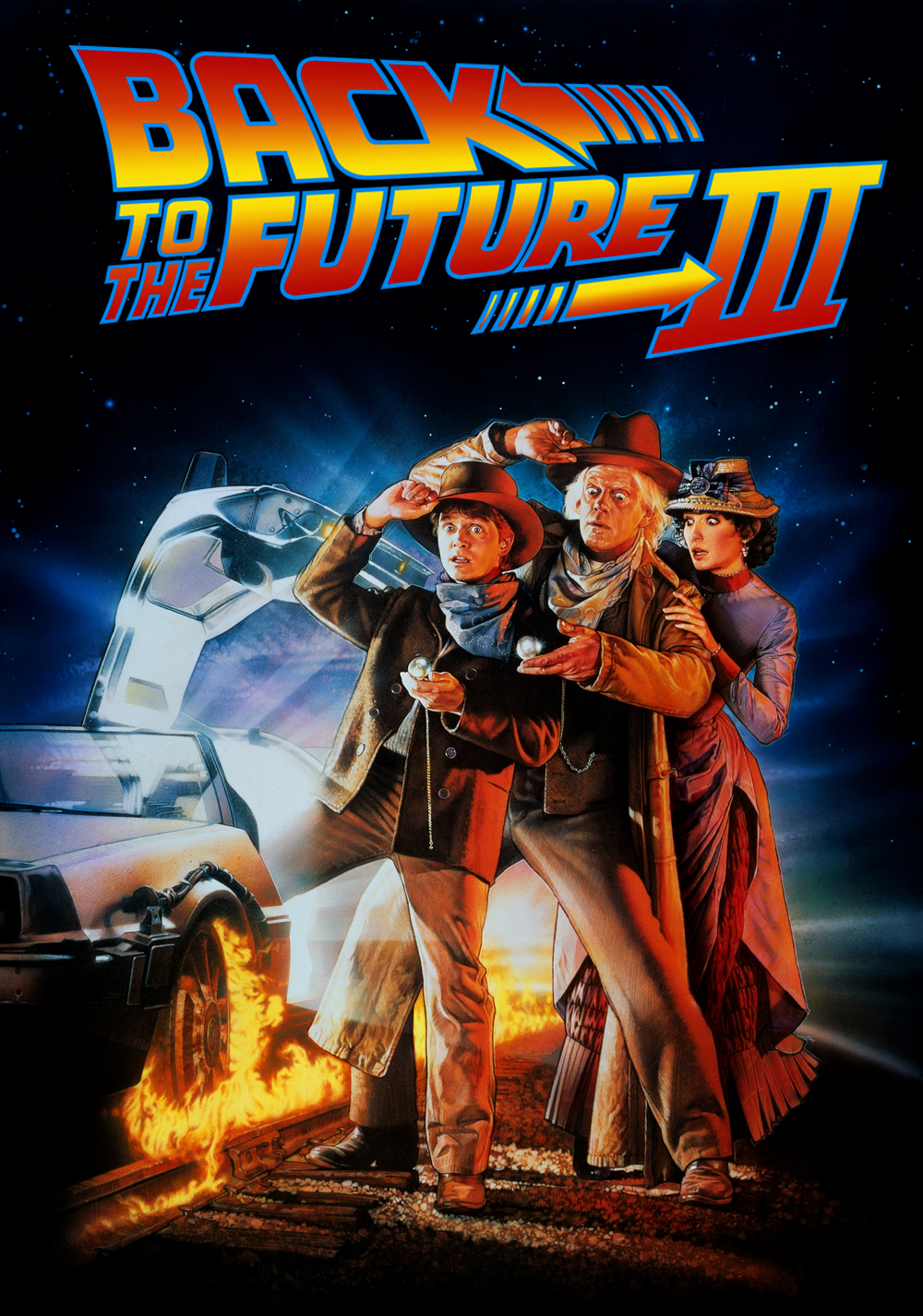
Back to the Future Part III
- Directed by
- Robert Zemeckis
- Runtime
- 119 min
- Studio
- Universal Pictures, Amblin Entertainment
198 archived facts 8 topics 1 source Last reviewed Sep 2026
The final installment finds Marty digging the trusty DeLorean out of a mineshaft and looking for Doc in the Wild West of 1885. But when their time machine breaks down, the travelers are stranded in a land of spurs. More problems arise when Doc falls for pretty schoolteacher Clara Clayton, and Marty tangles with Buford Tannen.
Summary: TMDB
13 Facts on the Deeper Meaning of Back to the Future Part III
- #003
Marty uses a "Frisbie's" pie plate to knock the gun out of Mad Dog's hand. The Frisbie Pie Company was founded in Connecticut in 1871; its pie tins were thrown around the Yale campus, which ultimately led to the invention of the Frisbee. This is another example of Marty bringing something into the timeline before its official invention and thus potentially giving the original inventors the idea to make them. In Back to the Future (1985) he turned a soapbox car into a prototype skateboard and unknowingly inspired Chuck Berry to write "Johnny B. Goode."
- #005
The 1885 setting stemmed in part from a suggestion by Michael J. Fox, who told the producers he thought acting in a Western would always be fun.
- #037
The name on the manure wagon in 1885 reads "A. Jones," while the name on the manure truck in 1955 reads "D. Jones."
- #041
The fastest steam locomotive in active service in the 1880s was the Eight-Wheeler Steam Engine (wheel configuration 4-4-0), with a top speed of forty-five miles per hour. Marty and Doc Brown therefore faced the task of doubling the speed of the fastest steam engine that existed at the time.
- #079
The steam locomotive used in this film is Sierra No. 3, painted and outfitted to resemble Locomotive 131. This type of locomotive was actually built in 1891.
- #082
The shimmering piano figure heard at the start of the film's main title theme is Alan Silvestri's homage to George Pal's H. G. Wells adaptation The Time Machine (1960). A nearly identical glittering piano or harpsichord motif can be heard at the opening of the piece "Fear" from the 1960 classic's original Russell Garcia score.
- #092
The unnamed man Doc Brown speaks to about barbed wire in the saloon is John Warne Gates. He was a salesman at the Southern Wire Company in St. Louis, Missouri, which in 1888 merged with William Edenborn's wire company to form the Braddock Wire Company, where Consolidated Steel and Wire Company was organized. With the help of Chicago lawyer Elbert Henry Gary, he created a monopoly in the American wire industry in 1898 with the American Steel and Wire Company. This was sold to J. P. Morgan in 1901 (again negotiated by Gary) in a deal that made it part of the new US Steel holding. Gates was also the founder of The Texas Company, which became the Texaco oil company. This is another reference to Texaco, which is represented in the first and second films and (because of this reference) in all time periods.
- #100
The steam locomotive in Sierra #3 recently returned to service at Railtown 1897 State Historic Park in California (also known as "The Movie Railroad") after an extensive overhaul.
- #160
Contains a major spoiler — show
The diesel locomotive that destroys the DeLorean near the end of the film is an Alco S6 (S = Switcher type), a train engine built by the American Locomotive Co. in Schenectady, NY, in June 1956. The manufacturer produced only 130 of them, and because it was not very popular with railroads, the S6 is a fairly obscure and rarely seen model. In the film (serial no. 81730) it was then number 9 on the Ventura County Railroad's motive power roster and appeared in the yellow and blue VCRR livery. It was originally built for and used by the Southern Pacific RR (numbered 1226 there), and a few years after the film it began working on the Fillmore and Western Railway as locomotive number 1059.
- #167
An abandoned subplot was that Seamus and Maggie were in fact a religiously mixed couple (Seamus being a typical Irish Catholic name and Margaret a typical Irish Protestant one), which explained why they had to leave Ireland, the dark fate of Seamus's brother, and his consequent hatred of violence. Like Strickland's murder, this was essentially deemed too dark a direction for a light film ("the Troubles" were still heated at the time) and was dropped from the final film.
- #171
Contains a major spoiler — show
The locomotive that destroys the DeLorean at the end of the film belonged to the Ventura County Railway.
- #177
A similar scene in which a locomotive pushes a car along a train track can be seen in The Great Race (1965).
- #194
The fastest locomotive of the 1880s was the A4 "Mallard," which could reach 195 mph. This model was part of the London and North Eastern Railway and was known for its speed and power, setting a new standard for steam locomotives.
Sources & editorial notes
Reference databases
Sources for the entries on this page
- IMDb IMDb
Information from external sources is independently selected, consolidated and edited by Arka Evren. Sources are listed for verification and further reading. Encyclopedia text is used under its licence (CC BY-SA). How we work