

FILM · 2005 · UK
Batman Begins
- Directed by
- Christopher Nolan
- Runtime
- 140 min
- Studio
- Warner Bros. Pictures, DC, Syncopy
394 archived facts 8 topics 2 sources Last reviewed Nov 2026
Driven by tragedy, billionaire Bruce Wayne dedicates his life to uncovering and defeating the corruption that plagues his home, Gotham City. Unable to work within the system, he instead creates a new identity, a symbol of fear for the criminal underworld - The Batman.

394 Interesting Facts About Batman Begins
Interesting Facts (161)
- #001
- #002
- #003
- #004
- #005
- #006
- #007
In an interview with Moviefone, Christian Bale said that he became interested in playing Batman after a friend of his loaned him the graphic novel "Arkham Asylum" (by Grant Morrison and Dave McKean) in 2000. After he read it, he told his agent that if anyone was making another Batman movie, he wanted in.
- #008
- #009
- #010
- #011
- #012
The cape was made with a technique called electrostatic flocking, taught to the crew by the British Ministry of Defense and normally used to decrease the night-vision visibility of objects. Nylon parachute fabric was brushed with glue and covered with fine hair-like material. An electrostatic current was then passed under the material, creating a dark sheen while maintaining the billowing appearance.
- #013
- #014
- #015
In a 2009 interview, Christian Bale said that during his first scene with Sir Michael Caine and Morgan Freeman (the scene in which he wakes up in bed and finds them waiting for him), he fell asleep after getting ready to shoot. He said that when he woke up, Caine poked him in the ribs and said, "Look at that! He actually fell asleep."
- #016
- #017
Early in the casting process, Christian Bale decided he did not want to play Batman in a flat way and chose to portray him as an anger-filled beast, and he thought this might polarize writer-director Sir Christopher Nolan. Bale was delighted that Nolan was very pleased with this unusual interpretation.
- #018
- #019
- #020
- #021
- #022
- #023
In his autobiography, Rutger Hauer wrote that he chose to accept the role of Wayne Enterprises executive Mr. Earle because he saw Earle as someone ruthless toward others but quick to accept defeat; that is how it ends in the film as well.
- #024
- #025
Rutger Hauer described Morgan Freeman as one of his heroes and said he had been a great admirer of his acting since The Shawshank Redemption. In his autobiography, he said of Freeman: "Working with someone like Morgan is a form of excitement... I found him very warm, relaxed and very sensitive as he almost disappears into his role. As far as I can see, working with the best actors is the easiest."
- #026
- #027
- #028
In a promotional interview, Sir Michael Caine stated that he had never worked with Christian Bale before this film but was fascinated by his performance as the caped crusader: 'Christian and I didn't know each other before, we get along very well. He's also a perfect actor, the best Batman I've ever seen.'
- #029
- #030
- #031
- #032
- #033
- #034
Christopher Nolan finally explained why he chose Christian Bale over Cillian Murphy: 'I think he [Murphy] wasn't physically right at the time. We tested everyone as Bruce Wayne and Batman, and what was striking about Christian was that he understood acting is largely about reality. Acting is about emotional reality. And when you wear a costume like the Batsuit, you have to become an icon. Christian had a crazy energy that he channeled. He had figured out how this works and what it would be - just as Bruce Wayne does in the film.' The director concluded by saying that Christian Bale 'drilled a hole in the screen.'
- #035
Sir Gary Oldman said: 'When we did the first Batman, London stood in for Gotham. I made 27 round-trip flights from LA. I'd fly in for a day. I'd shoot for a day. To give Chris Nolan his due, he stuck to his schedule. I'd go home for three days. I'd come back for two days. I'd go home for the weekend. I'd come back for a day... otherwise I'd feel like my kids were being raised by a nanny.'
- #036
Christopher Nolan cast Cillian Murphy as Professor Jonathan Crane, a.k.a. Scarecrow, after seeing him in '28 Days Later' (2002). Comparing Nolan and Danny Boyle, Murphy said: 'I know they have great respect for each other. Chris had seen '28 Days Later' before casting me in 'Batman Begins.' I know they're fans of each other's work. They're singular voices, truly unique filmmakers, and they have the same passion and energy on set.' Murphy recalled the moment he learned he got the role: 'I was at the airport, queuing for a RyanAir flight, jumping up and down.'
- #037
Frank Miller, the writer of the 'Batman: Year One' comic book that had a major influence on this film, said: 'When I work on a character, I tend to be very critical of what others do. So I don't tend to like Batman movies or Daredevil movies.' However, he approved of this film: 'It really had heart and essence, and Christian Bale gave without a doubt the best Batman performance I've ever seen.'
- #038
- #039
- #040
- #041
- #042
- #043
- #044
- #045
- #046
- #047
- #048
- #049
- #050
- #051
- #052
- #053
- #054
- #055
- #056
- #057
- #058
- #059
- #060
- #061
- #062
- #063
- #064
- #065
- #066
- #067
- #068
- #069
- #070
- #071
- #072
- #073
- #074
- #075
- #076
- #077
- #078
- #079
- #080
- #081
- #082
- #083
- #084
- #085
- #086
- #087
- #088
- #089
- #090
- #091
- #092
- #093
- #094
- #095
- #096
- #097
- #098
- #099
- #100
- #101
- #102
- #103
- #104
- #105
- #106
- #107
- #108
- #109
- #110
- #111
- #112
- #113
- #114
- #115
- #116
- #117
- #118
- #119
- #120
- #121
- #122
- #123
- #124
At distributors' request, Britain's BBFC viewed the film during post-production before the sound mix was complete. Warner Bros. wanted 12A. To avoid a higher rating, the BBFC advised 'care not to exaggerate impact sounds in several scenes and to avoid bone-crunching effects.' With the mix unfinished, distributors received no specific instruction to reduce existing effects, and it passed uncut at 12A. The same version was released worldwide.
- #125
- #126
- #127
- #128
- #129
- #130
- #131
- #132
In 1999 Warner Bros. commissioned Darren Aronofsky to write and direct Batman: Year One. He brought in Frank Miller as co-writer, with Matthew Libatique as cinematographer, planned Tokyo as Gotham and considered Clint Eastwood for Batman. Warner rejected the script for deviating from the source material.
- #133
- #134
- #135
- #136
- #137
- #138
- #139
- #140
- #141
- #142
Nolan explained choosing Bale over Murphy: 'Murphy wasn't physically right then. What struck me about Bale was that he understood acting is about emotional reality. In a Batman suit, you must become an icon. Bale had a crazy energy he channeled, just as Bruce does.' He said Bale 'burned a hole in the screen as Batman.'
- #143
- #144
- #145
- #146
- #147
- #148
- #149
- #150
- #151
- #152
- #153
- #154
- #155
- #156
- #157
- #158
- #159
Jonathan Nolan wrote Bruce's narration for the first teaser, released in late July 2004, in a few hours in Christopher's trailer. Bruce's arrest for stealing Wayne Enterprises property was being filmed in London. Jonathan confirmed the monologue was specifically for the teaser and among his favorite trilogy writing, while admitting 'won't stop until he gets revenge' would never fit the film because it contradicts Bruce's development in Begins.
- #160
- #161
Production Story (54)
- #162
- #163
Bruce Wayne's voice-over in the first teaser, released in late July 2004, was written in a couple of hours by Jonathan Nolan in Sir Christopher Nolan's trailer while the scene of Bruce's arrest for stealing Wayne Enterprises property in Shanghai was being filmed in London. Jonathan Nolan has since confirmed that the monologue was written specifically for the teaser, saying that it remains some of his favorite writing from the trilogy and admitted that it would never have fit within the context of the film since the line, "will not stop until it gets revenge" contradicts Bruce's arc in Begins.
- #164
Lana Wachowski and Lilly Wachowski were approached to direct, and even wrote their own treatment based on Frank Miller's graphic novel "Batman: Year One", but turned down the offer and made The Matrix Reloaded (2003) and The Matrix Revolutions (2003) instead.
Batman Begins (2005): Choreographed fight with Bruce Wayne / Batman on stageImage: Wikimedia Commons · Manuel Sagra, CC BY 2.0 - #165
Robert Downey Jr. met with Sir Christopher Nolan about playing The Scarecrow. Nolan later admitted to Downey that Cillian Murphy was always his first choice, but still took the meeting because "I always wanted to meet you... I was a huge admirer of yours and therefore selfishly just wanted to take the meeting. But I was also a little afraid of you, you know. I had heard all kinds of stories about how you were crazy. It was only a few years after the last of those stories that had come out about you." All three ended up working together on Oppenheimer (2023).
- #166
When Warner Bros. was considering "Batman: The Frightening" as the title, a script was released on-line that was widely believed to be official. Writers Terry Hayes and Rafael Yglesias were credited on the draft, but both denied writing it. The author was later discovered to be Brandon Gaines.
- #167
Writer and director Sir Christopher Nolan, screenwriter David S. Goyer, and production designer Nathan Crowley set up shop in Nolan's garage to work on the screenplay. They had to vacate the premises on the day that the cleaner came, as the garage simply became too hot with the washing machine and dryer going.
- #168
- #169
Despite this movie's darkness, Sir Christopher Nolan wanted to make this movie appeal to a wide age range. "Not the youngest kids obviously, I think what we've done is probably a bit intense for them, but I certainly didn't want to exclude the sort of ten to twelve-year-olds, because as a kid, I would have loved to have seen a movie like this." Because of this, nothing gory or bloody was filmed.
- #170
- #171
Cillian Murphy originally auditioned for the role of Batman and filmed a screen test wearing the full Batsuit as Bruce Wayne. The role went to Christian Bale, and Cillian Murphy was cast as Scarecrow. Murphy said he didn't believe he was ever close to landing the role and thought Bale "absolutely smashed it". Murphy's screen test was lately shown in The Fire Rises: The Creation and Impact of the Dark Knight Trilogy (2013), a documentary about Sir Christopher Nolan's films.
- #172
- #173
Filling the cast with renowned actors like Sir Michael Caine and Morgan Freeman was inspired by Superman (1978). Sir Christopher Nolan explained, "[Richard Donner] cast Marlon Brando and Glenn Ford and Ned Beatty, all the characters were played by these terrific stars. So we went after that kind of depth of casting."
- #174
- #175
- #176
Ashton Kutcher was in heavy considerations for the role of Bruce Wayne and was reportedly the studio executives' choice for the same. Writer and director Sir Christopher Nolan however, was not enthusiastic about the idea of casting Kutcher in the role, which prompted Warner Bros. studio heads to drop the idea. Kutcher's casting would have led to a controversy similar to the one that sparked the Batman (1989) movie when Michael Keaton, a comic actor, was cast as Batman.
- #177
- #178
- #179
Andrew Kevin Walker was interviewed by Sir Christopher Nolan to write the script. Walker had written a Batman vs. Superman film, with Christian Bale eyed to play Batman, but it was ultimately scrapped in favor of Batman Begins. Nolan served as executive producer on Batman v Superman: Dawn of Justice (2016).
- #180
- #181
Before Sir Christopher Nolan took over, director Darren Aronofsky was attached to make a Batman movie based on the graphic novel "Batman: Year One", and have author Frank Miller write the screenplay. By 2003, there was a first draft screenplay with story boards, which are properties of AOL Time Warner. The reasoning for Warner Bros. not producing the movie is unknown, but based on the details that have since leaked out, it probably would have to do with the screenplay, which strayed a considerable amount from the source material, making Alfred an African-American mechanic named "Big Al", the Batmobile being a souped-up Lincoln Towncar, and Bruce Wayne being homeless, amongst other things. This is all detailed in David Hughes' book "Tales from Development Hell".
- #182
- #183
- #184
- #185
- #186
- #187
- #188
Guy Pearce was considered for the role of Henri Ducard but was deemed too young. Pearce had previously worked with Sir Christopher Nolan on Memento (2000), and Pearce claimed that, despite Nolan's efforts, he was never cast in another film of Nolan's because an executive at Warner Bros. disliked him. Pearce himself admitted that his performance in the film was subpar, "I realized I hate what I did. And so all this stuff about an exec at Warners being why I've not worked with Chris again? It came crashing down. I know why I didn't work with Chris again - it's because I'm no good in Memento (2000)."
- #189
Christopher Nolan finally revealed the reason why he chose to go with Christian Bale instead of Cillian Murphy. "I don't think he [Murphy] had the physicality at the time. We tested everyone as Bruce Wayne and we tested them as Batman, and the thing that Christian had that was so striking was that he understood that so much of acting is about reality. So much of acting is about emotional truth. And when you put on a costume like the Batsuit, you have to become this icon. Christian had this crazy energy that he just directed. He'd figured out how that worked and what that would be -the way Bruce Wayne does in the film." The director ended his talk by remarking that Christian Bale "tore a hole on the screen as Batman".
- #190
- #191
The U.K. censors, the BBFC, viewed this movie at the request of the distributors during post-production. The sound mix was incomplete. Warner Bros. was keen to get a 12A rating (to match the U.S. PG-13) and the BBFC advised them that in order to avoid a higher rating, "care should be taken with the final sound mix so as not to play up the sound of blows and to avoid more bone crunching sound effects" in several scenes. Because the BBFC examiners did not advise the distributors to specifically reduce any of the sound effects, as the sound mix was incomplete at the time of the viewing, this movie was passed 12A with no cuts made. This same version was released worldwide, with the cuts discussed in full on the SBBFC website for students.
- #192
- #193
Bruce's imprisonment, and Henry Ducard offering to train Bruce, was heavily influenced by The Mask of Zorro (1998). In the movie, Diego De La Vega (Sir Anthony Hopkins) meets thief Alejandro Murrieta (Antonio Banderas), and he offers the thief to train him as Zorro, as Alejandro seeks to avenge his brother. The Zorro stories by Johnston McCulley was one of Bob Kane's inspirations behind Batman. Sir Anthony Hopkins turned down the role of Alfred Pennyworth.
- #194
- #195
- #196
- #197
- #198
Before shooting began, writer and director Sir Christopher Nolan invited the whole movie crew to a private screening of Blade Runner (1982). After the movie, he said to the whole crew, "This is how we're going to make 'Batman'." In addition, Rutger Hauer, the actor who plays Mr. Earle in this film also starred in Blade Runner (1982), portraying the main antagonist Roy.
- #199
Screenwriter Paul Haggis said that Casino Royale (2006) was influenced by this film, particularly in how it portrayed the "origin" of Batman, and how it revitalized the Batman franchise after a years-long absence. He explained, "We're trying to do for Bond what 'Batman Begins' did for Batman." In turn, Sir Christopher Nolan's version of Batman was influenced by the James Bond franchise.
- #200
- #201
When Sir Christopher Nolan asked Hans Zimmer to provide the score, Zimmer asked him if he could also bring James Newton Howard on-board. The two composers had been meaning to work together for some time, and this felt like the perfect project for two composers given the dichotomy of the lead character.
- #202
During production, DC Comics commissioned well-known Batman artists to give their interpretation of the Dark Knight. The results were shown to writer and director Sir Christopher Nolan and the cast to help give them a better idea of from where the comic artists were coming. Amongst the artists were James Jean, Jock, Tommy Lee Edwards, and John Paul Leon.
- #203
The title went through many changes. First, when it was planned to take place in the same universe as the Tim Burton and Joel Schumacher films, it was known as "Batman 5". It became "Batman: The Frightening" for a while, with the Scarecrow as the main villain, reviving the Joker from Batman (1989) and the Penguin from Batman Returns (1992) as fear gas illusions. To prevent script leaks, they were titled "Intimidation Game" to throw off the public, before settling on "Batman Begins".
- #204
- #205
Sir Christopher Nolan cast Cillian Murphy as professor Jonathan Crane, aka The Scarecrow, after seeing him in 28 Days Later (2002). Murphy compared Nolan and Danny Boyle stating "I know that they both have immense respect for each other. Chris saw 28 Days Later (2002) before he cast me in 'Batman Begins.' I know they're fans of each other's works. They're singular voices, you know, they really are unique filmmakers, and they have that same passion and energy on set." Murphy recalled the moment he found out he landed the part in the original film - "I was in an airport, queuing up for a RyanAir flight, jumping up and down.
- #206
Warner Bros. considered Gene Hackman, Jeff Goldblum, Samuel L. Jackson, Ewan McGregor, Skeet Ulrich and Howard Stern to play The Scarecrow before Sir Christopher Nolan signed on to direct. McGregor ended up playing another DC Comics villain, Black Mask in Birds of Prey and the Fantabulous Emancipation of One Harley Quinn (2020).
- #207
- #208
In 1999, Warner Bros. hired Darren Aronofsky to write and direct Batman: Year One, which was to be the fifth movie in the Batman franchise. Aronofsky brought Frank Miller to co-write Year One with him. Aronofsky collaborator Matthew Libatique was set as cinematographer. Also, he wanted to shoot the movie in Tokyo, doubling for Gotham City. Aronofsky wanted to cast Clint Eastwood for the role of Batman. However, Warner Bros. was not happy with the script, due to the differences from the source material, and did not greenlight the movie.
- #209
- #210
- #211
- #212
Before Nolan, Darren Aronofsky was commissioned to make Batman: Year One. By 2003 AOL Time Warner had storyboards and a first draft. Why Warner Bros. did not produce it is unknown, but leaked details showed major departures: Alfred as African-American mechanic 'Big Al,' a luxury Lincoln Towncar Batmobile and a homeless Bruce Wayne. David Hughes's Tales from Development Hell documents this.
- #213
- #214
- #215
Contains a major spoiler — show
In David S. Goyer's original screenplay, the climactic monorail chase/fight scene was different than in the finished film. In this draft, Batman would not have confronted Ra's before boarding the train and would instead battle Ra's and his ninja henchmen while the monorail train was speeding down the tracks, dodging gunfire and rockets launched by the ninjas. After subduing them, Batman and Ra's would fight hand-to-hand with Ra's gaining the upper hand. Instead of the memorable line Batman says ("I won't kill you, but I don't have to save you"), the final exchange would be Ra's asking Batman if he was afraid to which Batman would reply, "Yes... but not of you!" He would then break free and glide out of the train while it went off the track leaving the screaming Ra's to die more out of coincidence than intentional.
Behind the Scenes (58)
- #216
- #217
- #218
- #219
- #220
- #221
With the exception of the pier scene in Batman: The Movie (1966), this is the first Batman movie in which Gotham City scenes were filmed on-location in an actual city, as opposed to on a set, or images via stock footage. While the on-location scenes were filmed in London and Chicago, Gotham City in the comics is based on New York City, and in fact the name "Gotham" is a colloquial for New York City.
Batman Begins (2005): Bruce Wayne / BatmanImage: Wikimedia Commons · Manuel Sagra, CC BY 2.0 - #222
- #223
- #224
- #225
- #226
According to Rutger Hauer, there originally was a scene of Thomas and Martha Wayne's funeral planned with an entire graveyard setup for the shoot. However, the weather was uncooperative with heavy wind and rain making the outside set unable to shoot much footage. Sir Christopher Nolan then decided to shoot a scene taking place right after the implied funeral once the rain had passed.
- #227
- #228
- #229
Due to his part in The Machinist (2004), Christian Bale was vastly underweight (about one hundred twenty pounds on his six foot frame) when he was under consideration for the part. After being cast, he was told to become as "big as you could be" by Sir Christopher Nolan. Bale underwent a six month dietary and exercise regimen, and ending up weighing about two hundred twenty pounds (about forty pounds above his normal weight). It was decided that Bale had become too large (friends of his on this movie's crew dubbed him "Fatman") and he quickly shed about twenty pounds to have leaner, more muscular frame. Bale described the experience as an unbearable physical ordeal.
- #230
- #231
- #232
- #233
According to an interview with production designer Nathan Crowley, the waterfall guarding the entrance to the Batcave was originally meant to cover a solid rock wall, which Batman's enemies would slam into when attempting the jump in. The rock wall would have been opened with a button inside the Batmobile, but the sequence was cut before filming began.
- #234
- #235
- #236
- #237
- #238
- #239
- #240
- #241
Sir Gary Oldman said, "When we did the first Batman, London doubled for Gotham. I did 27 round trips of flying back from LA. I'd fly in for a day. I'd do a shoot a day. To Christopher Nolan's credit, he stayed on schedule. I would go home for three days. Come back for two. Go home for a weekend. Come back for a day... otherwise, I just felt my kids are being brought up by a nanny."
- #242
- #243
- #244
In an interview for Oppenheimer (2023), Cillian Murphy was asked about his experience making this film and portraying a comic book villain. Murphy mentioned that after he underplayed a particular scene he decided to do one take like "a proper villain" and add some camp to the line "He's here. The Batman!". Murphy didn't think Sir Christopher Nolan would use it; however, that was the take that ended up in the film.
- #245
- #246
While filming on Lower Wacker Drive in Chicago, Illinois, the filmmakers were so concerned for the care of the Batmobile that they told the stunt driver to take as much time as he needed to make any move. Therefore, when it came time to back the Batmobile up, they went so slow that they caused traffic jams that had to be reported on the news.
- #247
- #248
- #249
- #250
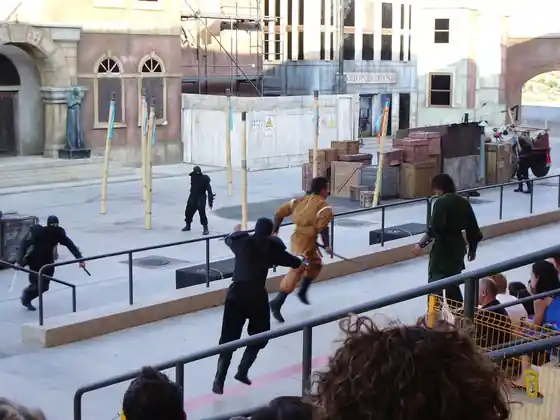
Writer and director Sir Christopher Nolan generally filmed the fight scenes with the actors doing as many of the stunts as physically possible (in the case of Christian Bale and Liam Neeson, that was pretty much all of them). He would then shoot the same fight sequences with the stuntmen for coverage.
- #251
The cape was made with a technique called electrostatic flocking, taught to the crew by the British Ministry of Defense and normally used to decrease the night-vision visibility of objects. Nylon parachute fabric was brushed with glue and covered with fine hair-like material. An electrostatic current was then passed under the material, creating a dark sheen while maintaining the billowing appearance.
- #252
- #253
- #254
Christian Bale revealed in interviews in 2009 that in his first scene with Sir Michael Caine and Morgan Freeman (one involving Bale waking up in bed to find them waiting there), he fell asleep after getting ready for the scene. Bale described waking up to find Caine poking him in the ribs, saying "Look at that! He's bloody fallen asleep."
- #255
The Batmobile, nine feet wide, and sixteen feet long, has a top speed of one hundred six miles (one hundred seventy kilometers) per hour, and can accelerate from zero to sixty miles (ninety-six kilometers) per hour in six seconds. The engine is a 5.7 liter V8 Chevy. It runs on unleaded gasoline, and can do about seven miles per gallon. It has four 44-inch tires at the rear, made by Interco Tire Corporation, while the front is covered in jagged plates of armor. It was designed and built by Chris Corbould and Andrew Smith at Shepperton Studios in England. This Batmobile was built from the ground up, and is estimated to be worth half a million pounds sterling. It was designed by mashing together several different off-the-shelf model kits. Its construction was so exacting to the model, that they even duplicated the blobs of excess glue.
- #256
- #257
- #258
- #259
- #260
- #261
- #262
- #263
- #264
- #265
- #266
- #267
- #268
- #269
While the film explains Ra's al Ghul's 'immortality' through doubles, Denny O'Neil's novelization suggests he really is several centuries old, including his journals and Bruce researching his past. Its ending differs: Bruce wounds Ra's in the manor fight, staining his costume with blood. Ra's's body cannot be recovered from the train, so Bruce buries the bloodstained costume beside his father in the family cemetery, honoring his mentor for creating Batman.
- #270
- #271
Contains a major spoiler — show
(at around 57 mins) The huge white room in which Bruce Wayne test drives the Tumbler is the interior of the Excel Exhibition Centre in East London. The separating walls have been pulled back to allow the Tumbler to drive around, but you can still see the hall numbers as they drive by them (N4, N5, etc).
- #272
- #273
Contains a major spoiler — show
(at around 19 mins) In a 2012 interview, Sir Christopher Nolan admitted that he invented the line "rub your chest, your arms will take care of themselves", spoken by Henri Ducard (Liam Neeson) after Bruce Wayne (Christian Bale) falls into the frozen lake, and that it has no scientific basis, adding that he imagined "Boy Scouts everywhere freezing to death" because they took the advice literally, thanks to Neeson's convincing delivery.
Characters & Cast (51)
- #274
- #275
- #276
- #277
- #278
- #279
Rutger Hauer described Morgan Freeman as one of his heroes, having become a huge fan of Freeman's acting talent since seeing The Shawshank Redemption (1994). Hauer described Freeman in his autobiography as "Getting to work with someone like Morgan is a form of excitement...I found Morgan so warm and comfortable and so precise in the way he almost disappeared and faded into his role. From what I've seen, the best actors are the easiest to work with."
- #280
- #281
- #282
- #283
During interviews with Christian Bale while promoting this movie, he continued using the American accent he'd adopted to play Bruce Wayne/Batman. He explained that he didn't want potential moviegoers to be confused about why Batman, an American institution, was being played by a Welshman. However, this may not be the whole truth, as Bale rarely gives an interview in his native Welsh accent. It is believed that this is because Bale is always using whichever accent is required for his next role, which reflects his commitment as a method actor.
- #284
Christian Bale had read some of the graphic novels long before he played Batman. He said that in 2000, a friend lent him a copy of the graphic novel "Arkham Asylum," which he thoroughly enjoyed, and made him wonder why that version of Batman hadn't been portrayed on-screen. In preparing for the role, Bale said he made a conscious effort to avoid watching the performances of previous Batman actors, so he could approach the character from a fresh perspective.
- #285
In an interview with Moviefone, Christian Bale said that he became interested in playing Batman after a friend of his loaned him the graphic novel "Arkham Asylum" (by Grant Morrison and Dave McKean) in 2000. After he read it, he told his agent that if anyone was making another Batman movie, he wanted in.
- #286
- #287
Christian Bale never wanted to play Batman as Bruce Wayne in a bat costume. For him, it's a completely different character.
Batman Begins (2005): Metallic Batman logo on a black backgroundImage: Wikimedia Commons · Elroy Serrao, CC BY-SA 2.0 - #288
- #289
- #290
- #291
- #292
Christian Bale had read some of the graphic novels long before he played Batman. He said that in 2000, a friend lent him a copy of the graphic novel "Arkham Asylum," which he thoroughly enjoyed, and made him wonder why that version of Batman hadn't been portrayed on-screen. In preparing for the role, Bale said he made a conscious effort to avoid watching the performances of previous Batman actors, so he could approach the character from a fresh perspective.
- #293
- #294
- #295
- #296
While promoting this film, Christian Bale continued to use the American accent he had adopted for Bruce Wayne/Batman in his interviews. He explained the reason as not wanting potential viewers to be confused about why Batman, an American institution, was being played by a Welshman. This may not be entirely accurate, however, since Bale rarely gives interviews in his own Welsh accent. The reason is thought to be that Bale always uses the accent required for his next role, reflecting his commitment to method acting.
- #297
Ashton Kutcher was seriously considered for the role of Bruce Wayne and was the studio executives' preference. Nolan, however, was not warm to the idea, and the Warner Bros. executives shelved the suggestion. Casting Kutcher could have led to a controversy similar to the one that arose over Michael Keaton's casting in the 1989 Batman film.
- #298
Cillian Murphy actually auditioned for the role of Batman and shot a screen test as Bruce Wayne wearing the full Batsuit. The role went to Christian Bale, and Murphy was cast as Scarecrow. Murphy said he never thought he came close to the role and that Christian Bale 'nailed it completely.' Murphy's screen test was later shown in The Fire Rises: The Creation and Impact of the Dark Knight Trilogy (2013), a documentary about Christopher Nolan's films.
- #299
Guy Pearce was considered for the role of Henri Ducard but was deemed too young. Pearce had previously worked with Christopher Nolan on 'Memento' (2000) and claimed that, despite Nolan's efforts, he never appeared in another Nolan film because an executive at Warner Bros. disliked him. However, Pearce admitted that his performance in 'Memento' was mediocre: 'I realized I hated what I was doing. The story that an executive at Warners caused me not to work with Chris again collapsed. I know why I didn't work with Chris again - I'm not good in 'Memento'.'
- #300
Robert Downey Jr. met with Christopher Nolan for the role of Scarecrow. Nolan later told Downey that Cillian Murphy had always been his first choice but that he had still accepted the meeting because 'I always wanted to meet you... I was a big fan and so I selfishly just wanted the meeting. But I was also a little afraid of you, you know. I'd heard all kinds of stories about you being crazy. It had only been a few years since the last of those stories.' The three later worked together on 'Oppenheimer' (2023).
- #301
In an interview for 'Oppenheimer,' Cillian Murphy was asked about his 'Batman Begins' experience and playing a comic book villain. Murphy said that after playing a particular scene without exaggeration, he decided to do a take like a 'real villain' and add a bit of camp to the line 'He's here. The Batman!' Murphy didn't think Christopher Nolan would use it, but that was the take used in the film.
- #302
- #303
Because of The Machinist (2004), Christian Bale was very thin when considered, weighing about 54 kilograms at 1.83 meters. Sir Christopher Nolan told him to become 'as big as possible.' Six months of diet and exercise brought him to around 100 kilograms, about 18 above normal. Deemed too large and nicknamed 'Fatman' by crewmates, he quickly lost about 9 kilograms to become leaner and more muscular. Bale called the experience unbearable physical torture.
- #304
- #305
- #306
In a 2012 interview, Nolan admitted inventing Henri Ducard's line after Bruce falls into the frozen lake, 'Rub your chest; your arms will take care of themselves,' without scientific basis. Neeson's convincing performance made him imagine Scouts following it literally and freezing to death.
- #307
- #308
- #309
- #310
- #311
- #312
- #313
- #314
- #315
- #316
Guy Pearce was considered for Ducard but deemed too young. Having worked with Nolan on Memento (2000), Pearce claimed a Warner Bros. executive disliked him and blocked further collaboration despite Nolan's efforts. Pearce later admitted his Memento performance was mediocre: 'I realized I hated what I'd done. The story about a Warners executive stopping me working with Chris again? It collapsed. I know why I haven't worked with Chris again: I'm not good in Memento.'
- #317
- #318
Robert Downey Jr. met Nolan about Scarecrow. Nolan later admitted Murphy had always been first choice: 'I really wanted to meet you... I was a huge fan, so selfishly I just wanted a meeting. But I was also a little afraid; I'd heard stories that you were crazy.' The three later worked together on Oppenheimer (2023).
- #319
- #320
- #321
- #322
Cornering Bruce in the bar, Carmine Falcone, played by Tom Wilkinson, says, 'You always fear what you don't understand.' Jonathan Kent, played by Kevin Costner, uses a similar phrase explaining Clark's secrecy in Nolan-produced Man of Steel (2013).
- #323
- #324
Contains a major spoiler — show
In his autobiography, Rutger Hauer wrote that he chose to accept the role of Mr. Earle, the executive of Wayne Enterprises, because he saw Earle as the kind of man who would be ruthless in his dealings with others, but also quick to accept his defeat, which is what happens in the end.
Easter Eggs & References (39)
- #325
- #326
- #327
- #328
- #329
- #330
- #331
A characteristic of Sir Christopher Nolan's Batman is that when talking with Gordon, Batman suddenly disappears. The origin of this is traced back to All the President's Men (1976), from a scene in which Bob Woodward (portrayed by Robert Redford) is in a dark parking structure at night speaking with his mysterious deep cover FBI informant (known as Deep Throat, portrayed by Hal Holbrook). In one instance, Woodward hears the squeal of car tires and when he turns back to continue the conversation, Deep Throat has vanished.
- #332
- #333
- #334
- #335
The key "combination" that Bruce plays on the piano to open the secret entrance to the Bat Cave is comprised of three pairs of notes, starting three octaves above middle-C. The keys he presses are D-E, D-E (up an octave), and G-A. However, the tones heard in the soundtrack are actually a half-step down from the correct tones for the notes he plays. This may simply be a post-production soundtrack adjustment or variance, but could also be that the piano was tuned a half-step down, which is sometimes done on older pianos to reduce the eighteen to twenty tons of string tension stress on their framing.
- #336
The name of the Commissioner in this movie is Loeb. This is not a reference to comic book writer Jeph Loeb, author of the graphic novels "The Long Halloween" and "Dark Victory", but rather the canonical name of the Gotham City Police Commissioner when Bruce Wayne returns to Gotham. This was shown in Frank Miller's Year One, which influenced "The Long Halloween" and "Dark Victory", and was published nearly ten years before either of those. Additionally, unlike the comics, Loeb is not a corrupt officer in this movie.
- #337
- #338
- #339
- #340
- #341
- #342
While appearing only briefly in his courtroom appearance, Victor Zsasz is a much larger villain in the comics, where he's a sadistic and brutal serial killer that carves marks of his victims on his own body. He's also seen very briefly later in the movie as the inmates are being released from Arkham.
- #343
- #344
- #345
During the Batmobile chase it crashes through a security barrier and the barrier guard is briefly shown looking into his own cup with disbelief. This could be a homage to the James Bond films The Spy Who Loved Me (1977), Moonraker (1979) and For Your Eyes Only (1981) in which a similar drunk character witnesses a dramatic escape by the hero.
- #346
- #347
The title changed repeatedly. Initially intended for the Burton/Schumacher continuity, it was called Batman 5, then Batman: Terrifying, with Scarecrow as the main villain and Joker from Batman (1989) and Penguin from Batman Returns (1992) returning as fear-gas illusions. The Intimidation Game misled the public to prevent script leaks before Batman Begins was chosen.
- #348
- #349
- #350
- #351
Commissioner Loeb's name does not reference writer Jeph Loeb; it is the canonical Gotham commissioner's name when Bruce returns, as depicted in Frank Miller's Year One. That work influenced The Long Halloween and Dark Victory and preceded them by nearly a decade. Unlike the comics, this Loeb is not corrupt.
- #352
- #353
Contains a major spoiler — show
(at around 1h 3 mins) During Batman's first appearance in the suit, crime boss Carmine Falcone asks "What the hell are you?", to which Batman replies "I'm Batman." In Tim Burton's Batman (1989), when Batman first appears, Nic also asks "What are you?", to which Batman also replies "I'm Batman."
- #354
Contains a major spoiler — show
(at around 1h 40 mins) Ducard's line "But is Ra's Al Ghul immortal?" is an in-joke, since the comic book version of the character is over six hundred years old (and has been killed and resurrected many times) thanks to a device called the Lazarus Pits. Writer and director Sir Christopher Nolan chose to abstain from all fantasy elements for his version of Batman.
- #355
- #356
Contains a major spoiler — show
The ultrasonic "bat caller" that Batman used in his escape from Gotham Police in Arkham was another reference to Frank Miller and David Mazzucchelli's Batman: Year One series. In the issue, Batman mentions it's a shame he can't patent it, as it would be worth a fortune.
- #357
- #358
Contains a major spoiler — show
The Bat Symbol at the beginning of each movie in the trilogy foreshadows something to happen later. In this case, the Bat Symbol is made up of bats, symbolizing Batman using the sonar to call them to distract the cops while he escapes from Arkham Asylum with Rachel.
- #359
- #360
Contains a major spoiler — show
(at around 2h 10 mins) The Joker playing card presented to Batman at the end of this movie is a replica of the Joker Card from the 1989 graphic novel "Arkham Asylum" by Grant Morrison and Dave McKean. It carries an evidence label, this label reads that the officer who discovered it was a J. Kerr, one of the Joker's favorite aliases (Joe Kerr) in the comic books.
- #361
- #362
Contains a major spoiler — show
(at around 1h 45 mins) In Wayne Manor, Ra's Al Ghul says that Jonathan Crane doesn't know the plan, and that Crane thinks the plan is to hold the city for ransom. In The Dark Knight Rises (2012), Bane publicly holds the city ransom for the League of Shadows.
- #363
Deeper Meaning (16)
- #364
Frank Miller, whose comic book Batman: Year One was a major influence on this movie, said, "Whenever I've worked on a character, I tend to be very critical of what anybody else does. So I tend not to like Batman movies or Daredevil movies." However, he approved of this movie, saying, "it really had heart and substance, and Christian Bale with no doubt performed the best Batman I have ever seen."
- #365
- #366
Batman's origin story in this movie (learning ancient arts in Tibet, going from a wealthy young man to a man with nothing to lose, learning to be a more noble and selfless person) has been called into question by comic book fans, because it is practically identical to the origin story of the Marvel character Doctor Strange.
- #367
- #368
A common idea in the comics is that Bruce saw a Zorro movie with his parents before they were murdered. Writer and director Sir Christopher Nolan explained that by ignoring that idea, which he stated is not found in Batman's first appearances, it emphasized the importance of bats to Bruce, and that becoming a superhero is a wholly original idea on his part. It is for this reason, Nolan believes other DC characters do not exist in the universe of his movie; otherwise, Wayne's reasons for taking up costumed vigilantism would have been very different.
- #369
- #370
- #371
- #372
- #373
Bruce's piano 'combination' opening the Batcave comprises three pairs of notes starting three octaves above middle C: D–E, D–E an octave higher, and G–A. However, the soundtrack is a semitone lower than the keys' correct pitches, possibly through post-production adjustment or a piano tuned a semitone flat.
- #374
Goyer's original monorail climax differed. Batman did not confront Ra's before boarding; instead he fought Ra's and his ninjas aboard the speeding train, dodging gunfire and rockets. After subduing them, Batman fought Ra's hand-to-hand, with Ra's gaining the advantage. Rather than 'I won't kill you, but I don't have to save you,' Ra's asked whether Batman was afraid, and he answered, 'Yes... but not of you!' He escaped and glided away, accidentally rather than deliberately leaving the screaming Ra's to die as the train derailed.
- #375
- #376
- #377
- #378
Contains a major spoiler — show
(at around 46 mins) Psychologist Dr. Robin S. Rosenberg commended this movie for portraying the psychological concept of "exposure" in the scene where Bruce Wayne is in a cave surrounded by bats. He first becomes scared and panicky and slowly calms down, and afterwards, his fear of bats is gone.
- #379
Contains a major spoiler — show
In each part of the Dark Knight Trilogy, Batman/Bruce Wayne has either a friend (or associate) who becomes a villain or vice versa. In this film, Ra's Al Ghul trains Bruce Wayne, then turns against him. In "Dark Knight" Harvey Dent becomes Two-Face." And in "Dark Knight Rises" Miranda Tate is revealed to be Talia Al Ghul.
Career & Awards (12)
Life & Family (3)
- #392
Due to not wanting to spend too much time away from his kids in the US, Gary Oldman believes that he made around twenty seven round trips between the shoot in the UK and his family in the USA during the six month shoot. Oldman believes that the jet-lag from these trips helped him find the world weariness of Jim Gordon's character of being a cop who was stuck in a corrupt system that he could not ever hope to change on his own.
- #393
- #394
Related pages
- Dunkirk — Batman Begins comes up in the facts on that page
- Reign of Fire — Batman Begins comes up in the facts on that page
- Person of Interest — Batman Begins comes up in the facts on that page
Continue through the archive




Sources & editorial notes
Reference databases
- Wikipedia
- IMDb
Information from external sources is independently selected, consolidated and edited by Arka Evren. Sources are listed for verification and further reading. Encyclopedia text is used under its licence (CC BY-SA). How we work