
FILM · 1967 · USA
Bonnie and Clyde
- Directed by
- Arthur Penn
- Runtime
- 111 min
- Studio
- Tatira-Hiller Productions, Warner Bros.-Seven Arts
29 archived facts 3 topics 1 source Last reviewed Oct 2026
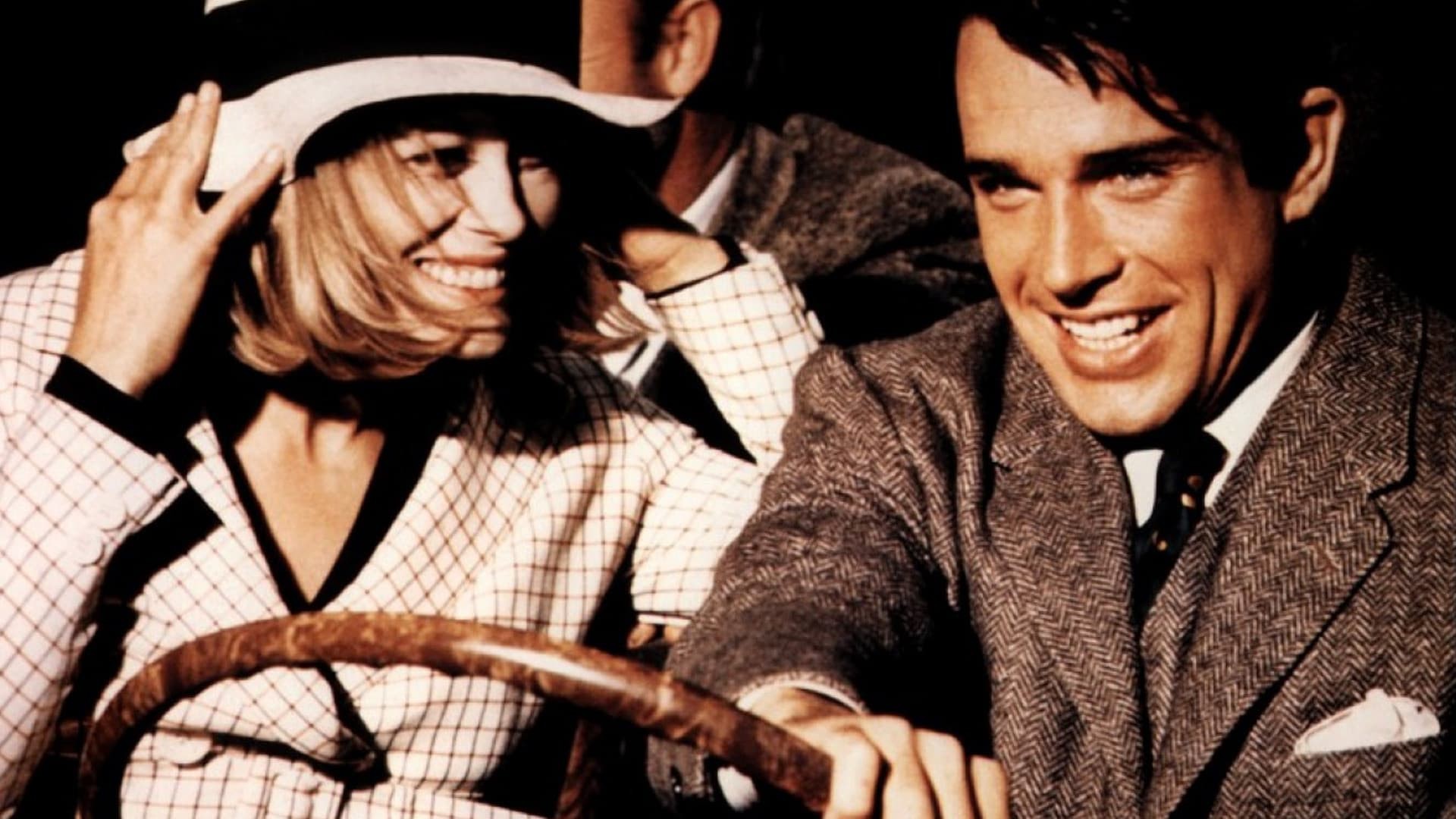
In the 1930s, bored waitress Bonnie Parker falls in love with an ex-con named Clyde Barrow, and together they start a violent crime spree throughout the country, stealing cars and robbing banks.
Summary: TMDB
All facts (29)
- #001
It was Gene Wilder's first film.
- #002
In real life, Clyde Barrow was an extremely dangerous marksman who had mastered most firearms, including the Browning automatic rifle and the Thompson submachine gun. The lawmen pursuing him were well aware of his skill with weapons, which partly explains the ruthlessness behind the way he was shot.
- #003
The final moment of the field shootout, in which the gang surrounds the dying Buck and a hysterical Blanche, is based on a rare "action" photograph taken of that moment. In reality, Blanche was screaming at a police officer who had his foot on Buck's wounded head and a gun to his face, threatening to shoot him again. Since he was already dying, she begged him not to shoot him again.
- #004
The screening went very badly for Warren Beatty and Arthur Penn, with Jack L. Warner getting up three times to urinate. Warner initially dumped the film into drive-in and second-run theaters and apparently went to his grave still hating it.
- #005
A significant fact left out of the film was that Bonnie Parker was nearly incapacitated by a car accident during the last year of her life. While Clyde Barrow was driving fast on a deserted country road in Texas, he came upon a washed-out bridge. Unable to stop in time, the car went over the edge of the ravine and hit a creek. The force of the impact threw Bonnie's seat forward and trapped her in the car as it began to catch fire. She suffered severe burns on the backs of her legs that made walking difficult. She would either limp or be carried by Clyde. In fact, she was injured in the nighttime tourist court shootout and in the field shootout that occurs near the end of the film (where Buck is killed). This particular chapter of Bonnie's life was depicted early in the Netflix film The Highwaymen (2019).
- #006
In a television interview, director Arthur Penn noted that this film was the first to show a gun being fired and its consequences in a single shot. Before this, a gun was seen being fired, then there was a cut, and the next shot showed a bleeding corpse. Here, a gun is seen firing continuously into a person's face. This was incredible at the time and would have been censored in the past. (However, such a shot had already been used in all three films of Sergio Leone's "Dollars" trilogy.)
- #007
Michael J. Pollard did not realize that, because of the possibility of repeated takes in the eating scenes, the actors did not actually eat all the food. Of course, he soon regretted it in the scene where the outlaws kidnap a couple and eat lunch in the car. By the 12th take, Pollard was feeling quite sick because he had to eat exactly 12 hamburgers.
- #008
In real life, Blanche Barrow did not flee from the Joplin house screaming with a spatula. She actually helped Clyde push one of the police cars out of the garage driveway and down the hill. The car began rolling faster and rolled toward a large tree across the street. They were dragged along by the momentum, and that was what witnesses saw. Clyde was filmed at that moment, and Blanche let out a scream and kept moving to get out of the line of fire. This was the last shot fired since the ammunition had run out when the police officer fired, so Buck called her back, and instead of being pulled from the street as shown in the film, she returned to get into the getaway car in front of the apartment.
- #009
During the thrilling massacre, Faye Dunaway's leg had to be tied to the gear shift to keep her from falling completely out of the rocking car.
- #010
In the film, Clyde stops his car on a country road to help a friend change a flat tire. When Bonnie and Clyde realize their friend has set a trap for them, they look at each other lovingly and try desperately to be in each other's arms before they are cut down by machine-gun fire. In reality, Bonnie and Clyde were ambushed just outside Gibsland, Louisiana, on May 23, 1934. They never left the car, which was hit by 187 bullets. Bonnie had a sandwich in her mouth.
- #011
Near the end of the film, Bonnie and Clyde lie in bed discussing marriage. In reality, before she met Clyde, Bonnie married her high-school sweetheart, Roy Thorton. Thorton was a petty criminal who was sent to prison for life for murder. Bonnie never divorced him and was still wearing his ring when she was killed.
- #012
Arthur Penn initially turned down the script, but after several directors, including William Wyler, did the same, Warren Beatty had to bring the script back to Penn. He agreed only on the condition that he could make some significant changes, the most important being to make Clyde impotent rather than bisexual. Penn also received a 10% profit share.
- #013
Bonnie's family reunion scene was shot through a window curtain to give it a hazy, nostalgic effect.
- #014
Contrary to the film's depiction of Blanche Barrow accidentally revealing C. W. Moss's identity to Texas Ranger Frank Hamer and thereby setting Bonnie and Clyde's deaths in motion in real life, Hamer found Bonnie and Clyde through simple surveillance methods. Hamer knew they traveled in a loop. They would routinely start from Dallas, head north through Oklahoma and Kansas, east to Missouri, south to Arkansas and Louisiana, and west back toward Dallas. Knowing that gang member Henry Methvin (the person C. W. Moss's character was partly based on) had family in Louisiana, Hamer made a deal with Methvin's father (as shown in the film) to set up Bonnie and Clyde.
- #015
Warren Beatty demanded that the gunshots in the film be much louder than the rest of the soundtrack. He was heavily influenced by Shane (1953). However, at a screening in London he noticed that the gunshots were much softer than intended. He went to the projection booth, where the projectionist told him he had "helped" the film by adjusting the gunshots. The projectionist said he had not come across a film so badly mixed since "Shane."
- #016
After Faye Dunaway wore one in this film, thousands of berets were sold worldwide.
- #017
One of director Arthur Penn's goals was to make the character of Blanche as hysterical as possible, so that Bonnie would appear even cooler by comparison.
- #018
In a 1968 interview, Warren Beatty said that his last conversation with his former girlfriend Natalie Wood took place in the summer of 1966, when he made an unsuccessful attempt to get her to play Bonnie Parker in his film. Later that evening, she attempted suicide and was discovered by her live-in maid.
- #019
Half a dozen of the cars used in the film, including the one stolen from Eugene Grizzard (Gene Wilder), were loaned to the studio by a Mr. Seng of Castro Valley, California, a private owner who specialized in restoring Model As, Roadsters and Model Ts. His only condition for lending his cars to the studio was that they not be shot.
- #020
Claims about Clyde Barrow's homosexuality may have stemmed from Barrow being repeatedly raped by another male inmate while a prisoner at Texas's Eastham Prison Farm (1930 - 1932). According to Jeff Guinn, author of a reliable biography of Bonnie and Clyde, Barrow eventually lured his attacker into an isolated area of the prison and then beat him to death with a lead pipe. This was Barrow's first murder. Another inmate, already serving a life sentence, took the blame for the crime of Barrow, a hardened 22-year-old killer who was released from the prison farm in February 1932.
- #021
During one of the bank robberies, Buck Barrow (Gene Hackman) vaults over the teller's cage. This was a stunt John Dillinger routinely performed, and he had learned it by watching Douglas Fairbanks in "Zorro" films.
- #022
In the film, Bonnie and Clyde meet when she catches him stealing her mother's car. In reality, they are believed to have met after a mutual friend broke his arm and Bonnie stayed with him as a caretaker. When Clyde came to visit his friend, he found Bonnie making hot chocolate in the kitchen. It was said to be love at first sight. This was on January 5, 1930, at Clarence Clay's house. The address was 105 Herbert Street in Dallas, Texas.
- #023
The idea of shooting the final ambush in slow motion came from Arthur Penn, who wanted to make the death scene more "balletic." As written, the scene depicted the shooting as a series of photographs, with screams and machine-gun fire playing in the background.
- #024
Despite his notorious womanizing, Warren Beatty did not have a relationship with Faye Dunaway. They agreed to remain platonic for the good of the film.
- #025
When Roger Ebert saw this film, he had been a film critic for only six months, and he hailed it as the first masterpiece he had seen in the job.
- #026
The story of Bonnie Parker smoking a cigar in a photograph is true. She did it as a joke. But after the shoot at the bungalow in Joplin, Missouri, police found the photos the gang had taken and published Bonnie's picture, leading to Bonnie's undeserved reputation as the "Cigar Smokin' Gun Moll."
- #027
Because this was Estelle Parsons's first film, the scale of the special effects astonished her. When she and Gene Hackman tried to escape a motel room using a mattress as cover from police fire, Parsons had to turn a hidden wheel that fired bullets embedded in the foam in sequence, simulating the impact of police bullets.
- #028
The film portrays Texas Ranger Frank Hamer as a bungler who is humiliated by Bonnie, Clyde and Buck and forced to pose for a photograph before being set adrift in a boat. In reality, Hamer, already a legendary Texas Ranger, came out of semi-retirement at the request of the Governor of Texas after the notorious 1934 Eastham Prison raid. He was tasked with hunting down and killing Bonnie and Clyde. He had never met the pair until that inevitable ambush. His family was deeply upset by the portrayal and successfully sued Warner Brothers for an undisclosed sum.
- #029
In reality, Buck Barrow's death was far more brutal. After he was shot repeatedly, a police officer pressed his foot on his face and was about to deliver the fatal blow when Blanche's scream alerted him to what he was actually doing.
Continue through the archive

Sources & editorial notes
Reference databases
Sources for the entries on this page
- IMDb IMDb kaydı
Information from external sources is independently selected, consolidated and edited by Arka Evren. Sources are listed for verification and further reading. Encyclopedia text is used under its licence (CC BY-SA). How we work