

ACTOR · BORN 1930 · DIED 2025
Gene Hackman
- Born
- 30 January 1930, San Bernardino, California, USA
- Died
- 17 February 2025
- Known for
- The Conversation (1974), Unforgiven (1992), Bonnie and Clyde (1967), Absolute Power (1997)
68 archived facts 5 topics 1 source Last reviewed Nov 2026
Gene Hackman (30 January 1930 – 17 February 2025) was an actor best known for The Conversation, Unforgiven and Bonnie and Clyde.
Gene Hackman over the years


68 Interesting Facts About Gene Hackman
Interesting Facts (39)
- #001
While at the Pasadena Playhouse, Gene Hackman and a classmate were voted "Least likely to succeed." The classmate was Dustin Hoffman.
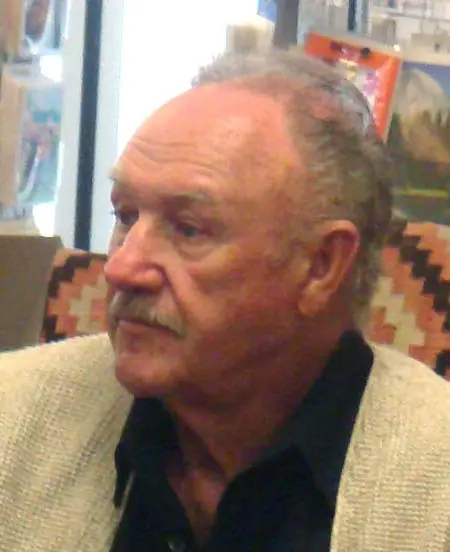
Gene Hackman: portraitImage: Wikimedia Commons · Gene_hackman.jpg : serreel a.k.a Bill Chodubski derivative work: Bea o, Public domain - #002
- #003
- #004
Gene Hackman said the failure of Scarecrow (1973) turned him away from art films, out of frustration at working hard on a film that was praised by critics but fell short at the box office and won no awards. After that flop, Hackman focused mainly on acting for the money, turning down films such as One Flew Over the Cuckoo's Nest (1975) and Network (1976) for roles in films such as March or Die (1977) and Lucky Lady (1975), which offered him higher salaries.
- #005
- #006
After Dustin Hoffman finished his training at the Pasadena Playhouse, he came to New York. The two lived together in New York in Hackman's one-bedroom apartment at 2nd Avenue and 26th Street. Hoffman slept on the kitchen floor. Hackman had initially offered to let him stay a few nights, but Hoffman did not want to leave. Hackman had to take him out to look for his own apartment.
- #007
Gene Hackman and Dustin Hoffman were roommates and often went up to the roof of their apartment building to play drums. Hoffman played the bongos while Hackman played the congas. They did this out of their love for Marlon Brando, whom they had heard play music in clubs. They wanted to be like Brando and were huge fans of his.
- #008
Along with Margot Kidder, Gene Hackman was appalled at how producers Alexander Salkind and Ilya Salkind treated director Richard Donner, who directed most of the first Superman (1978) and the second Superman film before the Salkinds fired him over creative differences. Hackman, who said he only made the first two films because Donner persuaded him, was so angry at the Salkinds that he flatly refused to reprise the role of Lex Luthor in Superman III (1983), while Margot Kidder, who played Lois Lane, appeared only in a cameo. Hackman was later persuaded to reprise Luthor in Superman IV: The Quest for Peace (1987).
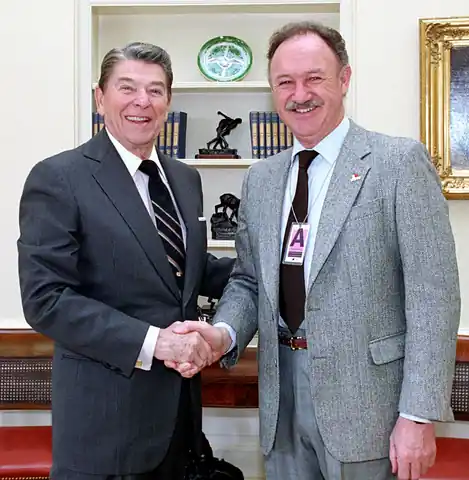
Gene Hackman: President Allen Richmond, in the officeImage: Wikimedia Commons · Series: Reagan White House Photographs, 1/20/1981 - 1/20/1989 Collect…, Public domain - #009
- #010
After leaving the Pasadena Playhouse and moving to New York City with Dustin Hoffman, who had dropped out of the school, Hackman worked as a doorman at the Howard Johnson's restaurant in Times Square. One day, Hackman's Pasadena Playhouse acting teacher, whom he hated, walked past him, stopped, and told him he had been right — Hackman would never amount to anything.
- #011
While a struggling actor in New York, Gene Hackman worked as a soda jerk in a drugstore and as a furniture mover. In 2011, however, he told Time magazine that the "worst job I ever had" was working nights in the legendary Chrysler Building as part of a crew that polished leather furniture.
- #012
- #013
- #014
During the filming of "The Hunting Party," Candice Bergen credited Gene Hackman with teaching her film acting.
- #015
- #016
After playing Little Bill in Unforgiven (1992), Gene Hackman vowed never to appear in a violent film again. Having appeared in violent films such as Bonnie and Clyde (1967) and The French Connection (1971) — a role Peter Boyle turned down for the same reasons — he said he had grown tired of them.
- #017
- #018
Kevin Costner considers Gene Hackman the best actor he has ever worked with.
- #019
In a 2004 Vanity Fair story about Dustin Hoffman and Robert Duvall, Hackman said one of his worst memories of being a struggling actor was working as a doorman in New York. He recalled seeing former Navy officers pass by as he opened the door, one of whom said, "Hackman, you're a sorry son of a bitch."
- #020
- #021
- #022
- #023
During the 1972 presidential election he appeared on Richard Nixon's notorious "List of Enemies"; it was the only time Hackman became publicly involved in politics. In a July 2004 interview on Larry King Live (1985), Hackman stated that although he was a Democrat, he liked President Ronald Reagan, who had died the previous month.
- #024
- #025
- #026
- #027
- #028
- #029
- #030
- #031
- #032
- #033
- #034
- #035
- #036
- #037
- #038
- #039
Behind the Scenes (13)
Characters & Cast (4)
- #053
Gene Hackman was initially reluctant to take the role of Lex Luthor in Superman (1978) because he did not want to shave off the mustache he had recently grown. Richard Donner made a deal with him: if Hackman shaved, Donner would shave his own. After Hackman did so, Donner revealed that the mustache he wore was fake. This earned Donner Hackman's instant respect and affection.
- #054
Although he no longer smoked, Gene Hackman took on a chain-smoking role in Heartbreakers (2001). He used a special type of cigarette that produced heavy smoke without needing to be inhaled. Tragically, in 1962 Hackman's mother, Lydia, died from injuries caused by a fire started by her own smoking.
- #055
- #056
Gene Hackman replaced George Segal as Kibby in the famous flop Lucky Lady (1975). Segal, who likely sensed the film would be a turkey, dropped out of the production and Hackman was brought in at the last minute. Desperate producers paid Hackman a large increase over the enormous box-office success of The Poseidon Adventure (1972) — a reported $1.2 million for the role, $500,000 more than Segal's going rate. Hackman knew co-star Burt Reynolds from having appeared in the first episode of Burt's short-lived 1966 TV series Hawk (1966).
Career & Awards (5)
- #057
As a young man, Gene Hackman attended a screening of A Streetcar Named Desire (1951) and was struck by Marlon Brando's performance for its naturalism and for the fact that he did not look the way a film star typically looked in the 1950s. After leaving the theater, he told his father he wanted to be an actor.
- #058
- #059
- #060
- #061
Life & Family (7)
Related pages
- The Firm — Gene Hackman comes up in the facts on that page
- Peter Finch — Gene Hackman comes up in the facts on that page
- The Good Shepherd — Gene Hackman comes up in the facts on that page
Sources & editorial notes
Reference databases
- Wikipedia
- IMDb
Information from external sources is independently selected, consolidated and edited by Arka Evren. Sources are listed for verification and further reading. Encyclopedia text is used under its licence (CC BY-SA). How we work