
FILM · 1972 · GERMANY
Cabaret
- Directed by
- Bob Fosse
- Runtime
- 124 min
- Studio
- Allied Artists Pictures, ABC Pictures, Bavaria Film
21 archived facts 6 topics 1 source Last reviewed Oct 2026
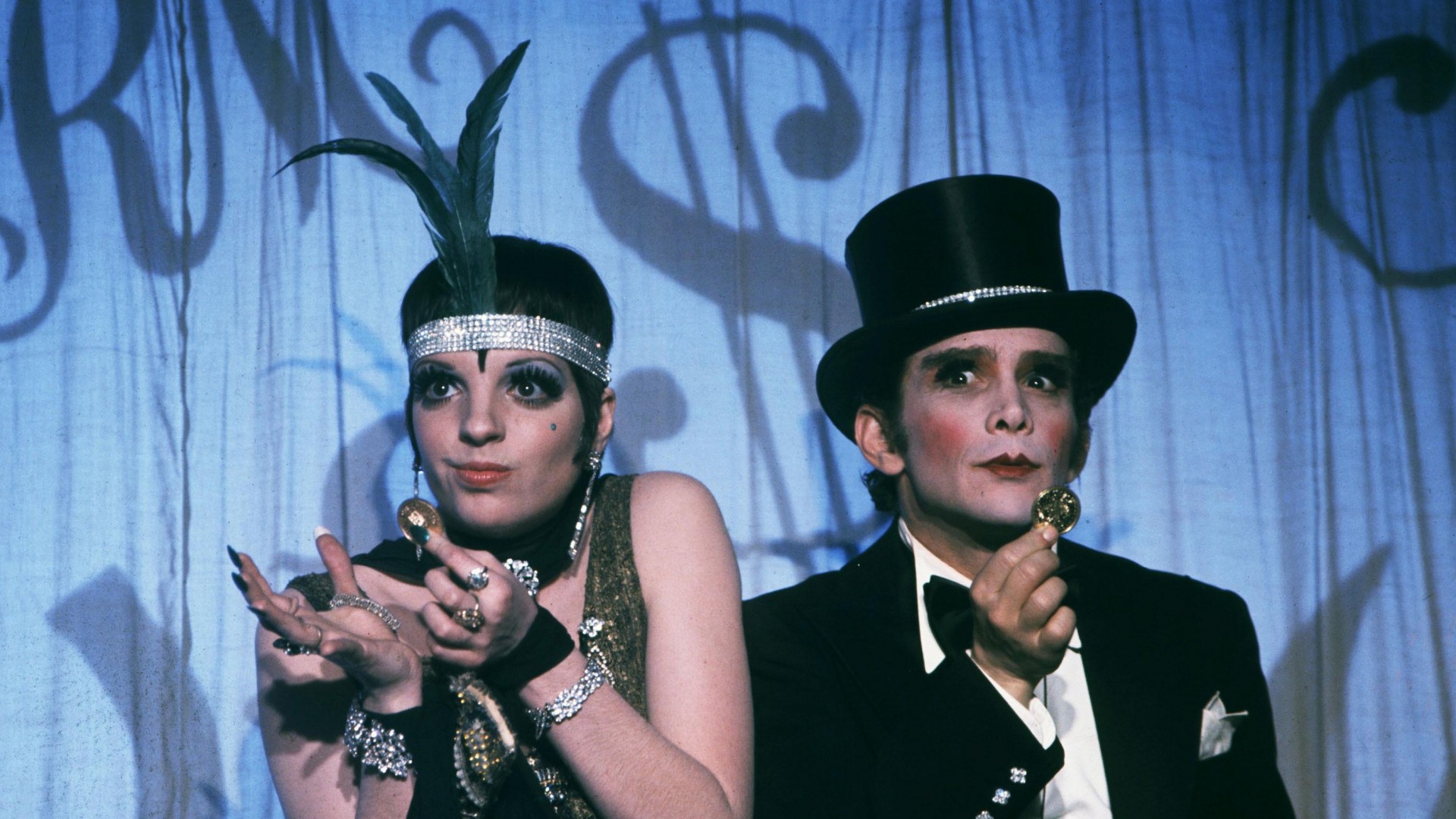
Inside the Kit Kat Club of 1931 Berlin, starry-eyed singer Sally Bowles and an impish emcee sound the clarion call to decadent fun, while outside a certain political party grows into a brutal force.
Summary: TMDB
All facts (21)
- #001
Although Cabaret did not win the Best Picture Oscar, it won 8 Academy Awards. It lost Best Picture and Best Adapted Screenplay to The Godfather (1972). As of 2022, the film still holds the record for the most Oscars won without taking Best Picture.
- #002
The character of Sally Bowles was based on Jean Ross, an aspiring film actress who worked as a cabaret singer in the lesbian bars and run-down nightclubs of Weimar Berlin. A bohemian hedonist in her youth, Ross became a devout Stalinist after leaving Berlin and later joined the Communist Party. She served as a war correspondent in the Spanish Civil War, earning praise for her bravery while reporting from the front lines and enduring aerial bombardments. Among her many sexual partners were Eric Maschwitz, Peter van Eyck, Claud Cockburn and John Cornford.
- #003
The original Broadway production of Cabaret opened on 2 November 1966 at the Broadhurst Theatre, ran for 1165 performances and won the 1967 Tony Award for Best Musical. Joel Grey appeared in the production as the Emcee and won the 1967 Tony Award for Best Featured Actor in a Musical for the role. He won the Best Supporting Actor Oscar for reprising the role in the film, making him one of the few actors to win both a Tony and an Oscar for the same role.
- #004
Most of the film's interiors were shot on sound stages in Munich that had recently been vacated by the cast and crew of Willy Wonka & the Chocolate Factory (1971).
- #005
In interviews, Joel Grey said he believed Bob Fosse wanted the search for an actor to play the Emcee to fail because Fosse wanted to play the role himself in the film. Fosse was displeased when the film's producers told him he had to cast Grey, which complicated their relationship during the shoot.
- #006
Christopher Isherwood never disclosed until his death in 1973 that Jean Ross had inspired Sally Bowles. However, in 1951, Ross's vindictive former partner Claud Cockburn, who had previously abandoned her and their young daughters, leaked to the tabloid press that she was the inspiration for the character. As a result of Cockburn's betrayal, tabloid reporters pursued Ross for the rest of her life. Ross bitterly noted that journalists pretended to want information "about Berlin in the '30s," but "didn't want to know about unemployment, poverty or the Nazis marching in the streets. All they wanted to know is how many men I'd slept with."
- #007
Actor Joel Grey said Bob Fosse turned to Cabaret (1972), an unconventional musical, because he wanted to shift his career toward directing non-musical shows and films. At one point Fosse lobbied for several musical numbers to be severely cut, but the film's producers Cy Feuer and Harold Nebenzal refused.
- #008
Some interpret the Emcee as a personification of Bob Fosse. Although the Emcee is bisexual, Fosse was behind the scenes, and his heterosexual confusion was satirized in the semi-autobiographical All That Jazz (1979). In interviews, however, Fosse admitted he was attracted to men; he never acted on it. Joel Grey, for his part, came out as gay in his memoir. He was married to Jo Wilder from 1958 to 1982 and was the father of two children, including Jennifer Grey, who appeared in Dirty Dancing (1987) and Ferris Bueller's Day Off (1986).
- #009
While preparing to reprise his stage role as the Emcee in the film adaptation, Joel Grey did extensive research to achieve a more authentic German accent.
- #010
In a 1972 interview with Dick Cavett, actress Liza Minnelli said she had placed personal ads in newspapers in a vain attempt to meet Jean Ross, the woman on whom Christopher Isherwood based the character of Sally Bowles. Ross refused to meet Minnelli because she disliked her popular association with the character.
- #011
The film depicts Sally Bowles, the character inspired by Jean Ross, as having an abortion against Brian Roberts's wishes. In historical reality, Jean Ross had a relationship in 1931 with jazz pianist Peter van Eyck, who was a teenager at the time and later a well-known actor in films such as Five Graves to Cairo (1943), The Spy Who Came in from the Cold (1965) and The Wages of Fear (1953). When their relationship ended, Ross discovered she was pregnant with Eyck's child. Ross persuaded her gay friend Christopher Isherwood to help arrange the abortion. Isherwood, who visited Ross while she was recovering in a Berlin hospital, felt the hostility of the hospital staff, who believed he had forced her into the abortion. This tragicomic scenario inspired Isherwood's 1937 short novel "Sally Bowles."
- #012
Billy Wilder, Joseph L. Mankiewicz and Gene Kelly were briefly considered by the film's producers to direct the project before they hired Bob Fosse. After being hired, Fosse insisted on revising Jay Presson Allen's screenplay. Fosse instructed writer Hugh Wheeler to revise the script to be more faithful to Christopher Isherwood's stories based on real events.
- #013
Although it was controversial at the time of its release and was the first musical to receive an X rating, the film sanitizes Christopher Isherwood's sexual activities during his time in Weimar Berlin. In his memoirs, Isherwood wrote that he moved to Berlin to seduce the child prostitutes found in the city's Jazz Age cabarets. "To Christopher," Isherwood recalled, "Berlin meant boys." The 27-year-old Isherwood soon began a relationship with a 16-year-old boy named Heinz Neddermeyer. In 1933 they fled Nazi Germany together. In 1937, while they were in Luxembourg, Neddermeyer was deported to Nazi Germany. Neddermeyer, who was gay, was sentenced by the Nazis to hard labor in a prison camp. Isherwood later moved to the United States. In 1952, the 48-year-old Isherwood met 17-year-old Don Bachardy, who became his lifelong partner.
- #014
In 2003 it was selected by the Smithsonian Institution as one of eight films to be preserved for future generations.
- #015
After the shopping trip with Max, Sally shows off her fur coat and compares herself to the famous 1930s film star Kay Francis. Francis was known as "America's Best Dressed Woman" and in 1935 was Warner Brothers' highest-paid star.
- #016
Brian Roberts (Michael York) expresses surprise that Sally Bowles (Liza Minnelli) is American, a reference to the fact that Sally is English in the short novel and the musical. In Christopher Isherwood's original stories and the earlier film adaptation I Am a Camera (1955), both Sally and Brian are English.
- #017
During the opening number "Willkommen," the Emcee (Joel Grey) says: "Outside it is windy, but inside it is so hot." In the stage musical he says it is winter outside. Because the exterior scenes were shot in hot weather, "Winter" was changed to "windy."
- #018
The character Baron Maximilian von Heune was based on John Blomshield, a wealthy bisexual playboy and friend of Ernest Hemingway. He appears under the nickname "Clive" in Christopher Isherwood's Berlin Stories. Isherwood claimed that Blomshield made sexual advances toward both him and Jean Ross in Weimar-era Berlin. He persuaded them to accompany him on a trip abroad. When the time came for the trio to leave together, Blomshield disappeared without saying goodbye.
- #019
In 2007 the American Film Institute ranked it as the 63rd Greatest Film of All Time. This was the first time the film was included on the list.
- #020
While Jean Ross was recovering in Berlin after an abortion, the political situation in the Weimar Republic deteriorated. Berlin's everyday scenes featured "poverty, unemployment, political demonstrations and street fights between far-left and far-right forces." After the Enabling Act of March 1933 consolidated Hitler's power, the writer Christopher Isherwood fled Germany. Berlin's cabarets were subsequently shut down by the Nazis. Many of Isherwood's friends fled abroad or died in concentration camps. These events gave rise to Isherwood's Berlin stories.
- #021
For the role of Brian, 20 British actors were tested or auditioned, including Malcolm McDowell, David Hemmings, Timothy Dalton, Leonard Whiting, Jeremy Irons, John McEnery, Bruce Robinson, Tim Curry and Paul Nicholas.
Continue through the archive

Sources & editorial notes
Reference databases
Sources for the entries on this page
- IMDb IMDb kaydı
Information from external sources is independently selected, consolidated and edited by Arka Evren. Sources are listed for verification and further reading. Encyclopedia text is used under its licence (CC BY-SA). How we work